A Coevolutionary Framework for Constrained
Multi-Objective Optimization Problems
Ye Tian, Tao Zhang, Jianhua Xiao, Xingyi Zhang,
Senior Member, IEEE
, and Yaochu Jin,
Fellow, IEEE
Abstract—Constrained multi-objective optimization prob-lems (CMOPs) are challenging because of the difficulty in handling both multiple objectives and constraints. While some evolutionary algorithms have demonstrated high per-formance on most CMOPs, they exhibit bad convergence or diversity performance on CMOPs with small feasible regions. To remedy this issue, this paper proposes a co-evolutionary framework for constrained multi-objective op-timization, which solves a complex CMOP assisted by a simple helper problem. The proposed framework evolves one population to solve the original CMOP and evolves another population to solve a helper problem derived from the original one. While the two populations are evolved by the same optimizer separately, the assistance in solving the original CMOP is achieved by sharing useful information be-tween the two populations. In the experiments, the proposed framework is compared to several state-of-the-art algorithms tailored for CMOPs. High competitiveness of the proposed framework is demonstrated by applying it to 47 benchmark CMOPs and the vehicle routing problem with time windows.
Index Terms—Constrained multi-objective optimization, evolutionary algorithm, coevolution, vehicle routing prob-lem.
I. INTRODUCTION
C
ONSTRAINED multi-objective optimization prob-lems (CMOPs) widely exist in many real-worldManuscript received –. This work was supported in part by the National Key R&D Program of China under Grant 2018AAA0100100, in part by the National Natural Science Foundation of China under Grant 61672033, Grant 61822301, Grant 61876123, Grant 61906001, Grant 61590922, and Grant U1804262, in part by the Hong Kong Scholars Program under Grant XJ2019035, in part by the Anhui Provin-cial Natural Science Foundation under Grant 1808085J06 and Grant 1908085QF271, in part by the State Key Laboratory of Synthetical Automation for Process Industries under Grant PAL-N201805, and in part by a Royal Society International Exchanges Program under Grant IEC\NSFC\170279.(Corresponding author: Xingyi Zhang.)
Y. Tian is with the Key Laboratory of Intelligent Computing and Signal Processing of Ministry of Education, Institutes of Physical Science and Information Technology, Anhui University, Hefei 230601, China (email: [email protected]).
T. Zhang and X. Zhang are with the Key Laboratory of Intelligent Computing and Signal Processing of Ministry of Education, School of Computer Science and Technology, Anhui University, Hefei 230601, China (email: [email protected]; [email protected]).
J. Xiao is with the Research Center of Logistics, Nankai University, Tianjin 300071, China (email: [email protected]).
Y. Jin is with the Department of Computer Science, University of Surrey, Guildford, Surrey, GU2 7XH, U.K., and also with the Department of Computer Science and Engineering, Southern Uni-versity of Science and Technology, Shenzhen 518055, China (email: [email protected]).
applications, such as vehicle routing [1], robot gripper optimization [2], and water distribution system design [3]. A CMOP can be mathematically defined as
min x f(x) = (f1(x),· · · , fM(x)) s.t. x∈Ω gi(x)≤0, i= 1,· · ·, p hj(x) = 0, j = 1,· · ·, q , (1)
where x = (x1,· · ·, xD) ∈ Ω is a solution consisting
of D decision variables; Ω ⊆RD is the decision space;
f : Ω→RM consists ofM objectives;g
i(x)arep
inequal-ity constraints; and hj(x) are q equality constraints. To
solve a CMOP, the solutions should not only minimize the objectives f(x) as much as possible, but also satisfy all the constraints gi(x) and hj(x). For example, the
vehicle routing problem with time windows (VRPTW) [4] aims to find the solutions minimizing both the num-ber of vehicles and the total traveled distance, in which the solutions should also satisfy the time windows of customers and capacities of vehicles. Due to the strict constraints of time windows and capacities, it is difficult to find many feasible solutions for the problem, hence, the optimization of number of vehicles and total traveled distance becomes very challenging [5]. In short, exist-ing multi-objective evolutionary algorithms (MOEAs) encounter difficulties on CMOPs [6].
Having been developed for more than two decades, MOEAs have shown high performance in solving var-ious multi-objective optimization problems [7]. While attention has been drawn toward many-objective opti-mization [8] and large-scale multi-objective optiopti-mization [9] in recent years, more research efforts on constrained multi-objective optimization are needed [6], [10], [11]. CMOPs are not the extension of general multi-objective optimization problems with more objectives or decision variables, since the constraints and objectives should be separately handled and balanced [12]. To this end, vari-ous constraint handling techniques have been suggested, including the constrained dominance relation of NSGA-II [13], the two-archive collaborative framework of C-TAEA [14], and the biphasic search process of PPS [15]. Although constrained multi-objective optimization has been studied for two decades, there exist some limita-tions in the state-of-the-art MOEAs [16]. More specif-ically, existing MOEAs may be incapable of
ing constraints and objectives on CMOPs with small feasible regions (e.g., the feasible region is discrete or far from the unconstrained Pareto front), which leads to a bad convergence or diversity of the population [6]. Unfortunately, many real-world CMOPs are with small feasible regions (e.g., VRPTW [17]), posing stiff challenges to existing MOEAs. Inspired by the success of coevolutionary algorithms [18], this paper proposes a coevolutionary framework for solving CMOPs. The main new contributions of this work are as follows.
1) A Coevolutionary Constrained Multi-objective Op-timization framework (CCMO) is proposed for solving CMOPs, which aims to solve a CMOP with the assistance of solving a simple helper prob-lem. The proposed CCMO evolves two populations with the same optimizer separately, where the first population is to solve the original CMOP and the second population is to solve a helper problem de-rived from the original one. The novelty of CCMO mainly lies in the new paradigm of coevolution, in which the cooperation between two populations is much weaker than the cooperation in existing coevolutionary algorithms. Case studies and exper-imental results demonstrate that the weak cooper-ation in CCMO is more effective than the strong cooperation in existing MOEAs for solving CMOPs. 2) Based on the proposed framework, an MOEA is proposed by adopting NSGA-II [13] as the opti-mizer for evolving the two populations. The pro-posed MOEA is tested on a set of benchmark CMOPs to verify its effectiveness. Moreover, the proposed MOEA is equipped with three local search strategies to solve the VRPTW problem. According to the experimental results, the pro-posed MOEA outperforms several state-of-the-art MOEAs on both the benchmark CMOPs and the VRPTW problem.
In the remainder of this paper, we first introduce the existing MOEAs for CMOPs in Section II. Then we elaborate on the proposed framework CCMO and exam-ine its performance in comparison to existing MOEAs in Section III. Afterwards, the experimental results are detailed in Sections IV and V. Finally, conclusions are drawn and future work is outlined in Section VI.
II. RELATEDWORK
In this section, the existing MOEAs for solving CMOPs are introduced. Since this paper focuses on a coevo-lutionary framework, existing coevocoevo-lutionary constraint handling techniques are also reviewed.
A. Existing MOEAs with Constraint Handling Techniques Since both constraints and objectives are functions to be minimized, early MOEAs usually treat constraints and objectives equally. For example in [19], the objective vector of each solution was extended by adding the vio-lation of each constraint, then the non-dominated sorting
was performed on the extended objective vectors. In [20], the objective values of each solution were modified by considering its constraint violation. In [21], a constrained non-dominated rank was defined by integrating the original non-dominated rank and a constraint rank.
Although the above constraint handling techniques are straightforward and effective for some simple con-straints, it is difficult to make a good balance between constraints and objectives by tuning the penalty factors [15]. Since the feasibility of solutions takes precedence over convergence in CMOPs, some other MOEAs make constraints prior to objectives in dominance relation. NSGA-II [13] embeds feasibility in Pareto dominance, where feasible solutions dominate infeasible solutions and a solution with lower constraint violation dominates another solution with higher constraint violation. To be specific, the constraint violation of each solutionxis first calculated by CV(x) = p ∑ i=1 max{gi(x),0}+ q ∑ j=1 |hj(x)|, (2)
then a solutionxis said to dominate another solutiony
if the following conditions hold:
• IfCV(x) = 0 andCV(y) = 0,∀i∈ {1,· · ·, M} such
that fi(x) ≤ fi(y) and ∃j ∈ {1,· · ·, M} such that
fj(x)< fj(y);
• otherwise,CV(x)< CV(y).
This constraint handling technique can be used in other MOEAs based on Pareto dominance. In addition, the number of violated constraints [22], the dominance re-lation based on constraints [23], and the normalized constraint violation [24] have also been considered.
For decomposition based MOEAs ignoring Pareto dominance, a similar idea has been widely adopted to give priority to feasible solutions [25]. Specifically, when updating the solution of a weight vector, the solution with the lowest constraint violation is preferred; if there exist multiple feasible solutions, they compete with each other based on the aggregation function values on the weight vector. To relax the definition of feasibility, the algorithm in [26] regards solutions with small constraint violations as feasible ones; the algorithm in [27] treats two infeasible solutions as non-dominated if the angle between them is large; the algorithm in [28] preserves the infeasible solutions in isolated regions; and the algorithm in [29] regards the objective value and constrain violation as a biobjective optimization problem to be optimized.
More recently, some MOEAs with multiple stages or populations have been developed to solve CMOPs, which can dynamically adjust the balance between con-straints and objectives. The PPS framework [15] divides the search process into a push stage and a pull stage. In the push stage, the population is evolved without considering any constraints; while in the pull stage, the population is evolved by considering all the constraints and objectives. The ToP framework [10] also suggests a two-stage search process, where all the constraints
and a single objective are considered in the first stage, and all the constraints and objectives are considered in the second stage. For C-TAEA [14], a convergence-oriented archive is evolved by optimizing both the con-straints and objectives, and a diversity-oriented archive is evolved by optimizing only the objectives.
B. Coevolutionary Constraint Handling Techniques
Coevolutionary algorithms have shown effectiveness on many challenging problems including large-scale op-timization problems [30], dynamic opop-timization prob-lems [31], many-objective optimization probprob-lems [32], and so on, but the development of coevolution for constraint handling is still in the infancy [18].
The coevolutionary constraint handling technique was first used in solving constrained single-objective opti-mization problems. In [33] and [34], a coevolutionary genetic algorithm and a differential evolution algorithm were proposed for constrained optimization, respec-tively. These two algorithms evolve multiple popula-tions simultaneously, where each population is assigned an independent penalty factor for balancing constraints and objective. In the memetic coevolutionary differen-tial evolution algorithm proposed in [35], a population is to minimize the objective regardless of constraints, and another population is to minimize the violation of constraints regardless of the objective. In [36], the algorithm decomposes the constraints and evolves one population for each constraint, where each population first tries to satisfy its assigned constraint and then the other constraints from other populations.
In terms of constrained multi-objective optimization, a multi-objective particle swarm optimization algorithm was proposed in [37], which uses one population to store feasible particles and the other population to store infeasible particles, where feasible particles are updated towards Pareto optimality and infeasible particles are updated towards feasible particles. Besides, an infeasible solution can migrate to the feasible population once it be-comes feasible. In [38], the differential evolution frame-work cooperatively evolves M populations for solving M constrained single-objective optimization problems and evolves a population for solving the constrained M-objective optimization problem. C-TAEA [14] is also an evolutionary algorithm evolving two populations. In C-TAEA, the convergence-oriented archive (CA) is evolved to optimize the constraints and objectives, and the diversity-oriented archive (DA) is evolved to opti-mize only the objectives. Besides, the two populations cooperate with each other in mating selection and envi-ronmental selection.
As revealed in some recent studies [6], [10], most existing MOEAs encounter difficulties in obtaining a set of well-converged and well-distributed feasible solutions for CMOPs. In particular, the limitation of coevolution-ary MOEAs is mainly due to the strong cooperation between populations. By contrast, the proposed coevo-lutionary framework holds a weak cooperation between
Algorithm 1: Procedure of the proposed CCMO
Input:forigin (original CMOP),fhelp(helper
problem), M OEA(the employed MOEA),N (population size)
Output:P (final population)
1 P opulation1←RandomInitialization(N); 2 P opulation2←RandomInitialization(N); 3 EvaluateP opulation1 byforigin;
4 EvaluateP opulation2 byfhelp;
5 whiletermination criterion not fulfilleddo
6 P arent1←SelectN/2 parents fromP opulation1
by the mating selection ofM OEA;
7 P arent2←SelectN/2 parents fromP opulation2
by the mating selection ofM OEA;
8 Of f1←GenerateN/2 offsprings based on
P arent1 by the operators ofM OEA;
9 Of f2←GenerateN/2 offsprings based on
P arent2 by the operators ofM OEA;
10 P opulation1←P opulation1∪Of f1∪Of f2; 11 P opulation2←P opulation2∪Of f1∪Of f2; 12 EvaluateP opulation1 byforigin;
13 EvaluateP opulation2 byfhelp;
14 P opulation1←SelectN solutions from
P opulation1 by the environmental selection of
M OEA;
15 P opulation2←SelectN solutions from
P opulation2 by the environmental selection of
M OEA;
16 returnP opulation1;
populations. The proposed framework is described in Section III-A, and the superiority of the weak coop-eration over strong coopcoop-eration in solving CMOPs is analyzed in Section III-B in detail.
III. THEPROPOSEDFRAMEWORK
A. Procedure of CCMO
As presented in Algorithm 1, the proposed CCMO starts with the random initialization of two populations P opulation1 and P opulation2 with sizeN. In each gen-eration, two parent sets P arent1 and P arent2 are se-lected fromP opulation1andP opulation2by the mating selection strategy of the employed MOEA, respectively. Then, each of the two parent sets is used to generate an offspring population by the operators of the employed MOEA. Afterwards, bothP opulation1 and P opulation2 are combined with the two offspring populations, and further truncated by the environmental selection strat-egy of the employed MOEA. Finally, P opulation1 is returned as the final output. Note that the solutions in
P opulation1are always evaluated by the original CMOP
forigin, and the solutions in P opulation2 are always
evaluated by a helper problemfhelpderived fromforigin.
In general, fhelp consists of part of the objectives and
constraints inforigin, so the calculation offhelp does not
Existing MOEAs (evolving multiple populations cooperatively)
Proposed CCMO (evolving Population 1 with the assistance of Population 2) Initialization Population 1 Population 2 Mating selection Offspring generation Mating selection Offspring generation Combination of Population 1 and offsprings Combination of Population 2 and offsprings Environmental selection Environmental selection Initialization Population 1 Population 2 Mating selection Offspring generation Mating selection Offspring generation Combination of Population 1 and offsprings Combination of Population 2 and offsprings Environmental selection Environmental selection Strong cooperation Weak cooperation
Fig. 1. Procedures of many existing coevolution based MOEAs and the proposed CCMO.
In short, the proposed CCMO evolves P opulation1 to solve the original problem forigin and evolves
P opulation2to solve a helper problemfhelper, where the
assistance in solving forigin is achieved by sharing the
offsprings generated by the two populations. Sincefhelp
is easier thanforigin, the solutions inP opulation2usually
have better convergence and diversity than those in P opulation1, so the offsprings generated byP opulation2 can possibly improve the convergence of P opulation1. Besides,P opulation1may get trapped into a narrow fea-sible region, while the offsprings inP opulation2can help it jump out of local optimums. On the other hand, the offsprings generated by P opulation1 can also enhance the convergence speed of P opulation2 to some extent.
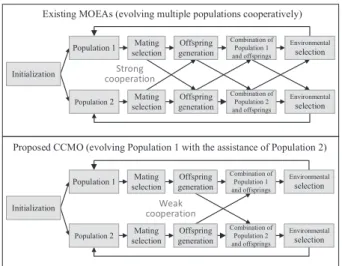
It is worth noting that, although there exist a few coevolutionary MOEAs tailored for CMOPs, the purpose of using coevolution in the proposed framework is to-tally different. Existing coevolutionary MOEAs evolve multiple populations to better balance convergence and diversity, where one population is to converge to the global Pareto front (PF) and the other population is to explore the undeveloped areas for better diversity [14], [39]. By contrast, the proposed coevolutionary frame-work aims to solve a CMOP with the assistance of solving a helper problem. The difference between the ideas of CCMO and existing MOEAs is reflected in the difference between the procedures of evolution. As illustrated in Fig. 1, existing MOEAs make populations cooperate with each other in mating selection, offspring generation, and environmental selection; by contrast, the populations in CCMO are evolved separately, only shar-ing all the offsprshar-ings in each generation. In other words, existing MOEAs use a strong cooperation to evolve the populations, whereas CCMO uses a weak cooperation to give each population the freedom to evolve towards the optimal PF of its own problem, and shares the offsprings generated by all the populations to assist in solving the original CMOP. Now a key question may arise – is such a weak cooperation more effective than a strong
cooperation for solving CMOPs? In the next subsection, the answer is cleared by several empirical studies. B. Analysis of CCMO
To analyze the effectiveness and understand the mech-anism of the proposed CCMO, it is combined with the constrained NSGA-II to tackle challenging CMOPs. More specifically, the constrained dominance relation and crowding distance are adopted as the criteria for selecting parents (Lines 6 and 7 of Algorithm 1) and truncating populations (Lines 14 and 15 of Algorithm 1), and the simulated binary crossover [40] and polyno-mial mutation [41] are adopted for generating offsprings (Lines 8 and 9 of Algorithm 1). Here the original CMOP without any constraint is regarded as the helper problem
fhelp, which is the same as those in some existing MOEAs
such as PPS and C-TAEA.
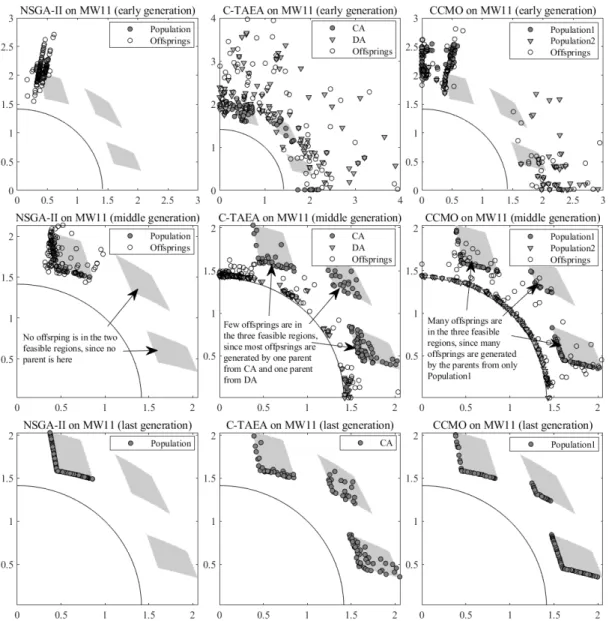
The proposed CCMO is compared to NSGA-II and C-TAEA, where NSGA-II is adopted as the basic optimizer in CCMO and C-TAEA is a state-of-the-art MOEA evolv-ing two populations (i.e., CA and DA) cooperatively. Fig. 2 plots the populations in the early, middle, and last generations of the compared MOEAs on 2-objective MW11, where the parameter settings are the same as those described in Section IV-A. MW11 has three small feasible regions as shown in the figure, which pose challenges to MOEAs in terms of diversity. As shown in the first column of Fig. 2, the population of NSGA-II can only converge to a single feasible region in the early gen-erations and cannot spread to the other feasible regions at last, though the population distributes uniformly in one of the three feasible regions. This is because NSGA-II is driven by the constrained dominance relation, which always prefers feasible solutions and has trouble in jumping over infeasible regions. For the populations of C-TAEA, CAhas a much better spread than the popu-lation of NSGA-II in the early generations, due to the diversity enhancement provided by DA. In the middle generations,CAlocates in all the feasible regions since it considers both the constraints and objectives, while the populationDA locates on the unconstrained PF since it considers only the objectives. However, C-TAEA usually selects a parent from CA and a parent from DA to generate an offspring, so most offsprings locate between CA and DA. In other words, the generated offsprings do not have good feasibility or good convergence, and are unable to updateCA for better diversity. Therefore, C-TAEA cannot find a sufficient number of feasible and well-converged solutions at last. As for the populations of CCMO, P opulation1 can also have a good spread due to the assistance of P opulation2. But in contrast to C-TAEA, the parents in CCMO are selected from
P opulation1 and P opulation2 separately, which makes
some offsprings around P opulation1 and some others around P opulation2, and the diversity of P opulation1 can be enhanced by the offsprings around it. Hence, P opulation1 has better diversity thanCAat last.
Fig. 2. Populations in the early, middle, and last generations of NSGA-II, C-TAEA, and CCMO on 2-objective MW11. The black line denotes the unconstrained PF of the problem, and the grey surfaces denote the feasible regions of the problem.
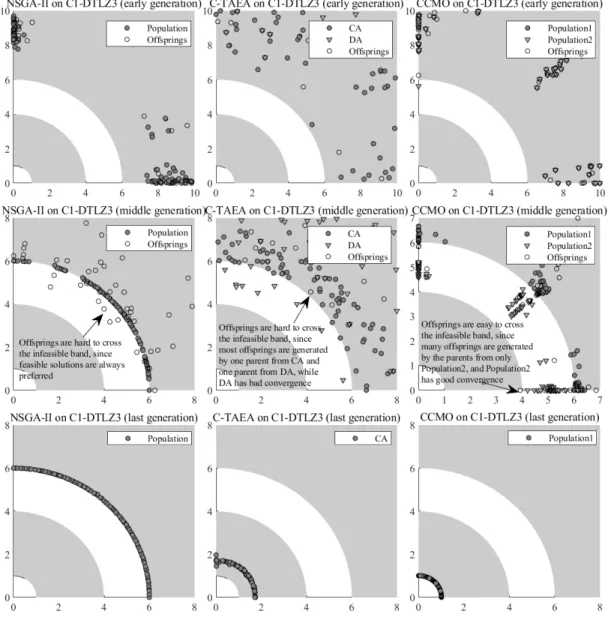
Fig. 3 depicts the populations in the early, middle, and last generations of the compared MOEAs on 2-objective C1-DTLZ3, which has a highly multimodal landscape and a band of infeasible region, posing challenges to MOEAs in terms of convergence. As shown in the first column of Fig. 2, the population of NSGA-II can con-verge to the boundaryx2+y2= 6of a feasible region in the middle generations, but it has trouble in jumping over the infeasible band since the constrained domi-nance relation prefers feasible solutions, even though the feasible solutions have much worse convergence than some infeasible solutions. Once a feasible offspring under the infeasible band is found, the whole population can quickly jump over the infeasible band and converge to the global PF. However, this scenario rarely happens since the infeasible band is wide. For the populations of C-TAEA, the solutions inCAspread along the boundary of a feasible region, and most solutions in DA have
worse convergence than those in CA in the middle generations. This is because C-TAEA updates DA by selecting the solutions having different directions from those in CA. While most solutions are feasible, the well-converged ones are put into CA, and those with different directions must have worse convergence and are further put intoDA. Since the generated offsprings locate between CA and DA, they are unlikely to have significantly better convergence than the solutions in CA. That is, the offsprings can hardly jump over the infeasible band to enable CA to evolve towards the global PF. For the populations of CCMO, P opulation1 is similar toCAsince both of them are evolved without considering the constraints. By contrast, P opulation2 is different from DA since CCMO updates P opulation2 without considering the directions of solutions in the other population. Hence, most solutions in P opulation2 are in the infeasible region. Since some offsprings are
Fig. 3. Populations in the early, middle, and last generations of NSGA-II, C-TAEA, and CCMO on 2-objective C1-DTLZ3. The black line denotes the unconstrained PF of the problem, and the grey surfaces denote the feasible regions of the problem.
generated around P opulation2, it is likely to generate an offspring that can jump out of the infeasible region, and such an offspring can help P opulation1 jump over the infeasible band and evolve towards the global PF. As a consequence, CCMO has better convergence per-formance than NSGA-II and C-TAEA since it can jump over infeasible regions more easily.
CCMO shows better diversity and convergence perfor-mance than existing MOEAs on MW11 and C1-DTLZ3, respectively. The superiority of CCMO on MW11 is due to the fact that CCMO generates offsprings based on the parents separately selected from P opulation1 and
P opulation2; in other words, the two populations do
not cooperate with each other in the mating selection of CCMO. Besides, the superiority of CCMO on C1-DTLZ3 is due to the fact that CCMO selectsP opulation2 without considering the solutions inP opulation1, which means that the two populations do not cooperate with
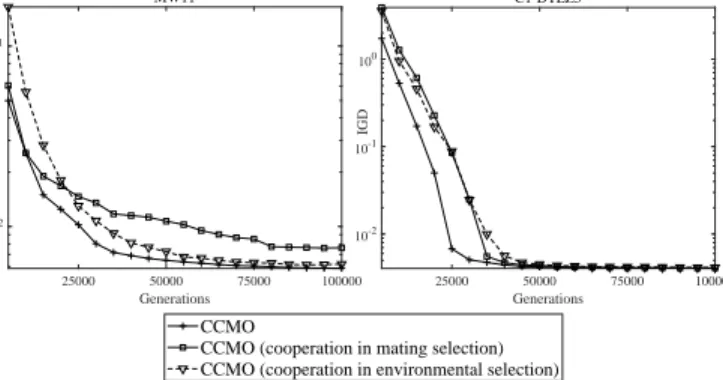
each other in the environmental selection of CCMO. Therefore, it can be confirmed that the weak cooperation in CCMO is more promising than the strong cooperation in C-TAEA for solving CMOPs. As further illustrations, the proposed CCMO is compared to its two variants with stronger cooperations. The first variant enables popula-tions to cooperate with each other in mating selection, i.e., each offspring is generated based on one parent fromP opulation1and one parent fromP opulation2. The second variant enables populations to cooperate with each other in environmental selection, i.e., the solutions having different directions from those in P opulation1 are put intoP opulation2. According to the convergence profiles of IGD values shown in Fig. 4, it can be observed that the original CCMO converges faster than its two variants on MW11 and C1-DTLZ3. Therefore, the supe-riority of the weak cooperation in CCMO over stronger cooperations can be further confirmed.
25000 50000 75000 100000 Generations 10-2 10-1 IGD MW11 CCMO
CCMO (cooperation in mating selection) CCMO (cooperation in environmental selection)
25000 50000 75000 100000 Generations 10-2 10-1 100 IGD C1-DTLZ3
Fig. 4. Convergence profiles of IGD values obtained by CCMO, CCMO with cooperation in mating selection (i.e., each offspring is generated based on two parents from different populations), and CCMO with cooperation in environmental selection (i.e., solutions having different directions from those inP opulation1are put into P opulation2) on 2-objective MW11 and C1-DTLZ3, averaged over 30 runs.
C. Computational Complexity of CCMO
Since the proposed CCMO does not suggest any specific selection strategy as shown in Algorithm 1, the time complexity of the proposed CCMO is mainly determined by the employed MOEA (e.g., NSGA-II). Assuming thatN is the population size,Dis the number of decision variables, andM is the number of objectives, the worst case time complexities of the mating selec-tion, genetic operators, and environmental selection of NSGA-II are O(N),O(N D), and O(M N2), respectively [13]. Since CCMO evolves two populations with the same strategies, the worst case time complexities of the mating selection, genetic operators, and environmental selection of CCMO with NSGA-II is 2×O(N2) =O(N), 2×O(N2D) =O(N D), and2×O(M N2) =O(M N2). As a consequence, the proposed CCMO has the same worst case time complexity as the employed MOEA, but it is in fact slower than the employed MOEA since it performs each search strategy twice a generation.
D. Remarks
Although the idea of evolving multiple populations has been adopted in several existing MOEAs for solv-ing CMOPs, the coevolutionary framework of CCMO can exhibit better performance as illustrated above. To summarize, the advantages of CCMO mainly lie in the following three aspects:
• The core idea of CCMO is to solve a difficult CMOP with the assistance of solving a helper problem, but not to evolve multiple populations cooperatively. To this end, CCMO enables each population to concen-trate on the optimization of its own problem, with-out the disturbance of the other population solving the other problem. Therefore, the helper problem can be specially handled by a population, and this population can generate some well-converged and well-distributed offsprings to assist in solving the difficult CMOP. It is worth mentioning that a similar idea has been adopted in multifactorial evolution
[42], which employs a unified representation to simultaneously solve different problems with the assistance of the implicit transfer of useful genetic material between problems [43].
• Due to the weak cooperation between populations, the proposed CCMO is flexible and light. On the one hand, CCMO can be easily embedded with most existing MOEAs, since the two populations in CCMO are evolved by the same MOEA sepa-rately. On the other hand, CCMO does not suggest any novel selection strategy or introduce any new parameter, which is easy to implement without a significant increase in computational complexity. • The proposed CCMO evolves the second population
P opulation2 to optimize a helper problem derived
from the original CMOP, where the helper problem is not necessarily an unconstrained problem as those in existing MOEAs (e.g., PPS and C-TAEA). That is, when using CCMO to solve a specific CMOP, the helper problem can be empirically adjusted for better performance. In fact, for the experiments in the next two sections, the helper problem is set to the original problem without any constraint when solving the benchmark CMOPs, while it is set to the original problem with fewer constraints when solving the VRPTW problem.
IV. COMPARISONS ONBENCHMARKPROBLEMS
This section verifies the performance of the proposed CCMO by comparing it to the constrained NSGA-II [13], PPS [15], C-TAEA [14], and ToP [10] on the constrained DTLZ test suite [14], [25], the MW test suite [6], the LIR-CMOP test suite [44], and the DOC test suite [10]. The experiments are implemented on the evolutionary multi-objective optimization platform [45].
A. Parameter Settings
1) Problems: The number of objectives M and the number of decision variables D of each benchmark problem are set as follows. For the 10 constrained DTLZ problems, M = 3, D = 7 for C1-DTLZ1, DC1-DTLZ1, DC2-DTLZ1, and DC3-DTLZ1, and D = 12 for the remaining problems. For the 14 MW problems, M = 3 for MW4, MW8, and MW14, M = 2 for the remaining problems, andD= 15. For the 14 LIR-CMOP problems, M = 3 for LIR-CMOP13 and LIR-CMOP14, M = 2 for the remaining problems, and D = 10. For the 9 DOC problems, M = 3 for DOC8 and DOC9, M = 2 for the remaining problems, and D is fixed to different values for different problems [10].
2) Algorithms: The parameters of all the compared algorithms are set as suggested in their original pa-pers, which have demonstrated the high performance of these parameter settings. For the PPS framework, it is embedded with the constrained MOEA/D, where the parameter settings are α = 0.95, τ = 0.1, cp = 2, l= 20. For the ToP framework, it is embedded with the
TABLE I
IGD VALUE OFNSGA-II, PPS, C-TAEA, TOP,ANDCCMOONCONSTRAINEDDTLZANDMW PROBLEMS. THEBESTRESULT INEACHROW IS
HIGHLIGHTED. ‘N/A’ INDICATES THATNOFEASIBLESOLUTION ISFOUND. ‘+’, ‘−’,AND‘≈’ INDICATE THAT THERESULT ISSIGNIFICANTLY
BETTER, SIGNIFICANTLYWORSE,ANDSTATISTICALLYSIMILAR TO THATOBTAINED BYCCMO, RESPECTIVELY.
Problem NSGA-II PPS C-TAEA ToP CCMO
C1-DTLZ1 2.6661e-2 (1.42e-3)− 2.6860e-2 (8.10e-4)− 2.3314e-2 (2.82e-4)≈ 3.7269e-1 (0.00e+0)− 1.9944e-2 (1.48e-4) C2-DTLZ2 5.6562e-2 (2.71e-3)− 5.6032e-2 (1.80e-3)≈ 5.6306e-2 (1.07e-3)≈ 6.1116e-2 (5.93e-3)− 4.2735e-2 (4.96e-4) C1-DTLZ3 7.0281e+0 (2.81e+0)− 1.0681e+0 (2.81e+0)− 1.8588e-1 (3.23e-1)≈ 2.2301e-1 (2.29e-1)− 5.3304e-2 (5.22e-4) C3-DTLZ4 1.2577e-1 (3.40e-3)− 1.7316e-1 (9.09e-2)− 1.1292e-1 (2.58e-3)≈ 1.4333e-1 (5.55e-3)− 9.4618e-2 (1.28e-3) DC1-DTLZ1 1.4887e-2 (8.86e-4)≈ 2.0029e-2 (1.47e-3)− 1.5168e-2 (2.08e-4)≈ 2.5308e-2 (6.93e-3)− 1.1373e-2 (1.38e-4) DC1-DTLZ3 1.2984e-1 (3.05e-3)≈ 1.6964e-1 (1.03e-1)≈ 1.3094e-1 (2.39e-3)− 6.3444e-1 (9.37e-1)− 1.1407e-1 (7.71e-4) DC2-DTLZ1 N/A 2.8587e-2 (4.07e-4)≈ 2.3267e-2 (1.84e-4)≈ N/A 2.0127e-2 (1.29e-4) DC2-DTLZ3 N/A 1.5810e-1 (2.02e-1)≈ 2.2512e-1 (2.33e-1)≈ N/A 5.2954e-2 (3.17e-4) DC3-DTLZ1 1.5541e-1 (1.14e-1)− 1.3250e-2 (7.78e-4)− 9.2340e-3 (2.26e-4)≈ 2.9054e+0 (3.85e+0)− 6.8172e-3 (2.73e-5) DC3-DTLZ3 1.6939e+0 (3.23e-1)− 9.7563e-1 (9.01e-1)≈ 1.7093e-1 (3.38e-3)≈ 7.3461e+0 (4.65e+0)− 1.5811e-1 (1.16e-3) MW1 2.0033e-3 (8.06e-5)≈ 3.1064e-3 (1.94e-4)− 2.0164e-3 (7.32e-5)≈ N/A 1.6141e-3 (1.02e-5) MW2 4.0008e-2 (2.35e-2)≈ 1.4630e-1 (1.03e-1)≈ 1.1948e-2 (6.49e-3)≈ 1.4281e-1 (1.21e-1)≈ 3.0184e-2 (2.22e-2) MW3 5.9557e-3 (2.83e-4)≈ 6.3657e-3 (4.13e-4)− 4.9220e-3 (1.89e-4)≈ 5.2656e-1 (4.36e-1)− 4.6882e-3 (1.31e-4) MW4 5.5794e-2 (2.07e-3)≈ 6.2161e-2 (6.45e-3)− 4.6642e-2 (3.42e-4)≈ N/A 4.0786e-2 (4.14e-4) MW5 3.5915e-1 (3.42e-1)− 3.7649e-1 (3.86e-1)≈ 1.2110e-2 (3.65e-3)≈ N/A 5.2249e-4 (1.09e-4) MW6 2.4507e-2 (1.32e-2)≈ 5.4190e-1 (2.65e-1)≈ 1.1619e-2 (8.73e-3)≈ 9.5561e-1 (3.60e-1)− 2.3629e-2 (8.73e-3) MW7 5.0207e-3 (2.11e-4)≈ 5.7817e-3 (4.86e-4)≈ 6.4789e-3 (7.23e-4)− 5.5588e-2 (8.17e-2)− 4.7869e-3 (2.23e-4) MW8 6.5857e-2 (6.09e-3)≈ 1.5099e-1 (5.18e-2)− 5.4147e-2 (1.63e-3)≈ 6.0557e-1 (3.62e-1)− 4.3866e-2 (2.38e-3) MW9 5.2281e-3 (2.83e-4)≈ 9.7001e-1 (6.45e-1)− 1.0287e-2 (4.61e-4)− 2.2709e-1 (5.11e-1)− 4.3755e-3 (1.54e-4) MW10 1.0414e-1 (3.36e-2)≈ 4.8307e-1 (2.09e-1)≈ 1.0789e-2 (1.04e-2)≈ 6.8925e-1 (0.00e+0)− 5.1263e-2 (4.11e-2) MW11 2.2297e-1 (3.15e-1)− 7.5458e-3 (3.35e-4)≈ 1.4141e-2 (1.81e-3)− 6.8934e-1 (1.46e-1)− 6.0966e-3 (2.27e-4) MW12 5.4987e-3 (1.66e-4)≈ 1.1671e-2 (9.36e-3)− 7.7417e-3 (7.88e-4)− 8.5904e-1 (7.09e-2)− 4.7738e-3 (1.07e-4) MW13 2.9604e-1 (4.74e-1)≈ 5.2455e-1 (3.81e-1)− 2.5484e-2 (1.19e-2)≈ 6.6615e-1 (4.12e-1)− 6.3957e-2 (3.51e-2) MW14 1.2066e-1 (4.00e-3)− 1.3052e-1 (7.47e-3)≈ 1.1030e-1 (4.13e-3)≈ 3.5506e-1 (3.87e-1)≈ 9.8086e-2 (9.20e-4)
+/−/≈ 0/9/13 0/12/12 0/5/19 0/17/2
constrained NSGA-II, where the first phase ends when the feasibility proportion Pf is larger than 1/3 or the
difference δ is less than 0.2. For the proposed CCMO, it is also embedded with the constrained NSGA-II; to further enhance the population diversity, the truncation strategy in SPEA2 [46] is adopted in the environmen-tal selection instead of crowding distance. Besides, the helper problem in CCMO is set to the original problem without any constraint.
3) Genetic operators: NSGA-II, C-TAEA, and CCMO adopt the simulated binary crossover [40] and the poly-nomial mutation [41] to generate offsprings, while PPS and ToP adopt the differential evolution [47] and the polynomial mutation to generate offsprings. The proba-bility of simulated binary crossover is set to 1, the prob-ability of polynomial mutation is set to 1/D (D denotes the number of decision variables), the distribution index of both crossover and mutation is set to 20, and the parameters CR and F in differential evolution are set to 1 and 0.5, respectively.
4) Population size and number of function evaluations: For a fair comparison, the population size is set to 100 on problems with 2 objectives and 105 on problems with 3 objectives for all the compared MOEAs. The total num-ber of function evaluations of all populations is adopted as the termination criterion for all the compared MOEAs, which is set to a sufficiently large value to enable each MOEA to converge. Specifically, the number of function evaluations is set to 100,000 for the constrained DTLZ and MW problems, and set to 300,000 for the LIR-CMOP and DOC problems.
B. Experimental Results on Constrained DTLZ and MW Problems
Table I presents the mean value and standard devi-ation of the IGD values obtained by NSGA-II, PPS, C-TAEA, ToP, and CCMO on the constrained DTLZ test suite and the MW test suite for 30 independent runs. The IGD values on each problem are calculated according to approximately 10,000 reference points sampled on the PF of the problem by the methods suggested in [48]. As shown in the table, the proposed CCMO obtains the best results on 20 problems, which is followed by C-TAEA achieving 4 best results. Besides, NSGA-II, PPS, and ToP perform the best on none of the 24 problems. Table I also gives the statistical results obtained by the Friedman test with Bonferroni correction at a significance level of 0.05 [49]. It can be found that CCMO significantly outperforms NSGA-II, PPS, C-TAEA, and ToP on 9, 12, 5, and 17 problems, respectively.
Fig. 5 plots the feasible and non-dominated solutions with median IGD value among 30 runs obtained by the five MOEAs on C1-DTLZ3, MW5, and MW8. For C1-DTLZ3 with a highly multi-modal landscape, it is obvious that CCMO has better convergence performance than the other MOEAs. As further evidenced by Fig. 6, CCMO has much faster convergence speed than the other MOEAs on C1-DTLZ3. As illustrated in Fig. 3, the fast convergence speed of CCMO is mainly attributed to the offsprings generated by the population for the helper problem, which enable the population for the original CMOP to jump over infeasible regions more easily. For
Fig. 5. Feasible and non-dominated solutions with median IGD value among 30 runs obtained by NSGA-II, PPS, C-TAEA, ToP, and CCMO on C1-DTLZ3, MW5, and MW8. 25000 50000 75000 100000 Generations 10-1 100 IGD C1-DTLZ3 NSGA-II PPS C-TAEA ToP CCMO
Fig. 6. Convergence profiles of IGD values obtained by NSGA-II, PPS, C-TAEA, ToP, and CCMO on C1-DTLZ3, averaged over 30 runs.
MW5 and MW8 with discontinuous feasible regions, CCMO exhibits better diversity performance than the other MOEAs, which is owed to the offsprings gener-ated by the population for the original CMOP as illus-trated in Fig. 2. In short, the weak cooperation between P opulation1for the original CMOP andP opulation2for the helper problem can effectively improve the conver-gence and diversity of P opulation1. On the one hand, since the constrained DTLZ problems have multi-modal landscape and wide infeasible band, the offsprings gen-erated by P opulation2 can help P opulation1 jump over infeasible regions for better convergence. On the other hand, since the MW problems have small and discon-tinuous feasible regions, the offsprings generated by P opulation1 can improve the diversity ofP opulation1. By contrast, these benefits cannot be achieved in a strong cooperation, since most offsprings are generated
between the two populations.
Furthermore, Table II lists the proportion of feasible and non-dominated solutions in the final population obtained by the five MOEAs. For NSGA-II with the constrained dominance relation, the obtained solutions are all feasible and non-dominated on 19 out of the 24 problems. For PPS with a multi-stage framework, the obtained solutions are all feasible and non-dominated on 23 problems. C-TAEA with a coevolutionary framework obtains fewer feasible and non-dominated solutions than NSGA-II and PPS. ToP can only obtain a few feasible and non-dominated solutions on the 24 problems, since the strategies in ToP are tailored for solving the CMOPs with constraints in both the decision and objective spaces [10]. Besides, the proposed CCMO is able to obtain a sufficient number of feasible and non-dominated solutions on all the 24 problems except for MW5, where the PF of MW5 contains only several isolated Pareto optimal solutions.
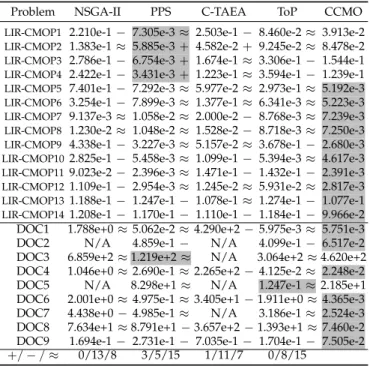
C. Experimental Results on LIR-CMOP and DOC Problems The proposed CCMO is further challenged on more difficult test suites, namely, CMOP and DOC. LIR-CMOP contains 14 LIR-CMOPs with small feasible regions and complicated linkages between position and distance variables, and DOC contains 9 CMOPs with complex constraints in both decision and objective spaces. Ac-cording to the experimental results shown in Table III, the numbers of best results obtained by NSGA-II, PPS, C-TAEA, ToP, and CCMO are 0, 5, 0, 1, 17, respectively. Therefore, it can be concluded that the proposed CCMO has better overall performance than some state-of-the-art MOEAs for solving benchmark CMOPs.
TABLE II
PROPORTION OFFEASIBLE ANDNON-DOMINATEDSOLUTIONS IN THEPOPULATIONOBTAINED BYNSGA-II, PPS, C-TAEA, TOP,ANDCCMO
ONCONSTRAINEDDTLZANDMW PROBLEMS. THEBESTRESULTS INEACHROW AREHIGHLIGHTED. ‘+’, ‘−’,AND‘≈’ INDICATE THAT THE
RESULT ISSIGNIFICANTLYBETTER, SIGNIFICANTLYWORSE,ANDSTATISTICALLYSIMILAR TO THATOBTAINED BYCCMO, RESPECTIVELY.
Problem NSGA-II PPS C-TAEA ToP CCMO
C1-DTLZ1 1.0000e+0 (0.00e+0)≈ 9.9725e-1 (5.09e-3)≈ 1.0000e+0 (0.00e+0)≈ 1.0875e-1 (4.42e-2)− 1.0000e+0 (0.00e+0) C2-DTLZ2 1.0000e+0 (0.00e+0)≈ 1.0000e+0 (0.00e+0)≈ 1.0000e+0 (0.00e+0)≈ 1.0000e+0 (0.00e+0)≈ 1.0000e+0 (0.00e+0) C1-DTLZ3 1.0000e+0 (0.00e+0)≈ 1.0000e+0 (0.00e+0)≈ 1.0000e+0 (0.00e+0)≈ 1.0000e+0 (0.00e+0)≈ 1.0000e+0 (0.00e+0) C3-DTLZ4 1.0000e+0 (0.00e+0)≈ 1.0000e+0 (0.00e+0)≈ 1.0000e+0 (0.00e+0)≈ 1.0000e+0 (0.00e+0)≈ 1.0000e+0 (0.00e+0) DC1-DTLZ1 1.0000e+0 (0.00e+0)≈ 1.0000e+0 (0.00e+0)≈ 1.0000e+0 (0.00e+0)≈ 1.0000e+0 (0.00e+0)≈ 1.0000e+0 (0.00e+0) DC1-DTLZ3 1.0000e+0 (0.00e+0)≈ 1.0000e+0 (0.00e+0)≈ 1.0000e+0 (0.00e+0)≈ 1.0000e+0 (0.00e+0)≈ 1.0000e+0 (0.00e+0) DC2-DTLZ1 3.5375e-1 (5.93e-2)− 1.0000e+0 (0.00e+0)≈ 1.0000e+0 (0.00e+0)≈ 1.6125e-1 (3.64e-2)− 1.0000e+0 (0.00e+0) DC2-DTLZ3 4.3750e-1 (4.18e-1)− 1.0000e+0 (0.00e+0)≈ 9.4918e-1 (1.44e-1)≈ 1.4000e-1 (4.63e-2)− 1.0000e+0 (0.00e+0) DC3-DTLZ1 1.0000e+0 (0.00e+0)≈ 1.0000e+0 (0.00e+0)≈ 1.0000e+0 (0.00e+0)≈ 9.4500e-1 (1.56e-1)≈ 1.0000e+0 (0.00e+0) DC3-DTLZ3 9.9750e-1 (7.07e-3)≈ 1.0000e+0 (0.00e+0)≈ 1.0000e+0 (0.00e+0)≈ 9.8250e-1 (3.62e-2)≈ 1.0000e+0 (0.00e+0) MW1 8.8125e-1 (3.36e-1)≈ 1.0000e+0 (0.00e+0)≈ 1.0000e+0 (0.00e+0)≈ 3.7500e-2 (1.75e-2)− 1.0000e+0 (0.00e+0) MW2 1.0000e+0 (0.00e+0)≈ 1.0000e+0 (0.00e+0)≈ 1.0000e+0 (0.00e+0)≈ 6.0500e-1 (3.92e-1)− 1.0000e+0 (0.00e+0) MW3 1.0000e+0 (0.00e+0)≈ 1.0000e+0 (0.00e+0)≈ 1.0000e+0 (0.00e+0)≈ 4.2125e-1 (4.79e-1)− 1.0000e+0 (0.00e+0) MW4 1.0000e+0 (0.00e+0)≈ 1.0000e+0 (0.00e+0)≈ 1.0000e+0 (0.00e+0)≈ 6.3125e-1 (1.94e-1)− 1.0000e+0 (0.00e+0) MW5 9.9875e-1 (3.54e-3)≈ 1.0000e+0 (0.00e+0)≈ 1.5875e-1 (9.91e-3)− 6.6250e-2 (2.97e-2)− 8.5375e-1 (1.55e-1) MW6 1.0000e+0 (0.00e+0)≈ 1.0000e+0 (0.00e+0)≈ 1.0000e+0 (0.00e+0)≈ 4.3250e-1 (2.60e-1)− 1.0000e+0 (0.00e+0) MW7 1.0000e+0 (0.00e+0)≈ 1.0000e+0 (0.00e+0)≈ 7.3375e-1 (4.93e-2)− 9.0625e-1 (1.98e-1)≈ 1.0000e+0 (0.00e+0) MW8 1.0000e+0 (0.00e+0)≈ 1.0000e+0 (0.00e+0)≈ 1.0000e+0 (0.00e+0)≈ 6.8750e-1 (4.29e-1)− 1.0000e+0 (0.00e+0) MW9 1.0000e+0 (0.00e+0)≈ 1.0000e+0 (0.00e+0)≈ 5.3125e-1 (3.09e-2)− 1.0000e+0 (0.00e+0)≈ 1.0000e+0 (0.00e+0) MW10 1.0000e+0 (0.00e+0)≈ 1.0000e+0 (0.00e+0)≈ 1.0000e+0 (0.00e+0)≈ 1.0375e-1 (1.23e-1)− 1.0000e+0 (0.00e+0) MW11 1.0000e+0 (0.00e+0)≈ 1.0000e+0 (0.00e+0)≈ 5.7875e-1 (5.00e-2)− 8.5375e-1 (1.09e-1)≈ 1.0000e+0 (0.00e+0) MW12 1.0000e+0 (0.00e+0)≈ 1.0000e+0 (0.00e+0)≈ 8.1750e-1 (5.18e-2)− 3.6625e-1 (2.27e-1)− 1.0000e+0 (0.00e+0) MW13 1.0000e+0 (0.00e+0)≈ 1.0000e+0 (0.00e+0)≈ 1.0000e+0 (0.00e+0)≈ 7.7375e-1 (1.85e-1)− 1.0000e+0 (0.00e+0) MW14 1.0000e+0 (0.00e+0)≈ 1.0000e+0 (0.00e+0)≈ 1.0000e+0 (0.00e+0)≈ 1.0000e+0 (0.00e+0)≈ 1.0000e+0 (0.00e+0)
+/−/≈ 0/2/22 0/0/24 0/5/19 0/13/11
TABLE III
IGD VALUE OFNSGA-II, PPS, C-TAEA, TOP,ANDCCMOON
LIR-CMOPANDDOC PROBLEMS. THEBESTRESULT INEACHROW ISHIGHLIGHTED. ‘N/A’ INDICATES THATNOFEASIBLESOLUTION IS
FOUND. ‘+’, ‘−’,AND‘≈’ INDICATE THAT THERESULT IS
SIGNIFICANTLYBETTER, SIGNIFICANTLYWORSE,ANDSTATISTICALLY
SIMILAR TO THATOBTAINED BYCCMO, RESPECTIVELY.
Problem NSGA-II PPS C-TAEA ToP CCMO LIR-CMOP1 2.210e-1− 7.305e-3≈ 2.503e-1− 8.460e-2≈ 3.913e-2 LIR-CMOP2 1.383e-1≈ 5.885e-3+ 4.582e-2+ 9.245e-2≈ 8.478e-2 LIR-CMOP3 2.786e-1− 6.754e-3+ 1.674e-1≈ 3.306e-1− 1.544e-1 LIR-CMOP4 2.422e-1− 3.431e-3+ 1.223e-1≈ 3.594e-1− 1.239e-1 LIR-CMOP5 7.401e-1− 7.292e-3≈ 5.977e-2≈ 2.973e-1≈ 5.192e-3 LIR-CMOP6 3.254e-1− 7.899e-3≈ 1.377e-1≈ 6.341e-3≈ 5.223e-3 LIR-CMOP7 9.137e-3≈ 1.058e-2≈ 2.000e-2− 8.768e-3≈ 7.239e-3 LIR-CMOP8 1.230e-2≈ 1.048e-2≈ 1.528e-2− 8.718e-3≈ 7.250e-3 LIR-CMOP9 4.338e-1− 3.227e-3≈ 5.157e-2≈ 3.678e-1− 2.680e-3 LIR-CMOP102.825e-1− 5.458e-3≈ 1.099e-1− 5.394e-3≈ 4.617e-3 LIR-CMOP119.023e-2− 2.396e-3≈ 1.471e-1− 1.432e-1− 2.391e-3 LIR-CMOP121.109e-1− 2.954e-3≈ 1.245e-2≈ 5.931e-2≈ 2.817e-3 LIR-CMOP131.188e-1− 1.247e-1− 1.078e-1≈ 1.274e-1− 1.077e-1 LIR-CMOP141.208e-1− 1.170e-1− 1.110e-1− 1.184e-1− 9.966e-2 DOC1 1.788e+0≈5.062e-2≈4.290e+2−5.975e-3≈ 5.751e-3 DOC2 N/A 4.859e-1− N/A 4.099e-1− 6.517e-2 DOC3 6.859e+2≈1.219e+2≈ N/A 3.064e+2≈4.620e+2 DOC4 1.046e+0≈2.690e-1≈2.265e+2−4.125e-2≈ 2.248e-2 DOC5 N/A 8.298e+1≈ N/A 1.247e-1≈2.185e+1 DOC6 2.001e+0≈4.975e-1≈3.405e+1−1.911e+0≈4.365e-3 DOC7 4.438e+0−4.985e-1≈ N/A 3.186e-1≈ 2.524e-3 DOC8 7.634e+1≈8.791e+1−3.657e+2−1.393e+1≈7.460e-2 DOC9 1.694e-1− 2.731e-1− 7.035e-1− 1.704e-1− 7.505e-2
+/−/≈ 0/13/8 3/5/15 1/11/7 0/8/15
Moreover, Table IV lists the mean value of the time consumption of the five MOEAs on each test suite, averaged over 30 runs. It can be found that
NSGA-TABLE IV
AVERAGETIMECONSUMPTION(INSECOND)OFNSGA-II, PPS, C-TAEA, TOP,ANDCCMOONCONSTRAINEDDTLZ, MW, LIR-CMOP,ANDDOC PROBLEMS. THEBESTRESULT INEACHROW
ISHIGHLIGHTED.
Problem NSGA-II PPS C-TAEA ToP CCMO DTLZ
3.9241e+0 3.5348e+1 2.4955e+2 1.0940e+1 5.3379e+1 problems
MW 4.1752e+0 4.1412e+1 2.6718e+2 2.4737e+1 4.9596e+1 problems
LIR-CMOP
1.1564e+1 1.2950e+2 7.1397e+2 2.1835e+1 1.5344e+2 problems
DOC 1.1703e+1 1.0128e+2 5.3677e+2 5.8446e+1 1.1980e+2 problems
II consumes the least time and C-TAEA consumes the most time. Besides, it is worth noting that the proposed CCMO is less efficient than NSGA-II though they use the same search strategies, since CCMO performs selection strategies twice a generation and employs the trunca-tion strategy instead of crowding distance, where the truncation strategy is much more time-consuming than calculating crowding distance [50].
V. COMPARISONS ONVEHICLEROUTINGPROBLEM WITHTIMEWINDOWS
This section verifies the performance of CCMO in solving the VRPTW problem, which is an extensively studied combinational optimization problem with com-plicated decision space and strict constraints [4]. VRPTW has been tackled by many exact, heuristic, and meta-heuristic methods [51]. In recent years, a number of
MOEAs have also been employed for solving VRPTW, including NSGA [52], MOPSO [53], and MOEA/D [17]. A VRPTW considers a central depot and a number of customers, where each customer has its own location, demand, and service time window. The goal of solving the problem is to minimize the total traveled distance of multiple vehicles for serving all the customers, with the satisfaction of the capacities of vehicles and the service time windows of customers. The objectives of a VRPTW can be defined as [17] min x f(x) = (f1(x), f2(x)) f1(x) =K f2(x) = N ∑ i=0 N ∑ j=0 K ∑ k=1 dijaijk , (3)
where x is a solution denoting the routes of multiple vehicles;N denotes the number of customers;Kdenotes the number of vehicles;dijdenotes the distance between
customers ci and cj (c0 denotes the central depot); and aijkis set to 1 if arc⟨ci, cj⟩is traversed by thek-th vehicle
and 0 otherwise. In short, the problem aims to minimize both the number of vehicles f1 and the total traveled distancef2. The constraints of a VRPTW can be defined as N ∑ i=1 ai0k= N ∑ j=1 a0jk= 1 fork∈ {1,· · ·, K}, (4) ∑N j=0,j̸=iaijk= ∑N j=0,j̸=iajik≤1 fori∈ {1,· · ·, N}and k∈ {1,· · ·, K} , (5) K ∑ k=1 N ∑ i=0,i̸=j aijk= 1 for j∈ {1,· · ·, N}, (6) K ∑ k=1 N ∑ j=0,j̸=i aijk= 1 fori∈ {1,· · · , N}, (7) N ∑ i=0 qi N ∑ j=0,j̸=i aijk≤Qfork∈ {1,· · ·, K}, (8) tj=ti+wi+si+tij fori, j∈ {1,· · ·, N}, i̸=j, (9) ei≤ti+wi≤li fori∈ {0,· · ·, N}, (10)
whereQdenotes the capacity of each vehicle;qi denotes
the demand of customer ci; ti denotes the time when
the vehicle arrives at ci; wi denotes the waiting time
at ci (in case the vehicle arrives before the service time
window); si denotes the service time required by ci;tij
denotes the traveling time betweenciandcj; andei and
li determine the service time window ofci. In short, (4)
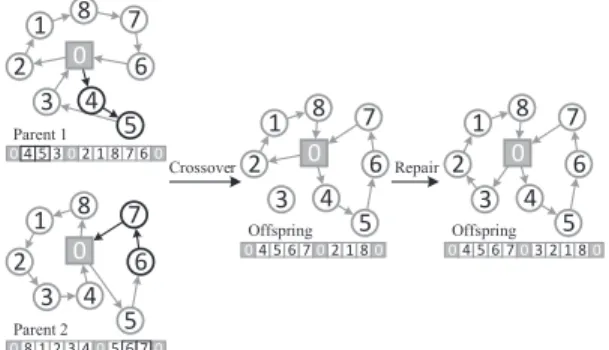
and (5) ensure that each vehicle always starts from the depot, visits customers in sequence, and finally returns to the depot, (6) and (7) ensure that each customer is visited only once, (8) gives the constraints of capacities of vehicles, and (9) and (10) give the constraints of time windows of customers. 1 0 2 3 8 7 6 4 5 1 0 2 3 8 7 6 4 5 1 0 2 3 8 7 6 4 5 1 0 2 3 8 7 6 4 5 045302 1 8 7 60 0812 3 4056 70 0456 7021 80 0456 70321 80 Parent 1 Parent 2 Crossover Offspring Repair Offspring
Fig. 7. Procedure of sequence based crossover.
1 0 2 3 8 7 6 4 5 0456 0321 80 1 0 2 3 8 7 6 4 5 1 0 2 3 8 7 6 4 5 1 0 2 3 8 7 6 4 5 04560321 870 0 4 50187 60 0234 50187 60 Reallocation Reposition Offspring 1 0 2 3 8 7 6 4 5 045 0 1 80 Exchange Offspring 2 6 7 3 2 7 3
Fig. 8. Procedure of remove and reinsert mutation.
A. Genetic Operators for Solving VRPTW
As shown in Fig. 7, a solution for VRPTW is usu-ally represented by a permutation of customers (i.e., 1,· · ·, N) and the depot (i.e.,0), where the routes of dif-ferent vehicles are separated by the value 0. Accordingly, the sequence based crossover [54] and the remove and reinsert mutation [55] are adopted to generate offsprings. Given two parents as shown in fig. 7, the crossover operator randomly selects a route from the first parent (e.g., 4-3) and a route from the second parent (e.g., 5-6-7), and splits each route into two sequences. Then, the offspring is set to the same as the first parent, while a new route is generated by combining the first sequence of the first route and the second sequence of the second route (e.g., 4-5-6-7). If some customers are missed in the offspring (e.g., 3), the offspring will be repaired by randomly inserting the missed customers into a feasible position.
According to Fig. 8, the mutation operator selects two routes from the offspring, then performs the reallocation operator if the two routes are the same and the exchange operator otherwise. The reallocation operator selects a sequence (e.g., 5-6-7) from the route, and checks whether each customer in the sequence can be inserted into other routes for a feasible solution with shorter distance. The exchange operator selects a sequence (e.g., 3-2 and 6-7) from each route, and checks whether each customer in each sequence can be inserted into the other route for a feasible solution with shorter distance. Lastly, the repo-sition operator is performed, which selects a customer (e.g., 3) and checks whether it can be inserted into other positions in the same route for a shorter distance.
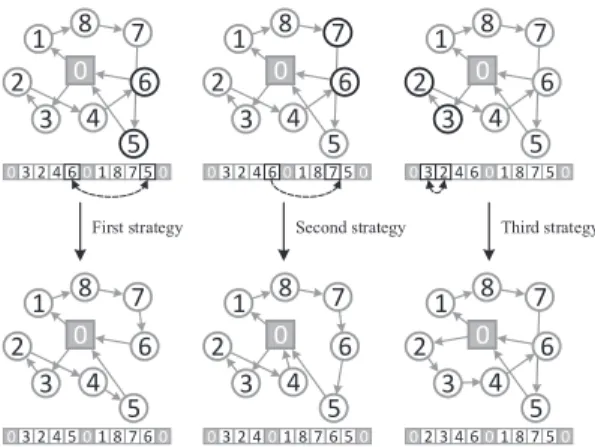
1 0 2 3 8 7 6 4 5 032460187 50 1 0 2 3 8 7 6 4 5 03246018750 1 0 8 7 6 4 5 0 46018750 2 3 3 2 1 0 8 7 6 4 5 0 46018750 2 3 2 3 1 0 2 3 8 7 6 4 5 03240187650 1 0 2 3 8 7 6 4 5 032450187 60
First strategy Second strategy Third strategy
Fig. 9. Procedure of the local search strategies in CCMO.
B. Local Search Strategies for Solving VRPTW
To further enhance the performance of MOEAs for solving VRPTW, three local search strategies are sug-gested to fine-tune the population at the end of each ten generations. For each solution in the population, one of the three local search strategies is randomly selected and performed on it, and it can be replaced by the fine-tuned solution if the latter has a shorter distance.
In the proposed search strategies, the neighborhood customers of each customer ci are defined as those
having the ⌈0.1N⌉ shortest distances to ci. As shown
in Fig. 9, the first strategy randomly selects two routes, then traverses each customerciin the first route to check
whethercican be swapped with each customercj in the
second route for a feasible solution with shorter distance; the customer cj to be swapped with ci should be a
neighborhood customer of ci. The second strategy
ran-domly selects two routes, then traverses each customer ci in the first route to check whether ci can be inserted
after each customercj in the second route for a feasible
solution with shorter distance; similarly, the customercj
in the second route should be a neighborhood customer of ci. The third strategy randomly selects a route, then
traverses each pair of customers in the route to check whether the customers between them can be reversed for a shorter distance. To summarize, these three strategies can reduce the objective values of each solution by differ-ent greedy strategies. Specifically, the first strategy aims to enhance the diversity by exchanging the customers in different routes, the second strategy aims to reduce the number of vehicles by moving customers from one route to another, and the third strategy aims to reduce the distance by reallocating the customers in the same route.
C. Parameter Settings
The proposed CCMO is compared to NSGA-II, PPS, C-TAEA, ToP, MACS-VRPTW [56], HMOMA [57], and M-MOEA/D [17] on R101–R112, where R101–R112 are 12 datasets taken from the Solomon’s benchmark [58], each of which contains 100 customers with various
location, demand, and service time window. MACS-VRPTW, HMOMA, and M-MOEA/D are three effective evolutionary algorithms tailored for VRPTW, which are based on ant colony system, Pareto dominance based MOEA, and decomposition based MOEA, respectively.
Since NSGA-II, PPS, C-TAEA, ToP, and the proposed CCMO are not tailored for VRPTW, all of them employ the genetic operators described in Section V-A and the local search strategies proposed in Section V-B. Besides, MACS-VRPTW, HMOMA, and M-MOEA/D use their own recombination operators, and they adopt different local search strategies. The parameters of PPS and ToP are set to the same as those in Section IV-A. For MACS-VRPTW, the parameter settings in the ant colony system are α = 1, q0 = 0.9, β = 2, ρ = 0.1. For HMOMA, the archive size is set to 200, the depth of local search is set to 10, and the ratio of computing resources of two phases is set to 1/3. For M-MOEA/D, the neighborhood list size is set to 10 and the archive size is set to 100. For CCMO, the helper problem is set to the original problem without the constraints of time window (i.e., (9) and (10)). Besides, the population size and number of function evaluations are set to 50 and 100,000 for all the compared MOEAs, respectively. A parameter sensitivity analysis of all the compared MOEAs is given in Supplementary Materials I.
D. Experimental Results on VRPTW
Table V lists the objective values of the results of the eight MOEAs on R101–R112, where each result includes the non-dominated solutions among all the solutions obtained in 30 independent runs. It is clear that most solutions found by CCMO have the same number of vehicles but shorter traveled distance than those found by the other MOEAs. For NSGA-II, PPS, C-TAEA, and ToP, although they use the same genetic operators and local search strategies to CCMO, they exhibit bad performance since their search strategies cannot balance between constraints and objectives on VRPTW that has a highly discrete landscape and a small feasible region. For MACS-VRPTW and HMOMA, they are also worse than M-MOEA/D and CCMO since they always prefer feasible solutions and are easily trapped into local optima. For M-MOEA/D with a novel selection strategy, it obtains some better results than CCMO since the selection strategy is tailored for VRPTW that makes a balance between constraints and objectives. While for the proposed CCMO, it solves VRPTW with the assistance of solving the same problem without the constraints of time window, having achieved the best solutions on 11 out of the 12 datasets.
To verify the rationality of the helper problem in CCMO, the last column of Table V also lists the objective values obtained by a variant of CCMO, which sets the helper problem as the original VRPTW without any con-straint (i.e., a traveling salesman problem). It is obvious that CCMO obtains better solutions than the variant
TABLE V
OBJECTIVEVALUES OF THENON-DOMINATEDSOLUTIONSOBTAINED BYNSGA-II, PPS, C-TAEA, TOP, MACS-VRPTW, HMOMA, M-MOEA/D,ANDCCMOONR101–R112. THEBESTRESULTS INEACHROW AREHIGHLIGHTED.
Problem NSGA-II PPS C-TAEA ToP MACS-VRPTW HMOMA M-MOEA/D CCMO
CCMO with an unconstrained helper problem f1 f2 f1 f2 f1 f2 f1 f2 f1 f2 f1 f2 f1 f2 f1 f2 f1 f2 R101 19 1790.17 19 1825.64 19 1864.28 19 1690.87 20 1684.63 19 1690.28 19 1652.17 19 1650.80 19 1663.86 20 1689.70 20 1703.70 20 1758.15 20 1664.13 21 1656.39 20 1664.13 20 1644.70 20 1643.79 20 1649.84 R102 17 1564.12 17 1562.19 17 1583.64 17 1513.74 18 1527.18 17 1513.74 17 1486.12 17 1492.92 17 1499.37 18 1504.73 18 1501.83 18 1528.35 18 1487.07 19 1496.42 18 1487.07 18 1473.73 18 1477.03 18 1489.61 R103 13 1473.25 14 1392.04 14 1402.76 13 1392.73 14 1287.00 13 1354.22 13 1354.22 13 1375.26 14 1346.57 15 1289.30 15 1286.47 14 1247.31 15 1268.52 14 1237.05 14 1213.62 14 1213.62 14 1237.39 R104 10 1092.31 10 1064.74 10 1054.39 10 1020.87 10 1047.58 10 1020.87 10 999.31 10 992.38 10 1008.24 11 1032.47 11 1022.58 11 1027.70 11 1010.24 11 1043.73 11 1010.24 11 991.91 11 991.91 11 1005.93 R105 14 1458.64 14 1446.15 14 1437.83 14 1415.13 15 1424.62 14 1415.13 14 1410.64 14 1382.50 14 1415.13 15 1399.58 15 1392.06 15 1387.61 15 1390.12 16 1384.33 15 1390.12 15 1366.58 15 1366.18 15 1380.85 R106 12 1308.65 12 1305.31 12 1368.59 12 1284.82 12 1265.99 12 1262.05 12 1271.86 13 1291.22 13 1283.57 13 1289.22 13 1254.22 13 1270.28 13 1254.22 13 1249.22 13 1253.35 13 1260.99 R107 10 1179.47 10 1146.62 10 1193.75 10 1147.93 10 1139.47 10 1135.40 10 1174.29 11 1106.22 11 1102.31 11 1112.45 11 1100.52 11 1125.59 11 1100.52 11 1086.22 11 1075.71 11 1086.52 R108 10 987.52 10 980.26 10 985.08 10 975.34 10 971.91 10 975.34 10 965.52 10 952.40 10 986.48 R109 12 1174.44 12 1197.52 12 1195.04 12 1169.85 12 1224.67 12 1169.85 12 1157.44 12 1153.89 12 1174.83 13 1168.38 13 1187.67 13 1183.93 13 1166.09 13 1215.06 13 1166.09 13 1155.38 13 1151.84 13 1155.52 R110 11 1181.26 11 1158.73 11 1178.53 11 1112.21 11 1112.21 11 1110.68 11 1110.68 11 1146.63 12 1166.03 12 1149.91 12 1152.70 12 1108.42 12 1150.28 12 1106.03 12 1101.20 12 1107.97 R111 11 1109.82 11 1107.86 11 1104.03 11 1084.76 11 1135.61 11 1084.76 11 1073.82 11 1064.73 11 1100.26 12 1086.45 12 1092.27 12 1079.82 12 1079.82 12 1061.33 12 1084.60 R112 10 981.43 10 996.73 10 991.56 10 976.99 11 1027.13 10 976.99 10 981.43 10 969.48 10 979.51
with an unconstrained problem. In fact, according to the table, the performance of CCMO becomes worse than M-MOEA/D on most datasets if an unconstrained problem is used as the helper problem. Therefore, it is confirmed that a simple problem without the constraints of time window is more promising to assist in solving VRPTW than a helper problem without all constraints. Besides, the proposed CCMO is compared to MACS-VRPTW, HMOMA, and M-MOEA/D with the same local search strategies in Supplementary Materials II. The experimental results show that CCMO still outperforms the three algorithms, which demonstrates that the better performance of CCMO is mainly due to the proposed framework but not the local search strategies.
VI. CONCLUSIONS ANDFUTUREWORK
This paper has proposed a coevolutionary framework for solving CMOPs, which aims to solve a difficult CMOP with the assistance of solving a helper problem. To this end, the proposed framework evolves one pop-ulation to solve the original CMOP and evolves another population to solve a helper problem derived from the original one. In contrast to existing coevolutionary MOEAs, the proposed framework holds a weak cooper-ation between populcooper-ations to achieve the assistance in solving the original CMOP, rather than a strong coop-eration to evolve multiple populations cooperatively. As verified in Section III-B, the novel paradigm of CCMO is promising for solving CMOPs.
In the experiments, the proposed framework has been compared to several state-of-the-art MOEAs tailored for CMOPs. According to the results in Sections IV-B and
IV-C, the proposed framework has better overall per-formance than the compared MOEAs on 47 benchmark CMOPs. Moreover, the proposed framework has been tested on the VRPTW problem, which has also shown better performance than existing MOEAs.
Since the proposed framework is light and flexible, it is highly desirable to extend it for better performance and wider applicability. Firstly, more effective optimizers need to be developed and equipped in the proposed framework to better evolve the two populations. Sec-ondly, the performance of the proposed framework on the VRPTW problem can be further enhanced by adopt-ing some tailored strategies (e.g., the random key based representation [59]). Thirdly, it is necessary to acquire some useful experience in designing the helper problem for a given real-world CMOP.
REFERENCES
[1] N. Jozefowiez, F. Semet, and E. G. Talbi, “Multi-objective vehicle routing problems,” European Journal of Operational Research, vol. 189, no. 2, pp. 293–309, 2008.
[2] R. Saravanan, S. Ramabalan, N. G. R. Ebenezer, and C. Dhar-maraja, “Evolutionary multi criteria design optimization of robot grippers,”Applied Soft Computing, vol. 9, no. 1, pp. 159–172, 2009. [3] H. Mala-Jetmarova, N. Sultanova, and D. A. Savic, “Lost in optimisation of water distribution systems? a literature review of system operation,”Environmental Modelling and Software, vol. 93, pp. 209–254, 2017.
[4] L. H. Lee, K. C. Tan, K. Ou, and Y. H. Chew, “Vehicle capac-ity planning system: A case study on vehicle routing problem with time windows,” IEEE Transactions on Systems, Man, and Cybernetics-Part A: Systems and Humans, vol. 33, no. 2, pp. 169– 178, 2003.
[5] A. Dixit, A. Mishra, and A. Shukla, “Vehicle routing problem with time windows using meta-heuristic algorithms: a survey,” Har-mony Search and Nature Inspired Optimization Algorithms. Advances in Intelligent Systems and Computing, vol. 741, pp. 539–546, 2019.