Enterprise Master Data Management:
Market Review & Forecast for 2008-12
An MDM Institute MarketPulse™ In-Depth Report
Aaron Zornes
Chief Research Officer
The MDM Institute
September 2008Corporate master data is a critical asset that must be increasingly managed within and beyond the enterprise — primarily to solve business problems in compliance,
customer service, sales, and marketing. Such master data may be indentified, harmonized and integrated at multiple levels of the software stack to materialize a
“single customer view” (or supplier, product, view etc.).
Master data management (MDM) solutions will vary by industry in terms of tactical approaches taken – e.g., pharmaceutical/life sciences will adopt semi-batch, database-centric approaches for master physician data to be deployed to sales forces, while financial services providers and online retailers will require near
real-time, business process-centric solutions to compete in the business-to-consumer online world.
During 2008-09, most large enterprises will focus on MDM by deploying 3rd generation packaged MDM solutions to deliver panoramic customer, product and supplier views across multiple channels, business lines, and heterogeneous IT
environments. By 2010-11, 4th generation solutions will begin to predominate due to requirements for multiple master entities, unstructured data, etc. By 2012, more
than 80% of the Global 5000 size enterprises will have committed to enterprise MDM as a core business strategy and have implemented at least one master entity
– whether party (customer/supplier/citizen) or product.
The aggregate enterprise MDM market (customer and product hubs, plus systems implementation services) totaled US$730 million at YE2007 and will reach US$2 billion by the end of 2012. Software sales are but one portion as MDM systems integration services reached US$510 million alone during 2007 and are projected to
Page 2
© 2008-09 The MDM Institute
An MDM Institute MarketPulse™ In-Depth ReportContents
Executive summary
... 3
Key findings
... 5
Enterprise MDM
... 8
3
rdgeneration MDM solutions
... 9
4
thgeneration MDM solutions
... 10
Business justification for enterprise MDM
... 12
Strategic MDM planning assumptions
... 14
Leading MDM vendor profiles & field reports
... 19
Enterprise MDM forecast for 2008-12
... 35
MDM MarketPulse™ Conclusion
... 51
Raison de etre of this MDM MarketPulse™ report
... 53
For more information
... 55
About the MDM Institute
... 55
Figures
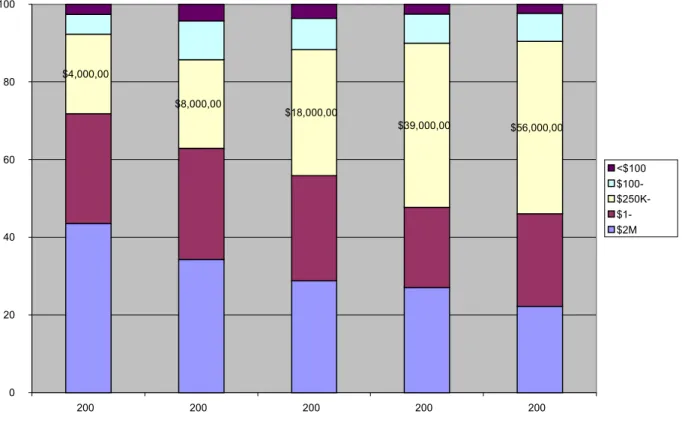
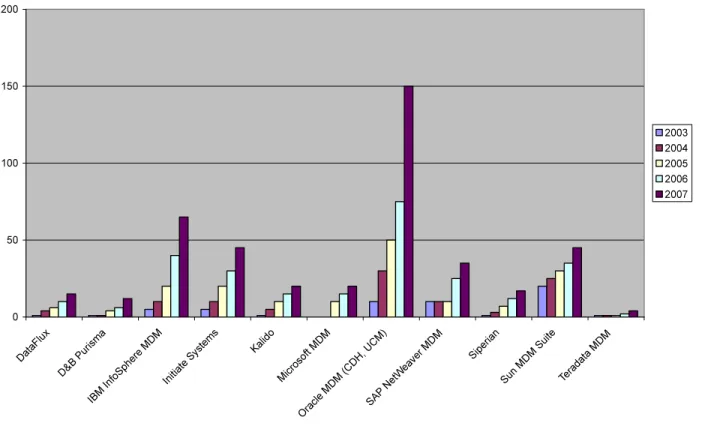
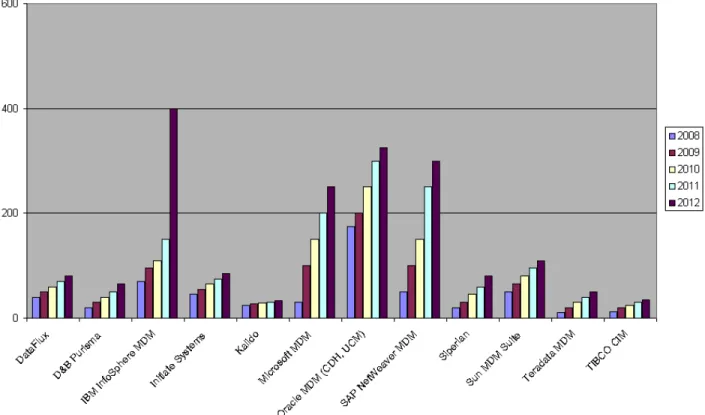
Figure 1 - Enterprise MDM Software Market (2003-07)... 38Figure 2 - Enterprise MDM Software Market (2008-12)... 39
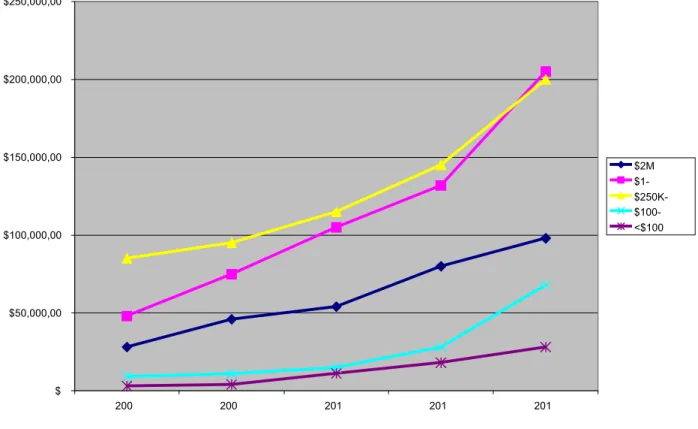
Figure 3 - Enterprise MDM Market Price Points (2003-07)... 41
Figure 4 - Enterprise MDM Market Price Points (2008-12)... 42
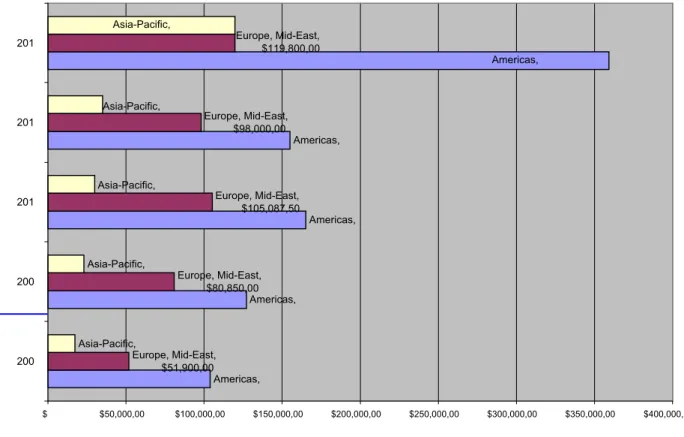
Figure 5 - Enterprise MDM Geographic Market Growth (2003-07)... 43
Figure 6 - Geographic Growth of MDM Market (2008-12) ... 44
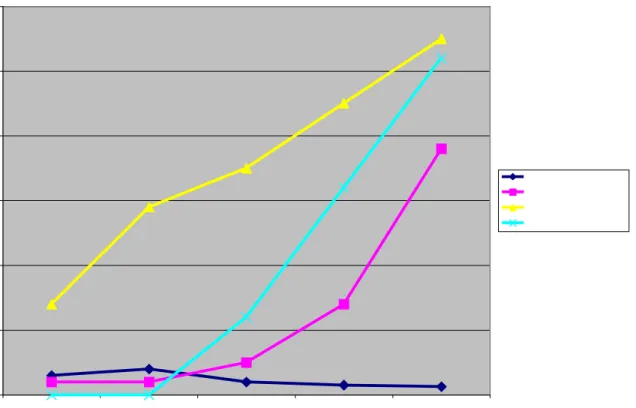
Figure 7 - MDM Architecture/Platform Growth (2003-07) ... 45
Figure 8 - MDM Architecture/Platform Growth (2008-12) ... 46
Figure 9 - MDM Market Share by Number of Installations (2003-07) ... 47
Figure 10 - MDM Market Share by Revenues (2003-07)... 48
Figure 11 - MDM Market Share by Nmmber of Installations (2008-12) ... 49
Page 3
© 2008-09 The MDM Institute
An MDM Institute MarketPulse™ In-Depth ReportExecutive summary
The market for master data management (MDM) solutions continues to grow, diversify, and mature. Mega vendors IBM, Oracle and SAP are the dominant solutions with more than 80% of the total market between them, however, best-of-breed vendors continue to proliferate and accelerate their market share across this rapidly growing market. Unlike other analyst research reports which measure MDM as an aggregate/macro market (including data quality tools, data service provider/hosting revenues, and more) this is the first report to exclusively examine the “enterprise MDM” market under a microscope – e.g., the sum of customer data integration solutions that are also enabled to support product information management masters.
MDM rationale
. Enterprises are increasingly turning towards MDM as a means to increase business optimization by rationalizing and sharing master data and processes – e.g., a single view of the customer/product/supplier.Corporate master data is a critical asset that must be increasingly managed within and beyond the enterprise — primarily to solve business problems in compliance, customer service, sales, and marketing. Such master data may be indentified, harmonized and integrated at multiple levels of the software stack to materialize a “single customer view” (or supplier, product, view etc.).
Master data management (MDM) solutions will vary by industry in terms of tactical approaches taken – e.g., pharmaceutical/life sciences will adopt semi-batch, database-centric approaches for master physician data to be deployed to sales forces, while financial services providers and online retailers will require near real-time, business process-centric solutions to compete in the business-to-consumer (B2C) online world.
Since 2004, given the choice of building or buying an MDM solution, the trend has clearly been to purchase off-the-shelf MDM packaged applications and customize them to the organization’s needs – similar to prior trends in
Enterprise Resource Planning (ERP) and Customer Relationship Management (CRM). The two primary MDM markets remain: customer master data (referred to as Customer Data Integration or CDI) and product master data (referred to as Product Information Management or PIM). Based on quarterly surveys of the MDM Institute Business Council™ (8,000+ subscribers to the MDM Alert newsletter engaged in MDM projects), the perennial top five business drivers for MDM initiatives are summarized as: (1) compliance and regulatory reporting; (2) economies of scale for mergers and acquisitions (M&A); (3) synergies for cross-sell and up-sell; (4) legacy system integration and augmentation; and (5) “once & done” economies and customer satisfaction.
Market trends
. The aggregate MDM market will grow from US$2.8 billion to US$4 billion over the forecast period (2008-2012), including revenues from both MDM packaged solutions and implementation services as well as the billion plus dollars related to data service providers such as Acxiom and Dun & Bradstreet. The above figure does not include the discrete software components such as extract-transform-load (ETL) or data profiling, Implementation services account for 21% of MDM market revenues today, but will rise to 26% of all MDM revenues by 2012 as Microsoft and other vendors deliver lower-end solutions targeted at the mid-market.The aggregate enterprise MDM market (customer and product hubs, plus systems implementation services) totaled US$730 million at YE2007 and will reach US$2 billion by the end of 2012. Software sales are but one portion as MDM systems integration services reached US$510 million alone during 2007 and are projected to exceed US$1.3 billion per year by 2012.
Even after several years of healthy adoption rates, the MDM market is actually just beginning its trajectory toward broad adoption and deep penetration. Moreover, during the next five years, we will also see buyer behavior migrating from point products (i.e., to address customer or product master data only) to enterprise MDM (supporting multiple entities/data domains such as customer, product, supplier, location, price, etc.) — and, to a lesser extent, from
Page 4
© 2008-09 The MDM Institute
An MDM Institute MarketPulse™ In-Depth Report software products to hosted/managed services (software as a hosted service). Concurrently, MDM vendors will decompose their products into service-oriented architecture (SOA)-enabled functions, and in turn repackage and OEM them through a wide range of channels (vertical and horizontal).Technology trends.
In our meetings with the MDM implementation teams at these and other venues, we have noted that the requirement for commercial MDM solutions to provide support for multiple types of master data (“domains” or “entity types”) is increasingly on the minds of business technologists at these large enterprises. Specifically, the overarching concern is to avoiding “repaving the cow paths”. This occurs when an IT group executes on a shortsighted strategy of mastering the master data in one given business area with a specific brand of MDM solution and then discovers that another division or line-of-business has chosen a different brand of MDM product (and architecture) to solve their MDM issues. All too often these different product-specific MDM solutions do not offer the capability of integrating master data “across” the great divide between “party” master data (customers, suppliers, employees) and “product” … resulting in “random acts of MDM”.In terms of technology directions, MDM packaged solutions continue to evolve in several directions. Specifically In the past 12-18 months, there has been a great deal of both marketing and product development to support multiple entities or data domains. Additionally there’s been increased emphasis on adding or improving fundamental data governance capabilities beyond mere data steward consoles. We’ve also seen emphasis on data profiling as well as the
integration of analytical capabilities such as dashboards and reporting. Both software as a service (SaaS) and open source movements are also interesting as they are providing lower price points as well as fundamentally fresh approaches to software licensing.
During 2008-09, most large enterprises will focus on MDM by deploying 3rd generation packaged MDM solutions to
deliver panoramic customer, product and supplier views across multiple channels, business lines, and heterogeneous IT environments. By 2010-11, 4th generation solutions will begin to predominate due to requirements for multiple
master entities, unstructured data, etc. By 2012, more than 80% of the Global 5000 size enterprises will have committed to enterprise MDM as a core business strategy and have implemented at least one master entity – whether party (customer/supplier/citizen) or product.
Summary
. The goal of this MDM Institute MarketPulse™ market forecast is to outline the requirements for such capabilities while providing an industry road map that highlights the planning assumptions necessary.Enterprises on the enterprise MDM journey are challenged to focus on mitigating the organizational and business case challenges that such an enterprise -wide, multi-data domain business strategy introduces – often this is Business Process Optimization and Business Transformation at their grandest. Among the challenges facing such enterprise MDM initiatives include: the architecting of a comprehensive SOA
1
-based technology infrastructure and the concurrent revitalization of the relationship among business and IT organizations.Despite such significant challenges, the business goal of delivering trusted data throughout the enterprise shouldn't be downplayed or ignored as the competition most likely has already begun their drive to this end goal. Instead of envisioning MDM as a “game change” strategy (which it often is), the pragmatic business will acknowledge although enterprise MDM is a multi-phase, multi-year, evolving business capability, it is an essential business strategy for keeping the enterprise sound in the increasingly competitive 21st century. The goal of the agile corporation mandates delivery of trusted, high quality and timely customer, product, and other vital master data.
1 SOA – Service-oriented architecture
Page 5
© 2008-09 The MDM Institute
An MDM Institute MarketPulse™ In-Depth ReportKey findings
Clearly, enterprise MDM is a major IT initiative being undertaken by a large number of market-leading Global
5000 size enterprises. Both as an IT discipline and an integrated set of technology solutions, MDM
continues to evolve at a rapid pace. This research focuses on the below top five market trends for MDM and
advises which actions enterprises should take to generate business value and achieve competitive
advantage. These are the key findings of this MarketPulse™ market report.
1. Steady evolution away from data-centric hubs into application hubs 2. Elemental movement towards Enterprise MDM in multiple phases 3. Futile dogmatic resistance is fading against the power of multiples 4. Inexorable shift to formal data governance structures5. Rapid growth of MDM market into mid-market as well as across industries and geographies
Steady evolution away from data-centric hubs into application hubs
Enterprise MDM solutions are steadily but rapidly evolving away from data-centric hubs into full blown application stacks.. In other words, MDM is becoming less of a standalone technology infrastructure as the emphasis is increasingly on relationship between domains, user interface, and integration with other emerging and adjacent technologies such as RFID, entity analytics, business intelligence, etc. This “application hub” focus concerns more than integration with existing CRM and ERP systems. It is recognition that MDM is the type of infrastructure solution that will leverage all other systems – other application stacks, other CRM and ERP instances, other data feeds, etc. Finally, such hubs are increasingly integrating more than applications, etc. within a line-of0business and are actually fundamental to integrating the actual lines-of-business.
Elemental movement towards Enterprise MDM in multiple phases
Enterprise MDM is “strategic” and therefore is the appropriate focus across multiple lines of business, multiple
channels, and therefore across multiple years. Such enterprise MDM becomes a reality of multiple factors – especially when the enterprise desires to leverage one MDM product or platform across domains. Both IT and business
management are increasingly focused on the longer term, i.e., 2-5 years down the line. Therefore, these same IT strategists are looking for vendors who can provide solutions that span more than one phase. Savvy customers are starting to ask for an integrated platform that indeed does support multiple domains across multiple phases.
An example of multiple phases is where the tactical project might start with batch and very little SOA as perhaps just a registry-architected solution. At some point in the 12-18 months horizon most organizations outgrow registry
architectures and require much more of a full blown hub architecture.
Futile dogmatic resistance is fading against the power of multiples
MDM is increasingly concerned with the notion of “multiples” – multiple data domains, the multiple relationships among them, and the multiple usage styles. Even a tactical MDM project will require facets of an enterprise MDM solution set, for example a financial service provider will need to master more than “customer” as it looks to master “product” in post phase one stages. Additionally, product-centric MDM tactical projects quickly move to address customer master
Page 6
© 2008-09 The MDM Institute
An MDM Institute MarketPulse™ In-Depth Report attributes such as pricing, entitlements, etc. to be simplistic, it is important not to paint one’s self into a corner. Typically all projects start with A, B and C but must be able to grow else they create yet another data silo. MDM architects need therefore to think broadly in terms of styles (operational, analytical, and collaborative) as it quickly becomes evident that the business requirements will bleed into more than one data domain and deployment style – “think global, and act local”.Increasingly, the notion of “multiples” includes not only more than a singular master domain (e.g. customer or product). Even the definitions of the domains are getting more sophisticated. For example, only several years ago “location” was a point in space, however, now it includes which party of assets occupy that location. Moreover, the attributes of a domain/entity are becoming more complex. Clearly, the MDM Institute analysts are increasingly seeing more RFPs where enterprises acknowledge that it is not provident to focus solely on one master data domain when clearly both party and product master data quickly bleed into each other post-phase one.
Inexorable shift to formal data governance structures
One of the greatest challenges is the political arena which necessarily accelerates or brakes the critical momentum of both tactical and enterprise MDM. While tactical MDM marts may be successful via judicious efforts of data stewards who focus on the data quality of a singular domain, when the business utilization of master data expands across departments and lines of business then the government’s framework is essential. Each and every consuming and producing organization has a duty or role in the governance of master data. For example once it is determined that master data is “a corporate asset” then that data must be protected across its life cycle from creation/capture through its retirement including such critical issues as accessibility, compliance, unfortunately most of the market did MDM solutions do not adequately address this formal requirement.
In fact, most vendors will point to their data steward console as the acme of their data governance capabilities. In reality, what’s needed are formal processes, assisted by workflow software, to enable formalized decision making, documentation, and delegation, regarding the rules rendered as part of the governance lifecycle. Another gaping hole in data governance capabilities of the majority of MDM vendors is their inability to directly store and execute such governance-generated procedures as part of the MDM logic that controls the software which in turn should enforce the governance. True data governance mandates the integration of people, process, and technologies via a formalized framework. These formal structures are inevitable as they are the key enablers of data governance policy functions – much are so than paper-based methodologies and accelerator/frameworks.
Rapid growth of MDM market into mid-market as well as across industries and geographies
The market for MDM solutions is significantly and quickly expanding – across geographies, industries, and price points. This in turn is making MDM capabilities affordable to mid-market enterprises (small-to-medium size businesses). The steady growth of the MDM market into this mid-market further makes it economically viable to apply the solution cross a broad range of industries and geographies. Three to five years ago the typical MDM solution cost in excess of $1 million just for the software and an additional $3-4 million for the implementation services during the first year. During 2008, price points and product packaging (we should say “repackaging”) a provider more modest MDM functionality and accordingly less complexity which supported market pricing in the sub $500K range. Overall, MDM matured from “early adopter IT project” status to become a mainstay “Global 5000 business strategy” during 2007-08 These new price points are reflective of various types of projects and the related product capabilities, i.e., enterprise MDM initiative vs. very-specific business solution. Moreover market dynamics further drove price differentiation as the market became more sophisticated and understood the price:value ratio of hybrid vs. registry vs. tool kit vs. full fledged MDM application.
Page 7
© 2008-09 The MDM Institute
An MDM Institute MarketPulse™ In-Depth Report Summary. For the Global 5000 enterprise (and increasingly the small-to-medium sized business or SMBs),approaching “enterprise MDM” as an IT infrastructure development project is career-challenging, There is very little economic rationale in building such custom middleware (with this associated high maintenance costs) when
commercial off the shelf software meets the performance, reliability, and scalability requirements of most every industry and size organization. There will be in use cases that mandate the ultimate in speed and performance -- such as command and control systems for military applications or a straight through processing for financial services, however, these are not the norm.
Clearly, enterprise MDM is a major IT initiative being undertaken by a large number of the market-leading Global 5000 size enterprises. Most enterprises and solutions vendors are finding near-term success with the single-faceted approach inherent with the third generation of MDM solutions. Increasingly, however, these same enterprises are determining that this myopic strategy of focusing solely on a single data domain and usage style is detrimental to the longer term business strategy of integrating supply, demand, and information chains across both intra- and extra-enterprise boundaries. Coming to market during 2008-09 are multi-entity MDM solutions which are characterized as the fourth generation of MDM solutions which address the requirement for multiple domains and styles as well as the roles of the consumers.
To help IT organizations and their business partners focus on the more desirable longer term MDM strategy, vital issues that this market research report addresses include:
• What is enterprise MDM?
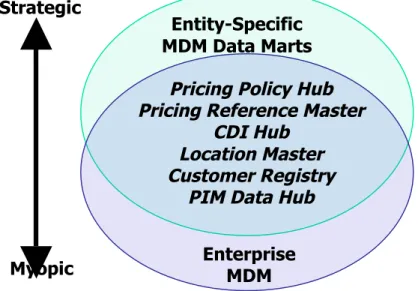
• Why is enterprise MDM considered “strategic” while domain-specific MDM data marts viewed as “myopic”? • How does an organization plan for enterprise MDM deployment?
The value of enterprise MDM can be intuitively recognized in a range of business initiatives – from short-term fixes to a narrow set of problems such as capturing customer privacy preferences across product lines to long-term enterprise-wide initiatives to delivering infrastructure agility by embracing SOA.
Page 8
© 2008-09 The MDM Institute
An MDM Institute MarketPulse™ In-Depth ReportEnterprise MDM
During the previous five year cycle (2003-07), MDM solutions matured from “early adopter IT projects” to become “Global 5000 business strategies”. The industry consensus is that “enterprise MDM” is that service-oriented
architecture (SOA) infrastructure which provides for large scale, high availability, highly accurate MDM services across application portfolios and lines of business. Correspondingly, “multi-entity MDM” is a software solution to concurrently manage multiple, diverse master data domains (customers, accounts, products) across intra- and extra-enterprise business processes. Additionally, enterprises are
determining that master data must be presented via multiple views to accommodate the wide range of data consuming and creating roles that exist across an organization. By centralizing the most critical master data to a single trusted source, and managing this within the context of governance-driven data lifecycle, multi-entity MDM provides flexible business process integration across multiple data domains and usage types. Multi-entity MDM solutions deliver such complex and collaborative business processes such as identifying the most valuable customers, introducing new products rapidly, crafting new product bundles more quickly, and managing threat and fraud risk more effectively.
Global 5000 size businesses are rapidly ramping up plans to consolidate “master” data into data hubs using a combination of off-the-shelf data hubs, EAI/EII/DQ toolkits, and even custom-built IT projects. The current commercial off-the-shelf solutions available to enterprises are commonly characterized as 3rd generation solutions.
Industry Terminology
Master Data Management (MDM). Authoritative, reliable foundation for data used across many applications and constituencies with the goal to provide a single view of the truth no matter where it lies.
Multi-Entity MDM. AnMDM solution to concurrently manage multiple, diverse master data domains (customers, accounts, products) across intra- and extra-enterprise business processes. By centralizing the most critical data to a single trusted source within a cohesive data lifecycle, multi-entity MDM provides configurable process integration across multiple data domains.
Customer Data Integration (CDI). Processes and technologies for recognizing a CUSTOMER and their relationships at any touch-point while aggregating, managing and harmonizing accurate, up-to-date knowledge about that customer to deliver it ‘just in time’ in an actionable form to touch-points.
Product Information Management (PIM). Processes and technologies for recognizing PRODUCT ,SUPPLIER, and PRICING master data.
Data Governance (DG). Formal orchestration of people, process, and technology to enable an organization to leverage data as an enterprise asset.
Page 9
© 2008-09 The MDM Institute
An MDM Institute MarketPulse™ In-Depth Report3
rdgeneration MDM solutions
During 2007-08, many of the requirements for MDM solidified into what most analysts characterize as 3rd generation
MDM solutions. As a group, visa MDM solutions tended to focus on specific industries which in turn drove the product groups to further bifurcate and Elleni a based on industry requirements. For example Oracle Universal Customer Master was predominant in telecommunications, IBM WebSphere Customer Center dominated the financial services, Siperian dominated in pharmaceutical, SAP dominated in manufacturing,, and initiate systems likewise dominated and retail pharmacy as well as health care.
Concurrently those MDM solutions which originated as application-centric solutions in turn both leveraged and were indebted to the data models underlying those applications, i.e. IBM WCC with the Insurance Application Architecture and Banking Data Warehouse data models, Oracle Universal Customer Master with Siebel CRM, and SAP MDM with SAP R/3. On the other hand of those MDM solutions not coming from an application center heritage (e.g., Initiate Systems, Kalido, Purisma, and Siperian) focused on unifying multiple diverse data sources for them singular application portfolios.
What are the “vital signs” of a 3rd generation MDM solution? In our experience with the MDM Institute Advisory Council
membership, “type A” MDM project leadership within very large scale IT organizations advise of these five “DNA markers” as good indicators:
1. SOA/shared services architecture evolving to “process hubs”.
Rather than re-invent the “data hubs” that are inherent within enterprise CRM and ERP vendor solutions, savvy IT organizations understand that the real need is to centralize and manage “business policies” such as pricing discounts, privacy preferences, etc. In turn, this will require major attention by the vendors to such issues as business process management/workflow API compatibility – i.e., BPEL compliance alone is not enough to enforce BPM compatibility. See also “Dysfunctional Data Hubs - 2006-07 Strategic Planning
Assumptions for CDI-MDM and Business Services” January 19, 2006.
2. Sophisticated hierarchy management.
The management of data about organizational structures such as subsidiaries, business units, and sales regions, etc. is a complex and costly endeavor for all businesses but especially critical for businesses selling to other businesses. Because it is difficult to "know" these complex customers and to consolidate information about the business relationship, “hierarchy management” is fundamental to such CDI business initiatives. CDI and MDM are inherently about managing the “relationships” among parties such as customers and suppliers. While is somewhat reminiscent of the OLAP data mart trends of years past (everyone creating their own slice of the data with a drillable view based on their dimensional views), such “hierarchy-by-anarchy” philosophy counters the basic premise of MDM wherein enterprises are looking to capture, manage and leverage “standard” master data and relationships (hierarchies). Nonetheless, it is vitally important that a 3G MDM solution support flex-hierarchies to both manage relationships across data hubs (different ERP general ledgers for example) as well as import and map to industry standard hierarchies such as D&B’s DUNSRight legal entity hierarchies. See also “Customer Data Integration: MDM Milestones, Part 2” March 2006 DM
Review.
3. High availability identity management.
The essential identity matching and linking capability is necessarily high-RAS (reliable, available, and
scalable). This is because the ability to positively identify a customer, for example, is critical in online financial services transactions. Another example would be the initialization of a call center inquiry based on the inbound phone number used to dip into an ANI database and determine the caller’s account number, credit rating, next-best offer, etc. – all at speed-of-thought. In today’s increasingly 24x7x365 business climate, an enterprise cannot go offline for maintenance nor suffer outages when it comes to identifying customers or suppliers – or when serving up pricing policies, etc. A vital distinction is that this functionality is more than match/merge capability as such identity matching capabilities must also materialize and match on hierarchy
Page 10
© 2008-09 The MDM Institute
An MDM Institute MarketPulse™ In-Depth Report and other relationship attributes.4. Data governance-ready framework.
Every MDM vendor and consultancy seems to have gotten “data governance religion” yet there remains the huge disconnect between methodologies and processes with the actual MDM software that enforces such MDM policies. To be generous, MDM solutions evaluators need to acknowledge this age old metadata problem still challenges the software vendors, however, 2008 will see pressure on the mega vendors to provide at least a “lite” methodology with integration to the underlying MDM software stack given that such solutions will be offered from best-of-breed or 3rd party vendors. See also “Corporate Data Governance -
From De Rigueur to De Facto to De Jure” November 2005 DM Review.
5. Registry, persisted, & hybrid architecture flexibility.
Architectural forms vary in terms of the amount of instantiation of master data – varying from a fully virtual registry style cross reference index (e.g., web portal) to a fully persisted physical data hub (e.g., enhanced operational data stores). More common is the hybrid model which allows both in one solution to better support operational, analytical and collaborative “use case” MDM styles.
4
thgeneration MDM solutions
During 2008-09, both mega vendors and best-of-breed MDM vendors will not only have embraced and delivered the five key 3G MDM capabilities but will also be well on their way to the next generation of MDM solutions. These 4G solutions can be characterized as “full spectrum” hubs due to their support for both structured and unstructured information.
Additionally, we expect to see greater emphasis on extreme “enterprise scalability” while concurrently delivering “master data search” capability. The latter is a relatively new CDI-MDM ecosystem category furthering the utilization and ROI of such enterprise information management (EIM) by incorporating “search” for both structured and unstructured info across a variety of applications such as catalog management, deep web search, and enterprise search.
Our five key “DNA markers” for 4th generation MDM solutions focus on:
1. Multi-entity MDM.
An MDM solution will need to concurrently manage multiple, diverse master data domains (customers, accounts, products, etc.) across intra- and extra-enterprise business processes. Moreover, a 4G solution will provide the capability to expand on relationships among entities – i.e., evolve from the 3G requirement of a single primary data domain and other supporting domains into becoming the system of record for multiple data domains and relationships among them.
2. Multiple “use case” styles.
4G MDM solutions should support all users and usage requirements for master data – e.g., different functions to define and create data (collaborative), use and maintain (operational), and derive insight (analytical). Additionally, this implies multiple deployment capabilities including the ability to start as an index for one domain and grow into full multi-entity over time.
3. Process/policy hub architecture.
Clearly, BPM workflows are critical to achieve value from MDM and to ensure that the outcome of such data governance infrastructure is actually orchestrated across business units and master data hubs. Just as clearly, there are major ROI and other benefits from centrally managing such policies within a single trusted policy/process hub. In short, 4G MDM will support the linkage of MDM styles into the actual business processes.
4. Integrated data governance.
Page 11
© 2008-09 The MDM Institute
An MDM Institute MarketPulse™ In-Depth Report enterprises to institutionalize data governance, the longer term goal is to integrate, measure and manage data governance metrics within the context of the master data lifecycle. Clearly, effective data governance is integral to delivering reliable and usable MDM to develop master data as a corporate asset.5. Enterprise search & support for unstructured info.
During 2008-09, semantically-enabled metadata will enable “search” for both structured and unstructured information across a variety of applications such as catalog management and deep web search, and enterprise search. By 2009-10, enterprise semantics and SOA-enabled data services will further provide the technology foundation for policy hub. While the majority of contemporary MDM solutions focus on the structured data held in CRM and ERP applications, the reality is that a plethora of valuable customer, product, supplier, employee, etc. information resides in what is characterized as “unstructured” information, e.g., emails, instant message log files, voicemails, etc. To provide a robust “universal customer view”, etc., it is clearly desirable to incorporate these valuable information sources as part of the composite view.
Page 12
© 2008-09 The MDM Institute
An MDM Institute MarketPulse™ In-Depth ReportBusiness justification for enterprise MDM
Enterprise MDM is increasingly mandated to manage master data (customers, accounts, products, etc.) that has significant impact upon the enterprises’ most important business processes. Based on quarterly surveys of the MDM Institute Business Council™ (the 8,500+ subscribers to the MDM Alert newsletter who are engaged in MDM projects), the perennial top five business drivers for MDM initiatives can be summarized as:
1. Compliance and regulatory reporting 2. Economies of scale for M&A 3. Synergies for cross-sell and up-sell
4. Legacy system integration and augmentation 5. “Once & done” economies and customer satisfaction
Compliance and regulatory reporting
• Centrally manages privacy preferences for consistent rules of visibility and entitlements
• Enhances “evergreening” of customer data accuracy – e.g., continuous customer data improvement by
providing self-directed customer care portals … which in turn integrate customer info across business units
• Enables regulatory reporting compliance– i.e., large customers’ material events (SOX, BASEL II) • Facilitates compliance with AML, OFAC, USA PATRIOT, et al
Economies of scale for M&A
• Facilitates quick scales of economy in mergers and acquisitions (M&A) – e.g., shortening customer, desktop,
and billing integration timeframes while providing scalability to support rapid assimilation of new block of customers
• Accelerates revenue growth via more intelligent cross-sell and up-sell enabled by complete understanding of
customer (profile, accounts and interactions) to leverage bundling opportunities
Synergies for cross-sell and up-sell
• Maximizes wallet share across product lines and business units • Up-sell via sticky bundles
• New markets via cross sell to existing customer base
• Increases understanding of large customers by grouping all buying organizations into corporate (B2B) or
household (B2C) hierarchy
• Enables integrated customer analytics – i.e., profitability analysis, lifetime value
• Enables “co-opetition” and electronic storefront models – e.g., B2B, B2C, and B2B2C by Drives costs of “dirty
data” out of the info supply chain
• Accelerates revenue growth via more intelligent cross-sell and up-sell enabled by complete understanding of
Page 13
© 2008-09 The MDM Institute
An MDM Institute MarketPulse™ In-Depth Report• Enables self-directed customer experience for sales and service
• Provisions hyper-integrated 21st century supply chain – e.g., outsourced manufacturing, outsourced service
Legacy system integration and augmentation
• Enables integration of new and old channels – e.g., collections, fraud, contact centers with kiosk, ATM, IVR
and online self-service
• Minimizes architectural complexity to simplify application solution design, deployment, and maintenance • Reduces number of interfaces between applications and increasing reuse factor to save substantial
integration costs
• Improves infrastructure flexibility and control to enhance overall system performance • Accelerates ROI of enterprise CRM solutions
• Reduces overall project risk through increased flexibility and centrally managed architecture
“Once & done” economies and customer satisfaction
• Drives fundamental operational savings and efficiencies – e.g., “once & done” enterprise-wide services for key
customer processes such as account changes (name, address)
• Protects brand integrity by increasing customer satisfaction due to more focused marketing and service
campaigns – e.g., “blended agent” capability to provide customer service across multiple touchpoints/contact channels
• Actualizes “consistent customer treatment” by blending channels to deliver common customer interactions /
Page 14
© 2008-09 The MDM Institute
An MDM Institute MarketPulse™ In-Depth ReportMDM strategic planning assumptions
Research analysts at the MDM Institute annually produce a set of twelve milestones for their “MDM Road Map” to help Global 5000 enterprises focus efforts for their own large-scale, mission-critical MDM projects. For planning purposes, we thus identify 10-12 “milestones” which we then explore and publish via our MDM Alert research newsletter. This set of strategic planning assumptions presents an enlightening view of the key trends and issues facing IT organizations during 2008-09 and beyond by highlighting:
Planning for the juggernaut of MDM market momentum, maturation, and consolidation
Coping with the skills shortage for data governance, enterprise architecture, et al.
Identifying the essential (vs. desirable) features of an enterprise-strength MDM initiative
Thus the 2008-09 “MDM road map” helps Global 5000 enterprises (and IT vendors selling into this space) utilize these “strategic planning assumptions” to help focus their own road maps on large-scale and mission-critical MDM projects. During the following six months, we use these milestones as the focus for our analyst research in that every research report we write either confirms or evolves one or more milestones as its premise. The remainder of this section will present the below MDM Milestones:
1. Market maturation 2. Market momentum
3. Market consolidation & diversification 4. Budgets/skills
5. Data governance 6. MDM convergence
7. Architecture & data models 8. Identity resolution
9. Party data quality 10. Analytics 11. Policy hubs 12. Enterprise search
Page 15 of 55
© 2008-09 The MDM Institute
An MDM Institute MarketPulse™ In-Depth Report1. Market Maturation
• During 2008, the MDM market will continue to shift gears from “early adopter” to “mainstream” as 95%+ of
financial services, communications services, high tech, and pharma/life sciences enterprises actively explore to replace homegrown MDM solutions
• Through 2009-10, verticalization/horizontalization of MDM solutions will expand beyond corporate financial
reporting, EMPI healthcare, etc. into financial services and government especially
• By 2012, the market for enterprise MDM solutions (software and services) as both strategic initiatives and to
refresh aging legacy MDM capabilities will exceed US$2.5B
2. Market Momentum
• During 2008, MDM solutions such as IBM, Oracle, SAP, and Teradata will monopolize majority market share
in the G5000 enterprise; while mid-market solutions arrive from Microsoft, Nimaya, and Oracle plus Data Quality vendors (Pitney Bowes/G1, SAS/DataFlux, Trillium)
• Through 2009-10, both mega and best-of-breed MDM vendors will aggrandize the traditional master customer
DB business of Data Service Providers (e.g., Acxiom, D&B, and Experian) as these vendors sprint to deliver on-premise CDI hub solutions
• By 2012, every major application and database vendor will provide either native or OEMed MDM capability –
including Amdocs, Microsoft, and salesforce.com
3. Market Consolidation and Diversification
• During 2008, mega IT vendors (IBM, Oracle, SAP) will continue M&A-driven R&D gyrations in moving to an
enterprise MDM-centric portfolio with Oracle and SAP challenged additionally in moving from silo’ed application architectures into SOA-based architectures (Fusion and NetWeaver)
• By 2009-10, IBM (ASCL/CRSW/DMC/DWL/LAS/Princeton Softech/SRD/Trigo/Unicorn) and ORCL
(HYSL/iFlex/JDE/PSFT/RETK/SEBL/Sunposis) will begin to overcome most architectural/BPM/ metadata/platform issues that confounded SAP earlier (A2i/BOBJ/Callixa)
• Through 2009-10, mega IT vendors (IBM, Oracle, SAP, and Teradata) will dominate the MDM market with
niche/best-of-breed vendors (D&B/Purisma, DataFlux, i2, Initiate Systems, Kalido, Siperian) thriving in specific industries and horizontal/corporate applications
Page 16 of 55
© 2008-09 The MDM Institute
An MDM Institute MarketPulse™ In-Depth Report4. Budgets/Skills
• During 2008, G5000 size enterprises will spend US$1M for MDM software, with an additional US$3-4M for SI
services; Global Service Providers will operate under this price floor by applying highly-customized, labor intensive frameworks and related accelerators
• Throughout 2009-10, skill shortages will greatly inflame project costs as demand for data stewards, enterprise
data architects, and individuals with data governance experience outstrip market supply; concurrently, SIs will fill the void in their classic style by baiting and switching senior veterans for junior rookies
• By 2012, market will stabilize as enterprises react by training and protecting their own MDM staff with specific
product and project expertise; until then, enterprises will struggle with re-skilling same resources multiple times as emerging/evolving data management technologies mature (e.g., Fusion, NetWeaver, …)
5. Data Governance
• During 2008, most enterprises will struggle with cross-enterprise data governance scope as they initially focus
on customer, vendor, and product; enterprise-level data governance that includes entire master data lifecycle (creation, promotion, archiving, …) will be mandated as a core deliverable of large-scale MDM projects
• Through 2009-10, major systems integrators and MDM boutiques will focus on productizing data governance
frameworks while MDM software providers struggle to link governance process with process hub technologies and enterprises struggle to realize enterprise data governance in a cost-effective way
• By 2011-12, both corporate and LOB data stewards will be a common position as Global 5000 enterprises
formalize this function amidst increasing de facto and de jeure recognition of information as a corporate asset
6. MDM Convergence
• During 2008, party and product data interdependencies will quickly broaden MDM requirements – i.e., from
“customer” to “product” to “vendor”; concurrently, vendor dogma will promote nouveau approaches such as collaborative MDM to assuage multi-entity conundrum
• Through 2009-10, select best-of-breed vendors (D&B/Purisma, Kalido, Initiate Systems, Siperian) will provide
multi-hub (entity, architecture and brand) connectivity via hierarchy management extensions
Page 17 of 55
© 2008-09 The MDM Institute
An MDM Institute MarketPulse™ In-Depth Report7. Architecture and Data Models
• During 2008, vendors will expose MDM capabilities as “always on” services in loosely-coupled architectures;
enterprises will begin establishing a central, business-side led data management team with embedded data quality and external data update services in flow of core business processes
• During 2009-10, mega vendors (IBM, Oracle, SAP, Teradata) will focus significant resources on “industry
content” of data models which will force specialist vendors to stay “data model lite” via specialization in B2B/B2B2C hierarchy management and distributed MDM
• Not until 2011-12, will mega MDM vendors rewire foundational software to fully support strategic application
infrastructure (Fusion, NetWeaver, …) and have completed transitioning from client/server to SOA; concurrently, G5000 business requirements will drive vendors into 4th generation, full spectrum hubs that support both structured and unstructured information
8. Identity Resolution
• During 2008, independent Data Quality vendors (AddressDoctor, G1, Human Inference, Trillium) will focus on
name and address cleansing as they struggle against better funded match/merge and data profiling
capabilities increasingly integrated with mega vendor MDM solutions; ongoing challenge will be aggregation of customer data balanced against privacy dictates
• During 2008-09, MDM capabilities for classifying, discovering and archiving party data/relationships while
maintaining privacy will become a major requirement; concurrently, users will be challenged to discern the price/performance/scalability and accuracy of matching algorithms; use of cross platform/cross brand customer keys will become core to enabling seamless loyalty programs and online services
• By 2009-10, sophisticated hierarchy management capabilities will include “global IDs” as mainstay feature for
all MDM vendors to link both legacy and newly-built hubs with Data Service Providers’ enrichment data; concurrently, support for metadata repositories to link mega vendors’ multitude of acquisitions will continue to significantly lag
9. Party Data Quality
• During 2008-09, enterprises will focus more on degree to which “party data quality” (consumer, subscriber,
owner, member, vendor, establishment, contact, …) is sufficient to meet requirements of diffuse business entities
• By 2009, ”quality” metrics will increasingly be defined specific to purpose of particular business function
(product development, marketing, sales, order admin, service, compliance, analytics, …) and in turn be driven by enterprise-wide data governance initiatives
• Through 2010-11, wide deployment of loosely-coupled SOA architectures will catalyze consumption of
highly-optimized data quality functions as made available via both mega data service provider and enterprise application vendors
Page 18 of 55
© 2008-09 The MDM Institute
An MDM Institute MarketPulse™ In-Depth Report10. Analytics
• During 2008, the convergence of MDM and business intelligence (BI) will accelerate as enterprises leverage
MDM concepts in a BI context
• Through 2009-10, ongoing agglomeration of Analytical MDM and Operational MDM will increasingly benefit
enterprises by blending such transactional hubs with master reference data repository as well as provide greater visibility into the impact of master data quality on business performance metrics
• By 2012, inline and real-time analytics derived from MDM-enabled aggregation of both transactional and
historical data will have become a major source of sustainable competitive differentiation for Global 5000 enterprises
11. Policy Hubs
• During 2008, MDM vendors will lag their BPM counterparts in providing workflow orchestration to synchronize
the trusted sources that comprise a federated master data store
• Through 2009-10, the mega MDM vendors (IBM, Oracle, SAP) will struggle to provide BPEL-compatible
workflows while specialist MDM solutions rush distributed Collaborative MDM capabilities to market
• By 2012, without such flexible workflows, organizations will merely rebuild the same master data files they
evolved the past 15-20 years with their ERP and CRM infrastructures
12. Enterprise Search
• Through 2008, the unique properties and behavior of master reference data will spawn a series of vertical
applications and specialized features within MDM solutions
• During 2009-10, semantically-enabled metadata will enable “search” for both structured and unstructured info
across a variety of applications such as catalog management and deep web search, and enterprise search
• By 2012, enterprise semantics and SOA-enabled data services will provide the technology foundation for
policy hubs; concurrently, the 4th generation of hubs will innately support Analytical, Operational, and Collaborative and MDM business services
Page 19 of 55
© 2008-09 The MDM Institute
An MDM Institute MarketPulse™ In-Depth ReportLeading MDM vendor profiles & field reports
The toughest and most trying aspect of any major IT investment decision is wading through the vendors and their references. The MDM Institute helps organizations save time and money by meeting with all the leading vendors, evaluators, and expert consultants – and compressing that information into a single chart of strengths and weaknesses The below MDM solutions are the major products for mastering customer data (or customer and product master data) these are general purpose package MDM applications and not industry-specific. In addition the requirement was that the MDM solution has strong support for persistent data (i.e. not be solely a registry or virtual solution). And lastly, we’re required that each product at least five references.
• D&B/Purisma Data Hub
• DataFlux qMDM
• Data Foundations OneData
• i2 MDM
• IBM InfoSphere MDM Server
• Initiate Systems Master Data Services • Kalido MDM
• Liaison Technologies MDM • Microsoft MDM
• Oracle Customer Data Hub • Oracle Hyperion DRM
• Oracle UCM
• Orchestra Networks EBX
• SAP NetWeaver MDM • Siperian MDM Hub • Sun MDM Suite/Mural • Teradata MDM • TIBCO CIM • VisionWare MultiVue
Page 20 of 55
© 2008-09 The MDM Institute
An MDM Institute MarketPulse™ In-Depth ReportD&B/Purisma Data Hub v3.7
Field Report
D&B’s efforts to deliver CDI solutions met only modest success prior to 2008 – primarily in its own customer base. In late 2007, D&B acquired Purisma which seemed an obvious conclusion to the serious partnering that had been taking place previously among the two vendors. The combination offers the potential to redefine the CDI market because every MDM implementation needs and will continue to need an external reference data source that can be trusted. This “external reference data source” backbone of any CDI initiative is needed to keep customer (B2C or B2B) information fresh and accurate … and complete in the “holistic” sense. All of the IBM and Oracle/Siebel MDM implementations will continue to require such reference data.
While its good to have a parent with deep pockets (D&B revenues of US$1.6B) it is also a challenge to remain innovative as part of a much larger organization as well as to “train the troops” in such a large U.S. organization (note that the D&B does not have a strong a worldwide presence. While the market is still looking forward to the synergies promised by the acquisition, at YE2008 the number of new name customers was significant in our view based on review of 15+ new customers from 2008. Additionally, the average selling price moved up as the vendor no longer operated as a start-up MDM vendor given its acquisition by D&B. Moreover, we see 50% or more of existing installations now moving into phase 2 deployments.
Strengths
•
B2B, B2C, and B2B2C hierarchy
management
•
Flexible data model
•
Data governance accelerators
•“My Data for D&B Purisma Appliance”
solution for midmarket
•
Plans to extend B2B relationships to
include people relationships
•
Additional market focus on SAP
co-existence
•
US$1.6B D&B parent and momentum
Weaknesses
•
Unlikely to add support for Product
master data
•
Lack of industry data models
•Only granular web services
•
Minimal integration with 3
rdparty data
quality & data integration tools
•
Minimal SI partners
Page 21 of 55
© 2008-09 The MDM Institute
An MDM Institute MarketPulse™ In-Depth ReportDataFlux qMDM v2.0
Field Report
Another vendor with parental deep pockets is DataFlux. As a leader in the data quality market with healthy growth and solid long term prospects, DataFlux has gained tremendous experience in helping organizations deal with data governance and data integration issues. In fact, it is the only independent data quality vendor that has successfully evolved its product line to support MDM requirements. Its current challenges include the need to add more CDI functionality given that master customer data is the largest opportunity and pain point for global enterprises. Moreover, DataFlux needs “live” proof points in the scalability of its new architecture. We do like what we see in the current market differentiation wherein the soon-to-be-released “qMDM” products highlight their strengths in data governance and data quality. Near term, DataFlux needs to evolve its marketing and sales strategies to reflect a move towards packaged MDM applications more so than MDM tools (data quality tools, data stewardship tools, etc.). Steady growth in the customer base for MDM users show that the strategy is working wherein DataFlux helps organizations manage their customer data quality issues first, then data governance, and then on to MDM. While the product supports a “multi-entity data model” existing DataFlux users are just beginning to plan this phase.
Strengths
•
Graduated approach to MDM
•Integrated data quality
•Multi-entity data model
•
Commitment to data governance and
related work flow
•
SAS “deep pockets”, channel and stability
•Rapid plans for integration of SAS data
integration technologies
•
Midmarket references – American Heart
Association, Aspect, Intrawest, Sun
(StorageTek)
Weaknesses
•
Modest number of CDI references
•Nascent support and references for
product master data
•
Relatively small number of customers
adding product master to customer
master
•
No references for registry or high-volume
operational MDM implementations
•
Lack of SI channels
Page 22 of 55
© 2008-09 The MDM Institute
An MDM Institute MarketPulse™ In-Depth ReportIBM InfoSphere MDM Server 8.1/8.5
(formerly IBM WebSphere Customer Center (WCC) & DWL Customer)
Field Report
IBM’s MDM family suffers from an “embarrassment of riches” based on the perpetual M&A machine that has been put in gear. Due to its origination and strengths in the financial services industries, this product has done very well globally to support large banks and insurance companies. Both its strengths and weaknesses also derive from its strong affinity for the IBM industry data models and IBM software stack. This multi-level set of business services provides accelerator frameworks but often at the cost of dragging along considerable IBM software (InfoServer, DataStage, QualityStage, et al). Nonetheless this is the leading MDM solution for customer data in retail banking and insurance with suitability and success in other key markets such as retail and communications. In number of installations and associated dollar value of sales (software and services) IBM was the clear leader for enterprise MDM during 2007. With its 50% year-to-year growth in installations, combined with the formidable IBM global marketing, sales, and consulting organizations we expect IBM to continue to dominate in these industries. This is further evidenced by its strong references for high volume transactional environments as well as proven ability to support multi-phase complex enterprise-wide rollouts. Our audit of the IBM MDM Server installation base shows a surge in the number of phase 2 deployments during 2008-09. Recent challenges in marketing are quickly being overcome as IBM launches initiatives and packages to reduce the complexity of installation and customization to attain a 1:1 software to services ratio while not forcing customers to sacrifice time-to-value vs. long term product functionality and business value. Despite turbulence in the decoupling of the WebSphere Product Center mastering capabilities from the planned integration with WebSphere Customer Center, IBM now has defined and begun rapid execution on a roadmap to provide product mastering capabilities within InfoSphere MDM Server for operational MDM as well best-of-breed product mastering capabilities to better address new product introduction (NPI) and other collaborative MDM user cases.
Strengths
•
Advanced “Party” data model
•
Multi-domain/form/entity support for dynamic
product mastering
•
SOA architecture provides for hub swap-out
and cross-domain services
•
Industry model expertise and focus on
“business-level services”
•
Integration with Information Server pro-active
DQ processing and data integration
•
Integration with Enterprise Analytics, Content
Management and FileNET Market
•
High-end production sites – Bell Canada
Enterprises, Citi, MetLife, …
•
Channel leverage via IBM GBS channel +
*major* SI partners ... ACN; CAP; CTSH;
CSC; Deloitte; INFY; SAY;; TCS; WIT
Weaknesses
•
Data governance strategy maturing
•Business process management (BPM)
strategy is maturing for process hubs
•
Registry strategy still maturing
(Foundations, Rapid Deployment
Program, et al)
Page 23 of 55
© 2008-09 The MDM Institute
An MDM Institute MarketPulse™ In-Depth ReportInitiate Master Data Service – v8.5
Field Report
Initiate Systems has rapidly involved out of its enterprise master patients index (EMPI) origins to become a major MDM solution focused on party data such as customer, citizen, organization, and patient. Its 40% year-to-year growth is often attributed to its relatively fast “time-to-value“ however this same rapid deployment is arguably the result of a less powerful MDM platform (fewer functions and architectural options) than the mega vendors IBM, Oracle, and SAP. Moreover many of its blue chip high-end references have yet to deploy more then out-of-the-box registry style MDM services. The product does indeed support hybrid deployments as well as operational/transactional styles but less than 25% of its customers have taken advantage of the features beyond its sophisticated cross reference and matching capabilities. Although it positions itself as multi-entity MDM, its core competency is in party data – B2C customer, patient, and citizen in particular. Initiate Systems is a leader in helping industries launch data exchanges among multiple organizations.
Strengths
•
Fast time-to-value
•
Real-time probabilistic match scalability
•Web-based data stewardship for complex
relationship management
•
Scalable references – Humana, Intuit, Microsoft,
Sun Int’l, Wells Fargo, …
•
Healthcare/Heath Insurance expertise
•Hospitality, Retail Pharmacy, Government
expertise
•
SI channel primed ... Accenture, Capgemini,
CSC, IBM GBS, ...
•
50% growth in customer base – from 100 to 140+
customers ... new customers in 2008 – Dell,
Suncorp, Tower Insurance, Vancity, Walgreens,
Zurich Insurance, …
Weaknesses
•
Product entity support limited / still
maturing
•
Limited transactional hub references
•Data governance strategy still maturing
•Lacks support for more complex/
collaborative data governance processes
•
Industry-specific business services
capabilities just emerging
Page 24 of 55
© 2008-09 The MDM Institute
An MDM Institute MarketPulse™ In-Depth ReportKalido MDM 8.4
Field Report
This company successfully transformed itself into an international software firm the last several years by growing its North American presence to greater size than its UK origins. Although an early pioneer in analytical MDM capabilities, Kalido has been challenged to grow into the broader MDM market – especially operational or transactional MDM. More recently It has once again transformed itself to focus on its original/core business intelligence/ data warehouse strengths. We have most often seen Kalido in business intelligence/reporting areas where sophisticated, time sensitive data warehouses are analyzed to provide insights into cross subjects. Strengths include its sophisticated workflow and support for modest data stewardship and data governance – although this is not a true automated data quality
capability. Kalido does support product mastering albeit primarily in support of analytical MDM – definitely not hig-volume operational MDM or NPI-like collaborative MDM.
Strengths
•
Time-to-value/ROI
•
Analytical MDM focus with modest number
operational MDM users
•
Visual business modeler
•Out-of-the-box multi-entity
•
Process flows and workflow engine for data
governance/stewardship
•
Focus on MDM for analytics and corporate
performance management
•
MDM methodology
•
Model flexibility for customization
•
Time variance support for change management
•Analytical MDM references
Weaknesses
•
Lack of strong SI channel
•
Marketing still ramping up for analytical
MDM
•
Enterprise data warehouse positioning
Page 25 of 55
© 2008-09 The MDM Institute
An MDM Institute MarketPulse™ In-Depth ReportMicrosoft MDM (Stratature +EDM) 1.0
Field Report
Microsoft has had a slow start in this fast moving market but we expect it to fully catch up to provide robust MDM capabilities for the small-to-medium enterprise. Part of its strategy to catch up is to acquire some of the more difficult technologies. For example in the past two years of Microsoft has acquired Stratature and Zoomix – two interesting companies whose products enjoyed modest success and will now proliferate greatly due to Microsoft’s distribution as part of a formal Microsoft MDM product family and related integrated solutions.
Microsoft is expected to accomplish multiple goals with a singular MDM solution: (1) enable its Office Products software to provide consistent data sharing across the SQL Server, Business Intelligence, SharePoint, and PerformancePoint product families; (2) provide master data infrastructure for sharing universal views of
customer/product/supplier etc. across its Dynamic family of ERP and CRM application packages; and (3) provide a standalone MDM capability to enable small-to-medium enterprises to integrate a diverse data sources into consistent master views and hierarchies. For this latter capability it is expected that SQL Server‘s DDIS will play a major role. Despite being late to market and slow in building up steam, we fully expect Microsoft to dominate in the small-to-medium enterprises over the next two to five years due to a price point and packaging that is very appropriate to this market
Strengths
•
Hierarchy management a.k.a. "Enterprise
Dimension Management"
•
Customer, product, financial, supplier,
employee, KPI, etc.
•
Microsoft software stack Integration with
SharePoint and MS Office
•
Support for dynamic ERP and CRM
•Support for PeopleSoft, SAP BW, and
SAP R/3 hierarchy import
•
Low cost of ownership
Weaknesses
•
Lacks identity resolution (to be
ameliorated by Zoomix long term)
•
Not enterprise scalable
•Lack of strong SI channel
•Under invested in marketing
Page 26 of 55
© 2008-09 The MDM Institute
An MDM Institute MarketPulse™ In-Depth ReportOracle Customer Data Hub r12
Field Report
Oracle necessarily envisions MDM as more then discrete infrastructure as such capabilities are fundamental to the successful execution of its Fusion application package strategy. Moreover, Oracle Customer Data Hub (CDH) is currently a foundation-level integration layer for Oracle’s e-Business Suite (EBS) application family. We estimate that CDH has benefited from 20% per annum growth across its 250+ known installations. Simply put, CDH and its sister product PIM Data Hub are the best match for EBS users, however, it is infrequently seen in standalone evaluations. For integration of customer and product master data processes, there is considerable synergy between CDH and Oracle Product Information Management (PIM) Data Hub. EBS’s Global Single Schema provides such environments these common capabilities: data model extensibility; UI look and feel; Integration Repository for all open APIs and Web Services interfaces; single adapter for BPEL process management integration; plus a consistent application
development environment for composite hub extensions. Based on our interviews and market research, we have documented more than 10% of CDH customers having acquired Oracle PIM data hub with the plan to leverage these commonalities.
During the next eighteen months Oracle is expected to develop in multi-entity and multi use case MDM capability to be marketed as Fusion MDM. Meanwhile Oracle customers are leveraging such capabilities as Oracle’s Application Integration Architecture (AIA) to integrate, for example, Oracle PIM Data Hub with Oracle Universal Customer Master (the former Siebel UCM product) for high end operational environments.
Strengths
•
Strong enterprise MDM vision and
roadmap
•
Multi-entity platform
•
Trading Community Architecture (TCA)
•Mid-market references
•
High-tech mfg expertise
•
Integrated data quality and analytics
•Global reach
•
Upgrade path to Fusion MDM via
automation – not migration
Weaknesses
•