Intelligent Systems that Combine Pervasive Computing and Social Networking
Sarah Gallacher, Elizabeth Papadopoulou, Nick K. Taylor, Fraser R. Blackmun, M. Howard Williams
School of Maths and Computer Sciences Heriot-Watt University
Edinburgh, UK
{S.Gallacher, E.Papadopoulou, N.K.Taylor, F.R.Blackmun, M.H.Williams}@hw.ac.uk
Abstract— Despite the obvious importance of pervasive computing to help the user cope with the growing number of devices and services that surround her, thus far the take-up of developments emanating from research in this area has been somewhat limited. On the other hand Social Networking Systems have developed at an extraordinary rate with widespread take-up. By bringing together these two paradigms in an integrated and seamless way one can create a Pervasive Social Networking (PSN) system that can provide the benefits of both. To assist in developing pervasive systems the notion of a Personal Smart Space was introduced. This paper extends this notion to that of a Cooperating Smart Space and the accompanying Community Interaction Space which can be used as a basis for developing a PSN. The Societies project is currently using this to develop a PSN which will be evaluated in terms of its usefulness and effectiveness in a series of field trials with real users starting in the last quarter of 2012. The largest of these will involve a cohort of students and this paper also reports briefly on preparatory work leading to the implementation of the PSN system to be used in the student trials.
Keywords- pervasive; social networking; platform; user trials; student environment
I. INTRODUCTION
As the cost of devices has continued to fall, the number of devices in the environment surrounding a user and the range of different functionalities that they can provide has grown enormously. If the user is to be able to take full advantage of this and interact with them, they will need all the assistance they can get from pervasive systems [1]. The ideas of mobile computing are aimed at supporting the ability of the mobile user to interact with the devices in the environment surrounding him/her. Likewise the focus of smart space research has generally been on the development of smart buildings, such as the Smart Home or Smart Office. As a result of these different lines of research, a range of prototypes have been and are continuing to be produced, based on different assumptions or investigating different approaches to solving the problems. Despite the significant efforts in this area thus far there has been little take up of the results, either commercially or as open software, and the appeal of pervasive computing remains an ambition of its advocates rather than having the anticipated impact on end users.
Social networking by contrast has had quite the opposite reception. Systems such as Facebook, LinkedIn, MySpace, Bebo, YouTube, Flickr, etc., have come into their own very rapidly, providing significantly improved social connectivity between users and creating a range of new opportunities for exploiting the Internet. The unexpectedly rapid take-up of these services has changed the way in which many users use their systems, and occupies a significant proportion of the time that the average user spends at his/her computer.
These two paradigms are very different but complement each other in a way that opens up a new challenge: Can these two be brought together in an integrated and seamless fashion to create a new type of system – a Pervasive Social Networking (PSN) system – with the benefits of both? This is the aim of the Societies project. Building on some of the technical developments in pervasive computing and some of the existing SNSs, it will create a PSN with the advantages of both pervasive computing and social networking systems which will meet the needs of a wide range of different applications and users.
The intention behind this is to produce a general system that can be used in a wide range of different domains. In order to ensure this, the system developed will be used in three separate user trials and subjected to rigorous evaluation through these. The three different user groups that were chosen are:
(1) Students. This group was selected because of their ability to take to new technology and to adapt it to their needs.
(2) Disaster Management. Real disaster management end users have strict constraints on their operation.
(3) Enterprise users. Use by industrial users will assess its potential for use in commerce and industry.
In order to assist in developing pervasive systems the concept of a Personal Smart Space (PSS) has been introduced [2]. This was used in the Persist project to produce a prototype pervasive platform that could be used to demonstrate the functionality of such a system. The aim of this paper is to present an extended version of this concept – a Cooperating Smart Space (CSS) – which together with the concept of a Community Interaction Space (CIS) can be used as a model to underpin the development of a PSN.
This paper will also describe some of the preparations and initial results relating to the user trials that will be conducted in the last quarter of this year.
2012 9th International Conference on Ubiquitous Intelligence and Computing and 9th International Conference on Autonomic and Trusted Computing
The next section provides a brief introduction to pervasive systems and the Personal Smart Space approach that has been developed for realizing such systems. Section 3 describes the concepts of Cooperating Smart Space (CSS) and Community Interaction Space (CIS) and elaborates on some aspects of these. Section 4 describes some scenarios involving the use of a PSN which have been used to guide the development of the SOCIETIES platform. Section 5 summarizes the current status and section 6 describes some of the preparations made thus far for the student trials. Section 7 concludes.
II. PERVASIVE SYSTEMS AND PERSONAL SMART SPACES As noted earlier, the environment surrounding a user is becoming increasingly complex and there is a growing need to provide some form of intelligent support to assist the user in managing the situation. This is the main aim underpinning the development of pervasive systems. Research in this area has been growing steadily as the challenges of ubiquitous/pervasive computing have been acknowledged (e.g. [3]). Many different researchers have adopted different assumptions and explored different approaches to solving this class of problems, and in the process many prototypes have been produced to test these ideas (e.g. Coen et al [4], Wang et al [5], Abowd and Mynatt [6], Krummenacher and Strang [7]). A review and classification of some of these is given in [8].
One class of system that has attracted particular attention is the fixed smart space, of which the most important is the Smart Home, because of its obvious benefits in providing intelligent support for elderly and disabled residents. Many examples of this are reported in the literature, including the Adaptive House [9], MavHome [10], GAIA [11], Synapse [12] and Ubisec [13]. Another example of a fixed smart space which is of interest is the smart office (e.g. Chen et al [14]).
Another major focus of research has been on systems to support the mobile user. Here the problems are somewhat different with a much greater emphasis on user location and on providing access to devices, networks and services wherever the user may be. Context-awareness plays an important role with the selection of services being dependent on a user’s current context and needs. For instance, this might mean that different services will be chosen if a user is at work compared with those chosen if the user is travelling in a car. Some examples of prototypes developed for this type of system include Daidalos (Williams et al [15]), Spice (Cordier et al [16]), Mobilife (Strutterer et al [17]), etc.
The concept of a Personal Smart Space (PSS) (Crotty et al [2]) provides a simple and effective way of combining these two different types of system into a single system. Thus the PSS effectively integrates fixed smart spaces and mobile systems in a clean and consistent manner so that the user has the benefits of both. As a result the user is provided with a degree of pervasive support at all times by their own pervasive PSS although the facilities that the PSS provides will vary with time depending on the additional services offered by other PSSs in the vicinity.
A PSS can be defined as a system which has the following characteristics:
(1) It consists of a dynamic space of connectable devices together with the set of services that are running or available within this space.
(2) This set of services and devices are controlled or administered by a single “owner”. The owner may be a person or a legal entity or organization that owns it. The owner determines the behaviour of the resulting pervasive system.
(3) The devices are connected together via a network and, although each device can operate independently, the pervasive system as a whole coordinates them so that they appear to the user to operate as a unit.
(4) The PSS is either fixed or mobile. If the collection of devices that make up the PSS is grounded in a fixed location, the PSS is referred to as a fixed PSS. This corresponds to the case of some form of smart building such as a Smart Home. Conversely, if the devices belong to a person and move around with that person, the PSS is a mobile PSS. In each case the PSS has an owner, whether it is a person or an organization. In addition in each case the functionality of the PSS is identical.
(5) A PSS can identify other PSSs that are nearby. When one mobile PSS comes close to another mobile PSS, a link is established between them via a common network and the two PSSs can communicate with each other. The first thing which each PSS must do is to identify itself to the other, and to check whether it recognizes the other PSS. Depending on the outcome of this and the degree of trust that one PSS associates with the other, a PSS may proceed to further interaction.
Since mobile and fixed PSSs are identical, the same process is undergone when a mobile PSS approaches a fixed PSS. As before each PSS must identify itself to the other and check whether it recognizes the other. Again, depending on the outcome of this and the degree of trust associated with the other PSS, a PSS may proceed to further interaction.
If more than two PSSs are within range of one another, they may all be linked together. This is particularly relevant in the case of a number of mobile PSSs within or near to a fixed PSS, such as a Smart Home or Smart Office.
(6) Once a PSS has established the identity of another PSS and that it has sufficient trust in the other PSS, it can proceed to communicate and interact further with the other PSS. This allows one PSS to access some of the services of the other or to provide more information about itself or its owner to the other PSS.
One of the problems at this stage is the identification of what information and which services to share with another PSS. For example, depending on the relationship between one PSS and another (e.g. if the other PSS is a friend, a relation, a work colleague, a client, etc.), the user may have different criteria regarding what can be shared and with whom. One way of assisting in this process is for users to identify groups of PSSs, which can be used to help in deciding what information or services can be shared with any particular PSS. For example, a PSS could specify groups of users in different categories who can be given access to
particular items of information (such as location) or particular services. In other words this can be used to help in determining the level of trust associated with a PSS.
(7) The PSS must be context-aware and personalizable. As with any pervasive system, personalization has a key role to play in a PSS. To this end a PSS needs to be able to store and manipulate knowledge relating to the needs and preferences of its owner, and to use this knowledge to adapt its behaviour and that of its services according to the current situation and environment in which it finds itself.
Again this applies whether the PSS is fixed or mobile. In the case of a mobile PSS the needs and preferences are those of the person who owns the PSS, in the case of a fixed PSS they are those of the person or organization that owns it. For example, a user may have certain preferences relating to environmental conditions such as lighting and heating. When in a smart home or smart office these may be communicated to the relevant services of the fixed PSS and used to adapt the environment to suit the user. However, the fixed PSS responsible for the behaviour of the smart home or office will have its own preferences such as conserving energy, and in the absence of any other PSSs requesting otherwise, it will apply these.
Thus both the context and the preferences affect the behaviour of a PSS with the result that each PSS may behave slightly differently from any other, and its behaviour may vary with time, location and other aspects of context. This in turn implies that each PSS may behave in a unique fashion in accordance with the needs and preferences of its owner.
In addition to these a PSS must also have other characteristics expected of a pervasive system. These include:
(a) Pro-active behaviour.
(b) Learning from user behaviour. (c) Protection of user privacy. And so on.
The Persist project has developed an architecture for the PSS (Roussaki et al [18]) and implemented a pervasive platform prototype based on this. This has been used to demonstrate various aspects of pervasive system functionality and behaviour (e.g. Papadopoulou et al [19]).
III. PERVASIVE SOCIAL NETWORKING AND COOPERATING SMART SPACES
The notion of a PSS provides a useful basis on which to build a pervasive system. However, a very similar concept can be used as a basis for implementing PSNs. This will be referred to as a Cooperating Smart Space (CSS). This is defined as:
A Cooperating Smart Space (CSS) consists of a distributed collection of CSS Nodes together with their information and services, owned by a single user or organisation, and which provides both pervasive and social networking capabilities in an integrated form. A community consists of a collection of CSSs formed for some purpose. A CSS can be associated with zero or more communities, and can interact, communicate, or share with another CSS, either directly or via a community.
Like the PSS, a CSS has the following properties:
(1) Components. It consists of a distributed collection of connectable devices (CSS Nodes) together with the set of services that are running on them or available through them.
(2) Ownership. The set of services and devices that make up the CSS are controlled or administered by a single “owner”. The owner may be a person or a legal entity or organization that owns it. The owner determines the behaviour of the resulting PSN.
(3) Connectivity. The nodes are connected together so that, although each node can operate independently, the PSN as a whole coordinates them so that they appear to the user to operate as a unit. Note that, in the case of a PSS it was assumed that devices are connected together by a single network, in a CSS this constraint is dropped and connectivity can be achieved in different ways.
(4) Mobility. Each CSS may be composed entirely of fixed nodes or entirely of mobile nodes or possibly a mixture of both. If the collection of CSS nodes that make up the CSS is grounded in a fixed location, the CSS is referred to as a fixed CSS. As in the case of the PSS this can be used to create a smart building such as a smart home or office. Conversely, if the nodes are all mobile (e.g. they belong to a person and move around with that person), the CSS is a mobile CSS. However, there is no distinction in functionality between fixed and mobile nodes. Thus if the CSS comprises a mixture of fixed and mobile nodes (a hybrid CSS), each component node of this hybrid will behave in the same way.
(5) Identification of other CSSs. This is where the major difference between a PSS and a CSS lies. In the case of a PSS, identification of other PSSs is based on proximity (i.e. which PSSs are nearby) and the ability of one PSS to link to another via a common network. If a PSS detects the presence of another, it identifies itself, checks for recognition and for degree of trust. This extends to multiple PSSs which can link together if they are within range of one another and proceed to further interaction.
However, in the case of a CSS, there are two main routes to the identification of other CSSs. The first is the same as that for the PSS, namely on the basis of proximity. Thus if one CSS is close to another, a link can be established between them. The second route to identification is through membership of the same community. This will be described later.
(6) Futher Interaction between CSSs. Once a CSS has established the identity of another and that it has sufficient trust in it, it can proceed to communicate and interact further with it. This allows CSSs to share services or to provide more information about themselves or their owners.
Just as the PSS uses the notion of a group to assist in deciding what information and services to share with whom, the CSS uses the community for this purpose. However, the group is a very restrictive concept based on proximity of the PSSs, whereas the community is a more general notion
which relates to the social networking functionality provided.
(7) Interaction with a community. Just as a CSS can interact with another CSS on an individual basis, it can also interact with a community, sharing information and services with other members of the community.
(8) Context-awareness and Personalisation. As with a PSS, a CSS must be context-aware and personalizable. For this it needs to store and manipulate knowledge relating to the needs and preferences of its owner, and to use this knowledge to adapt its behaviour and that of its services according to the current situation and environment in which it finds itself. Again this applies whether the CSS is fixed or mobile.
In this respect the behaviour of a CSS is essentially the same as that for a PSS, and the example of control over environmental conditions in a smart home or smart office mentioned in the previous section applies here to.
In addition to these eight properties, a CSS must also have other characteristics expected of a pervasive system. These include: Pro-active behaviour, Learning from user behaviour, Protection of user privacy, etc.
The other basic concept of the PSN model is the community, which is represented as a Community Interaction Space (CIS) and is defined as:
A Community Interaction Space (CIS) is a representation of a Pervasive Community and has one or more CSSs associated with it.
Again it has the following characteristics:
(1) Creation/deletion of communities. A CIS may be created by a CSS based on common attributes (e.g. all students in a particular class, all students who are interested in playing football, etc.) or for a particular purpose (those students who want to go the cinema this evening). This may be done manually by the user or may be suggested by the system. However, the problem of identifying potential communities dynamically is a challenging one which involves analyzing the data relating to a set of CSSs and looking for clusters based on their attributes.
Once a community has served its purpose one may want to delete it and once again the system may help in detecting CISs that may be candidates for deletion.
(2) Joining communities. A CSS may request to join a community, and provided that the CSS satisfies the membership criteria for the CIS, will be added to the membership set of that community. Equally a CSS may opt to leave a community at any time.
However, a CSS needs to provide more support than this, assisting the user by informing her of communities that might be relevant and of interest, inviting her to join where appropriate, and subscribing automatically where the user gives permission to do so.
(3) Administrative information. Once created, a CIS must contain administrative information relating to the community and how it operates. This might include:
• A unique identity, name and description.
• Membership criteria (can be empty for
open/public communities)
• A set of one or more administrating CSSs. • A dynamic membership list of member CSSs.
(4) Content. It also includes information on content available for the membership. This may include:
• The set of third party services or resources that members may have access to.
• The type of information that a member is prepared to share with another.
(5) Sub-communities. Within any community one may also have sub-communities – subsets of the membership of the parent community who are linked together for some purpose. These will be stored separately but a link needs to be maintained between parent and child.
(6) Personalisation. Just as individual users may have preferences associated with them, communities too may have preferences. For example, suppose that one creates a community of first year Computer Science students at a university. This community may have a particular preference for where to meet for lunch on a weekday at university, or for getting together on a Wednesday afternoon to play/watch football. These community preferences could be obtained by extracting the individual preferences from the preference sets of each of its members and analyzing them to look for clusters. Alternatively, one may aggregate the history data from all its members and analyze this to extract preferences that apply to the whole group. Furthermore, a sub-community may inherit preferences from the parent community as well as having its own unique preferences.
Likewise a CIS may contain information on the intent models for members of the community.
(7) Context. A CIS may include knowledge on the overall context of members of the community. For example, if all members of a community are together in one place, it will be useful to know the group location. It may also include other optional community centric information.
IV. SOME SCENARIOS
To illustrate the power of such a system, consider the following set of scenarios that are representative of those currently being used to drive the development of the Societies system:
Scene 1: Harry is a new student who has just arrived at university. On his arrival, he is invited to join several important communities that might be relevant to him, particularly the "Freshers" community that all new students can join. When Harry joins the Freshers community, he inherits several community preferences. These include their preferred venues to buy lunch on campus. As a result, at lunch time on his first day his CSS suggests one of these, based on his current location. When he accepts the suggestion, the CSS navigates him to the venue. On his way there, he passes another student, Paul, who is also a member of the Fresher’s community, has similar interests and is going to the same venue for lunch. Since Paul’s mood is
happy, Harry’s CSS suggests an introduction which he accepts. Following this introduction the two students go off to lunch together.
Scene 2:
That evening Harry attends a Freshers' event called the "Proactive Disco". It is a community based disco that takes into account the music preferences of all the people currently dancing on the dance floor (identified using sensor technology) and decides what music tracks to play.Scene 3: Since Harry is in residence, he discovered the "Dorm 1" community, whose members are in his residence, and has joined this community. One useful feature that it provides is the "Student Cooking" service. This service compares the cooking ingredients provided by members and suggests that community members with compatible ingredients get together to make a meal between them. It also factors in group food preferences and learns who prefers to dine with whom over time. Different incentives and awards are given to community members for various reasons, e.g. the most active members or members who are considered the best cooks.
The first scene covers the issues of joining communities, of personalisation and proactive behaviour. Here the system identifies communities that might be of interest and invites Harry to join. When Harry accepts, it completes the necessary operations to sign him up. It then passes community preferences to Harry’s CSS such as the preferred lunch venue for the community. When it detects that the time is approaching lunch time, Harry’s preferences are evaluated and recommendation made proactively. When this is accepted, a navigation service is used to guide Harry there. Besides being location aware, this service could also take account of individual user preferences and other context factors – e.g. if the weather is fine, Harry might prefer a route that takes him outside rather than having to make his way through over-crowded corridors. Since a CSS is always checking for other CSSs nearby, it finds another CSS from a common community (Freshers) and initiates communication with it. When it discovers that they both have the same intent, it offers to introduce them. And so on.
The second scene illustrates how the different preferences of a collection of users can be taken into account to decide what music to play.
The third scene is based on a third party service using both individual and community preferences to provide the different aspects of the service.
V. THE SOCIETIES PLATFORM
Despite having a very similar model, the set of requirements that is emerging for a PSN system is much more extensive than that for a pervasive system alone, and a new type of architecture is called for that can deal with this combination of functionalities. For example, the issue of scalability takes on new significance when communities can end up with thousands, tens of thousands or even greater numbers of users.
Thus, in order to create the type of functionality in the platform that extends beyond the individual to dynamic communities of users, the Societies project has developed an architecture based on the CSS/CIS model which is currently
being used as the basis on which to produce a PSN system. This is scheduled to be completed later this year and will be described in a separate paper.
Once the initial version of the platform is complete, it will be exposed to different types of users and its performance evaluated in three separate user trials.
The three groups chosen are:
(1) Students. The plan here is to provide a class of third-year students studying either Computer Science or Information Systems at Heriot-Watt University with a device containing a prototype PSN platform to trial over an extended period. Since students sometimes have a unique approach to their use of technology, we hope to discover new things relating to potential applications, unanticipated uses of the functionality or even new functionality that will add to the benefit of this approach.
(2) Disaster Management. The situation covered here is very different from the case of the students. In this trial a set of professionals who meet annually to simulate large scale disaster scenarios will use the platform to assess its capabilities in assisting them to deal with disaster management situations. The criteria here are very different from the first trial as the system will need to cater for the needs of users working under extreme pressure and tight time constraints.
(3) Enterprise. The idea here is to evaluate the usefulness of the platform to workers in industry. One major focus of this trial will be to evaluate it in the context of providing support for delegates at a conference.
All three domains have a common requirement for some form of pervasive support to assist users in interacting with devices in their environment as well as some form of social networking support. All three have a strong need for privacy and security and this is being addressed by subsystems that deal with multiple identities, privacy policies and privacy policy negotiation, and trust management. This is a major topic and will be covered in a separate paper. It is also imperative to provide user-friendly interfaces that are usable by these different types of users. This too is being addressed.
On the other hand, there are also significant differences in the detailed requirements of the three trials. It is hoped that the very different nature of the three should provide valuable feedback on the range of functionalities provided and insight into how they are used.
VI. THE STUDENT TRIALS
The most taxing of the three trials will be that relating to the students. As mentioned, the plan is to provide a class of third-year students with a device containing a prototype PSN platform to trial over an extended period. During this period they will not only use the basic facilities and applications provided in our system but will also be encouraged to develop their own applications. For the duration of the trial their use of the system will be monitored and feedback obtained, which can be used to assess the usefulness of the functionality provided as well as any shortcomings in our implementation. This will be done both from the point of view of the student as an end-user of the system as well as
from the viewpoint of the student as a developer of applications.
In preparation for this trial, student participation was engaged from the outset of the project. This began in 2010 when the students were in their first year of study by obtaining their assistance in the identification of key scenarios that they felt were most useful or interesting for a PSN prototype to support. This assisted us in identifying the opportunity spaces for the PSN prototype in the everyday life of a group of student users. These were then used in the extraction of requirements and the formulation of use cases.
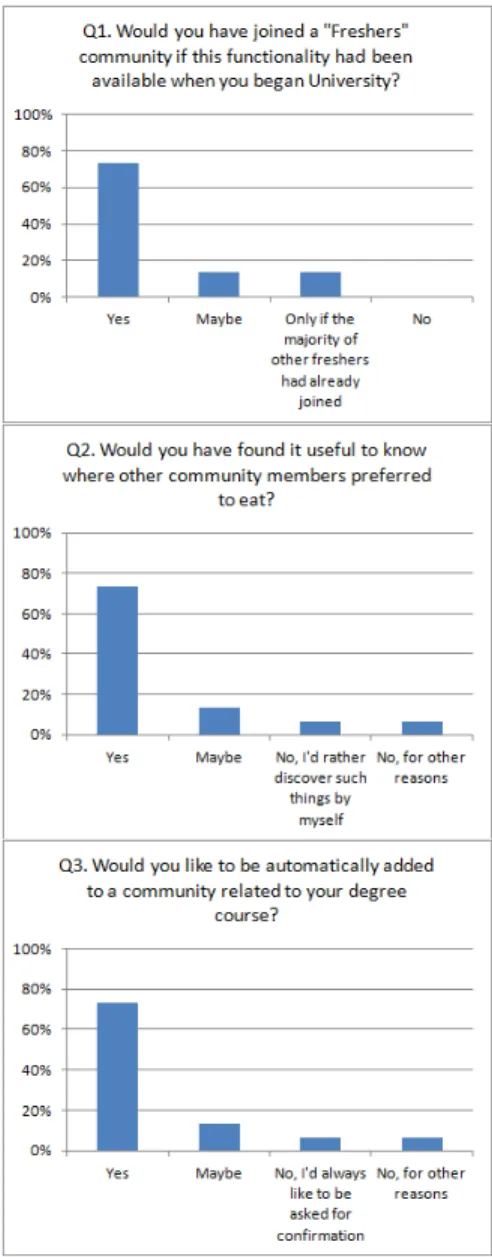
Figure 1. Some results obtained from the storyboard trial This was followed in 2011 by two preparatory user trials using two different methodologies. The first was based on storyboarding to convey ideas on how the PSN might work and gauge the user’s reactions to these. Some results from this that are relevant to the scenarios described in section IV are shown in Fig. 1.
The second used an immersive environment to provide users with a proper look and feel of how the PSN prototype might behave. Each participant in the trial was given a device which simulated the behaviour of our planned PSN and was taken through a series of stations where different effects were observed. In particular, the trial involved wall screens similar to those in public areas within the department and displayed different types of personalized information on them when the participant was close at hand. They were then questioned about their reactions to this. Some results from this are given in Fig. 2. The results of both were fed into the design process.
Figure 2. Some results from the immersive environment trial Finally, this year (2012) the students were engaged in a further exercise to determine their preferences with regard to the third party services which they might use.
Another major undertaking in preparation for the student trials has been to set up several areas within the department
to handle the detection of CSSs and determine their location. In addition these areas have been equipped with various devices that can be accessed through the PSN such as large public screens, directional speakers which can be used to focus sound in particular areas, etc.
VII. CONCLUSION
The concept of a Pervasive Smart Space (PSS) provides a useful and powerful model that can be used as the basis for developing pervasive systems. However, the slow pace with which the ideas of pervasive systems are being taken up has led to the idea of combining pervasive systems with social networking to produce a more powerful kind of system, referred to here as a Pervasive Social Network (PSN).
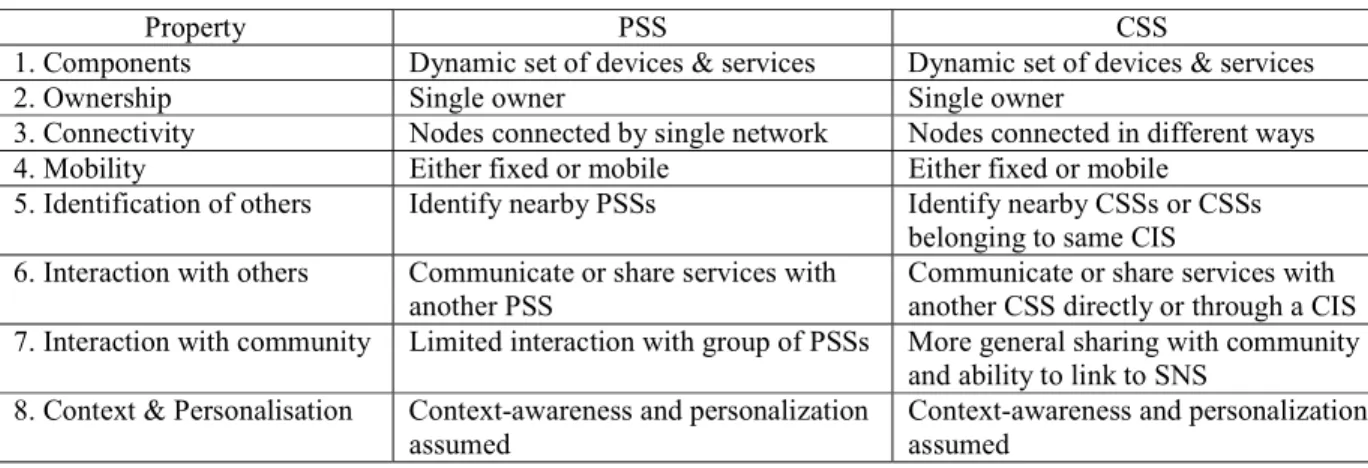
In order to assist in the development of such systems and provide a simple framework which can be used to understand such systems, this paper introduces the notions of Cooperating Smart Space (CSS) and Community Interaction Space (CIS) which can be used as a model as a basis for the development of Pervasive Social Networks (PSNs). These concepts are a natural extension of the idea of a PSS. A brief summary comparing the notions of PSS and CSS is given in Table 1.
The PSS concept was used to develop an implementation of a pervasive system to test the basic ideas. The CSS concept, although very similar, has been used to produce a slightly different architecture which is being used to develop a very different implementation.
The implementation produced will be evaluated in a set of real user trials, the most important of which involves a cohort of third year Computer Science students. Section 6 outlines briefly some of the preparations for this.
Although there is an issue concerning the provision of sensors and services in an environment, this is easily taken care of if every device is linked to a CSS, whether this be a mobile CSS (corresponding to a user) or a fixed CSS (corresponding to a smart home, smart room, smart office, etc.).
ACKNOWLEDGMENT
This work is supported by the European Union under the FP7 programme (Societies project) which the authors gratefully acknowledge. The authors wish to thank all colleagues in the Societies project and all those who have taken part in the exercises outlined in this paper. However, it should be noted that this paper expresses the authors’ personal views, which are not necessarily those of the Societies consortium. Apart from funding the Societies project, the European Commission has no responsibility for the content of this paper.
REFERENCES
[1] M. Satyanarayanan, “Pervasive computing: vision and challenges,” IEEE PCM, vol. 8, 2001, pp. 10—17.
[2] M. Crotty, N. Taylor, H. Williams, K. Frank, I. Roussaki, and M. Roddy, “A pervasive environment based on personal self-improving smart spaces,” Proc Workshop on Constructing Ambient Intelligence, AmI 2008, Springer Verlag CCIS 32, 2010, pp. 58-62.
[3] The UK Grand Challenges Exercise. Available:
http://www.ukcrc.org/grand_challenges/
[4] M. Coen, B. Phillips, N. Warshawsky, L. Weisman, S. Peters and P. Finin, “Meeting the computational needs of intelligent environments: the Metaglue system,” Proc. 1st International Workshop on Managing Interactions in Smart Environments (MANSE 99), Dublin, Ireland, 1999, pp. 201-212.
[5] X. Wang, J. Dong, C. Chin, S. Hettiarachchi and D. Zhang, “Semantic space: an infrastructure for smart spaces,” IEEE Pervasive Computing, vol. 3(3) , 2004, pp. 32-39.
[6] G.D.Abowd, and E.D. Mynatt, “Designing for the human experience in smart environments,” in Smart Environments, D.J. Cook and S.K. Das, Eds. Wiley, 2005, pp. 153-174.
[7] R. Krummenacher, and T. Strang, “Ubiquitous semantic spaces,” Proc. 7th International Conference on Ubiquitous Computing (UIC), Tokyo, Japan, 2005.
[8] C. Endres, A. Butz and A. MacWilliams, “A survey of software infrastructures and frameworks for ubiquitous computing,” Mobile Information Systems Journal vol. 1(1) , 2005, pp. 41-80.
[9] M. C. Mozer, “Lessons from an adaptive house,” in Smart Environments: Technologies, protocols and applications, D. Cook and R. Das, Eds., 2004, pp. 273-294.
[10] M. G. Youngblood, L. B. Holder and D. J. Cook, “Managing adaptive versatile environments,” Proc. 3rd IEEE Int. Conf. on Pervasive Computing and Communications (PerCom ’05) , 2005, pp. 351-360. [11] M. Roman, C.K. Hess, R. Cerqueira, A. Ranganathan, R.H.
Campbell, and K. Nahrstedt, “Gaia: a middleware infrastructure to enable active spaces,” IEEE Pervasive Computing, vol. 1, 2002, pp. 74–83.
[12] H. Si, Y. Kawahara, H. Morikawa and T. Aoyama, “A stochastic approach for creating context aware services based on context histories in smart home,” Proc. 1st International Workshop on Exploiting Context Histories in Smart Environments, 3rd Int Conf on Pervasive Computing (Pervasive 2005), 2005, pp. 37-41.
[13] J. Groppe and W. Mueller, “Profile management technology for smart customizations in private home applications,” Proc. 16th Int. Workshop on Database and Expert Systems Applications (DEXA ’05) , 2005, pp. 226-230.
[14] H. Chen, F. Perich, D. Chakraborty, T. Finin and A. Joshi, “Intelligent agents meet semantic web in a smart meeting room,” Proc. 3rd International Joint Conference on Autonomous Agents and Multi Agent Systems (AAMAS 2004), New York, USA, 2004, pp. 854-861.
[15] M.H. Williams, N.K. Taylor, I. Roussaki, P. Robertson, B. Farshchian and K. Doolin, “Developing a pervasive system for a mobile environment,” Proc. eChallenges 2006 – Exploiting the Knowledge Economy, IOS Press, 2006, pp. 1695 – 1702.
[16] C. Cordier, F. Carrez, H. van Kranenburg, C. Licciardi, J. van der Meer, A. Spedalieri, J.P. Le Rouziv and J. Zoric, “Addressing the challenges of beyond 3G service delivery: the SPICE service platform,” Proc. Workshop on Applications and Services in Wireless Networks (ASWN ’06), 2006.
[17] M. Strutterer, O. Coutand, O. Droegehorn and K. David, “Managing and delivering context-dependent user preferences in ubiquitous computing environments,” Proc. International Symposium on Applications and the Internet Workshops (SAINTW ’07), 2007. [18] I. Roussaki, N. Kalatzis, K. Doolin, N. K. Taylor, G. Spadotto, N.
Liampotis and M. H. Williams, “Self improving personal smart spaces for pervasive service provision,” in Towards the Future Internet, G. Tselentis, A. Galis, A. Gavras, S. Krco, V. Lotz, E. Simperl, B. Stiller, and T. Zahariadis, Eds., IOS Press, 2010. pp. 193-203.
[19] E. Papadopoulou, S. Gallacher, N.K.Taylor, and M.H.Williams, “A personal smart space approach to realising ambient ecologies,”
Personal and Mobile Computing, in press.
TABLE I. COMPARISON BETWEEN PSS AND CSS
Property PSS CSS
1. Components Dynamic set of devices & services Dynamic set of devices & services
2. Ownership Single owner Single owner
3. Connectivity Nodes connected by single network Nodes connected in different ways 4. Mobility Either fixed or mobile Either fixed or mobile
5. Identification of others Identify nearby PSSs Identify nearby CSSs or CSSs belonging to same CIS 6. Interaction with others Communicate or share services with
another PSS
Communicate or share services with another CSS directly or through a CIS 7. Interaction with community Limited interaction with group of PSSs More general sharing with community
and ability to link to SNS 8. Context & Personalisation Context-awareness and personalization
assumed
Context-awareness and personalization assumed