Bayesian non-parametric inference for stochastic
epidemic models using Gaussian Processes
XIAOGUANG XU
Institute of Population Health, University of Manchester, Manchester, UK
THEODORE KYPRAIOS, PHILIP D. O’NEILL∗
School of Mathematical Sciences, University of Nottingham, Nottingham, UK [email protected]
SUMMARY
This paper considers novel Bayesian non-parametric methods for stochastic epidemic models. Many stan-dard modeling and data analysis methods use underlying assumptions (e.g. concerning the rate at which new cases of disease will occur) which are rarely challenged or tested in practice. To relax these assump-tions, we develop a Bayesian non-parametric approach using Gaussian Processes, specifically to estimate the infection process. The methods are illustrated with both simulated and real data sets, the former illustrating that the methods can recover the true infection process quite well in practice, and the latter illustrating that the methods can be successfully applied in different settings.
Keywords: Bayesian non-parametrics; Epidemic model; Gaussian process; SIR model.
1. INTRODUCTION
This paper is concerned with developing methods of Bayesian non-parametric inference for stochastic epi-demic models which are partially observed through time. Our specific focus is on models of the susceptible-infective-removed (SIR) type in which only removals are observed. The following paragraphs contain the background and motivation for this work.
Methods for fitting stochastic models of disease transmission to outbreak data have been the sub-ject of considerable research activity during the past fifteen years or so. Popular approaches include Markov chain Monte Carlo (MCMC) methods (Gibson and Renshaw,1998;O’Neill and Roberts,1999;
O’Neilland others, 2000), Approximate Bayesian Computation methods (McKinleyand others,2009) and Sequential Monte Carlo methods (Ionidesand others,2006), all of which assume an underlying para-metric model whose parameters are to be inferred from the data to hand. A natural alternative is to consider non-parametric approaches, which do not assume a specific parametric model and therefore offer greater potential flexibility. Another motivating factor in the context of epidemic models is that it is often unclear ∗To whom correspondence should be addressed.
c
The Author 2016. Published by Oxford University Press. This is an Open Access article distributed under the terms of the Creative Commons Attribution License (http://creativecommons.org/licenses/by/4.0/), which permits unrestricted reuse, distribution, and reproduction in any medium, provided the original work is properly cited.
how best to assess the goodness of fit of parametric epidemic models, and hence hard to quantify the extent to which the underlying model assumptions are in line with observed data.
Non-parametric methods have to date received relatively little attention in the epidemic modeling lit-erature, and to our knowledge there have been no previous Bayesian approaches. BothBecker and Yip
(1989) andBecker(1989) consider non-parametric estimation of the infection rate in the so-called gen-eral epidemic model (i.e. the SIR model with infectious periods distributed according to an exponential distribution) by allowing the infection rate to depend on time. Their approach uses estimating equations, derived from suitable martingales, in combination with a suitable smoothing kernel. The approach also requires infection times to be known, which is rarely the case in reality, although by assuming fixed-length infectious periods the infection times are immediately specified by the observed removal times. In con-trast,Lau and Yip(2008) assume only removals are observed, and use a kernel estimator to estimate the unobserved process of infectives, assuming that the parameter of the exponential infectious period distri-bution is known. Finally,Chenand others(2008) consider a related problem in which kernel estimation is used to estimate the infection rate in a large-scale epidemic model in which the depletion of susceptibles is ignored.
In this paper, we consider an SIR model in a closed population, and for simplicity and comparison with other methods, we assume exponentially distributed infectious periods. However, our methods can also be applied to general infectious period distributions. Throughout, we assume that the available data consist only of removal times, so that the infection process itself is unobserved. This assumption can usually be interpreted to mean that we observe case detection times, and that, at these times, the individuals in question are no longer able to infect others, perhaps due to isolation or other interventions. We assume that the infection mechanism is time-dependent, specifically making one of two assumptions.
First, we suppose that the usual overall incidence rate of new infections, βX(t)Y(t), is replaced by β(t)X(t)Y(t), whereX(t)andY(t) are the numbers of susceptibles and infectives at timet, respectively. This approach is a natural starting point for non-parametric inference since it retains the usual natural mass-action assumption for new infections. In the second approach, we replaceβX(t)Y(t)byβ(t)I{X(t)Y(t)1}, whereIAis the indicator function of the event A. A key motivation here is to relax the usual mass-action
assumption, which at least informally enables us to investigate the validity of assuming a particular para-metric form for the incidence rate.
Although the assumption thatβ is constant over time is a common one in epidemic modeling, it is certainly not always realistic (Fangand others,2004). Specifically,βcould vary over time as a result of factors such as behavior change in response to the epidemic, the introduction of control or mitigation measures, greater public awareness of the epidemic, and so on. There have been numerous approaches to estimating time-dependent infection rates for epidemic models, including the assumption of a particular parametric form with few parameters (Becker,1989;Lekone and Finkenstadt,2006) or many parameters (Ionidesand others,2006;Cauchemez and Ferguson,2008), inference in deterministic models assuming that the number of infectives is known (Pollicottand others,2012) and for modified deterministic models by assuming that the infection rate is a function of a diffusion process (Dureauand others,2013). All of these approaches are distinct from that which we consider.
We adopt a Bayesian framework, and base our non-parametric modeling on Gaussian Processes (GPs). Specifically, we place GP prior distributions on the incidence rate or infection rate as appropriate, and adapt a method for estimating the intensity function of an inhomogeneous Poisson process (Adamsand others,
2009) to our setting. The methods involve MCMC algorithms.
The paper is organized as follows. In Section2, we define the epidemic models of interest, and briefly recall some key facts about GPs. In Sections3and4, we present estimation methods for the infection rate and overall incidence rate, respectively. Section5contains some numerical illustrations of the methods, and we conclude in Section6with some discussion.
2. BACKGROUND
2.1 Multitype SIR epidemic model
We first recall a multitype stochastic epidemic model (see, e.g.Becker and Hopper,1983). In this model, individuals are grouped according to their susceptibility to disease, but all individuals are equally infectious if they become infected.
Consider a population consisting ofkgroups, labeled 1, . . . ,k, such that theith group initially contains Ni susceptible individuals. At any time, each individual in the population can be in one of three states,
namely susceptible, infective, or removed. An epidemic is initiated in this population at timet=0 by one of the susceptibles becoming infective. Fort0 andi=1, . . . ,kdenote byXi(t)andYi(t), respectively,
the numbers of susceptibles and infectives in theith group at timet. LetY(t)=ki=1Yi(t)denote the
total number of infectives in the population at timet. The epidemic can be defined as a bivariate Markov chain with the following transition probabilities, which correspond, respectively, to an infection in group i and a removal:
Pr((Xi(t+h),Y(t+h))=(x−1,y+1)|(Xi(t),Y(t))=(x,y))=βix yh+o(h),
Pr((Xi(t+h),Y(t+h))=(x,y−1)|(Xi(t),Y(t))=(x,y))=γyh+o(h),
with all other transitions having probabilityo(h). It follows that (i) the overall rate of new infections, which we refer to as theincidence rate, is given byki=1βiXi(t)Y(t), and (ii) individuals have infectious
periods that are independently distributed according to an exponential distribution with meanγ−1. Theβ i
parameters are calledinfection rates. Ifk=1,there is only one group, the model reduces to the general stochastic epidemic model (see, e.g.Bailey,1975), and in this case we writeβforβ1.
2.2 GPs and inference for Poisson processes
We now briefly review relevant facts about GPs (see, e.g.Rasmussen and Williams,2006), and a method of Bayesian non-parametric inference for time-inhomogeneous Poisson processes that we shall adapt to our setting. Recall that a GP is a stochastic process whose realizations consist of Gaussian random variables indexed by some set (in our case, the set of timest in some interval). A GP is completely specified by its mean and covariance function. Throughout this paper, we will only use zero-mean GPs, so that we need only specify a covariance function. GPs are commonly used in Bayesian inference to act as prior distributions over spaces of functions which are themselves the object of inference. We will use GPs as prior distributions for infection rate and incidence rate functions.
A closely related problem to that we will consider is that of Bayesian non-parametric inference for a time-inhomogeneous Poisson process. Specifically, suppose we observe a set of points{sk}Kk=1 from a Poisson process with time-dependent intensityλ(t)during [0,T]. The likelihood is specified by
π({sk}kK=1|λ)= K k=1 λ(sk−)exp − T 0 λ(t)dt ,
whereλ(sk−)=limt↑skλ(t). Ifλ is the object of inference, then in the non-parametric setting,λis an infinite-dimensional object (specifically, it is defined by the set of values{λ(t): 0tT}), which in turn makes the integral in the likelihood intractable in practice.
A method for overcoming this difficulty is described inAdamsand others(2009). The key idea is that the original process can be viewed as a thinned homogeneous Poisson process of rateλ∗, whereλ(t)λ∗ for all 0tT, in which each point is retained with probabilityλ(t)/λ∗(seeLewis and Shedler,1979).
Inference then proceeds by augmenting the observed data with the unobserved thinned points,{˜sm}mM=1, say, yielding an augmented likelihood
π({sk}Kk=1,M,{˜sm}mM=1|λ, λ∗)=(λ∗) M+K exp{−λ∗T} K k=1 λ(sk−) λ∗ M m=1 1−λ(s˜m−) λ∗ .
Finally, sinceλ0,it cannot be assigned a GP prior distribution directly, but instead we use the trans-formationλ(t)=λ∗σ(g(t)), whereσ(z)=(1+e−z)−1, and assign a GP prior distribution tog. This prior distribution is specified by assuming a particular form of covariance function with parameter vectorθ, and placing a prior distribution onθ.
LetgM+K=(g(s1−),g(s2−), . . . ,g(sK−),g(s˜1−),g(s˜2−), . . . ,g(s˜M−)). Then from Bayes’ Theorem the
posterior density of interest is
π(g, λ∗,{˜sm}Mm=1,M, θ| {sk}kK=1)∝(λ∗) M+K exp{−λ∗T} K k=1 σ (g(sk−)) M m=1 σ (−g(s˜m−)) ×π(gM+K|{sk}kK=1,{˜sm}mM=1, θ)π(λ∗)π(θ),
whereπ(gM+K| {sk}kK=1,{˜sm}Mm=1, θ)is the density of a multivariate Gaussian random variable, andπ(λ∗)
andπ(θ), respectively, are the prior density functions ofλ∗andθ. In practice these prior distributions are often fairly uninformative; note also that a Gamma prior distribution forλ∗ is (conditionally on the data and other parameters) conjugate. The posterior density itself can be explored using MCMC methods as described inAdamsand others(2009), and sinceλis specified bygandλ∗, we can hence obtain posterior samples forλ.
3. NON-PARAMETRIC INFERENCE FOR THE INFECTION RATE
In this section, we modify the multitype SIR model by replacing the group-i infection rateβiwithβ˜i(t),
and then describe how to estimate the latter in a Bayesian non-parametric framework. Thus the transition probabilities governing the model become
Pr((Xi(t+h),Y(t+h))=(x−1,y+1)|(Xi(t),Y(t))=(x,y))= ˜βi(t)x yh+o(h),
Pr((Xi(t+h),Y(t+h))=(x,y−1)|(Xi(t),Y(t))=(x,y))=γyh+o(h).
We assume that the data consist of the unique group membership of each individual in the population, the removal times in each group, and the initial numbers of susceptiblesN1, . . . ,Nk. For convenience, we
assume time zero is the time of the first observed removal time and that all removals are observed during [0,T]. Our objective is to infer both the infection rate functionsβ1, . . . ,˜ β˜kand the removal rateγ. We start
with some notation.
Fori=1, . . . ,k, letni andmidenote, respectively, the numbers of observed removals and unobserved
infections in groupi. LetRi=(Ri1,Ri2, . . . ,Ri ni)denote the set of ordered removal times in groupi, so
thatRi1Ri2· · ·Ri ni, and letIi=(Ii1,Ii2, . . . ,Ii mi)denote the vector of ordered infection times in
groupi. SetIminas the time of the initial infection andimin as the group of the initial infective, so that if j=imin, then Ij1=Imin. LetI=(I1,I2, . . . ,Ik)\Imin denote all infection times other than the initial infection time. Finally, setR=(R1,R2, . . . ,Rk),β˜(t)=(β1(˜ t),β2(˜ t), . . . ,β˜k(t)),N=(N1,N2, . . . ,Nk)
The likelihood of the observed dataRgiven the model parameters is analytically and computationally intractable in all but the simplest cases, essentially because its calculation requires integrating over all possible unobserved infection events. We therefore adopt the data augmentation approach in
Hayakawaand others (2003) in which the unobserved infection times become model parameters. This leads to the augmented likelihood
π(I,R| ˜β(t), γ,Imin)= ⎛ ⎝k i=1 ⎛ ⎝ni j=1 γYi(Ri j−) ⎞ ⎠ m i l=2 ˜ βi(Iil−)Xi(Iil−)Y(Iil−) ⎞ ⎠ × ⎛ ⎝ k i=1,i=imin ˜ βi(Ii1−)Xi(Ii1−)Y(Ii1−) ⎞ ⎠ ×exp − k i=1 T Imin ˜ βi(s)Xi(s)Y(s)ds+ T Ii1 γYi(s)ds .
We now place a prior distribution onβ˜iby settingβ˜i(t)= ˜βi∗σ (gi(t)), whereβ˜i∗is an upper bound on
˜
βi(t),σ (z)=(1+e−z)−1andgihas a GP distribution with parameter vectorθi. As for the Poisson process
example described above, this makes the augmented likelihood intractable, so we proceed by regarding the infection process as a thinned homogeneous Poisson process, as follows.
For groupifor whichIi1=Imin, we introduce the additional variables (i) the number of thinned events, Mi; (ii) the locations of the thinned events,˜Ii=(I˜i1, . . . ,I˜i Mi); (iii) thegifunction values at the infection times,gmi=(gi(Ii2−), . . . ,gi(Ii mi−));and (iv) the gi function values at the locations of thinned events, gMi =(gi(I˜i1−), . . . ,gi(I˜i Mi−)). For groupsi withIi1=Imin, we introduce the corresponding variables but also need to consider the first infection time,Ii1, in groupi. Specifically,gi(Ii1−)is added togmi. The augmented likelihood thus becomes
π(I,R,{Mi,˜Ii,gMi+mi} k i=1|{ ˜βi∗, θi}ki=1, γ,Imin) = ⎛ ⎝k i=1 ⎛ ⎝ni j=1 γYi(Ri j−) ⎞ ⎠ m i l=2 ˜ β∗ iXi(Iil−)Y(Iil−)σ(gi(Iil−)) ⎞ ⎠ × k i=1 M i s=1 ˜ β∗ iXi(I˜i s−)Y(I˜i s−)σ(−gi(I˜i s−)) ⎛ ⎝ k i=1,i=imin ˜ β∗ iXi(Ii1−)Y(Ii1−)σ(gi(Ii1−)) ⎞ ⎠ ×exp − k i=1 T Imin ˜ β∗ i Xi(s)Y(s)ds+ T Ii1 γYi(s)ds × k i=1 π(gMi+mi|Mi,{Iil}ml=i1+δi,{ ˜Ii s} Mi s=1, θi) ,
wheregMi+mi is the concatenation ofgMi andgmi andδi=I{i=imin}. Note that the values ofXi(t)andYi(t) do not change at the times of the thinned events. The posterior density of interest is then given by
π(I,{Mi,I˜i,gMi+mi} k i=1,{ ˜βi∗, θi}ki=1, γ,Imin|R) ∝π(I,R,{Mi,˜Ii,gMi+mi} k i=1|{ ˜βi∗, θi}ki=1, γ,Imin)π({ ˜βi∗})π(γ )π(Imin)π({θi}),
where the final four terms denote prior densities. Note that we assume independent prior distributions; this can of course be relaxed, but independence seems the most natural assumption. Samples from the posterior density can be obtained using MCMC methods, as described in the online supplementary material (available atBiostatisticsonline).
4. NON-PARAMETRIC INFERENCE FOR THE OVERALL INCIDENCE RATE
We now adapt the methods described above to the situation in which the mass-action assumption is relaxed. Specifically, we are interested in estimating the overall incidence rate in the absence of any particular para-metric form for the infection process model. We restrict attention to the single-type epidemic, in keeping with the motivation to make as few assumptions as possible about the infection mechanism. However, the methods could be extended to multitype models.
The model of interest is a single-type SIR model in which the overall incidence rate βX(t)Y(t)is replaced byβ(t)I{X(t),Y(t)1}, whereIAdenotes the indicator function of the eventA. Thus infections can
only occur if there is at least one infective and one susceptible. The epidemic can be described according to the transition probabilities
Pr((X(t+h),Y(t+h))=(x−1,y+1)|(X(t),Y(t))=(x,y))=β(t)I{x,y1}h+o(h), Pr((X(t+h),Y(t+h))=(x,y−1)|(X(t),Y(t))=(x,y))=γyh+o(h).
As before, we assume that we observe only the removal times and the initial number of susceptibles. Our objective is to infer bothβ(t)andγ.
Denote the observed ordered removal times in [0,T] asR=(R1=0,R2, . . . ,RK), soR1R2· · · RKT. Let I1<0 be the unobserved time of the first infection and letI=(I2,I3, . . . ,IK)denote the
remaining unobserved ordered infection times during [I1,T], so I1I2· · ·IK. We assume that the
epidemic is known to have ceased by timeT, i.e. the number of infection times and removal times are equal. In order that the epidemic does not die out before all the observed removals have occurred, we require that IiIi+1Ri fori=2,3, . . . ,K −1. The augmented likelihood of the removal times and unobserved
infection times is π(R,I|β(t), γ,I1)=χ K j=2 β(Ij−)exp − T I1 β(s)ds K i=1 γY(Ri−)exp − T I1 γY(s)ds ;
see, for example,O’Neill and Roberts (1999), whereχ denotes the indicator function of the event that X(Ij−),Y(Ij−)1 for j=2, . . . ,K, i.e. χ=1 if and only if there is at least one infective and one
susceptible present when each infection event occurs.
As before, we place a GP prior on β by setting β(t)=β∗σ(g(t)), where β∗ is an upper bound on β(t), σ (z)=(1+e−z)−1, and g is a random function that has a GP distribution with param-eter vector θ. Suppose that the (unobserved) set of thinned infection events is { ˜Is}sM=1 and define gM=(g(I˜1−),g(I˜2−), . . . ,g(I˜M−))as the vector of values of g at these events. Similarly define gK= (g(I2−),g(I3−), . . . ,g(IK−))as the vector of values ofgat the infection times, and denote bygM+K the
concatenation ofgMandgK. We then obtain the augmented likelihood π(R,I,M,{ ˜Is}sM=1,gM+K|β∗, γ,I1, θ)∝χ(β∗) K+M−1 exp(−β∗(T −I1)) × K j=2 σg(Ij−) M s=1 σ−g(I˜s−) K i=1 γY(Ri−)exp − T I1 γY(s)ds πgM+K|M,I,{ ˜Is}sM=1, θ ,
and the posterior density of interest is
π(I,M,{ ˜Is}Ms=1,gM+K, β∗, γ,I1, θ|R)
∝π(R,I,M,{ ˜Is}sM=1,gM+K|β∗, γ,I1, θ)π(β∗)π(γ )π(I1)π(θ),
whereπ(β∗),π(γ ),π(I1),andπ(θ)denote prior densities. The posterior density can be explored using MCMC methods as described in the online supplementary material (available atBiostatisticsonline).
5. EXAMPLES
We now illustrate our methods via some examples. Simulated data are used to show that the methods work in practice. We then consider two classical data sets in small populations, and finish with a more elaborate example to show that the methods can also be extended to larger population settings.
Unless stated otherwise, we use the squared exponential covariance function for the GP prior (see, e.g.
Rasmussen and Williams,2006), i.e.
K(x,y)=α2exp[−(x−y)2/(2θ2)],
withα=2. We comment on the use of different priors later. The prior distribution for the hyperparameterθ was set to be Exp(0.1), where Exp(λ)denotes an exponential random variable with meanλ−1. The param-etersγ,β˜i∗, andβ∗were assigned independent Exp(0.0001)prior distributions, which, for the examples
below corresponds to fairly uninformative prior beliefs. In general, the choice of prior distribution will be problem-specific, depending on the time scale in question. Finally, we defined a time axis by setting the first removal time equal to time zero and then set−Imin∼Exp(0.1)a priori.
5.1 Simulated data
Full details of a simulation study can be found in the online supplementary material (available at Bio-statisticsonline). We considered three scenarios, namely a single-type model with constant infection rate, a single-type model with infection rate exponentially decreasing through time, and a multitype model with three types of individual. In each case we simulated 50 data sets, and applied our methods to each result-ing data set. In each scenario, we found that the true infection rate was well estimated on average across the simulations, while estimates based on single data sets were also reasonable, even for relatively small epidemic outbreaks.
5.2 Abakaliki smallpox data
We now consider a classic smallpox data set taken from Bailey(1975, p. 125). The data were origi-nally reported in a World Health Organization report (Thompson and Foege,1968) and the time series of 30 case detection times, assuming a homogeneously mixing population of 120 individuals, have since been analyzed by numerous authors (e.g.Bailey and Thomas, 1971; Becker, 1989; Rida, 1991;
O’Neill and Roberts,1999;Boys and Giles,2007and references therein), whileEichner and Dietz(2003) provide a far more comprehensive analysis that takes into account the mixing structure of the population and other important factors. In terms of non-parametric analyses,Becker and Yip(1989) assume known infection times and latent periods, and use a kernel smoothing method to estimate the infection rate as a function of time, concluding that the infection rate displays some oscillation over time but with a grad-ual downward trend during the outbreak. Finally,Lau and Yip(2008) use kernel smoothing to obtain a non-parametric estimate of the trajectory of infectives, but assume the infection rate itself is fixed.
(a)
(b)
Fig. 1. Estimation of the infection rate (a) and incidence rate (b) for the Abakaliki smallpox data. Both plots show the posterior mean (thick line), 95% posterior credible intervals (thin line), and the days on which cases were detected in the data set (vertical dashes at top of plot). All curves are plotted over the mean posterior time during which infectives were present in the population.
In our analysis, we assume that only case detection times are available, corresponding to removal times. The infection times for each individual and the removal rate are all inferred via the MCMC algorithm. Figure1shows posterior summaries for the infection rate and incidence rate. The infection rate shows a
slight initial increase followed by a slight gradual decline. The fact that we do not see the oscillations in the Becker–Yip analysis is most likely due to the fact that our estimation of the infection times provides a degree of smoothing. The incidence rate curve peaks at aroundt=50, which is around the time that con-trol measures were estimated to have been introduced during the outbreak (Eichner and Dietz,2003). For comparison, if the standard SIR model is fitted in a Bayesian framework, the posterior mean (standard devi-ation) of the infection rateβ is 0.94×10⁻³ (0.19×10⁻³) (Fearnhead and Meligkotsidou,2004), which is evidently very similar to the values taken byβ(˜ t)in our analysis.
5.3 Tristan da Cunha respiratory disease data
We also apply our methods to a data set analyzed inBecker and Hopper(1983) andHayakawaand others
(2003). The data set corresponds to removal times of individuals with a respiratory disease which occurred between October and November of 1967 on the island of Tristan da Cunha in the South Atlantic. The total population of the island of 255 was partitioned into three groups by age: infants, children, and adults. As there was one unidentified case, we suppose thatN=254. The initial number of susceptibles areN1=25, N2=36,andN3=192, and we assume that the initial infective is an adult since the first case was an adult and occurred 9 days before the first non-adult case. The number of cases in each group was 9 (infants), 6 (children), and 25 (adults).
Figure2shows the estimation results for the infection rate of each group. The infection rate among children falls slightly during the outbreak whilst that for adults gradually increases. These findings are not unreasonable given the pattern of removals in these groups; for instance, most of the adult cases occur in the second half of the outbreak. Nevertheless, it is also clear that assuming constant infection rates would not be unreasonable for these data.
The analysis inHayakawaand others(2003) assumes the same model as ours, but with infection rates constant through time. Posterior mean (standard deviation) infection rate estimates of 0.0045 (0.0018), 0.0018 (0.00082), and 0.0013 (0.00038) were obtained for infants, children, and adults, respectively, using MCMC methods. These are clearly comparable with our results.
5.4 London measles data
Our final example shows that the idea of using GPs as a prior distribution for an infection rate function can also be applied to other settings. We specifically consider an application to an inference method for large populations. The full details are rather extensive and can be found inXu(2015); here we just report the key aspects.
Consider data aggregated into time intervals (such as weeks or fortnights) consisting of numbers of new infections occurring during each time interval. For an SIR model, inference for the infection rate over any such time interval could in theory be achieved by imputing the numbers and times of infection and removal events, but in practice this approach breaks down in large populations unless the time interval is small, because the parameter space becomes too large to explore efficiently.Cauchemez and Ferguson
(2008) tackle this problem by (i) assuming that the number of susceptibles in a time interval is constant, which implies that the infectives process is now a linear birth–death process; (ii) using an analytically tractable diffusion process to approximate the birth–death process, yielding a tractable approximation to the true likelihood. The methods also allow incorporation of data on new susceptibles, such as the number of births in each time interval in the context of childhood diseases, and estimation of the case reporting rate.
Cauchemez and Ferguson(2008) applied this method to fortnightly pre-vaccination-era data on measles in London, in which the data consist of numbers of new cases and births in each bi-weekly time interval. The authors estimated the infection rate for each time interval during a year,β0, . . . , β25, say, under the assumption that the infection rates are viewed as independent parameters with no structural dependence.
(a)
(b)
(c)
Fig. 2. Estimation of the infection rates for infants, children, and adults for the Tristan da Cunha respiratory disease data. All plots show the posterior mean (thick line), 95% posterior credible intervals (thin line), and the days on which cases were detected in the data set (vertical dashes at top of plot). All curves are plotted over the mean posterior time during which infectives were present in the population.
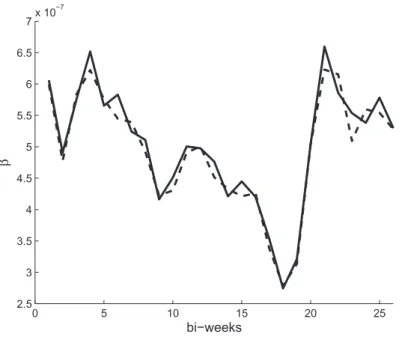
Fig. 3. Posterior mean of the infection rates over 1 year for the CF method (dashed line) and NP method (solid line) using the squared exponential covariance function for the GP for the London measles data.
Fig. 4. Posterior mean of the infection rates over 10 years for the CF method (dashed line) and NP method (solid line) using the periodic covariance function for the GP for the London measles data.
Table 1. Posterior mean,equal-tailed 95% credible intervals, and posterior standard devia-tion for the reporting rate,ρ,the initial number of susceptibles S0and infectives I0,and two illustrative infection rates for the London measles data. CF,NP,and NP periodic represent, respectively,the CF method,the non-parametric method using the squared exponential covari-ance function for the GP prior with seasonal infection rates,and the non-parametric method using the periodic covariance function for the GP prior without assuming the infection rates are
seasonal CF NP NP periodic ρ (%) 50.87 [50.69, 51.05] (0.11) 50.71 [50.56, 50.87] (0.10) 50.26 [50.09, 50.44] (0.11) S0(×103) 164 [160, 168] (2.6) 161 [158, 164] (2.1) 185 [180, 190] (3.0) I0 603 [551, 659] (33.3) 605 [550, 661] (33.7) 602 [547, 658] (33.9) β0(×10−7) 5.99 [5.81, 6.17] (0.11) 6.08 [5.92, 6.24] (0.10) 5.31 [5.15, 5.47] (0.10) β10(×10−7) 4.91 [4.74, 5.06] (0.10) 5.02 [4.88, 5.17] (0.09) 4.18 [4.05, 4.32] (0.08)
In reality we might expect to see some relationship between infection rates, e.g.β1might be close toβ0 andβ2.Cauchemez and Ferguson(2008) also modeled year-by-year trends by using the same infection rate parameters every year, but assuming that the incidence rate in each bi-weekly period was inversely proportional to the size of the number of children under the age of 4, itself known from the available data. In our framework, an alternative way to allow annual variation is to include a separate infection rate parameter for each 2-week time period in the entire data set, but then impose a GP prior on these parameters with a suitable periodic covariance structure.
We introduced these aspects by implementing the Cauchemez–Ferguson (CF) method with a non-parametrically modeled infection rate with a GP prior distribution. Specifically, we assume that the infec-tion rate is constant in each fortnightly time interval, and then regard the mid-point of each interval as an input for the GP. Two scenarios are adopted: first, that the infection rate function was the same year-by-year, and second that it was not. We also implemented the CF method, without the trend modeling, for compar-ison.Cauchemez and Ferguson(2008) also considered incidence rates of the formβX(t)Y(t)1−, which we do not consider here since our focus is toward assessing and illustrating our non-parametric approach, and extra model complexity reduces the transparency of these activities. We used 10 years of measles data, 1948–1957. Both our method and the CF method involve imputation of variables necessary to compute a likelihood, namely the number of unobserved cases in each time interval, the number of infectives at the start of each time interval, and the number of susceptibles at the start of the first time interval. Both methods also assume that the mean infectious period is 14 days. For our second non-parametric method, we used the periodic covariance function
K(x,y)=α2exp(−θ−1(1−cos(2πω−1|x−y|))),
in whichωrepresents the length of one period, which we set equal to 364 days (i.e. 26 bi-weeks, each 14 days). Rather than fixingα,we included it as a model parameter, and assignedαandθindependent U(0,107)prior distributions.
Figure 3 shows a comparison of the posterior mean of the infection ratesβ0, . . . , β25 from the CF method and the Bayesian non-parametric method, the latter using a squared exponential covariance function for the GP prior. Both methods produce relatively similar estimates. Figure4compares the CF method with the periodic covariance function, again showing posterior mean values. Here, the CF method is as before, so each year has identical estimates, as shown in Figure3. It appears visually that there is relatively little variation year-by-year in the non-parametric estimate; in fact, there are differences, but they are very small, typically of the order 10−11. We also attempted to use the CF method by individually estimating an infection
rate for each of the 260 bi-week intervals, but the mixing of the MCMC algorithm was prohibitively poor. Our periodic covariance function method therefore appears to offer a viable alternative in this setting.
Table1shows some posterior parameter estimates for the three methods. Broadly speaking these are fairly similar, although there are some differences in the estimate of the initial number of susceptibles.
6. DISCUSSION
We have demonstrated that Bayesian non-parametric inference for epidemic models can be achieved using GP methods. Although our work is preliminary, it appears worthy of further exploration. The methods that we have developed can be extended to other settings, such as epidemic models with non-exponential infection periods and with latent periods, and those with more complex population mixing structures.
We have largely employed a squared exponential covariance function to define a prior for the GP of interest in our examples. However, we found that using other covariance functions such as exponential or Matern class functions did not have a material impact on the results, with the main difference in results being the smoothness of the posterior estimates for the infection rate functions. More details can be found inXu(2015). A more general question is how best to choose a covariance function; this is partly an issue of model assessment, i.e. selecting a covariance function to give the best fit to data, and an interesting avenue for future research. In some settings certain covariance functions might arise naturally, as illustrated by our use of a periodic covariance function in the measles data example.
One practical challenge with our methods is that the computational complexity increases with the size of the problem. Specifically, calculating the multivariate Gaussian density functions involves inversion of the GP covariance matrix, an operation of typical complexity in the range O(n2.5)to O(n3)for ann×nmatrix, the size of which increases with the number of infections and thinned infection events. We found that the number of thinned events was often between two and three times larger than the number of infections. In practice we found that a data set with around 100 infections took around 1–2 h to run, increasing to 3–5 h for 200 infections. It is possible that recent developments in matrix inversion (e.g.Chen and Yi,2016) could be fruitfully applied to reduce computation times. Nevertheless, as demonstrated in the measles example, our methods can be adapted via suitable approximating models.
SUPPLEMENTARY MATERIAL
Supplementary material is available athttp://biostatistics.oxfordjournals.org.
ACKNOWLEDGEMENTS
We thank the reviewers and Associate Editor for suggestions which have greatly enhanced the paper. Conflict of Interest: None declared.
FUNDING
This work supported by the University of Nottingham (X.X.), the European Union’s Seventh Frame-work Programme FP7-Health-2012-INNOVATION [grant agreement number 305280 (MIMOmics)] (X.X.), and the UK Engineering and Physical Sciences Research Council [grant number EP/J013528/1] (T.K.). Funding to pay the Open Access publication charges for this article was provided by Research Councils UK.
REFERENCES
ADAMS, R. P.,MURRAY, I.ANDMACKAY, D. J. C. (2009)Tractable Nonparametric Bayesian Inference in Poisson Processes with Gaussian Process Intensities. New York: ACM Press.
BAILEY, N. T. J. (1975)The Mathematical Theory of Infectious Diseases and its Applications, 2nd edition. London: Griffin.
BAILEY, N. T. J.ANDTHOMAS, A. S. (1971). The estimation of parameters from population data on the general stochas-tic epidemic.Theoretical Population Biology2, 253–70.
BECKER, N. G. (1989)Analysis of Infectious Disease Data. London: Chapman and Hall.
BECKER, N. G. AND HOPPER, J. L. (1983). Assessing the heterogeneity of disease spread through a community.
American Journal of Epidemiology117, 362–374.
BECKER, N. G.ANDYIP, P. S. F. (1989). Analysis of variation in an infection rate.Australian Journal of Statistics31, 42–52.
BOYS, R. J.ANDGILES, P. R. (2007). Bayesian inference for stochastic epidemic models with time-inhomogeneous removal rates.Journal of Mathematical Biology55, 223–247.
CAUCHEMEZ, S.AND FERGUSON, N. M. (2008). Likelihood-based estimation of continuous-time epidemic models from time-series data: application to measles transmission in London.Journal of the Royal Society Interface5(25), 885–897.
CHEN, F.,HUGGINS, R. M.,YIP, P. S.ANDLAM, K. F. (2008). Nonparametric estimation of multiplicative counting process intensity functions with an application to the Beijing SARS epidemic.Communications in Statistics: Theory and Methods37, 294–306.
CHEN, K.ANDYI, C. (2016). Robustness analysis of a hybrid of recursive neural dynamics for online matrix inversion.
Applied Mathematics and Computation273, 969–975.
DUREAU, J.,KALOGEROPOULOS, K.ANDBAGUELIN, M. (2013). Capturing the time-varying drivers of an epidemic using stochastic dynamical systems.Biostatistics14, 541–555.
EICHNER, M.AND DIETZ, K. (2003). Transmission potential of smallpox: estimates based on detailed data from an outbreak.American Journal of Epidemiology158, 110–117.
FANG, C. T.,HSU, H. M.,TWU, S. J.,CHEN, M. Y.,HWANG, J. S.,WANG, J. D.,CHUANG, C. Y.AND THEDIVISION OF
AIDSANDSTD, CENTER FORDISEASECONTROL, DEPARTMENT OFHEALTH, EXECUTIVEYUAN(2004). Decreased HIV transmission after a policy of providing free access to highly active antiretroviral therapy in Taiwan.Journal of Infectious Diseases190(5), 879–885.
FEARNHEAD, P.AND MELIGKOTSIDOU, L. (2004). Exact filtering for partially observed continuous time models.
Journal of the Royal Statistical Society Series B66, 771–789.
GIBSON, G.ANDRENSHAW, E. (1998). Estimating parameters in stochastic compartmental models using Markov chain methods.IMA Journal of Mathematics Applied in Medicine and Biology15, 19–40.
HAYAKAWA, Y.,O’NEILL, P. D.,UPTON, D.AND YIP, P. S. F. (2003). Bayesian inference for a stochastic epidemic model with uncertain numbers of susceptibles of several types.Australian and New Zealand Journal of Statistics 45, 491–502.
IONIDES, E. L.,BRETO, C.ANDYIP, A. A. (2006). Inference for non-linear dynamical systems.Proceedings of the National Academy of Sciences103(49), 18438–18443.
LAU, E. H. Y.ANDYIP, P. S. F. (2008). Estimating the basic reproductive number in the general epidemic model with an unknown initial number of susceptible individuals.Scandinavian Journal of Statistics35, 650–663.
LEKONE, P. E.ANDFINKENNSTADT, B. F. (2006). Statistical inference in a stochastic SEIR model with control inter-¨ vention: Ebola as a case study.Biometrics62, 1170–1177.
LEWIS, P. A. W.ANDSHEDLER, G. S. (1979). Simulation of a nonhomogeneous Poisson process by thinning.Naval Research Logistics Quarterly26, 403–413.
MCKINLEY, T.,COOK, A. R.ANDDEARDON, R. (2009). Inference in epidemic models without likelihoods.The Inter-national Journal of Biostatistics5(1), Article 24.
O’NEILL, P. D.,BALDING, D. J.,BECKER, N. G.,EEROLA, M.ANDMOLLISON, D. (2000). Analyses of infectious disease data from household outbreaks by Markov chain Monte Carlo methods.Journal of the Royal Statistical Society Series C49(4), 517–542.
O’NEILL, P. D.ANDROBERTS, G. O. (1999). Bayesian inference for partially observed stochastic epidemics.Journal of the Royal Statistical Society Series A162, 121–129.
POLLICOTT, M.,WANG, H.ANDWEISS, H. (2012). Extracting the time-dependent transmission rate from infection data via solution of an inverse ODE problem.Journal of Biological Dynamics6, 509–523.
RASMUSSEN, C. E. AND WILLIAMS, C. K. I. (2006) Gaussian Processes for Machine Learning. Cambridge, Massachusetts: MIT Press.
RIDA, W. N. (1991). Asymptotic properties of some estimators for the infection rate in the general stochastic epidemic model.Journal of the Royal Statistical Society Series B53, 269–283.
THOMPSON, D. AND FOEGE, W. (1968) Faith Tabernacle Smallpox Epidemic. Abakaliki, Nigeria: World Health Organization.
XU, X. (2015). Bayesian nonparametric inference for stochastic epidemic models, [Ph.D. thesis]. University of Nottingham.http://eprints.nottingham.ac.uk/29170/.