Design an efficient three-party authenticated key exchange
protocol in the cloud environment
Chung-Yi Lin a,*, Yuh-Min Chen a, Shu-Yi Liawb, Chen-Hua Fuc a
Institute of Manufacturing Information and Systems, National Cheng Kung University, Tainan, ROC b Department of Business Administration, National Pingtung University Science and Technology, Pingtung,
ROC
c Department of Information Management, National Defense University, Taipei, ROC * Corresponding author E-mail address: [email protected]
A
BSTRACTWith the emergence of cloud computing, conventional three-party authenticated key exchange (3PAKE) protocols face two common problems; one is that the server and users are not in the same domain, and therefore, the shared authenticated keys may be unknowingly compromised. The other problem is these protocols require higher on-line computation cost and on-line communication cost during session key agreement, which can create excessive overhead for cloud clients using devices with low computational capacity. This paper proposes a novel protocol based on the self-verified token pair scheme employed by Chen et al. The proposed protocol does not require that the authenticated keys be stored in clouds to achieve user authentication. Furthermore, it overcomes the security threats existing in the protocol developed by Chen et al. and improves the performance in session key agreement to make it suitable for 3PAKE in cloud environments.
Keywords: 3PAKE, Authenticated key exchange, Cloud environment
I.
I
NTRODUCTIONSince the first key exchange protocol was proposed by Diffie and Hellman [1], a number of researchers have proposed schemes with similar authentication functions such as [2][3][4][5]. Steiner et al. proposed that users share their authenticated keys with a trusted server for mutual authentications in subsequent session key agreements [6]. This became known as the three-party authenticated key exchange (3PAKE) protocol. However, the protocol developed by Steiner et al. is unable to detect on-line guessing or off-line password-guessing attacks. To eliminate the threat of such attacks, some schemes using server public keys such as [7][8]. Nevertheless, these schemes rely on public-key infrastructure create excessive computational overhead, making them unsuitable for environments with limited computational resources.
Although recent 3PAKE protocols such as [9][10][11][12] do not use server public keys, the emergence of cloud computing presents new challenges. First of all, the server and the users are not necessarily in the same trusted domain. Even if a cloud could replace the server and assist two communication parties in mutual authentication, storing the shared authenticated keys in the cloud would pose the risk of keys being compromised. The equipment used by cloud clients, such cell phones and e-readers, are extremely limited with regard to computational capabilities, memory, communication
bandwidth, and battery power [13][14]. The means of adapting conventional 3PAKE protocols to cloud environments is thus an issue worthy of further investigation. For cloud clients using 3PAKE with such devices, we concur that some of the systems and applications may be required to expend on-line resources for computation and communication simultaneously, which could lead to excessive overhead.
Chen et al. proposed a protocol with a self-verified token pair scheme that does not require the additional storage of sensitive tables in the server to achieve user authentication [15]. In this scheme, the server hides the secret key derived in the self-verified token pair given to a specific user. Subsequently, the server requires only its private key and the self-verified token pair sent by the user to obtain the shared authenticated key. This provides an ideal method to secure authenticated keys stored in clouds; however, Yang and Chang pointed out that this protocol is unable to withstand stolen-verifier attacks [16]. Nose further noted that once an adversary obtains an authenticated key, a key-compromise impersonation attack can be initiated [17]. Yang and Chang also pointed out that the protocol proposed by Chen et al. requires higher on-line computational costs and communication loads in reaching session key agreement, and therefore, the protocol is inappropriate for the limited resources of mobile devices.
To develop a 3PAKE protocol suitable for cloud environments, this paper proposes a novel protocol based on the scheme established by Chen et al. with the objective of obtaining better security and performance in session key agreement.
II.
P
RELIMINARIESA. System model
Figure.1 illustrates the proposed system model. The participating parties include Initiator A, Responder B, and the cloud. To achieve mutual authentication, A and B must register with the cloud to obtain the respective authenticated keys that the cloud shares with them. Beforehand, A and B generate the random exponents and components required to produce the session key as well as the verification values of their components. During session key agreement, A and B exchange their components, and through the cloud, they exchange the verification values of their components. When A and B receive the verification value, they use it to verify the integrity of the component sent to them earlier. Subsequently, when A and B wish to establish secure communication at a specific time, they can use their own random exponent and the component from the other party to generate a common session key.
Responder B
Cloud
Initiator A
A’s component B’s component A’s verification value
of component
B’s verification value of component
Figure 1. Conceptual model
B. Security requirements
We assume that two types of adversaries exist in the environment: illegal (unregistered) malicious users, referred to as external adversaries, and legal (registered) malicious users, referred to as internal adversaries. Both types of adversary may attempt to steal the shared authenticated keys and private random exponents through stolen-verifier attacks to enable impersonation attacks and crack session keys. Internal adversaries may also try to impersonate Initiator A or Responder B through cloud authentication during session key agreement, thereby tricking the other party into opening a session with them.
In view of the above, we conclude that the security requirements include (1) ensuring the confidentiality of the shared authenticated keys and the private random exponents to oppose stolen-verifier attacks and (2) ensuring that internal adversaries are unable to perform impersonation-of-initiator attacks or impersonation-of-responder attacks.
III.
P
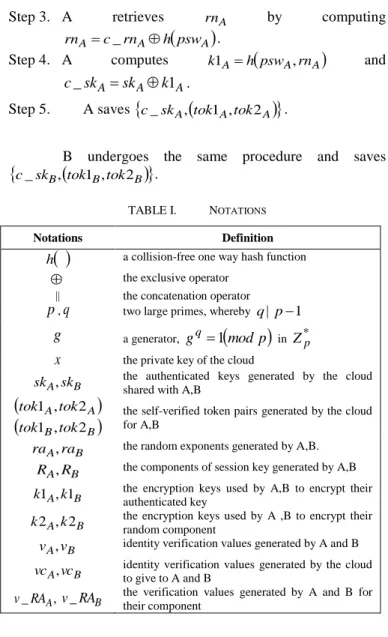
ROPOSED PROTOCOLSThe notation used in the proposed protocol is presented in TableⅠ. Sections A and B describe the phase, procedures and computation steps.
A.
Initialization phase
In this phase, A and B perform the same procedures. Take A for instance.
1) Registration procedure:
Prior to this procedure, A must first select
psw
Aand generate a random number rnA
1rnAq
before computing c_rnArnAh
pswA
. Then, A applies for registration in the cloud:Step 1. The cloud generates a random number A
1Aq
and computes skAH
IDA,A
.Step 2. Cloud computes g A p
A mod
and generatesself-verified token pair
tok1A,tok2A
through computing
A A
A h ID
tok1 , and
x tok
qtok2A A 1A mod . Then, cloud delivers
skA,tok1A,tok2A
to A.Step 3. A retrieves rnA by computing
A
A
A c rn h psw
rn _ .
Step 4. A computes k1Ah
pswA,rnA
and AA
A sk k
sk
c_ 1 .
Step 5. A saves
c_skA,
tok1A,tok2A
.B undergoes the same procedure and saves
c_skB,tok1B,tok2B
.TABLE I. NOTATIONS
Notations Definition
h a collision-free one way hash function the exclusive operator
|| the concatenation operator
p,q two large primes, whereby qp1
g
a generator, gq
modp
1 in Z*p x the private key of the cloud
B A sk
sk , the authenticated keys generated by the cloud
shared with A,B
tok1A,tok2A
tok1B,tok2B
the self-verified token pairs generated by the cloud for A,B
B A ra
ra , the random exponents generated by A,B.
B A R
R , the components of session key generated by A,B
B A k
k1 , 1 the encryption keys used by A,B to encrypt their authenticated key
B A k
k2 , 2 the encryption keys used by A ,B to encrypt their
random component
B A v
v , identity verification values generated by A and B
B A vc
vc , identity verification values generated by the cloud
to give to A and B
, _RAA
v v_RAB the verification values generated by A and B for their component
2) Pre-process procedure:
Step 1. A generates one time random number raAZ*p and computes RA graA p
A mod .
Step 2. A retrieves rnA by computing
A
A
A c rn h psw
rn _ .
Step 3. A computes k2Ah
rnA,pswA
.Step 4. A divides
ra
A into n blocks with the same bit-lengths as k2A , such as
r1A,r2A,,rnA
, and computes
c1A,,cnA
r1Ak2A,rnAk2A
. Step 5. A saves
RAA,
c1A,,cnA
.B undergoes the same procedure and saves
RAB,c_raB
. B. AKE phase:Step1. A retrieves k1 by computing A rnAc_rnAh
pswA
and k1Ah
pswA,rnA
.Step2. A retrieves skA by computing
A A A c sk k
sk _ 1 .
Step3. A generates v_RAA by computing
A A
A hID RA
RA
v_ , .
Step4. A generates TA and identity verification value
B A A A
A hID T v RA sk
v , , _ , .
Step5. A sends
IDA,RAA
and
IDA,IDB,TA,v_RAA,vA, tok1A,tok2A
to B andthe cloud, respectively. 2) Round 2:
Upon receiving the message delivered by A, B does the following:
Step 1. B retrieves
k
1
B by computing
B
B
B c rn h psw
rn _ and k1Bh
pswB,rnB
.Step 2. B retrieves skB by computing
B B B c sk k
sk _ 1 .
Step 3. B generates v_RAB by computing
B B
B hID RA
RA
v_ , .
Step 4. B generates TB and identity verification value
A B B B
B hID T v RA sk
v , , _ , .
Step 5. B sends
IDB,RAB
and
IDB,IDA,TB,v_RAB,vB,tok1B,tok2B
to A andthe cloud, respectively, and saves RAA temporarily. Similarly, upon receiving the message from B, A saves RAB temporarily.
3) Round 3:
After receiving the messages from A and B, the cloud follows the steps below:
Step1. The cloud authenticates A and B.
Step1.1. The cloud verifies whether the timestamps respectively created by A and B are fresher than those of the last request.
Step1.2. The cloud retrieves sk'A by computing q tok x tok A A A 2 1 mod ' and
A A
A H IDsk' ,' . Similarly, the cloud also retrieves
sk
'
B by computingq tok x tok B B B 2 1 mod ' and
B B
B H ID sk' ,' .Step1.3. The cloud verifies vA and vB , such as
B A A A
A ?H ID ,T ,v_RA ,sk' v and
A B B B
B ?H ID ,T ,v_RA ,sk' v .Step1.4. The cloud generates vcAand vcB, such as
B B A
AH
ID
,
v
_
RA
,
sk
'
vc
and
A A B
BH
ID
,
v
_
RA
,
sk
'
vc
for A and B, respectively.Step1.5. The cloud sends
ID
A,
ID
B,
vc
A
and
ID
B,
ID
A,
vc
B
to A and B, respectively.Upon receiving the message from the cloud, A and B respectively use RAB and RAA to verify vcAand vcB,such as vcA?h
IDB,h
IDB,RAB
,skA
and
A A A B
B ?hID ,hID ,RA ,sk
vc . If they pass verification, then
A and B confirm the integrity of RAB and RAA.
Thereafter, when A and B wish the establish secure
communication at a given time, A computes
A
A A c rn h psw rn _ and k2Ah
rnA,pswA
, retrieves A ra by computing raA
c1Ak2A| || |cnAk2A
, andobtains the common session key by computing
RA
pkey
session raA
B mod
. In the same manner, B
retrieves raB and obtains the common session key by computing sessionkey
RA
raB pA mod
.
IV.
S
ECURITY ANALYSISIn this section, we assess whether the proposed protocol meets the security requirements. Before the security demonstration, we emphasize the following facts to assist in security analysis: (1) discrete logarithm problems (DLP) and D-H problems (DHP) are difficult to solve, (2) one way hash functions are collision-free and irreversible, and (3) clouds can protect their private keys from being compromised. These are widely accepted baselines in security. Furthermore, we assume that one way hash functions and random number algorithms are sufficiently secure and have the same bit-lengths. In addition to the original parties A, B, and the cloud, the parties of the security demonstration also include external adversary and internal adversary .
A. Proposition1: The proposed protocol can withstand stolen-verifier attacks
We use party A is attacked as an example. The proof of our proposition is as follows. To ensure the confidentiality of authenticated key skA and random exponent raA, A computes
A A
A h psw rn
k1 , and k2Ah
rnA,pswA
to generate encryption keys k1 and A k2 . Then, A uses A k1 to encrypt AA
sk as c_skAskAk1A and A uses k2A to encrypt the
blocks divided from raA , thereby deriving
r1Ak1A,,rnAk1A
. As or use the same attackapproaches, we will explain the attack using an attack by as an example. Suppose attacks A and steals c_skA, c_raA, and c_rnA. To obtain skA and raA, must first gain k1 A and k2 . Therefore, A attempts to gain pswA or
rn
A fromA
rn
_
either or. Even if performs a brute force attack, they cannot differentiate the real pswA or rnA from c_rnA . Consequently, can only guess. Say pswA and rnA are both 128 bits. The chances of correctly guessing pswA or rnA is 1/2128, and thus, it is unlikely that will be able to derive k1 A or k2A. This demonstrates that the proposed protocol can achieve our proposition.
B. The protocol can withstand impersonation attacks
The proof of Proposition 1 shows that neither nor can obtain the authenticated key of A. As a result, they cannot pass the authentication of the cloud with messages forged as though they were from A. However, possesses a shared authenticated key with which both impersonation-of-initiator and impersonation-of-responder attacks could be attempted. Below is our proof with regard to Proposition 2.
CASE 1 Impersonation-of-initiator attack:
Suppose impersonates A and attempts to establish a session with B. sends
ID
A,
v
_
RA
and
ID
,
ID
B,
T
,
c
_
RA
,
v
,
tok
1
,
tok
2
to B and the cloud, respectively. Upon receiving the message, B sends
ID
B,
v
_
RA
B
and
IDB,IDA,TB,c_RAB,vB,
tok1B,tok2B
to A and the cloud, respectively. Subsequently, must intercept messages from the channel between B and A and tamper with the message from the channel between B and the cloud by changing it to
IDB,ID,TB,cRAB,vB,
tok1B,tok2B
in an attempt to pass the authentication of the cloud. B will think that they are establishing a session with A when in fact they are doing so with . However, cannot impersonate A because the verification value generated by B is
A B B B
B
h
ID
,
T
,
c
_
RA
,
sk
v
; if changed IDA to ID, thecloud would discover that
v
B
h
ID
,
T
B,
c
_
RA
B,
sk
B
. As a result, would be unable to pass the authentication of the cloud.CASE 2 Impersonation-of-responder attack:
Supposing A wishes to establish a session with B, A sends
ID
A,
v
_
RA
B
and
ID
A,
ID
B,
T
A,
c
_
RA
A,
v
A,
tok
1
A,
tok
2
A
to B and the cloud, respectively. tampers with the message from the communication channel between A and the cloud by changing it to
ID
A,
ID
,
T
A,
c
_
RA
A,
v
A,
tok
1
A,
tok
2
A
. intercepts the messages in the communication channel between A and B. Moreover, sends
ID
B,
v
_
RA
and
ID,IDA,T,c_RA,v, tok1,tok2
to A and the cloud, respectively, in an attempt to pass the authentication of the cloud and make A think a session is being established with B, when in fact the session is with . However, is unable to impersonate B because the verification value generated by A is
B A A A
A hID T c RA sk
v , , _ , ; if changed IDB to ID, the cloud would discover that vAh
ID,TA,c_RAA,skA
. As a result, would be unable to pass the authentication of the cloud.V.
E
FFICIENCY ANALYSISWe compared the proposed protocol with that proposed by Chen et al. with regard to performance in communication costs and on-line computation costs.
A. Communication cost
We compared the communication costs of the two protocols with regard to communication efficiency and the size of messages being transmitted.
1) Communication efficiency:
We used the number of rounds and times of communication to examine the communication efficiency of the protocol. The proposed protocol requires 3 rounds and 6 communications. In contrast, the protocol proposed by Chen et al. requires 3 rounds and 7 communications. The protocol proposed in this paper demonstrates superior communication efficiency.
2) Message transmission size:
Chen et al. assumed that the sizes of
p
andq
are 1,024 bits and 160 bits, the output size of one way hash function is 128 bits, the size of the timestamp is 96 bits, and the size of ID is negligible. We thus compared the sizes of messages transmitted from 3 rounds using the proposed protocol and that proposed by Chen et al. based on the aforementioned assumptions. Figure 2 presents the results. In both the first and second rounds, the costs of the proposed protocol were 96+128*3+160+1024 bits, whereas in the third round, the cost was 2*128 bits. Thus, the total size of messages transmitted was 3584 bits. This result is approximately 2240 bits smaller than that using the protocol proposed by Chen et al.B. On-line computation cost:
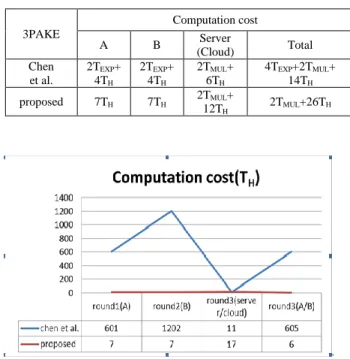
The session key agreement requires on-line computation; therefore, we compared the proposed protocol and that proposed by Chen et al. with regard to the computation costs required in the AKE phase. The symbols used to analyze the computation cost are presented in Table Ⅱ. As introduced in previous studies as [18][19][20], the relationships of the various computation costs can be determined as shown in Table Ⅲ. Table Ⅳ compares the total computation costs required by A, B, and the server (cloud) in the proposed protocol and that proposed by Chen et al. Figure 3 displays the computation costs required in each round. To facilitate the comparisons in Figure 3, we converted the costs of TEXP and TMUL into cost of TH. The results of the comparisons indicate that the proposed protocol imposes significantly lower computation costs than that proposed by Chen et al. with the exception of the cloud, which induces computation costs higher than those of the server in the protocol developed by Chen et al. Regardless, clouds are likely to have greater computation capabilities, and therefore, such costs will not cause excessive computational overhead.
Figure 2. Comparison of size of messages transmitted. TABLE II. SYMBOLS USED TO ANALYZE COMPUTATION COSTS
Symbol Definition
TEXP Cost of one modular exponential operation TMUL Cost of one modular multiplication operation TADD Cost for one modular addition operation
TH Cost of one hash function operation T⊕ Cost of one exclusive OR operation
TABLE III. RELATIONSHIPS AMONG VARIOUS OPERATIONS 1 TEXP240 TMUL
1 TEXP600 TH 1 TH
0.4 TMUL TADD is negligibleT⊕is negligible
TABLE IV. COMPARISON OF COMPUTATIONAL COSTS
3PAKE Computation cost A B Server (Cloud) Total Chen et al. 2TEXP+ 4TH 2TEXP+ 4TH 2TMUL+ 6TH 4TEXP+2TMUL+ 14TH proposed 7TH 7TH 2TMUL+ 12TH 2TMUL+26TH
Figure 3. Comparison of computational costs required in each round.
The above analysis demonstrates that the proposed protocol has better communication efficiency and transmits smaller messages that the protocol developed by Chen et al. Furthermore, in the AKE phase, the proposed protocol significantly reduces computational costs for the two communication parties with regard to session key agreement.
VI.
C
ONCLUSIONThe objective of this paper was to improve the protocol proposed by Chen et al. in terms of security and performance during session key agreement to make it applicable to 3PAKE in cloud environments. Security analysis shows that the proposed protocol is able to withstand stolen-verifier attacks as well as impersonation attacks. Efficiency analysis indicates that the proposed protocol has higher communication efficiency and transmits smaller messages than the protocol developed by Chen et al. In addition, the proposed protocol significantly reduces the overhead of on-line computation for the two communication parties during session key agreement. We can thus conclude that the proposed protocol is suitable for 3PAKE in cloud environments. This paper assumes that the cloud is honest and follows the required security service agreement. However, malicious clouds are still possible, and we therefore plan to develop a 3PAKE protocol capable of withstanding malicious attacks even from the clouds themselves.
R
EFERENCES[1] W. Diffie, M.Hellman, “New directions in cryptography, ”
IEEE Trans Inform Theory, vol. 22, pp.644–54, 1976.
[2] S.M. Bellovin, M. Merrit, “Encrypted key exchanged: Password-based protocols secure against dictionary attacks, ” in: Proc. of IEEE Symposium on Security and Privacy, pp.72–84, 1992.
[3] V. Boyko, P. Mackenzie, S. Patel, “Provably secure password authenticated key exchange using Diffie-Hellman, ” in: Proceedings of EUROCRYPT’2000, Advances in Cryptology. Springer-Verlag, pp.156–171, 2000.
[4] O. Goldreich, Y. Lindell, “Session-key generation using human passwords only, ” in: Proceedings of CRYPTO’2001, Advances in Cryptology. Springer-Verlag, vol. 2139, pp.408–432, 2001.
[5] R. Gennaro, Y. Lindell, “A framework for password-based authenticated key exchange, ” In: Proceedings of EUROCRYPT’2003, Advances in Cryptology. Springer-Verlag, vol. 2656, pp.524–543, 2003
[6] M. Steiner, G. Tsudik, M. Waidner, “Refinement and extension of encrypted key exchange, ”, ACM SIGOPS Operating Systems Review, vol. 29, pp.22-30, 1995.
[7] C.L. Lin, H.M. Sun, T.Hwang, “Three-party encrypted key exchange: attacks and a solution, ” ACM SIGOPS Operating System Review, vol. 34, pp.12-20, 2000.
[8] H.-M. Sun, B.-C. Chen, T, Hwang, “Secure key agreement protocols for three-party against guessing attacks, ” The Journal of Systems and Software, vol. 75, pp.63-68, 2005.
[9] R. Lu, Z. Cao, “Simple three-party exchange protocol, ” Computers & Security, vol. 26, pp.94-97, 2007.
[10] T.F. Lee, T. “Hwang, Simple password-based three-party authenticated key exchange without server public keys, ” Information Sciences, vol.180, pp.1702-1714, 2010.
[11] T.Y. Chang, M.S. Hwang, W.P. Yang, “A communication-efficient three-party password authenticated key exchange protocol, ” Information Sciences, vol. 181, pp.217-226, 2011.
[12] C. Lv, M. Ma, H. Li, J. Ma, Y. Zhang, “An novel three-party authenticated key exchange protocol using one-time key, ” Journal of Network and Computer Application, vol. 36, pp.498-503, 2013.
[13] M. Conti, et al., “Looking ahead in pervasive computing: Challenges and opportunities in the era of cyber–physical convergence, ” Journal of Pervasive and Mobile Computing, vol. 8, pp.2-21, 2012.
[14] Q. Shi, N. Zhang, D.-L. Jones, “Efficient autonomous signature exchange on ubiquitous networks, ” Journal of Network and Computer Application, vol.35, pp.1793-1806, 2012.
[15] T.Z. Chen, W.B. Lee, H.B. Chen, “A round- and computation-efficient three-party authenticated key exchange protocol, ” The Journal of Systems and Software, vol. 81, pp.1581-1590, 2008.
[16] J.H. Yang, C.C. Chang, “An efficient three-party authenticated key exchange protocol using elliptic curve cryptography for mobile-commerce environments, ” The
Journal of Systems and Software, vol. 82, pp.1497-1502, 2009.
[17] P. Nose, “Security weaknesses of authenticated key agreement protocols, ” Information Processing Letters, vol. 111, pp.687-696, 2011.
[18] Y.P. Liao, S.S. Wang, “A secure dynamic ID based remote user authentication scheme for multi-server environment, ” Computer Standards & Interfaces, vol.31, pp.24-29, 2009.
[19] Z. Li, J. Higgins, M. Clement, “Performance of finite field arithmetic in an elliptic curve cryptosystem, ” IEEE Computer Society, pp.249 – 258, 2001.
[20] R.C. Wang, W.S. Juang, C.L. Lei, “A Web Metering Scheme for Fair Advertisement Transactions, ” International Journal of Security and Its Applications, vol. 2, pp.49-56, 2008.