Nicholas Barr
Pensions: overview of the issues
Article (Accepted version)
(Refereed)
Original citation:Barr, Nicholas (2006) Pensions: overview of the issues. Oxford Review of Economic Policy, 22 (1). pp. 1-14.
DOI: 10.1093/oxrep/grj001
© 2006 Oxford University Press
This version available at: http://eprints.lse.ac.uk/2631/
Available in LSE Research Online: January 2007
LSE has developed LSE Research Online so that users may access research output of the School. Copyright © and Moral Rights for the papers on this site are retained by the individual authors and/or other copyright owners. Users may download and/or print one copy of any article(s) in LSE Research Online to facilitate their private study or for non-commercial research. You may not engage in further distribution of the material or use it for any profit-making activities or any commercial gain. You may freely distribute the URL (http://eprints.lse.ac.uk) of the LSE Research Online website.
This document is the author’s final manuscript accepted version of the journal article, incorporating any revisions agreed during the peer review process. Some differences between this version and the published version may remain. You are advised to consult the publisher’s version if you wish to cite from it.
Pensions: Overview of the issues
Nicholas Barr
March 2006
Oxford Review of Economics Policy, Vol. 22. No. 1, Pensions, forthcoming
Pensions: Overview of the issues
1Nicholas Barr2
Abstract
Many countries face increasing fiscal problems financing pensions in the face of population ageing. There is controversy about the underlying economic theory, about the extent of the problem, and about the best mix of policies to protect old-age security. This paper establishes the areas of debate; gives thumbnail descriptions of pension arrangements in different countries; discusses the main analytical and empirical issues relevant to thinking about pension design; and assesses a range of policy directions. The main conclusions are that what matters most is effective government and economic growth; that the debate between Pay-As-You-Go and funding is secondary; that good pension schemes can take many forms; and that there is a problem in financing pensions, but not a crisis.
1 Defining the terrain
Old age pensions3 are seen as a problem, and are controversial both theoretically and in policy terms. Section 2 asks whether there really is a crisis. Section 3 sets out some major issues in thinking about pension design – information problems, fiscal issues, administrative costs, and the role of government. Section 4 discusses policy directions. The final section offers some conclusions.
As a starting point, it is useful briefly to establish what the problems are, to set out the major arguments about diagnosis and prescription, and to summarise the way different
countries organise their old age pensions.
1.1 What is the problem?
Many countries face rising pension spending, often combined with significant pensioner poverty. The problem is attributed to various trends, notably a pincer movement between rising life expectancy and lower birth rates. Table 1 in the paper by Whiteford and
Whitehouse (2006, this volume) shows that average pension spending in the OECD in 2001 was 7.4 per cent of GDP, the comparable figure for the EU15 (i.e. the older member states)
1
I am grateful for helpful comments from Christopher Allsopp, Peter Diamond, Andrew Glyn, Dieter Helm, and Margaret Stevens.
2
Professor of Public Economics, London School of Economics and Political Science; Email: [email protected].
3
This paper uses the term ‘pensions’ because ‘social security’ has different meanings in different countries. British usage – all publicly provided cash benefits – differs from the narrower American definition of social security as retirement benefits, and from the broader EU definition which includes health services. The term is therefore avoided where possible.
being 8.2 per cent. But spending in some countries was significantly higher, 10.4 per cent in France, 10.8 per cent in Germany and 12.6 per cent in Greece. If pension formulae remain unchanged, projected trends in longevity, fertility and economic growth suggest that pension spending in some countries could double from their present levels as populations age, in Greece for example to nearly 25 per cent of GDP in 2050 if no action is taken (UK Pensions Commission, 2004, Table D.2).4 These problems notwithstanding, section 2 questions whether there is a genuine pensions ‘crisis’.
1.2 What are the big arguments?
There are many debates about pensions, some of the references to which are listed in footnote 6 of Barr and Diamond (2006, this volume).
SHOULD BE PENSIONS BE PAY-AS-YOU-GO (PAYG) OR FUNDED? In a PAYG scheme pensions are paid out of current income. In a fully-funded scheme, pensions are paid from a fund built over a period of years from members’ contributions. Virtually all state pension schemes are mainly PAYG; private schemes are generally funded (though not necessarily adequately).
Chile has become a famous exemplar in the debate. In 1981, Chile moved from Pay-As-You-Go (PAYG) pensions to individual funded accounts. This strategy, in essence a form of privatisation, underpinned the World Bank’s advocacy of the ‘multipillar model’ (World Bank 1994) with a significant mandatory funded component. The demonstration effect of Chile and the advocacy of the World Bank were powerful, in that many countries, notably in Latin America and Central and Eastern Europe have added mandatory contributions to private, funded pensions alongside contributions to the PAYG state system.5
In assessing this debate, it helps to be clear about what is controversial. At its
simplest, the multipillar model has three elements: the first tier is a state-run PAYG pension, usually with some redistribution built in; the second tier is mandatory membership of a privately-managed funded pension, usually run on a fairly strict actuarial basis; the third tier comprises voluntary contributions to funded pensions. Though the level and construction of the state pension is a matter for discussion, its existence is not; equally, nobody seriously questions the desirability of suitably-regulated voluntary private pensions. The point of acute controversy is whether membership of a private scheme should be mandatory. Thus the controversy focuses largely on the desirability or otherwise of the second-tier – a question taken up in section 4.4, below, and in more detail by Barr and Diamond (2006, this volume).
4
For wide-ranging projections of spending on pensions, health care, long-term care, etc. in the EU25 until 2050, see Economic Policy Committee of the European Union (2006).
5
WHAT WEIGHTS SHOULD BE GIVEN TO THE DIFFERENT OBJECTIVES OF PENSIONS? As discussed more fully in the paper by Barr and Diamond, pensions have multiple objectives, including insurance (e.g. in respect of the longevity risk), consumption smoothing (i.e. enabling people to redistribute to themselves over their life cycle), poverty relief, and redistribution. Some writers argue that an additional objective is to promote economic growth.
A particular form of that debate is whether pensions should be defined-contribution (DC) or defined-benefit (DB). In a pure funded DC scheme, the pension a person receives depends on his lifetime pension accumulation. Two features of such an arrangement stand out. First, it leaves the individual worker to face the risks associated with the performance of his pension fund, depending inter alia on the performance of the stock market. Second, in a pure DC scheme, the pension a worker gets bears a strictly actuarial relationship to his contributions. Thus a pure DC scheme does little to address poverty relief and, the important longevity risk apart, offers no insurance (e.g. against uncertain lifetime income prospects); DC pensions thus give heavy weight to the consumption smoothing objective.
In a DB scheme, often run at the firm or industry level, the pension a person receives depends on his or her wage history and on length of service. One feature of this arrangement is that the risk of differential pension portfolio performance falls on the employer, and hence is shared more broadly than with DC arrangements. Secondly, the pension a worker gets is not fully actuarially related to his or her previous contributions.6
In some countries, notably Sweden (see the paper by Sundén, 2006, this volume), pensions are organised on a Notional Defined Contribution (NDC) basis, that is, pensions are PAYG, but a person’s pension entitlement bears a roughly actuarial relationship to his or her lifetime contributions, given the person’s age at retirement and the life expectancy of his or her birth cohort, in the same way as in a DC scheme. Thus, NDC pensions are a PAYG analogue of DC schemes. NDC pensions bring together the previous two debates. They are relevant to the debate about weights, in that a pure NDC scheme concentrates on
consumption smoothing. They are also relevant to the debate about PAYG v. funding; if a country wishes to have an element in its pension system that offers fairly pure consumption smoothing there are circumstances where NDC might be more appropriate than funded DC.
ANALYTICAL ARGUMENTS. Writing about pensions is prone to analytical errors, four of which are discussed by Barr and Diamond (2006, this volume).
6
1.3 How do different countries organise pensions?
This section briefly outlines arrangements in a number of countries to illustrate the range of choice.
Experience in Chile, and other Latin American countries is discussed by Arenas and Mesa Lago (2006, this volume). As already noted, Chile has a DC funded accounts. These are supported by a state-guaranteed minimum pension for workers who have contributed for 20 years or more. Thus the second-tier is a mandatory, privately-managed, individual funded account, with a residual first tier in the form of a guarantee.
Sweden’s NDC pensions are discussed by Sundén (2006, this volume). The NDC element is supported by a safety net pension for people with low lifetime earnings and credits for periods spent caring for children. Thus Sweden has actuarial benefits plus a safety net guarantee, and is thus in important respects a publicly-organised, PAYG analogue of Chile, since each places heavy emphasis on a strong relationship between contributions and benefits.
The USA, discussed by Thompson (2006, this volume) has an earnings-related PAYG scheme which is generous relative to a minimalist view, though not in comparison with a number of European countries. Though people can retire earlier, full pension is paid when a person retires aged 65, rising gradually to 67. Many people also belong to a company or industry pension scheme and/or to an individual defined-contribution pension, such membership being voluntary so far as government is concerned. These are supported by a safety net pension for people with low incomes, but at below-poverty level. Thus the only mandatory element in the US arrangements is the state pension.
The UK, discussed by Hills (2006, this volume) has a flat-rate PAYG basic state pension. The basic pension has always been below the poverty line, in that people whose only income is the basic pension are eligible for additional income-tested benefits.
Superimposed on the basic pension is mandatory membership of an earnings-related pension, which can be the state earnings-related scheme or an approved occupational scheme or an individual account. One of the major criticisms rightly levelled at the system by the UK Pensions Commission (2004) is its complexity.
Australia is like Chile in that its second-tier pension builds on mandatory individual funded accounts, but unlike Chile in that it has a much more fully-articulated first tier paid out of general taxation and has a role for employers in organizing the individual funded accounts.
New Zealand has a generous universal flat-rate pension (about 65 per cent of average weekly earnings) financed through general taxation, supplemented by voluntary, funded, defined-contribution pensions. In a referendum in 1997, a proposal to move to a Chile-type system was heavily defeated (in an 80 per cent turnout, 91.8 per cent of voters rejected the proposal).
The Netherlands is like New Zealand, in that it also has a generous, tax-funded flat-rate universal pension. Superimposed, is mandatory membership of private schemes, frequently at an occupational level, and a system of voluntary pensions.7
The experience of different countries in the OECD is assessed by Whiteford and Whitehouse (2006, this volume).
2 A pensions crisis?
Why is there ‘suddenly’ a crisis in pensions; and is there a crisis?
2.1 Why is there ‘suddenly’ a crisis?
High and rising pension costs create worries about sustainability. That worry is given added point by the pressures of globalisation, which derive from two roots. First, since 1970 international trade has become increasingly open. Secondly, as a result of technological change, a rising fraction of trade is electronic, making national boundaries increasingly porous. For both reasons, globalisation reduces, though it does not eliminate, the ability of a country to act independently in designing its institutions, for example in setting its pension contribution rate.
Most of these factors, however, are not new. The impact of population ageing was both predictable and predicted (Barr, 1979), yet few countries have got to grips with its implications. Average age at death in the UK (and similarly in other countries) has been rising steadily at least since 1860. In the early part of the period, few people reached
pensionable age. During the middle of the twentieth century, the average age at death started to exceed 65, increasing the numbers of people who drew pension, if only on average for a short time. Clearly, as more and more people live to pensionable age and, having achieved that, live longer and longer beyond that, the costs of pensions rise and, as a proposition in pure logic, rise disproportionately.8
7
A Dutch student tells me that this is sometimes referred to as ‘the cappucino model’: largely coffee (the flat-rate pension), with a layer of cream (the occupational pension) and a dusting of cocoa (voluntary pensions).
8
Assume everyone retires at 65 and dies on their 67th birthday. An increase in life expectancy of one year raises pension costs by 50 per cent.
2.2 Crisis or problem?
There are several elements to the costs of pensions. Looking to the past:
• Pensions have tended to increase and, as noted by Whiteford and Whitehouse (2006, this volume), older people in OECD countries over recent decades have gained relative to the population as a whole.
• Retirement has lengthened, in part because of earlier retirement but mainly because of longer life: ‘[across the OECD] whereas men could expect to spend around 10 years in retirement on average in 1970, this had risen to around 20 years in 2004’
(Whiteford and Whitehouse, **p. 5 TS) Looking to the future, projections indicate that:
• There will be more older people, as life expectancy continues to increase.
• There will be fewer younger people. Whiteford and Whitehouse point to a projected decline in the absolute number of people aged 20-64 in OECD countries.
Is this a crisis? This paper argues that there is not a crisis, but a problem and, moreover, a problem with a range of solutions: lower benefits, rising contributions, more years of work, or a combination, discussed more fully in section 4.
Some commentators question whether there is even a problem. Mullan (2000) argues that rising productivity will suffice. This may be the case; but as a country gets richer, the expectation is that pensions will grow broadly to keep pace with living standards; it may be that rising productivity would make it possible in 2050 (say) to pay pensions at today’s real levels; but by then the average level of pensions is likely to be significantly higher.
Others (see Banks, Emmerson, Oldfield and Tetlow, 2005) argue that wealth
accumulation, notably in the form of housing, will largely resolve the problem. The paper by Hills (2006, this volume) addresses the issue, and argues that non-pension private wealth, though helpful, is far from a complete answer. Equity release schemes for housing do not offer a good return, not least because of growing uncertainties about longevity; and there are other potential claims on housing wealth, notably to self-insure against the need to finance expensive long-term care in extreme old age.
In contrast, Helm argues that conventional measures understate the problem, given wealth decumulation through the consumption of natural resources (for fuller discussion see Heal, 1998, and Dasgupta, 2001). In other words, Helm argues, present pension policies are unsustainable because they are based on assumptions about growth rates that are overstated because they take no account of the costs of environmental damage.
2.3 The UK problem
Alongside the general trends of population ageing, the UK faces country-specific problems. Since the mid-1980s the state pension has been indexed to changes in prices rather than wages, thus depressing the pension relative to average earnings. This, it was deemed, was appropriate because the state pension was accompanied by a well-articulated system of private pensions – largely occupational DB pensions – a system that was the envy of many other countries. Since 2000, the strategy has lost much of its viability. The story has three elements: pension fund deficits, legislative changes, and a shift towards government bonds.
Pension fund deficits: today many pension funds face large measured deficits. The origin of those deficits is threefold:
• During the times of strong stock market performance in the 1990s many companies took contribution holidays.
• In 1997 some of the tax advantages of pension funds were reduced. • In 2000 the stock market fell sharply.
Legislative changes:
• Accounting rules designed to improve transparency now require that the deficit of a company pension scheme appears on the company’s books; this deficit is presented analogously to an annual trading loss.
• The Pension Protection Fund, which began in 2005, charges risk-rated premiums. A resulting move into government bonds: the initial deficit, together with continued shaky stock market performance, led many companies to redirect their pension funds towards bonds, and that movement was increased by the fact that the Pension Protection Fund charged risk-rated premiums, which are lower for low-risk assets like government bonds. Thus the demand for long-dated gilts rose sharply, and the yield fell correspondingly to a low on 50 year indexed bonds of 0.38 per cent.
To compound the problem, pension fund deficits are measured in terms of the return on long-dated gilts; thus the increased demand for long-dated gilts, by depressing yields, makes the measured deficit even larger.
In sum, the legislative changes made a real problem worse and the record-low bond rate made it worse still. Though part of the problem is real, the result of optimistic
assumptions about returns to pension funds in the 1990s, part is self-inflicted, the result of unintended consequences of regulation.
3 Major issues
3.1 This volume
The papers in this volume are about old-age pensions. For reasons of space, there is little discussion of other types of pension, for example, for disability, nor much discussion of health care, despite its parallel importance, particularly in the USA.
The volume is in two parts. The papers in the first cluster are mainly conceptual. Barr and Diamond set out the economics of pensions, intended as an analytical toolkit in terms of which the experiences of different countries can be assessed. Banks and Smith discuss the nature of retirement – a more multi-dimensional concept than is always realised, illustrating their analysis with UK data. McCarthy discusses the rationale for occupational pensions, anchoring their existence in a series of market imperfections. Administrative costs are a cross-cutting theme. Nugée and Persaud discuss the regulatory environment in which pensions currently sit and argue that its unintended effect is to shift financial risk from where it should be to where it should not. In particular, they argue that, in the name of safer
institutions, financially unsophisticated and constrained pensioners bear more risk than they need to or than they did in the past. They put forward a radical proposal for changing the basis of financial regulation, moving away from the focus on ridding institutions of private risks at any point in time, to a focus on the proper concerns of regulators: systemic risk, consumer protection and encouraging risk to where it is best managed.
The second cluster of papers discusses pensions in different countries, chosen to illustrate a range of different experiences. The paper by Whiteford and Whitehouse offers an overview of pension issues and reform strategies in OECD countries, including the new EU member states. Thompson looks at the historical evolution and current position of the US system, and assesses the recent strident debate on pension reform in the US.9 The UK, too, is debating options for reform, though in a much more measured way. Hills, a member of the UK Pensions Commission, sets out the recommendations of the Commission’s Second Report (UK Pensions Commission, 2005) and the core analysis that underpins them. Sweden’s move to notional defined-contribution pensions is discussed in Sundén’s paper, which explains the thinking behind the reforms and assesses some of the main outcomes. Arenas and Mesa Lago assess the 25-year experience in Chile in the broader context of reform in Latin America, concluding that that experience is mixed, but by some margin the most successful in the region.
-o0o-
9
For an official assessment, see US GAO (2005) and, for trenchant discussion of events in the UK since the mid-1980s and their relevance to the USA, Cohen (2005). Diamond (2006) offers a joint assessment of the US and UK.
The rest of this section discusses four issues that run through the papers: information
problems both for workers and for the providers of pensions (mainly a microeconomic issue) (section 3.2); the fiscal costs of a move to funded pensions, mainly a macroeconomic issue (3.3); administrative costs (3.4); and the major and inescapable role of government (3.5).
3.2 Information problems and the difficulty of resolving them
Information problems on the demand side
CHOICES ABOUT PENSION PRODUCTS. Decisions about pensions raise issues of long-run choice, and pensions products are generally complex. Both factors create information
problems which reduce – often considerably – people’s ability to make choices that maximise their own long-term well-being. As Arenas and Mesa Lago (p. **10 pdf) note in the context of Chile, ‘… most insured lack the data and skills to make an informed selection of the best [pension provider] and are influenced in their decision by advertisement and salesmen.’
A common problem is that people make bad choices. Sweden’s notional defined-contribution pension is supplemented by the Premium Pension (i.e. individual accounts). Sundén, commenting on early experience with the Premium Pension, notes (p. **13 pdf) that, ‘making investment decisions is complicated and results from the first few years with
Premium Pension show that workers are making similar mistakes to those documented in other individual-account systems …. As a result, groups of workers may experience systematically poor outcomes ….’
A particular manifestation of bad choice is to make no choice at all, a common result where excessive choice or excessive complexity leads to immobilisation. In Sweden,
individuals can choose from around 700 providers of the Premium Pension but, as Sundén points out, in 2005, over 90 per cent of new entrants to the labour force ended up in the government default fund because they had not chosen any other fund.
It is often argued that the solution is to improve consumer information. However, even in an advanced countries like Sweden and the USA progress has been very limited. The Barr-Diamond paper suggests that imperfect information in this context is hard to resolve because what is involved in not an information problem (resolved by offering more information) but an information-processing problem, that is, a problem which is too
complicated for individuals to resolve even if they are given the necessary information (many medical choices have a similar characteristic). This is not an argument against transparency and broader efforts at public education, but a caution against expecting such policies to be a complete solution.
CHOICES ABOUT RETIREMENT AGE. Analogous issues arise over the timing of retirement. Evidence suggests that many people retire at the earliest permissible age, even at a pension that is low and which would be larger if he or she delayed retirement. If pensions bear an actuarial relationship to a person’s expected duration of retirement, the combination of longer lives and retirement at the earliest permissible date inescapably aggravates elderly poverty. As Sundén notes, incentives to encourage delayed retirement in Sweden have had little effect. Information problems on the supply side
Insurers also face information problems. A particular issue is the ability to predict life expectancy, where it can be argued that longevity increasingly faces not only risk but also uncertainty. The distinction is important: actuarial insurance can address risk (where the relevant probability distribution is known), but deals less well with uncertainty (where it is not). As the First Report of the Pensions Commission (UK Pensions Commission 2004) points out, there are different elements in the longevity risk:
• Specific longevity is the probability distribution of age-at-death of a given person at age 65; this is the risk which an annuity is designed to cover. It is a genuine risk. • Cohort longevity, relating to the life expectancy of men born in a given year, has a
larger variance than specific longevity. We know that life expectancy is increasing, but there is uncertainty about how much. Thus there is a ‘funnel of doubt’, and – importantly – the area of doubt gets wider as the duration of retirement increases. Official projections have been on the low side: they correctly identified a slow-down in the rate of increase of life expectancy in the second half of the twentieth century, but mistakenly attributed it to a ‘maximum duration of life’, rather than to the
cumulative impact of smoking, an effect that has now been absorbed and, if anything, is being reversed. The practical question is whether providers of annuities have the capital to address the variance in longevity; the more fundamental question is whether longevity is better regarded as risk or as uncertainty.
• Longevity over the longer term, i.e. over all cohorts, creates uncertainty rather than risk. If the costs of that uncertainty fall on the annuity provider, there will tend to be two effects: either the terms on which the annuity is offered become increasingly parsimonious, as the annuity provider protects shareholder interest by pricing policies on the basis of pessimistic assumptions;10 or the annuity provider pulls out of the market – a trend already noted in the UK.
Policy must therefore address the facts that the underlying problem is uncertainty, and that uncertainly creates uninsurable costs. Those costs have to fall somewhere.
10
The same problem arises for other long-term uncertainties, notably the high price and loosely-specified contracts offered by insurance policies covering the costs of long-term care (see Barr, 2001, Ch. 5).
• They can fall on the annuitant if annuities are (a) missing or (b) offer poor value, or (c) if retirement age rises alongside rising life expectancy.
• Or costs can be shared more broadly, e.g. with the taxpayer. The state could provide the annuity – either the whole annuity (as in Sweden) or that element which addresses rising life expectancy (i.e. not the risk element but the uncertainty element).11
One approach is to share the risk: the costs of rising life expectancy during working life could be imposed on the worker through later retirement; the cost of rising life
expectancy once a person has retired could be imposed on the taxpayer.
3.3 The fiscal costs of a move to funding
A second theme is the fiscal cost of a move towards funding. In a PAYG scheme, the contributions of younger workers pay the pensions of older people. But if a country moves towards funding, the contributions of younger workers instead go into their individual
accounts, so the pensions of retired people must come from some other source, notably higher public spending financed by higher taxation or additional government borrowing. Thus a move towards funding generally imposes an added burden on workers, who have both to pay their own contributions and some or all of the taxes that pay for current pensions.
It is thus no accident that Arenas and Mesa Lago report an average deficit in Chile between 1981 and 2004 of 5.7% of GDP, projected to continue at about 5% of GDP for the period 2005-2010. The root of the deficit is the fiscal cost of transition; and that cost is increased because policy makers over-estimated contribution density (i.e. the extent to which people would make regular contributions) and hence underestimated the costs of the pension guarantee and the social assistance pension. Similar problems arise in other countries for similar reasons.
One way to contain the fiscal costs of the transition is to phase in funded pensions gradually, as in the UK over past decades. Another is to postpone a move to mandatory funded accounts. For example, Barr and Diamond (forthcoming) argue that the strategy in China of a pooled element plus individual accounts is a sensible one, but that mandatory funded individual accounts (the current arrangement), are sub-optimal. Instead, individual accounts should be run as notional accounts for the time being, supplemented by voluntary funded accounts. This approach avoids the additional fiscal and administrative burdens of a move towards funding, while maintaining the structure of individual accounts and keeping open the option of phasing in funded accounts in the future as and when such a move better
11
An analogue with current institutions would be if private pensions provided limited price indexation, with the state taking on the risk of inflation above the limit.
fits conditions in China. Slightly to oversimplify, the suggestion is to move from a Chile-type construct to a more Swedish Chile-type of arrangement.
There is a flawed argument which runs, ‘PAYG pensions face major fiscal problems, therefore they should be privatised’. This argument is mistaken because the word ‘therefore’ does not follow in logic. In considering the issue, it is important to distinguish two questions:
• Is the fiscal cost of public pensions a problem?
• Would a move towards funded pensions be beneficial?
The paper by Barr and Diamond makes clear, inter alia, that these are two different
questions, requiring separate answers. If the fiscal cost of public pensions is a problem and there are no major gains perceived from a move to funded pensions, the relevant policy directions are those that reduce public pension spending; in contrast, if there are potential benefits from funding, a move in that direction may be sound policy even where the fiscal costs of a public pension are sustainable.
3.4 Administrative costs
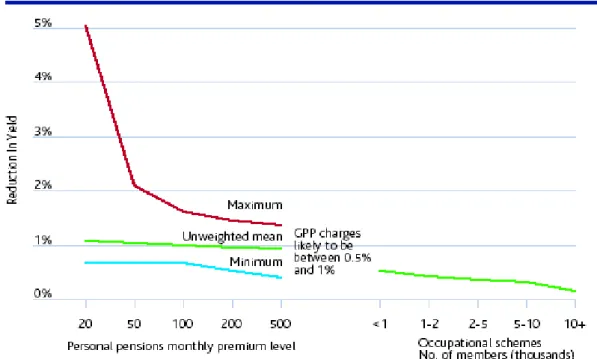
Administrative costs are important, with very different costs for different types of scheme. As Figure 1, from the First Report of the Pensions Commission, shows, individual accounts tend to have higher charges and occupational schemes lower; state schemes are generally the cheapest to run. Figure 1 also shows that the unweighted mean annual management charge for personal pensions in the UK is about 1 per cent of a person’s pension accumulation. Under plausible assumptions, a charge of 1 per cent over a working life will reduce the accumulation by about 20 per cent (Diamond, 2004, p.3), that is, a person’s pension will be 20 per cent lower than otherwise for each 1 per cent of administrative charge. Clearly, a major issue for policy makers is the way in which pensions generally, and charges in particular, are regulated, a central issue in Nugée and Persaud (2006, this volume).
[Figure 1: Administrative costs of pension schemes in the UK: about here] Among the benefits claimed for individual accounts are (a) that they increase individual choice and (b) that they attract a higher return to pension accumulations. Given the information problems discussed above, the welfare gains from the first and the magnitude of the second can both be questioned. Whatever their importance, they cannot be considered in isolation but alongside the costs of individual accounts, notably (c) greater risk and
(d) higher administrative costs. It is necessary also to take into account distributional issues: administrative costs are largely a fixed cost per account; thus, charges, if they parallel costs, bear most heavily on small accounts.
The issue of administrative costs arises in many of the papers. Sundén questions whether it is cost effective for the Swedish system to offer workers such a wide choice of providers of individual accounts, pointing to the much lower costs of the default state
scheme. She also points out that ‘plan implementation has been more costly and complicated than anticipated’ (p. **15 pdf).
Arenas and Mesa Lago make two points: that, taking Latin America as a whole, administrative costs of private schemes were considerably higher than of public schemes; and that in Chile, far from falling over time, administrative costs have if anything increased over the 25 year life of their private system.
Sweden has sought to address these issues through a clearing house model, whereby the administration and maintenance of individual accounts is centralised. Another scheme with this characteristic is the Thrift Savings Plan, offered to civil servants in the USA (see http://www.tsp.gov). The scheme offers civil servants a severely constrained range of choice (currently five broadly-based funds); the accounts are maintained centrally; and fund
management is on a wholesale basis, that is, the fund manager knows only the total volume of resources to be managed, not the details of which worker owns how much. As a result, administrative costs are astonishingly low – currently well below one-tenth of 1 per cent of a person’s accumulation.12 The approach is of potential interest to developing countries where institutional capacity is limited, and to advanced countries particularly for low earners or people with patchy employment records.
For precisely such reasons, the UK Pensions Commission (2005) (see the paper by Hills) proposed a National Pensions Saving Scheme, in which the government holds the ring in establishing simple, reliable savings products with very low administrative costs.
3.5 The role of government
Directly connected with the three sets of issues just discussed, a final theme is the major role of government in pensions in all countries, irrespective of the specific configuration of arrangements. Governments are involved in the following ways.
• As a response to serious information problems and other forms of market
imperfections, discussed in the papers by Barr and Diamond and by McCarthy. These problems means that purely private arrangements for insurance and consumption smoothing will be either inefficient or non-existent.
• To provide poverty relief and bring about redistribution. • To reduce administrative costs.
12
• As a response to political pressures. Some of these pressures relate to the popularity of state schemes, which in some countries are seen as more reliable than private ones. One interpretation of the US debate discussed by Thompson is that radical reform failed because the electorate wanted to protect the current PAYG scheme. The New Zealand referendum discussed above makes a similar point. A second set of pressures is for government to regulate private schemes and perhaps to offer some guarantees to their members.
4 Policy directions
There is a range of ways of adjusting pension systems to rising numbers of older people, including lower pensions (section 4.1), higher contributions (4.2), and later retirement (4.3). Economic growth can assist the process of adjustment, so policies to encourage growth, such as increased saving, are also an important part of the picture (section 4.4).
4.1 Lower pensions
Faced by larger numbers of pensioners, most countries have adopted one of two strategies. The first is largely to ignore the problem. Thus pension spending rises broadly in line with the number of pensioners, as in a number of countries in the wider EU. This approach creates fiscal problems now, with worse to follow. However, as Whiteford and Whitehouse note, the need to reduce pension spending should not weaken safety nets for poor pensioners. If, as in some countries, pensions are tightly linked to previous earnings, the risk is that safety-net elements become inadequate. The point is important: the objectives of pensions include both poverty relief and consumption smoothing; it is a vulgar error, discussed by Barr and
Diamond, to focus exclusively on one objective, ignoring others.
A second widespread strategy has been to reduce the average pension. This approach avoids fiscal problems, but at the risk of pensioner poverty. In the UK, the strategy since the mid-1980s has been to lower the average state pension relative to the average wage, relying on means-tested supplements to alleviate elderly poverty.
In Sweden, as Sundén notes, the effect of introducing notional-defined contribution pensions was to reduce pensions: ‘replacement rates are likely to be lower in the new system compared to the old’ (p. **12 pdf). The point is important. Notional defined-contribution schemes, whatever, their other advantages, do not per se solve the demographic problem; what they do is to bring in a system in which expenditure does not exceed income; the resulting replacement rate may or may not be compatible with effective poverty relief.
As well as moves towards lower pensions, Whiteford and Whitehouse also note a parallel trend, the tendency for reforms to transfer more of the pension risk towards individual workers.
4.2 Higher contributions
Contributions have tended to rise over time: by increasing the percentage rate of contribution; by raising the ceiling on income on which contributions are levied; or (an implicit reduction in benefits) by increasing the number of years of contribution to get a full pension.
4.3 Later retirement
People are living longer; this is a wonderful thing – longer healthy life, it can be argued, is the greatest achievement of the twentieth century. The term ‘the ageing problem’ thus grotesquely misses the point. The problem is not that people are living longer but that they retire too early. If we were designing a pension system for a new planet whose native life form was living longer and longer, we would not choose a retirement age fixed for all time at 65. The logic is (a) that workers should retire later, but (b) that each person should have more choice over the move from full-time work to retirement.
The UK story is illustrated by Figure 2. A man who retired in 1950 on average had left school aged 14; in 1950 the average age of exit from the workforce was 67, i.e. 53 years after leaving school; and remaining life expectancy at that age was 11 years. Thus a worker of that generation contributed for nearly 5 years for each year of retirement. In contrast, a man retiring in 2004 left school at 16 and, on average, left the labour force at age 64, at which age remaining life expectancy was 20 years – thus he contributed for slightly less than 2.5 years for each year of retirement.
[Figure 2: UK: Life course, men retiring in 1950 and 2004: about here] In comparing men retiring now with their grandparents’ generation:
• Retirement is earlier, on average 64 rather than 67. • Life after retirement is longer, 20 years rather than 11. In addition, today:
• Working hours are shorter (in 1950 a 5½ day work week was typical). • Holidays are longer.
• The data refer to people who reached retirement age in 1950 and 2004; more people failed to do so in 1950 and hence are not included in the figures.
Later retirement is picked up in most of the papers. Whiteford and Whitehouse point out that men on average are still in the workforce at 65 in some countries but on average have left by 60 in others, and emphasise the importance of increasing employment to population ratios, especially increasing employment at older ages. They go on to point out that
‘sensitivity estimates … indicate that if the labour force participation of older workers increased by 10 percentage points between 2000 and 2050, … , total [spending on] old age pensions (as a percentage of GDP) could be reduced on average by 0.6 percentage points’ p. **6 pdf, emphasis added).13 Thompson’s conclusion makes the same point about the USA, that, ‘sooner or later there will have to be a further adjustment in the retirement age. Next time, however, the increase needs to be in both the normal retirement age and the age of first eligibility to avoid further depressing monthly benefits.’ (p. **17 pdf).
The US case is interesting. It was decided many years ago, as an explicit response to population ageing, that the age at which a person can receive a full pension should increase over time from 65 to 67; however, the earliest age at which a person can receive a pension from the social security system remained (and remains) at 62. The only other OECD countries thus far to have taken steps to raise pensionable age above 65 are Norway and Iceland.
As discussed by Hills, the UK Pensions Commission (2005) suggests that state pensionable age in the UK, currently 65, should rise after 2020 by about one year every decade reaching 68 or 69 by 2050 (for a supportive assessment, see Barr, 2006).
Sweden is one of few countries explicitly to enlarge choices about the move from full-time work. As Sundén notes, from the age of 60, workers have the option of drawing part of their pension while continuing to work part time, with their remaining pension entitlement continuing to grow actuarially.
Though the case for later retirement is strong, pension design needs to minimise unintended regressive effects which can arise in badly-designed schemes. For example, Sundén points out that under the old Swedish scheme, swept away by the 1998 reforms, ‘Contributions were paid on all earnings from age 16 until retirement, while benefits were based only on the 15 years with highest earnings. Thus, the formula redistributed income from those with long working lives and a flat life-cycle income (typically low-income workers) to those with shorter work histories and rising earnings profiles (typically high-income workers)’ (p. **4 pdf) .
13
Raising retirement age has analogous regressive effects, since workers from poorer backgrounds typically start work earlier and hence make contributions for longer, but have a shorter life expectancy than better-off workers. It can be argued that pension design alone cannot solve problems of wider inequality, which require a broad range of policies including nutrition, health care, occupational safety, and education and training. But at a minimum it suggests a potential role for other instruments, notably disability pension, to reduce
regressivity.
These considerations suggest a strategy which includes:
• An initial retirement age that makes it fiscally possible to provide a genuinely adequate state pension.
• A subsequent retirement age that rises gradually in a rational and transparent way as life expectancy increases.
• Labour market development, in particular flexibility that allows people to move from full-time work towards full retirement along a phased path of their choosing.
• Pensions development, in particular arrangements that do not distort decisions about choices intermediate between full-time work and full retirement.
• Development of policies to reduce any regressive effects of later retirement.
4.4 Pensions, saving and growth
At a given level of national output, these three policies – lower pensions, higher
contributions, or later retirement – are only mechanisms for dividing that output in different ways between workers and pensioners, that is, a zero-sum game. Higher contributions place more of the burden on workers, lower pensions more on people who have retired. Higher output, other things equal, enlarges the contributions base and thus makes it possible to spend more on pensions without increasing contribution rates.
Thus policies to promote growth are an important part of the response to population ageing. It is often suggested that there is a strong link between funded pensions and growth hence, it is argued, a move towards funding assists the response to demographic change. This argument is scrutinised in the Barr-Diamond paper, which concludes that the relationship between funding and growth is neither simple nor automatic.
• Funding may or may not increase saving. It will fail to do so, for example, if an increase in mandatory pension savings is offset by reduced saving elsewhere in the economy.
• An increase in saving may or may not increase output. Inefficient capital markets may lead to a low marginal product of investment as, for example, in Central and
Eastern Europe and the former Soviet Union in the latter years of communism. Separately, it may not be right to argue that additional savings are always translated into productive investment via adjustments in the interest rate – the Keynesian
argument that higher saving together with sluggish investment may lead to stagnation rather than growth may not be wholly dead.
• The fact that funding may increase saving does not mean that the policy is necessarily optimal. In a country with an exceptionally high rate of saving, China for example, yet further increases in saving might well be suboptimal.
• Even where funding is the optimal policy in principle, it may not be feasible, the answer depending on whether the country has the necessary institutional capacity. Output growth is of central importance in addressing population ageing, and funding may be helpful in that context. However, the case depends on country specifics. Thus policy needs to consider growth-enhancing policies more broadly. One approach is to increase the productivity of each worker, (a) through more and better capital equipment and (b) by improving the quality of the labour force through more education and training. A second approach is to increase the number of workers from each age cohort. Such policies include (c) policies to increase labour supply, for example, by married women by offering better childcare facilities, (d) raising the age of retirement, (e) importing labour directly, for example, through more relaxed immigration rules, and (f ) importing labour indirectly by exporting capital to countries with a young labour force.
The fundamental conclusion is that policy makers should consider the entire menu of pro-growth policies, rather than placing undue weight on a single policy.
5 Conclusion
Many conclusions can be drawn from the preceding analysis. I want to suggest four.
• Two things matter above all: effective government and economic growth. Effective government is essential however pensions are arranged. PAYG pensions require that governments can collect contributions, have the necessary fiscal capacity, and have the political capacity to remain within plausible fiscal limits. Private pensions require that government can maintain macroeconomic stability (essential to sustain
accumulated funds) and can regulate financial markets effectively. Output growth, though not essential is helpful; without it, any policy for pensions will be a zero-sum game between workers and pensioners.
• Avoid red herrings. In particular, the debate between PAYG and funding, though important, is not central to addressing population ageing.
• One size does not fit all. Good pension schemes can take many forms, evidenced by the wide range of different arrangements in the OECD and more broadly.
• There is a problem but not a crisis. The problem is not rising life expectancy but more pensioners and longer retirement. An obvious variable in the cost equation is the average age at which people first collect their pension. As Figure 2 shows, there is room for raising this age over time in a way that allows future generations to have as much – or more – retirement than the present generation. Thus there is an
References
Arenas de Mesa, Alberto, and Mesa Lago, Carmelo (2006), ‘The structural pension reform in Chile: Effects, comparisons with other Latin American reforms, and lessons’, Oxford Review of Economic Policy, 22(1).
Banks, James, Emmerson, Carol, Oldfield, Zoë, and Tetlow, Gemma (2005), Prepared for retirement? The adequacy and distribution of retirement resources in England, London: Institute for Fiscal Studies.
Banks, James, and Smith, Sarah (2006), ‘Retirement in the UK’, Oxford Review of Economic Policy, 22(1).
Barr, Nicholas (1979), ‘Myths My Grandpa Taught Me,’ Three Banks Review, No. 124 (December), pp. 27–55, reprinted in Nicholas Barr (ed.) Economic Theory and the Welfare State, Edward Elgar Library in Critical Writings in Economics, (Edward Elgar, 2001), Vol. II, pp. 83-111.
Barr, Nicholas (2001), The Welfare State as Piggy Bank: Information, Risk, Uncertainty, and the Role of the State, London and New York: Oxford University Press.
Barr, Nicholas (2006), ‘Turner gets it right on pensions’, Prospect, January, pp. 48-50. Barr, Nicholas and Diamond, Peter (2006), ‘The Economics of Pensions’, Oxford Review of Economic Policy, 22(1).
Barr, Nicholas and Diamond, Peter (forthcoming), Reforming Pensions: Principles and an Application to China, New York and Oxford: Oxford University Press.
Cohen, Norma (2005), ‘A bloody mess’, American Prospect, February.
Dasgupta, Partha (2001), Human Well-Being and the Natural Environment, New York and Oxford: Oxford University Press.
Diamond, Peter A. (2004), ‘Social Security’, American Economic Review 94/1, (March), pp. 1-24.
Diamond, Peter A. (2006), ‘Reforming public pensions in the US and the UK’, Economic Journal, 116/509, pp. F94-F118.
Economic Policy Committee of the European Union (2006), The impact of ageing on public expenditure: projections for the EU25 Member States on pensions, health care, long-term care, education and unemployment transfers (2004-2050), Special Report no. 1/2006, Brussels: European Commission Directorate-General for Economic and Financial Affairs, http://europa.eu.int/comm/economy_finance/publications/european_economy/2006/eespecialr eport0106_en.htm.
Gill, Indermit S., Packard, Truman, and Yermo, Juan, with Pugatch, Todd (2005), Keeping the Promise of Social Security in Latin America, Washington DC: The World Bank, and Stanford, California: Stanford University Press.
Heal, Geoffrey (1998), Valuing the Future, New York: Columbia University Press. Hills, John (2006), ‘A New Pension Settlement for The Twenty-First Century? The UK Pensions Commission’s Analysis and Proposals’, Oxford Review of Economic Policy, 22(1). McCarthy, David (2006), ‘The Rationale for Occupational Pensions’, Oxford Review of Economic Policy, 22(1).
Mullan, Phil (2000), The Imaginary Time Bomb: Why an Ageing Population is not a Social Problem, I.B Tauris.
Nugée, John and Persaud, Avinash (2006), ‘Redesigning Regulation of Pensions and Other Financial Products’, Oxford Review of Economic Policy, 22(1).
OECD (2006), Ageing and Employment Policies: ‘Live Longer, Work Longer’, Paris: OECD. Sundén, Annika (2006), ‘The Swedish experience with pension reform’, Oxford Review of Economic Policy, 22(1).
Thompson, Lawrence H. (2006), ‘The US retirement income system’, Oxford Review of Economic Policy, 22(1).
UK Pensions Commission (2004), Pensions: Challenges and Choices: The First Report of the Pensions Commission, London: TSO, 2004, downloadable from
http://www.pensionscommission.org.uk
UK Pensions Commission (2005), A New Pension Settlement for the Twenty-First Century: Second Report of the Pensions Commission, London: TSO, 2005, downloadable from
http://www.pensionscommission.org.uk
US GAO (2005), Social Security Reform: Other countries’ experiences provide lessons for the United States, Report GAO-06-126, Washington DC: Government Accountability Office.
Whiteford, Peter, and Whitehouse, Edward (2006), ‘Pension Challenges and Pension Reforms in OECD Countries’, Oxford Review of Economic Policy, 22(1).
Figure 1: Administrative costs of pension schemes in the UK Source: UK Pensions Commission (2004, Figure 6.9)
Figure 2: UK: Life course, men retiring in 1950 and 2004 16.2 14.1 47.6 53.1 20.1 10.8 0 10 20 30 40 50 60 70 80 90 2004 1950
Education, work and retirement
Source: author’s calculations based on Banks and Smith (2006, Table 2), Labour Force Survey, and UK Pensions Commission (2004, Figure 2.8).