Mount Royal Undergraduate Education Review
______________________________________________________________________
Volume 1(1) Spring 2014
____________________________________________________________________________ Inquiry based learning and technology, negative or positive?
Rebecca Medeiros, Mount Royal University Abstract
In this research paper, the conflicts with the implementation of inquiry based learning and digital technology into an elementary school setting are explored. They are investigated under the grounds of an inquiry-based research study conducted mainly through online surveys. This survey was important because there were two deployed: one to current teachers and one to future teachers. The aim was to discover what conflicts teachers were having with inquiry based
learning and whether or not technology was a negative or a positive attribute with the implementation of inquiry based learning (IBL). Also, I wanted to discover what future educators think about their future teaching roles and whether or not they will use digital
technologies to help with IBL in the classroom. The participants were Mount Royal University Education students as well as K-9 teachers and staff throughout several schools in Calgary, Alberta. Analysis from the surveys and written responses will document the practicing teacher and future teacher perspectives on inquiry based learning through digital technologies.
Introduction
As time moves on digital technologies continues to develop and evolve. Through this passing time we are becoming more technologically advanced and more receptive to new resources and new ways of learning. A conflict we have been facing as educators over the past few years is with regards to the implementation of an inquiry based approach to learning (IBL) in elementary education. IBL is seen as providing the students with opportunities to ask questions and discover the answers on their own. We are now beginning to focus on how digital
technologies apply to IBL. This purpose of this study was to investigate and identify peers and educators’ perspectives regarding the struggles with the implementation of IBL. I wanted to see how technology applies to this and, if it is a beneficial aspect that will positively influence IBL.
I am interested in this topic because during my research I discovered that a lot of educators are afraid to implement IBL in their classrooms because of the challenges they might encounter. I wanted to investigate if technology could be a changing factor in this concept and maybe ease educators in to an inquiry based approach to learning. I myself am aware of the benefits of IBL through technology and I want to be able to someday positively use this method in my classroom. Although I am aware of some of the benefits I am still learning and I am confused about the right way to implement IBL. This study has helped me further my knowledge and share with you the conflicts and benefits of how to use or implement IBL through the use of digital technologies.
Background
I begin the background for my research study with an attempt to define inquiry based
pre-distinguished traditional learning from IBL by stating that “Traditional hands-on teaching allows for a very teacher directed and controlled form of teaching, whereas student research demands that the teacher acquire a less directed and more hands-off role in the teaching process” (p.148). The author’s explanation in my opinion is that traditional teaching does not allow for the
students to have much freedom or options in their learning process. Student research provides them with this opportunity to explore and learn for themselves. The ultimate goal of teaching is to provide your students with the skills and information to complete the schooling process without you. Giving them this opportunity allows them to use an inquiry side of learning to explore and ask questions leading to an IBL approach. The study outlined in this article was based on the National Science Education (NSE) Standards (Hayes, 2002):
A. Guiding students in developing their own questions to examine.
B. Providing meaningful concrete experiences from which such questions can be generated.
C. Facilitating open-ended long-term student investigations.
D. Fostering a community of learners who work cooperatively in their investigations.
These NSE standards are linked to creating IBL studies in elementary science programs. They are the outcomes of elementary science learning and they are all related to IBL. IBL is based on following a question and seeing where it can take you. The only difference is that this model is for a science based program when I think it could be integrated into any elementary schooling program.
The next article I examined focused on a summer program workshop that was meant to aid teachers with finding an understanding and participating in an IBL program (Akerson et al., 2009). They designed the program to provide teachers with an experience of how “real”
teachers participating in the study saw science in a perspective that was modeling,
communicating results, and observing the data. Post program, the teachers’ viewpoint on the nature of science changed as well. They found that scientists used creativity to figure things out and to construct conclusions. This is now what the teachers are trying to develop for their elementary students. The ability to form questions and explore the answers, which is what scientists are doing in their research. This workshop demonstrated to teachers how it is possible to use this methodology in an elementary classroom. (Akerson et al., 2009).
The last article I reviewed discussed IBL and technology and what this meant for elementary students (Owens, Hester, & Teale, 2002). The authors’ discussed the formal process of IBL as being where you select a topic, formulate questions, synthesize the
information, and then do something with it. The article moves into technology and the fact that technology is with us daily. It is something that is always changing and we cannot fight it or get rid of it. The only solution is to embrace technology and learn how to use it in a way that benefits us. Digital technologies can aid in IBL because when students are interested in a topic and they pose their questions they need to look somewhere to find the answers. Yes, the Internet has its flaws but there are by far more benefits such as, communication with experts around the world. You may not be an expert on every child’s topic but someone out there is! You can use the Internet to connect with these experts and get your questions answered. Using technology also allows the children to get out of the classroom frame of mind and think in a “real world” setting. Other people have these questions to and the idea of seeing the other information makes the children feel connected to the outside world. (Owens, Hester, & Teale, 2002).
Research Context and Methods of Investigation
The majority of my research data was collected from online surveys I created and sent out through Google Forms. Two surveys were created, one specifically for elementary education students at Mount Royal and one for current teachers enrolled with the local school board. The surveys were anonymous and the participants had the opportunity to skip questions they felt uncomfortable with or preferred not to answer. Prior to sending out these surveys I completed my TCPS 2: Core- Ethical Conduct for Research Involving Humans Course on Research Ethics, which was designed by the Government of Canada. The data from these surveys was gathered into a Google Spreadsheet that allowed for easier data analysis. The purpose of my surveys was to gain a better understanding about the use of digital technologies to support an inquiry based approach to learning in elementary education. I wanted to compare the viewpoints of pre-service education students and practicing elementary teachers. The elementary teacher survey focused more on what their experience was and their knowledge of IBL because some of them may have been teaching for years and it may be a relatively new concept.
The pre-service education student survey consisted of ten questions with a mix of multiple choice and short answer responses. I was able to receive 32 student responses to my survey from Mount Royal Education students. The questions asked the students to: rate their level of confidence with defining IBL, plans to integrate IBL in their future classrooms, whether they think IBL a negative or positive aspect to the classroom, ways in which they use technology daily, if and why technology is important to use in the elementary classroom, whether
technology is helpful when it comes to IBL, and if they chose an IBL approach in their future teaching practice would they use technology, and what ideas do you have for using technology to help further inquiry based learning? With the data I collected I was able to gain a better
understanding of why teachers are willing to use IBL with technology but, also what are some of their concerns. I hope that this study will clarify the benefits of technology and IBL for some of the unsure future educators.
The teacher survey consisted of ten questions as well with a mix of multiple choice and short answer. I was able to collect 14 responses from teachers and staff in Calgary. The questions asked to teachers were: rate your level of confidence with defining IBL, how many years have you been teaching, how often is IBL taking place in your classroom, if you are using it, what are the positives/ negatives, if not, what are your reasons for this, how often are you using
technology in the classroom, is technology a positive or negative factor in regards to IBL implementation, explain, when students do use technology is the work individual, on a personal note would you rather work with technology or other methods in the classroom. My questions allowed me to get a well rounded response on perspectives of IBL and the use of digital technologies.
The written responses from the online surveys provided me with a lot of insight, which helped to form a series of recommendations and conclusions. The majority of my findings were summarized using a Google Spreadsheet to construct charts and graphs. In summary, the online summaries were my main source of data for this research study.
Findings
I have been able to use charts and graphs that I constructed with a Google Spreadsheet to analyze and display my data findings. These findings were generated from my pre-service education student survey, which had 32 responses and my teacher survey, which had 14 responses.
Pre-service Education Student Results
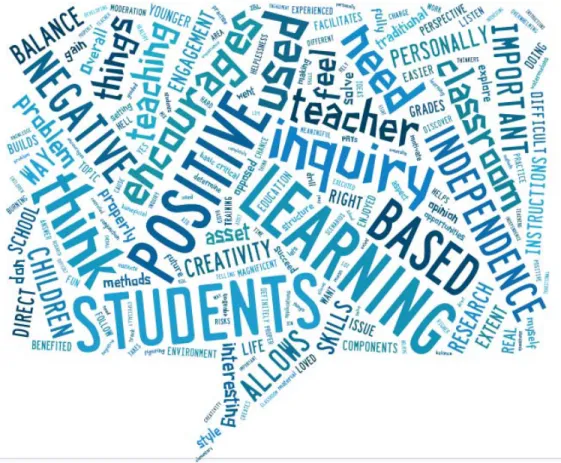
My first survey question asked pre-service education students to describe their impressions of inquiry based learning. The following word cloud was generated from the responses in the Tagexdo application (Figure 1).
Figure 1. Education student impressions of inquiry based learning
The resulting word cloud demonstrates that many participants believe that inquiry based learning can have a positive impact on student learning while some believe a balance is required between inquiry and teacher directed approaches to learning.
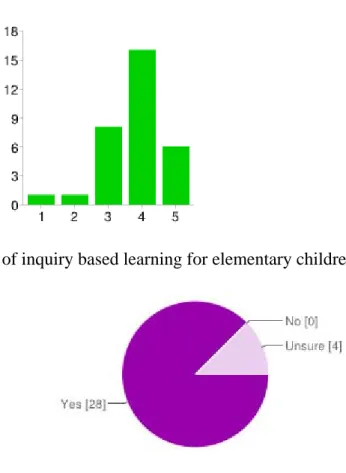
The next question asked the pre-service education students to rate their confidence in being able to define inquiry based learning (Figure 2).
Figure 2. Confidence with defining inquiry based learning.
Figure 2 demonstrates that one pre-service student was not confident at all, while two were completely confident. The majority of student participants where somewhat confident in their ability to define inquiry based learning.
I was then curious to determine how many education students were interested in fully integrating an inquiry based learning approach in their future teaching practice (Figure 3).
Figure 3. Interest in fully integrating an inquiry based learning approach into future teaching practice
Out of those surveyed, 44% said that they want to make this change happen and have inquiry based learning be the foundation of their classroom. This means that 56% of participants are unsure or don’t want to fully implement inquiry based learning in their classroom.
Figure 4. Daily use of technology devices
The results demonstrate that all education students who completed the survey use their cell phones and laptops on a daily basis while they also sometimes use a tablet device and a music player. These findings demonstrate that education students are using technology in their daily lives, so potentially they may be able to use these digital devices to help with the
implementation of inquiry based learning.
The next question asked the students if they thought that digital technologies could be helpful in supporting an inquiry based approach to learning (Figure 5).
Figure 5. Helpfulness of digital technologies to support an inquiry based approach to learning The survey results illustrate that 91% of the student participants indicate that technology would be helpful to implement inquiry based learning.
I also wondered if the education students thought that inquiry based learning was important for elementary children and if the pre-service education students would use digital technologies to support an inquiry based approach to learning in their future teaching practice
(Figures 6 and 7).
Figure 6. Importance of inquiry based learning for elementary children
Figure 7. Support for using digital technologies to support inquiry based learning in future teaching practice
The vast majority of the education students surveyed (94%) indicated that inquiry based learning was important and 88% stated that they would use digital technologies to support inquiry in their future teaching practice. Based on the analysis of the education student survey, the results indicate that the majority view IBL as a positive approach to learning and many students believe that it is important and should be implemented in the elementary classroom. Digital technologies provide a tool set for elementary students to conduct their own research and to explore of new ways of learning, which are key components for inquiry based learning
fairly comfortable with using IBL in their future classroom. People are realizing that digital technologies surround us and since we are still in the schooling process we have an opportunity to learn about these new advances, first hand. We need to embrace the technology, learn how to use it, and work together to use them in the elementary classroom to our advantage.
Practicing Teacher Results
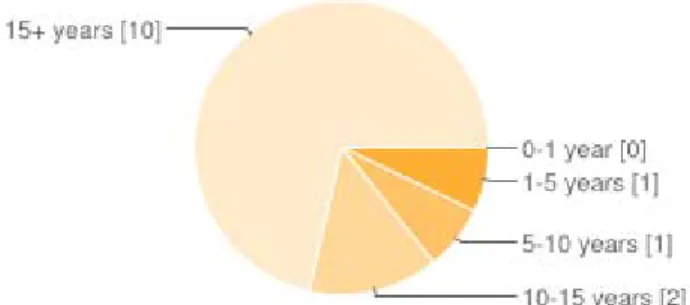
The first survey question for the practicing teachers asked them to identify how many years they have been teaching (Figure 8).
Figure 8. Years of teaching experience
The results indicated that the majority (71%) had been teaching for 15+ years, which indicates that the teachers who took part in this study have numerous years of experience with the Calgary Board of Education (CBE) and the elementary schooling process.
The next question asked teachers to rate their confidence with defining inquiry-based learning (Figure 9).
The results showed that teachers felt more confident in their ability to define inquiry based learning in comparison to the education students.
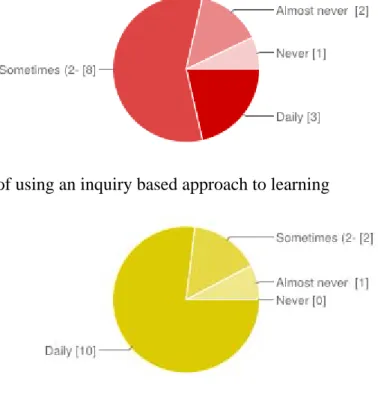
I was curious to discover how often these teachers used an inquiry based approach to learning in their elementary classrooms and how often they used digital technologies (Figures 10 and 11).
Figure 10. Frequency of using an inquiry based approach to learning
Figure 11. Frequency of using digital technologies
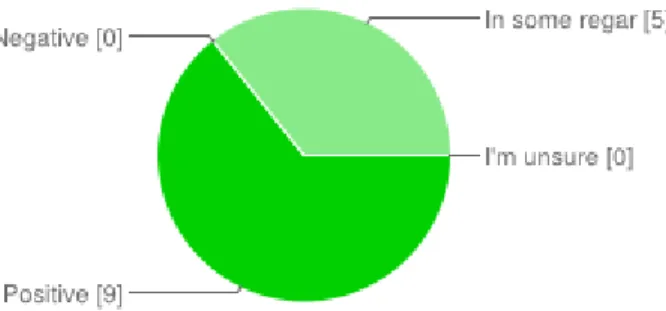
Only 21% of the teachers reported that they used IBL on a daily basis and 57% indicated sometimes. With regards to digital technologies, 77% of the teachers surveyed said that digital technologies were used on a daily basis in their classrooms, although not exclusively for IBL. Teachers surveyed were also asked if they looked at technology as a positive or negative factor in regards to the implementation of IBL (Figure 12).
Figure 12. Teacher perspectives about using digital technologies to support IBL
I was impressed to see that 0% of those surveyed had a negative perspective of using technology to support IBL. Some teachers still have their doubts about technology and IBL but everyone is able to see at least some benefits.
The final question asked teachers whether digital technologies promoted individual student work or reliance on teacher directed instruction (Figure 13).
Figure 13. Impact of digital technologies on elementary students’ work
The response came back with 0% of teachers saying that technology inspired individual work and that most student work required some teacher assistance.
Overall, the results of my practicing teacher survey suggest that digital technologies have a positive impact on elementary classrooms because they provide so many opportunities for research and exploration but these devices can be unpredictable. The unpredictability is often due to the teacher’s lack of knowledge about how to properly use digital technologies and their lack
of ability to trouble shoot technical problems. Most of teachers surveyed believe that digital technologies are a catalyst or a step in the right direction to help get other teachers on board with IBL in elementary schools. Both education students and practicing teachers surveyed can see the benefits of IBL and technology in a positive way, now we just need to make the switch to ease the fear and make it happen in the elementary school system.
Conclusion
Overall, this research study has helped me to understand some of conflicts that educators are having in regards to the implementation of IBL and digital technology. Through my
education student and practicing teacher survey results I was able to see that awareness of IBL is improving but many are still confused with what IBL actually is. Not many people feel 100% confident in their ability to define IBL, and if you aren’t aware of what it is, how are you
supposed to feel comfortable with implementing it into your own classroom. We need to create a general awareness of IBL and educate the teachers through workshops about how we can use it to our advantage in the elementary classroom.
Digital technologies can help with the integration of IBL because technology and the Internet provide many opportunities to search for the answers to our inquiry questions. IBL is asking questions based on a topic of your interest and trying to find the answers. Technology provides you with a database of experts and resources at the type of a keyboard. The Internet allows you to have worldwide contact outside of the school, which creates that “real world” experience where you are living outside of the classroom. Providing elementary students with this opportunity to have IBL experiences makes them excited. They have an opportunity to explore topics that interest them and it makes them realize that their ideas are linked to the
This study is important to me because as a future educator learning more about the benefits of IBL in the elementary classroom will help me provide my students with as many rich learning opportunities as possible. I think that giving the students the opportunity to ask
questions and find the answers themselves is an important life skill. When students are able to find the answers themselves it provides a sense of self reliance and accomplishment. IBL to me creates individual driven learners and the goal of teaching is to provide your students with the skills to find the answers themselves and work without you. They can use you for guidance but a sign that you have done a great job is if your students are able to get the work done without relying on you for lots of assistance.
Learning through the analysis of the online survey data enabled me to also get an insight into a practicing teacher's eye regarding IBL and technology in the classroom. I was able to see from experts what they are identifying as problems currently in their own classrooms. With these results, I was able to see why some educators use a different approach from IBL in the classroom and most of what I discovered was that it was easier to use a different route. Some teachers preferred to use worksheets or textbooks for math because it was easier than trying to figure out how to use an inquiry approach. Currently, we are still discovering how to make the
implementation of IBL easier with technology for all subjects in the elementary classroom. For future research, I would like to discover why digital technologies are not helping to create individual work that is question driven in most elementary classrooms. I’ve always believed that technology would allow the students to work individually and focus on creating their own ideas. After the survey results came back, teachers said that the students were still relying heavily on teachers during technology work. The main reason being because technology is unpredictable and can have many glitches. I would like to investigate how to make technology
more individually driven and from what I am able to tell right now the answer would be inquiry. If children knew how to ask the right questions and how to find reliable sources I believe that IBL and technology would be independently driven in the classroom.
Resources
Akerson, V. L., Townsend, J. S., Donnelly, L. A., Hanson, D. L., Tira, P., & White, O. (2009). Scientific modeling for inquiring teachers network (SMIT’N): The influence on
elementary teachers’ views of nature of science, inquiry, and modeling. Journal of Science Teacher Education, 20(1), 21-40.
Hayes, M. T. (2002). Elementary pre-service teachers' struggles to define inquiry-based science teaching. Journal of Science Teacher Education, 13(2), 147-165.
Owens, R. F., Hester, J. L., & Teale, W. H. (2002). Where do you want to go today? inquiry- based learning and technology integration. The Reading Teacher, 55(7), 616-625.