Programming in VB .NET
From Novice to Professional
DANIEL CAZZULINO
VICTOR GARCIA APREA
JAMES GREENWOOD
CHRIS HART
Beginning Visual Web Programming in VB .NET: From Novice to Professional
Copyright © 2005 by Daniel Cazzulino, Victor Garcia Aprea, James Greenwood, Chris Hart
All rights reserved. No part of this work may be reproduced or transmitted in any form or by any means, electronic or mechanical, including photocopying, recording, or by any information storage or retrieval system, without the prior written permission of the copyright owner and the publisher.
ISBN (pbk): 1-59059-359-6
Printed and bound in the United States of America 9 8 7 6 5 4 3 2 1
Trademarked names may appear in this book. Rather than use a trademark symbol with every occurrence of a trademarked name, we use the names only in an editorial fashion and to the benefit of the trademark owner, with no intention of infringement of the trademark.
Lead Editor: Ewan Buckingham Technical Reviewer: Victor Garcia Aprea
Editorial Board: Steve Anglin, Dan Appleman, Ewan Buckingham, Gary Cornell, Tony Davis, Jason Gilmore, Chris Mills, Dominic Shakeshaft, Jim Sumser
Assistant Publisher: Grace Wong Project Manager: Beckie Stones Copy Manager: Nicole LeClerc Copy Editor: Marilyn Smith
Production Manager: Kari Brooks-Copony Production Editor: Kelly Winquist Compositor: Dina Quan
Proofreader: Katie Stence Indexer: Kevin Broccoli Artist: Kinetic Publishing Cover Designer: Kurt Krames
Manufacturing Manager: Tom Debolski
Distributed to the book trade in the United States by Springer-Verlag New York, Inc., 233 Spring Street, 6th Floor, New York, NY 10013, and outside the United States by Springer-Verlag GmbH & Co. KG, Tiergartenstr. 17, 69112 Heidelberg, Germany.
In the United States: phone 1-800-SPRINGER, fax 201-348-4505, e-mail [email protected], or visit http://www.springer-ny.com. Outside the United States: fax +49 6221 345229, e-mail [email protected], or visit http://www.springer.de.
For information on translations, please contact Apress directly at 2560 Ninth Street, Suite 219, Berkeley, CA 94710. Phone 510-549-5930, fax 510-549-5939, e-mail [email protected], or visit http://www.apress.com. The information in this book is distributed on an “as is” basis, without warranty. Although every precaution has been taken in the preparation of this work, neither the author(s) nor Apress shall have any liability to any person or entity with respect to any loss or damage caused or alleged to be caused directly or indirectly by the information contained in this work.
The source code for this book is available to readers at http://www.apress.comin the Downloads section. You will need to answer questions pertaining to this book in order to successfully download the code.
to be as supportive with you as you have been with me. You have been the most amazing companion I could have ever dreamed of.
To Agustina, my little baby, for giving me yet another reason to love working at home. Watching you grow every day up close is a great gift
from God (I hear Any say I shouldn’t be *just* watching :o)). To my father, for being such a life warrior. I’ll never give up, just as you never do. Thanks for staying with us and giving me the opportunity of making you feel proud of me. I can clearly see now that it wasn’t your
time, and God really wanted you to see everything that came after. To all my girls, mum and sisters, for showing me what great women
look like. I must listen to you more. I’m working on that. To my dear friends (you know who you are), for always being there and bringing me back to earth. Talking to you makes me understand there’s a
beautiful life outside (along with?) .NET.
To Olga, for being like a second mother, and to Pedro, for doing all the things I should do at home so I can spend more time programming, without getting Any mad at me. I never thank you enough. With regards
to Pedro, it’s already too late. I hope I never make that mistake again. We miss you a lot.
Contents at a Glance
About the Authors
. . . xvAbout the Technical Reviewer
. . . xviiAcknowledgments
. . . xixIntroduction
. . . xxiCHAPTER 1
Environment and Architecture
. . . 1CHAPTER 2
Web Development in .NET
. . . 29CHAPTER 3
User Interfaces and Server Controls
. . . 59CHAPTER 4
ADO.NET
. . . 117CHAPTER 5
Data Binding
. . . 155CHAPTER 6
ASP.NET State Management
. . . 207CHAPTER 7
Markup Languages and XML
. . . 259CHAPTER 8
XML and Web Development
. . . 293CHAPTER 9
Web Services in Web Applications
. . . 343CHAPTER 10
ASP.NET Authentication, Authorization, and Security
. . . 389CHAPTER 11
Debugging and Exception Handling
. . . 421CHAPTER 12
Caching and Performance Tuning
. . . 475CHAPTER 13
Publishing Web Applications in .NET
. . . 521APPENDIX A
The Friends Reunion Application
. . . 567APPENDIX B
Management of IIS and MSDE
. . . 573INDEX
. . . 595About the Authors
. . . xvAbout the Technical Reviewer
. . . xviiAcknowledgments
. . . xixIntroduction
. . . xxi■
CHAPTER 1
Environment and Architecture
. . . 1Web Application Considerations
. . . 1The Web Model
. . . 2Desktop Applications vs. Web Applications
. . . 3Web Servers and Web Clients
. . . 4System Configuration for Web Development
. . . 7Installing and Configuring IIS for .NET Web Applications
. . . 8Administering IIS
. . . 9Configuring Virtual Directories
. . . 16Dynamic Web Applications
. . . 17Client-Side Processing and Server-Side Processing
. . . 18An Introduction to State Management . . . 24
Web Application Architecture
. . . 24Summary
. . . 27■
CHAPTER 2
Web Development in .NET
. . . 29An Introduction to ASP.NET
. . . 29Web Form Construction in VS .NET
. . . 30Understanding Web Form Structure:
Presentation and Processing
. . . 31Using the Properties Browser
. . . 40Using Code-Behind
. . . 45A Brief Tour of An ASP.NET Application
. . . 49ASP.NET Application Files
. . . 49The Class View
. . . 50Object Orientation in ASP.NET
. . . 51Reusability and Encapsulation
. . . 52Compilation
. . . 53The Lifecycle of a Page
. . . 54Summary
. . . 56■
CHAPTER 3
User Interfaces and Server Controls
. . . 59Server Controls
. . . 60HTML Controls
. . . 61HTML Server Controls
. . . 72Web Server Controls
. . . 76Validation Controls
. . . 87User Controls
. . . 94Custom Controls
. . . 102Dynamic Content
. . . 110Avoiding Code Duplication
. . . 113Summary
. . . 116■
CHAPTER 4
ADO.NET . . . 117
The Architecture of ADO.NET
. . . 117The Data Reader Object
. . . 118Data Providers
. . . 119Programmatic Use of ADO.NET
. . . 121Adding Data to a Database
. . . 121Retrieving Data from a Database
. . . 126Changing the Data in a Database
. . . 133The Rest of the Picture: The DataSet and Data Adapter Objects
. . . 141Dealing with Disconnected Data
. . . 141Using a DataSet Object
. . . 143Summary
. . . 154■
CHAPTER 5
Data Binding
. . . 155Introduction to Components
. . . 155Placing a Component on a Form
. . . 156Configuring Dynamic Properties
. . . 158Data Binding
. . . 160Using Binding Expressions
. . . 161Formatting with the DataBinder Class
. . . 162Using Data Binding
. . . 162Binding to Sets of Data
. . . 170 ■C O N T E N T SWorking Visually with Data
. . . 177Working with Data Components
. . . 178Using Typed Datasets
. . . 179Advanced Data Binding
. . . 186Paging
. . . 189Freestyle Data Binding and Editing—The DataList
. . . 192Summary
. . . 206■
CHAPTER 6
ASP.NET State Management
. . . 207State Storage and Scope
. . . 207Session State
. . . 208Controlling the Session State
. . . 220Configuring the Session State
. . . 224Application State
. . . 226Using Application Object and Events
. . . 232Viewstate
. . . 233Using the Viewstate As a Datastore
. . . 237Transient State
. . . 243Cookies
. . . 248Passing Data with Query Strings
. . . 255Passing Data with Hidden Form Fields
. . . 256Summary
. . . 256■
CHAPTER 7
Markup Languages and XML
. . . 259Markup Languages
. . . 260HyperText Markup Language
. . . 261Extensible Markup Language (XML)
. . . 262XML Data Exchange
. . . 267XML Schemas and Validation
. . . 268Markup Languages, Schemas, and Validation
. . . 270XML Schema Creation
. . . 272Using XML Namespaces
. . . 274Building an XML Schema
. . . 276Defining Complex Types
. . . 280Defining Custom Simple Types
. . . 286Restricting Element Occurrence
. . . 288Viewing the Entire Schema
. . . 289■C O N T E N T S
x
■
CHAPTER 8
XML and Web Development
. . . 293XML Document Creation in VS .NET
. . . 294Creating XML Documents Visually
. . . 294Creating XML Documents in the Data View
. . . 298Programmatic Manipulation of XML in .NET
. . . 300Reading and Validating XML
. . . 300Receiving the Uploaded File
. . . 308XML Queries with XPath
. . . 321Querying Document Object Model (DOM) Documents
. . . 324Understanding the XPath Data Model
. . . 329Building XPath Expressions Dynamically
. . . 334XML APIs Comparison
. . . 338Summary
. . . 340■
CHAPTER 9
Web Services in Web Applications
. . . 343Overview of Web Services
. . . 343Web Services Relationship to the Browser/Server Model
. . . 344VS .NET Support for Web Services
. . . 345Web Service Implementation
. . . 346Implementing Web Methods
. . . 346Testing the Web Service
. . . 349Using Complex Data Types
. . . 352Web Service Consumption
. . . 357An Introduction to SOAP
. . . 363Understanding the SOAP Message Format
. . . 363Viewing a SOAP Request and Response
. . . 365Error Handling in Web Services
. . . 366Web Service Efficiency
. . . 370Caching in Web Services
. . . 370Reducing the Amount of Data Involved
. . . 371Using Custom Data Types for Optimization
. . . 376Adding State to Web Services
. . . 385Third-Party Web Services
. . . 386Summary
. . . 387■
CHAPTER 10
ASP.NET Authentication, Authorization,
and Security
. . . 389Security Overview
. . . 389Essential Terminology
. . . 390The ASP.NET Security Infrastructure
. . . 395Application Security Configuration
. . . 398Authentication Configuration
. . . 398Authorization Configuration
. . . 399Location Configuration
. . . 400Authentication Modes
. . . 401Windows Authentication
. . . 401Passport Authentication
. . . 403Forms Authentication
. . . 403Customized Authentication and Role-Based Security
. . . 409Implementing Custom Authentication
. . . 410Securing Folders
. . . 416Summary
. . . 419■
CHAPTER 11
Debugging and Exception Handling
. . . 421Types of Errors
. . . 422Syntax Errors
. . . 422Semantic Errors
. . . 424Input Errors
. . . 426Debugging Web Applications
. . . 426ASP.NET Tracing
. . . 427Tracing and Assertions in .NET
. . . 437The VS .NET Debugger
. . . 442Exceptions
. . . 459Exception Handling
. . . 460Unhandled Exceptions
. . . 469Summary
. . . 474■
CHAPTER 12
Caching and Performance Tuning
. . . 475What Is Good Performance?
. . . 475Performance Monitoring
. . . 476Configuring the System Monitor in PerfMon
. . . 477Avoiding External Overhead
. . . 484Performance Testing an Application
. . . 485Installing the Web Application Stress Tool
. . . 485Generating a Realistic Set of Data
. . . 486Preparing a Performance Test with a Simulated Load
. . . 487Caching
. . . 494Caching Overview
. . . 495ASP.NET Caching
. . . 498Monitoring the Cache API
. . . 512Controlling the Viewstate
. . . 512Disabling the Viewstate for Controls
. . . 512Disabling the Viewstate at the Page and Application Levels
. . . 514Checking the Viewstate Encryption Features
. . . 515Deciding What to Put in Viewstate
. . . 515More ASP.NET Performance Tips
. . . 515Server-Side Redirection Using Server.Transfer
. . . 515Using Web Controls Conservatively
. . . 517Disabling Session State
. . . 518Improving Database Access
. . . 518Summary
. . . 519■
CHAPTER 13
Publishing Web Applications in .NET
. . . 521Methods for Deploying .NET Applications
. . . 521XCOPY Deployment
. . . 522Deployment Projects
. . . 522Manual Web Application Deployment
. . . 523Setup Projects in VS .NET
. . . 528Creating Web Setup Projects
. . . 530Including the dotnetfx.exe File with Your Installation
. . . 536Viewing Application Dependencies and Outputs
. . . 536Using the Setup Project
. . . 538Uninstalling a Project
. . . 539Customized Deployment
. . . 540Adding a Custom File
. . . 540Editing the User Interface
. . . 541Building the Project
. . . 546Adding Custom Actions
. . . 548Using Installer Classes
. . . 550Deploying Application Configuration Settings
. . . 559Using Launch Conditions
. . . 560Summary
. . . 563Web Applications—An Overview
. . . 564 ■C O N T E N T S■
APPENDIX A
The Friends Reunion Application . . . 567
Friends Reunion Database Design
. . . 567How to Set Up the Code Download Package
. . . 568Setting Up the Database
. . . 568Setting Up the Code Samples
. . . 569How to Create GUIDs for Database Keys
. . . 571■
APPENDIX B
Management of IIS and MSDE
. . . 573IIS Configuration
. . . 573Configuring Site-Wide Settings
. . . 573Configuring ASP.NET Applications in IIS
. . . 578Locking Down IIS
. . . 583Impersonation Configuration
. . . 583An Introduction to IIS 6
. . . 588MSDE Management
. . . 590Using MSDE
. . . 590Administering Data via the Server Explorer
. . . 590About the Authors
■DANIEL CAZZULINO, one of the original authors of this book, is the main editor of this edition. He reviewed and modified the original text to make it an even more consistent book and to adapt it to the latest changes in the ASP.NET product.
Daniel (also known as “kzu”) is cofounder of Clarius Consulting (http://clariusconsulting.net), providing training, consulting, and development in Microsoft .NET technologies. He coauthored several books for Wrox Press and Apress on web development and server controls with ASP.NET, has written and reviewed many articles for
ASP TodayandC# Today, and currently enjoys sharing his .NET, XML, and ASP.NET experiences through his weblog (http://clariusconsulting.net/kzu). He also works closely with Microsoft in key projects from the Patterns and Practices group, shaping the use of OO techniques, design patterns, and frameworks for .NET. Microsoft recognized him as a Most Valuable Professional (MVP) on XML Technologies for his contributions to the community, mainly through the XML-savvy open source project NMatrix (http:// sourceforge.net/projects/dotnetopensrc) he cofounded and his weblog. He also started the promising Mvp.Xml project with fellow XML MVP experts worldwide (http://mvp-xml.sf.net). Surprisingly enough, Daniel is a lawyer who found a more exciting career as a developer and .NET/XML geek.
■JAMES GREENWOODis a technical architect and author based in West Yorkshire, England. He spends his days (and most of his nights) designing and implementing .NET solutions— from government knowledge-management systems to mobile integration platforms—all the while waxing lyrical on the latest Microsoft technologies. His professional interests include research into distributed interfaces, the automation of application development, and human-machine convergence. When he can be pried away from the keyboard, James can be found out and about, indulging in his other great loves: British sports cards and Egyptology. You can reach James at [email protected].
■CHRIS HARTis a full-time developer, part-time author based in Birmingham (UK). Chris took the long route into development, having originally studied Mechanical Engineering. She is currently working at Trinity Expert Systems (www.tesl.com), and her most recent project has involved developing a heavily customized Microsoft CMS Server application. In her spare time, she enjoys writing about ASP.NET, and she has contributed chapters to many books, published by both Apress and Wrox Press. In the remaining hours of the day, she enjoys cooking, going to the gym, and relaxing with her extremely supportive husband, James.
■VICTOR GARCIA APREA, one of the authors of the original version of this book, also served as the technical reviewer of this edition. You can read about him on the “About the Technical Reviewer” page.
Reviewer
■VICTOR GARCIA APREAis cofounder of Clarius Consulting, providing training, consulting, and development in Microsoft .NET technologies. Victor has been involved with ASP.NET since early in its development and was recognized as a Microsoft MVP for ASP.NET since 2002. He has written books and articles, and also has done a lot of reviewing for Wrox Press, Apress, and Microsoft Press. Victor is a regular speaker at Microsoft Argentina (MSDN DevDays, Ask the Experts panel, and other events) and .NET local user groups.
You can read Victor’s weblog at http://clariusconsulting.net/vga.
Acknowledgments
S
pecial thanks to Chris Hart for sharing her writing skills with me and turning a chaotic, spasmodic writer into a bearable author. To Ian Nutt for letting me learn the intricacies of the editing work, which ultimately made my role in this book possible. The editorial industry misses you!Thanks to Dominique, for remembering my name after the lunch, our meeting, and the years, and for believing in the strong and concise material we created for this book. Hey, I slipped Mono release only by a year :o)!
And thanks to Ewan, Marilyn, Beckie, and Kelly for their help in getting this book out the door.
And thanks to Victor for being the most amazing technical reviewer (besides being an excellent author and partner, too). It’s great to see that just as we began, we continue (not that you being the reviewer and me the editor means I’m sort of your boss…).
—Daniel
T
he introduction of .NET has blurred the lines between previously distinct programming disciplines, and it has done so to great effect for developers. With so much functionality encapsulated by the .NET Framework class library, some diverse tasks have gained a common programming interface.One area in which this change is particularly striking is that of web development. Before .NET, web application programming “the Microsoft way” was all about ASP. At the time, ASP was new, accessible, and exciting. But it was also script-based and inefficient. It led to serious maintainability problems, and the IDEs were disjointed. Microsoft has channeled the lessons it learned from ASP into its .NET Framework. Now, with ASP.NET (the .NET web development technology), you can create efficient, interactive Internet applications using the same lan-guages that you use for Windows desktop applications.
In Visual Studio .NET (VS .NET), Microsoft has taken this idea even further; not only does thecodelook similar, but the GUIlooks similar, too. Visual Basic .NET’s (VB. NET’s) familiar form-based interface is used for development of web applications, as well as for desktop pro-grams. If you want to, you can create a web application without ever seeing a line of HTML code, and you can take advantage of all the facilities for testing and debugging that VS .NET provides to programmers of all disciplines.
The structure of class libraries in the .NET Framework is such that the methodology you use is the same, regardless of whether you’re developing desktop applications or web applica-tions. ASP.NET is really just a series of classes in the .NET Framework, just like the Windows Forms classes. From this perspective, the move from desktop application development to web development shouldn’t be too much of a leap.
Yet there aresome major differences that you need to consider when you move to web development. We are no longer talking about applications installed and running on individual machines; instead, we’re talking about hosting an application on a central server, ready to be accessed by hundreds or thousands of remote clients every hour. This means that you need to be more concerned with performance, scalability, and security issues to ensure that the end user’s experience is as smooth and secure as possible.
In this book, we’ll explain the issues involved in the web development paradigm and how they’re different from those you’re used to in desktop application development. To demon-strate how to apply these principles, beginning in Chapter 3, this book guides you through building a feature-rich, interactive web application called Friends Reunion, using VB .NET, ASP.NET, and VS .NET.
The emphasis is on learning by practice. Every example in the book is described step by step, and we’ll outline and explain each stage in the development, debugging, and deploy-ment of the Friends Reunion application.
Who Is This Book For?
This book is predominantly targeted at developers who have some experience in the VB .NET language (perhaps through practical application of the language or simply from a VB .NET tutorial book). These developers may fall into one of two groups:
• Readers who have little or no web development experience, have gained their VB .NET experience mostly in the context of desktop applications, and are seeking to apply this VB .NET expertise in web development in .NET
• Readers who have gained some web development experience using ASP, PHP, or other technologies, and are seeking to move into web development using .NET and VB .NET. This book does not assume that you have programmed for the web environment before, but it does assume that you have some familiarity with VB .NET. Previous experience with the VS .NET integrated development environment (IDE) is not essential, but it is helpful. Similarly, we assume no previous experience with HTML, XML, databases, or any of the other technolo-gies mentioned in this book—though a little background knowledge does no harm.
What Does This Book Cover?
The first two chapters of this book are introductory. They provide the basic foundation you need to begin working on the Friends Reunion web application in Chapter 3.
The remaining chapters examine different aspects of web application development using VB .NET and ASP.NET. In each chapter, we study an aspect both in general terms and within the context of the Friends Reunion application. Over the course of these 11 chapters, we build, test, debug, and deploy a rich interactive web application—and you’ll see every single step. You can obtain all of the code presented in this book from the Downloads section of the
Apress web site (http://www.apress.com). Appendix A contains an overview of the code and
explains how to install and run it for each chapter. Here’s a summary of the contents of this book:
• Chapter 1 is an introduction to the web environment. It discusses the similarities and differences between web applications and desktop applications, and explains what happens behind the scenes when a user employs a browser to request a web page. The intention is to clarify the issues that influence the way we design applications for the Web and to set the scene for the remainder of the book. We also set up the web server here and create a couple of simple examples to get things started.
• In Chapter 2, we move on to create some basic ASP.NET web forms using VS .NET. We look at how web forms are processed and the lifecycle of a page, and we demonstrate it all by walking through our first ASP.NET application.
• Chapter 3 is all about the server control. The server control is the core part of any web form; it’s at the heart of the development of dynamic, interactive web sites in .NET. VS .NET allows you to drag-and-drop server controls onto your web forms in exactly the same way that you insert Windows Forms controls into a Windows desktop applica-tion. And you can add code to your forms to interact with these controls in much the same way, too.
■I N T R O D U C T I O N
• In Chapters 4 and 5, we turn our attention to data. Most interactive web applications rely on the existence and manipulation of data of some form, and on storage of that data (either in a full-scale database or some other format). In Chapter 4, we use ADO.NET to access and manipulate data. In Chapter 5, we demonstrate how data binding techniques make it easy to display data on your pages in a user-friendly man-ner. You will also see how to apply templates to your web forms to alter the look and feel of your data-bound controls.
• Chapter 6 is about applications, sessions, and state.By nature, the Web is a stateless
medium—when you request a web page, the web server delivers it, and then forgets about you. If you want your web applications to recognize users when they make multiple page requests (for example, as they browse an e-commerce application adding items to a shopping basket), you need to know about the different techniques you can use to retain state across pages, for a session, or across an application. • Chapters 7 and 8 focus on XML, a topic that has become very important as widespread
Internet connectivity becomes the norm. In Chapter 7, we look at the concept of markup and how it is widely relevant to data-driven applications, and we create our own XML language by way of an XML Schema. In Chapter 8, we explore how to use that XML Schema to facilitate a data-transfer feature—exploiting XML’s nature as the perfect vehicle for data transfer across the Internet.
• In Chapter 9, we turn briefly away from web sites to explore a different type of web application: the web service. Web services enable you to expose your application’s functionality to other “client” applications. These applications make requests using standards and protocols over the Internet. This also means that you can use other people’s web services in your code as if they were components on your own system, even though they are only accessible across the Internet. We’ll examine both how to create web services and how to consume existing services.
• Chapter 10 is about ASP.NET authentication, authorization, and security. The role of security in an application is motivated by the need to restrict a user’s (or application’s) access to certain resources and ability to perform certain actions. For example, you may want to include administrative tools in your web application and to prevent access to these administrator pages for all but authorized users. This chapter looks at the ASP.NET tools for authenticating and authorizing users of your applications.
• Chapter 11 tackles two distinct but related subjects: debugging and exception handling. Debugging is much easier when you understand the different types of bugs that can occur, and easier still with the array of debugging tools and techniques made available by VS .NET and the .NET Framework. We’ll study all that in the first half of the chapter. In the second half, we use the .NET exception mechanism to handle some potential input errors that could occur at runtime and prevent the application from crashing in a heap.
• In Chapter 12, we focus on two more different but related subjects: performance and caching. We set out to clarify what we mean by “good performance,” and suggest a number of techniques you can use to analyze your application in realistic conditions. We’ll apply some of those techniques to our Friends Reunion application, putting the application under stress to see what happens, and identifying and fixing a number of
different bottlenecks. We’ll explain the issues related to caching and employ some caching techniques to save our application some processing effort, thereby optimizing the use of the server’s resources.
• In Chapter 13, we describe how to prepare your application for deployment. VS .NET provides some easy-to-use tools that enable you to build your own deployment wizards. We demonstrate how to prepare the application for deployment—web site, database, and all—by wrapping it all up into an easy-to-use installation wizard.
• Appendix A contains a brief overview of the structure and functionality of the Friends Reunion web application, the design of the database, and the structure and use of the downloadable code.
• Appendix B contains more information about the setup and configuration of the Internet Information Server (IIS) web server and the Microsoft SQL Server Desktop Engine (MSDE).
What You Need to Use This Book
The following is the list of recommended system requirements for running the code in this book:
• A suitable operating system—server versions, such as Windows 2000 Server or Windows Server 2003 Web Edition, or professional versions, such as Windows 2000 or Windows XP Professional Edition
• Internet Information Server (IIS), which is shipped with the suitable operating systems (the version will depend on the operating system, but all of them are suitable for ASP.NET development)
• Visual Studio .NET (or Visual Basic .NET) Standard Edition or higher • The Microsoft SQL Server Desktop Engine (MSDE) or Microsoft SQL Server
■
Note
Windows XP Home Edition does notcome with IIS and cannot run IIS. For ASP.NET web develop-ment on Windows XP Home Edition, you may consider the ASP.NET Web Matrix tool, available for free download from http://www.asp.net. This tool offers limited ASP.NET web server functionality, and you won’t be able to run web projects in VS .NET with this version.Read Appendix B for details on how to download and install MSDE if you don’t have a full SQL Server. VS .NET provides a useful user interface for any SQL Server or MSDE database.
■I N T R O D U C T I O N
Environment and Architecture
W
indows desktop applications and web applications have many differences, but one differ-ence is fundamental. This differdiffer-ence lies in the relative locations of the applicationitself and itsuser interface:• When you run a Windows desktop application, the user interface appears on the screen of the machine on which the application is running. Messages between the application and its user interface are passed through the operating system of the machine. There’s just one machine involved here and no network.
• When you run a web application, the user interface can appear in the browser of any
machine. Messages between the application and its user interface must also pass across a network, because, typically, the web application and its user interface are on twoseparatemachines.
This single difference in architecture manifests itself in many ways. If you’re used to writ-ing desktop applications and you’re comwrit-ing to web applications for the first time, it brwrit-ings many new issues for you to consider. Let’s begin with an overview of these considerations.
Web Application Considerations
Arguably, the most significant advantage of web applications is that the end users don’t need to be on the same machine on which the application is running. In fact, they don’t even need to be in the same country! But there are many other technical, practical, and design considerations, such as these:
Messaging:Since a running web application must communicate with its user interface across a network, there needs to be a way of passing messages between the two that is “network-proof.”
Manipulating the user interface:How can a web application tell its browser-based user interface which buttons, text, labels, and so on to show, and how to arrange and style them? Security:If a web application is available across a public network, you need to prevent unwanted users from accessing the application or from tapping in on authorized users.
1
C H A P T E R 1 ■ E N V I R O N M E N T A N D A R C H I T E C T U R E
2
Multiple users:A web application can be executed via a remote machine, so it can effec-tively be executed by two or more users at the same time (potentially millions of them if it’s a successful one!).
Identification and state:How does a web application identify a user for the first time and recognize that user when she returns? This is especially important because of the stateless nature of the Web (see the “An Introduction to State Management” section later in this chapter).
If you’re migrating from desktop application development to the Web, these are just a few issues that derive from the simple fact that an executing web application is (usually) physi-cally separate from its user interface. We’ll address all of the issues over the course of the book.
This chapter focuses on the web environment and on the architecture of web applica-tions, to give you an idea of the implications of having an application and its user interface on different machines. In this chapter, we’ll look at these aspects:
• How the web works, from the time the user requests a page to the time the user receives the response
• What a web application is and how it is composed
• The purpose of HTTP (the protocol underlying the Web) and its role in the request/response interaction between a browser and the web application server • The role of the web server in hosting a web application
• The use of virtual directories in organizing web applications • The difference between static content and dynamic content
• How client-side code and server-side code bring different effects to the world of dynamic content
We’ll start by taking a look at how the web works and how requests for web pages are processed.
The Web Model
You can take advantage of the Web to set up an application that runs in one central location and can be accessed by users located anywhere in the world, through just a browser and an Internet connection.
The earliest web applications weren’t really “applications” in the functional sense, but they took advantage of this basic concept to host documents in a single, central location and enable users to access those documents from distant places. With the global explosion of interest in the Internet, developers all over the world are now creating web applications that are much more functionally rich in their design.
Web applications no longer exist just as a central resource for shared documents. Now, they’re still a central resource, but we use them interactively to buy groceries, to calculate our taxes, and to send and receive e-mail. Our children use the Web as an exciting, interactive
learning experience. We’re now using web applications to perform all those interactive tasks that were previously only in the domain of the desktop application. We don’t need to install the software anymore; we just need to point the browser across the Internet to the application.
Desktop Applications vs. Web Applications
If you’ve built a Windows desktop application in a language like Visual Basic .NET (VB .NET),
then it’s not too difficult to sit down and write a VB .NET webapplication that looks and feels
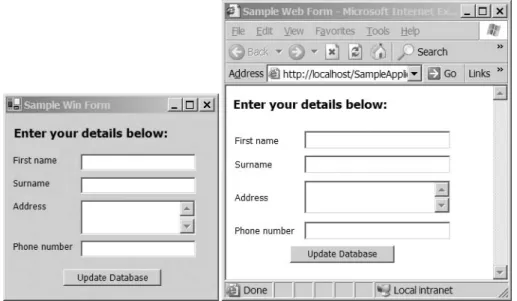
quite similar to that desktop application, as illustrated in Figure 1-1. You can design the forms in the user interface (UI) to be similar, have the forms react to mouse clicks and button presses in a similar way, and make the back-end processing of the two applications quite similar.
Figure 1-1.A desktop application (left) and a web application (right) can look and feel quite similar.
To use the desktop version of an application, you need to install it on a machine, and then sit at that machine while you use it. When you ask the operating system to run the application,
it will create a new processfor it, where the application will execute. Afterwards, your mouse
clicks and keypresses will be detected by the operating system and passed to the process in which the desktop application is running. The application interprets these messages, does whatever processing is necessary, and tells the operating system what changes should be made to the UI as a result. All the communication between the application process and the UI is done via the operating system of that machine.
To use the web version of an application, you need to use a web browser. You type a URL into the web browser, which tells it where to find the machine on which the application is run-ning. The browser arranges for a message to be sent across a network to this other machine. When the message is received by that machine, it’s passed to the application, which interprets the message and decides what the UI (a web page) should look like. Then it sends a descrip-tion of that web page back across the network to the browser.
Far more players are involved in the use of the web application than are involved with the desktop application, but the advantages of this remote-access concept are nothing short of phenomenal. To build an effective web application, you need to understand these interactions between the browser and web application in finer detail, because they shape the way you write web applications.
Web Servers and Web Clients
You know that by entering a URL into the Address box of a browser window, you can surf and navigate to a web site. But what actually happens, behind the scenes, when you press Enter or click the browser’s Go button to submit that URL?
Before looking into the process, you need to understand the distinctions between the dif-ferent machines and messages involved:
Web client/web server:The machine on which a browser is running is referred to as a web client. The machine on which the web application is running is called a web server. Request/response:When a user types a URL into a browser, or clicks a link in a web page, the resulting message sent from the browser to the web server is called a request. The message containing the contents of a web page (which is sent by the web server to the browser in reaction to receiving the request) is called a response.
Therequestandresponseare the vital components of this communication process. From the point of view of a web application, they’re critically important. The request tells the web application what to do, and the response contains the fruits of its labors.
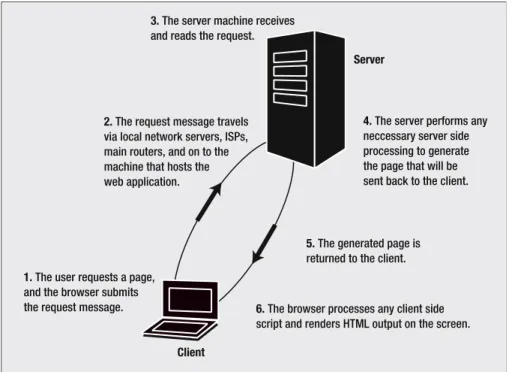
With those concepts clearly defined, let’s examine the process that takes place when a user employs a browser to request a web page. As illustrated in Figure 1-2, it’s all about the exchange of messages: the request message and response message. In fact, the client is also able to send responses in addition to requests. The following sections describe each step in the process that you see in Figure 1-2.
Step 1: Initiating the Client Request
In the first stage, the user clicks a link, types a URL into a browser, or performs some similar
action that initiates a request. The requestis a message that must be sent to the web server.
In order to send any request (or response) message, the browser needs to do three things: • Describethe message in a standard way so that it can be understood by the web server
that receives it. For this, it uses the Hypertext Transfer Protocol (HTTP), the protocol used by the Web to describe both requests and responses. The described request message is called the HTTP request, and it has a very particular format that contains information about the request plus the information required to deliver it to the web server.
• Packagethe message so that it can be safely transported across the network. For this, it uses the Transmission Control Protocol (TCP).
• Addressthe message, to specify the place to which the message should be delivered. For this, it uses the Internet Protocol (IP).
C H A P T E R 1 ■ E N V I R O N M E N T A N D A R C H I T E C T U R E
Figure 1-2.What happens when a user requests a web page from a browser
■
Note
TCP and IP are often grouped together and referred to as TCP/IP. When you hear people talking about TCP/IP, they’re discussing packaging and addressing Internet messages.After the browser has described the message, packaged it, and addressed it, the request is ready to be dispatched across the network to its intended target: the web server.
Step 2: Routing the Request
Thanks to the HTTP, TCP, and IP protocols, the request message is formatted in such a way that it can be understood by each of the machines involved in routingthe request—that is, passing the request from one machine to another as it finds its way from the web client to the web server.
The web server machine will be connected to the Internet (either directly or via a firewall) and will be uniquely identified on the Internet by its IP address. An IP address is a set of four numbers, each of which ranges between 0 and 255.
However, the original request probably didn’t contain an IP address. More likely, it was made using a URL that began with a named web site address (this is usually something more memorable, like http://www.apress.com/). The link between an IP address and its named equivalent is mapped using the Domain Name Service (DNS). For example, DNS currently
maps the URL http://www.microsoft.com/ to the IP address http://207.46.245.222/, so
requests for web pages at the URL http://www.microsoft.com/ are directed to the web server
whose IP address is http://207.46.245.222/.
■
Note
The set of four numbers in an IP address enables us to address almost 4.3 billion machines uniquely. IP version 6 (IPv6) is a new version of the protocol that allows for many more unique addresses by employing eight sets of four hexadecimal digits (so that each set of four is between 0000 and FFFF). Despite the fact that 4.3 billion sounds like a lot, the invention of portable devices with “always on” Internet connections, such as mobile phones connecting over General Packet Radio Service (GPRS), means that we will eventually run out of today’s IP addresses. This is why IPv6 was created.One address you’ll be seeing a lot of in this book is http://localhost/. This is a special address that resolves to the IP address http://127.0.0.1/. Any computer recognizes this address as referring to itself. It’s not actually a real IP address, but a reserved address used as a shortcut for the local machine, known as a loopback address.
Step 3: Receiving and Reading the HTTP Request
The standardized format for web requests is defined by HTTP, so when the HTTP request arrives at its destination, the web server knows exactly how to read it.
In HTTP, a web client can make two principal types of requests of a server:
GETrequest:The client can ask the server to send it a resource such as a web page, a pic-ture, or an MP3 file. This is called a GETrequest, because it gets information from the server. This is a commonly used method, for example, when developing a search facility on a web site, where the same request will be made on more than one occasion. It’s also how you request simple web pages and images.
POSTrequest:The client can ask the server to perform some processing in order to gener-ate a response. This is called a POSTrequest, because the client posts the information that the server must process, and then awaits a response. This method is more likely to be used, for example, when submitting personal data to an online shopping site or in any other situation where you are sending information to the server.
Step 4: Performing Server-Side Processing
The web server is the place where the application is running. It is responsible for ensuring that any necessary server-side processing takes place in order to complete its task and generate a response.
If the HTML request contains a request for a simple HTML page, the web server will locate the HTML page, wrap it into an HTTP response, and dispatch it back to the client. In contrast, if the request is for an .aspxpage, for example, the web server will pass the request to the ASP.NET engine, which takes care of processing the page and generating the output (usu-ally HTML), before the web server wraps that newly generated output into an HTTP response, ready to be sent back to the client.
C H A P T E R 1 ■ E N V I R O N M E N T A N D A R C H I T E C T U R E
The HTTP response consists of two parts: the header and the body. The headercontains information that tells the browser whether the request was successful or there was an error processing it. For example, if the web server received the request but was unable to locate the requested page, the header will contain an HTTP 404 (File Not Found) error code. The
response bodyis where a successfully requested resource (such as a block of HTML) is placed.
Step 5: Routing the Response
The HTML page, generated at the web server, has been described in terms of an HTTP response message, and is packaged and addressed using TCP/IP. The return address is an IP address, which was included in the HTTP request message sent in step 1.
The HTTP response message is routed back across the network to its target destination: the web client that made the original request.
Step 6: Performing Client-Side Processing and Rendering
When the HTTP response reaches the web client, the browser reads the response and processes any client-side code. This processed code is now displayed in the browser window.
Now that you know what goes on when a user requests a page, it’s time to start using some code.
System Configuration for Web Development
The best way to understand the web application process is to create some web pages and look at them from the perspective of both the end user and web server. You’ll begin to do this shortly (and you’ll create plenty of web pages during the course of the book), but before you can start, you need to install and configure a web server, which you’ll use to host your web applications.If you are running Windows 2000, Windows XP, or even Windows Server 2003, you’ll be able to use Microsoft’s own web server—Internet Information Services (IIS)—to host your applica-tions. Other web servers are available for Windows (such as Cassini, a web server written in .NET) and for other development platforms (notably Apache, which can be installed on Win-dows machines, Linux machines, and now even comes preinstalled on Mac OS X machines). For this book, we’ll use IIS to host the sample web applications, because it’s the platform pro-vided by Microsoft in order to run ASP.NET applications (although not the only one).
Different versions of IIS are supplied as part of different versions of the Windows operat-ing system:
• Windows 2000 Professional or higher has IIS 5.0 • Windows XP Professional has IIS 5.1
• Windows Server 2003 has IIS 6.0
IIS 5.0 and IIS 5.1 are very similar (in fact, IIS 5.1 is just a minor update of IIS 5.0). IIS 6.0 is a more substantial revamping of the IIS architecture, providing improvements in security and speed, as well as a deeper level of integration with ASP.NET applications.
Having said that, the front-end interface for all of these versions is very similar; therefore, the configuration process described in this chapter works equally well for all of these IIS
versions. For the remainder of the book, we’ll limit the discussions mainly to the features
available to IIS 5.xdevelopers, because it’s the main platform for workstations. We’ve included
an overview and setup instructions for IIS 6.0 in Appendix B, as there are some differences that should be taken into account when setting up web development or deploying the appli-cation on a server with Windows Server 2003.
Installing and Configuring IIS for .NET Web Applications
The IIS installation process itself is a fairly painless operation. If you haven’t installed any of
the necessary software yet, then it’s recommended that you install IIS beforeeither the .NET
Framework or Visual Studio .NET (VS. NET), because the installation of the latter configures the former so that it is able to deal with the ASP.NET files that are central to web applications in .NET.
If You Haven’t Installed the .NET Framework or VS .NET Yet
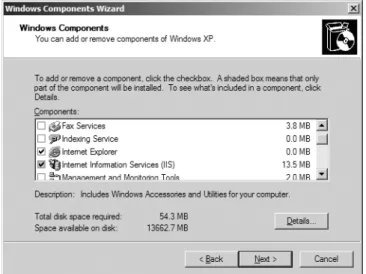
If you have not yet installed the .NET Framework or VS. NET, open the Control Panel and head to Add/Remove Programs. In the dialog box that appears, select Add/Remove Windows Com-ponents. In the list of components that appears, select Internet Information Services (IIS), as shown in Figure 1-3. Accept all the default settings, and the installation process will commence. Now, you can go ahead and install the .NET Framework and VS. NET, too.
Figure 1-3.Choosing to install IIS
If You’ve Already Installed the .NET Framework or VS .NET
If you have already installed the .NET Framework and/or VS .NET, you could proceed by unin-stalling VS .NET, and then uninunin-stalling the .NET Framework (via the Add/Remove Programs group in your Control Panel). Then you could install IIS, and finally, reinstall VS .NET. But this is an aggressive (and time-consuming) process. Instead, we recommend that you try to use one of the following tools to “repair” the .NET Framework, and use the uninstall/reinstall method only as a last resort.
C H A P T E R 1 ■ E N V I R O N M E N T A N D A R C H I T E C T U R E
First, try to run the ASP.NET IIS registration utility. Select Start ➤Run. In the dialog box that appears, type the following command:
%systemroot%\Microsoft.NET\Framework\[Version]\aspnet_regiis.exe
[Version]is the .NET version you have: v1.0.3705for .NET 1.0 or v1.1.4322for .NET 1.1. If that doesn’t work, you should be able to do the job using the VS. NET DVD or CDs.
If you own the VS .NET DVD, insert the DVD, and then select Start ➤Run. In the dialog
box that appears, type the following command (on one line):
<Drive>:\wcu\dotNetFramework\dotnetfx.exe /t:c:\temp
/c:"msiexec.exe
/fvecms c:\temp\netfx.msi"
If you have the VS .NET CDs, insert the VS .NET Windows Component Update CD, and
then select Start ➤Run. In the dialog box, type the following command (on one line):
<Drive>:\dotNetFramework\dotnetfx.exe /t:c:\temp /c:"msiexec.exe
/fvecms c:\temp\netfx.msi"
Administering IIS
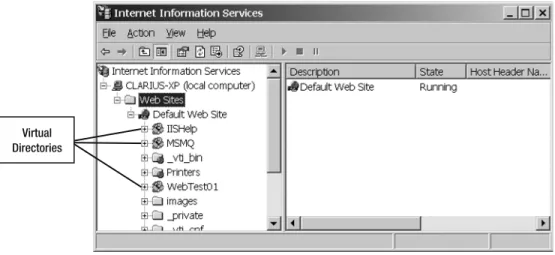
Once the IIS installation has completed, you can check that it was successful by viewing the IIS console. The IIS console is the key administration tool that you will use to configure your IIS web server software.
To run the console, select Start ➤Run, type inetmgrin the dialog box, and click OK.
Alter-natively, you can use the Internet Services Manager shortcut in the Administrative Tools group in your Control Panel (if you are running Windows XP, this link is named Internet Information Services). The IIS console appears, and it should look something like the window shown in Figure 1-4.
Creating Virtual Directories
In the folder list, you will notice that several of the folders are marked with a package-like (gear-like in IIS 6.0) icon (shown in Figure 1-4). This icon indicates that the folder is a virtual directory, which is also configured to be a root location for a web application.
IIS maps each virtual directory to a physical directory on the web server machine. This mapping works as follows:
• The virtual directory structure is the structure that the end users see when they browse the pages of the web site though a browser.
• The physical directory structure is the actualfolder structure that is used on the web
server’s hard disk for organizing and storing the pages and resources of the web appli-cation.
Thus, web developers can use this mapping of virtual directories to physical ones to place the web application’s source files in the most convenient place on their server and to hide their server’s physical organization from end users (each virtual directory is just the alias of a physical directory). Let’s see how this works and examine the process in more detail in an example.
Try It Out: Create a Virtual Directory In this example, you’ll use the IIS console to create a virtual directory that points to a physical folder on your system. You’ll write a simple HTML page and place it inside the physical directory, so that it will be possible to use a browser to navigate to that page via HTTP, using the virtual directory structure you created.
1. Use Windows Explorer to create a directory called Apressanywhere on your drive, and
then create a subdirectory called BegWebwithin it, so that you have a physical directory
structure like C:\Apress\BegWeb.
2. Fire up a text or code editor such as Notepad. (You’ll be using VS .NET in every other
example in the book, but for this example, it’s really not necessary.) Enter the following simple HTML code into a new file:
<html> <head>
<title>Beginning Web Programming - Simple Test HTML Page</title> </head>
<body>
<h2>A Simple HTML Page</h2> <p>Hello world!</p>
</body> </html>
3. Save this file as HelloWorld.htmin the \BegWebdirectory that you just created.
4. Now, you’ll create a virtual directory. Open the IIS console (select Start ➤Run and type
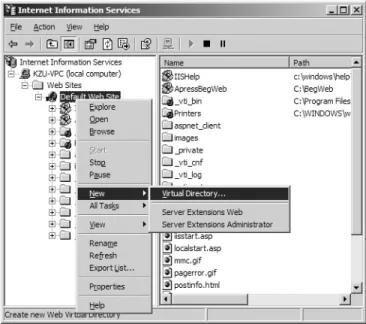
inetmgr). Right-click the Default Web Site node, and select New ➤Virtual Directory from the context menu, as shown in Figure 1-5.
C H A P T E R 1 ■ E N V I R O N M E N T A N D A R C H I T E C T U R E
Figure 1-5.Choosing to create a new virtual directory
5. At this point, an introductory dialog box will appear. Just click Next to continue.
6. In the first page of the wizard, you’ll be prompted for the name that you want to give to
your virtual directory. This is the name that end users will see in the Address box of a
browser when they request the page. Name your directory ApressBegWeb, as shown in
Figure 1-6. Then click Next.
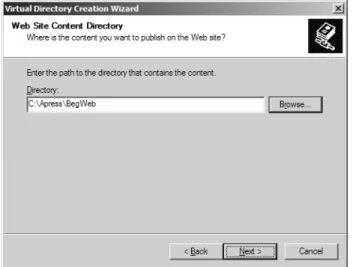
7. In the next wizard page, browse to the BegWebphysical directory (or just enter the directory path into the text box), as shown in Figure 1-7, and then click Next.
Figure 1-7.Specifying the physical directory that contains the web page contents
8. The next page, Access Permissions, presents a number of options relating to the
per-missions enabled on resources contained within this virtual directory, as shown in Figure 1-8. By default, users will be able to read files and run script-based programs. For now, leave the default settings and click Next to continue.
Figure 1-8.Setting access permissions C H A P T E R 1 ■ E N V I R O N M E N T A N D A R C H I T E C T U R E