Asynchronous Neighbor Discovery on Duty-cycled Mobile
Devices: Integer and Non-Integer Schedules
Sixia Chen
Central Connecticut StateUniversity
Alexander Russell
University of ConnecticutRuofan Jin
University of ConnecticutYanyuan Qin
University of ConnecticutBing Wang
University of ConnecticutSudarshan Vasudevan
Palo Alto NetworksABSTRACT
Neighbor discovery is a fundamental problem in wireless networks. In this paper, we study asynchronous neighbor discovery between duty-cycled mobile devices. Each node is duty-cycled, i.e., its radio may only be active for a small fraction of the time. The duty cycles of the nodes can be the same or different, leading to symmetric or asymmetric cases of the neighbor discovery problem. In addition, the setting is asynchronous, i.e., clocks of different nodes may not be synchronized. Most existing studies assume an integer model (where time proceeds in discrete steps); two recent studies break away from this assumption, which allows them to develop significantly more efficient schemes. Our study improves the state-of-the-art in three main fronts. Firstly, we develop a generalized non-integer model (where time is continuous) that permits unified treatment of the assump-tions in existing studies. We also provide a reduction that transforms any schedule in the basic integer model to a corre-sponding schedule in the generalized non-integer model while improving the performance by a factor of two. Applying this reduction, an optimal schedule in the integer model becomes an optimal schedule in the non-integer model. Thirdly, we establish a new family of lower bounds for the best achiev-able latency guarantee in the non-integer model. They are applicable to both symmetric and asymmetric settings, and encompass the lower bounds for the integer model as spe-cial cases. Finally, we develop a novel optimal construction based on Sidon sets for the symmetric setting. Our approach differs from the approaches taken by all existing studies, and provides a new direction for constructing neighbor discovery schedules.
Categories and Subject Descriptors
C.2.1 [Computer-Communication Networks]: Network
Architecture and Design—Wireless Communication; F.2.2 [Analysis of Algorithms and Problem Complexity]: Nonnumerical Algorithms and Performance
Permission to make digital or hard copies of all or part of this work for personal or classroom use is granted without fee provided that copies are not made or distributed for profit or commercial advantage and that copies bear this notice and the full cita-tion on the first page. Copyrights for components of this work owned by others than ACM must be honored. Abstracting with credit is permitted. To copy otherwise, or re-publish, to post on servers or to redistribute to lists, requires prior specific permission and/or a fee. Request permissions from [email protected].
MobiHoc’15,June 22–25, 2015, Hangzhou, China. Copyrightc 2015 ACM 978-1-4503-3489-1/15/06 ...$15.00. http://dx.doi.org/10.1145/2746285.2746297.
General Terms
Algorithm, Design, Performance, Theory
Keywords
Neighbor discovery, deterministic algorithms, Sidon set, dif-ference set
1.
INTRODUCTION
Neighbor discovery is a fundamental problem in wireless networks. Specifically, the proliferation of mobile devices, e.g., smartphones, PDAs, and sensors, has fueled many novel applications that utilize opportunistic localized device-to-device communication, including mobile social network-ing [14, 22, 18, 19], proximity-based services [1, 26], media sharing [16], traffic uploading [6], asset management [20], emergency rescue [8], tracking encountering pattern of mi-grating animals [13], and many more. These applications require mobile devices to rendezvous as they move into each other’s transmission range. On the other hand, limited bat-tery sources often mandate these devices to be duty-cycled, making them unable to discover other nodes while being asleep. In addition, in practice, nodes typically have no means of coordination (e.g., through a shared server or dedi-cated control channel), their clocks may not be synchronized, and they cannot act depending on individual “identities” (since the identities are not known before rendezvous).
We broadly refer to the above problem asasynchronous neighbor discovery onduty-cycled mobile devices. The duty cycles of the nodes can be the same or different, resulting in symmetricorasymmetricneighbor discovery, respectively. In such settings, it is possible to construct simple and powerful randomized algorithms (e.g., [15]); however, these schemes do not provide a bound on worst-case discovery latency and— rather remarkably—deterministic schemes can achieve better performance, even when compared with the “average case” performance of randomized algorithms. In this paper, we focus ondeterministic algorithms, where the schedules of the nodes are determined beforehand and the worst-case discovery latency is bounded.
Most existing studies [5, 9, 11, 24, 7] develop integer schedules where time proceeds in discrete slots of length ∆, and a node is either awake for an entire slot or asleep for an entire slot. Two recent studies [3, 17] break away from integer schedules by allowing “overflow” of active slots (i.e., an active slot is slightly lengthened to intersect the previous or subsequent slot), and demonstrate that the slight overflow can provide significant improvement.
In this paper, we improve the state-of-the-art on three main fronts: (i) we develop a generalizednon-integer model that permits unified treatment of existing studies, and demon-strate that any integer schedule can be converted into a non-integer schedule while improving the performance by a factor of two, (ii) we derive a family of lower bounds in the generalized non-integer model, and (iii) we develop a novel optimal construction for the symmetric setting.
Our main contributions are as follows:
• We develop a generalized non-integer model motivated by the observation that the integer model needlessly constrains switching to occur on integer boundaries and, additionally, does not reflect an important constraint that arises in practice. In our proposed non-integer model, time is continuous: nodes may become active or inactive at any point in time, subject to a few con-straints. In addition to switching latency ∆, we also introduce a required meeting timeδ: to discover one another, two nodes must be simultaneously awake for a continuous interval of duration at leastδ. This general-ized non-integer model permits unified treatment of the assumptions in existing studies: the basic integer model used in most existing studies arises as whenδ= ∆/2; the model of [3, 17] arises whenδ∆.
• We provide a general reduction that can transformany schedule in the basic integer model to a corresponding schedule in the generalized non-integer model. The reduction reduces the duty cycles of the nodes by a factor of two while preserving the discovery latency. Applying this reduction, an optimal schedule in the integer model becomes an optimal schedule in the non-integer model.
• We derive a family of lower bounds on the best achiev-able latency guarantees in the non-integer model (they reduce to lower bounds for the integer model when
δ = ∆/2). These are the first lower bounds that are characterized by both ∆ and δ, and the first lower bounds that are applicable to both symmetric and asymmetric settings. The two existing lower bounds derived in [30] and [17] are only for the symmetric setting; they are special cases of our lower bounds by taking ∆ = 1,δ= ∆/2 ([30]) andδ∆ ([17]).
• We propose a novel optimal construction based on the theory of Sidon sets for the symmetric setting. All existing optimal schemes [30, 11, 17] are based on Singer difference sets. Our construction uses a different approach, and provides a new direction for constructing neighbor discovery schedules.
Our optimal scheme based on Sidon sets is directly ap-plicable in practice (in fact, we have implemented it on smartphones). The non-integer schedules are particularly
important for mobile devices with δ ∆ (e.g., current
smartphones where ∆ is one or two seconds whileδ is in milliseconds) since they require significantly lower duty cy-cle for the same discovery latency (or lead to much faster discovery under the same duty cycle) compared to integer schedules. Using our reduction, all integer schedules in the literature can be directly converted into their corresponding non-integer schedules.
The rest of the paper is organized as follows. Section 2 briefly describes related work. Section 3 introduces the non-integer model and proposes a general reduction to transform any schedule in the integer model to a schedule in the non-integer model. Section 4 presents a family of lower bounds
for the non-integer model. Section 5 presents the Sidon sets construction. Finally, Section 6 concludes the paper and describes future work.
2.
RELATED WORK
Neighbor discovery has been studied extensively in the literature (e.g., [15, 4, 10, 25]). In the following, we only briefly review the studies that are closest to ours, specifically, those that develop deterministic schedules for asynchronous neighbor discovery on duty-cycled mobile devices.
Most existing studies develop integer schedules. Zheng et al. [30] derive a lower bound for the symmetric setting, and show the existence of optimal schedules throughSinger difference sets [21]. Lai et al. [11] expand the idea of cyclic quorum systems [24, 7], and propose a scheme, CQS-pair, that is also based on Singer difference sets. The construction for CQS-pair, however, takes exponential time, and hence is only practical for very large duty cycles. The general lower bound derived in our study encompasses the lower bound in [30] as a special case. We also provide a polynomial-time construction for Singer difference set based on the existence proof in [21]. In addition, we propose a novel optimal scheme based on Sidon sets for the symmetric setting; it is the first optimal scheme that does not rely on Singer difference sets. Two other existing integer schedules are Disco [5] and U-connect [9]. In Disco, for duty cycled, a node selects two different primesp1, p2 so that 1/p1+ 1/p2≈dand wakes up
in the slots that are multiples ofp1 orp2. Suppose nodei
has duty cycledi and chooses two primes,pi1 < pi2, such
that 1/pi1+ 1/pi2 ≈ di, i = 1,2. Then by virtue of the Chinese Remainder Theorem, the two nodes can discover each other with the worst-case discovery latency ofp11p21,
which is on the order ofc/(d1d2), c being a constant. In
U-Connect, a node uses a single prime,p. It wakes up in the first (p+ 1)/2 slots as well as the slots that are multiples of p in every p2 slots. For duty cycle d, the prime, p, is
chosen so that (3p+ 1)/(2p2)≤d. Suppose nodeihas duty
cycle di and chooses a prime pi, i = 1,2. Then the two nodes can discover each other with the worst-case latency of 1/(p1p2)≈2.25/(d1d2). Both Disco and U-Connect provide
integer schedules that are applicable to both symmetric and asymmetric settings. We propose a general reduction that can convert these integer schedules to their corresponding non-integer schedules while reducing the worst-case discovery latency by a factor of two.
The first study that breaks away from integer schedules is [3]. Specifically, Bakht et al. design a simple probing based approach, Searchlight, by leveraging the constant offset between periodic awake slots. The authors propose both integer and non-integer variants of Searchlight, and show that the non-integer variant significantly outperforms the integer variant. In our study, we propose a generalized non-integer model that encompasses the assumptions in [3] and provide a reduction that transforms any integer schedule to a corresponding non-integer schedule. This reduction can transform the integer variant of Searchlight to a non-integer version, and achieves the same performance as the non-integer variant of Searchlight (see Section 3.4).
A recent study [17] adopts the same non-integer assump-tion in [3]. The authors derive a new lower bound for the symmetric setting as well as an optimal scheme, Diff-Codes, that is based on Singer difference sets (they also provide a greedy heuristic technique to deal with the cases when prime numbers are sparse, which leads to sub-optimal schedules for those cases). The general lower bound that we derive is applicable to both symmetric and asymmetric settings,
encompassing the lower in bound [17] as a special case. In ad-dition, applying our reduction to an optimal integer schedule based on Singer difference sets leads to a family of optimal non-integer schedules for the symmetric setting; Diff-Codes (the optimal schedules that are based on Singer difference sets) is a special instance. In addition, we also develop a novel optimal scheme based on Sidon sets; the first optimal scheme that does not use Singer difference sets.
As other related work, the studies in [28, 27] propose schemes that are based upon an existing asynchronous neigh-bor discovery scheme to further reduce energy consump-tion. Two recent studies [29, 12] propose neighbor discovery schemes on mobile duty-cycled devices. Both of them however require clock synchronization, and hence are not applicable to asynchronous settings.
3.
INTEGER AND NON-INTEGER MODELS
In this section, we briefly describe the integer model that is adopted by most existing studies. We then present an intersection property that holds for any valid schedule in the integer model and use it to motivate the definition of the generalized non-integer model. We then establish a general reduction that transforms any schedule in the integer model to a corresponding schedule in the non-integer model; the re-ductionreduces duty cycle by a factor of two while preserving the discovery latency.
3.1
Integer Model
In this model, time is discretized into slots of width ∆, a hardware-dependent parameter that we refer to as the switching interval. Specifically, ∆ is the time required by nodes to change their states (from asleep to awake and vice versa). On certain mobile devices, ∆ may be on the order of milliseconds [5, 9] or even a fraction of a millisecond [20], while it can be over a second for other mobile devices (e.g., ∆ is one or two seconds on current smartphones due to limitation of the hardware [3]).
A schedule may then be described by calling for a node to beawake during some of these slots andasleep during the others. Indexing the slots with the natural numbers 0,1,2, . . ., a schedule is simply determined by a subsetS
ofN; such a schedule we call aninteger schedule. We shall
typically constrain nodes to adopt schedules with bounded duty cycles: they must be awake for no more than a bounded fraction of the time. Formally, we say that an integer schedule
S⊂ {0,1, . . .}has duty cycledif there is an infinite sequence of timesτ1< τ2<· · · so that
|S∩ {0,1, . . . , τi−1}|
τi
≤d .
Consider two nodes, A1 andA2, each with a fixedduty
cycle, denoteddi<1. We may determine the behavior of these nodes by associating with each of them an integer scheduleSi⊂ {0,1,2, . . .}meeting the duty cycle constraint; then the nodeAiis awake only during those slots indexed by the scheduleSi. In general, we do not assume that the clocks of the two nodes are synchronized and so must entertain the possibility of arbitrary (even non-integer) shifts of the nodes’ schedules. For this reason, it is convenient to treat the schedulesSi as subsets of the real numbersRin the obvious
way: associate the integerswith the interval [s∆,(s+ 1)∆). (We use the notation [a, b) to denote the “half open” interval
{x|a≤x < b}.) Then, for the integer scheduleS we define
S∆= [ s∈S
s∆,(s+ 1)∆⊂R.
w
overlap by a complete slot
w r’ r
(1) w is a multiple of slot length
(2) w is not a multiple of slot length overlap by r and r’
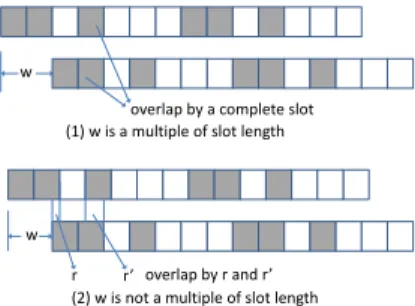
Figure 1: Illustration of the intersection property in the basic integer model.
Consider the circumstances where the nodesA1 andA2
come into each other’s range at the moment whenA1’s clock
readst1 andA2’s clock readst2. The time to discovery for
these particular shifts is then given by the smallest t for which both nodes are awake: t1+t∈S1 andt2+t∈S2. We
write this quantity as
L(S1, S2;t1, t2) = min{t|t1+t∈S1 andt2+t∈S2}.
For two schedulesS1 andS2, then, this motivates the
fol-lowing definition ofdiscovery latency, the worst case time to discovery taken over all shifts:
L(S1, S2) = max
t1,t2>0L(S1, S2;t1, t2).
We remark that—in general—this quantity may not even be well-defined (that is, there may be shifts for which the schedules never overlap). The basic problem is to construct schedulesSi, satisfying the duty-cycle constraints, that mini-mize the discovery latencyL(S1, S2).
Periodic schedules. One natural way to define an integer schedule is to fix a finite-length schedule and periodically re-peat this sequence. More specifically, fixing a subset ˇS⊂Zn of the integers modulon, one can define an integer schedule
S={z|zmodn∈Sˇ} ⊂Z. One advantage of schedulesS defined in this way is that their duty cycle can be determined as the simple ratio|Sˇ|/n. As a matter of notation, we blur the distinction between ˇSandS, referring to the finite set ˇS
as a schedule.
3.2
Motivation for Non-Integer Model
We next show any valid schedule in the basic integer model has the following property:
Property 1. Consider two nodes using a schedule in the
basic integer model for neighbor discovery. Suppose the sched-ule guarantees discovery in time n. Letwdenote the relative time shift of the two nodes. Then, for any w, we find one of two possible cases:
• The shiftw is an integer, and there exists an entire time slot during which both nodes are awake.
• The shift wis non-integral, and there exist two time periods (among the firstn) during which both nodes are awake; furthermore, the durations of these time periods,
randr0, sum to∆. Hence eitherrorr0 is longer than ∆/2.
This property is illustrated in Fig. 1. The first case in the above property is straightforward. We therefore only describe why the second property holds. For ease of exposition, we
assume ∆ = 1 (when ∆6= 1, we just need to divide time by ∆ and the explanation below applies similarly). Sincew
is non-integral, considerwas a fractional number between two integersz andz+ 1. We shall show that the schedules of the two nodes, denoted as S1 and S2, have (at least)
two overlaps, one of which has lengthw−zand the other has length z+ 1−w. We know that if S2 started at z,
then there would be a complete time slot (say s1 in the
schedule of S2) so that S1 andS2 overlap. Since now S2
starts atw, they will just overlap for part ofs1 which has
length (1−(w−z) =z+ 1−w. Similarly, ifS2 started at z+ 1, there would be a complete time slot (says2 in the
schedule ofS2 which is different froms1) thatS1 andS2
overlapped. Since the real case is to shiftS2 to the left by
lengthz+ 1−w, the overlap is actually part ofs2 that is
with length 1−(z+ 1−w) =w−z. It is clear that the sum of the two overlapping portions is one, and one of them has length at least half, as desired.
The above property prompts us to define a further hardware-dependent parameter, therequired meeting timeδ >0: This is the minimum amount of time required by two devices to discover each other when they are both active. The basic integer model implicitly assumes thatδ= ∆/2. While this assumption is reasonable for some wireless devices that have compatibleδand ∆ (e.g., both in a few milliseconds or less than one millisecond [5, 9, 20]), it can be quite pessimistic for other wireless devices whereδ ∆/2 (for instance, ∆ is one or two seconds whileδ is in milliseconds on current smartphones [3]). We therefore propose a generalized model that considers bothδand ∆. This model provides a unified setting that accommodates the characteristics of a diverse range of wireless devices. It meaningfully considers contin-uous time, which is less restrictive than the integer model. Whenδ= ∆/2, it reduces to the basic integer model. In the rest of the paper, we assumeδ≤∆/2.
3.3
Non-Integer Model
Fix ∆ andδas above. As we have relaxed the assumption that schedules adhere to integer boundaries, we may consider arbitrary schedules of the formS⊂R; we assume, however,
that each scheduleS consists of a set of disjoint intervals,
S = S
`[a`, b`), and that each b`−a` ≥ ∆ so that the schedule satisfies the ∆ switching constraint. We refer to such schedules as non-integer schedules. The quantity δ
then determines the discovery time as follows. Consider a pair of schedulesSiand a pair of shiftst1, t2≥0 (i= 1,2).
For these two shifts, we define the time to discovery to be the smallest time at which the two schedules overlap at an interval of width at leastδ:
L(S1, S2;t1, t2) = min t [t+t1−δ, t+t1)⊂S1 and [t+t2−δ, t+t2)⊂S2 .
As above, we define the discovery time for such a pair of schedules to be the worst case over all shifts:
L(S1, S2) = min
t1,t2≥0
L(S1, S2;t1, t2).
As above we may consider periodic schedules. Specifi-cally, if the schedule S repeats with period n∈ Rit can
be represented as a subset ˇS ⊂ [0, n). We say that such a periodic schedule has duty cycle d if |Sˇ|/n ≤ d, where
|Sˇ|=P
`(b`−a`). As above, we notationally blur the dis-tiction betweenS and the “finite length” schedule ˇS, which describes one “period” ofS. Again the goal is, given duty cyclesdi, to design periodic schedulesSi⊂[0, ni) (so thatSi has periodni), that minimize the resulting discovery latency.
2Δ
wakeup sleep (Δ-δ)/2 (Δ-δ)/2 Original schedule
New schedule
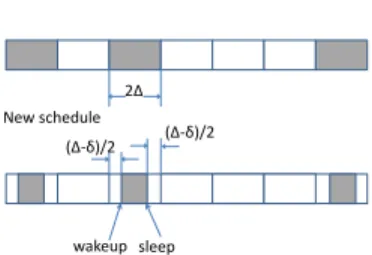
Figure 2: Illustration of the reduction that converts an integer schedule to a corresponding non-integer schedule.
3.4
General Reduction from Integer Schedules
to Non-integer Schedules
We propose a general reduction that can be applied to any integer schedule to obtain a corresponding (lower duty-cycle) non-integer schedule. The reduction is motivated by the following observation. Consider an integer schedule with slot length ∆. We can construct a new schedule by “trimming” the amount of time that a node is awake in an active slot from ∆ to ∆/2 +δ. The new schedule still guarantees that two nodes can discover each other. This is because, by Property 1, if the two nodes discover each other by time naccording to the original schedule, then there exists a time interval of at least ∆/2, during which both of them are awake. After “trimming”, since the amount of time a node is awake in an active slot is ∆/2 +δ, the new schedule can still guarantee at leastδamount of overlap while both nodes are awake, which is sufficient for neighbor discovery. The above construction significantly reduces the duty cycle: in the new schedule, the duty cycle isdi(∆/2 +δ)/∆, approximately half ofdi when
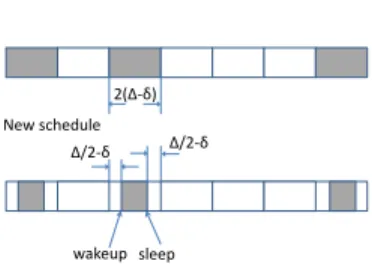
δ∆, wherediis the original duty cycle of nodei,i= 1,2. The new schedule, however, violates the switching interval constraint (since the amount of awake time, ∆/2 +δ, in a slot is less than ∆). This violation can be easily fixed by assuming that the original integer schedule uses slot length of 2∆ (instead of ∆); the “trimming” reduces the amount of time that a node is awake in an active slot from ∆ to ∆/2 +δ. Fig. 2 illustrates the “trimming” procedure. In the figure, the “trimming” is by removing (∆−δ)/2 on each end of an active slot. In general, the “trimming” only needs to ensure that there remains a continuous length of ∆/2 +δawake time in an active slot. Besides the example shown in Fig. 2, there are many other ways of “trimming”, e.g., removing (∆−δ) at the beginning or end of an active slot.
The above reduction converts an integer schedule to a non-integer schedule while preserving the discovery latency and reducing the duty cycle by (approximately) a factor of two. We next describe how to obtain a non-integer schedule from an integer schedule so that the duty cycle remains to be the same while the discovery latency is significantly reduced. Suppose the duty cycle isd. The new non-integer schedule is constructed as follows. We first construct an integer schedule with duty cycle ofd(2∆)/(∆ +δ) and slot length of 2∆. We then apply the above “trimming” procedure (see Fig. 2) so that the duty cycle is reduced tod, as desired. For two nodes with duty cyclesd1 andd2, if the worst-case discovery time
of the original integer schedule isc/(d1d2)·∆, wherecis a
constant (many existing schedules have this property; and as we shall see, optimal schedules also have this property), then the discovery latency of the new non-integer schedule
isc/(4d1d2)·2∆ =c/(2d1d2)·∆, only half of the original value. 1 2 3 4 5 103 104 105 Duty Cycle (%) W o rs t-ca se L a te n cy ( ∆
) DiscoDisco Trim
U−Connect U−Connect Trim Singer
Singer Trim
Figure 3: Performance of integer schedules and their corresponding non-integer schedules (symmet-ric case).
The above reduction can be applied toanyinteger schedule. We next illustrate it using three existing schemes, Disco [5] U-Connect [9], and schemes using Singer difference sets [30, 11], that provide integer schedules. Using the above reduc-tion, we convert the integer schedules to their corresponding non-integer schedules. Fig. 3 plots the worst-case discovery latency versus duty cycle for these three schemes in the sym-metric case. The results of both the original integer schedules and the “trimmed” non-integer schedules are plotted in the figure. We observe that for all three schemes, the worst-case discovery latency of the non-integer schedule is only half of that of the integer schedule. When “trimming” Singer sets based integer schedules using our reduction, the performance of the resultant non-integer schedules coincides with that of Diff-Codes [17] (for the schedules of duty cycles that are constructed using Singer sets). This is because Diff-Codes expands each slot in the schedule from Singer sets to two consecutive slots, an active slot followed by a sleeping slot, and a sleeping slot followed by another sleeping slot. When overflowing an active slot to its subsequent slot, it coincides with a special form of “trimming” (i.e., by “trimming” an amount ∆−δ at the end of a 2∆ slot).
1 2 3 4 5 102 103 104 Duty Cycle (%) W o rs t-ca se L a te n cy ( ∆ ) Searchlight−NSSearchlight−S Searchlight Trim
Figure 4: Performance of the integer and non-integer schedules for Searchlight (symmetric case).
The study in [3] proposes both integer and non-integer variants of Searchlight, referred to as Searchlight-NS (no striped probing) and Searchlight-S (with striped probing), respectively. We can convert Searchlight-NS to a non-integer schedule, referred to as “Searchlight trim,” following our proposed reduction. Fig. 4 plots the worst-case discovery latency versus duty cycle for these three schemes for symmet-ric duty cycles. We observe the performance of “Searchlight trim” overlaps with that of Searchlight-S, both reducing the worst-case discovery latency of Searchlight-NS by a factor of two. 5 10 15 20 103 104 Duty Cycle (%) W o rs t-ca se L a te n cy ( ∆
) DiscoDisco Trim
U−Connect U−Connect Trim
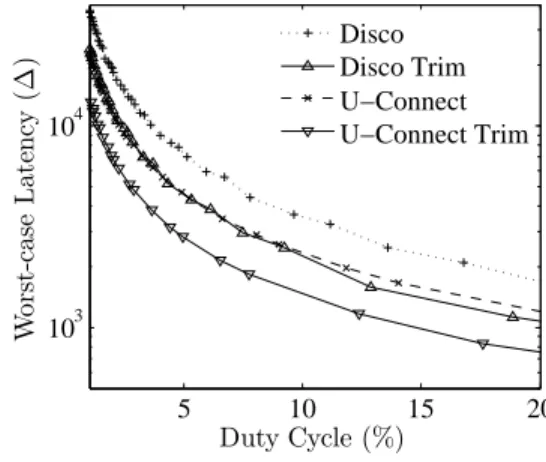
Figure 5: Performance of integer schedules and their corresponding non-integer schedules (asymmetric case).
The above examples illustrate applying the reduction in the symmetric case. The reduction also works for the asym-metric case. One example is shown in Fig. 5, where we plot the performance of Disco [5] and U-Connect [9], and their corresponding non-integer schedules under asymmetric duty cycles. The duty cycle of one node is fixed to be 1% while the duty cycle of the other node varies from 1% to 20%. We again observe the non-integer schedule reduces the worst-case discovery latency of the integer schedule by a factor of two.
4.
LOWER BOUNDS
We next develop a general lower bound in the non-integer model. This lower bound is characterized by both ∆ (switch-ing time) andδ(required meeting time). It is for the general case where two nodes have duty cycles,d1 andd2, which can
be the same or different. As we remark at the end, this lower bound leads to a family of lower bounds for both symmetric and asymmetric settings.
Theorem 2. Consider two schedulesS1, S2 in the
non-integer model with parameters ∆, δ. Assume that S1, S2
have duty cycles d1, d2 and, furthermore, L(S1, S2) ≤ n,
i.e., they guarantee discovery within timen. Thend1d2 ≥
∆2/(2n(∆−δ)). Conversely, the discovery latency is at least
∆2/(2d
1d2(∆−δ)).
Proof. Consider two schedulesS1 ⊂ R+ andS2 ⊂R+
with duty cyclesd1 andd2, respectively. We suppose that
these schedules achieve discovery latencyn, and proceed to prove that we must then have
n≥ ∆
2
2d1d2(∆−δ)
Select two large timesT1, T2nfor whichTj+n6∈Sj (for eachj= 1,2) and
S1∩[0, T1+n) ≤d1(T1+n),and S2∩[0, T2+n) ≤d2(T2+n). (Recall that ifA=S
i[αi, βi) is a disjoint union of half-open intervals, we define|A|=P
i(βi−αi).) We may express each of these “prefixes” of the schedulesSj∩[0, Tj+n) as a disjoint union of some (maximal) intervals:
S1∩[0, T1+n) = k1 [ i=1 Bi(1), S2∩[0, T2+n) = k2 [ i=1 Bi(2),
where eachB(ij) has the form [α, β). Let`
(j)
i =|B
(j)
i |, the length of theith interval appearing inSj; then, for each node
j,
|Sj∩[0, Tj+n)|=
X
i
`(ij)≤dj(Tj+n).
We pause briefly to introduce some further notation. For a subsetS⊂Rand an elementr∈R, we letS+r={s+r|
s ∈ S} (and likewise define S−r). We also extend the notation|A|, defined above for subsets A⊂R, to subsets
ofR×R. Specifically, ifA= [α(1), β(1))×[α(2), β(2)), we
define|A|= (β(1)−α(1))·(β(2)−α(2)). IfAis a disjoint
unionS
iAi, where each Ai is such a product of intervals, we define|A|=P
i|Ai|.
AsS1andS2achieve discovery latencyn, for any (t1, t2)∈
[0, T1)×[0, T2) the intersection of (S1−t1)∩[0, n) and
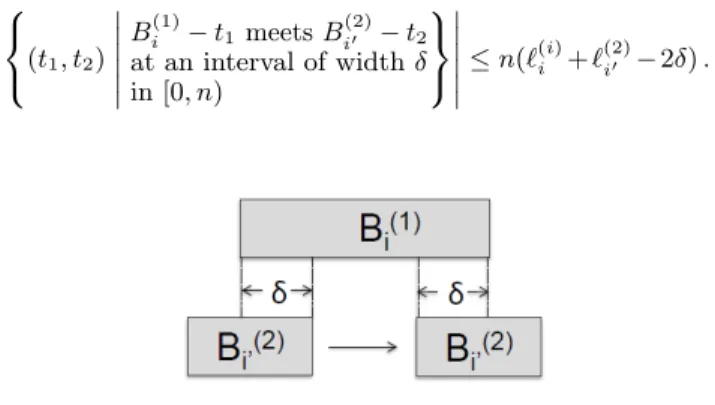
(S2−t2)∩[0, n) must contain an interval of width at least δ. Fixing the position of a particular intervalBi(1), observe that the intervalB(2)i0 overlaps with B
(1)
i at an interval of widthδfor a collection of times of length`(1)i +`(2)i0 −2δ(see
Fig. 6). It follows that
(t1, t2) Bi(1)−t1 meetsBi(2)0 −t2 at an interval of widthδ in [0, n) ≤n(`(ii)+` (2) i0 −2δ).
Figure 6: Overlap occurrences from a pair of inter-vals.
As every pair (t1, t2)∈[0, T1)×[0, T2) must be covered by
some pair of intervals as above, we have
T1T2≤ X i,i0 n`(1)i +` (2) i0 −2δ =n k1 X i0 `(2)i0 +k2 X i `(1)i −2k1k2δ ! ≤n(k1d2(T2+n) +k2d1(T1+n)−2k1k2δ). We conclude that n≥ T1T2 k1d2(T2+n) +k2d1(T1+n)−2k1k2δ . (2) Additionally, we recall that any interval of activity must have width ∆, and hence
k1∆≤d1(T1+n) and k2∆≤d2(T2+n). (3)
To complete the proof, we establish an upper bound on the denominator of (2)
φ(k1, k2),k1d2(T2+n) +k2d1(T1+n)−2k1k2δ
subject to the constraints (3). Note that, assumingk2
satis-fies (3), ∂ ∂k1 φ(k1, k2) =d2(T2+n)−2δk2 ≥d2(T2+n)−2δ d2(T2+n) ∆ =d2(T2+n) 1−2δ ∆ ≥0.
(Recall that 2δ/∆≤1). It follows that for any choice ofk2
consistent with (3), the functionφis maximized by takingk1
as large as possible—that is, so that the constraint (3) fork1
is tight. An analogous computation of∂φ/∂k2establishes the
corresponding statement fork2: In particular, φ(k1, k2) is
maximized when the constraints (3) are tight. We conclude that
φ(k1, k2)≤2d1d2(T1+n)(T2+n)
∆−δ
∆2
Finally, in light of (2), we conclude that
n≥ ∆ 2 2d1d2(∆−δ) · T1T2 (T1+n)(T2+n) .
As we are free to selectTjas large as we wish, the inequal-ity (1) follows, as desired.
A few remarks area in order.
• When δ= ∆/2, the lower bound becomes the lower
bound for the basic integer model. We see whenδ∆ (the assumptions in [3, 17]), the lower bound is a factor 2 less than the lower bound for the integer model, showing the significant benefits of non-integer schedules. In the rest of the paper, non-integer model assumesδ∆.
• Whend1 =d2, the lower bound on discovery latency
becomes ∆/p2n(∆−δ). When ∆ = 1 andδ ∆,
it reduces to the lower bound of 1/√2n in a recent study [17]. The derivation of [17] only considers metric settings. Our lower bound applies to both sym-metric and asymsym-metric settings, and permits a quite general model, characterized by the two parameters ∆ andδthat account for practical constraints.
• When d1 = d2 and δ = ∆/2, the lower bound on
discovery latency is ∆/d2, which coincides with the
lower bound for integer schedules in the symmetric case [30]. When d1 6= d2 and δ = ∆/2, the lower
bound on discovery latency is ∆/(d1d2), which is, to be
best of our knowledge, the first lower bound for integer schedules in the asymmetric case.
5.
OPTIMAL SCHEDULES
In this section, we first demonstrate that the reduction in Section 3.4 converts an optimal integer schedule to an optimal non-integer schedule. We then discuss optimal schedules for symmetric and asymmetric settings, respectively. Our focus is on periodic schedules, as in most existing studies.
5.1
Optimal Integer and Non-integer
Sched-ules
Consider an optimal integer schedule. Suppose two nodes have cyclesd1andd2. When the slot length is 2∆, based on
the lower bound in Section 4, for the two nodes to discover each other in timen, we must have
d1d2 ≥
2∆
n . (4)
Under the reduction in Section 3.4, the duty cycle of a node in the non-integer schedule, denoted asd0i, satisfies
d0i = di ∆ +δ 2∆ , i= 1,2, (5) d01d 0 2 = d1d2 ∆ +δ 2∆ 2 (6) Substituting (4) into (6) yields
d01d 0 2≥ 2∆ n ∆ +δ 2∆ 2 =(∆ +δ) 2 2n∆ ≈ ∆2 2n(∆−δ),
where the last approximation holds since δ∆ (we only
consider the non-integer model withδ∆, see remarks in Section 4). The new non-integer schedule therefore meets the lower bound for the non-integer model, and hence is an optimal non-integer schedule.
In fact, we can use a more exact reduction (see Fig. 7), which divides time into slots of length 2(∆−δ) and “trim” a total amount of ∆−2δ in each active slot. This reduction still ensures discovery since the length of the awake time in an active slot is ∆ while the ensured overlap is at least 2(∆−δ)/2 = ∆−δ. Repeating the above derivation, we have d1d2 ≥ 2(∆−δ) n , d0i = di ∆ 2(∆−δ), i= 1,2, d01d 0 2 ≥ 2(∆−δ) n ∆ 2(∆−δ) 2 = ∆ 2 2n(∆−δ). That is, the constructed non-integer schedule matches the lower bound in the non-integer model exactly, and hence is optimal.
5.2
Symmetric Case
Our discussion below only considers optimal integer sched-ules; using the reduction in Section 3.4, they can be readily converted to optimal non-integer schedules.
While existing studies [30, 11, 17] show optimal schedules can be achieved through Singer difference sets, the only ex-plicit construction [11] in the networking community that we are aware of requires exponential running time. In the appendix, we describe an efficient polynomial-time construc-tion based on the existence proof in [21]. In the following, we present a novel optimal construction that is based on the theory ofSidon sets (see, e.g., [23] for a detailed descrip-tion of the theory). It is the first polynomial-time optimal algorithm that does not rely on Singer difference sets.
2(Δ-δ)
wakeup sleep
Δ/2-δ Δ/2-δ
Original schedule
New schedule
Figure 7: Illustration of an optimal reduction that converts an integer schedule to a corresponding non-integer schedule.
In the following, for ease of exposition, we regard the step length, ∆, as one unit of time and approach the dual problem: fixing a period n, how can one schedule a node’s wake-up slots so that the schedule intersects with every rotation of the schedule and, furthermore, minimizes the duty cycle,d
(determined by the number of active slots)? A solution to the dual problem can be immediately converted to a schedule for the original problem, i.e., for a given duty cycle, scheduling the wake-up times so that the discovery latency is minimized. LetS represent the schedule. LetL(S) =L(S, S) represent the worst-case discovery latency.
LetZndenote the residue classes of the integers modulo
n. We wish to construct a setS⊆Zn of size|S| ≈
√
nsuch that for anyα, β∈Zn,
|(α+S)∩(β+S)| 6= 0,
whereα+Sdenotes the set{α+s|s∈S}. Note that using this setSto define a periodic schedule immediately results inL(S)≤n(andd=|S|/n). To simplify our requirements on the setS, we observe the following:
Lemma 3. |(α+S)∩(β+S)| 6= 0for anyα, β∈Znif and only ifZn⊆S−S, whereS−S denotes the set of differences
{s1−s2|s1, s2∈S}.
Proof. It is easy to see the statement that|(α+S)∩(β+
S)| 6= 0 for anyα, β∈Znis equivalent with|(α+S)∩S| 6= 0 for anyα∈Zn. If|(α+S)∩S| 6= 0 for anyα∈Zn, then there exist two elements s1, s2 ∈S such thatα+s1 =s2; thus α=s2−s1 ∈S, which proves one direction of the lemma.
For the other direction, asZn⊆S−Sfor anyα∈Zn, we can find two elementss1, s2 ∈Ssuch thatα=s2−s1. Therefore α+s1=s2∈(α+S)∩S, as desired.
This allows us to focus our efforts on construction of satu-rated difference sets inZn. Specifically, we say that a subset
S ⊂Zn is a saturated difference set ifS−S,{s1−s2 | s1, s2 ∈S}contains every element ofZn.
The Sidon set construction. Consider a prime number p
and letϑ be a generator of themultiplicative group Z∗p =
{1, . . . , p−1}of units modulop. Then the mapt7→ϑtis an isomorphism betweenZp−1, the integers modulop−1 under
addition, andZ∗p, the multiplicative group of units modulop. Consider the set
S0={(t, ϑt)|t∈Zp−1} ⊂Zp−1⊕Zp.
While the setS0 is defined using the multiplicative structure
of the ring of integers modulo p, our goal is to establish additive properties of the set (as a subset of the additive groupZp−1⊕Zp).
Lemma 4. {(a, b)|a, b6= 0} ∪ {(0,0)} ⊂S0−S0.
Proof. It is easy to see that (0,0)∈S0−S0. For a pair
(a, b)∈Zp−1×Zpfor whicha, b6= 0, consider the differences (a+`, ϑa+`)−(`, ϑ`) = (a, ϑ`(ϑa−1))
for`∈Zp−1. Asa6= 0, the sumϑa−16= 0 and it follows
thatb∈ {ϑ`(ϑa−1)|`∈
Zp−1}=Z∗pasϑis a multiplicative generator. In particular, by choosing`to be logϑ(b/(ϑa−1)) we find that (a, b) = (a+`, ϑa+`)−(a, ϑa), as desired. (Here the notation logϑxdenotes the unique exponent in the set
{1, . . . , p−1}for whichϑα=x.)
Observe that sincepandp−1 are relatively prime,Zp−1⊕
Zp ∼= Zp(p−1) by the Chinese remainder theorem, and a
saturated difference set inZp−1⊕Zpimmediately yields a saturated difference set in the cyclic groupZp(p−1). However,
the setS0 above isnot saturated: differences of elements of
the set miss a few evasive “slices” ofZp−1⊕Zp ∼=Zp(p−1):
the elements (a, b) wherea= 0 orb= 0.
To complete the construction, we can apply an existing scheme in these small “slices.” We recall here the basic details of U-Connect [9], which we adapt for this purpose. For a given
k >0, consider the setAk={k,2k, . . . , k2} ∪ {0,1,2, . . . , k− 1} ⊂Z. Observe that{−k2, . . . , k2} ⊂Ak−Akand hence thatAk−Ak contains an element from every equivalence class of the integers modulo 2k2+ 1. To be precise, defining
Ak,n = {amodn | a ∈ Ak} it follows immediately that
Zn⊂Ak,n−Ak,nso long asn≤2k2+ 1. To summarize, for the integern, definekn=
p
(n−1)/2
andDn=Akn,n. By the discussion above,Dnis a saturated difference set inZnof size 2kn. As a function ofn, this yields a saturated difference set of size 2p
(n−1)/2
≤√2n+ 2 =
√
2n+O(1).
Returning to our construction, defineSa ={(0, b)|b∈
Dp}andSb={(a,0)|a∈Dp−1}(whereDn is as defined above), and observe now that the setS,S0∪Sa∪Sbclearly has the property thatZp−1⊕Zp⊂S−S. To summarize, this construction yields a saturated difference set inZp(p−1) ∼= Zp−1⊕Zpof size no more than
p−1 +p2p+p2(p−1)
≤ pp(p−1) +p2p+p2(p−1)
≤ pp(p−1) + 3p4
p(p−1),
asp >2. (The fact that√2p+p2(p−1)≤3p4
p(p−1) for
p≥2 follows immediately by expanding the fourth power of both sides.)
We record the results of this construction in the following theorem.
Theorem 5. For anynof the formp(p−1)withp >2,
there is an explicit saturated difference set inZn of size no more than√n+ 3√4n. For such a set, defining d=|S|/n, we haveL(S)≤ |S|= (1 +o(1))/d2.
We use the wordexplicit in the above theorem to indicate that one can efficiently compute, givenp, the elements of the difference set. The construction requires generating the elements ofS0,Sa, andSb, which is straightforward given a generatorϑof the cyclic groupZ∗p. Such a generator can be found very quickly with randomization; deterministically, one can simply check the first√pelements ofZpto find one with the property thatxp−1≡1 butx(p−1)/r 6≡1 for each primerdividingp−1. See [2] for details.
It remains, of course, to represent the setS insideZp(p−1)
via the isomorphism promised by the Chinese remainder theorem. For this purpose, note that
p≡1 modp−1 (p−1)2≡0 modp−1
p≡0 modp (p−1)2≡1 modp .
It follows immediately that the element (a, b)∈Zp−1⊕Zpis carried to the elementa·p+b(p−1)2 modp(p−1) inZp(p−1).
As arithmetic inZp,Zp−1andZp(p−1) can be carried out in
time poly(logp), we conclude that the entire setScan be computed in timep·poly(logp).
1 2 3 4 5 104 106 Duty Cycle (%) W o rs t-ca se L a te n cy ( ∆ ) SidonSinger
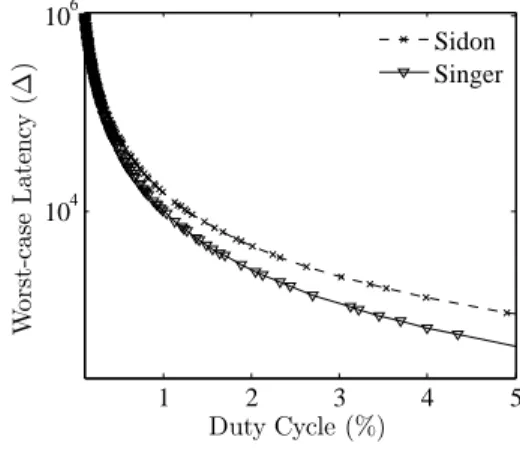
Figure 8: The worst case discovery latency of two optimal schemes (based on Singer and Sidon differ-ence sets) for symmetric duty cycles.
Fig. 8 compares the performance of the two optimal con-structions based on Singer and Sidon difference sets, respec-tively. The performance of Sidon set construction is very close to that of the Singer set construction for small duty cycles. The deviation under larger duty cycles is because the lower order terms in Sidon set construction, which can be improved using more efficient construction when filling the small “slices.” We remark that like the other known constructions that achieve asymptotic optimality, this Sidon set construction requiresn(and henced) to have particular number-theoretic properties.
5.3
Asymmetric Case
In the asymmetric case, we again only consider optimal integer schedules for the same reason as described earlier. For two nodes with duty cyclesd1andd2,d1 6=d2, the lower
bound of discovery latency is 1/(d1d2) (see Theorem 2). A
simple optimal schedule is as follows. Each node picks the closest prime number, pi, so that pi ≤ 1/di andp1 6=p2.
Then a node wakes up in the slots that are the multiples ofpi. By the Chinese Remainder Theorem, sincep1 6=p2, for any
time shift between these two nodes, they can meet in time
p1p2 ≈1/(d1d2). This simple optimal schedule, however,
only works whenp1 6=p2. Hence it does not work for the
symmetric setting or when two nodes have similar duty cycles (which leads top1=p2). In practice, we need a scheme that
works for both asymmetric and symmetric settings since the nodes do not know whether they have the same or different duty cycles beforehand.
Existing schemes that are based on prime numbers over-come the limitation in the above simple scheme through adding mechanisms. Specifically, in Disco [5], each node uses two prime numbers instead of one prime number; in
U-Connect [9], each node uses one prime, but is awake for a continuous period of time in addition to the multiples of the prime numbers. Neither of them is optimal. The asym-metric schedules in [3, 17] are not optimal either. Finding a schedule that is optimal in the asymmetric setting while also applicable (or even optimal) for the symmetric setting remains an open question that is left as future work.
6.
CONCLUSION AND FUTURE WORK
In this paper, we first developed a generalized non-integer model for asynchronous neighbor discovery on duty-cycled mobile devices. This generalized model permits unified treat-ment of the assumptions in existing studies, and allows us to place various existing results into a single setting. We then provided a reduction that transforms any schedule in the basic integer model to a corresponding schedule in the gen-eralized non-integer model while improving the performance by a factor of two. After that, we established a new family of lower bounds for the best achievable latency guarantee in the non-integer model. Last, we developed a novel optimal construction based on Sidon sets for the symmetric setting. Our work motivates two directions of further work. The first is to develop optimal schedules for general duty cy-cles, d, in the symmetric setting. (As mentioned above, known constructions—including the new construction pre-sented here—only provide control for a particular set ofd.) One way to achieve this is through padding, in which case the analysis of the worst-case performance requires detailed anal-ysis of the density of the relevantd. The second is to develop practical (close-to) optimal schedules for the asymmetric setting.
Acknowledgements
We gratefully acknowledge support from the National Science Foundation under grant 0835735, CAREER award 0746841, and grants 1117427 and 1407205. Any opinions, findings, and conclusions or recommendations expressed in this material are those of the authors and do not necessarily reflect the views of the funding agencies. We would like to thank the anonymous reviewers for their insightful comments.
7.
REFERENCES
[1] L. Aalto, N. G¨othlin, J. Korhonen, and T. Ojala. Bluetooth and WAP push based location-aware mobile advertising system. InProc. of MobiSys, June 2004. [2] E. Bach and J. Shallit.Algorithmic Number Theory,
Volume 1: Efficient Algorithms. Foundations of Computing. MIT Press, 1996.
[3] M. Bakht, M. Trower, and R. H. Kravets. Searchlight:
Won’t you be my neighbor? InProc. of ACM
MobiCom, 2012.
[4] S. A. Borbash, A. Ephremides, and M. J. McGlynn. An asynchronous neighbor discovery algorithm for wireless sensor networks.Ad Hoc Networks, 5(7):998–1016, 2007.
[5] P. Dutta and D. Culler. Practical asynchronous neighbor discovery and rendezvous for mobile sensing applications. InProc. of ACM SenSys, 2008.
[6] B. Han, P. Hui, V. Kumar, M. Marathe, J. Shao, and A. Srinivasan. Mobile data offloading through
opportunistic communications and social participation. IEEE Transactions on Mobile Computing,
11(5):821–834, 2012.
[7] C. S. Hsu, J. R. Jiang, Y. C. Tseng, and T. H. Lai. Quorum-based asynchronous power-saving protocols for ieee 802.11 and hoc networks.ACM Journal on Mobile Networks and Applications (MONET), 10(1-2):169–181, 2005.
[8] J.-H. Huang, S. Amjad, and S. Mishra. CenWits: a sensor-based loosely coupled search and rescue system using witnesses. InProc. of ACM SenSys, 2005. [9] A. Kandhalu, K. Lakshmanan, and R. R. Rajkumar.
U-Connect: a low-latency energy-efficient asynchronous neighbor discovery protocol. InProc. of IPSN, 2010. [10] A. Keshavarzian, E. Uysal-Biyikoglu, F. Herrmann, and
A. Manjeshwar. Energy-efficient link assessment in wireless sensor networks. InProc. of IEEE INFOCOM, March 2004.
[11] S. Lai, B. Zhang, B. Ravindran, and H. Cho. CQS-Pair: Cyclic quorum system pair for wakeup scheduling in wireless sensor networks. InProc. of Principles of Distributed Systems, 2008.
[12] D. Li and P. Sinha. RBTP: low-power mobile discovery protocol through recursive binary time partitioning. IEEE Transactions on Mobile Computing,
13(2):263–273, 2014.
[13] T. Liu, C. M. Sadler, P. Zhang, and M. Martonosi. Implementing software on resource-constrained mobile sensors: experiences with Impala and ZebraNet. In Proc. of ACM MobiSys, 2004.
[14] Locast.http://www.lokast.com.
[15] M. J. McGlynn and S. A. Borbash. Birthday protocols for low energy deployment and flexible neighbor discovery in ad hoc wireless networks. InProc. of ACM MobiHoc, October 2001.
[16] L. McNamara, C. Mascolo, and L. Capra. Media sharing based on colocation prediction in urban transport. InProc. of ACM MobiCom, September 2008. [17] T. Meng, F. Wu, and G. Chen. On designing neighbor
discovery protocols: A code-based approach. InProc. of IEEE INFOCOM, 2014.
[18] M. Motani, V. Srinivasan, and P. S. Nuggehalli. PeopleNet: engineering a wireless virtual social network. InProc. of ACM MobiCom, 2005.
[19] A. K. Pietil¨ainen, E. Oliver, J. Lebrun, G. Varghese, and C. Diot. MobiClique: middleware for mobile social
networking. InProc. of ACM Workshop on Online
Social Networks, August 2009.
[20] A. Purohit, N. Priyantha, and J. Liu. WiFlock: collaborative group discovery and maintenance in mobile sensor networks. InProc. of IPSN, 2011. [21] D. R. Stinson. Combinatorial designs: Constructions
and analysis.Springer Verlag, 2003. [22] Nintendo 3ds’s streetpass.
http://www.nintendo.com/3ds/features.
[23] T. Tao and V. Vu.Additive Combinatorics. Number 105 in Cambridge Studies in Advanced Mathematics. Cambridge University Press, 2006.
[24] Y.-C. Tseng, C.-S. Hsu, and T.-Y. Hsieh. Power-saving protocols for IEEE 802.11-based multi-hop ad hoc networks. InProc. of IEEE INFOCOM, 2002. [25] S. Vasudevan, M. Adler, D. Goeckel, and D. Towsley.
Efficient algorithms for neighbor discovery in wireless
networks.IEEE/ACM Transactions on Networking. To
Appear.
[26] Z. Yang, B. Zhang, J. Dai, A. Champion, D. Xuan, and D. Li. E-SmallTalker: A distributed mobile system for
social networking in physical proximity. InProc. of IEEE ICDCS, June 2010.
[27] D. Zhang, T. He, Y. Liu, Y. Gu, F. Ye, R. K. Ganti, and H. Lei. Acc: generic on-demand accelerations for neighbor discovery in mobile applications. InProc. ACM SenSys, 2012.
[28] D. Zhang, T. He, F. Ye, R. K. Ganti, and H. Lei. EQS: neighbor discovery and rendezvous maintenance with extended quorum system for mobile sensing
applications. InProc. of IEEE ICDCS, 2011. [29] L. Zhang and D. Guo. Neighbor discovery in wireless
networks using compressed sensing with Reed-Muller codes. InProc. of WiOpt, 2011.
[30] R. Zheng, J. C. Hou, and L. Sha. Asynchronous wakeup for ad hoc networks. InProc. of ACM MobiHoc, 2003.
APPENDIX
The Singer Difference Set Construction
Definition 6. A subset D ⊆ Zv is called a (v, k,
1)-difference set if|D| = k and, for any g ∈ Zv\{0}, there exists exactly one pair(x, y)∈D×Dsuch that g≡x−y
modv.
For a givenv, the Singer difference set [21] hask2+k+ 1 =v
andk−1 is a prime power. It is the minimal difference set whose size, k, approximates the lower bound √v, i.e.,
k ≈ √v. It can be directly used to construct an optimal neighbor discovery schedule for the symmetric setting. In the following, for completeness, we first prove the existence of Singer difference sets (the proof is adapted from that in [21]). We then describe an explicit polynomial time construction.
Theorem 7. Letq be a prime power. Then there exists
an explicit(q2+q+ 1, q+ 1,1)-difference set in
Zq2+q+1.
Proof. The finite fieldFq3 is a three-dimensional vector
space over Fq for any prime power q. Let V1 denote the
collection of all one-dimensional subspaces of Fq3 and V2
denote the collection of all two-dimensional subspaces ofFq3. For eachB∈ V2, letAB,{C∈ V1|C⊂B}. It is easy to
check that|V1|=q2+q+ 1, a quantity we call`throughout
the construction; furthermore |V2| = |V1|, as every
two-dimensional space is dual to a unique one-dimension space under the bilinear map hx, yi = TrF
q3/Fq(xy) = (xy) q2
+ (xy)q+xy. It is also easy to check that|AB|=q+ 1 for eachB∈ V2 and that any distinct pair (C1, C2)∈ V1× V1is
contained exactly in one two-dimensional spaceB∈ V2.
Letωdenote a primitive element ofFq3(that is, a generator for the multiplicative group F∗q3). Define a mapping α :
Fq3 → Fq3 byα(x) = ωx. Note that α is Fq-linear (and clearly bijective): it carries subspaces to subspaces. It is not difficult to show thatαpermutes the elements inV1in a single
cycle of length`. Fixing a particular one-dimensional space
C0, we write V1 = {C0, C1,· · ·C`−1}with the convention
that α(Ci) = Ci+1 mod` and, hence, Ci = ωiC0. (Note
that this is well-defined becauseα`, corresponding to left-multiplication by ω`, has the identity action on the Ci.) Rather remarkably, it can be proved thatαalso permutes the elements inV2in a single cycle of length`.
LetB0denote a fixed two-dimensional subspace and define D,{i|Ci⊂B0} ⊂Z`. To see thatDis a difference set, consider an elementg∈Z`,g6= 0. Now, the pair (C0, Cg) is contained in exactly one two-dimensional subspaceB; let
ihave the property that αiB0 =B. Now it follows that
α−iB =B
0 and bothC−i and Cg−i are contained in B0;
hence−iandg−iare both inD, withg−i−(−i)≡g mod`. Uniqueness follows similarly. ThusDis a (q2+q+ 1, q+ 1,
1)-difference set inZq2+q+1.
Construction: For a prime powerp,Fp3 can be realized asFp[x]/(g(x)) whereg(x)∈Fp[x] is an irreducible polyno-mial of degree 3. Then the elements ofFp3can be represented as polynomials inFp[x] having degree at most 2. We may chooseC0=Fp, the constant polynomials; we then choose
B0∈ V2 to be span(1, x) ={i+jx|i, j∈Fp}. This yields the difference set
D={y∈Zp2+p+1|ωy=ax+bfor somea, b∈Fq}, whereωis a primitive element ofFp3.
The remaining work is to find a irreducible polynomialg(x) and a primitive elementω. It turns out that we can do both at once. Initially, factorp3−1 such thatp3−1 =pn1
1 · · ·p
nk
k ,
where each pi is a prime number. It suffices to identify a polynomial g(x) = x3+bx2+cx+d (whereb, c, d ∈
Fp) so that: (i.) xp3−1 ≡1 modg(x), and (ii.) x(p3−1)/pi 6≡1
modg(x) for eachi. Suchg(x) is irreducible in Fp[x] and guarantees thatxis a primitive element ofFp3. As suchg are known to be sufficiently dense (in fact, they have density
φ(p3−1)/(3p3), whereφis the Euler totient function), this
can be carried out very quickly with a randomized algorithm; see [2]. As construction of the setSwill take time polynomial in p anyway, it is also possible to carry out this search over all triples a, b and c. In either case, so long as fast modular exponentiation is used to compute the powersxv, the construction can be carried out in timep3poly(logp), as desired.
This construction can be applied as well for prime powers of the formq=pk. The only new complication is that one must first construct the fieldFq, which can be accomplished using the same technique as described above: specifically, one chooses an irreducible polynomialh(x)∈Fp[x] of degree
k and uses the set Fp[x]/(h(x)) as a representation ofFq, where addition is simply addition of polynomimals, and multiplication is given by polynomial multiplcation modulo the polynomial h(x). The remainder of the construction proceeds as above.