Relational Learning within Industrial
Knowledge Graphs
Martin Ringsquandl
Relational Learning within Industrial
Knowledge Graphs
Martin Ringsquandl
Dissertation
an der Fakult¨
at f¨
ur Mathematik, Informatik und Statistk der
Ludwig-Maximilians-Universit¨
at M¨
unchen
vorgelegt von Martin Ringsquandl
aus Rosenheim
M¨unchen, den 21.02.2019
Erstgutachter:
Prof. Dr. Peer Kr¨
oger
Zweitgutachter
Prof. Dr. Pascal Hitzler
Drittgutachter:
Prof. Dr. Evgeny Kharlamov
Abstract iv
Zusammenfassung vi
1 Introduction 1
1.1 Industrial Knowledge Graphs . . . 1
1.2 Operational Data and Industrial KGs . . . 5
1.3 Research Topics in this Thesis . . . 6
1.4 Outline. . . 8
2 Semantic Data Models for Industrial Knowledge Graphs 10 2.1 Knowledge Graphs and the Semantic Web . . . 11
2.1.1 Knowledge Representation . . . 13
2.1.1.1 The Resource Description Framework. . . 13
2.1.1.2 Ontologies and Logical Reasoning . . . 15
2.1.2 Ontology-based Data Access . . . 17
2.2 Existing Semantic Modeling Approaches for Industrial Knowledge Graphs . 18 2.3 Contribution. . . 20
3 Domain knowledge-driven Feature Selection for Predictive Models within Industrial Knowledge Graphs 22 3.1 Background on knowledge-based Predictive Modeling . . . 23
3.1.1 Classification and Regression Models . . . 23
3.1.2 Feature Selection . . . 25
3.1.3 Graph-structured Data . . . 28
3.1.4 Feature Selection and Extraction for RDF Data . . . 29
3.2 Existing Domain Knowledge-driven Feature Selection Approaches . . . 32
3.3 Contribution. . . 34
4 Completion of Missing Facts in Industrial Knowledge Graphs 36 4.1 Statistical Relational Learning . . . 37
4.2 Existing Background-enhanced KG Completion Approaches . . . 42
4.2.1 Joint Embedding Models . . . 42
4.2.2 Graph Convolutional Networks . . . 43
4.3 Contribution. . . 43 5 Conclusion 46 5.1 Summary . . . 46 5.2 Outlook . . . 47 List of Figures 49 List of Tables 50 Bibliography 51 A Publications
During the years I have been working on this thesis, I had the privilege to get support from several amazing people. First of all, I want to thank my supervisor at Ludwig-Maximilians Universit¨at, Peer Kr¨oger, who guided me along the academic journey. Our talks have always been helpful, whether I needed feedback or just some calming words to sort things out. I’m also very grateful for the support of Steffen Lamparter and Raffaello Lepratti, who not only initialized this Ph.D. project, but also provided brilliant advice throughout every of its stages based on their academic and business experience. Further I would also like to thank Evgeny Kharlamov and Daria Stepanova for their tremendous help in sharpening my research and their contributions to our publications. It has been a pleasure getting all the work done towards the submission deadlines with your great expertise. I am also thankful for the discussions with colleagues from the SMR team at Siemens, especially Marcel Hildebrandt, Mitchell Joblin, and Thomas Hubauer. Equally important to me personally and to the shape of this thesis have been the ethical, philosophical, and musically-flavored talks with Hans Leonhardt, who has been a role model and a muse at the same time. I cannot thank you enough.
A special thank goes to my parents. This work would not have been possible without your support.
The ubiquitous availability of data in today’s manufacturing environments, mainly driven by the extended usage of software and built-in sensing capabilities in automation systems, enables companies to embrace more advanced predictive modeling and analysis in order to optimize processes and usage of equipment. While the potential insight gained from such analysis is high, it often remains untapped, since integration and analysis of data silos from different production domains requires high manual effort and is therefore not economic. Addressing these challenges, digital representations of production equipment, so-called digital twins, have emerged leading the way to semantic interoperability across systems in different domains. From a data modeling point of view, digital twins can be seen as industrial knowledge graphs, which are used as semantic backbone of manufac-turing software systems and data analytics. Due to the prevalent historically grown and scattered manufacturing software system landscape that is comprising of numerous pro-prietary information models, data sources are highly heterogeneous. Therefore, there is an increasing need for semi-automatic support in data modeling, enabling end-user en-gineers to model their domain and maintain a unified semantic knowledge graph across the company. Once the data modeling and integration is done, further challenges arise, since there has been little research on how knowledge graphs can contribute to the sim-plification and abstraction of statistical analysis and predictive modeling, especially in manufacturing.
In this thesis, new approaches for modeling and maintaining industrial knowledge graphs with focus on the application of statistical models are presented. First, concern-ing data modelconcern-ing, we discuss requirements from several existconcern-ing standard information models and analytic use cases in the manufacturing and automation system domains and derive a fragment of the OWL 2 language that is expressive enough to cover the required semantics for a broad range of use cases. The prototypical implementation
en-ables domain end-users, i.e. engineers, to extend the basis ontology model with intuitive semantics. Furthermore it supports efficient reasoning and constraint checking via trans-lation to rule-based representations. Based on these models, we propose an architecture for the end-user facilitated application of statistical models using ontological concepts and ontology-based data access paradigms.
In addition to that we present an approach for domain knowledge-driven preparation of predictive models in terms of feature selection and show how schema-level reasoning in the OWL 2 language can be employed for this task within knowledge graphs of industrial automation systems. A production cycle time prediction model in an example application scenario serves as a proof of concept and demonstrates that axiomatized domain knowl-edge about features can give competitive performance compared to purely data-driven ones. In the case of high-dimensional data with small sample size, we show that graph kernels of domain ontologies can provide additional information on the degree of variable dependence. Furthermore, a special application of feature selection in graph-structured data is presented and we develop a method that allows to incorporate domain constraints derived from meta-paths in knowledge graphs in a branch-and-bound pattern enumeration algorithm.
Lastly, we discuss maintenance of facts in large-scale industrial knowledge graphs focused on latent variable models for the automated population and completion of missing facts. State-of-the art approaches can not deal with time-series data in form of events that naturally occur in industrial applications. Therefore we present an extension of learning knowledge graph embeddings in conjunction with data in form of event logs. Finally, we design several use case scenarios of missing information and evaluate our embedding approach on data coming from a real-world factory environment.
We draw the conclusion that industrial knowledge graphs are a powerful tool that can be used by end-users in the manufacturing domain for data modeling and model validation. They are especially suitable in terms of the facilitated application of statistical models in conjunction with background domain knowledge by providing information about features upfront. Furthermore, relational learning approaches showed great potential to semi-automatically infer missing facts and provide recommendations to production operators on how to keep stored facts in synch with the real world.
Die umfassende Verf¨ugbarkeit von Daten in Produktionsbetrieben, haupts¨achlich getrie-ben durch den erh¨ohten Einsatz von Sensorik und entsprechender Software in industriellen Automatisierungssystemen, erm¨oglicht es Unternehmen vermehrt auf pr¨adiktive statistis-che Modellierung zu setzen, um damit ihre Prozesse und die Nutzung von Anlagen zu optimieren. Das große Potential von aus diesen Analysen zu gewinnenden Erkenntnissen bleibt jedoch weitgehend unerschlossen, da die Integration und Analyse von Datensi-los aus verschiedenen Produktions-Dom¨anen mit hohem manuellen Aufwand verbunden und damit nicht ¨okonomisch ist. Mit dem Ziel die semantische Interoperabilit¨at zwis-chen Systemen zu erh¨ohen, hat sich der Trend hin zu digitalen Repr¨asentationen von (Teil-)Anlagen, den sogenannten digitalen Zwillingen, etabliert. Aus Sicht der Daten-modellierung k¨onnen digital Zwillinge als industrielle Wissensgraphen angesehen werden, welche damit als umfassendes semantisches Fundament der Produktionsoftware und Anal-yse fungieren. Mit der vorherrschenden Vielzahl an Datenquellen und bestehenden In-formationsmodellen in Produktionssystemen herrscht allerdings noch großer Bedarf an semi-automatisierter Unterst¨utzung f¨ur Endanwender bei der semantischen Modellierung ihrer Produktionsdom¨ane und bei der unternehmensweiten Wartung von Wissensgraphen. Neben der Modellierung und Datenintegration ergeben sich neue Herausforderungen, in-sofern sich bisher wenige Untersuchungen damit besch¨aftigten, inwiefern Wissensgraphen die Anwendung von statistischen Analysen und pr¨adiktiven Modellen vereinfachen und abstrahieren k¨onnen, speziell in der Produktionsdom¨ane.
In dieser Arbeit stellen wir neue Ans¨atze zur Modellierung und Wartung von indus-triellen Wissensgraphen mit dem Fokus auf der Anwendung von pr¨adiktiven Modellen vor. Als erstes wird das Problem der Datenmodellierung betrachtet, indem Anforderun-gen aus verschiedenen standardisierten Informationsmodellen in ProduktionsumgebunAnforderun-gen und Automatisierungssystemen gesammelt werden, um daraufhin ein Fragment der OWL
2 Ontolgiesprache festzulegen, welches die Expressivit¨at der geforderten Semantik f¨ur ein breites Spektrum an Anwendungsf¨allen abdeckt. Eine prototypische Systemimplemen-tierung erlaubt es Endanwendern, die Basis-Modelle der Ontologie semantisch intuitiv zu erweitern. Desweiteren unterst¨utzt es effizientes Reasoning und Constraint- ¨Uberpr¨ufung durch ¨Ubersetzung in eine regelbasierte Repr¨asentation. Auf Basis dieser Modelle wird eine allgemeine Architektur skizziert, die eine erleichterte Anwendung von pr¨adiktiven Modellen unter Benutzung von ontologischen Konzepten und dem Paradigma des ontolo-giebasierten Datenbankzugriffes erlaubt.
Anschließend wird ein Ansatz zur Dom¨anenwissen-gest¨utzten Vorbereitung von statis-tischen Modellen im Hinblick auf die Auswahl von Variablen vorgestellt. Es wird gezeigt, wie OWL 2 Reasoning auf Schemaebene f¨ur diesen Zweck in industriellen Wissensgraphen angewendet werden kann. Als Machbarkeitsnachweis dient ein Vorhersage-Modell von Produktionsdurchlaufzeiten in einem simulierten Beispielszenario, worin sich erweist, dass axiomatisiertes Dom¨anenwissen ¨uber Variablen im Vergleich mit herk¨ommlichen daten-getriebenen Ans¨atzen qualitativ ¨ahnliche Ergebnisse liefern kann. Im Fall von hoch-dimensionalen Daten mit wenigen Beispielen zeigen wir, dass Graph-Kernel Methoden, angewandt auf Dom¨anen-Ontologien, wertvolle Informationen zu Abh¨angigkeiten zwis-chen Variablen extrahieren k¨onnen. Weiterhin wird eine spezielle Anwendung des Prob-lems der Variablenauswahl in graph-strukturierten Daten gezeigt, f¨ur die eine Methode entwickelt wurde, welche die Eingliederung von Dom¨anen-Constraints in Bezug auf einen Wissensgraphen in eine Branch-and-Bound Mustersuche integriert.
Darauf folgend wird das Problem der Wartung von Fakten in industriellen Wissens-graphen mit Hilfe von latenten Variablen Modellen zur automatischen Population und Vervollst¨andigung von fehlenden Fakten untersucht. Der aktuelle Stand der Technik kann nicht mit Daten in Form von Event-Zeitreihen umgehen, weshalb hier eine Erweiterung von Repr¨asentations-Lernverfahren f¨ur Wissensgraphen in Verbindung mit Zeitreihen, Events im speziellen, vorgestellt wird. Abschließend wird dieses Lernverfahren in ver-schiedenen gezielten Anwendungsf¨allen von fehlenden Fakten an realen Daten aus einer Produktionsumgebung evaluiert.
Als Fazit kann festgestellt werden, dass industrielle Wissensgraphen ein m¨achtiges Werkzeug sind, das von Endanwendern zur Datenmodellierung und ¨Uberfpr¨ufung ver-wendet werden kann. Vor allem im Hinblick auf die erleichterte Anwendung von pr¨ adik-tiven statistischen Modellen in Verbindung mit formalem Dom¨anenwissen k¨onnen
Wis-sensgraphen erfolgreich eingesetzt werden, indem sie Wissen ¨uber die Merkmale vorab zur Verf¨ugung stellen. Weiterhin erweisen sich relationale Lernverfahren in Wissensgraphen als vielversprechend, um semi-automatisiert fehlende Fakten zu erg¨anzen und Vorschl¨age an Administratoren zu geben, wie sie die Wissensbasis mit der realen Umwelt synchro-nisieren k¨onnen.
Introduction
We can only see a short distance ahead, but we can see plenty there that needs to be done
Alan Turing
1.1
Industrial Knowledge Graphs
Due to the paradigm shift towards mass-customization, manufacturing companies are challenged by the need to meet high quality demands of customers, while at the same time higher flexibility of processes, equipment and people is required to enable fast introduc-tion of new products [Sch14]. Enabling more flexibility comes with the price of entangling multitudinous inter-dependencies between production engineering and execution, includ-ing coherent changes of bill of processes, bill of materials and equipment configurations. Enterprise surveys have shown that this is a complex task that requires novel decision support and traditional manufacturing execution systems (MES) have not been designed to hold up to these new standards [JKSB14].
In order to bridge the gap between decision support software applications, i.e. MES, and physical processes, sensing and communication technologies are increasingly deployed on production equipment and products, such that it is possible to collect data throughout their life-cycle and reason about their current context [TCQ+18, LHSS12]. On a high-level, these developments should serve the “need of enterprises to enhance transparency
Product 1
Part A Part B
Pre-Assembly Assembly Finishing
Bill of Material
Process Routing
Digital Twin Model
Observations Operation 1 Operation 2 Operation 3 Line RobotA RobotB
Pre-Assembly Assembly Finishing
Manufacturing Bill of Process Operational Data Physical System Physical Equipment Synch ronization <<usedIn>> <<isMadeOf>> <<Data Flow>>
Figure 1.1: Digital Twin of an industrial automation system showing the three parts: the physical system, its digital twin model, and connected data.
and the derivation of short-term production control as well as process optimization based on near-real time data” [USL+17, p.114]. However, today, for example factory design engineers spend between 41% to 74% on manual data acquisition and preparation to design new variants [Paw14, p.357].
The aspiration of facilitated utilization of production data has led to an envisioned logical separation of real-world physical systems and digital representations – a concept referred to as thedigital twin [Dat16]. Borrowing from its original definition in the product life-cycle management domain, a digital twin of an industrial automation system consists of three parts: the actual physical system, the virtual system (model), and connected data that ties the real and virtual worlds together [MRP+05]. By transferring these ideas to
the manufacturing and automation system domain, this can be conceptually visualized as shown in Figure1.1. At the top of the figure, the digital twin model represents information about the product to be manufactured, exemplified here on a simple bill of material as partonomy. It further contains information about manufacturing processes routing and sequential relationships between processes, as well as the more detailed manufacturing bill of process which contains equipment models and their associated process operations. At the bottom of the figure, the actual physical automation system is depicted. The physical system generates operational data, i.e. sensor observations, which ties the physical and the model of the digital twin together.
From a technical point of view, the digital twin concept does not contribute to in-creased engineering flexibility or decision support. It is merely an analogy that summarizes the overall data integration and usage problems that the historically grown manufactur-ing and automation systems face. In this sense, the digital twin model can be seen as a conceptual data model that serves as a common ground in production data integration, i.e. the data model is a semantic representation of (fragments of) the digital twin model that is used to integrate operational data from the physical system.
An example of such a semantic data model is shown in Figure1.2, reflecting an onto-logical view of the concepts in the digital twin model of Figure 1.1. As before, the vital concepts Device, Process, and Material are represented. An example of a specialized subclass of Deviceis given here asSensingDevice, which is further defined to have an ex-istential restriction on theobservesobject property (relation) to anInformationEntity. We can further identify that the assembly process in the depicted automation system above should be an instance of the concept AssemblyProcess.
In most industry domains today, heterogeneous data models are prevalent and massive amounts of instance data is stored in disparate data sources and in a variety of formats, collected at high frequency, therefore matching every dimension of the definition of Big Data [JONK14]. The complexity of Big Data in industry has given rise to facilitated data integration and access based on semantic data models, which is an active research field in several industrial domains [KS ¨O+14, KHJR+15]. However, in contrast to the above mentioned works on semantic models for facilitated industrial end-user data access and works concentrating on semantic interoperability between MES and other production software systems [SMS11], the focus of this thesis is the application of predictive models within semantically integrated production data. Thus, in accordance to the machine
topObjectProperty usedEquipment calculatedBasedOn dependsOn (transitive) usedParameter consumedIntoFinalMaterial takenFromLot consumedMaterialLot physicallySeparated (symmetric) hasProperty directlyDependsOn independentOf (symmetric) hasPart (transitive) measuredDuring usedMaterialLot observedBy involvedEquipment measurementOf physicalRelation operatesIn observes isMadeOf follows (transitive) observedAt Feature SensingDevice Response MandatoryFea... DesignedArtifact Measurement Thing Property ExcludedFeature MaterialLot Event Device Material Process InformationEntity AssemblyProcess subclassOf object property existential restriction
Figure 1.2: Excerpt of a semantic data model reflecting the concepts of the digital twin model in 1.1.
learning community, stressing the importance of the relational instance data, we will refer to semantically integrated production data in the digital twin model as industrial knowledge graphs (KGs). When a clear distinction is needed we will use the term semantic data model or ontology to explicitly refer to the schema only.
The Web Science1 and Semantic Web Community have only recently picked up the direction of statistical methods on top of such industrial knowledge graphs as research field [PHGg17]. Further investigations towards the application of predictive models, e.g. machine learning, within industrial knowledge graphs is needed, especially in decision
1https://industrial-knowledge-graphs.github.io/2017/
support scenarios that require to predict future behavior or give recommendations to production engineers based on time-series and operational data [Gr¨o15].
1.2
Operational Data and Industrial KGs
A key characteristic that separates industrial knowledge graphs from general-purpose ones, such as DBPedia2, is the availability of operational data that reflects the functional behavior of the underlying physical systems. This poses challenges on how operational data can be used in combination with KGs in terms of making predictions about the system’s behavior as well as vice-versa inferring when the KG does not correctly reflect the physical system. These two points are the different directions of the synchronization problem, as indicated on Figure 1.1.
Towards the first point, there is a plethora of work on classical predictive models such as predictive maintenance, quality control, and production scheduling [WIT14, IOA09, LLBaK13]. However, the definition of predictive models in industry is challenging for data scientists, who typically lack the engineering knowledge and expertise of the production devices, processes, and products. To take away the need for specialized data scientists, domain-specific languages that allow domain experts to define analytic models have been studied [LNR14]. Although semantic data models are becoming widely adopted for data access and integration, there has still little research been done in considering how to fur-ther model concepts that facilitate predictive model preparation, execution and evaluation in industry. Rule-based approaches for device diagnostics have been studied that try to remove the dependence on data sources specific characteristics and therefore hide these details from the domain expert end-users [MKS+17]. However, this has not been done for more complex machine learning models and industrial KGs.
Concerning the second point, while text data is commonly used to populate and retract facts of general-purpose KGs, a detailed textual description of devices, processes, and products is usually not given in industry. There has been little work concerned towards the usage of operational production data to automatically extract or complete missing facts within industrial knowledge graphs. One such example is to extract physical dependence relations between devices given quality control data of production lines [BDMJ17]. These approaches are still in their infancy and not generic enough to be applied to different
datasets.
Furthermore, in large-scale general-purpose KGs, it has been shown that overall facts are usually highly incomplete. For example, the Freebase KG is missing the birthplace relation for about 71 % of all people entities [NMTG15]. This example shows that even simple facts that might be thought of as trivially retrievable can not be reliably managed with common KG construction techniques, whether manual curation or semi-automatic extraction from text. Exploiting statistical patterns to complete missing facts in general-purpose KGs has emerged as a big topic in machine learning research. These techniques, however, have not been sufficiently studied for industrial purposes, where the evolution of facts over time is much more significant and operational data is vital to understand the evolution of facts in the KG.
1.3
Research Topics in this Thesis
As mentioned in the above introduction, the focus of this thesis is to study issues related to predictive modeling in industrial knowledge graphs. This area is further divided into three concrete research topics.
Topic 1: Requirements analysis of conceptual information models for indus-trial knowledge graphs The first topic of this work concerns the study of information model requirements for industrial knowledge graphs with respect to:
Q.1 What kind of conceptual modeling constructs need to be supported in the modeling language for typical industrial analytic use cases and how can these constructs be made available in an ontology-agnostic and domain-user friendly editor for industrial engineers?
Q.2 How can the conceptual model further be used to formulate statistical analysis within the ontology-based data access paradigm?
For research questionQ.1, the aim is to define ontological concepts for the widely adopted industrial standard information models in ANSI ISA-88/95 (IEC/ISO 62264). This is the foundation of the Business-To-Manufacturing-Markup-Language (B2MML) 3, and the de facto standard for the interface between Enterprise Resource Systems (ERP) and MES.
End-user friendly management of these conceptual models is needed for practical ap-plication in the industrial domain, since concepts evolve over time. This requires to enable end-users (e.g. industrial engineers) to edit concepts and specify rules, such as data integrity, without having explicit training in formal description logics.
The next step inQ.2 is to evaluate how the ontology-based data access paradigm can not only facilitate access to heterogeneous data sources, but also enable further statistical analysis that goes beyond existing descriptive metrics, such as manufacturing key perfor-mance indicators. The semantic model makes cross-data source connections explicit and therefore opens the doors for more holistic statistical analysis across disparate produc-tion domains. We refer to this as the formulaproduc-tion of advanced manufacturing analytics, where the goal is to limit the manual effort needed for the preparation and execution of statistical analysis.
The aim is to assess these requirements for one concrete domain and use case scenario, since production environments are very diverse and a comprehensive analysis is not in the scope of this thesis.
Topic 2: Feature selection for predictive models within industrial knowledge graphs As mentioned above, the definition of predictive models in industry is challeng-ing for data scientists, because they usually lack the domain expertise and specific insights into how industrial systems function. The second topic in this thesis is concerned with the study of how such domain knowledge can be captured and exploited, in order to ensure that predictive models use the right variables (features).
Q.4 What kind of domain knowledge of industry experts can be captured in semantic data models to make feature selection more efficient w.r.t a large number of instance data points?
Q.5 Can domain knowledge-based feature selection prevent overfitting and therefore en-hance accuracy of predictive models?
We refer to the usage of ontological concept definitions for feature selection as semantic-guided feature selection. The concepts should allow to capture known physical engineering dependencies to make feature selection search more efficient. Additionally, it is of interest to study the effects on the statistical predictive power, i.e. enhance performance by preventing overfitting.
Furthermore, acceptance and trust of domain experts in predictive models can only be elevated with explainable selection of data. A semantic-guided feature selection should establishes trust and explicability for domain experts by implicitly removing spurious correlations.
Topic 3: Completion of missing facts in industrial knowledge graphs The third topic is concerning the application of relational learning to the task of knowledge graph completion in industrial scenarios. The following research questions are posed:
Q.6 How can relational learning be applied to the completion of missing facts in industrial knowledge graphs?
Q.7 What are possible extensions to existing representation learning models such that they can incorporate operational data into the completion task?
Q.8 Does operational data increase completion performance with regards to accuracy and can we identify different impact of operational data on different fragments of the industrial KGs?
Since there have not been any applied studies in this area, the research questions in this topic are more fundamental. The ultimate goal is to phrase the synchronization of digital and physical twin as a knowledge graph completion problem. The hypothesis here is that traditional approaches that do not allow to incorporate operational data are not sufficient and need to be extended. To this regard, we aim to carry out machine learning experiments that study the effects on different parts of industrial knowledge graphs based on data from real-world production facilities.
1.4
Outline
The remainder of this thesis is structured as follows:
Chapter 2 presents an introduction to the information modeling research topic of this thesis. First, it provides the necessary background on semantic data models and knowledge graphs in general. Then an overview of related work in semantic industrial information modeling is presented. Finally, we outline the contribution of this thesis and refer to the respective publication.
Chapter 3 focuses on predictive modeling withing knowledge graphs. A fundamental overview of statistical predictive modeling is given with related tasks of feature selec-tion, especially in graph-structured data. Then related work of domain knowledge-driven feature selection is presented and finally the contributions of this thesis are outlined.
Chapter4is concerned with the third research topic of knowledge graph completion in industrial settings. It introduces necessary background on statistical relational learning and recent representation learning approaches. Afterwards, a summary of related works in background-enhanced relational learning is presented and the chapter concludes with the contribution of this thesis and list the respective publications.
Chapter 5 presents concluding remarks in terms of a short summary that highlights again the contributions and how they fit into a bigger picture, as well as an outlook that states promising directions of future work.
Semantic Data Models for Industrial
Knowledge Graphs
Die Grenzen meiner Sprache bedeuten die Grenzen meiner Welt
Ludwig Wittgenstein Concerning the first challenge, defining shared vocabularies and concepts across several manufacturing domains, each connected to a plethora of existing standardized informa-tion models, is an elaborate task. It has been shown to require the involvement of domain experts as well as data engineers in data modeling [ALGM13]. Established industrial standards lack clearly defined semantics and are mostly not compatible to each other. For example, the OPC Foundation’s Unified Architecture (OPC UA), International Elec-trotechnical Commission standard (IEC 62541), for platform-independent communication and information modeling of automation systems, and AutomationML (IEC 62714) for describing production plants in engineering, both come with pre-defined basis information models that are not aligned [HS14]. Re-usage of such models is not well supported, since they often rely on proprietary formats, and further alignment of multiple information models is expensive as well as failure prone, i.e. leads to inconsistencies. While tooling support for these models is in its infancy, the Semantic Web technologies have come to a maturity that is ready to be used at industrial scale by applying state-of-the-art ontology-based data access (OBDA) modules. The work in this thesis consequently builds upon existing Semantic Web - World Wide Web Consortium (W3C) standards, such as the
Web Ontology Language, for the development of well-defined data models of industrial knowledge graphs.
2.1
Knowledge Graphs and the Semantic Web
Knowledge graphs recently have emerged as backbone of many applications, such as ques-tion answering [BGWB14], web search [DGH+14], and data integration [KS ¨O+14]. In recent years the term knowledge graph has been adopted by the artificial intelligence re-search community, originally popularized by Google’s work on extending the Freebase project [Sin12], in order to emphasize the large-scale aspect and refraining from previous terms such as knowledge base or ontology.
There are several different notions of KGs and therefore no clear formal definition exists to this date. However, the most commonly accepted characteristics of a knowledge graph can be given in reference to [Pau15] as follows:
Definition 1 (Characteristics of Knowledge Graphs). A knowledge graph
i) mainly describes real world entities and their interrelations, organized in a graph, ii) defines possible classes and relations of entities in a schema,
iii) allows for potentially interrelating arbitrary entities with each other and iv) covers various topical domains
From this set of characteristics it becomes evident that KGs are typically understood as databases that store facts about the world as instance data with an optional schema. Entities are the nodes in the graph and can represent real-world physical things, like per-sons and locations, or information objects, for example the theory of relativity. However, the most important feature of KGs are the directed edges, that is the relations between entities, which represent a certain type of relation. This means that in contrast to or-dinary directed graphs, the typed relations define the multi-relational graph structure of KGs. For example person entities may be connected via the relation friendOf, whereas the bornIn relation may connect persons to locations. A more formal definition of these graphs is given in 3.1.3.
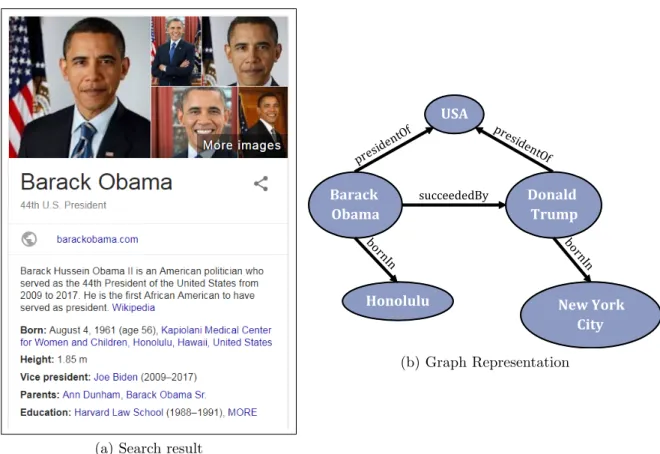
(a) Search result Honolulu Donald Trump Barack Obama USA succeededBy NewYork City (b) Graph Representation
Figure 2.1: Excerpt of a knowledge graph as part of search engine results
From an application perspective, KGs provide background knowledge that is both human and machine-readable. Most prominently, the Google search engine not only suggests websites, but also delivers additional information to the entities that are found in a given search query. For example, search for “Barack Obama”, would yield a set of facts, including birthplace and education, about the 44th president of the United States as shown in Figure 2.1a.
Both graphically and mathematically, these facts can be expressed as a multi-relational graph with entities as nodes and edges of different labels as the relations that connect them. An excerpt of the knowledge graph retrieved by the previous example query may look like the one in Figure2.1b. Here, facts about birthplaces are denoted by connecting an edge labeled bornIn from the person entity node to its respective birthplace entity node.
In the subsequent sections we will introduce the data model behind KGs, see section 2.1.1.1, as well as some of the formal ontology languages for describing KG schemata in
section 2.1.1.2.
2.1.1
Knowledge Representation
Knowledge representation is a research sub-field of artificial intelligence with its roots in the development of software programs that can answer questions based on declarative facts about the world, rather than based on procedural computing instructions, therefore to some extend mimic the human reasoning process. Most prominently the so-called expert systems were designed to incorporate a knowledge base of facts including rules and an inference engine that is able to draw conclusions.
More advanced formalism to define facts plus allowing automated reasoning have been studied, such as semantic networks and frame languages [RN10].
The most recent developments in this area have been made towards the vision of a machine-readable web of data, the so-called Semantic Web. Pursuing this vision, de-scription logics (DL) as knowledge representation language have been adopted for the development of an ontology language to describe resources on the web, which itself was heavily influenced by the earlier formalisms underlying frames and semantic net sys-tems, realizing the trade-off between high expressive power and decidability (complexity) [BCM+03]. Before describing the formal background of DL and ontologies in 2.1.1.2, we first introduce the basic building block of the Semantic Web, its standard data model – the Resource Description Framework.
2.1.1.1 The Resource Description Framework
In order to enable the automatic exchange of information on the Web, i.e. unified machine-readable content, the W3C standardized a data model specification called the Resource Description Framework (RDF)1. In contrast to other conceptual modeling approaches, such as the Unified Markup Language (UML) class diagrams, RDF is based on statements in form of triples (subject, predicate, object), which establish relationships between resources. These resources need to be uniquely identified by means of so-called Uniform Resource Identifiers (URIs). Every RDF entity is a resource and linking resources via triples results in a very loosely coupled structure that does not restrict the data to follow a specific schema, but rather allows the schema to evolve with the data. In simple terms,
subject predicate object
dbr:Barack Obama rdf:type dbo:Politician
dbr:Barack Obama dbo:bornIn dbr:Honolulu
Table 2.1: RDF triples about entity dbr:Barack Obama
an RDF data model is a directed labeled graph, where subjects and objects are nodes and predicates are labeled edges. There are special cases to this that do not fit this graph representation. It is allowed that predicates can also act as nodes. Also the notion of blank nodes is an exception, where an entity does not have to be identified by an actual URI and it serves mainly the purpose of reification, i.e. making statements about statements. For machine learning purposes these special characteristics are usually not considered [RP16a].
Besides the notion of triples, RDF also specifies some general pre-defined vocabulary, such as the type property, which is itself identified by the URI 2 and is used to indicate the type of a resource. Full URIs are usually shortened by using prefixes to refer to certain namespaces. For example, one would specify the RDF vocabulary to resort in the namespace 3 and define a prefix rdf as shorthand notation. Hence, the RDF type property can be referred to by simply declaring rdf:type. Other popular vocabularies for sharing information have been developed by the Semantic Web community, such as friend-of-a-friend (FOAF) for social relationships, DBPedia for the semantic Wikipedia, or the Dublin Core for general document properties. Revisiting the presidential example, Table 2.1 lists two triple statements taken from DBPedia about the entity referred to by the URIdbr:Barack Obama, specifying its type and birthplace. The prefixesdbranddbo
define namespaces for instance data and schema-level definitions respectively.
It is important to note that the URI is a symbolic identifier of the entity and does not have to be connected with the actual surface name (label) of the entity.
Another W3C standard building block is the RDF Schema (RDFS), which extends RDF to a larger vocabulary. One of the most import features of RDFS is the definition of classes, class-hierarchies (taxonomies), as well as definitions about relations, such as the domain and range, i.e. the types of the subject and object entities. In Table 2.2, RDFS predicates are used to define that dbr:Politician is a sub-class of dbr:Person, that is
2http://www.w3.org/1999/02/22-rdf-syntax-ns#type 3http://www.w3.org/1999/02/22-rdf-syntax-ns#
subject predicate object
dbo:Politician rdfs:subClassOf dbo:Person
dbo:bornIn rdfs:domain dbo:Person
dbo:bornIn rdfs:range dbo:Place
Table 2.2: RDF triples using RDFS vocabulary for class hierarchy and domain and range definitions
every entity of type dbr:Politician is also of type dbr:Person, as well as the domain and range definition of the dbo:bornIn relation. The formal model behind RDFS allows basic logical inference based on a set of entailment rules, such as in the type inference in the sub-class example.
Besides logical inference RDF-based knowledge graphs also provide means for query-ing. The standard language for querying data in RDF-based knowledge graphs is SPARQL [HS13]. Due to the RDF graph structure, it is conceptually different from other declarative query languages, as for example SQL, which is based on relational algebra. Similar to the triple notation of RDF, SPARQL queries are built by specifying graph patterns in form of RDF triples, where variables can be specified as placeholder for subjects, predicates and objects. Since the RDF data model represents RDF and RDFS triples likewise in the same graph, a convenient property of SPARQL is the capability to intertwine queries on schema and instance-level, also referred to as schema-aware querying. As an example, the following query defines the variable ?P to retrieve all instances which are of type
dbo:Politician who were born in dbr:Honolulu:
SELECT ?P WHERE {?P rdf:type dbo:Politician . ?P dbo:bornIn dbr:Honolulu .}
, which would bind dbr:Barack Obama as an answer to ?P.
2.1.1.2 Ontologies and Logical Reasoning
Borrowing the term from philosophy, Gruber defines an ontology as an “explicit specifi-cation of a conceptualization” [Gru93] , which means a formal, explicit way of describing a simplified model of a domain.
Although RDFS provides some support for the specification of ontologies based on RDF resources, the Web Ontology Language (OWL) family was introduced to allow more
expressive definitions building on top of the theories of description logics4, which are decidable fragments of first-order logic.
In terms of OWL an ontology is made of the following elements: • concepts (classes)
• taxonomic relations between classes,
• datatype properties, i.e. attributes defined by a simple datatype, • objects properties, i.e. named relations,
• individuals, i.e. instances of classes and properties, • restrictions, i.e. constraints on properties.
Due to its DL foundations, in OWL terms the set of instances is referred to asABox (assertions, denotedA), whereas the set of concept definitions is calledTBox (terminology, denoted T). As it is more common outside of the Semantic Web community, also in this work, the term knowledge graph is by default used to refer to the instances only and the term ontology is used to explicitly refer to schema-level definitions. The same goes for the size of a knowledge graph, usually addressing the number of individuals and not the number of concepts.
Description logics are designed to allow tractable logical reasoning in ontologies under the so-called open-world assumption (OWA). Contrary to the closed-world semantics of classical databases, where it is assumed that data is complete, OWA inherently assumes incompleteness of data, that is the absence of a fact does not consequently mean that it is not true. This assumption is crucial in order to deal with linked open data that can be flexibly integrated, so one cannot assume that the knowledge in the KG is complete.
Given a knowledge base KB as the tuple of a TBox and an ABox, KB =hT,Ai, the standard reasoning tasks in DLs include:
Concept satisfiability: Given conceptC: there exists an interpretation ofKB in which the conceptC contains a non-empty set of individuals, henceKB |=C. The unsat-isfiable concept is denoted as ⊥.
Instance retrieval: Given concept C retrieve all of its individuals. A sub-task to this is the instance-check, given an individual a, answer true or false if it is assigned to
C, denoted as KB |=C(a).
Other reasoning tasks, such as axiom entailment and classification (concept subsumption) can be reduced to concept satisfiability. For an in-depth discussion about DL reasoning, see [Rud11].
In general, DLs are very expressive and therefore can be complex, both for in terms of modeling and performing computations. Hence, the second version of the OWL family, named OWL 2, comprises different profiles with varying degree of expressiveness. For instance, the OWL 2 QL profile is the basis language for ontology-based data access (OBDA), see section 2.1.2, as it supports query answering that can be implemented by rewriting queries into relational query language (e.g. SQL) with efficient data complexity. Another profile is OWL 2 RL, which allows axioms to be translated into rules, and therefore can be efficiently implemented in logic programming paradigms and rule systems based on Horn clauses, such as Datalog, which poses some restrictions on the composition of rule predicates in terms of recursion and negation. For example, simple type inference in OWL 2 RL according to its rule specification:
C(?x)←D(?x)∧SubClassOf(D, C)
, where the left-hand side of the implication is called the head and the right-hand side is the body of the rule, in this case on variable ?x.
This leads to rule-based reasoning that is polynomial in the size of the ontology [MLD+09]. Today, many reasoning systems incorporate a dedicated Datalog engine for rule-based inference in RDFS and fragments of OWL, such as Jena5 or the RDFOx triple store [NPM+15].
2.1.2
Ontology-based Data Access
Due to the wide proliferation of relational databases as storage of industrial software systems, native RDF-based knowledge graphs have only been adopted sporadically in industrial applications. However, for heterogeneous relational data sources, the ontology-based data access paradigm has gained increasing attention in industry for the translation
of native data sources to a unified KG. The ontology in this case provides a convenient vocabulary for end-user queries and also allows some basic inference to give results even for incomplete data.
The main concept of OBDA is based on query rewriting of conjunctive queries over OWL 2 QL ontologies [RMKZ13]. The TBoxT serves as vocabulary abstraction to query the underlying data source’s schema. Given a query q over T one obtains a first-order rewriting of q and T, denoted as q0, that is the logically equivalent expansion of q by entailment. Retrieving the set of individuals a fromA as the answers to q0 over hT,Ai, first the axioms of T are applied to A to retrieve the canonical model, then it is checked if all interpretations I of hT,Ai yieldI |=q0(a).
In practice, access to the data within the vocabulary of the ontology requires the definition of so-called mappings, which define a declarative specification of how concepts of the ontology translate to entities and attributes in the relational schema. Given a query in the language of the ontology (e.g. SPARQL), OBDA systems employs rewriting as explained above. In a second step, the rewritten query is translated using the defined mappings, in order to produce the data sources native query language, e.g. SQL in case of relational schemata – this is also called query unfolding.
A mapping is a set of rules of the form:
S(x)←q(x)
,where S is a concept or a property of the ontology and q(x) a SQL query. That is, the answers to the query instantiate concepts or properties in the ontology. The W3C standard language for the specification of mappings is R2RML [DSC12]. One of the major OBDA systems is the Ontop 6 framework developed at the University of Bolzano.
2.2
Existing Semantic Modeling Approaches for
In-dustrial Knowledge Graphs
Semantic models for automation systems share a considerable overlap with the semantic models in the Internet-of-Things (IoT) community. The focus of these works is on the device modeling end, typically concerned with automated device discovery and capability
matchmaking [HBC17]. Hirmer et al. develop a modeling approach that enables au-tomated device monitoring based on so-called device blueprints in smart environments. The authors build on top of the SensorML ontology7 and a publish-subscriber message broker architecture. Monitoring applications are automatically deployed based on the semantic device descriptions. However, they do not elaborate on the semantic expressive-ness of their model and how to facilitate integration with existing industrial information modeling standards. They further propose the idea of an model editor that uses device blueprints (templates) to allow end-users to extend the ontology, but it is unclear how the users would interact with the semantic model, e.g. phrasing of axioms that could be used for data integrity checks.
Recently, Thuluva et al. [TDW+17a] introduced a layered model approach for au-tomation systems, building on top of the W3C WoT Thing Description8. For the purpose of sensing property modeling they employ the Semantic Sensor Network9 and QUDT10. Their tooling support, however, is very limited. It allows end-users to create rules to discover devices. The actual semantic models are created by ontology experts using general-purpose ontology engineering tools, e.g. Prot´eg´e. Also the authors do not discuss how to align existing industry standard information models to their semantics.
Other approaches from the domain of MES have been concerned with building of ontologies that reflect the ISA-88/95 industrial information model standard for data ex-change between production machines and the MES [SSF10]. This work is merely a termi-nological translation of the standard and lacks a detailed analysis of the expressiveness of the ontology. They describe the mapping of preconditions on data acquisition, however, using not ontological constructs, but rdfs:commenttext attributes.
The work most closely related to the one in this thesis was done by Petersen et al. [PHGg17]. They have shown a prototypical RDF-based information model specifically for accessing equipment data in an MES-like application using SPARQL. Their approach follows a classical data integration methodology. The conceptual model was hand-crafted by analyzing SQL-dumps and queries, conducting expert interviews, and review of existing information models, without generalizing their insights. They then also follow the typical OBDA workflow in designing R2RML mappings for the Ontop framework to access the
7https://www.opengeospatial.org/standards/sensorml 8https://www.w3.org/TR/wot-thing-description 9https://www.w3.org/TR/vocab-ssn
different data sources. Although the use case evaluation gives promising results, a deeper analysis of the needed expressiveness of the semantic models is missing, which is vital for data integrity checks.
In conclusion, all of the mentioned works above lack a further description how the domain knowledge in the semantic model can support the development of analytic (pre-dictive) models.
2.3
Contribution
The works in this thesis present a modeling approach based on a fragment of the OWL 2 language for the schema-level modeling of industrial KGs, including standard concept hierarchies as well as the formulation of data integrity constraints that need to be ad-dressed in common industrial information models. A prototypical system developed on top of the WebProt´eg´e framework demonstrates how these modeling capabilities can be realized within an end-user-oriented model editor. The prototype contains an efficient constraint checking via translation of constraints to Datalog rules, which are injected into a state-of-the-art Datalog inference engine. Based on the modeling capabilities, the chapter further introduces an architecture for ontology-based data access in order to ob-tain semantic end-user access and preparation of predictive models on top of industrial domain-specific ontologies. These contributions are outlined in the following publications: [KGJR+16] Evgeny Kharlamov, Bernardo Cuenca Grau, Ernesto Jim´enez-Ruiz, Steffen Lamparter, Gulnar Mehdi, Martin Ringsquandl, Yavor Nenov, Stephan Grimm, Mikhail Roshchin, and Ian Horrocks. Capturing industrial information models with ontologies and constraints. In Proceedings of the 15th International Semantic Web Conference, pages 325–343, 2016
[RLL16] Martin Ringsquandl, Steffen Lamparter, and Raffaello Lepratti. Graph-based predictions and recommendations in flexible manufacturing systems. In Proceedings of the IECON 2016 - 42nd Annual Conference of the IEEE Industrial Electronics Society, pages 6937–6942, 2016
The modeling approach was developed by main author Evgeny Kharlamov published in Capturing industrial information models with ontologies and constraints [KGJR+16]. Martin Ringsquandl supported the requirements analysis considering expressiveness of
conceptual descriptions in the production domain, created a use case and an ontology with associated instance data and logical constraints. Ernesto Jimenez-Ruiz and Yavor Nenov were responsible for the prototype implementation. Gulnar Mehdi provided a gas turbine application case. Steffen Lamparter, Stephan Grimm, Mikhail Roshchin and Ian Horrocks gave feedback. In the second publication Graph-based predictions and recom-mendations in flexible manufacturing systems [RLL16], the architecture of ontology-based preparation for predictive models and the proof-of-concept implementation was done by Martin Ringsquandl. Steffen Lamparter and Raffaello Lepratti provided feedback on the use case.
Domain knowledge-driven Feature
Selection for Predictive Models
within Industrial Knowledge Graphs
Le pr´esent ne contient rien de plus que le pass´e et ce qu’on trouve dans l’effet etait d´ej`a dans la cause.
Henri Bergson Besides sensing and communication capabilities of digital twins, the thereby intro-duced ubiquitous availability of data about the overall manufacturing operations enables manufacturing companies to embrace more advanced predictive modeling and analysis, in order to optimize processes and usage of equipment [LLBaK13]. As an example, in 2016 the Robert Bosch GmbH launched a public data science competition on the Internet platform Kaggle1, challenging participants to predict internal failures of production lines based on thousands of measurements and tests collected for each component.
However analysis of such data is challenging without extensive domain background knowledge, since it not only is of great volume and variety, including time-series, graph-structured and semi-graph-structured [JONK14], but also generated by engineered systems that exhibit known physical dependencies and constraints which are hard to uncover using
common predictive models. Revisiting the example, the aforementioned Kaggle compe-tition was also featured in the 2016th IEEE Big Data conference and one of the biggest problems for the participating data scientists was the processing of this dataset into mean-ingful representations [MK16].
Although there is a clear motivation for using predictive modeling, such as machine learning, for predictive analysis, the lifecycle management of these models from first ex-periments to deployment is hard to manage, since each phase must be guided by domain expert knowledge to ensure proper preparation and execution [LNR14].
3.1
Background on knowledge-based Predictive
Mod-eling
3.1.1
Classification and Regression Models
Statistical classification and regression are among the most common supervised learning tasks in the field of machine learning for the approximation of an unknown function over a datasets with existing label information. The goal is to find patterns in the data in order to predict the label of previously unseen data samples. Given a dataset D={(xi, yi)}ni=1 where xi∈Rp is a p-dimensional feature vector of instancei and yi ∈ Y is the true label
of instance i, formally, a supervised model corresponds to a function f : Rp → Y. The statistical inference task is to fit the model’s parameters w such that the approximation error is minimized. In case of a linear regression model,Y =R, and the learned function is of the form ˆy=f(w) = w>x, wherewis the linear model’s parameter vector. In ordinary classification yi is a categorical variable, e.g. binaryyi ∈ {0,1}, but further tasks extend
this to non-overlapping multiple classes (multi-class classification) and multiple labels (multi-label classification). The multi-label classification setting, where the label of an instance can be any subset of a set of labels yi ∈2Y, can be formulated ask−1 distinct
binary classification problems. (in case independence between labels is assumed)
In theory, function approximation is an optimization problem and the quality of the learned function approximation is typically measured by a certain loss or cost function,
e.g. mean-squared error (MSE) for regression: M SE = 1 n n X i=1 (ˆyi−yi)2
Unfolding the mean-squarred error for linear regression it is straightforward to solve this optimization problem by taking the partial derivative of the loss w.r.t. the model parameters: ˆ w= argmin w 1 n n X i=1 (w>xi−yi)2 ˆ w= argmin w (Xw−y) >(Xw−y) ∂ ∂w = 2(Xw−y) >X = 2X>Xw−2X>y
Setting the derivative to zero, one can solve forw that minimize the loss:
∂ ∂w = 0 X>Xw=X>y
w= (X>X)−1X>y
In this simple case of ordinary least squares regression, the loss function is quadratic and there is exactly one global minimum and no further constraints need to be considered in finding the optimal parameters. When moving to a more complex family of func-tions, e.g. multi-layer perceptrons with non-linear activations that are the basis of neural networks, the optimzation problem can no longer be solved in this straightforward way, because there may be several local minima. With the notion that a ‘good’ local minimum is still sufficient in most cases, fitting neural networks parameters is usually done with stochastic gradient descent algorithms.
The theoretical foundations of machine learning algorithms usually come with a proba-bilistic interpretation, such that the predicted outcome can be interpreted as a probability and therefore includes uncertainty by nature. The problem statement is formulated as
finding the parameter setting that maximizes the conditional probability, also called like-lihood function, P(y|x;w). The optimal parameter values ˆw are then found according to the maximum likelihood estimate principle.
3.1.2
Feature Selection
Given a dataset ofprandom variables the task of feature selection for predictive models is to obtain a subset of these variables (features) that are given for each instance, which are then input to the predictive model. In the supervised setting, the predictive model is used to solve a classification or regression problem, that is, the chosen features represent the independent variables to predict a given dependent variable. The number of variables is also referred to as dimensionality of the dataset. Feature selection can be seen as search through the powerset consisting of all 2p −1 subsets, which is again an optimization problem on its own.
The importance of feature selection has grown over the last decade due to the increas-ing availability of high-dimensional datasets. Since generalization of machine learnincreas-ing models over such data, i.e. the capability of a model to fit the data correctly without being to biased towards the given samples (training data), becomes exponentially harder as the number of variables increases [Dom12]. This is closely connected to the problem of overfitting in machine learning literature, as every learning algorithms come with a certain bias and variance towards its parameters. Highly biased algorithm need lots of evidence in the data to change their initial parameter choice, while high-variance algo-rithms very quickly fit to special peculiarities of datasets. Overfitting happens when the model parameters are over-specific to the characteristics of the training data and fail to generalize to unseen samples.
Another related challenge of high-dimensional datasets is thecurse of dimensionality, which holds for a broad family of data distributions and distance measures [HKK+10]. Formally this effect has been shown that with increasing data dimensionality the propor-tional difference between the farthest-point distance dmax and the closest-point distance
dmin converges to zero: on a dataset consisting ofpfeaturesD={x1,x2, . . . ,xn} ∈Rn×p,
when p → ∞, dmin(D) = min
i,j dist(xi,xj), then we have
dmax−dmin
dmin = 0. Since a stable distance or measure is vital for many predictive models, reducing high-dimensionality is an important challenge.
Wrapper-based framework
Search strategy All features
Predictive model
Feature subset performanceEstimated
Best subset
Figure 3.1: The wrapper-base feature selection framework is an iterative approach to select the best subset of features according to a search strategy
In order to avoid this problem, it is necessary to develop robust and yet cost-efficient predictive models by decreasing the data dimensionality beforehand. This reduction of input feature dimensionality is part of the well-known problem of feature selection. There are various feature selection methods that try to judge the usefulness of features towards the objective function of the predictive model. They can be grouped in to the following categories, cf [TAL14]: filter,wrapper, embedded.
The wrapper-based framework is shown in Figure 3.1. In this iterative approach, feature selection is performed by a search strategy (e.g. greedy) that selects a subset of all features. Then the predictive model is evaluated on this subset with respect to some performance metric, e.g. accuracy. Finally, the best subset according to the metric is chosen. This generic framework is agnostic of the predictive model and can therefore be applied universally. In contrast to embedded methods, the wrapper setting uses an external evaluation criterion that is not built into the predictive model itself. This is why wrapper approaches are computationally more expensive and the crucial part is to come up with an efficient search strategy that does not need exhaustive enumeration.
One form ofembedded feature selection approaches can be seen as adding constraints on the model parameters, a technique called regularization. TheL1–norm penalty on the model parameters induces a sparse feature representation. In linear regression models this is called the Lasso, or Laplacian prior. For very high variance models such as neural networks with multiple stacked layers of hidden parameters best practices to avoid
over-fitting are applied to the objective function by introducing a penalty on the magnitude of parameters. For example, given a parameter matrix W the L2–norm kWk2 is added to the objective function, therefore favoring solutions with small magnitude of the parame-ters. To increase accuracy of prediction on unseen data, these regularization techniques have been applied to linear models as well, e.g. in Ridge or Lasso regression models. Such linear models are also used in cases when p is greater than the number of data points n
(p > n). Here, further regularization schemes have been developed, especially focused on collinearity between predictor variables [ZH05]. Removing predictor variables from the model also has the benefit to increase interpretability of results.
Filter feature selection methods are based on characteristics of the features itself, such as their variance. This is closely related to dimensionality reduction approaches that transform the original feature space into a lower-dimensional one that still keeps most of the original variance in the dataset. This can be accomplished by combining highly cor-related features, as in principal component analysis (PCA) for example, which computes the eigenvectors of the feature’s covariance matrix over the whole dataset. Hence, most of the original variance can be retained by a subset of eigenvectors used as low-dimensional projection. The shortcoming of techniques like PCA are that they retain only linear cor-relations within the dataset. Furthermore, the low-dimensional projection can be hard to interpret in later explanation of the predictive model to domain experts.
In general, both dimensionality reduction as well as feature selection approaches have been targeted towards traditional tabular, i.e. propositionalized, data structures. How-ever, the proliferation of complex-structured data has pushed the demand for feature se-lection approaches that directly deal with these representations, e.g. connected datasets [GH11], common single-relational graphs (networks) [AW06], and multi-relational graphs [GLT+16]. Due to the difficulty of applying predictive models to complex-structured data, the border between pure feature selection and feature extraction vanishes and the result of applying these methods to graph-structured data again results in a tabular data rep-resentation, thereby enabling efficient statistical inference, which will be introduced in Chapter 4.
3.1.3
Graph-structured Data
Many real-world datasets are naturally encoded in a graph structure, such as social net-works, where a node corresponds to an individual and a edges between individuals rep-resent some form of interaction between two individuals [HKP06]. Mathematically, the most general definition of a graph is the undirected graph. Formally the graph is denoted as a tuple G=hV, Eiwith vertex (or node set) V and edge setE. A graph consisting of
n nodes defines V = {vi}in and the corresponding edges as (vi, vj) ∈ E. Another way of representing graphs is given by the adjacency matrix A∈RN×N, where
aij = 1, if(vi, vj)∈E 0, otherwise
Forundirected graphs this matrix is symmetric, i.e. (vi, vj) =⇒ (vj, vi). In case of
aweightedundirected graph, edges have a weight attributewattachedeij = (vi, vj, wij).
This means that the adjacency matrix is extended from binary values to any real value. In a statistical sense, edge weights are often used to denote the probability of an edge to exist with respect to some predictive model. This notion will be further discussed in section 4.1. Directed graphs are a special form of graphs which no longer posses the symmetry of edges, i.e. (vi, vj) expresses a directed connection from vi to vj which is
different from (vj, vi).
As mentioned before, the (subject, predicate, object) triples in RDF2 data can be formulated as labeled directed multi-graph, where there are finite sets of vertex and edge labels LV, LE and two maps `V, `E assigning labels to vertices and edges respectively.
Hence, G=hV, E, LV, LE, `V, `Ei. In this case E is a multiset of ordered pairs of vertices
and lE :E → {LE}, assigning a label to each ordered edge. The set of edge labels is also
referred to as the set of edge or link types.
We further define the notion of a subgraph: H is a subgraph ofG(H ⊆G) ifV(H)⊆
V(G) and E(H)⊆E(G).
A graph isomorphism between two graphsGand H is a bijection between the vertices of the two graphs p : VG → VH, such that if (vi, vj) ∈ EG then (p(vi), p(vj)) ∈ EH. On labeled graphs, p defines a re-labeling such that adjacency between labels is preserved.
3.1.4
Feature Selection and Extraction for RDF Data
For graphs consisting of only a single edge type where nodes have no labels or attributes attached, spectral graph theory and the concept of graph Laplacian provides a natural way to extract continuous representations out of the discrete graph representation. The Laplacian of a graph is defined as:
L=D−A
where D = diag(Pj,j6=iaij) is the degree matrix. The eigendecomposition of the graph
Laplacian is used in tasks like spectral clustering to extract continuous node represen-tations as the eigenvectors of the non-zero eigenvalues (spectral embeddings). These representations allow to solve relaxed versions of the NP-hard graph partitioning prob-lem.
Moving to more complex graph-structured data, RDF’s labeled directed multi-graphs or so-called heterogeneous networks with different types of nodes, the spectral theory does no longer provide a closed framework for extracting node representations. Statistical classification models in graph-structured data for tasks such as node classification, need to consider variables attached to an individual node as well as the variables of the nodes that are connected to it. Therefore common feature selection techniques do not suffice to capture features in graph-structured data. Simplifications of feature selection like feature aggregation or propositionalisation may be performed. These techniques compute some form of aggregation function over node neighborhoods, therefore condensing graph information into tabular structure. For example in a social network analysis a feature aggregation approach could be to take the mean value over the age attribute of nodes in a neighborhood. It has been shown for RDF data that these methods suffer from substantial loss of information [RP14]. On the other hand, once the notion of first-order neighborhood is extended to also include attributes of higher order neighbors, it becomes evident that the feature selection search space grows exponentially.
To this regard, special graph kernel methods have been developed to directly encode similarity of local graph structures instead of manually engineered features. Kernel meth-ods are a popular machine learning technique, particularly as part of support vector ma-chine (SVM) classifiers, because kernels can be readily plugged into the SVM maximum-margin objective. Since the RDF data model represents data in form of a graph, graph
A
B
C
D
E
F
G
A:B,C
B
C:E
D
E
F:D,E
G:A,F
Original graph 1. Iteration re-labeled graph
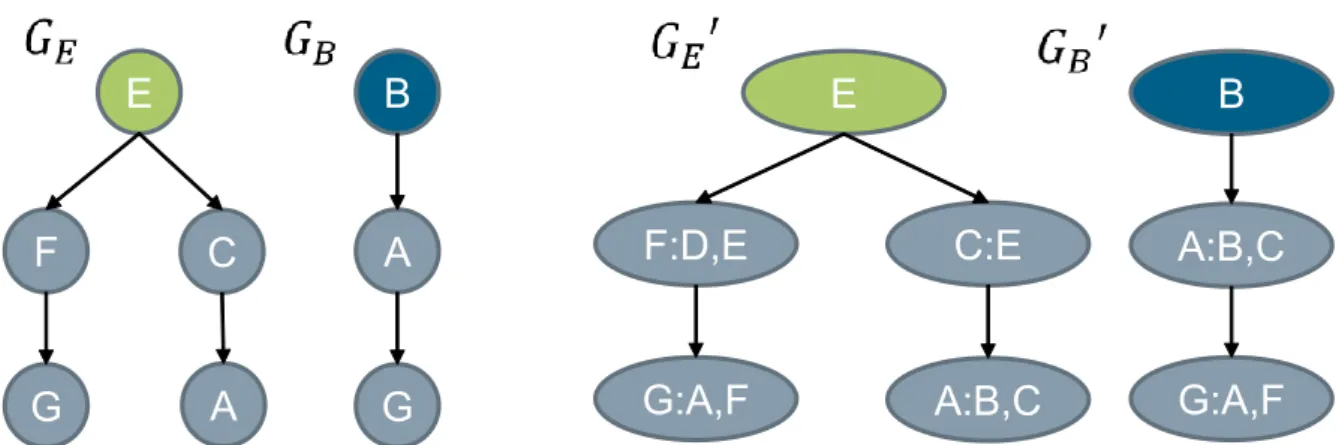
Figure 3.2: One iteration of Weisfeiler-Lehman re-labeling for graph isomorphism
kernels allow to directly apply machine learning algorithms on RDF data. A nice property of these methods is that the whole graph, including RDF schema definitions can be taken into account for similarity calculation.
Weisfeiler-Lehman Subtree graph kernel A graph kernel κ:G×G→Rmeasures the similarity between two graphs. In order to apply them to encode features for a pair of nodes (entities), vi, vj, one first extracts the two subgraphs Gi, Gj ⊂ G up to
a certain depth of neighborhood and then applies an appropriate graph kernel on these two subgraphs. The Weisfeiler-Lehman subtree graph kernel calculates the number of matching subtrees based on the Weisfeiler-Lehman test for graph isomorphism. The isomorphism test performs node iterative node re-labeling, collecting the multi-set of labels of node neighbors, then computing a hash to compress the multi-set of labels into a new one. The new label is then used in the next iteration.
As an example of the Weisfeiler-Lehman subtree graph kernel, Figure 3.2 shows a simplified RDF graph G, without considering edge labels. In this example, the kernel between nodesvE andvB, node with labelB and the node with labelEshall be calculated.
Applying one iteration of label propagation, we obtain G0, where the original label is concatenated with the neighboring ones.
It can be seen that the labels of nodes which do not have any incoming edges (B, D, E) do not change through iterations.


![Fig. 2. Designation models IEC 81346, ISO/TS 16952-10, and RDS-PP and example energy information model for an energy plant [31].](https://thumb-us.123doks.com/thumbv2/123dok_us/9773074.2469044/80.892.109.757.100.583/designation-models-example-energy-information-model-energy-plant.webp)