Neuro-fuzzy mid-term forecasting of electricity consumption
using meteorological data
Paul A. Adedeji 1a, Stephen Akinlabi b, c, Nkosinathi Madushele a, and Obafemi Olatunji a
a Department of Mechanical Engineering Science, University of Johannesburg, South Africa
b Department of Mechanical and Industrial Engineering, University of Johannesburg, South Africa
c Department of Mechanical Engineering, Covenant University, Ota, Nigeria. Email: [email protected]
Abstract. Forecasting energy consumption is highly essential for strategic and operational planning. This study uses the Adaptive-Neuro-Fuzzy Inference System (ANFIS) for a mid-term forecast of electricity consumption. The model comprises of three meteorological variables as inputs and electricity consumption as output. Two ANFIS models with two clustering techniques (Fuzzy c-Means (FCM) and Grid Partitioning (GP) were developed (FCM and ANFIS-GP) to forecast monthly energy consumption based on meteorological variables. The performance of each model was determined using known statistical metrics. This compares the predicted electricity consumption with the observed and a statistical significance between the two reported. ANFIS-FCM model recorded a better mean absolute deviation (MAD), root mean square (RMSE), and mean absolute percentage error (MAPE) values of 0.396, 0.738, and 8.613 respectively compared to the ANFIS-GP model, which has MAD, RMSE, and MAPE values of 0.450, 0.762, and 9.430 values respectively. The study established that FCM is a good clustering technique in ANFIS compared to GP and recommended a comparison between the two techniques on hybrid ANFIS model.
Keywords: ANFIS; Electricity Consumption; FCM; GP; Mid-term Forecasting
1. Introduction
Over the years, electricity has been observed to be central to a sustainable economy [1] and has been considered as the most important resource in the global economy [2]. It has also experienced global increased demand despite the annual increase in generation. Many developing countries still have low electricity access, most especially sub-Saharan Africa [3], [4]. Population increase, technological advancements, human migration, increase in energy related anthropogenic activities and many more have resulted in increased electricity demand. One of the groups of exogenous variables which influence electricity consumption is the meteorological variable. It has been established that air temperature affects electricity consumption [5]. It highly influences energy consumption during the winter seasons in
temperate regions, where electricity is largely used for space heating [6]. Among other factors which influence electricity consumption is the relative humidity, wind speed, solar irradiance, cloud cover and so on [7]–[9]. In order to efficiently manage the demand side of energy system, there is need for electricity consumption forecast relative to meteorological variables which can be used for the purpose of strategic planning.
The literature is replete with studies on electricity consumption forecast either in the form of an input-output model [10] or as an autoregressive model [11]. These forecasts has been divided based on the time scales to short term, mid-term and long-term forecast [12]. The short-term forecasts are hourly, daily, and weekly time scale forecasts. The mid-term forecast, on the other hand, suggests forecast on a monthly time scale while the long-term forecasts on the yearly time scale. Many of these studies are related to energy consumption in buildings. For example, an investigation of the a campus energy usage was performed by Huang et al. [13]. The authors applied support vector regression (SVR) for a short-term prediction of the next 24-hours consumption in the institution. The day of the week, weekend indicators, temperature factors, historical hourly energy consumption profile, and occupancy indicators were used as model inputs while the output remains the 24-hour- ahead energy consumption. Similarly, a study by Massana et al. [2] on the short-term load forecasting for non-residential buildings considered meteorological variables, occupancy, calendar, indoor environment, to forecast electric load of office buildings in a university environment. The study compared the efficiency of multiple linear regression (MLR), support vector regression (SVR), and multi-layer perceptron (MLP) for the forecast. Meteorological data are fuzzy in nature and this has a tendency of affecting the model output. Some studies have investigated the use of other models with fuzziness in the data accounted for. One of the commonest modelling techniques in this regard is the Adaptive Neuro-fuzzy Inference System (ANFIS). ANFIS technique is a modeling technique which combines the functionality of both the artificial neural network and fuzzy logic in a data-driven model [14]. The adaptive nature of ANFIS makes a non-linear mapping between inputs and output possible within n-dimensional space. ANFIS models follow a
supervised learning approach with inputs and outputs. The technique has been used in different studies some of which includes hydrology [15], [16], energy systems [17], [18], geosciences [19] and so on. It has also been used in electricity consumption forecast. For example, Cevik and Cunkas [20] experimented the use of fuzzy logic (FL) and ANFIS for load forecasting. While the model inputs were historical load, temperature difference and season the output is the load forecast. The study established the abilities of both models to be able to process large amount of data with accuracy of the forecast not compromised. Similarly, a one-step ahead forecast was performed by Cheng [21]. The study established the inability of statistical forecasting tools to perform efficiently in a non-linear data space. The study used a time series ANFIS model with a-step ahead integration. Also, Gholamreza et al. [10] applied ANFIS modelling to electricity demand using a combination of meteorological variables and socia-economic variables. Recently, the technique has been hybridized with optimization models like Particle Swarm Optimization (PSO) Genetic Algorithm(GA), Differential Evolution(DE) [22], [23], and so on towards achieving a global optimal parameter for effective predictions. Increased prediction accuracy has been recorded from these hybrids. Significant to the ANFIS model is the clustering technique. Clustering tools group multi-dimensional data into clusters based on density or distance functions according to specified radius of influence. Significant to this study is the study by Tiwari et al. [24]. This study investigated the efficiency of two clustering techniques: the subtractive clustering and the fuzzy-c-means clustering technique on water quality index of a river. However, the point of departure in this present study is the investigation of grid partitioning (GP) and fuzzy-c-means ANFIS integrated clustering technique on electricity consumption forecast. Several studies that utilizes ANFIS models for
energy consumption forecast are building related, however, this study applies ANFIS to forecast for a nexus of electricity consuming sectors which comprises the Gauteng Province of South Africa.
The world of fourth industrial revolution is tending towards not only smart manufacturing but smart buildings which include residential and non-residential buildings. These buildings are expected to be able to capture ambient variables to efficiently and intelligently optimize the energy consumption without user’s interference. Such buildings require intelligent algorithms with fuzzy capabilities for intelligent forecast, which forms one of the relevance of this study. One of these intelligent algorithms is the ANFIS modelling tool selected in this study. Gauteng province used as a case study in this paper constitute 24.1 % South African Population [25]. The province constitutes one provinces in the country with high consumption of electricity [26]. These consumptions largely come from industrial, residential, and non-residential buildings. However, this study investigates the effect of the choice of clustering technique on ANFIS modeling in electricity consumption forecast relative to meteorological variables.
2. Methodology
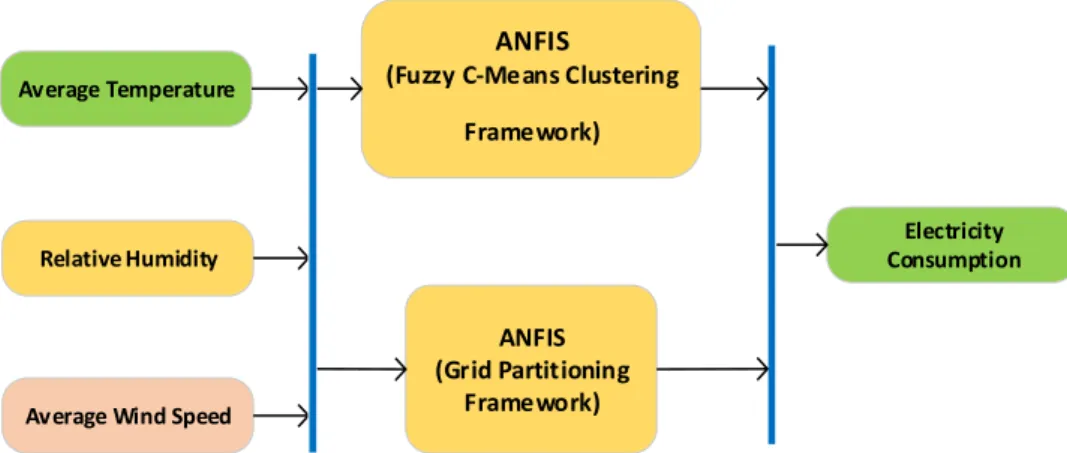
Two clustering based ANFIS models were developed in this study: the FCM and the ANFIS-GP model. The two models were built with same inputs and output as shown in Figure 1. The performances of these models were evaluated using known statistical metrics and the results reported. The Gauteng province of South Africa was chosen as a case study.
2.1.Data Collection
Meteorological data from representative weather stations in the province were collected from the South African Weather Service within a period of 2007 to 2017 on monthly basis. These stations were selected based on proximity to residential and non-residential and buildings, knowing well that meteorological variables have a close relationship with electricity consumption [9], [27]. This was achieved using GoogleEarth Pro. The meteorological data used in this study include the average temperature, relative humidity, and wind speed as identified to influence electricity consumption. Monthly electricity consumption for the province within the same number of years was collected from the South African Monthly Bulletin.
2.2.Model description
The general ANFIS model follows the Type-II Takagi-Sugeno inference system [28]–[30]. The ANFIS model is a five-layered network consisting of the fuzzy layer, the product layer, the normalized layer, the de-fuzzification layer, and the total output layer. More information on these layers can be obtained in [28], [30]. ANFIS consists of adaptive nodes interconnected by directional links [31]. The ANFIS model used in this work comprises of the three meteorological variables as inputs and the electricity consumption within the period of the data collection as output (as shown in Figure 1).
Average Temperature Relative Humidity Average Wind Speed Electricity Consumption ANFIS (Grid Partitioning Framework) ANFIS (Fuzzy C‐Means Clustering Framework)
Figure 1. The forecasting model using ANFIS framework
Clustering forms an integral part of the ANFIS modeling technique. This technique groups individual members into fuzzy classes. It employs several properties to find the similarity groups in the data [32], [33]. Several clustering methods have been identified in the literature with each having its peculiarities. These are classified into partitioning methods, the hierarchical methods, the density-based methods and the model-based methods [34], [35]. In this study, two clustering techniques (FCM and GP) were integrated into the ANFIS model.
2.2.1. Fuzzy C-Mean Clustering
The FCM technique follows the conventional Euclidean distance function that includes hyperspherical clusters [36]. The technique is a fuzzified version of the k-means algorithm which minimizes the least square error function , also known as the c-means function as presented in eqn. (1). The FCM performs well when member classes are not pre-specified. It is very good at suggesting suitable classes for observations. In this study, the number of clusters, partitioning exponent, maximum number of iterations and minimum improvement used were 10, 2, 100, and 1 10 respectively.
, , 1 ∞ 1
where = the centre of cluster = number of clusters | 2
= weighting exponent = vector data of observations
= positive definite weight matrix
‖ ‖ = dimensional Euclidean space wherein sample data belong.
2.2.2. Grid Partitioning
This is the most commonly used fuzzy partitioning technique to generate fuzzy members from observations within a dataset. Two other fuzzy partitioning techniques are the tree partitioning and the scatter partitioning. The GP technique divides the input space into different fuzzy slices with each specified by a membership function thereby forming a partition. The technique uses similar membership
functions on the input space to generate equal partitions within the symmetric membership function [37]. It has been established that finer grids offers a better model performance [38]. It should be noted that one of the common setbacks of this method is what is referred to as the “curse of dimensionality”. This is the exponential increase in the rule base as the problem size increase [39]. In this model, the Gaussian membership function was used for input and the linear membership function for output. The number of fuzzy rules is relative to the input-output.
3. Results and Discussion 3.1. Model result
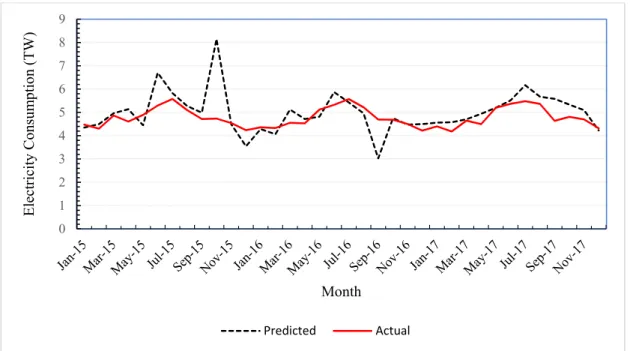
The two models were trained and tested with 70 % (84 months) and 30 % (36 months) of the data collected respectively. Shown in Figure 2 is a comparison plot between the actual energy consumption and that produced in the use of the ANFIS-GP model. The predicted ANFIS-GP model fits the trend in the observed data. From Figure 2, a large deviation is observed between the actual electricity consumption and the forecast at June 2015, October 2015, September 2016. While there was significant over-prediction in June 2015 and October 2015, there was significant under-prediction in September 2016. This could be due to misfiring of the ANFIS node. The other time steps during the forecast appears closer to the actual electricity consumption.
Figure 2. Prediction results for the ANFIS-GP model at testing phase between January 2015 to Dec 2017
Statistical analysis between the actual and predicted results obtained with ANFIS-GP was performed and presented in Table 1. At a confidence level of 0.05, 1.808 3.978 . The result shows that there is no statistically significant difference between the observed and the predicted electricity consumption. 0 1 2 3 4 5 6 7 8 9 El ect ri ci ty C onsum pt ion (TW ) Month Predicted Actual
Table 1. Statistical results between observed energy consumption and the predicted energy consumption using the ANFIS-GP model.
Source of Variation SS df MS F P-value F crit
Between Groups 0.867 1 0.867 1.808 0.183 3.978
Within Groups 33.573 70 0.480
Total 34.440 71
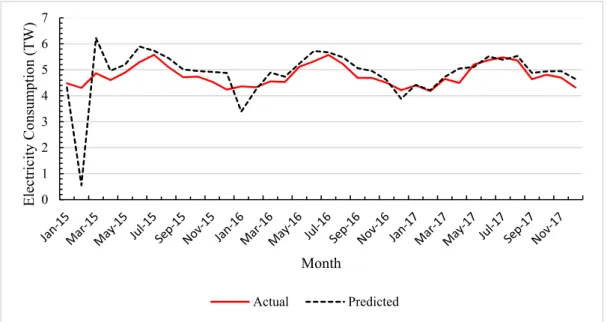
Similarly, a comparison between the actual and the predicted electricity consumption using the ANFIS-FCM model is reported (Figure 3). The result shows that the predicted electricity consumption follows a similar trend with the actual consumption as shown in Figure 3. The model under-predicted in the second month but predicted close to the observed electricity consumption in other months. The prediction in the ANFIS-FCM appears closer to the observed electricity consumption as compared to the ANFIS-GP model. After the significant underprediction in the second month (Figure 3), there was no significant underprediction in subsequent month as opposed to the ANFIS-GP model (Figure 2).
Figure 3. Prediction results for the ANFIS-FCM model at testing phase between January 2015 to Dec 2017
A statistical analysis to determine whether the difference between the observed and the predicted electricity consumption is statistically significant was performed and the results presented in Table 2. At a confidence level 0.05, 0.285 3.978 . The result obtained shows that the difference between the observed electricity consumption and the predicted is not statistically significant. Table 2. Statistical results between observed energy consumption and the predicted energy
consumption using the ANFIS-FCM model.
Source of Variation SS df MS F P-value F crit
Between Groups 0.149 1 0.149 0.285 0.595 3.978 Within Groups 36.586 70 0.523 Total 36.736 71 0 1 2 3 4 5 6 7 El ect ri ci ty C onsum pt ion (TW ) Month Actual Predicted
3.2.Performance Evaluation
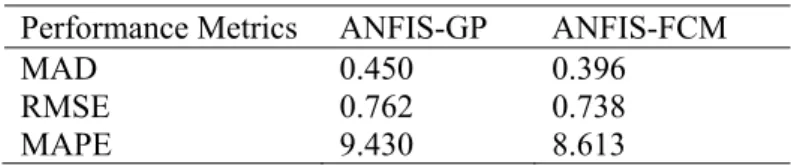
Both clustering techniques show no statistically significant difference between their prediction and the actual energy consumption. In order to determine the model performance, the Mean Absolute Deviation (MAD), Root Mean Square Error (RMSE) and Mean Absolute Percentage Error (MAPE) were used on the predicted electricity consumptions and the results are presented in Table 3. The ANFIS-FCM clustering technique records a lower MAD, RMSE, and MAPE value compared to the ANFIS-GP technique. These lower indices basically signify that the two models can predict better energy consumption. ANFIS-AFCM model records a lesser MAPE value which shows a model accuracy of 91.387% while ANFIS-GP model is 90.57% accurate in prediction. FCM based ANFIS model offers a high prospect of model accuracy and is not associated with curse of dimensionality as known for GP-based models.
Table 3. Model Performance at the testing phase Performance Metrics ANFIS-GP ANFIS-FCM
MAD 0.450 0.396
RMSE 0.762 0.738
MAPE 9.430 8.613
4. Conclusions
The effect of the clustering technique in forecasting electricity consumption using ANFIS modeling technique was investigated in this study. A case study of Gauteng Province, South Africa was used with three meteorological variables as model inputs and electricity consumption as output. The results obtained established that the FCM clustering technique performs better than the GP clustering technique. A study by [40] also establishes the effectiveness of the ANFIS-FCM model. GP clustering technique is also associated with curse of dimensionality, such that as the problem size increase, the rule base increases exponentially and thus resulting into increased computational time [39]. Investigating the effect of the clustering technique on a hybrid ANFIS model can be explored to establish the significance of clustering technique selection on either standalone ANFIS or hybrid ANFIS model.
Acknowledgements
The authors appreciate the South African Weather Service and the Statistics South Africa for providing the meteorological and the electricity consumption data respectively, used in this study. Also, the authors appreciate the University of Johannesburg for the financial conference support.
References
[1] D. Chirambo, “Towards the achievement of SDG 7 in sub-Saharan Africa: Creating synergies between Power Africa, Sustainable Energy for All and climate finance in-order to achieve universal energy access before 2030,” Renew. Sustain. Energy Rev., vol. 94, no. July, pp. 600–
608, 2018.
[2] J. Massana, C. Pous, J. Melendez, and J. Colomer, “Short-term load forecasting in a non-residential building contrasting models and attributes,” Energy Build., vol. 92, pp. 322–330,
2015.
[3] R. Best and P. J. Burke, “Electricity availability: A precondition for faster economic growth?,”
Energy Econ., vol. 74, pp. 321–329, 2018.
[4] Abel Oyuke, P. H. Penar, and B. Howard, “Off-grid or ‘off-on’: lack of access, unreliable electricity supply still plague majority of Africans,” Afrobarom. Dispatch, no. 75, pp. 1–26,
[5] M. A. Lokoshchenko and N. A. Nikolaeva, “Dependence of energy consumption on air temperature in Moscow,” Russ. Meteorol. Hydrol., vol. 42, no. 12, pp. 783–791, 2017.
[6] S. C. Taylor, S. K. Firth, C. Wang, D. Allinson, M. Quddus, and P. Smith, “Spatial mapping of building energy demand in Great Britain,” GCB Bioenergy, vol. 6, no. 2, pp. 123–135, 2014.
[7] D. Jose, M. Mathew, and A. Krishnan, “Weather dependency of electricity demand: A case study in warm humid tropical climate,” 2016 3rd Int. Conf. Electr. Energy Syst. ICEES 2016, pp. 102–
105, 2016.
[8] F. Apadula, A. Bassini, A. Elli, and S. Scapin, “Relationships between meteorological variables and monthly electricity demand,” Appl. Energy, vol. 98, pp. 346–356, 2012.
[9] L. Wang, X. Liu, and H. Brown, “Prediction of the impacts of climate change on energy consumption for a medium-size office building with two climate models,” Energy Build., vol.
157, pp. 218–226, 2017.
[10] G. Zahedi, S. Azizi, A. Bahadori, A. Elkamel, and S. R. Wan Alwi, “Electricity demand estimation using an adaptive neuro-fuzzy network: A case study from the Ontario province - Canada,” Energy, vol. 49, no. 1, pp. 323–328, 2013.
[11] P. A. Adedeji, S. Akinlabi, O. Ajayi, and N. Madushele, “Non-linear autoregressive neural network (NARNET) with SSA filtering for a university enegy consumption forecast,” in 16th Global Conference on Sustainable Manufacturing- Sustainable Manufacturing for Global Circular Economy, 2019, pp. 176–183.
[12] H. Guo, Q. Chen, Q. Xia, C. Kang, and X. Zhang, “A monthly electricity consumption forecasting method based on vector error correction model and self-adaptive screening method,”
Int. J. Electr. Power Energy Syst., vol. 95, pp. 427–439, 2018.
[13] Y. Huang, T. Lu, D. Xianfhua, and N. Gu, “Campus Building Energy Usage Analysis and Prediction: A SVR Approach Based on Muli-scale RDF Kernels,” in International Conference on Human Centered Computing, 2015, vol. 8944, pp. 441–452.
[14] J. A. Awan and D. H. Bae, “Improving ANFIS Based Model for Long-term Dam Inflow Prediction by Incorporating Monthly Rainfall Forecasts,” Water Resour. Manag., vol. 28, no. 5,
pp. 1185–1199, 2014.
[15] F. J. Chang and Y. T. Chang, “Adaptive neuro-fuzzy inference system for prediction of water level in reservoir,” Adv. Water Resour., vol. 29, no. 1, pp. 1–10, 2006.
[16] F. J. Chang and K. W. Wang, “A systematical water allocation scheme for drought mitigation,”
J. Hydrol., vol. 507, pp. 124–133, 2013.
[17] S. R. Moreno and L. dos Santos Coelho, “Wind speed forecasting approach based on Singular Spectrum Analysis and Adaptive Neuro Fuzzy Inference System,” Renew. Energy, vol. 126, pp.
736–754, 2018.
[18] D. Zheng, A. T. Eseye, J. Zhang, and H. Li, “Short-term wind power forecasting using a double-stage hierarchical ANFIS approach for energy management in microgrids,” Prot. Control Mod. Power Syst., vol. 2, no. 1, p. 13, 2017.
[19] A. Khashei-Siuki and M. Sarbazi, “Evaluation of ANFIS, ANN, and geostatistical models to spatial distribution of groundwater quality (case study: Mashhad plain in Iran),” Arab. J. Geosci.,
vol. 8, no. 2, pp. 903–912, 2015.
[20] H. H. Cevik and M. Cunkas, “Short-term load forecasting using fuzzy logic and ANFIS,” Neural Comput. Appl., vol. 26, pp. 1355–1367, 2015.
[21] C.-H. Cheng and L.-Y. Wei, “One step-ahead ANFIS time series model for forecasting electricity loads,” Optim Eng, vol. 11, pp. 303–317, 2010.
[22] L. M. Halabi, S. Mekhilef, and M. Hossain, “Performance evaluation of hybrid adaptive neuro-fuzzy inference system models for predicting monthly global solar radiation,” Appl. Energy, vol.
213, no. January, pp. 247–261, 2018.
[23] A. Azad, H. Karami, S. Farzin, A. Saeedian, H. Kashi, and F. Sayyahi, “Prediction of water quality parameters using ANFIS optimized by intelligence algorithms (Case study: Gorganrood River),” KSCE J. Civ. Eng., vol. 00, no. 0000, pp. 1–8, 2017.
[24] S. Tiwari, R. Babbar, and G. Kaur, “Performance Evaluation of Two ANFIS Models for Predicting Water Quality Index of River Satluj ( India ),” Adv. Civ. Eng., pp. 1–10, 2018.
[25] Z. J. Katima, O. I. Olukunle, O. loanna Kalantzi, A. P. Daso, and J. O. Okonkwo, “The occurrence of brominated flame retardants in the atmosphere of Gauteng Province, South Africa using polyurethane foam passive air samplers and assessment of human exposure,” Environ. Pollut., vol. 242, pp. 1894–1903, 2018.
[26] Department of Energy, “A survey of energy-related behaviour and perceptions in South Africa: The residential sector,” 2012.
[27] L. O. Idahosa, N. N. Marwa, and J. O. Akotey, “Energy (electricity) consumption in South African hotels: A panel data analysis,” Energy Build., vol. 156, pp. 207–217, 2017.
[28] P. Adedeji, N. Madushele, and S. Akinlabi, “Adaptive Neuro-fuzzy Inference System ( ANFIS ) for a multi-campus institution energy consumption forecast in South Africa,” in Proceedings of the International Conference on Industrial Engineering and Operations Management Washington DC, USA, September 27-29, 2018, 2018.
[29] D. Karaboga and E. Kaya, “Adaptive network based fuzzy inference system (ANFIS) training approaches: a comprehensive survey,” Artif. Intell. Rev., pp. 1–31, 2018.
[30] J. S. R. Jang, “ANFIS: adaptive-network-based fuzzy inference system,” IEEE Trans. Syst. Man. Cybern., vol. 23, no. 3, pp. 665–685, 1993.
[31] F. Chahkoutahi and M. Khashei, “A seasonal direct optimal hybrid model of computational intelligence and soft computing techniques for electricity load forecasting,” Energy, vol. 140,
pp. 988–1004, 2017.
[32] J. Bedi and D. Toshniwal, “Deep learning framework to forecast electricity demand,” Appl. Energy, vol. 238, no. October 2018, pp. 1312–1326, 2019.
[33] R. Dubes and A. K. Jain, “Clustering techniques: The user’s dilemma,” Pattern Recognit., vol.
8, no. 4, pp. 247–260, 1976.
[34] J. Han, J. Pei, and Kamber, Data mining: concepts and techniques. Elsevier, 2011.
[35] H. Motoda et al., Top 10 algorithms in data mining, vol. 14, no. 1. 2007.
[36] T. Küçükdeniz, A. Baray, and K. Ecerkale, “Expert Systems with Applications Integrated use of fuzzy c-means and convex programming for capacitated multi-facility location problem,” vol. 39, pp. 4306–4314, 2012.
[37] J. Galindo, Fuzzy Information Processing in Databases. 2008.
[38] Y. H. Joo, “Fuzzy Systems Modeling : An Introduction,” vol. 1, pp. 2009–2011, 2009.
[39] T. Vasileva-Stojanovska, M. Vasileva, T. Malinovski, and V. Trajkovik, “An ANFIS model of quality of experience prediction in education,” Appl. Soft Comput. J., vol. 34, pp. 129–138, 2015.
[40] H. Fattahi, “Adaptive Neuro Fuzzy Inference System Based on Fuzzy C–Means Clustering Algorithm, a Technique for Estimation of Tbm Penetration Rate,” Int. J. Optim. Civ. Eng., vol.