Bounded by Optimal Cost
Barna Saha
University of California, Berkeley, USA http://www.barnasaha.net
Sanjay Subramanian
Allen Institute for Artificial Intelligence, Seattle, WA, USA1 http://www.sanjayss34.github.io
Abstract
Several clustering frameworks with interactive (semi-supervised) queries have been studied in the past. Recently, clustering with same-cluster queries has become popular. An algorithm in this setting has access to an oracle with full knowledge of an optimal clustering, and the algorithm can ask the oracle queries of the form, “Does the optimal clustering put verticesuandvin the same cluster?” Due to its simplicity, this querying model can easily be implemented in real crowd-sourcing platforms and has attracted a lot of recent work.
In this paper, we study the popular correlation clustering problem (Bansal et al., 2002) under the same-cluster querying framework. Given a complete graphG= (V, E) with positive and negative edge labels, correlation clustering objective aims to compute a graph clustering that minimizes the total number of disagreements, that is the negative intra-cluster edges and positive inter-cluster edges. In a recent work, Ailon et al. (2018b) provided an approximation algorithm for correlation clustering that approximates the correlation clustering objective within (1 +) withO(k14log6nlogk)
queries when the number of clusters,k, is fixed. For many applications,kis not fixed and can grow with|V|. Moreover, the dependency ofk14 on query complexity renders the algorithm impractical even for datasets with small values ofk.
In this paper, we take a different approach. LetCOP T be the number of disagreements made
by the optimal clustering. We present algorithms for correlation clustering whose error and query bounds are parameterized byCOP T rather than by the number of clusters. Indeed, a good clustering
must have smallCOP T. Specifically, we present an efficient algorithm that recovers an exact optimal
clustering using at most 2COP T queries and an efficient algorithm that outputs a 2-approximation
using at mostCOP T queries. In addition, we show under a plausible complexity assumption, there
does not exist any polynomial time algorithm that has an approximation ratio better than 1 +α for an absolute constantα >0 witho(COP T) queries. Therefore, our first algorithm achieves the
optimal query bound within a factor of 2.
We extensively evaluate our methods on several synthetic and real-world datasets using real crowd-sourced oracles. Moreover, we compare our approach against known correlation clustering algorithms that do not perform querying. In all cases, our algorithms exhibit superior performance. 2012 ACM Subject Classification Theory of computation→Unsupervised learning and clustering; Theory of computation→Approximation algorithms analysis
Keywords and phrases Clustering, Approximation Algorithm, Crowdsourcing, Randomized Al-gorithm
Digital Object Identifier 10.4230/LIPIcs.ESA.2019.81
Related Version A full version of the paper is available athttps://arxiv.org/abs/1908.04976. Supplement Material Code and Data:
https://www.github.com/sanjayss34/corr-clust-query-esa2019
1 Most of this work was completed when the second author was at the University of Pennsylvania and the University of Massachusetts at Amherst.
Funding Barna Saha: B. Saha is partially supported by an NSF CAREER Award CCF 1652303, a Google Faculty Award and an Alfred P. Sloan fellowship.
Sanjay Subramanian: This work was supported in part by the National Science Foundation (NSF) Research Experiences for Undergraduates (REU) program.
Acknowledgements The second author would like to thank Dan Roth for letting him use his machines for running experiments, Sainyam Galhotra for help with datasets, and Rajiv Gandhi for useful discussions.
1
Introduction
In correlation clustering, the algorithm is given potentially inconsistent information about similarities and dissimilarities between pairs of vertices in a graph, and the task is to cluster the vertices so as to minimize disagreements with the given information [7, 10]. The correlation clustering problem was first proposed by Bansal, Blum and Chawla [7] and since then it has found numerous applications in document clustering, image segmentation, grouping gene expressions etc. [7, 10].
In correlation clustering, we are given a complete graphG= (V, E),|V|=n, where each edge is labelled either + or−. An optimal clustering partitions the vertices such that the number of intra-cluster negative edges and inter-cluster positive edges is minimized. The problem is known to be NP-Hard. The seminal work of Bansal et al. [7] gave a constant factor approximation for correlation clustering. Following a long series of works [7, 9, 4, 16, 12], the best known approximation bounds till date are a 3-approximation combinatorial algorithm [1] and a 2.06-approximation based on linear programming rounding [10]. The proposed linear programming relaxation for correlation clustering [9, 1, 10] is known to have an integrality gap of 2, but there does not exist yet a matching algorithm that has an approximation ratio 2 or lower.
Correlation clustering problem can be extended to weighted graphs for an O(logn )-approximation bound and is known to be optimal [12]. Moreover, when one is inter-ested in maximizing agreements, a polynomial time approximation scheme was provided by Bansal et al. [7].
Over the last two decades, crowdsourcing has become a widely used way to generate labeled data for supervised learning. The same platforms that are used for this purpose can also be used for unsupervised problems, thus converting the problems to a semi-supervised active learning setting. This can often lead to significant improvements in accuracy. However, using crowdsourcing introduces another dimension to the optimization problems, namely minimizing the amount of crowdsourcing that is used. The setting of active querying has been studied previously in the context of various clustering problems. Balcan and Blum [6] study a clustering problem in which the only information given to the algorithm is provided through an oracle that tells the algorithm either to “merge” two clusters or to “split” a cluster. More recently, Ashtiani, Kushgra and Ben-David [5] considered a framework of same-cluster queries for clustering; in this framework, the algorithm can access an oracle that has full knowledge of an optimal clustering and can issue queries to the oracle of the form “Does the optimal clustering put verticesuandv in the same cluster?” Because of its simplicity, such queries are highly suited for crowdsourcing and has been studied extensively both in theory community [3, 19, 2, 15] and in applied domains [23, 14, 17, 22]. Correlation clustering has also been considered in this context. Ailon, Bhattacharya and Jaiswal [2] study correlation clustering in this framework under the assumption that the numberk of clusters is fixed. They gave an (1 +) approximation algorithm for correlation clustering
that runs in polynomial time and issues O(k14lognlogk/6) queries. However, for most relevant applications, the number of clustersk is not fixed. Even for fixedk, the dependence of k14 is huge (consider k = 2 and 214 = 16384 with additional constants terms hidden underO() notation).
In this paper, we give near-optimal algorithms for correlation clustering with same-cluster queries that are highly suitable for practical implementation and whose performance is parameterized by the optimum number of disagreements. Along with providing theoretical guarantees, we perform extensive experiments on multiple synthetic and real datasets. Let COP T be the number of disagreements made by the optimal clustering. Our contributions are as follows.
1. A deterministic algorithm that outputs anoptimalclustering using at most 2COP T queries (Section 3).
2. An expected 2-approximation algorithm that uses at mostCOP T queries in expectation (Section 4).
3. A new lower bound that shows it is not possible to get an (1 +α) approximation for some constantα >0 with any polynomial time algorithm that issueso(COP T) queries assuming GAP-ETH (see definition in Section 5).
4. An extensive experimental comparison that not only compares the effectiveness of our algorithms, but also compares the state-of-the art correlation clustering algorithms that do not require any querying (Section 6).
Assumption of an optimum oracle [5, 2] is quite strong in practice. However, our experiments reveal that such an assumption is not required. In correlation clustering, often the±edges are generated by fitting an automated classifier, where each vertex corresponds to some object and is associated with a feature vector. In our experiments with real-world data, instead of an optimum oracle, we use crowdsourcing. By making only a few pair-wise queries to a crowd oracle, we show it is possible to obtain an optimum or close to optimum clustering. After our work, it came to our notice that it may be possible to use Bocker et al.’s [8] results on fixed-parameter tracktability of cluster editing to adapt to our setting, and get better constants on the query complexity. This is an ongoing work. Our algorithms and techniques are vastly different from [8] and are also considerably simpler.
2
Related Work
Asthiani et al. [5] considered thek-means objective with same-cluster queries and showed that it is possible to recover the optimal clustering underk-means objective with high probability by issuingO(k2logk+klogn) queries if a certain margin condition holds for each cluster. Gamlath, Huang and Svensson extended the above result when approximation is allowed [15]. Ailon et al. [2] studied correlation clustering with same-cluster queries and showed that there exists an (1 +) approximation for correlation clustering where the number of queries is a (large) polynomial ink. Our algorithms are different from those in [2] in that our guarantees are parameterized byCOP T rather than byk. Kushagra et al. [18] study a restricted version of correlation clustering where the valid clusterings are provided by a set of hierarchical trees and provide an algorithm using same-cluster queries for a related setting, giving guarantees in terms of the size of the input instance (or the VC dimension of the input instance) rather thanCOP T. [19] studied, among other clustering problems, a random
instance of correlation clustering under same-cluster queries. Our algorithms are based on the basic 3-approximation algorithm of Ailon et al. [1] that selects a pivot vertex randomly and forms a cluster from that vertex and all of its +-neighbors. They further honed this approach by choosing to keep each vertex in the pivot’s cluster with a probability that is a function of the linear programming solution. Chawla et al. [10] used a more sophisticated function of the linear programming solution to design the current state-of-the-art algorithm, which gives a 2.06 approximation for correlation clustering.
3
Finding an Optimal Clustering
We are given a query access to an oracle that given any two verticesuandvreturns whether or notuandv are together in a cluster in an optimal solution. LetOP T denote the optimal solution which is used by the oracle. Given a positive (+) edge (u, v), ifOP T puts uandv in different clusters, then we sayOP T makes a mistake on that edge. Similarly for a negative (−) edge (u, v), ifOP T puts them together in a cluster then againOP T makes a mistake on it. Similarly, our algorithm can decide to make mistakes on certain edges and our goal is to minimize the overall number of mistakes. It is easy to see that an optimal solution for a given input graph makes mistakes only on edges that are part of a (+,+,−) triangle. Moreover, any optimal solution must make at least one mistake in such a triangle.
The pseudocode for our algorithm,QueryPivot, is given in Algorithm 1. The algorithm is as follows (in the following description, we give in brackets the corresponding line number for each step). We pick a pivotuarbitrarily from the set of vertices that are not clustered yet [line 5]. For each (+,+,−) triangle (u, v, w) [line 10], if we have not yet determined via queries thatOP T makes a mistake on{u, v} or thatOP T makes a mistake on {u, w}[lines 11-14], then (1) we query{u, v}[line 17] and ifOP T makes a mistake on this edge, we too decide to make a mistake on this edge and proceed to the next (+,+,−) triangle involvingu and (2) ifOP T does not make a mistake on{u, v}, then we query{u, w}[line 23] and make a mistake on it ifOP T makes a mistake on it. Note that if we have already queries one of {u, v}or{u, w}and found a mistake, we do not query the other edge [line 11]. Once we have gone through all (+,+,−) triangles involvinguthen for everyv6=u, if we have not already decided to make a mistake on{u, v}, then if{u, v} is a + edge we keepv inu’s cluster and if{u, v} is a−edge we do not putv inu’s cluster. On the other hand, if we have decided to make a mistake on{u, v}, then if{u, v}is a−edge we keepv inu’s cluster and if{u, v}is a + edge we do not putv inu’s cluster. Finally, we remove all vertices inu’s cluster from the set of remaining vertices and recursively call the function on the set of remaining vertices.
In the pseudocode, Queried[v] = 1 means the algorithm has already issued a query (pivot, v) to the oracle,M istake[v] = 1 means it has decided to make a mistake on the edge (pivot, v) based on the oracle answer, andOracle(pivot, v) returns 1 iffOP T makes a mistake on the edge{pivot, v}. We prove the following theorem that shows thatQueryPivot is able to recover the optimal clustering known to the oracle with a number of queries bounded in terms ofCOP T.
I Theorem 3.1. Let COP T be the number of mistakes made by an optimal clustering. The QueryPivotalgorithm makes COP T mistakes and makes at most2COP T queries to the oracle.
Algorithm 1QueryPivot.
1: Input: vertex setV, adjacency matrixA, oracleOracle 2: if V ==∅then
3: return∅ 4: end if
5: pivot←Arbitrary vertex inV
6: T←all (+,+,−) triangles that includepivot 7: C←V
8: Queried←length-n array of zeros 9: Mistakes←length-n array of zeros 10: for(pivot, v, w)∈T do
11: if Mistake[v] == 1orMistake[w] == 1then
12: continue
13: else if Queried[v] == 1andQueried[w] == 1then
14: continue
15: else if Queried[v] == 0then
16: Queried[v]←1
17: if Oracle(pivot, v) == 1then
18: Mistake[v]←1 19: end if
20: end if
21: if Queried[w] == 0andMistake[v] == 0then
22: Queried[w]←1 23: if Oracle(pivot, w) == 1then 24: Mistake[w]←1 25: end if 26: end if 27: end for 28: forv∈V \ {pivot}do
29: if (v∈N−(pivot)andMistake[v] == 0)or(v∈N+(pivot)andMistake[v] == 1)then
30: C=C\ {v} 31: end if
32: end for
33: return{C} ∪QueryPivot(V \C, A,Oracle)
For a given cluster C and a vertex w∈C, we denote by NC+(w) the set of vertices in C that have + edges withw. Similarly, we denote byNC−(w) the set of vertices inC that have −edges.
The algorithm time complexity is dominated by the time taken to check (+,+,−) triangles involved with the pivots. LetE+denote the set of positive edges inG. Then all the (+,+,−) triangles that include a pivot can be checked in timeO(|E+| ∗n).
ILemma 3.2. The QueryPivot algorithm outputs a valid partition of the vertices.
Proof. Note that the pivot is never removed fromC. Hence, between each pair of consecutive recursive calls, at least one vertex is removed fromV. The algorithm must then terminate after at mostnrecursive calls. Moreover, in each recursive call, the set of vertices passed to the next recursive call is disjoint from the cluster created in that recursive call. Thus, inductively, the sets returned by the algorithm must be disjoint. J ILemma 3.3. Consider a clustering C in which some clusterC contains vertices u, v s.t.
{u, v}is a−edge and s.t. uandv do not form a(+,+,−)triangle with any other vertex in
Proof. If we were to removev fromC and put it in a singleton cluster, we would make |NC−(v)| − |N+
C(v)|fewer mistakes thanC. If|N
−
C(v)| − |N +
C(v)|>0, thenC is suboptimal. Therefore, assume |NC−(v)| ≤ |NC+(v)|. Now, note that∀w∈NC+(v), w∈NC−(u) because otherwise, u, v, and w form a (+,+,−) triangle. Thus |N+
C(v)| ≤ |N − C(u)| −1 because v∈NC−(u). Moreover,|N+ C(u)| ≤ |N − C(v)| −1 becauseu∈N − C(v).
Hence, if we were to removeufromC and put it in a singleton cluster, we would make |NC−(u)|−|NC+(u)| ≥ |NC+(v)|−|NC−(v)|+2 fewer mistakes thanC. Since|NC−(v)|−|NC+(v)| ≤ 0,|N+
C(v)| − |N
−
C(v)|+ 2>0, soCis suboptimal. J ILemma 3.4. Consider a clusteringC in which a clusterC1contains a vertexu, a different clusterC2contains a vertexv,{u, v}is a+edge, and in every(+,+,−)triangle that includes
{u, v}, the clustering makes at least2 edge mistakes. C is suboptimal.
Proof. If we were to remove u from C1 and put it in C2, we would make |N+ C2(u)|+ |NC− 1(u)| − |N − C2(u)| − |N + C1(u)|= 2|N + C2(u)|+|C1| − |C2| −2|N +
C1(u)| fewer mistakes than
C. If 2|NC+
2(u)|+|C1| − |C2| −2|N
+
C1(u)|>0, thenC is suboptimal. Otherwise, note that
∀w∈NC+
1(u), w∈N
+
C1(v) because if not,u, v, w would form a (+,+,−) triangle in which
the algorithm makes fewer than 2 edge mistakes. By a similar argument, ∀w ∈ NC+
2(v),
w∈NC+
2(u). Thus, since in addition,{u, v}is a + edge, we have that|N
+
C1(v)| ≥ |N
+ C1(u)|+ 1
and|NC+2(u)| ≥ |NC+2(v)|+ 1. Now if we were to removev fromC2 and put it inC1, the number of mistakes will reduce by|N+
C1(v)|+|N − C2(v)| − |N − C1(v)| − |N + C2(v)|= 2|N + C1(v)|+ |C2| − |C1| −2|NC+2(v)|. Since|N + C1(v)| ≥ |N + C1(u)|+ 1 and|N + C2(v)| ≤ |N + C2(u)| −1, we have that 2|NC+ 1(v)|+|C2|−|C1|−2|N + C2(v)| ≥2(|N + C1(u)|+1)+|C2|−|C1|−2(|N + C2(u)−1) . Since 2|N+ C2(u)|+|C1| − |C2| −2|N + C1(u)| ≤0, 2(|N + C1(u)|+ 1) +|C2| − |C1| −2(|N + C2(u)−1)>0, soC is suboptimal. J
ILemma 3.5. When given an oracle corresponding to an optimal clustering OP T, the clustering returned by the QueryPivot algorithm is identical to OP T. It follows that the algorithm’s clustering makes at most as many mistakes asOP T.
Proof. We will prove inductively that in each recursive call, the clusterC returned by the algorithm is a cluster inOP T. Note that at the beginning of the first recursive call, the claim that all clusters formed so far are clusters inOP T is vacuously true because there are no clusters yet formed. Now consider an arbitrary but particular recursive call, and letube the pivot in this recursive call. Suppose for contradiction thatCis not a cluster inOP T.
Case 1: There is a vertexv such thatv /∈C, but inOP T,v is in the same cluster asu. Let H be the cluster inOP T that contains uandv. First, observe thatH must be a subset of the remaining vertices in this recursive call; otherwise, one of the clusters formed in a previous call contains some vertex inH but does not includeu, contradicting the induction hypothesis because this previously formed cluster is not a cluster inOP T. Next, note that for any mistake that the algorithm makes on an edge incident on a pivot, the algorithm queries theOP T oracle and makes the mistake iffOP T makes the mistake. Then if{u, v}is a + edge, then the algorithm must have queried the oracle for{u, v}and found that OP T makes a mistake on it because the algorithm decided to make a mistake on that edge. This implies thatOP T putsuandv in different clusters, which is a contradiction. Now suppose instead that{u, v} is a−edge. Again if the algorithm queried the oracle for{u, v}, then OP T must have putuandv in different clusters, so it must be the case that the algorithm did not query the oracle for{u, v}. It follows that for any (+,+,−) triangle (u, v, w) that includes{u, v}, our algorithm has queried{u, w} and foundOP T makes a mistake on the + edge{u, w}. Then for any such triangle,w /∈H. It follows that uandv do not form a
(+,+,−) triangle with any vertex inH. Sinceuandvare in the same cluster H inOP T, {u, v}is a−edge, anduandv do not form a (+,+,−) triangle with any other vertex in H, the conditions for Lemma 3.3 are satisfied. Therefore,OP T is a suboptimal clustering, which is a contradiction.
Case 2: There is a vertexv such thatv∈C, but inOP T, vis not inu’s cluster. As in the first case, if{u, v} were a−edge, the algorithm must make a mistake on{u, v} and so must have queriedOP T and found thatOP T made a mistake on{u, v}, a contradiction. Now suppose instead that{u, v} is a + edge. If there is some vertexwthat was clustered prior to this recursive call s.t. {u, v, w}is a (+,+,−) triangle in whichOP T makes exactly one mistake (on{u, v}), then note that eitheruorv should be in the same cluster aswbecause one of {u, w}and{v, w} must be a + edge; in this case, we have reached a contradiction with the inductive hypothesis because the previously formed cluster that includedwdid not includeuor v. Then in order to show that the conditions for Lemma 3.4 are satisfied, we must show that for every vertexwin the set of remaining vertices when uis the pivot, if (u, v, w) is a (+,+,−) triangle, then OP T must make at least two mistakes in the triangle.
SinceOP T makes a mistake on{u, v}but the algorithm does not do so, it must be the case that the algorithm did not query{u, v}. Since the algorithm did not query{u, v}, for every (+,+,−) triangle (u, v, w) that includes{u, v}and such that w is in the set of remaining vertices whenuis the pivot, OP T must make a mistake on{u, w}. Then sinceOP T makes a mistake on{u, v}and on{u, w}in any (+,+,−) triangle (u, v, w), we have by Lemma 3.4 thatOP T is suboptimal clustering, which is a contradiction. J ILemma 3.6. LetCOP T be the number of mistakes made by an optimal clustering OP T.
Then the QueryPivotalgorithm makes at most 2COP T queries to the oracle.
Proof. The algorithm queries the oracle only when considering (+,+,−) triangles. Note that whenever considering a particular (+,+,−) triangle, if the algorithm makes a query, it makes at most two queries when considering that triangle and makes at least one mistake that had not been made when considering previous triangles. Therefore, the algorithm makes at most twice as many queries as mistakes. Since the algorithm makes exactlyCOP T mistakes, the
algorithm makes at most 2COP T queries. J
Theorem 3.1 follows directly from Lemmas 3.5 and 3.6.
4
A 2-Approximation Algorithm for Correlation Clustering
A natural question that arises from QueryPivotis how to use fewer queries and obtain an approximation guarantee that is better than the state-of-the-art outside the setting with same-cluster queries, which is a 2.06-approximation. In this section, we show that a randomized version of QueryPivotgives a 2-approximation in expectation using at most COP T queries in expectation.
The algorithm RandomQueryPivot(p) is as follows. We pick a pivot uuniformly at random from the vertices yet to be clustered. For each (+,+,−) triangle (u, v, w), we have two cases. (1) If{u, v} and{u, w}are both + edges, then with probability p(chosen appropriately), we query both{u, v} and{u, w} and for each of these two edges we make a mistake on the edge iffOP T makes a mistake on the edge. With probability 1−pwe make no queries for this triangle and proceed to the next triangle. (2) If one of{u, v}and{u, w} is a + edge and the other is a−edge, then with probabilityp, we do the following. First, we query the + edge and ifOP T makes a mistake on it, then we make a mistake on it and proceed to the next triangle. IfOP T does not make a mistake on the + edge, then we query
Algorithm 2RandomQueryPivot.
1: Input: vertex setV, adjacency matrixA, oracleOracle, parameterp 2: if V ==∅then
3: return∅ 4: end if
5: pivot←Random vertex inV
6: T←all (+,+,−) triangles that includepivot 7: C←V
8: Queried←length-n array of zeros 9: Mistakes←length-n array of zeros 10: for(pivot, v, w)∈T do
11: // Without loss of generality, suppose that{pivot, v}is a + edge 12: Sampler fromU nif orm(0,1)
13: if r > pthen 14: continue 15: end if 16: if Oracle(pivot, v) == 1then 17: Mistake[v]←1 18: end if
19: if M istake[v] == 0or{pivot, w}is a + edgethen
20: if Oracle(pivot, w) == 1then 21: Mistake[v]←1 22: end if 23: end if 24: end for 25: forv∈V \ {pivot}do
26: if (v∈N−(pivot)andMistake[v] == 0)or(v∈N+(pivot)andMistake[v] == 1)then 27: C=C\ {v}
28: end if
29: end for
30: return{C} ∪RandomQueryPivot(V \C, A,Oracle)
the−edge and make a mistake on the −edge iffOP T does so. Again, with probability 1−pwe make no queries for this triangle and proceed to the next triangle. Once we have gone through all triangles, if we have not already decided to make a mistake on{u, v}, then if{u, v}is a + edge we keepv inu’s cluster and if{u, v}is a−edge we do not putv inu’s cluster. On the other hand, if we have decided to make a mistake on{u, v}, then if{u, v}is a−edge we keep v inu’s cluster and if{u, v} is a + edge we do not putv inu’s cluster. Finally, we remove all vertices inu’s cluster from the set of remaining vertices and recursively call the function on the set of remaining vertices. Note that given a pivotuand a (+,+,−) triangle containingu, if the algorithm chooses not to query either of the edges incident onu, then the algorithm must make a mistake on the edge opposite touin that triangle. ITheorem 4.1. RandomQueryPivot(p)gives amax2,1+2p3 -approximation in expect-ation and uses at most max(4p,1)∗COP T queries in expectation.
ICorollary 4.2. When p= 0.25,RandomQueryPivotgives a 2-approximation in expect-ation and uses at most COP T queries in expectation.
ILemma 4.3. In an arbitrary but particular recursive call, the probability that
Random-QueryPivotqueries edge{u, v}on whichOP T makes a mistake given thatuis the pivot is equal to the probability thatRandomQueryPivotqueries edge{u, v}given thatvis the pivot.
Proof. For a + edge{u, v} on whichOP T makes a mistake, the probability that the edge is queried given that one of the vertices is the pivot is a function only of the number of (+,+,−) triangles that include the edge. In particular, if T is the number of (+,+,−) triangles including the edge, the probability that the edge is queried is 1−(1−p)T. This number of triangles does not depend on the pivot vertex, so the claim holds if{u, v}is a + edge. If{u, v} is a−edge, then we claim that the probability that{u, v} is queried given that eitheruorv is a function only of the number of (+,+,−) triangles that include{u, v} in whichOP T makes a mistake only on this−edge. This claim is true because (1) in any (+,+,−) triangle in whichOP T makes a mistake on the−and a + edge,OP T must make a mistake on all of the three edges in the triangle and (2) when considering a (+,+,−) triangle such that the pivot is an endpoint of the−edge, the algorithm queries the−edge iffOP T does not make a mistake on the + edge of which the pivot is an endpoint. It follows that for any (+,+,−) triangle in which the algorithm queries the−edge,OP T must make a mistake only on the−edge. Since the number of (+,+,−) triangles that include{u, v} in whichOP T makes a mistake only on{u, v} does not depend on whetheruorv is the pivot,
the claim holds when{u, v} is a−edge. J
Letsuv= 1 if{u, v}is a−edge and 0 otherwise. Let c∗uv equal 1 ifOP T makes a mistake on{u, v} and 0 otherwise.
Let OP Ttbe the number of edges{u, v} s.t. c∗uv = 1 and the algorithm makes a decision on{u, v}in iteration t. LetALGtbe the number of edges {u, v} s.t. the algorithm makes a mistake on{u, v} and the algorithm makes a decision on{u, v}in iterationt.
Let Vtbe the set of vertices remaining at the beginning of iterationt. LetDuvt be the event that the algorithm makes a decision on{u, v}in iterationt.
I Lemma 4.4. Let T be the number of iterations that the algorithm takes to cluster all vertices. If E[ALGt|Vt] ≤ αE[OP Tt|Vt], for each iteration t, then EhPT
t=1ALG ti ≤ αEhPT
t=1OP T ti.
Proof. Define X0 = 0 and for each s > 0, define Xs = P s
t=1αOP T
t−ALGt. If the condition in the lemma holds, thenXsis a submartingale becauseE[Xs+1|Xs]≥Xs. Also, T is a stopping time that is almost surely bounded (since T ≤nwith probability 1). By Doob’s optional stopping theorem [24, p. 100], ifT is a stopping time that is almost surely bounded andX is a discrete-time submartingale, thenE[XT]≥E[X0]. Then we have that E[XT] =E h PT t=1αOP T t−ALGti≥E[X 0] = 0. J
ILemma 4.5. The expected number of mistakes made by the algorithm’s clustering is at mostmax2,1+2p3 COP T.
Proof Sketch. Here we give a sketch of the proof. By Lemma 4.4, if we show thatE[ALGt− αOP Tt]≤0 for any t, whereα≤max2, 3
1+2p
, then the claim will follow. LetAt wbe the event thatw∈Vtis the pivot in iterationt.
E[OP Tt|Vt] = X {u,v}⊆E∩(Vt×Vt) c∗uv |Vt| X w∈Vt Pr[Duvt |At w]
Now we will write E[ALGt|Vt] by charging the algorithm’s mistakes to each of OP T’s mistakes.
LetMuvt be the charge incurred to{u, v}in iterationt. We will assign charges such that Mt uv= 0 ifc∗uv= 0. Then E[ALGt|Vt] = X {u,v}⊆E∩(Vt×Vt) c∗uvE[Muvt ] = X {u,v}⊆E∩(Vt×Vt) c∗uv 1 |Vt| X w∈Vt E[Muvt |At w]
Our goal is to compute an upper bound onE[Mt
uv|Atw]. To do so, we define several events. For each edge{u, v}s.t. c∗uv= 1, define the following subsets ofVt: {u, v},∀i∈ {1,2,3}, Tuv
i is the set of verticesws.t. {u, v, w}is a (+,+,−) triangle in whichOP T makes exactly imistakes,Suv is the set of vertices ws.t. {u, v, w}is a (+,−,−) or (+,+,+) triangle in whichOP T makes exactly 2 mistakes, Ruv ≡Vt\Tuv
1 \T2uv\Suv\ {u, v}. Furthermore, letTuv
2u be the subset of T2uv s.t. w∈T2uuv if the 2 mistakes in{u, v, w} are both incident on u. Similarly, let Suuv be the subset of Suv s.t. w ∈ Tuuv if the 2 mistakes in{u, v, w} are both incident onu. ∀w∈Tuv
1 , the probability that the algorithm makes a mistake on {u, v} given that wis the pivot is Pr[Duvt |Atw] = 1. Note that T1uv, T2uv, {u, v}, Suv, and Ruv partitionVt.
We computeE[Mt
uv|Atw] (or an upper bound thereof) whenwis in each of the sets{u, v}, T1uv,T2uuv, T2vuv, Suuv, Svuv, andRuv, which partition Vt. Similarly, we analyze Pr[Duvt |Atw], breaking up the calculation based on whether the pivotw is inTuv
1 , T2uuv, T2vuv, Suv2u, S2vuv, {u, v}, or Ruv.
In order to prove the claim, we show that X w∈Vt E[Muvt |At w]≤ max 2, 3 1 + 2p X w∈Vt Pr[Duvt |At w]
Thus, we have shown that E[ALGt|Vt]≤max2, 3 1+2p
E[OP Tt|Vt]. By Lemma 4.4,
the claim follows. J
ILemma 4.6. The expected number of queries made by RandomQueryPivotis at most
max (4p,1)COP T.
Proof. We follow an approach similar to that taken in the proof of Lemma 4.5. We will bound the number of queries made by the algorithm in each iterationt by charging queries to edges on whichOP T makes a mistake and on which the algorithm makes a mistake in iterationt. LetUtbe the number of queries made by the algorithm in iterationt. We charge queries as follows to an edge{u, v}on whichOP T makes a mistake:
1. Whenuorv is the pivot, the algorithm makes at most 1 query on{u, v} itself.
2. Whenuorv is the pivot (suppose WLOGuis the pivot),∀w∈T1uv (defined in the proof of Lemma 4.5), the algorithm makes a query on{u, w}with probabilitypif{u, w}is a + edge.
3. When the pivotw is inTuv
1 , then with probability pat most 2 queries are made when the algorithm considers the triangle{u, v, w}.
4. Note that we need not worry about charging mistakes in (+,+,−) triangles in whichOP T makes 2 mistakes because when considering such a triangle the algorithm is guaranteed not to query the −edge on which OP T does not make a mistake. We also need not worry about charging mistakes in (+,+,−) triangles in whichOP T makes 3 mistakes because each edge can be charged for any query made on that edge.
E[Ut|Vt]≤ X {u,v}⊆E∩(Vt×Vt) c∗uv |Vt| 2(1 +p|Tuv 1 |) + X w∈Tuv 1 2p ≤ X {u,v}⊆E∩(Vt×Vt) c∗uv |Vt|[2 + 4p|T uv 1 |]
Recall from the proof of Lemma 4.5 that E[OP Tt|Vt] = X {u,v}⊆E∩(Vt×Vt) c∗ uv |Vt| X w∈Vt Pr[Duvt |Atw]≥ X {u,v}⊆E∩(Vt×Vt) c∗ uv |Vt|(2 +|T uv 1 |)
Here the second inequality follows from computingP
w∈VtPr[D
t
uv|Atw] (see Case 1 and 7). Clearly, 2+4p|T1uv|
2+|Tuv 1 |
≤max (4p,1), so E[Ut|V
t] ≤max (4p,1)E[OP Tt|Vt]. Then by Lemma
4.4, the claim follows. J
Theorem 4.1 follows directly from Lemmas 4.5 and 4.6.
5
Lower bound on Query Complexity
The query complexities of the algorithms presented in this paper are linear inCOP T, but it is not clear whether this number of queries is necessary for finding an (approximately) optimal solution. In this section, we show that a query complexity linear in COP T is necessary for approximation factors below a certain threshold assuming that the Gap-ETH, stated below, is true.
IHypothesis 5.1 (Gap-ETH). There is some absolute constant γ >0 s.t. any algorithm that can distinguish between the following two cases for any given 3-SAT instance withn
variables andm clauses must take time at least2Ω(m). (see e.g. [13])
i. The instance is satisfiable.
ii. Fewer than(1−γ)mof the clauses are satisfiable.
The proof of the following lemma is provided in the appendix, which appears in the extended version of the paper.
I Lemma 5.2. Let COP T be the optimum number of mistakes for a given instance of correlation clustering. Assuming Hypothesis 1, there is no 1 + 10γ -approximation algorithm for correlation clustering on N vertices that runs in time2o(COP T)poly(N) where γ is as
defined in Hypothesis 1.
As a corollary to the above lemma, we obtain the following. ITheorem 5.3. There is no polynomial-time 1 + 10γ
-approximation algorithm for correla-tion clustering that useso(COP T)queries.
Proof. Suppose there exists an algorithm that approximates correlation clustering with an approximation factor of 1 +10γ
and uses at mosto(COP T) queries. We follow the algorithm but instead when the algorithm issues a query, we branch to two parallel solutions instances with the two possible query answers from the oracle. Since the number of queries iso(COP T), the number of branches/solutions that we obtain by this process is at most 2o(COP T). We
return the one which gives the minimum number of mistakes. This gives a contradiction
6
Experiments
In this section, we report detailed experimental results on multiple synthetic and real-world datasets. We compare the performance of the existing correlation clustering algorithms that do not issue any queries, alongside with our new algorithms. We compare three existing algorithms: the deterministic constant factor approximation algorithm of Bansal et al. [7] (BBC), the combinatorial 3-approximation algorithm of Ailon et al. [1] (ACN), and the state-of-the-art 2.06-approximation algorithm of Chawla et al. based on linear program (LP) rounding [10] (LP-Rounding). The code and data used in our experiments can be found at
https://github.com/sanjayss34/corr-clust-query-esa2019.
6.1
Datasets
Our datasets range from small synthetic datasets to large real datasets and real crowd answers obtained using Amazon Mechanical Turk. Below we give a short description of them.
Synthetics Datasets: Small
We generate graphs with≈100 nodes by varying the cluster size distribution as follows. [N] represents 10 cliques whose sizes are drawn i.i.d. from aN ormal(8,2) distribution. This generates clusters of nearly equal size. [S] represents 5 clusters of size 5 each, 4 clusters of size 15 each and one cluster of size 30. This generates clusters with moderate skew. [D] represents 3 cliques whose total size is 100 and whose individual sizes are determined by a draw from aDirichlet((3,1,1)) distribution. This generates clusters with extreme skewed distribution with one cluster accounting for more than 80% of edges.
Synthetics Datasets: Large
We generate two datasetsskew andsqrtn each containing 900 nodes of fictitious hospital patients data, including name, phone number, birth date and address using the data set generator of the Febrl system [11]. skew contains few (≈logn) clusters of large size (≈ n
logn), moderate number of clusters (≈ √n) of moderate size (≈ √n) and a large tail of small clusters. sqrtncontains√nclusters of size√n.
Noise Models for Synthetic Datasets
Initially, all intra-cluster edges are labelled with + sign and all inter-cluster edges are labelled with −sign. Next, the signs of a subset of edges are flipped according to the following distributions. Denote byC1, C2, ..., Ck the clusters that we generate. Let N denote the number of vertices in a graph. Let`1= 0.01, `2= 0.1, andLbe an integer. For the small datasets, we setL= 100, and for the largeskew andsqrtndatasets, we setL=b`2 N2
c.
I. Flip sign ofLedges uniformly at random.
II. Flip sign of min{bL/kc,|Ci| −1} edges uniformly at random within each cliqueCi. Do not flip sign of the inter-cluster edges.
III. Flip sign of edges as in II in addition to selecting uniformly at randomd`1|Ci||Cj|e edges between each pair of cliquesCi,Cj and flipping their sign.
Real-World Datasets
We use several real-world datasets.
In thecora dataset [20], each node is a scientific paper represented by a string determined by its title, authors, venue, and date; edge weights between nodes are computed using Jaro string similarity [14, 25]. Thecora dataset consists of 1.9Knodes, 191 clusters with the largest cluster-size being 236.
In thegym dataset [22], each node corresponds to an image of a gymnast, and each edge weight reflects the similarity of the two images (i.e. whether the two images correspond to the same person). The gym dataset consists of 94 nodes with 12 clusters and maximum cluster size is 15.
In thelandmarks dataset [17], each node corresponds to an image of a landmark in Paris or Barcelona, and the edge weights reflect the similarity of the two images. Thelandmarks
dataset consists of 266 nodes, 13 clusters and the maximum size of clusters is 43. In theallsports dataset [23], the nodes correspond to images of athletes in one of several sports, and the edge weights reflect the similarity of the two images. The pairs of images across sports are easy to distinguish but the images within the same category of sport are quite difficult to distinguish due to various angles of the body, face and uniform. Theallsports dataset consists of 200 nodes with 64 clusters and with a maximum size of cluster being just 5.
Since the underlying graphs are weighted, we convert the edge weights to±1 labels by simply labeling an edge + if its weight is at least 1/2 and−otherwise (the edge weights in all of the weighted graphs are in [0,1]). We also perform experiments directly on the weighted graphs [10] to show how the above rounding affects the results.
Oracle
For small datasets, we use the Gurobi (www.gurobi.org) optimizer to solve the integer linear program (ILP) for correlation clustering [10] to obtain the optimum solution, which is then used as an oracle. For larger datasets likeskew,sqrtn andcora, ILP takes prohibitively long time to run. For these large datasets,the ground-truth clustering is available and is used as the oracle.
For practical implementation of oracles, one can use the available crowd-sourcing platforms such as the Amazon Mechanical Turk. It is possible that such an oracle may not always give correct answer. We also use such crowd-sourced oracle for experiments on real datasets. Each question is asked 3 to 5 times to Amazon Mechanical Turk, and a majority vote is taken to resolve any conflict among the answers. We emphasize that the same-cluster query setting can be useful in practice because two different sources of information can produce the edge signs and the oracle – for instance, the edge signs can be produced by a cheap, automated computational method (e.g. classifiers), while the oracle answers can be provided by humans through the crowd-sourcing mechanism explained above.
6.2
Results
We compare the results of our QueryPivotandRandomQueryPivotalgorithm as well as the prior algorithms BBC [7], ACN [1] and LP-Rounding [10]. For the algorithms that are randomized (ACN, LP-Rounding andRandomQueryPivot), we report the average of three runs. The algorithm of Bansal et al. [7] requires setting a parameterδ. We tried several values of δon several of the datasets and chose the value that seemed to give the
Table 1 Results for Experiments on synthetic small datasets. BBC denotes the algorithm of [7], ACN denotes the 3-approximation algorithm of [1], LP Rounding denotes the algorithm of [10], QP denotesQueryPivot, and RQP denotesRandomQueryPivot(0.25). All numerical columns except those marked as “Queries” give the number of mistakes made by the algorithm.
Mode ILP Oracle BBC ACN LP Rounding QP QP Queries RQP RQP Queries N+I 100 271 205.67 100 100 113 104.33 63.3 N+II 48 104 70.0 48 48 47 56.33 27.33 N+III 93 201 130 123 93 91 97.67 66.0 D+I 100 100 267.0 100 100 86 100 83.33 D+II 48 48 144.33 48 48 57 48 40.67 D+III 64 64 216.33 64 64 71 64 75.0 S+I 100 969 206.0 100 100 136 100.67 92.0 S+II 60 831 100.67 61.67 60 71 63.67 58.67 S+III 137 913 297 141.33 137 159 139.33 107.33
Table 2 Results for Large Synthetic Datasets where Mistakes are measured with respect to ground-truth clustering and the oracle is the ground-truth clustering.
Dataset/Mode
LP
Rounding BBC ACN QP QP Queries RQP RQP Queries
Skew (I) 8175 31197.67 0 17108 71.33 10051.33 Skew (II) 700 1182.33 60 668 282 558.0 Skew (III) 8175 12260.67 56 8977 293.0 4475.67 Sqrtn (I) 13050 36251.33 0 13171 9.67 7851.0 Sqrtn (II) 0 1484.67 0 748 0.0 711.0 Sqrtn (III) 13050 12711.33 0 6449 0.0 2693.33 Synthetic Datasets
Table 1 summarizes the results of different algorithms on small synthetic datasets.
As we observe, our QueryPivot algorithm always obtains the optimum clustering. Moreover,RandomQueryPivothas a performance very close toQueryPivotbut often requires much less queries. Interestingly, the LP-rounding algorithm performs very well except forN+III. ACN and BBC algorithms have worse performance than LP-Rounding, and in most cases ACN is preferred over BBC.
For the larger synthetic datasetsskewandsqrt, as discussed the ground-truth clustering is used as an oracle. We also use the ground-truth clustering to count the number of mistakes. On these datasets, the LP-rounding algorithm caused an out-of-memory error on a machine with 256 GB main memory that we used. The linear programming formulation for correlation clustering hasO(n3) triangle inequality constraints; this results in very high time and space complexity rendering the LP-rounding impractical for correlation clustering on large datasets. Table 2 summarizes the results.
As we observe, QueryPivotalgorithm recovers the exact ground-truth clustering in several cases. RandomQueryPivot has a low error rate as well and uses significantly fewer queries.
Table 3Results for Real-World Datasets where mistakes are measured with respect to ground-truth clustering and the oracle is the ground-ground-truth clustering. LP Rounding (weighted) refers to the LP rounding of [10] applied to the weighted input graph.
Dataset/ Mode LP Rounding LP Rounding (weighted) BBC ACN QP QP Queries RQP RQP Queries Cora 62891 26065.0 4526 2188 4664.67 1474.33 Gym 221.0 332.67 449 301.67 8 150 82.67 97.33 Landmarks 29648.0 25790.0 31507 28770 3426 953 1124.67 1467.0 Allsports 230.0 226.33 227 253.33 217 41 223.67 21.0
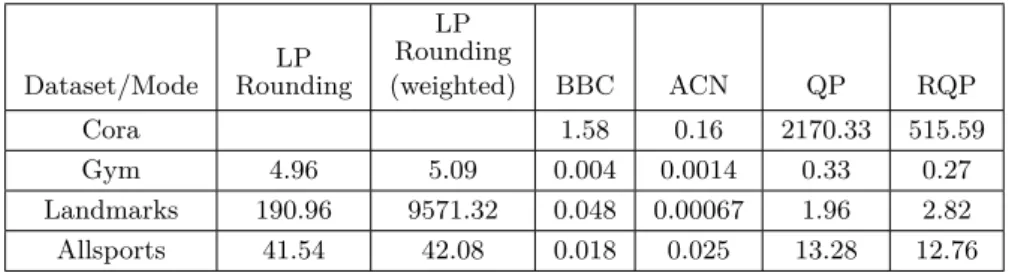
Table 4Running times (in seconds) for the results in Table 3. For randomized algorithms, the time shown is the average over three trials.
Dataset/Mode LP Rounding LP Rounding (weighted) BBC ACN QP RQP Cora 1.58 0.16 2170.33 515.59 Gym 4.96 5.09 0.004 0.0014 0.33 0.27 Landmarks 190.96 9571.32 0.048 0.00067 1.96 2.82 Allsports 41.54 42.08 0.018 0.025 13.28 12.76 Real-World Datasets
The results for the real-world datasets are reported in Table 3, 5 and 6. It is evident from Table 3 that our algorithms outperform the existing algorithms by a big margin in recovering the original clusters. Table 3 also includes results for the LP-rounding algorithm applied to the original weighted graph for the Gym, Landmarks, and Allsports datasets. We also report in Table 4 the running times for the experiments in Table 3. These numbers show that the BBC and ACN algorithms are substantially faster than the others, while our algorithms are substantially faster than the LP-rounding algorithm.
Table 5 reports the results using a faulty crowd oracle. Contrasting the results of Table 3 and 5, we observe minimal performance degradation; that is, our algorithms are robust to noise. The results in this table are important, as this setting is closest to the typical real-world application of same-cluster queries. Note that the source of information that gives the signs of the edges is different from that which is the crowd oracle. For the landmarks dataset, the original edge weights are determined by a gist detector [21], while the oracle used in Table 5 is given by high-quality crowd workers. For the gym and allsports datasets, the original edge weights are determined by (lower quality) human crowd workers, but the oracle used in Table 5 is based on high-quality crowd workers. Finally, in Table 6, we report
Table 5Results for Real-World Datasets where mistakes are measured with respect to ground-truth clustering and the oracle is the crowd.
Dataset/Mode QP QP Queries RQP RQP Queries
Gym 135 175 160.0 104.67
Landmarks 4645 1997 2172.33 1548.33
Table 6Results for Real-World Datasets where mistakes are measured with respect to the graph and the oracle is the optimal ILP solution for the graph.
Dataset/Mode
LP
Rounding BBC ACN QP QP Queries RQP RQP Queries
Gym 276.0 464 338.0 207 171 211.0 112.67
Landmarks 4092.0 4995 5240.67 4092 267 4092.0 265.33
Allsports 33.33 65 40.67 28 36 30.33 18.67
the results using the optimum ILP solution as the oracle. For the larger datasets, it is neither possible to run the ILP nor LP-Rounding due to their huge space and time requirements. Again our algorithms perform the best, followed by the LP-rounding algorithm.
References
1 N. Ailon, M. Charikar, and A. Newman. Aggregating Inconsistent Information: Ranking and Clustering. Symposium on the Theory of Computing (STOC), 2005.
2 Nir Ailon, Anup Bhattacharya, and Ragesh Jaiswal. Approximate Correlation Clustering Using Same-Cluster Queries. InLatin American Symposium on Theoretical Informatics, pages 14–27. Springer, 2018.
3 Nir Ailon, Anup Bhattacharya, Ragesh Jaiswal, and Amit Kumar. Approximate clustering with same-cluster queries. arXiv preprint, 2017. arXiv:1704.01862.
4 Nir Ailon, Moses Charikar, and Alantha Newman. Aggregating inconsistent information: ranking and clustering.Journal of the ACM (JACM), 55(5):23, 2008.
5 H. Ashtiani, S. Kushagra, and S. Ben-David. Clustering with Same-Cluster Queries. Advances in Neural Information Processing Systems (NIPS), 2016.
6 M. F. Balcan and A. Blum. Clustering with Interactive Feedback. International Conference on Algorithmic Learning Theory (ALT), 2008.
7 N. Bansal, A. Blum, and S. Chawla. Correlation Clustering. Symposium on Foundations of Computer Science (FOCS), 2002.
8 Sebastian Böcker, Sebastian Briesemeister, Quang Bao Anh Bui, and Anke Truß. Going weighted: Parameterized algorithms for cluster editing. Theoretical Computer Science, 410(52):5467–5480, 2009.
9 Moses Charikar, Venkatesan Guruswami, and Anthony Wirth. Clustering with qualitative information. Journal of Computer and System Sciences, 71(3):360–383, 2005.
10 S. Chawla, K. Makarychev, T. Schramm, and G. Yaroslavtsev. Near Optimal LP Rounding Algorithm for Correlation Clustering on Complete and Complete k-partite Graphs.Symposium on the Theory of Computing (STOC), pages 219–228, 2015.
11 Peter Christen. Febrl: a freely available record linkage system with a graphical user interface. InProceedings of the second Australasian workshop on Health data and knowledge management-Volume 80, pages 17–25. Australian Computer Society, Inc., 2008.
12 Erik D Demaine, Dotan Emanuel, Amos Fiat, and Nicole Immorlica. Correlation clustering in general weighted graphs. Theoretical Computer Science, 361(2-3):172–187, 2006.
13 I. Dinur. Mildly exponential reduction from Gap 3SAT to polynomial-gap label-cover.Electronic Colloquium on Computational Complexity (ECCC), 2016.
14 Donatella Firmani, Sainyam Galhotra, Barna Saha, and Divesh Srivastava. Robust Entity Resolution Using a CrowdOracle.IEEE Data Eng. Bull., 41(2):91–103, 2018.
15 Buddhima Gamlath, Sangxia Huang, and Ola Svensson. Semi-Supervised Algorithms for Approximately Optimal and Accurate Clustering. In 45th International Colloquium on Automata, Languages, and Programming, ICALP 2018, July 9-13, 2018, Prague, Czech Republic, pages 57:1–57:14, 2018. doi:10.4230/LIPIcs.ICALP.2018.57.
16 I. Giotis and V. Guruswami. Correlation Clustering with a Fixed Number of Clusters. ACM-SIAM Symposium on Discrete Algorithms (SODA), 2006.
17 Anja Gruenheid, Besmira Nushi, Tim Kraska, Wolfgang Gatterbauer, and Donald Kossmann. Fault-tolerant entity resolution with the crowd. arXiv preprint, 2015. arXiv:1512.00537. 18 Shrinu Kushagra, Shai Ben-David, and Ihab Ilyas. Semi-supervised clustering for de-duplication.
arXiv preprint, 2018. arXiv:1810.04361.
19 A. Mazumdar and B. Saha. Clustering with Noisy Queries. Advances in Neural Information Processing Systems (NIPS), 2017.
20 Andrew McCallum. Data. URL:https://people.cs.umass.edu/~mccallum/data.html. 21 Aude Oliva and Antonio Torralba. Modeling the shape of the scene: A holistic representation
of the spatial envelope. International journal of computer vision, 42(3):145–175, 2001. 22 Vasilis Verroios and Hector Garcia-Molina. Entity resolution with crowd errors. In2015 IEEE
31st International Conference on Data Engineering, pages 219–230. IEEE, 2015.
23 Vasilis Verroios, Hector Garcia-Molina, and Yannis Papakonstantinou. Waldo: An adaptive human interface for crowd entity resolution. InProceedings of the 2017 ACM International Conference on Management of Data, pages 1133–1148. ACM, 2017.
24 David Williams. Probability with martingales. Cambridge university press, 1991.
25 William E Winkler. Overview of record linkage and current research directions. InBureau of the Census. Citeseer, 2006.
![Table 1 Results for Experiments on synthetic small datasets. BBC denotes the algorithm of [7], ACN denotes the 3-approximation algorithm of [1], LP Rounding denotes the algorithm of [10], QP denotes QueryPivot, and RQP denotes RandomQueryPivot(0.25)](https://thumb-us.123doks.com/thumbv2/123dok_us/1440774.2692945/14.892.200.720.228.449/experiments-synthetic-algorithm-approximation-algorithm-rounding-querypivot-randomquerypivot.webp)