Journal of the Arkansas Academy of Science
Volume 60
Article 10
2006
Electron Shock Waves
Mostafa Hemmati
Arkansas Tech University, [email protected]
Michael Weller
Arkansas Tech University
Taylor Duncan
Arkansas Tech University
Follow this and additional works at:
http://scholarworks.uark.edu/jaas
Part of the
Physical Chemistry Commons
This article is available for use under the Creative Commons license: Attribution-NoDerivatives 4.0 International (CC BY-ND 4.0). Users are able to read, download, copy, print, distribute, search, link to the full texts of these articles, or use them for any other lawful purpose, without asking prior permission from the publisher or the author.
This Article is brought to you for free and open access by ScholarWorks@UARK. It has been accepted for inclusion in Journal of the Arkansas Academy of Science by an authorized editor of ScholarWorks@UARK. For more information, please [email protected].
Recommended Citation
Hemmati, Mostafa; Weller, Michael; and Duncan, Taylor (2006) "Electron Shock Waves,"Journal of the Arkansas Academy of Science: Vol. 60 , Article 10.
Electron
Shock
Waves
19 1 1
MOSTAFA
HEMMATI
',
MlCHAELWELLER ,
ANDTAYLORDUNCANDepartment
of
Physical Science, Arkansas Tech University,Russellville, AR 728012
Correspondence: [email protected]
Abstract.
—
Inthispaper wedescribe numericalinvestigations ofbreakdown wavesconcentrating on antiforce waves. We employedone-dimensional electron fluid dynamical equations foraluminous pulse wave propagating into aneutral gas region and subjected to anapplied electric field. We assumed that the electrons were the main element in the propagation of thewaveand that the electron gas
partial pressure provided the driving force. These waves are considered tobe shock fronted and arecomposed oftworegions: the thin
sheath region behind the shock front and the thicker quasi-neutral region following the sheath region. Oursetofequations, known as the electron fluiddynamical (EFD)equations, is composed of the equations ofconservation ofmass, momentum, and energy coupled with Poisson's equation. Forantiforce waves,we wereable tosuccessfully integrate the setofEFD equations through the sheath region using
aset ofinitialboundaryconditions atthe wavefront. Byusing values ofelectron gastemperature, electron number density,ionization
rate,andalso theexistingconditionsatthe end ofthe sheath region as initialboundary values for the thermal region ofthe gas, we were
able tointegrate the electron fluid dynamical equations, modified for the thermalregion of the gas, through thatregion. Ourresults satisfy the required conditions atthe end of the sheath and quasi-neutral regions. Thewaveprofiles for electric field,electron velocity, electron number density,electron gas temperature, and ionization ratewithinthe sheath and quasi-neutral regions weredetermined.
Keywords.
—
Breakdown waves, one-dimensional electron fluiddynamical (EFD) equations, luminous pulse wave,electrons.Introduction
Lightning has always been anawe-inspiring event that has
intrigued and perplexed mensince the beginning ofhistory. This is the pinnacle example of luminous fronts,orpulses, generated
by potential differences between twopoints in a gas. Von Zahn (1879)proposed lack of Doppler shift in the radiation emitted from breakdown waves, inferring negligible mass motion within the pulse. Thomson (1893)made the observation that breakdown
wavesmoved atapproximately half the speed oflight, rather than
instantaneously jumpingfromone pointtoanother.
Beams (1930) then proved Thomson's observations correct
and proposed anexplanation for this phenomenon: that the gas behind the pulse was electrically conductive, thereby carrying a
potential and creating abreakdown of thegasin the givenarea as
the wave propagates. Healso explained that because ofthe large mass difference between the positive ions and theelectrons, the positive ions,ascompared totheelectrons, willhave anegligible increase inspeed. This explanation is stillaccepted today. Paxton and Fowler (1962)applied athree-fluid,hydrodynamical model
toformulate aset ofequations describing thewave propagation.
Shelton and Fowler(1968)continued this workanddescribed the phenomena as "electron fluid dynamical" waves. They
developed a set of one-dimensional equations describing the
phenomena, deriving equations for energy and momentum loss
and gainterms during the electron collisions withheavy particles.
Their main concern was proforce waves, waves forwhich the electric field force onelectrons is in the same direction as the
direction of the propagation of the pulse. We willconcentrate onantiforce waves, waves for which the electric field force on electrons is inthe opposite direction ofthe propagation of the
wave. Using an approximation method, Fowler and Shelton
(1973) solved theirset ofelectron fluid dynamical equations for
the dynamical transition region of the wave. Their approximate
solutions areingoodagreement withexperimental data available (Blaisand Fowler 1973).
Later, Sanmann and Fowler (1975) tried to account for
the propagation of antiforce waves. They considered the electron gas partial pressure to be much larger than that of
the other species, therefore providing the driving force for the propagation of the wave. Fowler et al. (1984) completed
the set of electron fluid dynamical equations by adding terms to the equation ofconservation ofenergy, which proved tobe essential forexactnumerical solution of the set ofelectron fluid
dynamical equations. Theyalsodeveloped acomputer program
tointegrate the equations through the sheath region. Hemmati (1999) completed the set of electron fluiddynamical equations
representing the antiforce waves. Rakov (2000) provided a complete setofexperimental results for the wavespeed, current,
and charge inhis review of positive and bipolar lightning
discharges.
Analysis
The equations whichwere fullydeveloped by Fowler etal.
(1984), representing a one-dimensional, steady state, constant
velocity, electron fluiddynamical wavepropagating intoaneutral
medium, are the equations ofconservation ofmass, momentum,
Electron Shock Waves ax [I]
—
[mnviv-
V)+
nkT
e]=-enE-
Kmn{v-
V), [2] dx —[mnv(v-
Vf
+nkTe(5v-
2V)+2e«w4>—
"
e e] dx mK dx =-3AnkKT
e-(^)Kmn(v-V)\
M
M MdE
e ,v t.
—
-
—
n{ 1);dx
e0V
[4]where n,v, Te, e,and m are the electronnumber density,velocity,
temperature, charge, and mass, respectively. M, E,Eo, V, k, K, x,
p,
and cp areneutral particle mass, electric field withinthesheath region, electric fieldat the wave front, wave velocity,
Boltzmann's constant, elastic collision frequency, position within the sheath region, ionization frequency, and ionization potential ofthe gas, respectively.
To reduce the set of electron fluid dynamical equations
tonon-dimensional form, the following set of dimensionless
variables areintroduced:
E
,
2e<p
,
v_
T
ek
eE
ox2e0
mV „i8
2w
mF2 e£0 iC M
wherer/,V,y/,0,ju,and
£
represent the dimensionless netelectric field (applied plus space charge field),electron number density,electron velocity, electron gas temperature, ionization rate, and
position within the sheath region, respectively. OL and Kare waveparameters.
Substituting the dimensionless variables in equations (1-4)
reduces them tothe followingform:
d(vyj)
[5]
—
-W
—
[vip
(V-
1)+ av0]
=-vr]-
Kvty
-
1),
[6]d
,
2Sa'vddd^
JL.Tvtp(Ttf,_i)2+ccvd(5ip -2)+avip+ar)
~7^
=Ld% K "S
-a)Kv[3a6 + (ip -I)2],
[7]
d%
a[8]
Shelton andFowler (1968)proposed the existence oftwo
distinct regions within the wave:the sheath and thequasi-neutral region. Inthe sheath region, electron velocity,starting from an
initialvalue atthe shock front,reduces tospeeds comparable to
those ofheavyparticles. Also,the electric field,starting with its maximum value atthe shock front,reduces toanegligible value
atthe trailing edge of the sheath. These conditions translate into the followingequation form:
<y
2 =1,r]2=0,1/>2
=0,and Y]2 =0,
[91where, 1p2
,
T]2,lp'
2,
and T)2 are the non-dimensional electronvelocity, electric field,electron velocityderivative, andelectric field derivative attheend of the sheath region, respectively.
In the quasi-neutral region, through further ionization of neutral particles, the electron gas cools to near room
temperatures. Therefore, theelectric fieldenergy present ahead
of the waveis converted toionization energy behind the wave. Innon-dimensional form the expected conditions atthe end of
the quasi-neutral region are as follows:
Vf=1and0, =0.065.
i f
Allof our attempts at integrating equations 5-8 through
the quasi-neutral region failed. Equations 5-8 werederived by combining the primitive forms of the fluidequations, and since we werenotusing approximation methods forsolving the setof
fluidequations, there was noneed for the combined form of the
equations. Therefore, for our investigation of the quasi-neutral
region of the wave, wechose the primitive form of the electron-fluiddynamical equations: d{vip) [10]
¦»
—
[vxp
2+ avd]
--vrj-
Kvfy-
1)+
Kfjv, [11] Journal of the Arkansas Academy ofScience, Vol.60, 2006Mostafa Hemmati, Michael Weller,and Taylor Duncan d, 3 c a 5ct 2 vddd. d^ k dr 2vV>T7
-
2kv(V-
1) + Kitv(V-
1)-
(OKv[3a6+(t/;-
1)2 ],[12]dri
v,
[13]Byapplying the expected conditions attheend ofthe sheath
region[9]inthe expanded forms ofthe equations ofconservation of mass and momentum [10-11], the equations describing the quasi-neutral regionbecome
[14]
V2 =
Kll
2V2and
#2
=-K/*20
2 [15]where v'2and 0'2are the electron number density derivative and
electron gas temperature derivative inthe quasi-neutral region. Byintegrating equations 5-8through the sheath region, one can find the electron number density,electron gas temperature, and ionizationratevalues atthe end ofthe sheath region. These variables nowbecome the initial boundary conditions for the
quasi-neutral region. We have beenable tosuccessfully integrate
equations 14-15 through the quasi-neutral region of the wave
and ourresults meet the expected conditions atthe trailing edge
of thewave(vf=1 and0
r
-
0.065).For antiforce waves, slight changes in the electron fluid
dynamical equations need tobe made. Foranobserver stationary relativetothe wavefront,the heavyparticlesmoveinthe negative
xdirection(F<0,
Zs
o>0,andK
>0). Therefore,both Kand£
willbe intrinsically negative. Forantiforce waves, therefore,the set of dimensionless variables is slightly different and has
been derived by Hemmati(1999):
E
.
2ecp
,
t v Tek eEox Eo E0E 2 0 V 2e(f> mV 2ed) mV „ 6 2m a = hr,K K,U=i—
,£0=.
mV2 eE0 K MThe equations describing antiforce wavesinnon-dimensional
form are therefore
d
r,
[16]—
l>t/>0/>
-l)+«v0]
=vr}-Kv(tlf
-1), [17]—
7[vip(yj-I) 2+ov0(5i/; -2)+ovi^+a»72
-—
]=d%
K d$-cotc\{3ae+(ip-l)2], [18]
dr
l
v /,
nd%
a [19]Results
The electron velocityatthe wavefront is less than the wave velocity( v
,
<V)-Thedimensionless electron velocityatthe wave front,!//,
,
therefore must be less than 1.
As aresult,accordingtothe Poisson's equation, the electric field willhave apositive
slope behind the wave front resulting in an initial increase in
the electric field. Heading through the sheath region following the shock front,the electric field willincrease until the electrons gain speed inexcess of ion speeds. The dimensionless electron velocity willthen become larger than 1
,
making the electric fieldslope negative. The electric fieldtherefore decreases (Hemmati 1995)until the electrons slow downtospeeds comparable toion
speeds atthe end of the sheath region (ip2 ~*
1
),requiring that the electric field and its slope approach zero at the end of thesheath as well(rj2-? o,rj'2
—
0 )•We used a trial and errormethod tointegrate equations 16-19. Fora given wave speed, a
,
we chose aset ofvalues for wave constant,K,
election velocity,!//x,
and electron numberdensity,V,
,
atthe shock front. Werepeatedly changed the valuesofK,1p]
,
and V,,
in the process of integration of equations16-19 so that the process ledtoaconclusion inagreement with the expected conditions [9]atthe end of thesheath region. As in the proforce case, weused the conditions atthe end of the sheath
region tofind the equations describing the quasi-neutral region.
Forintegrating the setof equations describing the quasi-neutral
region, we used electron temperature, electron number density, and ionizationratevalues attheend ofthe sheath region as initial boundary values for the quasi-neutral region. For antiforce
waves, we were successful in integrating the electron-fluid
dynamical equations through both the sheath and quasi-neutral regions for twovalues of wave speeds, Of =
0.05
anda =1
,
representing wave velocities of 1.33xl07m/s and 2.96 xlO6m/s,respectively. Fora =
0.05
,
the initialboundary conditions required wereKT= 0.35,l/>i
= 0.95,andV!
=0.09. For a= 1,the conditions required atthe shock frontwereK
—
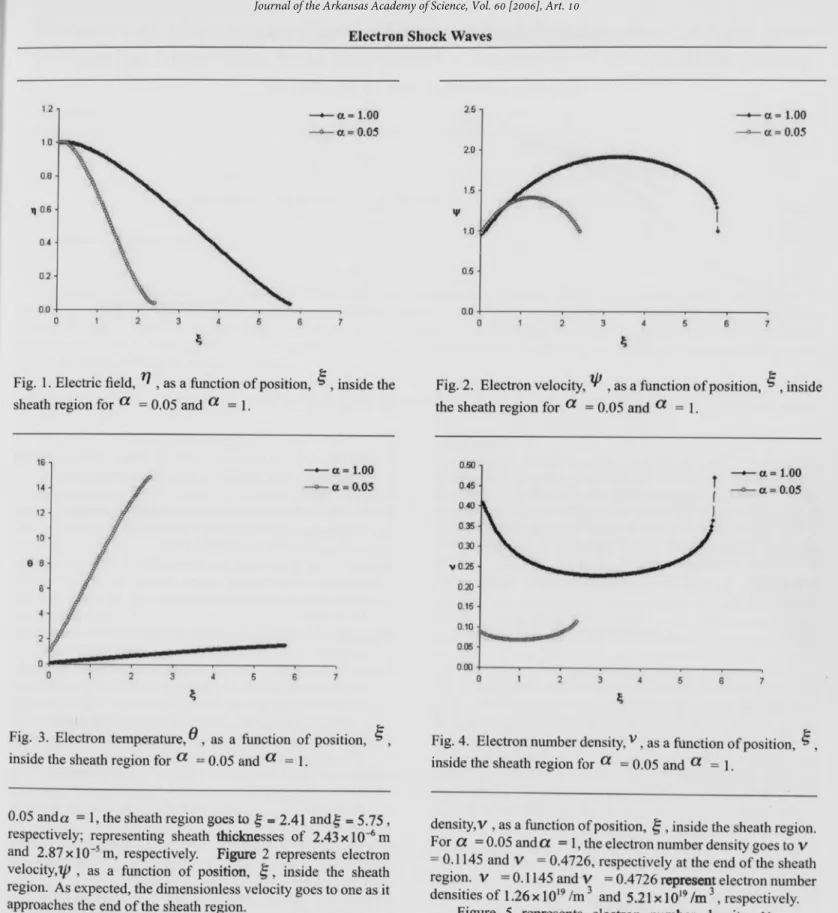
0.17, T/J,= 0.98,and Vj=0.40.Figure 1represents electric field,t]
,
as afunction ofposition,§ ,
inside the sheath region. Asitcan beseen, the electric fieldElectron Shock Waves
k
Fig. 1.Electricfield,
'
,as a
function ofposition, 5,
inside thesheath regionfor a =0.05 and a =1.
Fig. 2. Electron velocity,
,
as a function ofposition,'
,
inside the sheath region fora =0.05and a =1.
Fig. 3.Electron
temperature,",
as afunction ofposition,'
,
inside the sheath regionfor a =
0.05 and a
-
1.Fig. 4. Electron numberdensity, v
,as a
function ofposition,inside the sheath regionfor a =0.05 and a
-
1.
0.05 anda =1,the sheath regiongoes to
£
=2.41and£
=5.75,
respectively; representing sheath thicknesses of2.43xlO"6m
and 2.87xlO~5m, respectively. Figure 2represents electron
velocity,!/;
,
as a function of position,£
,
inside the sheathregion. Asexpected, the dimensionless velocitygoestoone asit
approaches the end of the sheath region.
Figure 3represents electron temperature, 6
,as a
function ofposition,
£
,
inside the sheath region. For a =0.05 anda =1,the electron temperature goes to6 =14.868 and 6
-
1.623,respectively atthe endofthe sheath region. 6 =14.868 and
6
-
1.623represent electron gas temperatures of 8.62xlO6Kand
9.41xlO5K,respectively. Figure 4
represents electron number
density,V
,as a
functionofposition,,
inside the sheath region. Fora =0.05anda =1,
the electronnumberdensity goes to V =0.1 145and V = 0.4726,respectively atthe end of the sheath region. V =0.1145and V =0.4726represent electron number
densities of1.26xlO19/m3 and
5.2
lxlO'Vm
3,respectively.
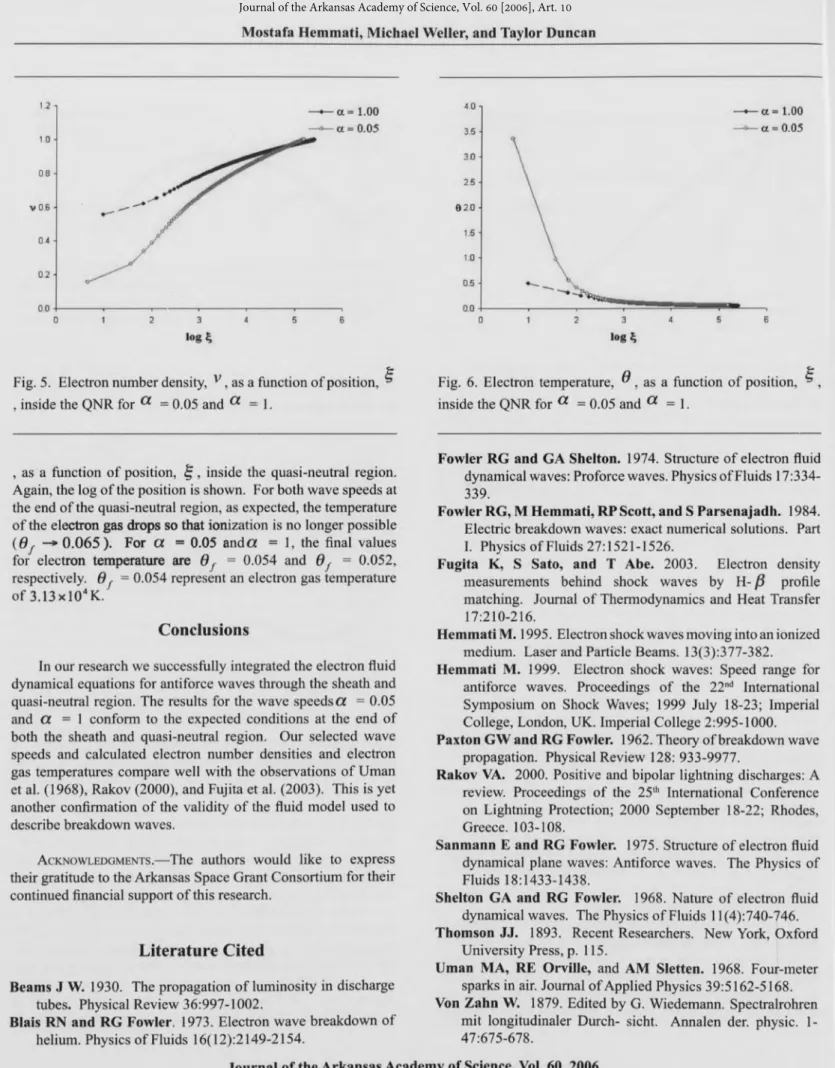
Figure 5 represents electron number density, V
,
as afunction ofposition, §
,
inside the quasi-neutral region. Thelog of position is graphed for simplification. As expected,
the dimensionless electron number density approaches one (vf -*1)for both wave speeds
at the end of the quasi-neutral
region, v
f =1.0 represents an electron number density of
1.10xl020/m
.
Figure 6represents electron temperature,6
Mostafa Hemmati, MichaelWeller,and Taylor Duncan 4 0 -*—a =1.00 a=0.05 35 3 0 ¦' 25 9 20 15 \ 10
?^^v
0 5 00 2 3 4 5 6 logS 0 1Fig. 6. Electron temperature, u
,
as a function of position,,
inside the QNR for a =0.05and a =1.log$
Fig.5. Electron number density, v,as a function ofposition,
*
,inside the
QNRfora =0.05and a =1.,
as a function ofposition,£~
,
inside the quasi-neutral region.Again, the log of the position is shown. Forbothwavespeeds at
the end of the quasi-neutral region, as expected, the temperature
of the electron gas drops so that ionization isnolonger possible
(d f
-*0.065). For a =0.05 and a =1, the final values
for electron temperature are d, =0.054 and 6, = 0.052,
respectively. 6f=0.054
represent an electron gas temperature
of3.13xlO4K.
Conclusions
In ourresearch we successfully integrated the electron fluid
dynamical equations for antiforce waves through the sheath and
quasi-neutral region. The results for the wave speeds Of =0.05 and OL
—
1 conform to the expected conditions at the end ofboth the sheath and quasi-neutral region. Our selected wave
speeds and calculated electron number densities and electron
gas temperatures compare wellwith the observations ofUman
etal.(1968), Rakov (2000), and Fujita etal.(2003). This isyet
another confirmation of the validity of the fluid model used to
describebreakdown waves.
Acknowledgments.
—
The authors would like to expresstheir gratitude tothe Arkansas Space Grant Consortium fortheir continued financial support of this research.
Literature Cited
Beams JW. 1930. Thepropagation ofluminosityindischarge tubes. Physical Review36:997-1002.
BlaisRN and RGFowler.1973. Electron wavebreakdown of
Fowler RG and GA Shelton. 1974. Structure ofelectron fluid dynamical waves: Proforce waves.Physics ofFluids 17:334-339.
FowlerRG,MHemmati, RPScott,and S Parsenajadh. 1984.
Electric breakdown waves: exact numerical solutions. Part I. Physics ofFluids 27:1521-1526.
Fugita K, S Sato, and T Abe. 2003. Electron density
measurements behind shock waves by
H-/3
profilematching. Journal of Thermodynamics and Heat Transfer
17:210-216.
Hemmati M.1995. Electron shock wavesmoving intoanionized medium. Laser and Particle Beams. 13(3):377-382.
Hemmati M. 1999. Electron shock waves: Speed range for antiforce waves. Proceedings of the 22nd
International Symposium on Shock Waves; 1999 July 18-23; Imperial
College,London,UK. Imperial College 2:995-1000. Paxton GW and RG Fowler. 1962.Theory ofbreakdown wave
propagation. PhysicalReview 128: 933-9977.
Rakov VA. 2000. Positive and bipolar lightning discharges: A
review. Proceedings of the 25thInternational Conference
onLightningProtection; 2000 September 18-22; Rhodes,
Greece. 103-108.
Sanmann E andRGFowler. 1975. Structure ofelectron fluid
dynamical plane waves: Antiforce waves. The Physics of
Fluids 18:1433-1438.
Shelton GA and RG Fowler. 1968. Nature ofelectron fluid dynamical waves. The Physics ofFluids 11(4):740-746. Thomson JJ. 1893. Recent Researchers. New York,Oxford
UniversityPress, p. 115.
Uman MA,RE Orville,and AM Sletten. 1968. Four-meter
sparks inair. Journal ofApplied Physics 39:5162-5168. Von ZahnW. 1879. Edited byG.Wiedemann. Spectralrohren
![Figure 1 represents electric field, t] , as a function ofposition,](https://thumb-us.123doks.com/thumbv2/123dok_us/1513324.2702613/4.907.44.882.29.593/figure-represents-electric-field-t-function-ofposition.webp)