MASTER’S THESIS
INTERNATIONAL ADMINISTRATION
AND GLOBAL GOVERNANCE
Does Institutional Quality
Determine Aid Allocation?
A Cross-Country Approach to General Budget Support:
Do Donors Practice What They Preach?
Author: Johan Sigroth Advisor: Anna Persson
Abstract
This thesis seeks to address the allocation of development aid in relation to institutional quality of recipient countries by focusing on General Budget Support (GBS) – an aid modality associated with increased aid effectiveness and un-earmarked funds to recipient governments that display high institutional quality, but also with risks of moral hazard. The thesis departs from a theoretical framework based on previous research concerned with aid allocation and an on-going debate on aid effectiveness taking place within main donor organizations. On the one hand, aid effectiveness could theoretically be enhanced when aid is allocated in the form of un-earmarked funds, allowing for recipient governments to pursue their own policies and decrease the transaction costs often associated with aid. On the other hand, previous research indicates that donors may allocate aid based on strategic self-interest rather than altruism and the performance of recipients, and associates aid-inflows with risks in the form of moral hazard and misuse of funds. In relation to GBS, these two theoretical strands can be seen as somewhat conflicting. Is GBS only allocated to recipients with high institutional quality, as often claimed by donors? Similar to other sources cited in this thesis, a quantitative, cross-country approach is adopted. Departing from a dependent variable measuring GBS provided by the European Union within the framework of the Cotonou Agreement, OLS regressions are used. Three features of institutional quality are used as independent variables. The results obtained do not indicate that the institutional quality of recipients determines the allocation of GBS.
Key words: Aid effectiveness, institutional quality, General Budget Support
Abbreviations
ACP African, Caribbean and Pacific countries CRS Creditor Reporting System
DAC Development Assistance Committee EC European Commission
ECD European Consensus on Development EU European Union
EDF European Development Fund GBS General Budget Support GDP Gross Domestic Product GNI Gross National Income GNP Gross National Product
ICRG International Country Risk Guide IMF International Monetary Fund MDG Millennium Development Goals NGO Non-Governmental Organization ODA Official Development Assistance
OECD Organization for Economic Cooperation and Development OLS Ordinary Least Squares
PFM Public Financial Management PRS Poverty Reduction Strategy
PDAE Paris Declaration on Aid Effectiveness PRS Poverty Reduction Strategy
QoG Quality of Government SBS Sector Budget Support UN United Nations
List of figures
Figure 1. Characteristics of Budget Support compared to “traditional” development aid 7
Figure 2. General Budget Support in relation to the agenda of aid effectiveness 8
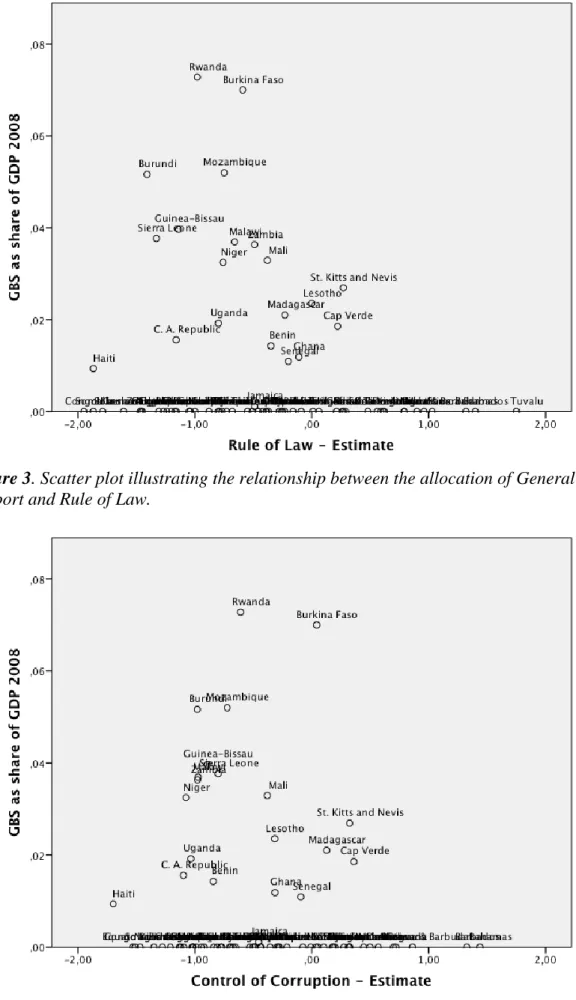
Figure 3. Scatter plot illustrating the relationship between the allocation of General Budget Support and Rule of Law 41
Figure 4.Scatter plot illustrating the relationship between the allocation of General Budget Support and Control of Corruption 41
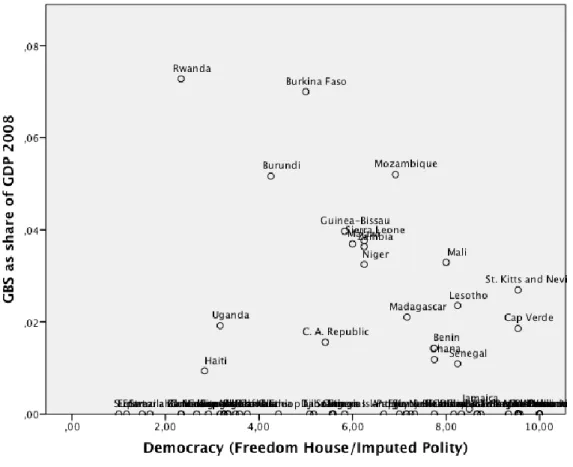
Figure 5. Scatter plot illustrating the relationship between the allocation of General Budget Support and Democracy 42
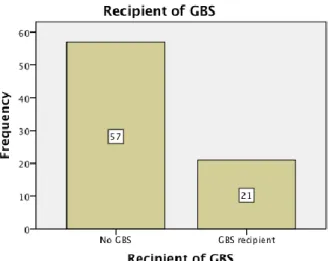
Figure 6. Illustration of GBS-recipients in relation to non-recipients among the signatories of the Cotonou agreement 63
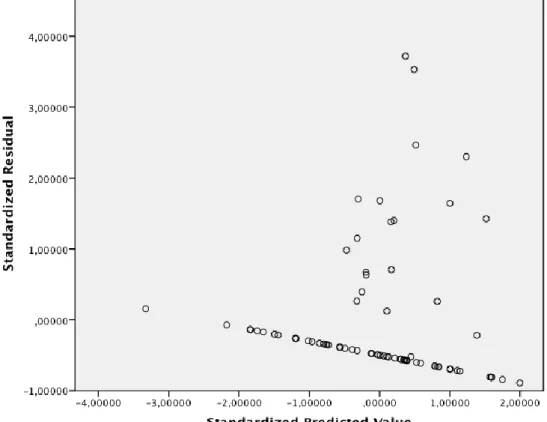
Figure 7. Predicted values plotted against residuals for the dependent variable 65
List of tables
Table 1. Correlations between variables 40Table 2. Results from bivariate regressions 43
Table 3. Results from multivariate regressions 45
Table 4. Summary of variables 63
Table 5. Comparison of means of institutional quality between recipients and non-recipients of GBS 66
Table of Contents
1. Introduction and purpose statement ... 1
2. Theoretical framework ... 4
2.1 Defining Aid ... 4
2.2 General Budget Support ... 6
2.2.1 Who provide General Budget Support? ... 8
2.2.2 Expectations, effects and experiences – rewards and risks ... 9
2.2.3 Who is eligible for General Budget Support? ... 11
2.3 Previous research ... 13
2.3.1 The effects of aid – theoretical risks and rewards ... 13
2.3.2 Institutions, aid and governance – theoretical implications ... 14
2.3.3 Aid and institutions – mixed empirical evidence ... 17
2.3.4 The allocation of Aid – the determining factors ... 19
2.3.5 Mixed implications of aid and institutions – a brief summary ... 22
2.4 Outlining the research problem ... 23
2.4.1 Purpose and research question ... 25
3. Research design, method and variables ... 26
3.1 Research design ... 26
3.2 Selection of case: The European Commission ... 27
3.2.1 General Budget Support provided by the European ... 29
3.2.2 Selection of recipients: The Cotonou Agreement ... 31
3.3 Method ... 32
3.3.1 The dependent variable: General Budget Support ... 33
3.3.2 Independent variables ... 34
3.3.3 Control variables ... 36
3.3.4 Discussion on shortcomings, analytical power and generalizability ... 37
4. Results and analysis ... 40
4.1 Conclusion and discussion ... 46
4.2 Directions for future research ... 49
4.3 Epilogue ... 49
References ... 51
Appendix A – The signatories of the Cotonou agreement ... 60
Appendix B – Description of the variables ... 61
1. Introduction and purpose statement
Every year, vast sums of development aid are provided by bilateral and multilateral donors to recipient countries and organizations. At the present, more than 150 billion US dollars per year is allocated, and the size of the yearly amounts has lately increased each year (OECD, 2011a).1 Increased aid flows can be seen as necessary in order to eradicate poverty (Sachs et al., 2004). At the same time, aid can also be associated with a number of problems. Its effects have been questioned, and it has also been associated with risks in the form of moral hazard, corruption and distorted incentives for recipient governments to be accountable towards their citizens (Bräutigam, 2000; Bräutigam & Knack, 2004; Djankov et al., 2008; Goldsmith, 2001; Knack, 2001; Tavares, 2003). The impact of aid has been recognized to depend on the institutional quality – often discussed in terms of growth-fostering rules, control of corruption, level of democracy and regulatory quality – of recipient countries (Burnside & Dollar, 2000; Ear, 2007; Easterly & Pfutze, 2008; Wright, 2009). Following this line of thought, higher institutional quality of a recipient country is associated with higher probability for positive impact of aid. Conversely, aid allocated to recipients with weak institutional quality can be associated with higher risks in terms of corruption, which in turn may decrease the probability to achieve desired results.
The notion of institutions in relation to aid has lately also gained increased attention by the donor community (OECD DAC, 2006a, 2012d). Outcome documents from a number of high level meetings, not least the Paris Declaration on Aid Effectiveness, have included commitments towards increased focus on recipient institutions in order to achieve improved results of aid resources spent (United Nations, 2003a, b; OECD DAC, 2005, 2008b, 2011, 2012c). In line with the Paris Declaration on Aid Effectiveness, donors have recognized that aid channelled through recipients' own financial systems can enhance aid effectiveness – meaning “ensuring that development resources have the greatest impact on development” (OECD DAC 2012b) – when allocating development aid. This is said to allow for recipient governments to pursue their own policies and thereby increase their capacity (OECD DAC, 2006a). This notion is central for an aid modality called General Budget Support – un-earmarked financial resources provided directly to a recipient's national treasury (OECD DAC, 2006c). Theoretically, the provision of un-earmarked financial resources is said to
reduce donor-driven administration costs as well as improve the capacity of recipient governments to formulate and fulfil their own strategies for poverty reduction. Donors stress that General Budget Support is to be provided to “good performers” – recipients with high institutional quality – in order to ensure a positive impact and reduce the risks of misuse of funds provided (Koeberle & Stavreski, 2006; Gunning, 2006). This is well in line with the notion that aid should be allocated to recipients with high institutional quality. However, no fixed eligibility-criteria for allocation of General Budget Support exist. Donors motivate this by stressing that General Budget Support sometimes also can improve the institutions of a “poor performer” (OECD DAC, 2006e).
The claim to allocate General Budget Support to “good performers” in combination with the lack of fixed eligibility criteria can be seen as interesting in relation to the previous research that indicate that donors may allocate aid based on factors such as strategic interests and historical relations with recipient countries rather than poverty alleviation (Alesina & Dollar, 2000; Collier & Dollar, 2002; Neumayer, 2003; Easterly and Pfutze, 2008; Schraeder et al., 1998). How is General Budget Support allocated?
Central to the problem formulation of this thesis is thus the lack of clear allocation criteria of General Budget Support combined with the potential risks of misuse of aid resources and the previous research indicating that donors may allocate aid first and foremost based on their own strategic priorities.
The purpose of this thesis is therefore to examine to what extent donors actually practise what they preach and allocate General Budget Support to recipient countries with high institutional quality. Do recipient countries with higher institutional quality receive higher amounts of General Budget Support, and vice versa? Departing from a policy-based discussion on aid effectiveness and a considerable body of research addressing the motives behind aid allocation, this thesis thus seeks to shed light on the role of institutional quality in relation to the allocation of a specific type of aid that can be seen as particularly interesting in relation to institutional aspects of recipient countries.
Similar to many publications cited in this thesis, a quantitative, cross-country approach – mainly Ordinary Least Square (OLS) regressions – is adopted. Where previous research mainly departs from the wide, loan-including definition of aid as ODA, the results presented
in this thesis are based on a dependent aid-variable comprising of flows of General Budget Support only. The data on General Budget Support is extracted from the Organization for Economic Cooperation and Development’s Development Assistance Committee's (OECD DAC) Creditor Reporting System (CRS) database.
Whilst the theoretical advantages of aid effectiveness and General Budget Support can be said to be recognized by the donor community in general, this thesis focuses on the General Budget Support provided by the European Commission financed by the member states of the EU within the framework of the Cotonou agreement, which provides the fundament for the relationship between the EU and 78 countries in Africa, the Caribbean and the Pacific. Together, the EU and its member states comprise the world's largest provider of aid. Hence, focusing on the EU can be seen as motivated given its leading role within the donor community. Furthermore, the EU can be seen as representative for the donor community given that the Commission, like other main donors, adhere to the principles of the Paris Declaration of Aid Effectiveness that emphasizes the need for allocating aid through recipient systems in order to enhance aid effectiveness (OECD DAC, 2005).
Departing from previous research, three measures of institutional quality – control of corruption, rule of law and level of democracy – obtained from the Quality of Government dataset (Teorell et al., 2011) are used as independent variables.
The results obtained indicate that the institutional quality of recipient countries does not determine the allocation of General Budget Support. No significant relationship between institutional quality and the allocation of General Budget Support is detected. This result is maintained when population and infant mortality are controlled for. Seen as groups, the countries that receive General Budget Support do not display significantly higher institutional quality than the countries that do not receive General Budget Support although the countries of the two groups all have signed the Cotonou agreement, which stipulates common allocation criteria for its signatories. The thesis finally seeks to analyse the results obtained in relation to previous research and the rationale of aid effectiveness.
2. Theoretical framework
According to Alesina and Dollar (2000), the literature on foreign aid can be divided in two parts: one concerned with the effects of foreign aid in recipient countries and the other concerned with how and why donors allocate foreign aid. Although the focus of this thesis is on the latter, these two fields of research can be seen as interlinked. Hence, they are both addressed in this thesis. This chapter provides the theoretical foundation of the thesis and rests upon two “pillars” – one based key policy documents and evaluations of General Budget Support issued by major donor agencies such as the OECD DAC and the World Bank, and the other based on previous research and empirical findings related to aid and institutional quality. The theory section seeks to shed light on issues related to aid allocation and institutional quality in general and in relation to General Budget Support in particular. Finally, the section motivates why the purpose of this thesis is important from policymakers’ as well as from researchers’ point of view.
2.1 Defining aid
Broadly speaking, aid can be seen as all resources transferred by “donors” to “recipients” (Riddell, 2007). According to Riddell, the definitions, roles and motives of donors and recipients may vary, as well as the modalities and results achieved. The very notion of “foreign aid” or simply “aid” may thus imply different interpretations. It can be related to different contexts and political objectives, from pursuing interests of donors during the Cold War to the achieving of the Millennium Development Goals (MDG) in the 21st century. Its origin may be traced back to the late 1940s and the implementation of the Marshall Plan (Bräutigam & Knack, 2004) or to the resource-flows to British and French colonies in the early 20th century (Riddell, 2007). Thus, the notion of aid may denote different purposes as well as providers - from official development aid for long-term development to humanitarian and emergency aid to meet acute needs, provided by governmental organizations as well as non-governmental dittos. Riddell discusses these different connotations in terms of three different “aid-worlds”, where official aid is accompanied by non-official aid and humanitarian aid. The concept “aid” is thus complex. Recognizing the potential magnitude of the concept and following the discussion of Riddell, this thesis is mainly concerned with issues related to aid provided from “rich” official donors to “poor” recipients, with the purpose of promoting human welfare and reduce poverty.
For the sake of this thesis, measures of aid-flows will depart from Official Development Assistance (ODA), which is used as a measure of aid in most research on aid cited in this thesis (for instance Alesina & Dollar, 2000; Alesina & Weder, 2002; Boone, 1996; Bräutigam, 2000; Bräutigam & Knack 2004; Charron 2011; Collier & Dollar, 2002; Djankov, Montalvo & Reynal-Querol 2008; Dollar & Levin, 2006; Dunning 2004; Ear 2007; Goldsmith 2001; Knack, 2001; Knack 2004; Sachs et al 2004; Schraeder, Hook &Taylor 1998; Svensson, 1999; Wright 2009; Wright 2011).2
The Development Assistance Committee of the Organization for Economic Cooperation and Development (OECD DAC), which can be seen as the main donor-organization, defines ODA as transfers of resources in the form of cash, commodities or services that have three central features: Firstly, each transaction has to be provided by ”official agencies, including state and local governments, or by their executive agencies”. Secondly, a transaction has to be ”administered with the promotion of the economic development and welfare of developing countries as its main objective”. Thirdly, it has to be ”concessional in character and convey a grant element of at least 25 per cent”. In addition, the recipient of ODA has to be on the OECD DAC list of ODA-recipients. Central to ODA is the notion of addressing economic development and welfare through the public sector of a developing country (OECD DAC, 2008c, p. 1-4). Besides from the recipients on the DAC list, transfers to a number of multilateral agencies may count as ODA, including those to many United Nations agencies, the European Commission (EC), the European Development Fund (EDF) and various World Bank and IMF-agencies (OECD DAC, 2010). ODA-funds are authorized by donor parliaments, most commonly on an annual basis (Riddell, 2007). Over the past 50 years, ODA-flows have been estimated to 2.3 trillion US dollars (Easterly & Pfutze, 2008).
Following this, aid is thus to be seen as ODA and “aid allocation” as the provision of aid from a donor to a recipient. In the context of this thesis, a donor is to be seen as a bilateral or multilateral provider of aid. A recipient is the country who receives aid.
2 The academic sources cited in the thesis discuss ODA in terms of aid, development cooperation, development
aid and foreign aid. Given that a nomenclature-based discussion is not the primary purpose of this thesis, the concepts of “aid” and “development aid” are mainly used due to their predominance in cited research.
Admittedly, ODA may be seen as an imperfect measure of aid, neglecting aid-efforts by Non-Governmental Organizations (NGOs) and including the aid-administration of donors as well as the funds reaching the recipients (Riddell, 2007). However, given its predominance in previous research and the availability of data, ODA-based research is seen as a relevant point of departure for the purpose of this thesis. In turn, the aid-modality central to this thesis – General Budget Support – is to be seen as a specific and narrower type of ODA (OECD, 2011a). Or put in another way: General Budget Support is ODA, but all ODA is not General Budget Support.
2.2 General Budget Support
The type of aid called Budget Support can be defined as “a method of financing a partner country’s budget through a transfer of resources from an external financing agency to the partner government’s national treasury” (OECD DAC, 2006a, p. 26). Budget Support can in turn be divided in the sub-categories of General Budget Support and Sector Budget Support (SBS), whereas the former refers to contributions to the overall budget and the latter to aid earmarked for discrete sectors of the budget (Koeberle & Stavreski, 2006; OECD DAC, 2006a). Regardless the similarities between these two types of budget support, the focus of this thesis is mainly on General Budget Support.3
General Budget Support can in turn be defined as “aid to governments that is not earmarked to specific projects or expenditure items” (OECD DAC, 2006b, p. 1). It is channelled through the recipient government’s own financial management system and is thus mixed with the recipient government’s own revenues. For the purpose of this thesis, General Budget Support is defined according to the OECD DAC CRS-database as “un-earmarked contributions to the government budget” (OECD, 2011c, p. 21).4
Different donors tend to differ slightly in their definitions of Budget Support, but the notion of direct financial support to a country’s budget for the purpose of recipient-led poverty reduction is always central to the concept (Koeberle & Stavreski, 2006; Hammond, 2006). Budget Support can therefore be seen as a shift from “traditional” project-based development aid to a more effective way of providing assistance that is in line with principles of
3 Some sources cited in this thesis only use the overarching concept of Budget Support (sometimes also labelled
Direct Budget Support, DBS) and thus do not emphasize the distinction between GBS and SBS. When GBS is not explicitly used by a source cited, this is marked with the use of Budget Support instead of GBS.
4
partnership as stated in the Paris Declaration on Aid Effectiveness. Where previous forms of development aid have been based on donor conditions, budget support can be seen as a new approach to conditionality as the conditions are jointly agreed upon before funds are disbursed (Williamson, 2006). Budget Support thus does not imply that the conditionality has disappeared completely, but rather transformed to reward “good performance” of recipients (Gunning, 2006). Theoretically, donors are to provide Budget Support when recipients can display that they live up to a number of conditions before the aid is transferred.
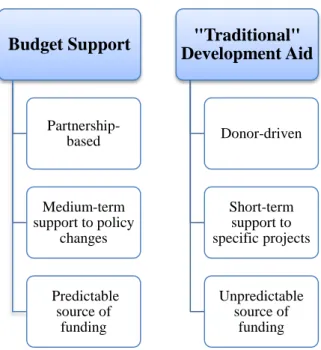
Koeberle and Stavreski (2006) have identified a number of key differences between Budget Support and “traditional” development aid, illustrated by the figure below.
Figure 1. Characteristics of Budget Support compared to “traditional” development aid.
According to OECD DAC, the notion of un-earmarked aid through government budgets should not be seen as a completely “new” phenomenon as it has been used before, for instance in the form of debt relief and structural adjustment lending. However, General Budget Support is seen as different from such approaches as it is designed to support nationally formulated – and thereby “owned” – Poverty Reduction Strategies (PRS). By supporting strategies as such, the ownership of recipients – and thereby the effectiveness of aid – can be increased (OECD DAC, 2006b).
Budget Support Partnership-based Medium-term support to policy changes Predictable source of funding "Traditional" Development Aid Donor-driven Short-term support to specific projects Unpredictable source of funding
General Budget Support can thus be seen as a way to strengthen national capacity of recipients and thereby ensure more efficient poverty reduction. Like World Bank-officials Koeberle and Stavreski (2006), an OECD-issued joint evaluation states that General Budget Support can be contrasted to the aid-approaches of the era of structural adjustment that imposed external solutions through donor-driven conditions (OECD DAC, 2006b). General Budget Support, with its focus on the recipients’ agenda, can therefore be seen as a contemporary approach to aid. Emphasizing the influence and capacity of the recipient, the focus on results and increased aid effectiveness, these features embody the core principles of the agenda for aid effectiveness.
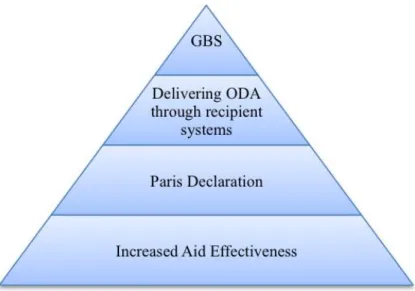
The function of General Budget Support in relation to the agenda of aid effectiveness is illustrated by the figure below.
Figure 2. General Budget Support in relation to the agenda of aid effectiveness.
2.2.1 Who provide General Budget Support?
OECD DAC has stated that delivering aid through recipient Public Financial Management (PFM) systems should be at the core of donor development strategies (OECD DAC, 2006a). In line with this statement, the potential of Budget Support has been recognized by many multilateral development organizations including various United Nations agencies, the World Bank and the European Commission (OECD DAC, 2006a; United Nations, 2010; European Commission, 2010a, b). It has also gained increased attention in the bilateral efforts of national governments that are pursuing the aid effectiveness agenda set out in the Paris
Declaration on Aid Effectiveness (Hoven, 2006; Amin, 2006; NORAD, 2006; Arakawa, 2006; Sida, 2011).
Among national governments, the United Kingdom, Sweden, Finland and the Netherlands have the largest share of General Budget Support relative other forms of development assistance (Strategic Partnership for Africa, 2009). In 2009, total commitments on General Budget Support-flows made by all donors reached almost 5 billion US dollars. Of these commitments, about two thirds were made by bilateral donors and one third by multilateral dittos (OECD 2011a).5
2.2.2 Expectations, effects and experiences – rewards and risks
The various dimensions of General Budget Support can be divided into a basic framework of “inputs” and “outputs”. Somewhat simplified, inputs refers to the disbursement of funds and outputs to the outcomes achieved (Hammond, 2006; Lawson et al., 2006). This distinction resembles the ditto outlined in the forthcoming section of previous research.
Theoretically, General Budget Support is associated with a number of advantages and benefits. By emphasizing the recipient government’s poverty reduction-agenda and delivering it to the national treasury, the method is recognized to hold the potential to improve the quality of the recipients’ institutions, decrease the transaction costs that often are associated with “traditional” forms of development aid and increase the predictability of aid-flows and thereby facilitate recipient government budgetary planning. These features can all be connected to improved poverty reduction and reaching the Millennium Development Goals (OECD DAC, 2006a, 2012d). The ownership-dimension also enables a potential to address crosscutting issues in the fields of public sector reform and improvements in governance in recipient states. By emphasizing recipients’ priorities and enabling increased government spending, General Budget Support can promote recipient government accountability – to its taxpayers as well as to donors (OECD DAC, 2006d, Koeberle & Stavreski, 2006). The method is also associated with non-financial inputs, such as policy-dialogue between donors and recipients (Williamson, 2006).
Although many advantages have been recognized, the effects of General Budget Support are seen as hard to measure given that the method can be seen as relatively new and evaluation
findings are hard to generalize. The OECD joint evaluation of the method states that the effects depend on the recipients’ PRS and that it can be hard to separate the effects of General Budget Support from the ditto of other aid-flows (OECD DAC, 2006d).
Despite the difficulties of measuring the effects of General Budget Support, recent donor evaluations give support to some of its positive connotations. For instance, General Budget Support has been shown to allow recipient governments to increase expenditure in priority areas such as health and education, formulate better poverty-focused policies and perform better on the MDG (National Audit Office, 2008; Alonso, Judge & Kluman, 2006; Beynon & Dusu, 2010). It has also been associated with strengthened ownership and empowerment of recipient governments, increased donor alignment to recipient priorities, successful support to recipient PRS and improved PFM-systems (OECD DAC, 2006d; Development Information Services, 2006; Williamson, 2006; de Renzio, Andrews & Mills, 2010). In addition, General Budget Support has been associated with increased investment and growth in recipient countries (Lawson et al., 2006).
Despite the positive potential and experiences of General Budget Support, a number of possible problems, risk and challenges have also been associated with the method. The OECD-issued joint evaluation concluded that General Budget Support-inflows neither had led to increased empowerment of the poor nor to enhanced transparency and accountability in recipient countries. Neither did it live up to the increased predictability of aid-flows stipulated in the Rome Declaration (OECD DAC, 2006d). From a policymaker point of view, the list of challenges continue: Putting financial resources into the national treasury of a recipient country with weak financial management systems can raise the risk of disbursed funds being misused, as it is not possible to track the use of funds disbursed (Shand, 2006). It can also strain the capacity of the recipient government by overemphasizing donor development priorities (Koeberle & Stavreski, 2006). Donors can undermine the domestic accountability of a recipient government if the dialogue is donor-dominated. The role of recipients in formulating PRS has also been recognized as weak (Williamson, 2006; Alonso et al., 2006). The sought-after process of strengthening recipient financial systems has also been showed to be slow in some cases (National Audit Office, 2008). Conversely, donors have been shown not to disburse amounts they previously have committed to (Strategic Partnership with Africa, 2009).
due to challenges in the recipient setting, often related to violent political opposition from domestic interests that oppose reforms. An agreement on long-term budget support can also be seen as ”insurance” that allows recipients to perform poor without a cancellation of disbursements (Mosley & Abrar, 2006). Yet another problem is related to that recipient countries known for violating human rights still may display a “good” track record in areas that are used to assess the eligibility for budget support (Devarajan & Shah, 2006). Related to this line of thought is the problem is that donors who provide General Budget Support assume that recipient governments can be held accountable by its citizens – something that may not always be the case (Hauck et al., 2005). The role of General Budget Support in fostering democracy has also been questioned, as channelling funds to a government may not be the most appropriate mean to strengthening the parliament, the media and the civil society (Development Information Services, 2006).
Finally, it has been argued that the focus on the recipient and the “partnership-terminology” associated to General Budget Support is misleading, in that it implies that power differences in the development context are not longer present and that the preferences of donors and recipients align completely, which not actually may be the case (Booth, Christiansen & de Renzio, 2006).
Evidently, the experiences and implications of the usage of General Budget Support are mixed. Although the method is recognized to have a number of advantages in the field of aid effectiveness, risks and challenges related to effects as well as selection of recipients are at hand.
2.2.3 Who is eligible for General Budget Support?
For the purpose of this thesis, the eligibility-aspect of General Budget Support can be seen as highly interesting yet somewhat puzzling. The recipient-focused, partnership-oriented approach to aid effectiveness combined with the method puts the recipient’s own policies and institutions in focus. But is General Budget Support suitable for all recipients? Despite the well-established claim that General Budget Support is to be allocated to “good performers”, there are no commonly accepted allocation criteria that decides who receives General Budget Support (Koeberle & Stavreski, 2006). This is due to the fact that there is no “universal approach” to the method is at hand among donors – different designs are adopted in different countries and vary among donors and recipients. This can be motivated by arguing that the usage of General Budget Support thus implies more than a yes or no-question, and involves
many choices related to size of disbursements, risks and results-monitoring (OECD DAC, 2006a, 2006e).
However, recipients typically share a set of characteristics, as Budget Support mainly is seen as suitable for “good performers” – recipient countries with “good policy environments” including strong ownership, commitment and capacity to allocate disbursed resources effectively (Koeberle & Stavreski, 2006; Gunning, 2006). This is to ensure the efficiency of General Budget Support, which depends on the recipients’ capacity of managing the funds disbursed (Development Information Services, 2006). When deciding to provide funds directly to the recipient’s national budget, donors thus need to balance the benefits of the method against the risks it may imply (OECD DAC, 2006a).
In order to be eligible for General Budget Support, the recipient government thus needs to display a will to commit to the General Budget Support-process, including an ability to engage with international partners and pursuing the own development-strategy. In addition, the recipient and the donor must reach a significant consensus on the development-strategy as well as a basic level of trust (OECD DAC, 2006e). Conversely, donors may not consider General Budget Support appropriate if the recipient government is seen as not having sufficient capacity to manage the funds disbursed (Development Information Services, 2006). The recipients of General Budget Support usually receive development aid in other forms as well, and all agencies that use budget support also use other aid modalities. There is thus often a complementarity between General Budget Support and other types of aid (OECD DAC, 2006e).
Despite the notion of disbursing Budget Support to “good performers” to ensure its effectiveness, the major OECD joint evaluation of General Budget Support concludes that donors apply different entry-conditions to different recipients. This pragmatic approach, with no fixed entry-criteria, is seen as fruitful as assessing the quality and commitments of recipients objectively may be very difficult. Furthermore, as General Budget Support can strengthen the quality of the recipients’ PFM-systems’ it may be justified to disburse it to “poor performers” as well (OECD DAC, 2006e). As will be evident in the following section, this rather positive view on the lack of fixed eligibility criteria can be seen as problematic in relation to previous research on aid and institutional quality.
2.3 Previous research
Whereas the previous section outlined the rationale of General Budget Support departing from a number of donor-issued publications, this section is concerned with previous research and empirical findings related to aid and institutional quality. As will be evident, the potential risks recognized by the donor community can be motivated by empirical findings as well.
2.3.1 The Effects of Aid – theoretical risks and rewards
There is a considerable body of publications seeking to depict the effects of aid. One can – broadly speaking – outline two strands of theoretical suggestions, where aid is associated with either positive or negative outcomes. These strands can be related to Wright and Winter’s (2010) discussion of “aid optimists” and “aid pessimists”.
On the one hand, it has been recognized that increased levels of aid is the best strategy to alleviate poverty in Africa, and that large, long-term aid-flows are required to achieve this. Following this line of thought, aid-inflows can be used to achieve a ”big push” in public investments, which can increase the productivity in recipient states (Sachs et al., 2004). Aid-inflows can also be associated with increased growth, either through increased capital spending in recipient countries or by the fostering of growth-inducing policies (Wright & Winters, 2010). Furthermore, aid can be seen as a potential instrument for democratization through the strengthening of electoral processes, education systems, legislatures, a free press and civil society organizations in recipient countries (Knack, 2001; 2004). In addition, it has been recognized that aid-inflows may decrease corruption in recipient countries through conditions or through increased salaries for public employees (Tavares, 2003).
On the other hand, aid can be associated with undesired features such as corruption, declining democracy and inefficiency. Svensson (2006) associates aid with a geographical and political separation between taxpayers from a donor country and the beneficiaries in a recipient country. This separation can lead to shortcomings in accountability, where it is difficult to hold anyone accountable for the management of aid-resources. It has also been recognized that the beneficiaries of aid – the poorest people in the world – often lack the political power to influence aid bureaucracies (Easterly & Pfutze, 2008). Another basic problem related to aid has been illustrated by Boone (1996). Following his line of thought, the role of a government is to finance public goods. Conversely, the government can also make non-productive
transfers to the ruling elite. Theoretically, aid-inflows to a country can be used for both types of expenses, but the outcome depends on the preferences of the recipient government.
According to Bräutigam & Knack (2004), an aid-recipient government may actually prefer to remain non-productive, given that its revenue is secured through aid-inflows regardless how it performs. Aid may thus imply that there is no incentive for the recipient government to improve its capacity. Conversely, improved conditions in a recipient country could result in lower inflows of foreign aid (Bräutigam, 2000). Following this, aid can be seen as an “unearned income”, that ultimately grants recipient leaders access to funds without needing to rely on tax revenues (Wright & Winters 2010). Accordingly, recipient states with large aid-inflows do not need to collect revenue through domestic taxation. Thus, the exchange between taxation and the provision of effective policies and public services may not be established and the democratic accountability weakened. (Djankov et al., 2008; Goldsmith, 2001; Knack, 2001; Tavares, 2003). This negative aspect of aid can be embodied by the concept of moral hazard (Bräutigam, 2000; Goldsmith, 2001), which in turn can be seen as a fundamental political and organizational problem relating to the self-interest of public officials, where the inefficiency of public institutions allows them to gain personally (Miller & Falaschetti, 2001; Miller & Hammond, 1994).
According to Bräutigam and Knack (2004), aid may create incentives for recipient politicians and donor officials to maintain aid-flows regardless their effects. They also conclude that aid can undermine the access to capable staff in recipient countries, by attracting the most competent staff to donor-managed projects with salaries impossible to match by recipient governments. In addition, they conclude that when multiple donors pursue multiple donor-administrated projects in a country, the government of the country may be cut off from the management of aid resources, which in turn hinders it to develop its own capacity. Large inflows of aid can also result in “aid dependency” – a situation where a recipient government cannot perform its core functions and provide its citizens with basic public services without foreign aid (Bräutigam, 2000).
2.3.2 Institutions, aid and governance – theoretical implications
The notion of institutions is often found in publications related to aid. This thesis departs from a definition of institutions being ”the rules of the game” and ”the framework within which human interaction takes place” as provided by North (1990, p. 3-4). This is in line with the
definition provided by Bräutigam (2000, p. 23), who defines institutions as ”sets of norms, codes of conduct, laws, and patterns of behaviour”.
Following the discussion of North (1990), institutions can be formal or informal, whereas the former can be illustrated by formal rules, such as political and economic rules and contracts, and the latter by informal conventions. Created by human beings, shaped by legislators reflecting different interest groups and with an ability to evolve and change over time, institutions establish structures for human interaction and thereby contribute to determining the opportunities in a society. According to North (p. 33), an institutional framework consists of “legal rules, organizational forms, enforcement, and norms of behaviour”.
According to North (1990), the institutional framework in a society in turn plays a major role for the economic performance by providing the structures for exchange and thereby determining costs of transaction. To what extent a society is able to develop effective enforcement of contracts is by North seen as a crucial factor for the economic performance. Effective judicial systems and well-specified bodies of law are examples of factors that enable contract enforcement. Thus they can be seen as “good” institutional features and thereby associated with the notion of high institutional quality. On the contrary, ambiguity of legal doctrines and uncertainty about agents' behaviour and insecure property rights are seen as negative for enforcement. These can in turn be seen as poor institutional features associated with low institutional quality. Following this line of argumentation, the quality of the institutional framework can be said to determine transaction costs, that in turn determine to what extent actors will engage in trade, that in turn foster wealth and development. Ideally, the institutional framework creates order and reduces uncertainty in exchange.
The quality of institutions has been showed to play a crucial role for per-capita income-levels and economic performance (Rodrik, Subramanian & Trebbi, 2004). Institutions may be measured different ways, but are often conceptualized in terms of growth fostering – for instance as protection against government expropriation, property rights and constraints on the incumbent (Acemoglu, Johnson & Robinson, 2001). Institutions are to be seen as somewhat context-specific, with origins in historical circumstances, geography, political economy and other initial conditions. Despite this, institutions in different contexts can embody the same economic and political core principles (Rodrik et al., 2004).
North (1990) associates “good” institutional aspects to “developed countries” and their opposite to “Third World countries” (p. 59). Poor institutional frameworks – that is, low institutional quality – in the latter, leads to higher transaction costs than in the former category. This is in line with the argumentation of Knack (2001), according to which institutional quality can be seen as a necessity for developing countries. Knack states that institutions that establish a predictable, impartial, and consistently enforced set of rules for investors are crucial for achieving economic growth – and thereby poverty reduction – in developing countries. According to Knack, such institutions can be encompassed by the concept ”good governance”. The discussions provided by North and Knack thereby establish the relationship between institutions and development in a country, which is central for the purpose of this thesis. High institutional quality is thus associated with development, and vice versa.
Furthermore, not only does institutional quality play a role for the level of development in a country. Institutional characteristics as such are widely recognized as determinants of the impact of aid (Dollar & Levin, 2006) as well as the allocation of aid (Bräutigam, 2000).
The notion of institutional quality can in be seen as related to the concept of governance, which in turn has been recognized as difficult to define but can be associated with the impartiality of government institutions (Rothstein & Theorell, 2005). In relation to aid, Bräutigam (2000) associates governance with features such as increased transparency, greater domestic ownership of policies and programs, fiscal management and accountability. Problems related to governance include deficient official information, weak mechanisms of accountability, weakly enforced rule of law and ineffective bureaucracies (Bräutigam & Knack, 2004). According to Bräutigam and Knack, poor governance – including weak institutions and high levels of corruption – is a characteristic feature of many developing countries that receives aid. Aid can affect the institutional quality in recipient states, but the institutional quality in a recipient country also can affect how much aid a country gets, as outlined by Bräutigam (2000).
Institutions related to growth are often discussed in terms of transparency, openness to trade and property rights and rules and behaviours that implement them (Kaufmann, Kray & Mastruzzi, 2010). There are quantitative measures of institutional quality of countries in line with these aspects. For instance, a number of publications cited in this thesis (Alesina &
Weder 2002; Dollar & Levin 2006; Easterly & Pfutze 2008; Bräutigam & Knack 2006; Tavares 2003) depart from an index provided by the International Country Risk Guide (ICRG), that quantifies measures of Corruption, Bureaucratic Quality and Law and Order (Teorell et al., 2011). How institutional quality will be measured for the sake of this thesis is further outlined in the methods-section.
2.3.3 Aid and institutions – mixed empirical evidence
There is a considerable empirical body on previous cross-country research depicting the relationship between aid and recipient institutions. However, this research does not depict a unanimous tendency. The findings of Goldsmith (2001) suggest that aid-inflows do not undermine the quality of recipient institutions. Rather, his results indicate that aid-inflows are associated with higher levels of political and civil liberty in Africa. Dunning (2004) has showed a positive relationship between and aid and levels of democracy in the post-Cold War era. Results presented by Tavares (2003) suggest that inflows of foreign aid may decrease corruption64 in recipient countries.
Conversely, it has been shown that high levels of aid may erode the quality of recipient political institutions in terms of bureaucratic quality, corruption and the rule of law (Bräutigam & Knack, 2004; Knack, 2001) and democracy (Djankov et al., 2008). The findings of Bräutigam (2000) indicate that this negative association may be stronger in countries where aid comprises a large share of the Gross National Product (GNP). In addition, Boone (1996) provides evidence that aid inflows rather benefits ruling elites and increases the size of government than improve the conditions for the poorest in recipient countries. Furthermore, the findings of Knack (2004) indicate that aid-inflows do not promote democracy.
Aid-inflows have thus been recognized to be positively and negatively associated with the institutional quality of recipient countries by different researchers. It has been recognized that the somewhat contradicting results depicted above may depend on different approaches to data and methodology (Wright, 2009). The role of data in relation to the mixed results of
6 The notion of ”corruption” is in this thesis to be seen as ”the extent to which public power is exercised for
related research has also been discussed and demonstrated by Easterly, Levine and Roodman (2004). Furthermore, Alesina and Dollar (2000) underline that the negative findings can be discussed as a “hen or egg”-problem: Does a negative association between aid-inflows and institutional decline imply that aid is at the core of the problem or that aid is directed to assist recipients with their problems?
Several publications have indicated that the outcomes of aid depend on the institutional quality in recipient countries: According to Wright (2009), foreign aid can foster or hinder democratization depending on authoritarian incumbents’ perceived likelihood of getting access to aid funds after democratization. Ear (2007) concludes that aid has the potential to contribute to improvements and decreased quality of recipient institutions, as aid-inflows are shown to be associated with improvements in some governance indicators but decreases in others. This is in line with Rodrik (1996) who states that aid can help “bad” governments as well as “good” ones to survive and Easterly and Pfutze (2008) who conclude that bad governments make aid less effective.
Aid has been shown to have a positive impact on growth in settings where the recipient displays a “good policy environment” that fosters growth (Burnside & Dollar, 2000). The association between aid and growth has also been showed to depend on recipients’ level of democracy (Svensson, 1999). Stating that aid recipients operate in different institutional settings – that in turn fosters different behaviours – Wright and Winters (2010) conclude that there is no simple conclusion on the relationship between aid and economic growth. On the one hand, aid inflows could foster economic growth. On the other, it could provide cover for recipient governments to keep insufficient economic policies and political institutions.
The extent to which aid may contribute to corruption has been showed to depend on the existing institutions in recipient countries and the timeframes available to spend resources (Wright, 2008, 2010). Consistent with these findings, Wright and Winters (2010) conclude that the political institutions of an aid-recipient country determine how aid resources are spent. In turn, these institutions may or may not facilitate positive outcomes of aid. Bräutigam (2000) concludes that the effects of aid depend on the institutions in recipient countries. Following her argument, aid can be used well if the recipient has strong institutions and vice versa. The “problem” is thus not aid per se but rather poor institutions, which often are present in developing countries. Consistently, aid can be seen as a double-edged sword, which
can be used to improve as well as aggravate the institutions in recipient countries (Bräutigam & Knack, 2004).
2.3.4 The allocation of aid – the determining factors
Various researchers have recognized the potential problems of aid in relation to institutional quality and the fostering of unsound incentives. In order to overcome the potential risks of aid-inflows and decreasing quality of recipient institutions, it has been recognized that aid needs to be delivered in ways that promote “good governance” and removes the incentives for poor governance in recipient countries. This is also said to make aid-resources used more effectively (Bräutigam, 2000). To achieve this, it has been argued that ”well-governed” countries with committed governments and sound policies should be offered increased levels of aid (Burnside & Dollar, 2000; Bräutigam & Knack, 2004; Collier & Dollar, 2002; Sachs et al., 2004). This is said to create incentives for good performance rather than its opposite. Bräutigam and Knack have also concluded that aid needs to be designed to support the recipient government instead of pursuing the donor’s agenda in order to make it more effective. This notion of allocating aid to recipients with “good” institutions has been labelled ”institutional selectivity”, which means that aid is channelled to countries that ”have the institutional and policy framework to use the resources effectively” (Dollar & Levin, 2006 p. 2036).
Which factors then determine how aid is allocated? Are donors practising the principle of allocating aid to “good” recipients as often stated? Theoretically, the answer to this may not be unanimously positive. It has previously been argued that aid-flows reflect the interests of donors rather than the needs of recipients (Boone 1996). Recipient needs can be seen as one of several factors that determine who receives aid (Wright & Winters, 2010). Maizels and Nissanke (1984) outline two broad and interlinked motivations for donors to disburse aid: to assist development in recipient countries and to promote their own interests. According to Schraeder et al (1998), aid may be allocated based on strategic interests of nation states, humanitarian needs in recipient countries or by the capitalist motives of ruling elites in recipient and donor countries. These three bases for allocation respond to the overarching paradigms of realism, idealism and neo-Marxism. Riddell (2007) outlines an aid-setting where the motives of poverty eradication, emergency-relief and the promotion of development, growth and human rights – often cited by official donors – are accompanied by a less outspoken pursuit of donor national, political and commercial interests and the fostering
of historical ties. Several other scholars have recognized this “hidden” dimension of aid: Svensson (2006) discusses foreign aid as a means of donors to influence policies and outcomes in another sovereign state. Alesina and Dollar (2000) conclude that aid allocation based on political and strategic interests of donors may “reward” corrupt and non-democratic recipients with “bad” policies and institutions, and thus reduce the likelihood for positive outcomes. Following their line of thought, aid allocation based on strategic interests may conflict with the often acclaimed general principles of foreign aid as a means to reduce poverty. Although often associated with industrialized and democratic donors (Schraeder et al 1998), it is important to underline is that aid is not to be seen as a solely “western” phenomenon. For instance, the Soviet Union and China have also used aid to pursue political objectives (Wright 2009; Wright & Winters 2010).
Several studies have confirmed the presence of donor interests in aid allocation. It has been showed that donors disbursed aid based on strategic and geopolitical considerations rather than on the level of democracy in the recipient countries during the Cold War (Dunning, 2004) even if Cold War-components may have diminished in present time (Wright & Winters, 2010).
Svensson (1999) has showed that while the disbursements from a few bilateral donors are associated with measures of democracy in recipient countries, donors in general do not allocate more aid to democratic countries. This may indicate that strategic and political motives – rather than the promotion of democracy – are prioritized by donors while providing aid. Results presented by Alesina and Weder (2002) indicate that donors in general do not discriminate corrupt governments from “good performers” when allocating aid. Their results also indicate that high levels of aid correlate with high levels of corruption in recipient countries. Donors have also been showed to allocate aid based on voting patterns in the United Nations General Assembly (Andersen, Hansen & Markussen, 2006) and on membership in the UN Security Council. (Dreher, Sturm & Vreeland, 2009; Kuziemko & Werker, 2006).
The findings of Alesina and Dollar (2000) indicate that strategic and political considerations of donors – rather than the policies and institutional quality of recipients – determine who receives foreign aid, although recipients who democratize may receive larger aid-inflows. They also show that bilateral donors allocate twice as much aid to a non-democratic former
colony than to a democratic non-colony. Accordingly, the allocation of aid based on colonial relations and voting patterns in the UN rather on institutional performance is seen as a hinder to achieve aid effectiveness. This is in line with the results presented by Collier and Dollar (2002), indicating that aid allocation is based on strategic and historical reasons and due to this often is directed to weak policy environments which in turn decreases the likelihood of poverty reduction. The findings of Neumayer (2003) indicate that far from all bilateral donors allocate more aid to recipients that respect human rights, although donors generally claim the opposite. Easterly and Pfutze (2008) conclude that although different donor agencies allocate aid based on different criteria, a lot of aid goes to corrupt countries and other countries than those that display the highest levels of poverty. This is in line with the findings of Schraeder et al (1998), who indicate that bilateral donors allocate aid based on strategic interest, economic self-interest and ideological similarities. They conclude that different donors allocate aid based on different considerations, and that the notion of foreign aid as an altruistic instrument as often claimed by donors needs to be rejected. The presence of donor interest can also be illustrated by Riddell’s (2007) finding that the poorest countries receive less than half of total ODA-flows.
One way for donors to pursue their interests is to attach policy conditions to the aid they provide. According to Wright and Winters (2008) the goal of conditionality is to encourage recipient governments to undertake economic, political or institutional reform. White and Morrissey (1997) have stated that donor objectives for applying conditionality may depend on the context. Furthermore, they state that ex post-conditionality – meaning that previous performance of recipients are used to determine their eligibility – is more effective than ex ante-conditionality, which in turn is based on agreed future goals. The Monterrey Consensus and the Paris Declaration of Aid Effectiveness (PDAE) can be seen as ways of donors to frame conditionality in terms of donors “helping” recipients decide which reforms are most suitable (Wright & Winters 2010).
There may also be a difference between bilateral and multilateral donors when it comes to aid allocation: Burnside and Dollar (2000), conclude that multilateral donors do allocate more aid to countries with “good policies” but that this does not hold for bilateral donors. Charron (2011) has also showed that aid provided by multilateral donors is associated with lower level of corruption in recipient countries, whilst this does not hold for bilateral donors.
Theoretically, bilateral aid allocation may be based on colonial relations and geopolitical interest to a greater extent, while multilateral donors may be less affected by factors as such. Multilateral aid-flows have therefore been recognized to have a higher potential to reward “good performers” and penalize corruption (Alesina & Weder, 2002). The findings of Dollar and Levin (2006) indicate that multilateral aid is significantly associated with “good institutions” in recipient countries, embodied by democracy and rule of law. Due to this, multilateral aid is therefore labelled more ”selective” than bilateral aid. The selectivity of donors is shown to have increased since the Cold War, mainly in terms of economic institutions. Dollar and Levin also show that bilateral donors tend to allocate aid to former colonies and countries in their own neighbourhoods. Multilateral donor-agencies have also been shown to be more sensitive towards the needs of recipients and less sensitive in terms of donor interest (Neumayer, 2003).
Following these results obtained by previous research, examining the determining factors for the allocation of General Budget Support can be seen as motivated.
2.3.5 Mixed implications of aid and institutions – a brief summary
As illustrated in this section, there are general issues related to aid. On the “output”-side, the effects of aid may be related to risks as well as benefits. Evidence presented in previous research is somewhat mixed. The effects of aid have been widely recognized to depend on the institutions in recipient countries. On the “input”-side, aid has been recognized to be more effective if allocated to recipients with “good” institutions. However, empirical evidence shows that donors do not only allocate aid based on the performance and needs of the recipients – their own interests may also influence the allocation.
The sources cited in this section outline what can be described as a clash where donors’ selectivity in favour of good performers can imply increased effectiveness, but also may contradict with their strategic interests, that in turn often has been described as determinants of aid allocation. Nevertheless, as outlined in the previous section, the rewarding of ‘good performers’ has gained increased attention from the donor-community over the past decade.
2.4 Outlining the research problem
As previous sections have outlined, there is a well-established debate of general issues related to aid and recipient institutions outlined by previous research as well as policy-documents and evaluations issued by main donor organizations. These two sources of publications commonly recognize benefits and risks associated to aid on an overarching level. Previous research typically departs from quantitative aid-variables based on the overarching concept of Official Development Assistance, whilst the World Bank and the OECD relies on qualitative approaches to a greater extent when examining the specific features of General Budget Support. This approach is intimately connected to the partnership-oriented agenda of aid effectiveness as outlined in the Paris Declaration on Aid Effectiveness, which puts recipients' priorities and systems in the centre of aid efforts.
The rationale of allocating General Budget Support to “good recipients” is well in line with the previously cited research that states that the impact of aid depends on the quality of recipient institutions (Burnside & Dollar, 2000; Svensson, 1999; Wright 2008; Wright, 2010; Wright & Winters, 2010; Bräutigam, 2000). In the context of General Budget Support, this line of thought can be extended to also include the input of aid: General Budget Support is seen as suitable for recipient countries with sufficient institutional quality (Koeberle & Stavreski, 2006).
Yet, the experiences of General Budget Support are mixed, and most evaluations depart from single cases. Institutional quality should determine allocation, but no fixed eligibility criteria are at hand. Despite the risks of corruption and misuse of aid resources, donors hold that it may be justified to allocate General Budget Support to recipients with weak institutional quality as well, as this may improve their institutions (OECD DAC, 2006e). Given this somewhat contradicting allocation aspect, how do donors allocate General Budget Support in practice?
Central to the problem formulation of this thesis is what may be referred to as a “double nature” of General Budget Support: It is labelled un-earmarked and connected to the concept of partnership but in practice donors decide about disbursements and influence the recipients’ policies. It can strengthen the recipients’ institutions but can at the same time weaken domestic accountability if allocated to “poor performers” with weak institutional quality, which may imply risks in the form of corruption. It is seen as more suitable for “good performers” with sufficient capacity to live up to agreed strategies and thus ensure aid
effectiveness but can also improve conditions in “bad” recipient countries. Furthermore, no
fixed eligibility criteria exist, which can qualify “poor performers”, but recipients with weak institutions may increase the risk for the misuse of funds provided.
Given its absence in previous research and its focus on the recipients, combined with the potential risks of aid-inflows distorting domestic accountability and fostering incentives for corruption in recipient countries, General Budget Support can be seen as highly interesting in relation to previous aid-related research.
Who receive General Budget Support? Does the institutional quality of recipients’ of General Budget Support determine the allocation of funds as donors’ claim that it should? As the existing evaluations of the method to a large extent are based on single cases, an overarching cross-country tendency is hard to outline. Does the quality of recipient institutions determine the allocation despite the lack of fixed eligibility criteria? A considerable body of previous research presented in previous research (Alesina and Weder 2002; Boone 1996; Maizels & Nissanke, 1984; Schraeder et al, 1998; Riddell 2007; Svensson, 1999; Svensson, 2006; Dunning, 2004; Andersen et al, 2006; Dreher et al, 2006) indicates that donors may not only allocate aid based on the performance and needs of recipients, but also may let allocation be influenced by their own interests. However, the conclusions of this research are almost in every case based on aid measured as ODA. Few (if any) quantitative cross-country approaches seem to depart from aid measured as General Budget Support, with the work of Beynon and Dusu (2010), presented in an “informal discussion paper” issued by the European Commission, as one rare exception.
By departing from General Budget Support, this thesis may therefore contribute to an extended knowledge of aid allocation, relevant for previous research as well as for the policy-based debate on aid effectiveness. Is the tendency of aid allocation policy-based on donor interest still to be found when the concept of aid is “narrowed” from ODA to General Budget Support? Or is General Budget Support, as has been claimed, first and foremost allocated to recipient countries with good institutions, as suggested by central donor-agencies? Or simply put: To what extent are disbursements of General Budget Support associated with the institutional quality of recipient countries? The aim of this thesis is to further investigate this.
This formulation of research problem is based upon two core recognitions. First, a main part of previous cross-country research on development aid is based on the broad definition of development aid as ODA. Secondly, previous donor-issued evaluations of General Budget
Support are based on single country-experiences and rather focus on the “output”-side of the method than on the “input”-side. This thesis seeks to bridge these two gaps, by focusing solely on the “input”-side of General Budget Support in a quantitative cross-country study. The approach of this thesis can therefore be seen as relevant in relation to previous research as well as to the recent policy-debate on aid effectiveness.
2.4.1 Purpose and research question
The general purpose of this thesis is to investigate to what extent donors allocate General Budget Support to recipient countries with high institutional quality. This formulation of purpose departs from a theoretical foundation derived from previous research, suggesting that donors may not allocate aid primarily based on recipient needs and performance, whilst the institutional quality of recipient countries is associated with the outcomes of aid.
The answering of the following research question will fulfil this purpose:
Does the institutional quality of recipient countries determine the allocation of General Budget Support?