Optimal bandwidth-aware VM allocation for
Infrastructure-as-a-Service
Debojyoti Dutta
Cisco Inc.
[email protected]
Michael Kapralov
Stanford University
[email protected]
Ian Post
Stanford University
[email protected]
Rajendra Shinde
Stanford University
[email protected]
February 16, 2012
AbstractInfrastructure-as-a-Service (IaaS) providers need to offer richer services to be competitive while optimizing their resource usage to keep costs down. Richer service offerings include new resource request models involving bandwidth guarantees between virtual machines (VMs). Thus we consider the following problem: given a VM request graph (where nodes are VMs and edges represent virtual network connectivity between the VMs) and a real data center topology, find an allocation of VMs to servers that satisfies the bandwidth guarantees for every virtual network edge—which maps to a path in the physical network—and minimizes congestion of the network.
Previous work has shown that for arbitrary networks and requests, finding the optimal embedding satisfying bandwidth requests is N P-hard. However, in most data center architectures, the routing protocols employed are based on a spanning tree of the physical network. In this paper, we prove that the problem remainsN P-hard even when the physical network topology is restricted to be a tree, and the request graph topology is also restricted. We also present a dynamic programming algorithm for computing the optimal embedding in a tree network which runs in timeO(3kn), wheren
is the number of nodes in the physical topology andkis the size of the request graph, which is well suited for practical requests which have smallk. Such requests form a large class of web-service and enterprise workloads. Also, if we restrict the requests topology to a clique (all VMs connected to a virtual switch with uniform bandwidth requirements), we show that the dynamic programming algorithm can be modified to output the minimum congestion embedding in timeO(k2n).
1
Introduction
Infrastructure-as-a-Service (IaaS) providers like Amazon [htta], Rackspace [httd] and Go-grid [hh] provide computing and other services on demand and charge based on usage. This has resulted in the commoditization of computing and storage. Typically, these providers provide service level agreements (SLA) [htte] where they guarantee the type of virtual machines (VMs) that they provide and the amount of disk space available to these VMs. Although some providers offer additional services like dedicated firewalls and load-balancers, no network performance guarantees are provided, which are critical for workloads like content distribution networks, desktop virtualization, etc. Given the rapid growth and innovation in these services [hcbiglc], it is important for service providers (SPs) to offer innovative service models for differentiation, e.g., by offering richer network SLAs to be competitive while optimizing their resource usage to keep costs down.
Next generation cloud services will require improved quality of service (QoS) guarantees for application work-loads. For example, multi-tier enterprise applications [httb] require network isolation and QoS guarantees such as bandwidth guarantees, and for over-the-top content distribution using a cloud infrastructure, bandwidth, jitter and delay guarantees are important in determining performance. Similar guarantees are necessary for MapReduce-based
analytics workloads too. Moreover, networking costs are currently a significant fraction of the total infrastructure cost in most data center (DC) designs [GT11, httc] since servers are cheap compared to core switches and routers. Thus, in order to provide richer network SLAs, it is important for SPs to ensure that networking resources are effi-ciently utilized while at the same time ensuring low congestion (that leads to better load balancing and more room for overprovisioning).
In this paper we consider a virtualization request model in which clients can request bandwidth guarantees between pairs of virtual machines (VMs) [GLW+10] for which SPs will allocate resources within their infrastructure. This
naturally leads us to study the following resource allocation problem: given a VM request graph—where nodes are VMs and edges represent virtual network connectivity between the VMs—and a real data center topology, find an allocation of VMs to servers that satisfies the bandwidth guarantees for every virtual network edge and minimizes congestion of the network. Note that in this setting, each virtual edge maps to a path in the physical network topology. The above request graph model is driven by application workloads that execute on top of network infrastructure provided by the SPs. Common workloads include enterprise applications [httb], MapReduce [DG08], and web hosting, and different workloads can lead to different service models. For instance, many web services request a small number of VMs to implement the web servers, the application servers, and the database. The VM implementing the web server receives a request and forwards it to an application server VM, which in turn queries the database server VMs. In such cases, specific bandwidth guarantees between the outside world and the web server, the web server and the application server, and so on, are important to ensure QoS. In MapReduce workloads on the other hand, it has been shown that network optimization can yield better results than adding machines [hsinfmc10], but in this setting since all the VMs implementing map and reduce tasks communicate with each other via data shuffle, the aggregate bandwidth available to the VMs may determine the application performance.
A number of metrics have been studied to measure the network load including congestion, jitter, delay, hop count, or a combination of the above. Here we focus on minimizing congestion, but we also note that our algorithmic techniques are generic and can easily be adapted to optimize other metrics.
It has been shown previously that the problem of embedding virtual requests in arbitrary networks isN P-hard [CRB09, GLW+10]. However in most data center networks, routing protocols used rely on a spanning tree of the
physical network [httc]. Hence, in this paper we study the problem of minimizing network congestion while allocating virtual requests when the network topology is restricted to be a tree.
1.1
Our Contributions
First, we prove that optimally allocating VMs remains N P-hard even when both the physical network topology and request topology are highly restricted. We show that if the network topology is a tree then even for simple request topologies like weighted paths with the weights signifying the amount of bandwidth required between the corresponding VMs, it isN P-hard to approximate the minimum congestion to a factor better thanO(θ), whereθis the ratio of the largest to smallest bandwidth requirements in the path request. We also show that in the unweighted case (or uniform bandwidth requirement on all edges) the problem isN P-hard to approximate to within a factor of
O(n1−)for any∈(0,1), even for the case when the request topology is a tree.
Given these complexity results, we cannot hope for an efficient algorithm for all instances of the problem. However, we note that in practice, many workloads consist of a small number of VMs allocated in a huge datacenter. Accord-ingly, our second result is a dynamic programming algorithm (Algorithm 2) for computing the minimum congestion embedding of VMs in a tree network for any request graph, which satisfies the pairwise bandwidth requirements and runs in timeO(3kn), wherenis the number of nodes in the physical topology andkis the number of VMs in the request graph. Enterprise workloads often consist of small requests with specific bandwidth requirements between VMs, and for these instances the exponentialO(3k)term is quite small, and can thus be optimally served using our algorithm whose run time is only linear in the network size.
Third, workloads like Map-Reduce jobs have too many VMs to use an algorithm with a runtime ofO(3kn), but these have uniform bandwidth requirements between the VMs [MPZ10], and we show that the exponential dependence onkcan be removed when the request network is uniform. For the special case in where the requests are restricted to be cliques orvirtual clusters[BCKR11], we propose an algorithm that finds the minimum congestion embedding inO(k2n)time (Algorithm 3). Hence our algorithms yield the minimum congestion embeddings of virtualization
requests for several common use cases.
We also present simulations which validate our results for common request models and practical network configu-rations.
1.2
Outline of the paper
The paper is organized as follows. We first review previous work in Section 2 and formally define the problem and notation in Section 3. We prove the hardness results in Section 4 followed the algorithms in Section 5. In Section 6 we provide simulations, which validate the running time and correctness of our algorithms. Finally, we conclude and point to future work in Section 7.
2
Related Work
Previous work has shown that the problem of embedding virtual request graphs in arbitrary physical networks isN P -hard [CRB09, GLW+10]. A number of heuristic approaches have been proposed including mapping VMs to nodes in the network greedily and mapping the flows between VMs to paths in the network via shortest paths and multi-commodity flow algorithms [FA06, ZA06]. However these approaches do not offer provable guarantees and may lead to congested networks in some circumstances. The authors of [CRB09] assume network support for path-splitting [YYRC08] in order to use a multi-commodity flow based approach for mapping VMs and flows between them to the physical network, but this approach is not scalable beyond networks containing hundreds of servers [GLW+10].
Guoet al.[GLW+10] proposed a new architectural framework, Secondnet, for embedding virtualization requests
with bandwidth guarantees. This framework considers requests with bandwidth guaranteesfij between every pair of VMs (vi, vj). This framework provides rigorous application performance guarantees and hence is suitable for enterprise workloads but at the same time also establishes hardness of the problem of finding such embeddings in arbitrary networks. Our results employ the SecondNet framework but restrict attention to tree networks.
Very recently, Ballaniet al.[BCKR11] have described avirtual clusterrequest model, which consists of requests of the formhk, BirepresentingkVMs each connected to a virtual switch with a link of bandwidthB. A requesthk, Bi
can be interpreted (although not exactly) as a clique request onkVMs with a bandwidth guarantee ofB/(k−1)on each edge of the clique. They describe a novel VM allocation algorithm for assigning such requests on a tree network with the goal of maximizing the ability to accommodate future requests. For eachvin the tree networkT, they maintain an interval of values that represents the number of VMs that can be allocated toTv without congesting the uplink edge fromvand allocate VMs to sub-trees greedily. We generalize this approach to the case of virtualization requests in the Secondnet framework and we use a dynamic programming solution in order to find the optimal minimum congestion embedding. By restricting the requests tovirtual clusters, [BCKR11] offers a tradeoff to the providers between meeting specific tenant demands and flexibility of allocation schemes. In this work, we explore this tradeoff further and show that it is possible to formulate flexible allocation schemes even in the Secondnet framework for small requests.
The problem of resource allocation has also been studied in the virtual private network (VPN) design setting where bandwidth guarantees are desired between nodes of the virtual network [DGG+99, GKK+01]. In this setting, a set
of nodes of the physical network representing the VPN endpoints is provided as the input, and the task is to reserve bandwidth on the edges of the network in order to satisfy pairwise bandwidth requirements between VPN endpoints. The fixed location of VPN endpoints makes this problem significantly different from that of embedding virtualization requests in a network, since the latter involves searching over all possible embeddings of the VMs in the network.
3
Preliminaries
An instance of our problem consists of a datacenter network and a request network. The datacenter networkN is a tree onnnodes rooted at a gateway nodeg. Edges inNhave capacitiescerepresenting their bandwidth. LetLdenote the set of leaves ofN.
The request networkGRis an arbitrary, undirected graph onk+ 1nodes. Nodes inGRconsist of a setV ofk virtual machinesv1, . . . , vkand a special gateway nodeg. Edgesein the request graph specify bandwidth guarantees
fe (flow requirements) and are divided into two types: edges of type-I have the form e = (vi, g) and specify a requirement for routingfeflow betweenviand the gateway nodeg(uplink bandwidth to the outside world), and edges of type-II have the forme= (vi, vj)and specify flows between two virtual machinesviandvj(“chatter” bandwidth between virtual machines). We useRI andRII to denote the sets of type-I and type-II edges andR =RI∪RII to denote all edges.
A solution consists of an embeddingπ:V →Lmapping virtual machines onto leaves in the datacenter network. For simplicity we will assume only a single VM can be mapped to each leaf, although it is easy to modify our algorithm so that each datacenter nodevcan support up tonvVMs. The gateway nodeginGRis always mapped to the gateway inN. Ifπmaps the endpoints of edgee= (vi, vj)(equivalentlye= (vi, g)) ontoπ(vi)andπ(vj), thenecontributes
feflow to every edge along the pathPπ(vi),π(vj)betweenπ(vi)andπ(vj)inN. The congestion of an edgeeinN
under embeddingπis Cong(π, e) = 1 ce X (u,v)∈Rs.t.e∈Pπ(u),π(v) f(u,v)
and our goal is to findπminimizingmaxe∈NCong(π, e).
4
Hardness results
In this section we show that the embedding problem isN P-hard even with the restricted topologies of the host and request graphs. In particular, we show that the problem of embedding aweighted path request, which is perhaps the simplest weighted request topology, isN P-hard to approximate to a factor better thanO(θ), whereθis the ratio of the largest to smallest bandwidth requirements. Furthermore, we show that in the unweighted case the problem is
N P-hard to approximate to a factor smaller thanO(n1−)for any constant∈(0,1), wherenis the number of VMs in the request, even for the case when the request topology is a tree.
Both of our reductions are from 3-partition. An instance of 3-partition consists of a multisetS ={s1, . . . , s3m} of3mintegers summing tomB, and the goal is to determine whetherScan be partitioned intomsubsetsS1, . . . , Sm such that the sums of elements in each of theSiare equal toB and|Si|= 3for alli. Crucially, 3-partition remains
N P-complete even when the size of the integers are bounded by a polynomial inm:
Theorem 1([GJ79]). The 3-partition problem is strongly N P-complete, even whenB/4 < si < B/2 for alli,
forcing any partition to consist of triples.
4.1
Weighted topologies
Theorem 2. The embedding problem isN P-complete even when restricted to instances where the request graph is a
weighted path, and the host network is a tree. Moreover, it isN P-hard to approximate to within a factor better than
θ/6, whereθis the ratio of the largest to smallest weight in the request graph.
Proof. First, the problem is inN P, since given a candidate embedding, it is easy to verify that its congestion is at
most1.
Now, letS={s1, . . . , s3m}be a multiset of3mintegers summing tomB, constituting an instance of 3-partition, such thatB/4 < si < B/2 for alli. LetT be a tree of height two. The root/gatewayg hasm children labeled
S1, . . . , Sm, each of which hasBchildren of its own. Since 3-partition is stronglyN P-complete, we may assume that
Bis bounded by a polynomial inm, soThas polynomial size. All edges fromgto theSihave capacity 6. Each node
Siis connected to each of itsBchildren by edges of capacityW >6. LetR=RI ∪RII be defined as follows. LetV ={v
1, . . . , vmB}be a set of VMs. Forj = 1, . . . ,3m+ 1let
qj =P j−1
i=0si, where we sets0 = 0for convenience (note thatq1 = 0andq3m+1 =mB). Further, defineheavy
Define chatter bandwidth requestsfij by setting
fij=
W, if{i, j} ⊆Ikfor somek
1 otherwise.
Define uplink bandwidths asfi = 1for i = 1 andfi = 0otherwise. Thus, the requests form a path with the first node on the path connected to the gateway node. The path is partitioned into intervals of lengthsi, such that the bandwidth requirement between consecutive nodes in each interval is high and the requirement between adjacent nodes on the path that belong to different intervals is low. We refer to the edges of weightW asheavy edgesand the edges of weight 1 aslight edges.
IfShas a 3-partition, then the heavy intervalsIj can be divided intomsetsP1, . . . ,Pmof 3 intervals each, such that the sum of the lengths within eachPiis exactlyB. We can map all VMs inPito the children of nodeSi. Each edge(g, Si)carries flow from at most 2 light edges on the border of each of the 3 heavy intervals inPi, and each edge connectingSito its children has load at mostW, for a congestion of 1.
Now suppose thatS does not have a 3-partition. Then since by assumptionB/4 < si < B/2, in any feasible allocation of VMs at least one heavy intervalIk must be divided between children of different nodesSiandSj, and hence at least one heavy edge must congest the edge(r, Si), yielding congestion at leastW/6.
Thus, it isN P-hard to distinguish between instances with an optimal congestion of1andW/6 =θ/6, whereθis the ratio of largest and the smallest weight in the request graph, i.e.θ=W/1.
4.2
Unweighted topologies
Theorem 3. Letndenote the number of leaves in the host tree. The embedding problem isN P-complete andN
P-hard to approximate to within a factor better thanΩ(n1−), for any ∈ (0,1), when the set of requests forms an
unweighted tree.
Proof. As before, we first note that the problem is inN P, since given a candidate embedding, it is easy to verify
that its congestion is at most1. We use a reduction to 3-partition similar to the reduction to Maximum Quadratic Assignment used in [HLS09].
LetS={s1, . . . , s3m}be a multiset of3mintegers summing tomB, constituting an instance of 3-partition, such thatB/4< si< B/2for alli. LetT be a tree of height two. The rootghasmchildren labeledS1, . . . , Sm, each of which has3 +B·M children of its own, whereM = (5mB)d(1−)/e. Since 3-partition is stronglyN P-complete,
we may assume thatBis bounded by a polynomial inm, soThas polynomial size. Each nodeSiis connected to each of its3 +B·M children by links of capacityB·M+ 2, and the root is connected to each ofSiby links of capacity6.
We now defineR=RI ∪RII. LetV =V1∪V2, whereV1={v1
1, . . . , vm1}andV2={v12, . . . , vmBM2 }be a set of VMs organized in a tree as follows. First forj = 1, . . . ,3m+ 1letqj =P
j−1
i=0si, where we sets0 = 0for
convenience. We now define bandwidth requirements between VMs inV. Eachv1
i ∈V1requires chatter connections of bandwidth 1 tov2 M·(qi+1), v 2 M·(qi+1)+1, . . . , v 2 M·qi+1. Also,v 1
i requires a chatter connection tov1i−1 ifi > 1and
v1
i+1 ifi < m. Finally, bothv11 andvm1 require uplink connections to gatewayg of bandwidth 1. Thus, the request topology is a tree consisting of stars onsi·M nodes with centersv1i, for eachi= 1, . . . , m. Adjacent centers of stars (i.e.v1
i andv1j for|i−j|= 1) are connected to each other.
IfSadmits a 3-partition, then there exists an embedding of congestion at most1: assign the corresponding three centers and their children to the children ofSjforj = 1, . . . , m, which is possible since eachSjhas exactly3 +B·M children. The congestion is at most 1 since the edges ofT incident on the nodes where the centers are mapped will carry load exactlyB·M + 2(B·M unit bandwidth connections to the children as well as two connections to neighboring centers or uplink connections), and the edges(Sj, g)will carry at most2units from each of the 3 centers mapped to the children ofSj, yielding congestion at most1.
Now suppose thatSdoes not admit a 3-partition. Consider the nodeSj∈Twith the maximum number of centers mapped to its children. Denote these centers byv1
c1, . . . , v
1
ck, wherek > 3. We then have Pk
j=1scj ≥B+ 1, and
hence at leastM children ofv1
c1, . . . , v
1
ckare mapped outside the set of children ofSj. Hence, at leastM edges from
the centersv1
c1, . . . , v
1
leastM/6. The number of vertices in the treeT isn= 1 +m(3 +B·M)≤1 + (3 +B)m·M ≤(5mB)·M ≤
M/(1−)+1=M1/(1−). Hence, the congestion is at leastM/6≥n1−/6.
We have shown that it isN P-hard to distinguish between instances of the problem where the minimum congestion is1andΩ(n1−), thus completing the proof.
5
Algorithm
Next we present our algorithmic results and show that despite theN P-completeness results in the previous section, many practical instances can still be solved efficiently.
5.1
Creation of binary tree
We first convert the treeNinto a binary treeTwith not many additional nodes in a way that preserves the congestion of all solutions. This step is purely for convenience in simplifying the presentation of the algorithm that follows. We simply replace each degreednode with a complete binary tree ondnodes. Algorithm 1 describes the procedure Create-Binary-Tree(N, g) more formally.
Algorithm 1:Create-Binary-Tree(N, g) 1: for all v∈N, degree(v)>3do
2: Letu1, . . . , udbe the children ofv, ande1, . . . , edthe edges connectingvtoui
3: Replacee1, . . . , edwith a binary tree rooted atvwith leavesu1, . . . , ud
4: Set the capacity of parent edges ofuito beceiand that of all other new edges to be∞
5: end for
LetT be the resulting binary tree. We first show that the congestion of embedding intoT andN is equal: Lemma 4. The congestion of embedding any request graphGRinto a treeNrooted at nodegis equal to the
conges-tion of embeddingGRinto the binary treeT constructed by the procedure Create-Binary-Tree(N, g)
Proof. Consider any embeddingπof GR intoN. Since the auxiliary nodes inserted are not leaves, πdefines an
embedding ofGRintoTas well. Letu, v ∈N∩T andPu,vN ,Pu,vT be the edges on the unique paths betweenuandv inN andT. Observe thatPN
u,v⊆Pu,vT , and that all edges inPu,vT \Pu,vN have infinite capacity and contribute nothing to the congestion. Hence the congestion of embedding inNandT is equal.
Next, we show thatTis not much bigger thanN:
Lemma 5. The number of nodes isTis at most2nand the height ofTisO(Hlog ∆)where∆is maximum degree in
NandHdenotes the height ofN.
Proof. We replace each nodevof degreed, with a complete binary tree ondleaves, which has at most2dnodes.
Therefore, the number of nodes inT is at most2n. Also by this replacement, we stretch sub-trees of height1by a factor at mostdlog ∆ewhich shows that the height ofT isO(Hlog ∆).
5.2
Minimum congestion of embedding requests in a binary tree
Now we present our primary algorithmic result and show that if the request graph is small—which is true in many practical instances—then the optimal embedding can be found efficiently. Before describing the algorithm, we intro-duce some notation. For any nodeu∈T we use the symboleu to denote the link joining the parent of nodeutou andTuto denote the subtree ofTrooted atu. Ifuis not a leaf, we refer to the “left” and “right” children ofuinT as
ulandurrespectively. In this section we assume that the treeT rooted atgis binary and of heightH. LetLjdenote the set of vertices inTat distancejfromg, soL0={g}, whileLHdenotes the leaves at the lowest level.
The algorithm is straightforward dynamic programming. Starting at the leaves ofT, and moving upwards towards the root, for each nodeu∈Tand setS⊆V we calculate the congestion of the optimal embedding of the VMs inS
intoTuusing the congestion of embeddings intou’s children. Let Flow[S]denote sum of the bandwidth requirements crossing the cut(S, V ∪ {g} \S)inGR, and Cong[u, S]denote the optimal congestion of the edges of Tu when embedding the subgraph ofGRspanned bySintoTu. Then Cong[u, S]satisfies the recurrence
Cong[u, S] = min
Sl⊆Smax{Cong[ul, Sl],Cong[ur, S\Sl],Flow[Sl]/cel,Flow[S\Sl]/cer}
That is, it is the minimum over all partitions(Sl, S\Sl)ofSof the congestion of embeddingSlintoTulandS\Sl
intoTur. The terms Flow[Sl]/cel and Flow[S\Sl]/cer are the congestion on the edges connectinguto its children.
The base case is whenuis a leaf, in which case
Cong[u, S] =
(
0 if|S| ≤1
∞ if|S|>1
assuming for simplicity that each server can support at most a single VM. By changing this equation, we can easily allow a serverv∈T to support up tonvVMs.
After computing these recurrences, the algorithm outputs Cong[g, V]. Note thatL0 ={g}and that it suffices to compute Cong[g, V](i.e., Cong[g, S]for subsetsS ⊂ V is not needed). Algorithm 2 shows the procedure in more detail.
Algorithm 2:Minimum Congestion
Input: Binary treeT rooted atg, request graphGR
Output: Minimum congestion in embeddingV intoTsuch that requirementsRare satisfied 1: for allS⊆V do 2: Flow[S]← X (v,g)∈RI,v∈S f(v,g)+ X (u,v)∈RII,u∈S,v /∈S f(u,v) 3: end for
4: for allleavesu∈L, andS⊆V do 5: Cong[u, S]←0if|S| ≤1,∞otherwise 6: end for
7: forj=H, H−1, . . . ,0do 8: for allu∈Lj,unot a leafdo 9: tmin← ∞
10: for allS⊆V do 11: for all Sl⊆Sdo
12: t←max{Cong[ul, Sl],Cong[ur, S\Sl],Flow[Sl]/cel,Flow[S\Sl]/cer}
13: ift < tminthen 14: tmin←t 15: Smin←Sl 16: end if 17: end for 18: Cong[v, S]←tmin
19: Part[u, S]←(Smin, S\Smin)
20: end for 21: end for 22: end for
23: return Cong[g, V]
When we update Cong[u, S] we also store the partition(Sl, S\ Sl) that realizes this optimal congestion in a partition table Part[u, S]. After the execution of the algorithm, we can recover the optimal embedding by working
backwards in the standard fashion for dynamic programs: starting atgwe read the optimal partition(V1, V \V1)from
Part[g, V]. Now we find the optimal partitions ofV1with rootglandV \V1with rootgr, and so on. Now we analyze the correctness and runtime:
Lemma 6. Algorithm 2 finds the minimum congestion of embedding requestGRin a tree networkN.
Proof. By Lemma 4, optimizing the congestion onNis equivalent to optimizing it onT. The optimal congestion of an
embedding restricted toTurequires using an optimal partition into subsets embedded into left and right subtrees ofTu, and Algorithm 2 recursively computes the optimal embedding for all possible partitions of the VMs, thus retrieving the congestion of the optimal embedding.
Lemma 7. Algorithm 2 has running timeO(3kn).
Proof. We first calculate Flow[S]for every setS ⊆V. There are2k such sets, and each requires summing over at
mostk2edges inR, for a runtime ofO(k22k), which isO(3k)for large enoughk. In the main loop, for eachuinT
we compute Cong[u, S]for all setsS ⊆V. If|S|=i, computing Cong[u, S]requires looking at all2isubsets ofS
and doingO(1)work for each one. Summing over allO(n)nodes and all setsS, this requiresO(n)O(Pk
i=0 k i 2i) = O(3kn)work total.
5.3
Other Objective Functions and Request Models
The basic form of our algorithm is not specific to congestion, and the recurrence in Algorithm 2 can easily be modified to optimize for any objective function for which we can write a similar recurrence. For instance, if each edge inThas a delay and bandwidth capacity, we can minimize the average or maximum latency between VMs subject to satisfying bandwidth constraints (with a slightly more complex recurrence).
In practice it may not be desirable to allow request graphs to have arbitrary topologies and edge weights. If a request graph is sufficiently simple and uniform, then the complexity results of Section 4 no longer apply, and we no longer need to consider all2k cuts ofG
Rat each node. For instance, ifGR is a clique with equal bandwidth on all edges, then the congestion of embedding a set of VMsSintoTuis dependent only on the size ofS, so we only need to considerk+ 1subproblems for each node inT.
Ballani et al. [BCKR11] describe avirtual clusterrequest model, which consists of requests of the formhk, Bi
representingkVMs each connected to a virtual switch with a link of bandwidthB. Such a requesthk, Biis similar (but not identical) to a request consisting of a clique onkVMs and a bandwidth guarantee ofB/(k−1)on each edge of the clique in our setting. We show that when restricted tovirtual clusterrequests, a modified version of Algorithm 2 finds the minimum congestion embedding in timeO(nk2). For the sake of completeness and comparison with their work, we present Algorithm 3. Similar adjustments could be made to handle other request models for which considering all2kcuts of the request graph is unnecessary.
The correctness of Algorithm 3 can be inferred from the correctness of Algorithm 2 by noting that under thevirtual
clusterrequest model, all subsets of equal size embed in a subtree with same congestion, i.e. for anyS1, S2⊆V such
that|S1|=|S2|, we have Cong[u, S1] =Cong[u, S2]for allu∈T. For every nodeuand for allz∈0. . . k, Algorithm
3 calculates Cong[u, z]by optimizing overz+ 1possible splits of thezVMs among its children. A simple recursive calculation shows that this computation has complexityPk
z=0(z+ 1) =O(k
2). This shows that the running time of
Algorithm 3 isO(nk2).
6
Simulations
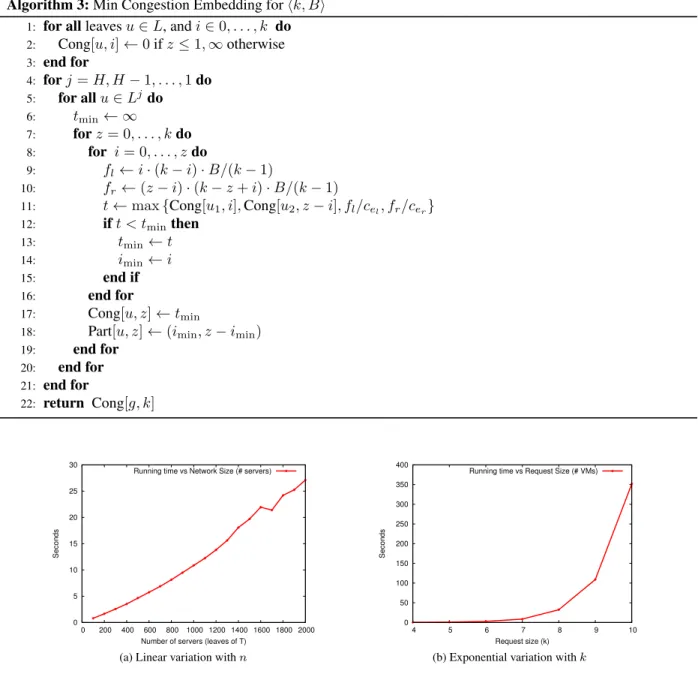
In this section we present simulations which verify the correctness and scaling properties of Algorithm 2 in both the pairwise bandwidth guarantees model, as well asvirtual clusterrequest model 5.3. We perform all simulations using an unoptimized python implementation of Algorithm 2 on Intel Sandy Bridge Quad Core machine having4GB of RAM using the networkx graph package [net] to simulate the physical network.
Algorithm 3:Min Congestion Embedding forhk, Bi
1: for allleavesu∈L, andi∈0, . . . , k do 2: Cong[u, i]←0ifz≤1,∞otherwise 3: end for 4: forj=H, H−1, . . . ,1do 5: for allu∈Ljdo 6: tmin← ∞ 7: forz= 0, . . . , kdo 8: for i= 0, . . . , zdo 9: fl←i·(k−i)·B/(k−1) 10: fr←(z−i)·(k−z+i)·B/(k−1)
11: t←max{Cong[u1, i],Cong[u2, z−i], fl/cel, fr/cer}
12: ift < tminthen 13: tmin←t 14: imin←i 15: end if 16: end for 17: Cong[u, z]←tmin
18: Part[u, z]←(imin, z−imin)
19: end for 20: end for 21: end for 22: return Cong[g, k] 0 5 10 15 20 25 30 0 200 400 600 800 1000 1200 1400 1600 1800 2000 Seconds
Number of servers (leaves of T) Running time vs Network Size (# servers)
(a) Linear variation withn
0 50 100 150 200 250 300 350 400 4 5 6 7 8 9 10 Seconds Request size (k) Running time vs Request Size (# VMs)
(b) Exponential variation withk
Figure 1: Pairwise bandwidth guarantees between all VMs: Dependence of the running time of Algorithm 2 with (a)
n, size of the network whenk= 5, (b) and withk, size of the requests whenn= 100.
6.1
Network configuration
In order to test our algorithm on a realistic networks, we simulate a typical three tier data center network [AFLV08] with servers housed in racks which are connected to a Top-Of-Rack (TOR) switch (tier I). The TOR switches connect the racks to other parts of the network via Aggregation Switches (AS, tier II). The AS switches have uplinks connecting them to the Core Switch (CS, tier III). We assume that TOR’s are connected to the servers with10GBps links while the uplinks from TORs to the AS’s are40GBps and from the AS’s to the CS’s are100GBps. We construct a tree topology over these elements, recalling that common routing protocols used in practice employ a spanning tree of the physical network. We model existing traffic in the data center network using random residual capacities for each link. We choose the residual capacity for edge eindependently of all other edges and uniformly at random from
Table 1: Linear scan for VM allocation: run time
n k Time (hours)
50 4 2.2
75 4 18.8
100 4 80
[0, c(e)]wherec(e)denotes the bandwidth capacity of edgee. The choice of random residual link capacities is forced on us due to lack of models describing realistic network flows in a data center. We note that Algorithm 2 finds the optimal congestion embedding for any of the distribution of residual capacities on the network links and any choices of bandwidth capacities of the links.
6.2
Linear scan over all possible VM allocations
By implementing a linear scan over all possible VM allocations in the network, we verify the correctness of Algorithm 2 by finding the allocation that minimizes congestion. Note that this implementation requires scanning nk
·k! =O(nk) feasible VM allocations wherendenotes the number of servers in the network andkdenotes the request size. Hence we choose small network and request sizesn∈ {50,75,100}andk= 4and verify correctness of the algorithm for different request topologies and randomly generated residual capacities on the network links. We observe that this procedure requires hours or even days to finish even for very small network and request sizes liken= 125andk= 4
as seen in Table 1 and hence is infeasible for modern data centers containing hundreds of thousands of servers. In contrast, Algorithm 2 has complexityO(3kn), which is linear in the network sizen, and as shown in the next sub section, finishes in order of seconds on our simulation setup for small values ofk.
6.3
Pairwise bandwidth requirements
Next, we verify the scaling properties of Algorithm 2 with respect to parametersnandk. First, we fix a request of sizek= 5, and plot the running time for increasing values ofn, the number of servers, fromn = 200ton= 2000
in Figure 1(a) which illustrates the linear variation of run time with respect ton. Next, we fix the network size to
n= 100and plot the run time forpath requestswith lengths fromk= 4tok= 10in Figure 1. This figure shows that the run time increases exponential with respect tok.
6.4
Virtual Cluster Request Model
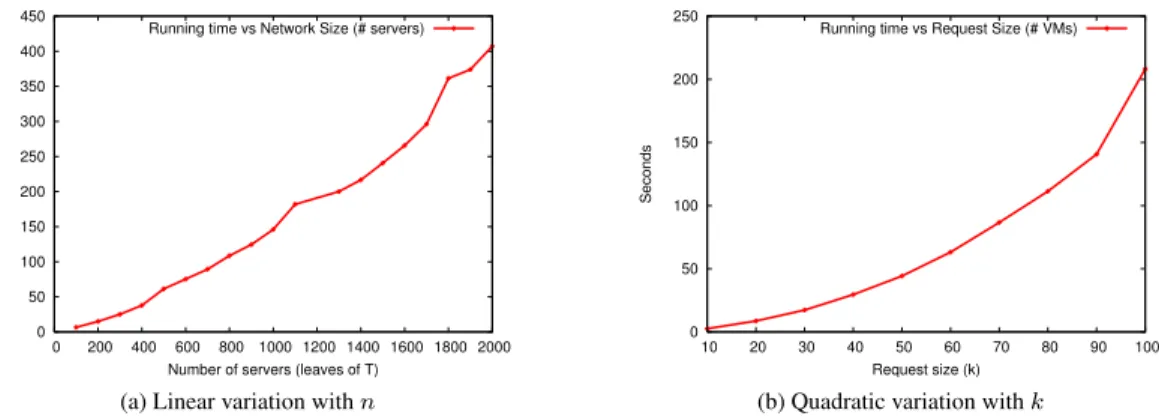
We also verify the scaling properties when the requests are restricted to the virtual cluster model [BCKR11]. For a fixed requesthk, Biwherek = 100andB = 100Mbps, we plot the running time for increasing values ofn, from
n= 200ton= 2000in Figure 2(a) which illustrates the linear variation of run time withn. Next, we fix the network size ton= 1000and plot the run time forkin the range10to100. These results show that forvirtual clusterrequests, our algorithm finds the minimum congestion embedding in timeO(nk2).
As mentioned before, a number of heuristic approaches have been formulated to perform VM allocation. However, lack of models of the existing network flows inside a data center, especially in the context of enterprise workloads, hinders the evaluation and comparison of their performance in realistic settings. In particular, we observe that by congesting particular edges in the network, it is possible to make the greedy heuristics for VM mapping perform significantly worse than the optimal embedding (output by Algorithm 2). However, a thorough comparison with heuristics requires models of flow in a data center serving enterprise requests, and we leave this to future work.
7
Conlusion and Future Work
In this paper we study the problem of allocating a graph request within a tree topology and we present aO(3kn) dynamic programming algorithm that embeds the resource request graph of sizekinto the data center topology (tree)
0 50 100 150 200 250 300 350 400 450 0 200 400 600 800 1000 1200 1400 1600 1800 2000 Seconds
Number of servers (leaves of T) Running time vs Network Size (# servers)
(a) Linear variation withn
0 50 100 150 200 250 10 20 30 40 50 60 70 80 90 100 Seconds Request size (k) Running time vs Request Size (# VMs)
(b) Quadratic variation withk
Figure 2:Virtual Clusterrequest model: Dependence of the running time of Algorithm 3 for thevirtual clusterrequest model with (a)n, size of the network whenk= 10, (b) and withk, size of the requests whenn= 1000.
of sizento minimize congestion. We believe this is useful in enterprise workloads when the request sizekis small. For clique requests, we present aO(n2k)dynamic programming algorithm to allocate clusters of sizekin a tree of
sizenfor minimizing congestion, which could be useful for MapReduce-like workloads. We believe that it would also be possible to extend our results to hybrid workloads involving tiers of VMs, with both inter-tier as well as intra-tier bandwidth guarantees. We also provide hardness results and show that the problem of finding minimum congestion embedding in a network remains inN P-hard even under the restriction to tree network. We focus on minimizing congestion as our objective function, but we believe our methods are applicable to a wider class of metrics and objective functions.
References
[AFLV08] M. Al-Fares, A. Loukissas, and A. Vahdat. A scalable, commodity data center network architecture.
SIGCOMM, 2008. 9
[BCKR11] H. Ballani, P. Costa, T. Karagiannis, and A. Rowstron. Towards predictable datacenter networks. SIG-COMM, 2011. 2, 3, 8, 10
[CRB09] N. M. M. K. Chowdhury, M. R. Rahman, and R. Boutaba. Virtual network embedding with coordinated node and link mapping.INFOCOM, 2009. 2, 3
[DG08] Jeffrey Dean and Sanjay Ghemawat. Mapreduce: simplified data processing on large clusters.Commun. ACM, 51:107–113, January 2008. 2
[DGG+99] N. G. Duffield, P. Goyal, A. Greenberg, P. Mishra, K. K. Ramakrishnan, and J. E Van Der Merwe. A
flexible model for resource management in virtual private networks. Inin Proc. ACM SIGCOMM, pages 95–108, 1999. 3
[FA06] J. Fan and M. Ammar. Dynamic topology configuration in service overlay networks - a study of recon-figuration policies.INFOCOM, 2006. 3
[GJ79] M.R. Garey and D.S. Johnson.Computers and Intractability: A Guide to the Theory of NP-completeness. WH Freeman and Company, San Francisco, 1979. 4
[GKK+01] A Gupta, J. Kleinberg, A. Kumar, R. Rastogi, and B. Yener. Provisioning a virtual private network: A network design problem for multicommodity flow. InIn Proc. ACM STOC, pages 389–398, 2001. 3
[GLW+10] C. Guo, G. Lu, H. Wang, S. Yang, C. Kong, P. Sun, W. Wu, and Y. Zhang. Secondnet: A data center network virtualization architecture with bandwidth guarantees.ACM CoNEXT, 2010. 2, 3
[GT11] M. Girola and A. M. Tarenzio. Ibm data center networking.ibm.com/redbooks, 2011. 2
[hcbiglc] http://www.businessinsider.com/amazons-cloud-business-is-growing-like-crazy 2011-7. Amazon’s cloud business is growing like crazy. 1
[hh] http://www.gogrid.com/cloud hosting/. Go grid cloud hosting. 1
[HLS09] R. Hassin, A. Levin, and M. Sviridenko. Approximating the minimum quadratic assignment problems.
ACM Transactions on Algorithms, 2009. 5
[hsinfmc10] http://blog.rapleaf.com/dev/2010/08/26/analyzing-some-interesting-networks-for-mapreduce clusters/. Analyzing some interesting networks for map/reduce clusters. 2010. 2
[htta] http://aws.amazon.com/vpc/. Amazon virtual private cloud. 1
[httb] http://en.wikipedia.org/wiki/Multitier architecture. Multi-tier application architecture. 1, 2
[httc] http://www.cisco.com/en/US/docs/solutions/Enterprise/Data Center/. Cisco data center infrastructure 2.5 design guide. 2
[httd] http://www.rackspace.com/cloud/. Rackspace cloud hosting. 1 [htte] http://www.rackspace.com/cloud/legal/sla/. Rackspace sla. 1
[MPZ10] X. Meng, V. Pappas, and Li Zhang. Improving the scalability of data center networks with traffic-aware virtual machine placement.INFOCOM, 2010. 2
[net] http://networkx.lanl.gov. 8
[YYRC08] M. Yu, Y. Yi, J. Rexford, and M Chiang. Rethinking virtual network embedding: Substrate support for path splitting and migration.SIGCOMM, 2008. 3
[ZA06] Y. Zhu and M. Ammar. Algorithms for assigning substrate network resources to virtual network compo-nents.INFOCOM, 2006. 3