Development of Internet of Vehicle's Information
System based on Cloud
Hengliang Shi
Information Engineering School of Henan University of Science & Technology, Luoyang, China, Email: [email protected]
Xiaolei Bai1 Chongguang Ren2 Changwei Zhao1
1. Information Engineering School of Henan University of Science & Technology, Luoyang, China, 2. Noah Information Technology (Suzhou) LTD.
Email: {[email protected]; [email protected]; [email protected]}
Abstract—As traditional mobile terminals have been unable to meet the needs of vehicle navigation, mobile office and etc, large amount of data from all kinds of sensors need to be acquired, stored and processed with the advent of Internet of vehicle. This paper puts forward vehicle network information processing platform based on Cloud, and designs the vehicle mobile terminal functions and interface functions. And the feasibility and reliability of data processing platform are verified by experiments.
Index Terms—Internet of Vehicle, Cloud, Data processing, mobile terminals
I. INTRODUCTION
Along with the development of modern automotive industry and electronic technology, many functions, such as vehicle navigation, communication, mobile office, multimedia entertainment, security assistant driving and remote fault diagnosis, can be integrated into vehicle information system function through the wireless network technology. The next generation of automobile meter system will be developed toward vehicle information system platform in an integrated, intelligent, and graphical way.
Internet of vehicle information system platform in the future will surpass the existing functions of the traditional instrument overall. The main functions of system include: digital instrument with full-graph, GPS(Global Position System) navigation, vehicle recognition system, multimedia audio and video entertainment, vehicle state display, remote fault diagnosis, network office, information processing, intelligent traffic assistant driving[1][2]. Powerful features mean to gather and process lots of vehicle data from all kinds of sensors. Transportation management agencies should timely grasp, process and analysis these data. The ability of traditional vehicle information unit is limited.[3][4] Unlike the traditional single vehicle, Internet of vehicle requires super-large scale data processing and management, and
more a powerful server center to deal with. So it contributes to the fusion between cloud computing and mobile. [5][6].
Vehicle information system is gradually becoming no longer a isolation system. In contrast, it emphasizes the integration among vehicles, vehicle control terminals, mobile phone, computer and so on. The typical cases, such as Ford SYNC[7], SAIC Roewe inkaNet[8], all manifest this point. The resource pool plays a buffered and managing role in data communication. The introduction of strategy of resource pool through which system control module can exchange data to prevent communication delay and data information regularization [9][10]. During the data processing procedure, all data are processed in the resource pool, which can eliminate the data delay, reduce the packet loss, and uniformly manage data [11][12][13].
II.INTERNET OF VEHICLE INFORMATION PLATFORM BASED ON CLOUD
Vehicle information system hardware architecture is shown in Figure1, the system can provide lower simulation such as operating system to cloud computing platform, and also afford CAN(Controller Area Network) equipment, LIN(Local Interconnect Network) equipment, I2C(Inter-Integrated Circuit) equipment analog signal [14][15] and voice equipment with analog diversity. Moreover, it can transfer those input information of vehicle equipment and user to the cloud for analysis as well. By means of the CAN control module, LIN control module, I2C control module, TABII control module, PND(Portable Navigation Device) control module providing CAN equipment, LIN equipment, I2C equipment, TABII equipment, PND equipment’s interfaces, and the communication interface provided with a cloud. The simulation range of the system transmission rate can be extended into 9600bps~128000bps.
Figure1. Vehicle Information System Demonstration based on Cloud Computing
Figure2. Vehicle Mobile Terminals Function Demonstration
III.VEHICLE TERMINAL FUNCTIONS AND
IMPLEMENTATION
As shown in Figure 2, the MSG(Message) management module achieve signal analysis, external interrupt response, task management, data read and write driver, state transition management, clock management, I/O management and hardware initialization and system environment initialization. As the message routing platform, the MSG management module provides transparent message communication mechanism for the
upper application software system. According to these input parameters in the function call procedure, cloud computing platform determines the physical address and the logical address of message, followed by the corresponding receiving module. After receiving the return signal, the corresponding module returns a confirmation signal. So cloud computing platform does not need to take into account the complex message routing, but only to call IPC (inter process communication ) unified device provided by API.
COMMUNICATION MESSAGE DEFINITION
NO. Message
type
Description
1 MSG_ID_CONFIG configuration
2 MSG_ID_STS_REQUEST request
3 MSG_ID_RESPONSE response
4 MSG_ID_RECV_DATA Receive data 5 MSG_ID_RECV_OK Receive data OK
6 MSG_ID_SEND_DATA Send daa
7 MSG_ID_SEND_OK Send data OK 8 MSG_ID_STS_NOTICE Send data overtime 9 MSG_ID_STR_NOTICE Receive data overtime 10 MSG_ID_SET_MODE Set work mode
11 MSG_DET_RUNMODE Running mode
IV.KERNEL AND DRIVER OF VEHICLE INFORMATION
SYSTEM
The kernel of vehicle information system offers system management, task management, message management, storage management, synchronization management and I/O management implementation. In order to improve the efficiency and reliability of the upper application software system, the kernel bans dynamic memory management function provided by operating system. Memory management module uses downward basic static memory management strategy afforded by real-time operating system. However, by built-in index table and pointer index table, it provides a flexible and effective management, including obtaining and releasing memory, which is earmarked for the unit reserved in buffer memory while the agreement is communicating, providing memory leak detection and recovery. Gateway control module and the connection module are used to achieve task processing between terminals and PC, including request, response, and priority, and simultaneously manage the input and output of buffer database interacted with network computing platform.
Interface functions are used by system hardware driver program, as follows:
VOID ReadFile(unchar DrvID, unchar *pdata, int length); This function is used to read the data which is sent from hardware.
VOID WriteFile(unchar DrvID, unchar *pdata, int length); Corresponding to the above read function, this function is used to write data for the hardware equipment.
VOID GetDrvStatus(unchar DrvId); The function is to get the driving condition according to the ID of hardware driver.
VOID DrvRun(unchar DrvId); This function is to ensure the legalization of hardware and to run the driver programs according to driving ID.
VOID SetDrvAddress(unchar DrvID,void *AdsInfo); This function is to set the drive chip address, to ensure that the processor can quickly find the driver programs.
V.DATA TRANSIMISSION PROTOCAL
The transmission protocol is used by the vehicle hardware equipments, as shown in figure 3. The 6th, 7th bit of the first byte is reserved for use, and the 4th, 5th bit is used to distinguish from broadcast which is in group or for all, and send data which is individual or broadcast transmitter. The latter lower four bits represent the device physical address. The system can take up to 16 devices with logical addresses. A byte then represents the data length of transmitted information. The front two bytes in transmitting data represent the logical address of sender and the logical address of receiver respectively. According to the previous command, the following data has two kinds of data length. The maximum data length of individual transmitter is 253 bytes, and that of broadcast transmitter is 21 bytes. The way of different data length is implemented on the basis of specific circumstances, saving storage space and the amount of data sent to a large extent. As the accepting equipment receives the data frame, the receiver is for analyzing these data based on the transport protocol, and stores the right data in a data buffer, thus to complete data sending and receiving processes.
Broadcas t Mode 4 bit Device Mode 4bit Data Length 1Byte Additional Information Sender Logical Add. 1Byte Receiver Logical Add. 1Byte order
Individual Send :Max253Byte Group Send:Max21Byte
Data which is sent
Data length which is sent
Device physical address identification
Bit7,6: Reserved
Bit5 0:Group Broadcast 1:Broadcast for all
Bit4 0:Individual send 1:send for all
Figure3. Data Transimission Protocol
The connection between sending device and receiving device obtains via the physical connection, increasing the code transportability on upper applications. By setting middleware on simulation platform, the system transfers some general module functions of upper application software to simulation platform, which embodies a clear hierarchical structure, realizing separation of upper application and platform function. In light of different communication protocols, the system divides vehicle
information system signal into CAN equipment signal, LIN equipment signal, I2C equipment signal, speech signal and so on. Through MSG management module, system can manage and transform devices signals such as CAN signal, which implements the interactions between system equipments and peripheral hardware. And the results can be viewed by display devices in real-time. These signals are analyzed and uploaded to the cloud computing platform by the protocol.
VI.EXPERIMENT RESULTS AND DISCUSSION
From the perspective view of cloud computing, the paper proposes vehicle information platform, the main function of which is to obtain and analysis of on-board equipment through the communication between the data bus. And these communication data is sent to PC by USB or RS232 and is displayed in the application. When the price of extended device connecting with vehicle operating system by bus is more expensive, or the access is not available, the application running on a PC origin can be simulated by vehicle equipment for developing or testing.
Vehicle information system’s interface on PC is developed by JAVA (shown in Figure 4). As can be seen
from the interface, the function selection is on the left. In the model unit, monitoring equipment information or simulation of the vehicle equipment information can be chosen. Communication signal of monitoring or simulation is divided into CAN equipment signal, LIN equipment signal, I2C signal, TABII signal, PND signal and other equipment signals, and all kinds of signals can be uniformly scheduled by resource pool management module. PC monitor terminal and vehicle information system terminal can communicate through USB or COM. On the right side of monitoring interface, you may timely analysis all kinds of output signal.
In the communication data panel, you can gain the CAN equipment, LIN equipment, I2C data communications equipment, TABII equipment and PND equipment. You can monitor working conditions and communication state of vehicle equipment from communication data. Monitor state of CAN equipment is shown as the bus signal data on the right side of Figure 5. Based on these data, you can check all kinds of data of each CAN device.
Online simulation of vehicle equipment is an important function of the system. Developers can simultaneously test under lack of real vehicle equipment case. For example, the simulation of DVD vehicle equipment which can simulate many parameters, including DVD address, DVD signal size and specific DVD signal data and other information, even simulate error DVD signal for data comparison during data processing analysis procedure. These simulation data can be saved to the XML file for next simulation usage. Vehicle information system based on cloud platform possesses real-time processing and simulation function. Real-time processing can deal with various kinds of equipment request of vehicle system, while the simulation function of vehicle equipment can make
simulation test between platform end and the actual vehicle. In contrast with the actual data, you can make the corresponding treatment.
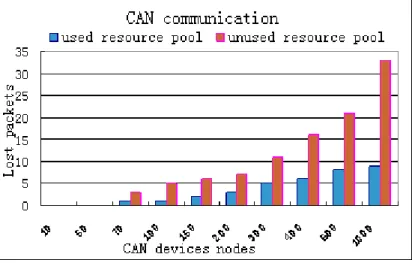
On account of the actual simulation, the vehicle information system of cloud computing functions can be verified, and completed some application experiments. Here the data loss problem of massive data processing can be mainly discussed. Without introducing resources pool strategy, when the number of simulation on-board equipment is more than 100, the loss of packet is more severe. The loss of the data pocket of CAN device and LIN device communication is shown in Figure 5 and Figure 6 respectively. When the number of CAN equipment and LIN equipment is lower 100, regardless of whether resources pool module is joined or not, the loss of data packets is non- existent during communication process. When the quantity of equipment is more than 100, the loss rate of communication data packet of CAN equipment reaches at above 5%, and that of LIN equipment is also more than 3%, packet loss is very obvious. With resource pool management module added, the loss rate of packet will be significantly decreased.
Figure 5. Data Lost Results by CAN Bus
VII.CONCLUSION
The system which is composed of vehicle terminal, call center and cloud computing, builds a “the Trinity” architecture, achieves the simulation of vehicle hardware platform data and facilitates the generation of cloud simulation data. And the system can efficiently analyze data under various conditions. Through the caching strategy, the system can deal with the problem of data packet loss in the process of transmission. With close connection and mutual cooperation of several parts, this system provides a integrated platform with information, entertainment, services and many contents as a whole for consumers.
REFERENCES
[1] Li Li, Jian Liu, Yuelong Yang." Research and Development of Intelligent Motor Test System". Journal of Computers, Vol 7, No 9 (2012), 2192-2199, 2012.
[2] Ying Lu,Wenqiang Chen,Xingmin Wei,Fuquan Zhao." On the Application Development of 3G Technology in Automobiles".Proceedings of the FISITA 2012 World Automotive Congress, pp.311~325,2012.
[3] Fan TongKe, "Smart Agriculture Based on Cloud Computing and IOT", JCIT, Vol. 8, No. 2, pp. 210 ~ 216, 2013
[4] R.lyer H,Wang LN, Bhuyan."Design and analysis of static memory management policies for CC-NUMA multiprocessors".Journal of System Architecture,Vol.48,No.3,pp.59~80,2002
[5] Yemini Y. ."The OSI network management model".Communications Magazine, IEEE, Vol.31, No.5, pp.20~29, 1993.
[6] Yong Tang, Hongin Gu,Lai Zhou. "Real time Virtual View Generation for Augmented Virtuality System". Journal of Computers, Vol 6, No 5, pp. 873-880, 2011.
[7] Ford.SYNC.http://www.ford.com/technology/sync/,2012-8 -1
[8] Chen Xiaohua,Li Chunzhi,Yu Jianqi."Virtual host cloud storage integer plan module and its optimal assignment algorithm". Science of electric information, Vol. 10, No.1, pp.89~ 94, 2010.
[9] Zhang Guigang,Li Chao,Zhang Yong,Xing Chunxiao."Research of cloud storage module based massive information process".Journal of computer research and development, Vol. 32, No.9, pp32~36, 2012.
[10]WEIL S A,BRANDT S A,MILLER E L,et al."Ceph: A scalable high-performance distributed file system". Proceedings of the 7th USENIX Symposium on Operating Systems Design and Implementation, pp. 307~320, 2006. [11]Lina Lan, Xuerong Gou, Yunhan Xie, Meng Wu.
"Intelligent GSM Cell Coverage Analysis System Based on GIS", Journal of Computers,Vol 6, No 5, pp. 897-904,2012.
[12]SCHMUCK F,HASKIN R."GPFS: A shared-disk file system for large computing clusters",Proceedings of the 1st
USENIX Conference on File and Storage Technologies,pp.231~244,2002.
[13]Jian Wang, Yanheng Liu, Wenbin Gao, "Securing Internet of Vehicles Using TCM", JDCTA, Vol. 4, No. 7, pp. 226 ~ 233, 2010
[14]A. Zimmermem, A. Lorenz and M.Specht, User modeling in adaptive audio-augment museum environments, Proc. Of the 9th International Conference of User Modeling,
pp.403-407, 2003
[15]M. Zancanaro, O.Stock and I.Alfaro, Mobile Cinematic presentations in a museum guide. In Book of Abstracts, Learning and skills Development Agency. London, 2003.
Hengliang Shi: Ph.D, associate
professor of Henan University of Science & Technology, Research interest includes cloud computing, distributed coumputing, software testing method and engineering.
Xiaolei Bai: Master degree of Henan
University of Sci&Tech, Her research interest includes cloud computing, parallel computing.
Chongguang Ren: Ph. D. Senior software architecture of Noah
IT Solution LTD. His research interest includes embedded system development, distributed system.
Changwei Zhao: Ph. D. Associate
professor of Henan University of Sci & Tech. His research interest includes Internet of Vihcle, distributed computing.