Inside the Black Box:
What Makes Workforce
Development Programs
Successful?
Elizabeth Weigensberg
Colleen Schlecht
Faith Laken
Robert Goerge
Matthew Stagner
Peter Ballard
Jan DeCoursey
2012
Inside the Black Box: What Makes Workforce Development Programs Successful? Elizabeth Weigensberg Colleen Schlecht Faith Laken Robert Goerge Matthew Stagner Peter Ballard Jan DeCoursey Recommended Citation
Weigensberg, E., Schlecht, C., Laken, F., Goerge, R., Stagner, M., Ballard, P., & DeCoursey, J. (2012). Inside the Black Box: What Makes Workforce Development Programs Successful? Chicago: Chapin Hall at the University of Chicago
ISSN: 1097-3125 © 2012 Chapin Hall at the University of Chicago Chapin Hall
at the University of Chicago 1313 East 60th Street Chicago, IL 60637 773-753-5900 (phone) 773-753-5940 (fax) www.chapinhall.org
Acknowledgments
We would like to thank the Ford Foundation for their generous support of this study. Additionally, we would like to thank all of the workforce program staff who participated in this study by sharing information about their programs and for sharing their valuable time with us during site visits and interviews. We would also like to thank Anne Clary and Matthew Brenner of Chapin Hall for their editorial assistance. Finally, we are grateful to the workforce experts who helped nominate programs for inclusion in this study.
Table of Contents
Executive Summary ... 1
Recommendations for Data Collection and an Improved Data System... 2
Success Factors and Their Measurement ... 3
Introduction ... 7
Conceptual Model... 8
Methodology... 10
Review of Recent Literature ... 11
Outcome and Process Measurement ... 11
Promising Program Practices and Characteristics... 13
Role of Data and Outcomes ... 16
Use of Data and Measures ... 16
The Need for Better Program Measures ... 19
The Need for Better Data Management Systems... 20
Data and Measurement Recommendations and Feasibility ... 22
Improved Measures for Workforce Development ... 22
Toward an Integrated Workforce Data Management Information System ... 26
Success Factors: Participants, Program, and Practice ... 28
Various Practice and Program Models ... 28
Intake Process ... 30
Address Needs with a Comprehensive Approach... 34
Prepare Participants for Successful Job Placement ... 39
Success Factors: Workforce Provider Organizations... 41
Flexibility in Service Delivery and Funding... 41
Strong Leadership and Staff ... 46
Plan Strategically for Growth ... 50
Success Factors: External Engagement with Employers, Programs, Community, and Policy... 52
Relationships with Employers ... 52
Collaboration among Workforce Programs... 58
Policy and Advocacy Efforts ... 62
Conclusion... 66
Implications ... 66
Appendix A: Organization Descriptions ... 70
Appendix B: Bibliography ... 82
Appendix C: Methodology... 90
List of Figures
Executive Summary
The workforce development system in Chicago and nationwide is multifaceted and includes public and private training providers that work with individuals of all ages and abilities. Broadly, the programs within the system aim to train their participants while preparing them to (re)enter the workforce, graduate them from the programs, and place them into jobs. Some programs experience greater success at these goals and have more lasting effects than others. Identifying successful employment programs and understanding why they are successful at placing people into employment amid such variety is critical, especially during times of high unemployment when the tasks of finding and retaining employment are highly competitive. This study looks at several successful programs in Chicago; it attempts to understand the factors that may explain why they achieve success of different types, and how these factors may be quantified or measured to help improve the system.
The study assesses the influence of a range of factors, from individual participant characteristics, program and practice elements, and provider organizational aspects, to the broader set of external relationships, on achievement of successful outcomes for workforce development programs. These nested levels of factors—the individual participant within the program, the program within the organization, and the organization within its external context—are interconnected and, taken together, influence success. Intersecting with all of these factors is the role data and outcomes play in how programs achieve and understand their success. Specifically, the study aims to identify the influences within each of these levels that lead to programs’ success, how and if these factors are currently measured, and recommend
improvements to the data collection methods and data system that currently exist within the workforce development system. Recommendations for a more robust data system, and the measures this system should track, are listed below, with more complete recommendations in the report. Following this, the influences on success at each level are outlined and explained in more detail in the full report, including how and if organizations measure these factors.
Recommendations for Data Collection and an Improved Data System
The workforce development programs in this study were asked about the array of factors that relate to successful program outcomes and to what extent they collect data on or measure these factors. They all use a variety of management information systems (MIS) to collect data and assess outcome measures. The people we interviewed identified many challenges and limitations with all of these data systems,
individually and collectively, and saw a need for more robust and improved measures and an improved, integrated data management information system to better assess program process and outcomes. Findings from this study led to several recommendations to improve the workforce development measures system-wide and to develop an integrated data management system.
Improved measures
Recommendation 1: Define a set of common measures across programs that can help establish some universal standards while allowing the flexibility to accommodate additional measures that individual programs find valuable or funders require.
Recommendation 2: Develop longitudinal measures on individuals to assess outcomes over time.
Recommendation 3: Analyze outcomes by subpopulations, including participant characteristics and barriers to employment, in order to develop risk-adjusted performance expectations.
Recommendation 4: Expand what is measured in program process and outcomes, including factors related to the individual client, program, organization, and contextual measures of external
engagement.
Measures should include the following:
Initial assessment and continual development of hard skills and soft skills
Engagement in negative behaviors
Intermediate participant achievements
Participant use of other support services and public benefits
Economic self-sufficiency and family well-being
Achievement of industry/occupational credentials
Process measures
Employer engagement and long-term outcomes with each employer
Community engagement and community impact
Toward an integrated workforce data management information system
1. Interface with other required data reporting systems, minimizing repetitive data entry into multiple systems.
2. Allow collection and analysis of data on all program participants, not just those that are part of a particular funding stream.
3. Provide programs with useful process and outcome measures for self-assessment and external reporting.
4. Improve how programs report outcomes to multiple funders. 5. Be flexible enough to meet the diverse needs of different programs.
Success Factors and Their Measurement
In our interviews with program providers, they identified a number of factors that they believe contribute to the success of their programs and organizations and to successful outcomes for program participants. The extent to which these factors are measured and tracked varies. A summary of the most significant factors that emerged from this study, as well as their existing measurement practices, is included below.
Participants, programs, and practice
Intake assessments
The eligibility and intake assessments that programs require of all applicants are thorough and extensive, capturing as much subjective and objective information about the applicant as possible to determine their willingness and ability to complete their program. As a result, potential barriers to success and
employment are identified early, and for those applicants that ultimately enroll, programs have assessed the supports that will be needed to encourage program completion and success.
Although all the organizations in this study capture client characteristics at intake and enrollment, they vary in what information they collect and how they use the information. Participant data is often used to identify and assess individual participants’ needs, and some of the organizations use the information to provide individualized program offerings and support. Others use entry tests for placement in the appropriate program. All collect basic demographic information, education and professional history, information on family and housing composition, public benefits used, criminal history, and attempt to gather subjective information on participants’ goals, motivations, challenges, and barriers to work. A comprehensive program approach
Given the barriers some participants face, the successful programs offer a comprehensive approach to training and engaging their participants in addition to the technical and job skills training. This includes addressing psychosocial challenges, such as conflict and time management and professionalism, and
addressing basic needs such as clothing, transportation, and medical assistance. Organizations often track what services clients use to help them overcome barriers, including whether clients use several services or “bundles” of multiple services, which public benefits they take up, and which services they access. This information helps providers know what services should be provided and the uptake of these services to ensure these supports are available. Data on participant characteristics are also used to assess program management and processes. Data about participants’ characteristics, needs, and experiences with the program are also used by program administrators to better allocate resources, including funding and staffing.
Provider organizations
Flexibility in many aspects of the organizations’ operations
Successful organizations demonstrate flexibility to remain committed to their mission while responding to changing participant needs and the economic environment. The organizations in this study are flexible in their service delivery strategies in order to meet the needs of participants, whose profiles are constantly evolving, as well as the fluctuating needs of employers and local businesses.
Successful provider organizations use client-level and organizational data to assess process measures and monitor how well they are doing at providing services and achieving their desired outcomes. Specifically, programs frequently measure the number of clients served, number who dropout, and number who complete the program, as well as internal operations measures, such as caseload size, referrals, and costs per participant.
Organizations also demonstrate flexibility in their capacity and need to diversify funding, and use data on funding in their daily operations. Organizations track where their funds are being spent to meet
accountability requirements put in place by funders. As part of these efforts, providers collect and report data differently for their various funding sources and grants, which often require multiple data systems with repetitive data entry.
Organizational leadership and staff
The boards and leadership staff in the organizations we studied are very active. Leadership staff and program staff are often in constant communication, with each recognizing the crucial role the other plays in participants’ success. Leadership staff endorsed the motivation, attitude, and personal experiences and characteristics that program staff bring to the organization, more so than their education or professional experience. Staff evaluations, completed by participants and/or management, are used in most
organizations to monitor staff performance. Plans for growth amid funding challenges
While acknowledging funding as a primary challenge, the organizations in our study all had strategic plans for future growth. These plans differed, with some opting to serve more participants and broaden their scope, and others choosing to narrow their focus and serve existing participants more thoroughly.
External relationships, community, and policy
Employer partners treated as customers and engaged in a variety of ways with the organization
Strong employer relationships permeate the successful organizations in this study, where employers are treated as customers who receive dedicated efforts to ensure their workforce needs are met. Employers engage with training providers in a number of ways—involvement in training components, serving on the board, engaging in volunteer efforts with the organization, and even taking business service trainings from the organization. Organizations must meet employers’ and industries’ changing demands while ensuring enough partnerships exist to place all graduates in employment. Each organization has dedicated staff who are responsible for finding and cultivating these relationships.
Given the importance of building and maintaining relationships with employers, and identifying and being responsive to employer needs, about half of the programs in the study formally or systematically track their employer engagement. One program in particular uses a business-focused contact management software to track all employer engagements. Most programs use data on employer engagement for self-assessment to identify what is working well, or not so well, regarding the number and quality of placements. One organization, for its industry-focused program, tracks interview-to-hire ratios with employers, with an effort to keep this ratio as low as possible. Data on employer engagement can be shared with employers to maintain existing employer relationships and recruit new ones, and demonstrate how well they are meeting the employer’s needs. One program provides customized reports to employers to describe their successful placement and retention outcomes and overall engagement with each
employer, demonstrating the quality of their relationship. A few programs in the study also track employer engagement with programmatic activities, such as employers’ volunteer efforts with the program, by maintaining spreadsheets that record such engagements.
Most programs in the study noted they also use employer-specific data and labor market data on industry and employer needs to better assess the current and projected demand for specific skills with job
placements. Some organizations have also used this information to help align their current and future training programs with the needs of employers.
Workforce providers collaborate with each other
The organizations in this study consider themselves to have a dual client base, serving their participants as well as their employer partners and local businesses. Training providers often exhibit collaborative tendencies to work together to fulfill the needs of participants and employers.
Community partners provide many services to the organizations’ clients
Community partners, such as schools, healthcare providers, other community-based organizations, and many others, serve as a source of referrals into the program as well as provide many support services that organizations cannot provide on their own. Communities also may play a role determining where an organization is located and/or the types of programs the organization provides. In this sense, organizations often serve an economic development purpose in the communities in which they operate.
With regard to measurement, organizations track community referrals, and some track engagements with community partners.
Engagement in policy and advocacy
The successful organizations in this study are active in advocating for their funding and supporting their services and programs before policymakers at all levels of government. Despite facing numerous policy challenges, they understand the value of advocacy and presenting tangible evidence to lawmakers to protect their organizations and advance their mission.
Introduction
The workforce development system is complex—composed of numerous public and private education, training, and assistance programs at the federal, state, and local levels (Chapin Hall, 2010). Workforce development programs use many combinations of service delivery models and provide services for diverse populations. Identifying successful employment programs and understanding why they are successful at placing people into employment amid such variety is critical, especially during times of high unemployment when the tasks of finding and retaining employment are highly competitive.
This study attempts to assess the influence of multiple factors, from individual participant characteristics to organizational external relations, on achievement of successful outcomes for workforce development programs. Identifying which workforce development employment and training programs are successful in placing and retaining participants in jobs is important for funding, policy, and customer decision making. Yet, comparison of programs’ outcomes can be challenging. Differences among workforce development program models and goals, participant demographics, and other factors—such as organizational
influences, community settings, and funding sources—may lead to differences in program outcomes. Improved knowledge about providers’ program processes and the context within which they operate is critical to understanding the differences between program outcomes and to facilitating program
improvement. Understanding the factors that contribute to organizations’ success in different domains and how these factors may be quantified or measured will strengthen the entire workforce development system and will help policymakers to interpret successful outcomes and improve decision making about funding.
This research explores the environmental and organizational contexts, program and service delivery processes, and measurement practices of six Chicago workforce development programs, which were identified by experts in the field based on their success in both program implementation and participant
outcomes.1 The programs chosen for the study represent one of the largest types of workforce
development programs—community-based employment and training programs. More specifically, the scope of the study is limited to those community-based programs that serve unemployed or
underemployed adults in Chicago. Focusing on community-based employment and training programs provides an opportunity to explore what program administrators believe contributes to successful participant outcomes while considering differences in program design, internal organizational structure, and external context. One-stop workforce centers and community college training programs, two other important types of workforce development programs, are not included.
Based on this research, we provide recommendations for how to improve the data management
information systems and measurement of individual, provider, and contextual factors to assess programs’ and participants’ progress, enhance service delivery and innovation, and describe program success among workforce development programs. We also discuss the potential changes programs, policymakers, and consumers can make and the impact those changes might have.
Conceptual Model
The implementation of workforce development programs is influenced by a range of factors, such as individual participant characteristics, program and practice elements, provider organizational aspects, and the broader set of external relationships. Given the nested nature of these types of factors—that is,
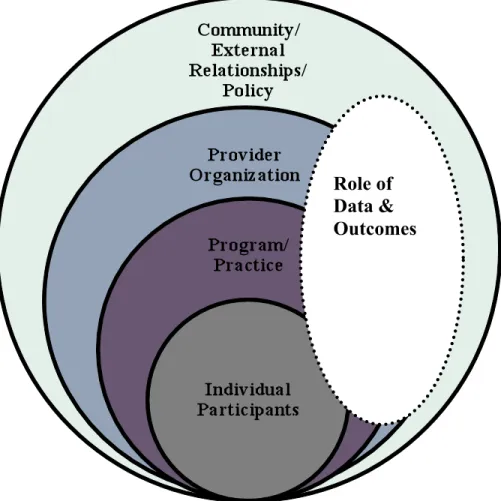
individuals and their particular characteristics within programs, programs within organizations, and organizations within a broader contextual environment of external relationships—we have adapted Bronfenbrenner’s Ecological Systems Theory, in which he describes a series of nested systems that, taken together, influence development.2 Our ecological model, shown in Figure 1, represents a conceptual
framework in which to depict these factors and their relationships. The additional overlapping layer of the role of data and outcomes is essential for this study because our focus is not only on identifying the factors influencing workforce development outcomes, but also on learning how these factors can be measured and used to assess and improve outcome achievement.
1 Local experts in Chicago’s workforce development field were identified through discussions with local and national researchers, local workforce development advocates, workforce development government program administrators, and private funders. These experts nominated the organizations in this study.
2 Since Bronfenbrenner established the theoretical principals of ecology theory in the 1970s, it has frequently been used as a part of conceptual frameworks for studying a variety of influences, characteristics, and processes involved with the understanding of individuals’ achievement of outcomes within their environment (Bronfenbrenner, 1979; Lerner, 2005). The main principle of ecological theory is that human development is a result of an individual’s interaction with environmental factors from a broad, multi-level context and that these surrounding environments are interconnected systems. The mutual interactions among elements across these nested systems—which include the microsystem, the mesosystem, the exosystem, and the macrosystem—represent the complex relationships of environmental factors that contribute to an individual’s development or change.
Figure 1: Interaction of Influences on Workforce Development Programs and Data
In this model, several levels are identified that represent sets of factors that influence achievement of successful workforce development outcomes:
The micro-level begins with Individual Participants who are engaged in the workforce development program. Their characteristics, history, and experiences all influence how well they may be able to complete the program and achieve job placements.
The surrounding level is the workforce Program/Practice that engages the individual participant and tries to develop their skills through training and supportive services.
Encompassing both Individual Participants and Program/Practice is the Provider Organization, which houses the specific workforce program. Such organizational factors as structure, mission, and funding can influence how the program, and ultimately the individual participants, is able to achieve desired outcomes.
Role of
Data &
Outcomes
The broadest level is Community/External Relationships/Policy, which influences each of the other three levels. Employers, other workforce programs, the surrounding community, and workforce policy are all important external factors that shape the success of workforce programs and the individuals they serve.
The additional cross-cutting component of Role of Data and Outcomes overlays the entire set of levels from the individual through external factors.
This ecological model serves as a useful framework for the purposes of conceptualizing the important factors and measurement aspects involved with achieving positive workforce development outcomes. Because multiple factors from all ecological levels play a role in how the individual achieves outcomes, this study provides a unique look at each of these sets of factors, assesses how they influence program success, and explores how these may be measured and used to improve achievement of outcomes. The conceptual framework described here was used throughout the study, including the structure of the protocol of questions during site visit interviews with program administrators as well as the organization of the study results presented in the following chapters.
Methodology
Workforce development training organizations and their respective training programs were recruited for this study using a process consisting of nomination, selection, and then invitation to participate.
Nominations of successful workforce programs were solicited from local experts in Chicago’s workforce development field. The criteria for selection included programs that: (1) had a goal of job placement and retention; (2) are community-based programs that operate within either large, multi-service or small, single-point-of-service organizations; and (3) serve low-income adult service recipients (age 18+) with multiple barriers to employment and retention. Among the 21 nominated programs, 6 workforce programs are included in the final sample for this study. They are described in Appendix A at the conclusion of this report.
Qualitative methods were used for this study, specifically a case study approach based on semi-open-ended, in-depth interviews with organization staff. Interviews and site visits were conducted with program staff for each of the six programs from March through August 2011. A total of 16 workforce staff were interviewed, including organization executive directors, vice presidents, program directors, and other staff. Interview field notes and additional supporting documentation, such as program descriptions and reports, were also included in the data collection. Qualitative software, ATLAS.ti 6, was used to code and analyze the data.
Review of Recent Literature
A review of over 100 documents reveals that much of the literature about workforce development program success can be grouped into two major categories: (1) literature that focuses on outcome and process measurement and (2) literature that identifies promising program practices and organizational characteristics. This review found that despite the prevalence of the promising practices for workforce development programs in existing workforce development literature, the actual measurement of these factors appears limited and is seldom documented. There is a distinct mismatch between what is known and what is measured; despite consensus in the workforce development literature that these practices are important and indicators of success, documentation of their measurement is seldom discussed in the literature.
Outcome and Process Measurement
Most evaluation of workforce development in the literature focuses on attainment of policymakers’ and funders’ desired outcomes. Job placement, retention, and wages are the primary outcomes discussed, not surprising given the primary goal of most programs—placement in employment, employment retention, and economic self-sufficiency. Additional outcomes considered include enrollment and completion, cost per client trained, skill gains, educational attainment, and certification, but these are not often considered (Wilson, 2005). Certain types of programs, such as community colleges, youth programs, or ex-offender programs, may have alternative primary missions, but the goals of employment are the same.
There is significant heterogeneity among workforce development programs in their models, participants, and service-delivery strategies and, as a result, heterogeneity in program-specific outcomes measurement and data collection approaches. For example, programs use various timeframes and outcomes for
assessing achievement, including the definition of job placement, the length of time required to measure retention, and how to measure increased wages over time (Bearer-Friend, 2009; Holzer & Nightingale, 2009; Heinrich & Holzer, 2009; Miles, Maguire, Woodruff-Bolte, & Clymer, 2010). As a result, the
literature often notes the need for reliable, consistent, and appropriate performance measures and data in order to improve program performance and achieve success (Miles, et al., 2010; Bearer-Friend, 2009; Bellotti, Rosenberg, Sattar, Esposito, & Ziegler, 2010; Holzer & Nightingale, 2009; Shore & Shore, 2009). Nevertheless, efforts to develop common integrated performance measures across various types of workforce development programs are challenged by the need to incorporate differences in program populations, models, and outcome goals (Wilson, 2005).
Existing process measures are more rarely described in the literature than are outcome and impact measures. A recent United States Government Accountability Office report describes the need for greater investment in rigorous evaluation of workforce development programs’ impact and investigation of how the workforce system can be modified to enhance its services (U.S. GAO, 2009). Recommendations for process measures, however, are quite limited in the existing literature, especially measures that transcend differences in program service-delivery models and participants.
Some nonexperimental studies have found how differences in program design and populations relate to program impacts. For example, Heinrich, Mueser, and Troske (2008) found that women and adult program participants had higher earnings than participants in a dislocated worker program. An MDRC report from 2006 explored how different service-delivery strategies significantly influence retention and advancement. Finally, a report from the Joyce Foundation’s Transitional Jobs Reentry Demonstration, which is testing employment programs for former prisoners, found the transitional job group was much more likely to work than the control group early on, but that the differences faded as men left their subsidized jobs (Redcross et al., 2010).
Additional information about process measures and influences on program outcomes will likely be gleaned from studies currently underway. MDRC is conducting an experimental study of the Workforce Investment Act (WIA), to be completed in 2015, that will explore how services are implemented and how differences in implementation affect participants’ employment, earnings, and related outcomes. The Public/Private Ventures “Benchmarking Project” is currently identifying meaningful outcome benchmarks for the workforce development field to better understand what constitutes “good”
performance, considering many influences on program outcomes such as program population, services, and organizational characteristics like age and size (Miles et al., 2010).
The literature does, in some cases, go beyond enumerating the process measures collected to describe how programs may benefit from better use of process data and improved measures. One report highlights the role data and use of performance measures can have to tailor programs to meet the needs of both participants and employers and see increased retention and placement rates (Clymer, 2003). A recent report by Eberts (2009) looked at how performance measures can be improved for the nation’s workforce
development system and found that in order to measure accurately the value added of the services
programs provide when looking at placement, retention and wage outcomes, local labor market conditions and the personal characteristics and work history of the participants need to be taken into account.
Moreover, combinations of process and outcome data may help organizations assess their programs and make changes to better serve program participants. In particular, one report found that participants with multiple barriers benefitted from periodic assessment of needs, growth, success, and long-term outcomes (Council for Adult and Experiential Learning (CAEL), 2006). Another noted that interim evaluations during enrollment could be based on combinations of assessment, program data, and administrative data such as participant employment and educational outcomes (Abt Associates and Metis Associates, 2005). Despite the limited coverage of measuring workforce development program practices, there is a wealth of literature on what these promising practices are, and their potential impact on participant and program outcomes.
Promising Program Practices and Characteristics
The workforce development literature is rich with descriptions of promising practices and characteristics of successful workforce development organizations, highlighting many different factors across the ecological model levels that likely influence success across the variety of workforce development programs.
Program Elements
Support Services. The literature emphasizes the provision of support services and case management—including child care, transportation, access to housing and cash assistance, food stamps, health care services, and referrals to substance abuse and mental health services—over any other factor in helping participants overcome barriers to attendance and work (Purmort, 2010; Klein-Collins, 2002; Maguire, Freely, Clumer, & Conway, 2010). For long-term unemployed individuals, research shows the advantage of a human development approach, which draws on psychology and sociology and focuses on understanding the process of change and growth in individuals (Herr & Wagner, 2007).
Flexibility. Flexibility in programming and service delivery is another crucial component of program success. Organizations that support a program’s ability to alter services in order to adapt to both business and participant needs are more likely to be efficient and successful. Flexibility in hours, location, and method of service delivery are desired characteristics in programs’ offerings (Hendra, et al., 2010; Strawn, 2010a; Holzer & Nightingale, 2009; Rynell, 2001; Maguire, et al., 2010).
Family Involvement. Family engagement in programs—including training multiple family members, assessing and intervening in family issues at the time of program enrollment, involving family
members in program-related activities and supportive services, and direct employment services to families—has implications for participants’ well-being and access to resources (King & Elliot, 2000). Programs that include and assist family members, especially programs that support other family members becoming wage earners, may have more success in helping their participants overcome poverty (Shore & Shore, 2009; Jackson, Brooks-Gunn, Huang, & Glassman, 2000).
Job Quality. A program that focuses on the quality of job placement may help participants achieve long-term employment success and self-sufficiency. Determinants of job quality have been defined in the literature as including wages and earnings as well as benefits, job security, advancement
opportunities, work schedule, access to child care, and fairness (Lower-Basch, 2007; Shore & Shore, 2009). Once placed in a job, inflexible work arrangements, insufficient benefits, and the workplace environment can influence retention outcomes (Abt Associates, 2009; Richman, 2006; Cohen & Single, 2001).
Organization Elements
Diverse Funding Sources. A number of sources in the literature describe how organizations with diverse funding sources are able to maximize their ability to address individual participant goals, and allow decisions to be made based on the best design of service to the participants instead of following a one-size fits all plan (Harris, 2006; Nightingale, 2008). Yet, this diversity in funding sources presents multiple challenges to program practice and measurement. Each funder may differ in
required performance measurements, and performance standards that funders request are, at times, not attainable by all programs.
Staff, Leadership, and Size. Additional organizational characteristics that may influence program outcomes include organizations’ staff and leadership characteristics as well as the size of the organization. Staff influences include staff continuity and dedication, staff experience with the program participants and the industries with which they aim to connect their participants, staff expressing cultural competency, and staff training (Abrazaldo, et al., 2009; Shore & Shore, 2009; Clymer, 2003; Nightingale, 2008). In addition, strong and stable leadership within the organization and on its board may be linked to successful outcomes (Abrazaldo, et al., 2009; Social Policy Research Associates and TATC Consulting, 2004; Clymer, 2003; Tate & Klein-Collins, 2004). Lastly, two studies found that the size of an organization, including smaller program enrollment, class size, and the staff-to-participant ratio, can lead to better outcomes (Abrazaldo, et al., 2009; Miles et al., 2010).
External Elements
Employer Engagement. Employer engagement permeates the literature as another factor that likely influences success in workforce development and training programs Employer engagement is credited
for contributing to program success and programs’ abilities to improve participants’ short and long-term outcomes (Gibson, 2000; Klein-Collins, 2002; CAEL, 2006; Clymer, 2003; Bellotti, et al., 2010). Several examples exist of employers being involved in the development of program
curriculum, which can help programs ensure their training is tailored to the needs of the employers they hope to place their participants with upon graduation (Nightingale, 2008; Uhalde & Kazis, 2010; Brown, Maxwell, DeJesus, & Schiraldi, 2002; Strawn & Martinson, 2000).
Partnerships. The literature identifies the strength of organizations’ partnerships with community organizations and programs—including employers, workforce development intermediaries, and other agents in the community—as a factor influencing success in programs. Using a dual-customer approach, where the organization seeks to serve program participants and employers, leads to strong employer partnerships, which are commonly referenced as being critical to workforce development programs (Klein-Collins, 2002; Hoops & Wilson, 2010; Gibson, 2000; Maguire, Freely, Clumer, Conway, & Schwartz, 2010).
External Contexts. Neighborhood and community contextual factors, such as crime rates, poverty levels, and access to education, appear underexplored in the literature. Yet, the availability of employment within the community is described as highly influential on program success. A meta-analysis of 73 randomized control trials of mandatory and voluntary welfare-to-work interventions found strong evidence suggesting that the availability of jobs in an area accounts for most contextual outcome variability (Gorey, 2009). Other authors discussed the importance of programs’ responses to the environment, including unemployment statistics, labor market information, and the changing needs of employers (Holm, Bergman, & Prince, 2010; Nightingale, 2008; Painter & Aldinger, 2011). Despite these promising practices, the scarcity in workforce development literature of the measures of these inputs, and the program and participant processes that lead to various outcomes, suggests that an opportunity exists to define helpful measures for program assessment and improvement, especially when considering the multiple influences on workforce development program service delivery and outcomes.
Role of Data and Outcomes
We interviewed representatives of 6 programs deemed to be exemplary by experts in the field. Among the commonalities we found was a need to improve data—to gather more data, to make it more consistent and applicable across programs, and to make it easier to enter and to access. This need is likely to sharpen in the future as funders require more evidence of success and as providers need to learn more about the people they are serving and the environment in which they are serving them. While the following chapters identify many of the key program elements related to successful outcomes, this chapter describes the role of data and outcomes among workforce programs in the study and identifies several challenges and recommendations regarding better data and outcomes. The discussion around these key elements and how and if organizations measure them drove the development and content of this chapter.
Use of Data and Measures
Meet Funder Requirements
Workforce programs are committed to achieving desirable training and employment outcomes for their participants. Programs collect data to assess the progress and outcomes of program participants, and assess the implementation of their programs and the success of the organization. All of the workforce organizations in this study collect standard measures of workforce development success—such as program completion, job placement, employment retention, and starting wages—that focus on participants’ achievement of positive outcomes. Typically, such measures are intended to meet the
requirements of public as well as private funding sources. Most of these outcomes focus on immediate job attainment once exiting a workforce program, and are used to assess whether the program met their expected performance goals.
While these standard measures capture the essential outcomes expected of all workforce development programs, providers in this study argued that using these measures alone presents an incomplete picture of not only achievement of outcomes, but of organizational effort and impact. Specifically, they do not
capture all of the participants’ achievements, such as interim accomplishments while in the program or longer-term outcomes that become evident after completing the program. In addition, program staff noted that standard measures do not capture the unique circumstances or characteristics of participants.
For example, current standard measures are focused on very specific, and often immediate, time frames. If a participant obtains a job after the time frame specified by funders, they will not recognize this as a placement when the program reports its outcomes. This holds true even for participants with barriers to employment, such as those who are homeless or are ex-offenders, and who may need additional time to achieve positive outcomes. Therefore, providers that do not serve clients with certain barriers to
employment can more easily achieve outcomes than providers that strive to serve all those who seek their services.
I kind of feel a lot of times we’re getting compared with other workforce development agencies that maybe are working with people that have less [sic] barriers, so they still have some barriers to employment, and so a lot of times funders [ask] … “Well, how do you compare to these entities?” And it’s just like I kind of feel like we’re comparing apples and oranges.
Unfortunately, some standard performance measures, such as WIA measures, can promote the opposite of what they desire to achieve and drive services in unintended ways. This may give programs an incentive to enroll only the best candidates, avoiding those that may take longer to get a job, or to set lower performance standards. One interviewee noted there are incentives to set lower expectations, so they can “set the bar low so we can achieve the bar high,” and demonstrate better performance to funders.
Use Additional Outcome Measures to Communicate a Broader Picture of Performance
Despite the limitations of standard performance measures, the programs in this study have goals that extend beyond the outcomes of interest to funders. This creates tension between collecting data to meet funder requirements and developing measures that reveal the degree to which individual programs achieve their particular goals with their own populations. The organizations in this study augment the standard measures with their own additional outcome measures to present a more comprehensive picture of individual and organizational success.
Because the goals for some organizations extend beyond program completion—such as fostering advancement to the next level of training to promote career development—many organizations in the study track employment outcomes for a longer-term time frame than typically required by funders. They assess job retention, increase in wages, and advancement beyond the initial job placement. Even if funders do not require the collection of this additional data, these organizations are committed to doing so and find it is the only way to evaluate whether they are meeting the goals of their mission—effecting substantial and long-lasting change.
For some programs, the achievement of industry certifications or credentials is an important participant outcome. WIA’s performance measures recognize acquiring only one such certification and this can force programs to focus more on job placement and less on earning an extra credential. However, in some programs participants earn several industry credentials during their training, and these additional achievements are not recognized as a positive outcome by some funders (U.S. Department of Labor, 2009). The perspective of program providers is that multiple credentials indicate advancement in an industry and prepare individuals for a career with the possibility of long-term retention. At the same time, few organizations are able to devote resources to collecting this data and reporting on the extent to which participants acquire multiple industry credentials.
In addition, several of the workforce programs in the study collect data to measure job quality, not just job placements. Job quality measures can include the number of hours a participant works, whether they are earning a livable wage, growth in wages over time, and receipt of benefits such as paid sick and vacation time and health insurance. Because many programs focus on helping participants achieve financial stability, they look at a multitude of financial inputs and outputs, including wages, public benefits being received, child care and other expenses, and even credit scores. This financial information provides a more complete picture of an individual’s financial situation than income alone, and may influence a participant’s ability to secure and retain employment.
Use Additional Data and Measures for Program Management
Process measures and other organizational evaluations are essential for organizations and programs to assess their own performance, and thus better manage the program and continually improve practices. As on administrator explained,
We need to eat our humble pie every quarter at least. It has to be a part of our habits and traditions in order to make sure that we stay present to what’s most important for the mission.
Some organizations track process measures, such as services used and participant attrition, as a method of internal program assessment and improvement. This sort of data helps them assess use of resources and identify programmatic aspects needing attention. A few organizations use internal and external
evaluations to provide insight into how they can improve their program and services. One of the providers had a consultant benchmark its client population, services, and results in comparison to several other recognized workforce development programs across the country. The purpose was to set long-term organizational goals informed by the circumstances and performance of other providers. Other programs conduct self-assessments to better understand how they could lower the attrition rate between the time of referral and the first day of starting the program, as well as attrition once participants begin the program.
The organizations also reported that they use staff evaluations and participant surveys to assess and improve program performance to better serve their participants.
The Need for Better Program Measures
All of the programs who participated in this study emphasized the need to track more comprehensive and meaningful outcome measures that better reflect participant accomplishments, progress, and program impacts. Specifically, many interviewees were interested in developing a more multidimensional picture of their participants. They wanted a better idea of their participants’ individual characteristics, life circumstances, and barriers to success; a deeper understanding of specific attributes of their program model; and they wanted to incorporate, and even exceed, the data requirements of their federal and private funders.
Several program interviewees wanted to measure the outcomes of their participants over a longer period of time than is currently measured in order to see longer-term changes in employment outcomes.
One of the biggest mistakes of foundations in general, even the public sector, is that…they want immediate outcomes and we can produce immediate outcomes, but not with effectiveness that will change the lives of the participant.
Program staff also noted that current measures do not account for programs that work with harder-to-serve populations that have barriers to employment. They expressed a desire to provide specific measures relevant to the populations they are serving and for performance expectations to be adjusted accordingly. Another point raised in the interviews concerned tracking participants who do not complete the program. Although funders are primarily interested in outcomes of those who complete the program and place into employment, one interviewee noted the potential value of tracking outcomes of those individuals who may have exited the program early or exited without a job placement. One interviewee expressed interest in measuring participant resiliency and assessing participants who may drop out due to challenging circumstances, but later reengage in the program.
Furthermore, in regard to measures required by funders, multiple organizations noted the difficulty of attributing an individual’s outcomes to a specific funding source, when funding from multiple sources is often used to support the individual as they progress through the program. Interviewees from multiple organizations said they are also looking for ways to tie outcomes to specific services offered, but not all support services are formally tracked. One of the providers believed that there was a positive impact from case management, but acknowledged the challenge in measuring and proving that impact.
Providers in the study also noted that they were looking for ways to measure participant outcomes beyond job placement, retention, and wages, since data about these areas provide only a narrow view of program
success. Providers would like to include additional measures regarding accomplishments, such as
achievement of intermediate outcomes during participation in the program and achievement of additional outcomes later, such as obtaining industry credentials and further education.
Several provider organizations noted that they need to look beyond whether individuals are getting and keeping jobs for ways to measure client self-sufficiency and impacts on families and communities. This kind of data would reflect the larger value of the organization to families and the broader communities they serve. One organization wanted to answer questions such as
What is the impact...of a person moving from $20,000 a year to $50,000 a year in the community? [and] How much does that increase the purchasing power of the family and what is the multiplying effect in the economy?
Finally, programs noted the current emphasis is largely placed on outcome measures when collecting more information to assess process measures would help them to better allocate resources and to learn about areas in their operations that need improvement, such as participant attrition and support services uptake.
The Need for Better Data Management Systems
Agencies expressed a desire to improve and expand data collection to provide a more complete
perspective on organizational performance. One of the most common challenges expressed by programs was that they are often using multiple data systems to collect and report program measures, making entering, management, and use of data cumbersome. Most data systems are designed for a specific function or to track a specific population supported by a particular funding source. For example, the Illinois Workforce Development System (IWDS) is used to collect participant information and outcomes on those supported by the WIA or Trade Adjustment and Assistance Act (TAA) funding sources. While all of the programs in our study use IWDS, most expressed frustration with its limited capacity for meaningful case management and outcomes assessment. Additionally, the four Centers for Working Families (CWF) grantees in our study are required to use the Efforts to Outcomes (ETO) data system for case management and assessing outcomes that are part of the CWF services. 3 While ETO was reported to
be useful for case management, interviewees did not find it to be useful for all programs; it particularly did not help with measures surrounding the educational aspects of programs. Despite recognizing the value of this system, one provider called ETO “really burdensome” because of the sheer volume of data
3 According to the website for the Centers for Working Families, their “approach brings together—or bundles—access to a full range of essential economic supports in a convenient location to help families build self-sufficiency, stabilize their finances, and move ahead.” (http://www.aecf.org/MajorInitiatives/CenterforFamilyEconomicSuccess/CentersforWorkingFamilies.aspx)
that needs to be collected. Another interviewee said that maintaining the system has been “intense,” but has resulted in a more “data-driven culture” within the organization.
Furthermore, the organizations reported using a variety of other program-specific data systems for collecting information on all of their participants for purposes of case management and tracking outcomes. Additional data systems are used to collect and assess other programmatic aspects, such as referrals, process measures, and engagement with employers. The capacity and customizability of these data systems varies widely. Although all of the programs have to use the standard measures of the state’s IWDS, they augment this with other systems such as business-management software like Salesforce, or basic data software such as Microsoft Excel or Access.
Because of the fragmentation and sheer number of multiple data systems, interviewees noted that it can require significant staff time to coordinate and use the systems and data correctly. Organizations devote varying levels of money and staff towards maintaining these systems. As a consequence, many programs do not use the data to its fullest potential. At least some manual data entry is required to keep the data in the systems updated and consistent. Not only do staff enter and update the information in the databases, but because the systems are often not integrated, staff also have to devote time to transferring data between systems to keep the systems in synch. The cumbersome data requirements staff must navigate can translate into staff having less time to devote to program services. Several program interviewees expressed a desire for a more unified, comprehensive data management system that includes all participants served and contains a broader set of useful measures.
Data and Measurement
Recommendations and Feasibility
The workforce development programs that were part of this study used a variety of management
information systems (MIS) to collect data and assess outcome measures. However, as mentioned earlier, there are many challenges and limitations to these data systems. Program providers need better measures and an improved, integrated data management information system in order to better assess program process and outcomes, with the aim of improved service delivery and program management. This chapter presents our recommendations, along with feasibility considerations, for improved measures and an integrated data management information system.
Improved Measures for Workforce Development
Recommendation 1: Define a set of common measures across programs that can help
establish some universal standards while allowing the flexibility to accommodate additional
measures.
Program providers stressed a need for some common measures so they can assess their performance in the context of other programs and establish better comparisons as benchmarks. However, they also
emphasized the importance of flexibility and using measures that are meaningful to their unique program and populations or are required by funders. Collecting data and reporting outcomes that better reflect their achievements would facilitate programs’ self-assessment and management efforts and benefit funders looking to assess the impact of workforce programs in a broader context.
Although challenging, the development of common definitions for some measures is feasible; in fact, there have been some efforts to establish these definitions through a few national and local efforts, which have advanced the discussion around identifying common measures and definitions across programs.
Recommendation 2: Develop longitudinal measures on individuals to assess outcomes over
time.
Workforce programs in the study noted the need to track participant outcomes over a longer period of time than currently required by funders. However, programs are not currently funded for long-term tracking of outcomes. Additional support would be needed to allow programs to follow up with participants for a longer period of time. Furthermore, longitudinal information obtained from linking existing administrative records, such as states’ employment and wage data systems, may give programs some of the employment, wage, and educational attainment outcomes they want to track.
Recommendation 3: Analyze outcomes by subpopulations, including participant
characteristics and barriers to employment, in order to develop risk-adjusted performance
expectations.
Current measures do not account for variation in achieving outcomes among those participants who are hardest to serve—those that have multiple barriers to employment. Measures and data targeting specific subpopulations or those with employment barriers would allow better understanding of outcomes for these participants and performance expectations to be adjusted. This subpopulation analysis is feasible if data is available on all program participants, including their characteristics and other factors that may identify barriers to employment.
Recommendation 4: Expand what is measured in program processes and outcomes,
including measures within the individual client, program, organization, and contextual
measures of external engagement.
More comprehensive data on a fuller array of measures related to program success will provide a better understanding of participants’ needs, progress, and outcomes as well as program process and
performance. Much of the data for these measures may already be collected by programs, but may not be part of a data system or formal data collection effort. Some information can be obtained through linked administrative data, such as data on other public benefits and services, which can be used to determine economic self-sufficiency and family well-being. Other measures, however, would require additional data collection. The following are suggestions for types of data that would help to give a fuller picture of the relative success of workforce development programs and their effects on participants, along with the feasibility of incorporating these measures.
Initial assessment and continual development of hard skills and soft skills
This information is essential in order to understand the needs and skills of those entering programs as well as monitoring their development as they progress through the program. These measures could be easily
included as long as programs capture assessment data at intake and at different time points throughout the program. While some of this information is already collected by programs, all of the information would need to be included in a data system.
Engagement in negative behaviors
Information about engagement in such negative behaviors as criminal activity and drug use may be somewhat difficult to obtain, but useful for assessing participants’ progress toward employability. If programs include drug testing as part of their program requirements, this information is readily available. However, if they do not, then they are likely not aware of participant drug use and the information becomes difficult to obtain. With regard to criminal activity, information about current or new activity may be difficult to obtain unless this information is shared by the participant, their referral source, or law enforcement. For longitudinal tracking of criminal activity, it may be feasible to use various
administrative data sources such as the Department of Corrections’ databases.
Intermediate participant achievements
Measures capturing intermediate client achievements, such as program advancement and retention, would be feasible to include. Most of these should be readily available given programs’ current efforts to track these achievements. The challenge may be that these achievements are often not currently tracked in a data system, but may be in case notes or other sources, which would be difficult to systematically convert into a data system.
Participant use of other support services and public benefits
Many programs track information about their own support services, but ideally this data would be supplemented with information about services and benefits obtained from outside the organization. Collecting such information is feasible as long as the case manager is aware of these services or follows up on referrals to support services; unfortunately, some services and benefits—especially those provided by a local community organization—may be unknown to the program case manager. It may be feasible to use linked administrative data to assess receipt of public benefits, such as TANF, SNAP, Medicaid, and child care subsidies.
Economic self-sufficiency and family well-being
Economic self-sufficiency and family well-being are broader indicators of how participants and their families move out of poverty toward improved well-being. These measures may be feasible to collect since the CWF sites already collect many indicators of finances and asset development. Moreover, because some programs consider the family, and not just the participant, as a client, it may be possible to include information about overall family well-being. However, this information about the family is
seldom systematically collected by programs. Linked administrative data from other public programs can be useful in these instances.
Achievement of industry/occupational credentials
Tracking industry and occupational credentials, as they are obtained by participants, will help programs and funders understand the longitudinal development of their participants and graduates. Collecting data on industry and occupational credentials may be challenging since this would require follow-up with the participants and likely require collaboration among many independent, and sometimes competing, certification bodies. There can be many credentialing bodies within each industry, and there is little incentive for them to collaborate to provide workforce development organizations with this information. It is also unclear whether these credentialing bodies track this data for their own purposes.
Process measures
Process measures, such as completion of administrative processes, referrals, case management, and training indicators, are all feasible to collect. These are efforts that may be informally tracked by programs for program auditing or assessment purposes. However, many of these indicators may not currently be systemically collected as part of a data system; efforts would be needed to enter this information into a data system.
Employer engagement and employer outcomes
Employer engagement and employer outcomes are feasible to track and, to varying degrees, are already being collected by some of the organizations in the study. This measure would consider employers as customers and track relevant engagement and outcome measures to ensure program staff are actively engaging and sustaining the employer relationship to meet their needs, and, in the process, place program participants in jobs. Programs that do not track this information could begin collecting this information and model it after current efforts of other programs that are engaged in extensive data collection efforts for employers.
Community engagement and community impact
Community engagement and community impact measures would help organizations track which resources they need and use regularly, what partners play an integral role in service delivery, and the impact the organization makes on its local community. Measuring community engagement is somewhat challenging unless programs are currently tracking their engagement efforts with community partners; many of them are already doing this in an informal manner. Community impact, such as economic development within a community or an impact on a community’s population through personal and professional development, is more difficult to assess since a variety of other measures on community factors would be needed that are often beyond the scope of the workforce programs.
Toward an Integrated Workforce Data Management Information System
An improved, integrated data management information system for workforce development programs should reduce the challenges of duplicative data entry, limited data scope, and limited external outcomes reporting. A data system should be able to provide programs with a valuable tool for self-assessment and research of important indicators and outcomes to promote program improvement. This data management information system would be much more than a front end software package, since it would need to include a spectrum of functions, including improved data collection, secure data storage or archive, analytic capacity, ability to interface with other existing data systems, and various reporting capabilities. There is a need to establish a more integrated data system that can do the following:
Interface with other required data reporting systems, minimizing repetitive data entry into multiple systems.
Allow collection and analysis of data on all program participants, not just those that are part of a particular funding stream.
Provide programs with useful process and outcome measures for self-assessment and external reporting.
Improve how programs report outcomes to multiple funders.
Be flexible enough to meet the diverse needs of different programs.
The biggest concern regarding feasibility is that developing a new data system may be cost prohibitive without external support from public or private funds. Ideally, funds would be leveraged from both public and private funding sources to support the development of a new integrated data system. Costs would involve not only the development and implementation of a new data system, but sustaining this system and ensuring that it is up to date and continues to be used by programs.
Another concern is the incentive for programs to participate in an integrated, more comprehensive data effort. However, if it is supported by the various public and private funders of workforce programs, that may be an incentive to implement a new MIS system, which would also ease programs’ reporting responsibilities to these funders and possibly lead to more consistent use of reporting measures. Developing a new data system requires substantial effort. However, this new system could build on existing data systems, such as Efforts to Outcomes (ETO), even though these existing systems can be cumbersome, time-consuming, limited, and carry a steep learning curve. An improved and more comprehensive system can at least build on the strengths of existing systems in terms of the measures collected, and then expand the capabilities and types of measures collected.
With regard to the planning and development of a new integrated data management information system, an agency or organization with the capacity to assure the proper data security and confidentiality will have to be identified to house the system. In addition, staff at the host organization need the expertise to maintain the data system, receive and assess the quality and validity of all incoming data, and respond to any technical problems.
Another aspect of the development of the data system would be assessing how an integrated system would connect with existing reporting systems, such as IWDS. Further, outreach and stakeholder
engagement efforts would be needed to develop organizational buy in by community-based providers and other workforce entities in order to obtain their involvement and agreement to share data.
Once the data system is up and running, resources will be needed to input prior data into the system and ensure newly collected data is properly incorporated in a timely manner. Additionally, all of the desired functionality of the new data system will need to be tested to ensure programs have the ability to obtain the information they desire about measures and outcomes for performance assessment and outcome reporting.
Finally, with regard to implementation of a new data management information system, education and technical assistance should be offered to all users to build their understanding and support their use of the new data system. These efforts should emphasize the importance of data entry and quality, as well as how data extracted from the system can inform their own self-assessment and improve their reporting.
Success Factors: Participants,
Program, and Practice
Throughout an individual’s engagement with the organization, program staff and participants engage in a variety of practices that influence a successful outcome for individuals and the programs. Participants and programs take steps at the recruitment and application stages in order to assess eligibility and determine the needs of the participants. At all points, programs address the variety of participants’ employment barriers by assisting in the acquisition of basic needs (such as housing, clothing, and healthcare) and development of soft skills that are necessary for employment success. Additionally, programs work throughout the participants’ engagement with the organization to ensure a successful job placement is possible for all participants.
Various Practice and Program Models
Workforce development training programs represent a broad range of models, service delivery
approaches, and sizes. This heterogeneity within programs, and the resulting range of inputs and factors, was a driver of this study. Many organizations design their programs after common practice models, such as industry-specific programs (i.e., sector-strategies), transitional jobs, career pathways, and bridge models. These models allow programs to narrow their focus on targeted participants, practice approaches, and industries. The organizations in this study use aspects of various models in their programs to best meet the needs of their participants. The programs within the six organizations we studied vary with regard to structure, yet all use a combination of models or functions of models as part of their workforce development programs.
The organizations in this study all offer job preparation along with life skills training, and together they place individuals with employers from diverse industries. One such organization acknowledged they just “don’t fit into a traditional hard skills training program.” Often, organizations offer multiple program
models in order to best serve their participants’ needs including—but not limited to—sector-based training, occupation-specific workshops or career training, transitional jobs, GED preparation, literacy programs, and bridge programs. Complementing, or at times incorporated into, the workforce
development training are social enterprise efforts, CWF services, and flexible programs offered via federal grants such as the Social Innovation Fund.4,5 Interviewees acknowledged that these centers and
programs provide innovative wa