Inference Generation and Reading Disability
Leesa Jayne Clarke
PhD
Psychology
September 2009
Abstract
This thesis investigated on-line inference generation in 7 to10-year-old children. Using the Simple View of Reading (Gough & Tunmer, 1986) as a framework to classify reading disability, poor comprehenders and poor decoders were compared with chronological age-matched typical readers.
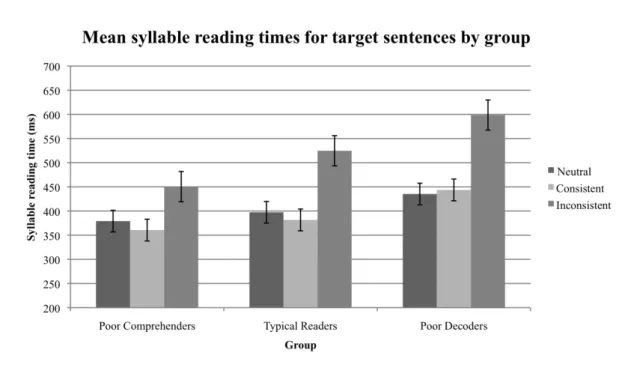
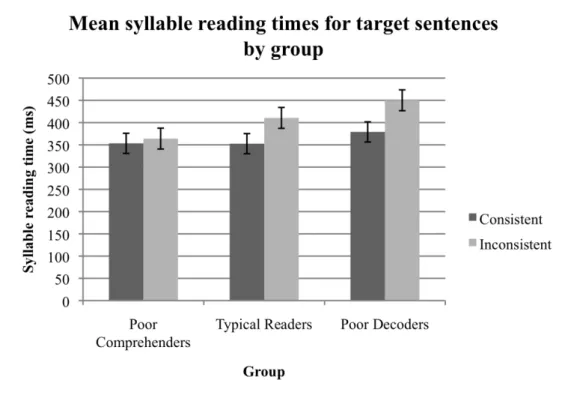
In Experiments 1, 2, 3 and 4 a self-paced reading paradigm was employed to assess on-line inference generation. Reading times to target sentences that were consistent and inconsistent with inferred context were compared. Experiments 1 and 2 showed that children made inferences about fictional characters’ emotion-states and spatial inferences on-line, indexed by increased reading times to inconsistent target sentences. Results indicated that poor
comprehenders made fewer inferences on-line than either typical readers or poor decoders.
In Experiment 3, participants generated inferences based on early-acquired general knowledge on-line but not inferences based on later-acquired knowledge. This was replicated in
Experiment 4 for early-acquired knowledge, however only poor comprehenders failed to generate inferences on-line using later-acquired knowledge. There was evidence of carry-over in post-target sentences, which was less pronounced in poor comprehenders.
In Experiment 5, a self-paced listening paradigm showed that poor comprehenders generated fewer on-line inferences than typical readers did when processing spoken language, but contrary to prediction so did poor decoders.
In Experiment 6, children read short vignettes followed by a question. They then evaluated four answers varying in plausibility. Poor comprehenders were equally accurate but responded faster than either poor decoders or typical readers. This was consistent with the view that poor comprehenders apply a lower standard for coherence when processing language.
Together, the results support the view that decoding and linguistic comprehension dissociate, as predicted by the Simple View of Reading. These results contribute further evidence, using an on-line measure, that poor comprehenders generate fewer inferences than typical readers or poor decoders, and suggest this may be driven by the application of a lower standard for coherence when comprehending written or spoken language.
Table of Contents
Abstract i
Table of Contents ii
List of Tables viii
List of Figures x
Acknowledgments xi
CHAPTER 1 1
Reading and Comprehension
1.1 What is Successful Reading Comprehension? 1 1.2 Components of Successful Reading Comprehension 3
1.2.1 Basic Skills 3
1.2.1.1 Decoding and Word Recognition Skills 3
1.2.1.2 Listening Comprehension 5
1.2.1.3 Vocabulary 5
1.2.1.4 Suppression 7
1.2.1.5 Working Memory 7
1.2.2 Higher Level Comprehension Skills 11
1.2.2.1 Understanding Story Structure 11
1.2.2.2 Comprehension Monitoring 12
1.2.2.3 Inference Generation 13
1.2.3 Moderating Influences on the Process of Comprehension 15
1.2.3.1 Exposure to Print 15
1.2.3.2 Domain Knowledge 16
1.2.3.3 Other Moderating Influences 16
1.2.4 Summary 17
1.3 Reading and Comprehension Difficulties: The Simple View 17 1.4 Children with Poor Comprehension Skills 20 1.4.1 General Cognitive Ability in Poor Comprehenders 21
1.4.2 Vocabulary in Poor Comprehenders 22
1.4.5 Poor Comprehenders’ Understanding of Story Structure 29 1.4.6 Comprehension Monitoring in Poor Comprehenders 29 1.4.7 Identification of a core deficit in Poor Comprehenders 31 1.5 Inference Generation and Reading Comprehension 33
1.5.1 Classification of Inference Types 34
1.5.2 Measurement of Inference Generation 35
1.5.2.1 Off-line Measures of Inference Generation 35 1.5.2.2 On-line Measures of Inference Generation 36 1.5.3 The Time Course of Inference Generation 37
1.5.4 Summary 39
1.6 Children’s Inference Generation 40
1.6.1 Inference Generation in Poor Comprehenders 41
1.6.2 Summary 44
1.7 Aims of this thesis 45
CHAPTER 2 47
Reading Disability and Children’s On-line Generation of Emotion-state and Spatial Inferences
2.1 Introduction 47
2.2 Experiment 1 Method 53
2.2.1 Materials 53
2.2.1.1 Experimental Stories 53
2.2.1.2 Comprehension Questions 56
2.2.1.3 Standardised Tests of Reading and Language Ability 58
2.2.2 Design 60
2.2.3 Participants 61
2.2.4 Procedure 64
2.3 Results 65
2.3.1 Comprehension Questions 65
2.3.2 Reading Times to Target Sentences 67
2.4 Discussion 70
2.6.1 Design 73 2.6.2 Materials 73 2.6.2.1 Experimental Stories 73 2.6.2.2 Comprehension Questions 75 2.6.3 Participants 76 2.6.4 Procedure 79 2.7 Results 79 2.7.1 Comprehension Questions 79
2.7.2 Reading Times to Target Sentences 81
2.8 Discussion 84
2.9 Summary and Conclusion 85
CHAPTER 3 88
Knowledge Integration and On-line Inference Generation
3.1 Introduction 88 3.2 Experiment 3 Method 91 3.2.1 Design 92 3.2.2 Materials 92 3.2.2.1 Experimental stories 92 3.2.2.2 Comprehension Questions 94
3.2.2.3 Standardised Tests of Reading and Language Ability 95
3.2.3 Participants 96
3.2.4 Procedure 99
3.3 Results 99
3.3.1 Comprehension Questions 99
3.3.2 Reading Times to Target Sentences 102
3.4 Discussion 104 3.5 Experiment 4 106 3.5.1 Introduction 106 3.6 Experiment 4 Method 107 3.6.1 Design 107 3.6.2 Materials 108
3.6.2.2 Comprehension Questions 110 3.6.2.3 Standardised Tests of Reading and Language Ability 110
3.6.3 Participants 112
3.6.4 Procedure 115
3.7 Results 116
3.7.1 Comprehension Questions 116
3.7.2 Reading Times to Target Sentences 118
3.7.2.1 Syllable Reading Times 118
3.7.2.2 Inhibition Scores 119
3.7.3 Reading Times to Post-target Sentences 120
3.7.3.1 Syllable Reading Times 120
3.7.3.2 Inhibition Scores 121
3.8 Discussion 122
3.9 Summary and Conclusion 125
CHAPTER 4 126
The On-line Generation of Emotion-State and Spatial Inferences in the Auditory Modality
4.1 Introduction 126 4.2 Method 127 4.2.1 Design 127 4.2.2 Materials 128 4.2.2.1 Experimental stories 128 4.2.2.2 Comprehension Questions 129
4.2.2.3 Standardised Tests of Reading and Language Ability 129
4.2.3 Participants 130
4.2.4 Procedure 133
4.3 Results 134
4.3.1 Comprehension Questions 134
4.3.2 Listening Times to Target Sentences 137
CHAPTER 5 144 Reading Disability, Passage Coherence and Sensitivity to
Context
5.1 Introduction 144
5.1.1 Standard for Coherence and Inference Generation 144 5.1.2 Comprehension Monitoring and Standard for Coherence 147 5.1.3 Understanding Story Structure and Standard for Coherence 147
5.1.4 Rationale for Experiment 6 147
5.2 Experiment 6 Method 149 5.2.1 Design 149 5.2.2 Materials 150 5.2.2.1 Item Generation 150 5.2.2.2 Experimental Scenarios 150 5.2.3 Participants 152 5.2.4 Procedure 155 5.3 Results 156 5.3.1 Yes responses 156 5.3.2 Response Times 158
5.3.3 Response Times to Uncertain Answers 159
5.4 Discussion 161
CHAPTER 6 165
General Discussion
6.1 The Simple View and Experimental Findings 165
6.1.1 Overview of Findings 168
6.1.2 Theoretical Context 173
6.2 Differences Between Off-Line and On-Line Processes 174 6.2.1 Individual Differences and the Development of Comprehension 175 Difficulties
6.2.2 Decoding Difficulties 178
6.3 Implications 179
6.4 Limitations 182
6.5 Suggestions for Further Research 184
6.6 Conclusions 186
References 188
Appendices
Appendix 1 – Experiment 1 Test Materials 206
Appendix 2 – Experiment 2 Test Materials 217
Appendix 3 – Experiment 3 Test Materials 226
Appendix 4 – Experiment 4 Test Materials 236
List of Tables
Page
Table 1.1 Developmental sequence of inference types in narrative 41 comprehension
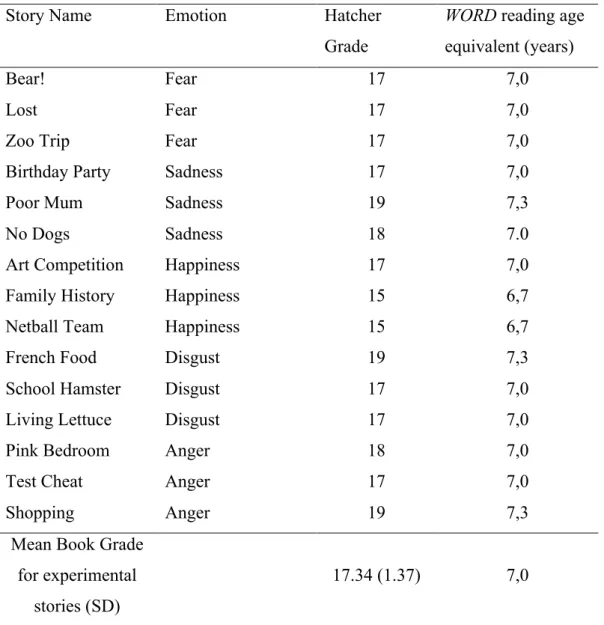
Table 2.1 Hatcher grading and WORD reading age equivalents for 54 experimental stories
Table 2.2 Reasons for participant withdrawals from study 62 Table 2.3 Characteristics of participants by group 63 Table 2.4 Means (and Standard Deviations) of scores to responses to 66
questions asked at the end of each story
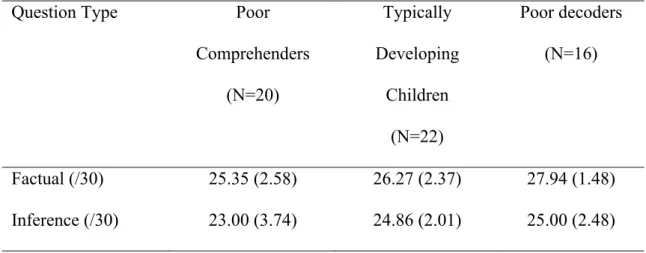
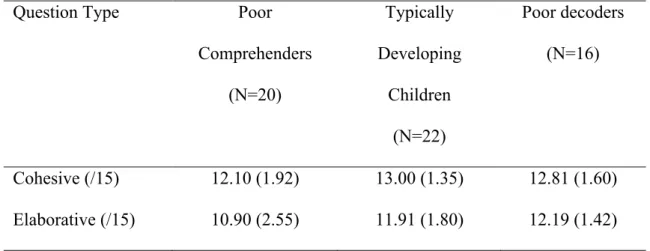
Table 2.5 Means (and Standard Deviations) of scores to responses to 67 inferential questions asked at the end of each story
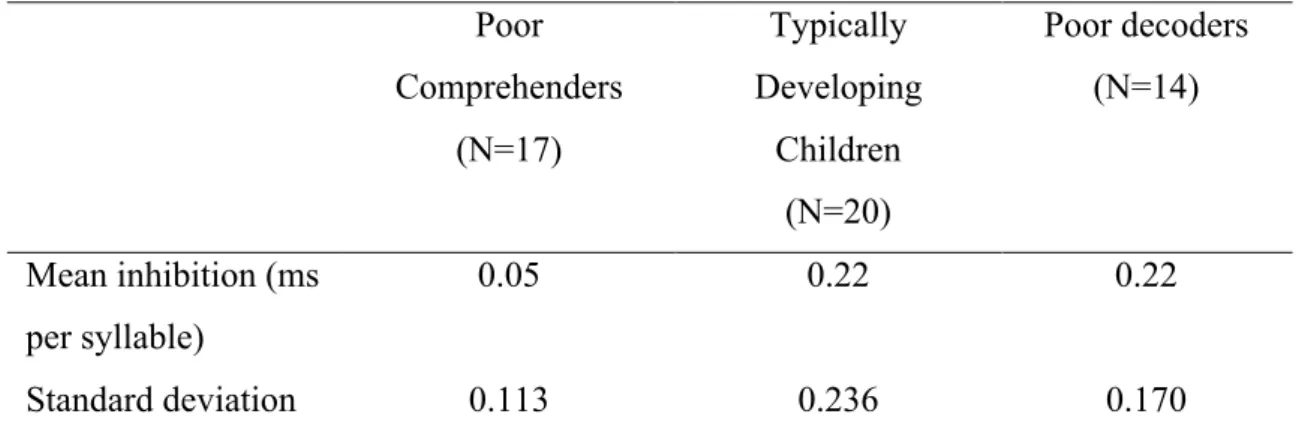
Table 2.6 Comparison of inhibition in syllable reading times by group 70 Table 2.7 Hatcher grading and WORD reading age equivalents for 75
experimental stories
Table 2.8 Characteristics of participants by group 77 Table 2.9 Means (and Standard Deviations) of scores to responses to 80
questions asked at the end of each story
Table 2.10 Means (and Standard Deviations) of scores to responses to 81 inferential questions asked at the end of each story
Table 2.11 Comparison of inhibition in syllable reading times by group 83 Table 3.1 Hatcher grading and WORD reading age equivalents for 94
experimental stories
Table 3.2 Characteristics of participants by group 97 Table 3.3 Means (and Standard Deviations) of scores to responses to 100
questions asked at the end of each story
Table 3.4 Means (and Standard Deviations) of scores to responses to 101 inferential questions asked at the end of each story
Table 3.5 Comparison of inhibition in syllable reading times by group 104 Table 3.6 Hatcher grading and WORD reading age equivalents for 109
extended experimental stories
Table 3.8 Means (and Standard Deviations) of scores to responses to 116 questions asked at the end of each story
Table 3.9 Means (and Standard Deviations) of scores to responses to 117 inferential questions asked at the end of each story
Table 3.10 Comparison of inhibition in syllable reading times by group 119 Table 3.11 Comparison of inhibition in syllable reading times by group 121 Table 4.1 Characteristics of participants by group 131 Table 4.2 Means (and Standard Deviations) of scores to responses to 135
questions asked at the end of each story.
Table 4.3 Means (and Standard Deviations) of scores to responses to 136 inferential questions asked at the end of each story
Table 5.1 Example scenarios with question and possible responses 151 Table 5.2 Characteristics of participants by group 153
List of Figures
Page
Figure 1.1 Classification of reading disorders based upon the Simple 19 View of Reading
Figure 2.1 Mean syllable reading speeds to target sentences in 68 milliseconds
Figure 2.2 Mean syllable reading speeds to target sentences in 82 milliseconds
Figure 3.1 Mean syllable reading speeds to target sentences in 102 milliseconds
Figure 3.2 Mean syllable reading speeds to target sentences in 118 milliseconds
Figure 3.3 Mean syllable-reading speeds to three post-target sentences 120 in milliseconds
Figure 4.1 Mean listening times to target sentences minus time taken 138 for the audio to play in milliseconds
Figure 5.1 Percentage ‘yes’ responses for each answer type by group 157 Figure 5.2 Mean response times in milliseconds to each answer type as 158
a function of group
Figure 5.3 Reaction times of responses to uncertain answers by 160 valence of response
Acknowledgments.
I would like to thank a number of people that have helped me over the years spent working towards my PhD. First and foremost I would like to thank Steve, for his support, tolerance and for always believing in me when I have doubted myself. Without his patience, encouragement, and at times powers of persuasion, I would not have completed this thesis.
I would also like to thank my supervisor, Maggie Snowling, for helping, guiding and supporting me. I feel very privileged to have worked with her. I would also like to thank Claudine Crane and Andy Young for their help and guidance. I would like to thank the ESRC for choosing to fund my research.
I am indebted to all of the wonderful children who took part in this research, and the staff of the schools I have worked in who made me feel so welcome during my time there. Thanks are also due to Pamela Baylis for helping me to screen
participants, and to Paula Clarke and Emma Truelove from the ReadME project. I would also like to thank Michelle St. Clair, Sophie Brigstocke and everyone at the CRL who has shown me friendship and support.
Huge thanks are also due to Lindsey Holroyd, for making coming back to work after maternity leave so much less stressful than I expected. Knowing that Malachi is happy while I’m working has made a huge difference.
Finally, I would like to dedicate this thesis to my son Malachi, who came along half way through my studies, and helped me to remember that life does not revolve around working all hours and studying for a PhD.
CHAPTER 1
Reading and Comprehension
1.1 What is Successful Reading Comprehension?
There is much more to reading than decoding printed words. Obtaining a full and coherent understanding of a text requires readers to extract meaning from words in the context of sentences and paragraphs, to integrate it with prior knowledge of the world and to elaborate upon the explicit information given. Only when all of these things are achieved can reading be said to be truly successful.
Caccamise and Snyder (2005) define a good reader as “one who reads with deep understanding, as demonstrated by such things as the ability to abstract, apply or generalize the information in the text”. Perfetti, Landi and Oakhill (2007) observe that the ultimate goal in the acquisition of reading comprehension is the ability to understand written text as well as one understands spoken language.
According to van Dijk and Kintsch (1983), three levels of complex processes are involved in successfully comprehending a text. The first of these is described as the linguistic level, which involves word decoding and recognition, and this is an absolute prerequisite for reading comprehension (Kintsch, 1998). At the second text base level, the reader begins to unravel the meaning within the text by extracting its explicit meaning. Meaning units or propositions are merged to form the locally coherent microstructure, and this microstructure is further organised into key topics or themes forming a globally coherent macrostructure (Kintsch & Rawson, 2007). This stage may necessitate the generation of some coherence inferences, in order to resolve pronouns and anaphora (Kintsch, 1998). At the third and final level is the situation model. This is a dynamic mental representation constructed from the meaning elicited from the text as reading proceeds, plus any prior knowledge that is activated and
integrated with it at any stage in the reading process. According to Kintsch, successful reading comprehension can be equated to the successful construction of a rich and elaborate situation model (Kintsch, 1998; van Dijk and Kintsch, 1983).
Gernsbacher (1990, 1995) proposed that construction of the situation model operates via a dynamic Structure Building Framework in which a core infrastructure is constructed, and new propositions encountered are mapped onto these foundations. If they are coherent with previously integrated information, they are mapped onto the existing structure, if this is not plausible then an additional branch or substructure is added. According to this view, a mental representation is analogous to the
construction of a mind-map (e.g. Buzan, 1974) with ideas linked onto a main topic, and projections added to represent the incorporation of new ideas.
If Kintsch’s view of successful reading comprehension is adopted (Kintsch, 1998), complex processes at the text, sentence and word levels are implicated, involving the generation of inferences. A level of prior knowledge is required to enable the generation of elaborative inferences and also for some additional coherence inferences to be made during reading. Previous experience will determine the precise content of this knowledge base, which includes a diverse selection of information about concepts such as spatial and temporal relations, object properties, knowledge of cause and effect in relation to events or actions, and plans that motivate a person’s actions or emotions (Graesser, Millis and Zwaan, 1997). It is important too that readers know how and when to perform inferential and integrative processes when reading a text (van Dijk and Kintsch, 1983). An understanding of text structure and comprehension monitoring skill is also critical at this higher-level stage in the comprehension process (Cain, Oakhill and Bryant, 2004).
From the outline above, it is clear that reading comprehension is a complex process that involves co-ordination of many skills, and impairment in any one of these has the potential to impact on successful comprehension. The development and integration of these component skills depends upon the adequate development of a range of genetically and environmentally determined cognitive abilities.
1.2 Components of Successful Reading Comprehension 1.2.1 Basic Skills
Basic skills and resources implicated in reading comprehension are word recognition, vocabulary, listening comprehension, suppression of irrelevant information, and working memory. These feed into higher-level skills such as
comprehension monitoring, inference generation and understanding of story structure. Ultimately, integration of these component skills, each dependent on factors such as motivation, attention, domain knowledge and reading goals, will determine the level of comprehension achieved. In the sections that follow, the relationship between reading comprehension and component skills will be discussed.
1.2.1.1 Decoding and Word Recognition Skills
The ability to decode and identify words is a necessary but not sufficient prerequisite for successful reading comprehension (Perfetti, Landi & Oakhill, 2007). Gough, Hoover and Peterson (1996) describe an elegant illustration of how decoding can proceed without comprehension. They tell the story of how John Milton taught his daughters to read Greek and Latin classics to him, to compensate for his failing sight, yet despite being able to read the words, the girls did not understand Greek or Latin.
However, it is clear that comprehension will be inhibited if decoding is laboured or inaccurate (Snyder, Caccamise & Wise, 2005). In beginning readers,
word decoding is a significant impediment to reading comprehension, and children’s spoken language comprehension naturally exceeds their written language
comprehension. In a study by Curtis (1980) it was found that the correlation between scores obtained in tests of reading and listening comprehension was considerably lower (0.50) in 7 to 8 year old children than it was in 8-10 year old children (0.75), reflecting how decoding limits reading comprehension in early reading. By the age of 9-10 years (fourth grade), it has been reported that readers’ emphasis is more focused upon extracting information from text, than on decoding the words (Keenan et al, 2006). Similarly Willson and Rupley (1997), and Rupley, Willson and Nichols (1998) observed that the contribution of decoding to variance in reading comprehension decreases with age. In their longitudinal study, Catts, Hogan and Adlof (2005) report a subgroup of ‘late emerging poor readers’ who show reading problems around the fourth grade, perhaps when extracting meaning from the text becomes more demanding, and children tackle more difficult texts.
Perfetti (1985) proposed that decoding bottlenecks are the proximal cause of poor reading comprehension. However, contradictory to this, there is an abundance of evidence demonstrating that decoding and comprehension skills can dissociate, and that comprehension skill can fall behind relative to word identification skill (e.g. Yuill & Oakhill, 1991; Nation & Snowling, 1997, 1998a, 1998b; Catts, Hogan & Adlof, 2005).
It could be argued, however, that results of tests of reading accuracy do not give any indication of the proportion of processing capacity allocated to word recognition (Cain & Oakhill, 2006b; Perfetti, 1985). Even though reading may be accurate, it is plausible that poor comprehenders may recognize words more slowly or effortfully, and may therefore have reduced processing capacity in reserve for
comprehension. However, this seems unlikely, given that poor comprehenders achieve equivalent scores to typical readers on tests that include a fluency measure (e.g. Cain, Oakhill & Bryant, 2000; Stothard & Hulme, 1995).
1.2.1.2 Listening Comprehension
As decoding ability improves, listening and reading comprehension become increasingly highly correlated (Curtis, 1980) until an asymptotic level is reached where listening and reading comprehension are at broadly similar levels (Gernsbacher, 1990). Support for this is provided by Adlof, Catts, Hogan and Little (2005) who, based on a longitudinal study of 604 typically developing second grade readers, showed that word recognition as measured by tests of single word reading and narrative reading, accounts for most of the variance in reading comprehension. By eighth grade, reading comprehension and listening comprehension in the same children were indistinguishable. In a study of young adult readers, Gernsbacher (1990) reported correlations of 0.90 between reading comprehension and listening comprehension.
The advancement of reading comprehension skill is constrained by a child’s level of spoken language comprehension. In typical readers, once word recognition is relatively automatized, listening comprehension and reading comprehension levels are positively correlated (de Jong & van der Leij, 2002). However, children with poor word identification skills usually perform at normal levels in tests of listening comprehension, which does not predict reading comprehension in this group (Curtis, 1980).
1.2.1.3 Vocabulary
Converging evidence strongly suggests that vocabulary size accounts for a significant proportion of variance in comprehension skill (Seigneuric, Ehrlich, Oakhill
& Yuill, 2000; Rosenshine, 1980). Cunningham and Stanovich (1997) showed that level of receptive vocabulary in first grade had far reaching effects, and remained a modest but significant predictor of reading comprehension in 11th Grade. In another study, kindergarten children’s receptive vocabulary was shown to predict reading comprehension in fourth and seventh grades (Snow, Tabors & Dickenson, 2001). Longitudinal work suggests that the influence of vocabulary on reading
comprehension increases as the contribution made by word recognition diminishes over time in developing readers (e.g. Rupley, Willson & Nichols, 1998).
Vocabulary training has been shown to have a positive effect that generalises to reading comprehension (e.g. Beck, Perfetti and McKeown, 1982; Kameenui, Carnine & Freschi, 1982; McKeown, Beck, Omanson & Perfetti, 1983), however in some interventions, only vocabulary-specific improvements are observed (Mezynski, 1983; Pany, Jenkins & Schrek, 1982). Nagy (1988) suggests two reasons why vocabulary training may fail to boost reading comprehension; firstly, the training may not provide sufficient elaboration to facilitate new word learning in context, and secondly, the training may focus on words that are not critical to overall passage comprehension (Nagy, Anderson & Herman, 1987; Freebody & Anderson, 1983). It is plausible that when vocabulary training does impact on comprehension, the training involves work on higher-level comprehension skills such as inference generation and comprehension monitoring, suggesting that the link between vocabulary and reading comprehension may be an indirect one. For example, in a training study, Nash and Snowling (2006) found that in children with poor language skills, comprehension was boosted by a vocabulary intervention that taught the use of semantic mapping as a technique for inferring meaning from context. Similar gains in comprehension were not observed in a comparison group who were simply taught definitions of the same words.
Exposure to print is an important predictor of vocabulary expansion in
developing readers (Nagy & Anderson, 1984). A child with an unremediated reading difficulty is likely to read less, with Matthew effects leading to further deterioration in vocabulary relative to peers. In line with this, Stanovich (1993) found that high exposure to print was associated with better vocabulary knowledge in children with poor comprehension skills. Interestingly, Stanovich (1993) also showed that higher comprehension skills in the presence of low exposure to print were associated with high cognitive ability, suggesting that children with higher IQ are better able to compensate for less than ideal conditions when comprehension skills are developing, and that exposure to print and the resulting increase in vocabulary size may mediate the effects of low cognitive ability on comprehension.
1.2.1.4 Suppression
According to Gernsbacher and Faust (1991), the ability to suppress the activation of irrelevant information is an important component of comprehension. During reading, activation occurs to all plausible meanings of words encountered in text, and the reader has to use evidence from context or syntax to narrow these down in order to identify the appropriate meaning. Gernsbacher and Faust found that speed of suppression of activation of inappropriate homophones was related to
comprehension skill.
1.2.1.5 Working Memory
Integration and storage of incoming text are key activities performed during text comprehension. These processes are likely to place demands on working memory, however the precise nature of the relationship between memory skills and comprehension has yet to be specified. Working memory has been shown to correlate positively with reading comprehension level at a variety of ages in developing readers
(Cain, Oakhill & Bryant, 2004; Seigneuric, Ehrlich, Oakhill & Yuill, 2000; Leather & Henry, 1994).
Kintsch and Kintsch (2005) suggest that working memory is important for comprehension because it determines the number of connections a reader is able to make between concepts presented in a text. If two concepts presented cannot be held in working memory at the same time, they suggest that new links between them cannot be formed and that this limits the development of the situation model and textbase. Supportive evidence for this is provided by Yuill, Oakhill and Parkin (1989) who found that poor comprehenders were less able than controls to use resolving information to solve an anomaly in a passage if the resolving information was further away from the anomaly in the text. Similarly, if inconsistencies are further apart in a text and higher demands are therefore placed on working memory, poor comprehenders are less likely to detect them than controls (Oakhill, Hartt & Samols, 2005).
Ericsson and Kintsch (1995) propose that richer and more elaborate situation models enable the formation of retrieval structures that tap into long-term memory and facilitate integration of incoming information with the existing knowledge base. Thus, if poor working memory limits the formation of connections between premises within a text, it effectively exerts a cumulative effect on comprehension – less elaborate situation models are less formed, and this reduces the number of retrieval structures available for knowledge integration, which in turn limits comprehension of further incoming text. In line with this idea, Oakhill, Cain and Yuill (1998) suggest that working memory limitations may result in an inability to build complete situation models, and thereby limit readers to the integration of local text only. Available
working memory resources may be taken up with lower level text processing such as word identification and syntactic processing (Oakhill, Cain & Yuill, 1998).
Verbal working memory span has been shown to correlate positively with reading comprehension skill (Daneman & Carpenter, 1980) and inferencing skills (Singer, Halldorson, Lear & Andrusiak, 1992). Swanson and Berninger (1995) established that participants with good comprehension skills performed better on a battery of verbal working memory tasks including story retelling, auditory digit sequencing, sentence span and phrase sequencing. They also demonstrated that working memory differences linked to comprehension levels were specific to the verbal domain and that comprehension skills were not linked to differences in phonological short-term memory. In support of this, a number of studies report that verbal working memory is a better predictor of reading comprehension than other components of working memory (Cain, Oakhill & Bryant, 2004; Cataldo & Oakhill, 2000; Nation, Adams, Bowyer-Crane & Snowling, 1999).
Although evidence cited so far seems to indicate that working memory and comprehension ability are positively related, there are a number of studies that cast doubt on this conclusion. Some studies failed to find a relationship between
comprehension skill and performance in tests of digit span, sentence recall and serial recall (Oakhill, Yuill & Parkin, 1986; Stothard & Hulme, 1992). Furthermore, word length and lexicality effects in serial recall were not found to relate to comprehension level (Nation et al, 1999).
A distinction may need to be made between working memory capacity and working memory efficiency, and it has been suggested that comprehension is only predicted by tasks that require information to be stored and processed simultaneously (Cain, Oakhill & Bryant, 2004; Cain, Oakhill & Lemmon, 2004). Furthermore, it is
also likely that the relationship between working memory and comprehension changes over time, and that this may explain some of the contradictory evidence. In a three-year longitudinal study of comprehension development in 74 French children, Seigneuric and Ehrlich (2005) found that as the importance of word recognition diminished, the contribution of working memory capacity (measured via an adapted listening span task) increased.
It has been suggested that links between comprehension skill and performance in some verbal working memory tasks can be better explained by underlying verbal and specifically semantic skills (e.g. Nation, 2005, Nation et al, 1999; Nation & Snowling, 1998a). In a study exploring predictors of reading comprehension in 180 mixed ability children aged between 9 and 11 years, Goff, Pratt and Ong (2005) showed that language variables accounted for a higher proportion of variance in reading comprehension than memory variables. Orthographic processing measured via a test of irregular word reading accounted for 36% variance in reading
comprehension after age and IQ were controlled.
In support of this, Nation and Snowling (2004) recently explored the relationship between reading comprehension and language skills in a longitudinal study of 72 typical readers. A series of hierarchical regression analyses showed that semantic skills, listening comprehension and vocabulary at age 8.5 predicted unique variance in reading comprehension at age 13 after age, nonverbal ability, nonword reading and phonological skill had been controlled. They also found that these
language variables accounted concurrently for a large proportion of unique variance in reading comprehension skill at age 8.5.
In conclusion, the evidence to date does not clearly specify the relationship between working memory and comprehension skill. Some involvement of working
memory is evident, however the precise mechanism by which it is involved in reading comprehension remains unclear. There is considerable debate over whether deficits in working memory task performance are artefacts of difficulties with the language manipulations involved in performing such tasks.
1.2.2 Higher Level Comprehension Skills
In addition to the basic abilities outlined above, comprehension also involves applying an understanding of story structure, comprehension monitoring, and inference
generation.
1.2.2.1 Understanding Story Structure
Children are quickly conditioned to basic conventions about stories, such as the understanding that stories usually have a title, an introduction, and an ending (Perfetti, Landi & Oakhill, 2007). Most children, before reaching the age of three, become familiar with the format of stories told to them by caregivers. Typically a name for the story is provided, and then storytelling begins with standard openings such as ‘once upon a time…’ and ends with something like ‘and they lived happily ever after’. On reaching school age, most children are sensitive to these and more subtle aspects of story structure. As literacy is acquired, reading experience also adds to the development of this understanding (Perfetti, 1994).
Using story-telling tasks, Cain (2003) and Cain & Oakhill (1996) showed that comprehension skills were positively related to production of coherent stories that followed typical structural conventions. Typically, less able comprehenders produced stories that contained fewer linguistic features that enabled concepts to be integrated smoothly.
Training in story structure understanding has been shown to boost reading comprehension (Yuill & Joscelyne, 1988; Gordon & Braun, 1985) and in Yuill and
Joscelyne’s (1988) second experiment, improvements in comprehension following training were specific to poor comprehenders, implying that the prerequisite knowledge was already activated by typical readers.
1.2.2.2 Comprehension Monitoring
Periodically when reading text, competent readers check whether the incoming information fits with their current representation of the situation. When an
inconsistency is detected, they use a range of strategies to achieve some sort of resolution of the anomaly. There may be different outcomes that the reader settles upon following a process of reanalysis. Possibilities include development of a satisfactory explanation that can be integrated with the mental representation and will account for the anomaly; acceptance of the anomaly as some sort of error in the text; identification and reparation of a previous reading or comprehension error, or decision to ignore the anomaly or put it to one side in the expectation that some explanation will follow. Reading behaviours that typically reflect effective comprehension monitoring include repetitions, slowing of reading, hesitations and self-corrections (Paris & Myers, 1981). Studies of comprehension monitoring typically employ error detection tasks, and manipulate factors such as error placement, type, and presence and/or position of resolving information. The proficiency and frequency of
comprehension monitoring behaviours has been shown to vary widely both within and between individuals, and has been linked to overall reading comprehension
performance (Oakhill, Hartt & Samols, 2005; Zinar, 2000; Yuill, Oakhill & Parkin, 1989) and word identification skills (Hacker, 1997; Paris & Myers, 1981). Levels of comprehension monitoring are positively related to overall comprehension skill (Cain, Oakhill & Bryant, 2004).
A number of explanations have been posited for reduced accuracy or frequency of comprehension monitoring behaviours, including working memory deficits,
difficulties with word identification, lack of awareness of the need to engage in comprehension monitoring, lack of motivation to read for meaning (deSousa & Oakhill, 1996), and acceptance of a low standard of coherence. It is possible that poor comprehension monitoring shares a reciprocal relationship with inference generation; in short a reader may fail to detect inconsistencies because they do not generate inferences that enable their identification.
1.2.2.3 Inference Generation
Inference generation lies at the very core of successful reading comprehension. If text were read without drawing any inferences, understanding would be extremely limited. For example take the passage:
“Jake was in the garden. As he sat underneath the apple tree a bird flew onto the lawn. He crept up on it stealthily. After a few seconds, he pounced. The bell on his collar warned the blackbird and it flew away just in time!” In order for the events in this passage to make sense it is necessary to infer information not explicitly stated in the passage. To do this the reader needs to exploit prior knowledge of language conventions and the domain of interest (Kintsch & Rawson, 2007). For a rich understanding of this passage, information such as Jake was a cat, therefore he wanted to catch the bird, that the bird on the lawn was the blackbird that flew away, that Jake ran onto the lawn, and that the bell made a noise when Jake moved fast so that the bird was alerted, would need to be inferred. In terms of understanding who did what to whom, the reader would need to recognize that the 3rd person pronouns he/his refer to Jake, and that “it” refers to the blackbird. This example shows how fundamental inferences are to understanding even short and
basic texts. It also highlights the range of task demands required for the construction of different inferences.
There is considerable debate as to which inference types individuals habitually generate on-line, or automatically during reading. On-line inferences are considered to be made contemporaneously as reading proceeds, whereas off-line inferences are thought to be more strategic, and are constructed retrospectively after a sentence or paragraph has been read. Thus, inferences made on- and off-line differ in terms of their time course, and the extent to which they are automatic or more strategically driven.
Kintsch (1998) has suggested that the majority of inferences are generated during the construction of the situation model. If meaning cannot be extracted from the text without anaphor and pronoun resolution, then these inferences are made at the textbase level. Graesser and Zwaan (1995) propose that only a proportion of
inferences are actually made during reading. Gernsbacher (1990, 1995) suggests that rather than a simple off-line versus on-line distinction; levels of activation generated during processing of incoming text may determine the off-line or on-line status of particular inference types.
There exists a range of theoretical positions from which predictions can be made about whether particular inference types are generated on-line. Two leading theoretical positions from which such predictions can be made are the minimalist view and the constructionist view. Supporters of the minimalist view proposed by McKoon and Ratcliff (1992) suggest that only inferences required for the maintenance of local coherence are made automatically on-line. Further inference generation is driven by readers’ strategies or goals. This view is difficult to disprove, given that one of the tenets of this theory is that the proportion of inferences generated would vary
according to the circumstances. The constructionist position (Graesser, Singer & Trabasso, 1994) postulates that readers make all the inferences they can automatically on-line, with the aim of building a deep and enriched situation model of the text. In the constructionist view, readers strive to maintain both global and local coherence.
The relationship between inference generation and reading comprehension is complex. Overall, there is convincing evidence that poor inferential skills are linked to comprehension failure (e.g. Yuill & Oakhill, 1991). Studies have shown individual differences in the frequency of inference generation, and in whether particular
inference types are generated on- or off-line, and these will be discussed later in this review.
1.2.3 Moderating Influences on the Process of Comprehension 1.2.3.1 Exposure to Print
Perfetti (1994) has suggested that low print exposure may be related in a cumulative fashion to comprehension skill. Initially, low print exposure may result in impoverished understanding of story structure and convention, which in turn may affect comprehension. If comprehension is poor then reading becomes less rewarding, and therefore a child will read less widely. It is clear that some variance in word recognition skills can be accounted for by levels of exposure to print (Cunningham & Stanovich, 1998). However the evidence for a relationship between exposure to print and reading comprehension level is equivocal, particularly in the early stages of learning to read. Cain, Oakhill and Bryant (2000) compared performance of 7-8 year old poor comprehenders, typical readers matched on reading age and younger
comprehension-age matched controls on an author recognition task. They found no differences between the skilled and less skilled group in their recognition of children’s authors’ names. The younger comprehension-age matched group had marginally
lower scores in this test, indicating that they had not had greater exposure to print than the older poor comprehenders.
Although these results seem to indicate that the poor comprehenders did not have lower print exposure, data from older children is suggestive of a relationship between exposure to print and development of reading comprehension. Stanovich, West, Cunningham and Cipielewski (1996) found that in an older sample, some variance in reading comprehension was predicted by exposure to print. They
suggested an indirect relationship, such that print exposure mediates development of vocabulary, general knowledge and metalinguistic skills that impact directly on comprehension skill. Goff, Pratt and Ong (2005) provide support for this view. In their study of predictors of reading comprehension skill in 180 children aged 9-11 years, they found that print exposure measured via a children’s book title recognition test made a small unique contribution to variance in reading comprehension.
1.2.3.2 Domain Knowledge
According to Caccamise and Snyder (2005), domain knowledge has a profound effect on an individual’s capability to extract meaning from a text. For example, it would be difficult for someone with no prior knowledge of psychology to read and understand a journal article about models of reading comprehension. Although they may be able to decode the words in the article, it is likely that their vocabulary will not extend to knowing the meaning of specific technical terms, and they will have
difficulty drawing appropriate inferences about the ideas presented. If vocabulary knowledge is adequate then the reader may be able to infer the meaning of unknown words from context, but if too many words are unknown this becomes increasingly difficult. Therefore a comprehension difficulty demonstrated during the reading of a specific text may reflect characteristics of that text rather than a general
comprehension difficulty in the reader. Ultimately, construction of a situation model cannot proceed adequately without a sufficiently elaborate appreciation of the
situation!
1.2.3.3 Other Moderating Influences
There are a number of influences external to the process of comprehension that moderate levels of reading comprehension, such as attention, environmental factors such as background noise and distractions, reading goals, motivation, text type and writing style (Kintsch & Kintsch, 2005; Guthrie & Wigfield, 2005). Together, these factors will influence reading performance, to a greater or lesser extent. These will not be discussed in detail in this review; however, they must be borne in mind as potential explanations for comprehension failure.
1.2.4 Summary
It is clear that reading comprehension is a complex activity requiring the co-ordination of input from different cognitive systems. For effective comprehension, basic decoding, working memory, vocabulary and listening comprehension skills are required, and these facilitate higher level processes such as comprehension
monitoring, inference generation and understanding of story structure. In turn, these processes are moderated by factors such as domain knowledge, strategy use, attention, reading goals, motivation, text type and writing style. Given all of this, it is easy to appreciate why comprehension sometimes fails. In the sections that follow, the relationship between reading difficulty and comprehension difficulty will be explored, followed by a discussion of specific comprehension difficulties in developing readers.
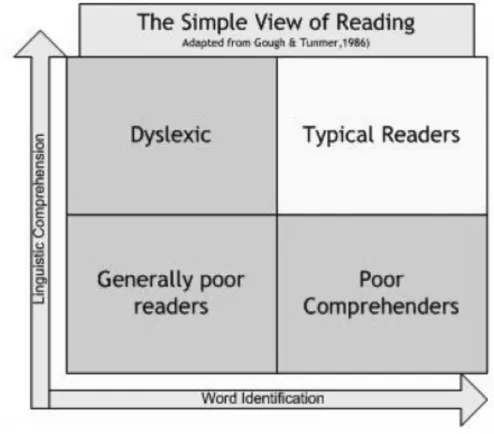
1.3 Reading and Comprehension Difficulties: The Simple View The Simple View of Reading (Hoover & Gough, 1990; Gough & Tunmer, 1986) proposes that reading comprises the product of decoding and linguistic
comprehension, each of which exerts an independent influence on reading comprehension. A multiplicative rather than additive relationship is proposed because reading cannot proceed in the absence of either decoding or linguistic comprehension. Returning to the earlier example of Milton who got his daughters to read Greek and Latin classics to him, he was unable to successfully read and extract meaning from them because his sight precluded any decoding, and his daughters were unable to extract any meaning from them despite adequate decoding, because they had no linguistic comprehension in the relevant languages. Thus, the product takes into account that reading cannot be achieved without some element of both decoding and linguistic comprehension.
The combination of decoding and linguistic comprehension has been shown to account for at least three quarters of the variance observed in reading comprehension skill (Hoover & Gough, 1990). The Simple View is supported by the presence of double dissociations seen in reading-disabled populations. For example, children with dyslexia present with impaired decoding but preserved linguistic comprehension (e.g. Catts & Kamhi, 2005) whereas children with specific comprehension difficulties (poor comprehenders) present with impaired linguistic comprehension with decoding skills intact (e.g. Cain, Oakhill & Bryant, 2000; Stothard & Hulme, 1995).
In a longitudinal investigation of 182 eighth grade readers, Catts, Adlof and Ellis Weismer (2006) compared phonological, language and cognitive abilities of typical readers, poor readers and poor comprehenders. They found that poor
comprehenders’ phonological abilities were normal, but their reading comprehension assessed using three standard assessment instruments was impaired, whereas the opposite profile was seen in the poor readers. Retrospective analysis of their
grades showed that this dissociation was apparent at all time points. Thus,
longitudinal evidence provides support for classifying reading disorders based upon the Simple View, (see Figure 1)
Figure 1.1. Classification of reading disorders based upon the Simple View of Reading
Behaviour genetic work provides further support for the Simple View of Reading. Keenan, Betjemann, Wadsworth, DeFries and Olson (2006) explored the genetic influences on composite measures of reading and listening comprehension. They measured reading comprehension and listening comprehension in 70
monozygotic and 121 dizygotic twin pairs. Analysis using Cholesky decomposition showed that genes had a strong independent influence on word recognition and listening comprehension. Both of these genetic components were found to exert independent influence on reading comprehension, and, crucially, they accounted for
all the genetic influence on reading comprehension skills. These results support phenotypic observations of comprehension difficulties that exist in the absence of word recognition difficulties. However, it must be remembered that genetic predispositions are modulated by environmental influences.
In summary, converging evidence supports the Simple View of Reading (Gough and Tunmer, 1986) as a framework for the classification of reading profiles. The studies reported in this thesis adopt this framework in the investigation of how the generation of different types of inference during reading may be influenced by
decoding and linguistic comprehension.
1.4 Children with Poor Comprehension Skills
According to the Simple View, comprehension difficulty occurs when linguistic comprehension is compromised in the presence of adequate word identification.
In a longitudinal study Catts, Hogan and Adlof (2005) classified poor readers in accordance with the Simple View of Reading. In second grade, 15% fulfilled criteria for specific comprehension difficulties. However by fourth grade, 31% poor readers and 30% eighth grade poor readers were classified as having specific
comprehension difficulty. This did not reflect shifts between classifications of reading disability. The comprehension difficulties were only becoming evident after decoding reached a reasonable level. The transition from ‘learning to read’ to ‘reading to learn’ in later stages of primary education is thought to lead to what is referred to as the “fourth-grade slump” (Chall, 1983; Catts, Hogan & Adlof, 2005). According to Nation (2007), approximately 10% of all children aged 7-10 years have difficulties with linguistic comprehension in the absence of word recognition impairments. Throughout this review such children are referred to as ‘poor comprehenders’.
Given that good comprehension is the product of a wide range of component factors working effectively together, it follows that a deficit in any one of those component factors has the potential to lead to comprehension failure. In general, poor comprehenders perform poorly on a range of tasks tapping component skills,
indicating impairments that may relate causally, consequentially or incidentally to their comprehension difficulty (Cornoldi, de Beni, & Pazzaglia, 1996).
1.4.1 General Cognitive Ability in Poor Comprehenders
Nation, Clarke and Snowling (2002) explored the relationship between general cognitive ability and comprehension skill. Previous research suggested that poor comprehenders had depressed verbal ability relative to age-matched controls,
(Stothard & Hulme, 1996) and this study replicated this finding in a sample of twenty-five 8-9 year old poor comprehenders. Overall, general cognitive ability was lower in the poor comprehenders, and this was accounted for by differences in verbal ability. Nation et al. also identified a subgroup of poor comprehenders with overall general cognitive ability below the normal range (<85). These children were not so much poor comprehenders as excellent decoders, and their comprehension skills were broadly in line with what their overall ability level would predict.
Across the poor comprehender group, spatial ability was equivalent to that of controls. Observed differences in general cognitive ability were accounted for by lower verbal ability and to a lesser extent lower non-verbal ability. In the average ability poor comprehenders, there was a large difference between verbal and spatial ability (spatial ability typically 13.5 standard score points higher than verbal ability), but in the low ability poor comprehenders the mean difference was smaller (5.4 standard score points difference in favour of spatial ability).
Studies differ with regard to whether they have reported poor verbal ability in poor comprehenders relative to controls matched on non-verbal ability (e.g. Nation, Clarke, Marshall & Durand, 2004; Nation, Snowling & Clarke, 2005; Stothard & Hulme, 1995; cf. Cain and Oakhill (2006a). The picture is complicated because of the varied selection criteria preferred by different investigators. In general, however, the evidence suggests that verbal skills are weaker in poor comprehenders than reading accuracy matched controls, but selection procedures may lead to the recruitment of children with either surprisingly impaired comprehension, or better reading accuracy than one might predict based upon their general ability in the presence of expected levels of comprehension.
1.4.2 Vocabulary in Poor Comprehenders
In a 2-year longitudinal study of 90 typically developing beginning readers, Muter, Hulme, Snowling and Stevenson (2004) found that vocabulary knowledge at age 4 years 9 months was a significant predictor of reading comprehension but not word recognition two years later. Similarly, in samples of older children, vocabulary has been shown to predict a proportion of the variance in reading comprehension (e.g. Cain, Oakhill & Bryant, 2004; Goff, Pratt & Ong, 2005; Seigneuric, Ehrlich, Oakhill & Yuill, 2000). The link between vocabulary and reading comprehension is
complicated because it accounts for variance in both word reading and text comprehension (Cain & Oakhill, 2006a). If one adopts a definition of reading comprehension in accordance with the simple view, this accounts for some of the variance shared between word recognition and linguistic comprehension.
In some studies, poor comprehenders selected based on a discrepancy between their reading accuracy and reading comprehension show average levels of vocabulary (e.g. Nation & Snowling, 1998b), however in other studies vocabulary is found to be
weaker in poor comprehenders than in reading-age matched controls (e.g. Nation, Clarke and Snowling 2002). Notwithstanding this, Yuill and Oakhill (1991) found that children matched on vocabulary and word recognition differed in reading
comprehension performance.
Cain (1994) suggested that vocabulary test selection might be important. In line with this, Daneman (1988) suggested that the relationship between vocabulary and comprehension test results reflect similarities in test requirements in that both measure information acquisition from context.
In order to explore the relationship between vocabulary and reading
comprehension further, Cain, Oakhill and Lemmon (2004) divided 9-10 year old poor comprehenders into two groups depending on their vocabulary test scores. They found that poor comprehenders with weaker vocabulary skills benefited less from direct vocabulary instruction, requiring more repetitions to learn a novel word meaning. In support of this, Nation, Snowling & Clarke (2007) found poor
comprehenders to be as good as chronological age- and decoding-matched controls at learning new phonological forms, but they required more direct instruction to learn their definitions.
Cain, Oakhill and Elbro (2003) found poor comprehenders had greater difficulty learning new words from context, and that this problem was further exacerbated if the words and information required to establish their meaning were separated in the text. Ricketts, Bishop and Nation (2008) found that poor
comprehenders’ ability to map orthographic forms to phonology was unimpaired relative to controls matched on chronological age and decoding ability. However, their semantic learning was impaired, particularly when tested after a delay. Interestingly, contrary to prediction, and despite showing impaired exception word
reading, the poor comprehenders did not show a proportionally greater deficit in orthographic or semantic learning of inconsistent novel word forms.
In summary, the precise relationship between comprehension skill and vocabulary remains to be clarified. Vocabulary is depressed in some groups of poor comprehenders, yet others selected using similar criteria show vocabulary levels equivalent to controls matched on chronological age and decoding ability. Studies of vocabulary acquisition consistently show that poor comprehenders have difficulty building associations between semantic and phonological forms relative to controls. This has been shown when they have been required to infer meanings from context and when they have been explicitly taught new words and their meanings. It is plausible, therefore, that the relationship between vocabulary and reading comprehension is mediated by inferential skills.
1.4.3 Working Memory in Poor Comprehenders
It has been suggested that a selective impairment in verbal working memory could be a common feature of those with difficulties in reading comprehension (Swanson & Berninger, 1995). Yuill, Oakhill and Parkin (1989) proposed a more general working memory impairment, as their sample of poor comprehenders performed more poorly on a counting span task as well as a listening span task. However others have failed to replicate this (Cain & Oakhill, 2006a; Stothard & Hulme, 1995). Cain and Oakhill (2006a) found that 7-8 year old poor comprehenders performed as well as good comprehenders on the counting span task, but performance on a listening span task was impaired.
Nation, Adams, Bowyer-Crane and Snowling (1999) point out that verbal skills are required for reading and recall of the digits, therefore there may be a verbal
selective impairment in verbal working memory in poor comprehenders, in the presence of normal performance on a spatial working memory task. Cataldo and Oakhill (2000) found no impairment in spatial working memory in poor
comprehenders, lending further support to the notion of impairment specific to the verbal domain.
Studies reporting comparisons between good and poor comprehenders on tasks involving anomaly resolution or detection suggest that poor comprehenders are less able to detect or resolve anomalies when they are a distance apart in the text. When they are adjacent to each other, poor comprehenders’ performance is much closer to that of controls (Yuill, Oakhill & Parkin, 1989; Oakhill, Hartt & Samols, 2005).
In summary, there does appear to be agreement in the literature that poor comprehenders do badly in tests of verbal working memory. However, there are three possible explanations for the differences in performance on working memory tasks shown by poor comprehender groups. Firstly, selection protocols using tasks with higher memory load may favour selection of poor comprehenders that perform relatively more poorly on working memory tasks; secondly, comprehension may be inhibited in the presence of poor working memory, and thirdly, as proposed earlier, poor performance in tasks tapping verbal working memory may reflect underlying language difficulties in poor comprehenders (Goff, Pratt & Ong, 2005; Nation et al, 1999).
1.4.4 Language Skills in Poor Comprehenders
Nation, Clarke, Marshall and Durand (2004) found an extensive range of oral language difficulties in a sample of poor comprehenders. They conducted a
comprehensive assessment of reading and language skills in twenty-three poor comprehenders and twenty-two controls matched on chronological age, nonword
reading and non-verbal ability. The children were given tests of phonological processing, semantic processing, morphosyntax, and broader language skills. The poor comprehenders performed as well as controls on phonological tasks, however their performance in all of the language tasks was poorer than that of the controls. In approximately 30% of the poor comprehenders, the language difficulties were
sufficiently severe to warrant a diagnosis of language impairment. Although there was significant overlap between the test scores obtained by these poor comprehenders and those observed in groups with specific language impairment (SLI), Nation et al suggest that there are qualitative differences in errors made by the two groups. For example, in past tense production, poor comprehenders make regularisation errors, whereas children with SLI are more prone to omitting grammatical markers.
Marshall and Nation (2003) found that poor comprehenders performed more poorly than controls on a sentence repetition task. Error analysis revealed a difference in the nature of their errors compared to those made by controls. Poor comprehenders made more errors, but also their errors were not in keeping with the gist of the
passage. Good comprehenders typically reproduced the meaning of the sentence appropriately, even if recall of the words was inaccurate.
In line with this observation, semantic and syntactic deficits have been
observed in poor comprehenders in a series of studies carried out by Nation, Snowling and colleagues (Nation & Snowling, 1998a, 1998b, 1999, 2000). They found that poor comprehenders’ word naming latency was not facilitated by prior context to the same extent as that of controls (Nation & Snowling, 1998b). Furthermore, poor comprehenders showed deficits in semantic priming (e.g. Animal primes Dog), with functional priming (e.g. Shampoo primes Hair) preserved (Nation & Snowling, 1999). In a comparison of phonological and semantic skills, Nation and Snowling (1998a)
showed that poor comprehenders performed normally on a rhyme judgement task, but were poorer than controls in a synonym judgement task.
Nation and Snowling (1998a) also found poor comprehenders to be worse at reading exception and low frequency words, a finding recently replicated by Ricketts, Bishop and Nation (2008). This conforms to predictions that follow logically from the connectionist triangle model of reading developed by Plaut, McClelland, Seidenberg and Patterson (1996). The model suggests that a breakdown in semantic processing would lead to difficulty with the recognition of exception and low frequency words, exactly as Nation and Snowling (1998a) observed. In line with this, Goff, Pratt and Ong (2005) found that irregular word reading measured using a test of exception word reading was the strongest independent predictor of reading comprehension once age and cognitive ability had been controlled.
Thus, the evidence suggests that poor oral language skills are common in poor comprehenders. Returning to the issue of overlap between reading comprehension difficulties and SLI, it is important to note that a child’s profile of reading and
language ability may change over time. A series of longitudinal studies by Bishop and colleagues following the progress of 87 children with a diagnosis of SLI at age 4, (Bishop & Adams, 1990; Bishop & Edmondson, 1987; Stothard, Snowling, Bishop, Chipchase & Kaplan, 1998) has shown that the profile of difficulties exhibited by children with SLI changes over the course of development. When assessed at 5 years 6 months, 30 of these children no longer showed a profile consistent with SLI
suggesting that the problem had now resolved, 38 children had persisting difficulties consistent with their SLI diagnosis at age 4, and 19 children were showing a profile of general developmental delay (Bishop & Edmondson, 1987). When their reading profile was assessed at 8 years 6 months, those with persistent SLI were shown to
have adequate reading accuracy, but scored relatively poorly on measures of reading comprehension. Therefore at this stage in development, such children could plausibly be identified as poor comprehenders.
Later work has found that children from both the persistent and resolved SLI groups subsequently developed reading difficulties affecting both phonology and linguistic comprehension at age 15-16 (Stothard et al, 1998), indicating that any apparent recovery shown by these children in the early years was not maintained.
In another study looking at this sample, Snowling, Bishop and Stothard (2000) showed that good performance IQ protected against some of the deleterious effects of language impairment on subsequent literacy development. They found that for those children with performance IQ greater than 100, their reading accuracy and
comprehension declined to a lesser extent between the ages of 8 and 15 years, then those with performance IQ less than 100.
In summary, there are areas where reading comprehension impairment and language impairment may overlap, to the extent where poor comprehender groups may include children with underlying language impairment severe enough to warrant a diagnosis of SLI. The heterogeneity seen in samples of poor comprehenders and language-impaired children complicates the picture further. Recent longitudinal studies tracking early development in children who subsequently develop reading comprehension difficulties indicate that oral language weaknesses shown by poor comprehenders precede the development of reading comprehension impairments, however precise causality has not yet been established (e.g.Nation, Cocksey, Taylor & Bishop (2010 in press.), and these are discussed more fully later in this review.
1.4.5 Poor Comprehenders’ Understanding of Story Structure
Cragg and Nation (2006) found structural limitations in stories written by a small sample of poor comprehenders. Eleven poor comprehenders and 19 typically developing children were asked to write a story based on a series of pictures provided. After a period of time had passed, the children were also asked to re-tell the story orally. The written stories produced by the control group were rated as more sophisticated in terms of story structure, and contained more main ideas than those produced by the poor comprehenders. Unlike the typically developing children, the poor comprehenders did not present more main ideas when producing the story orally. Moreover, the structure of the oral stories produced by the poor comprehenders was less sophisticated. As the studies reviewed require story production, although results are consistent with poor understanding of story structure, they could be more
indicative of expressive language difficulties or memory problems.
Interestingly, poor comprehenders’ story production can be improved simply by providing a more directive story title (Cain, 2003). This finding suggests that poor comprehenders may not activate their knowledge of structural conventions
spontaneously, but can do so if prompted. Therefore it seems that poor
comprehenders’ knowledge of story is intact, but their awareness of when to apply this knowledge may be lacking.
1.4.6 Comprehension Monitoring in Poor Comprehenders
Garner and Kraus (1984) compared comprehension monitoring in 12-13 year old good- and poor comprehenders using an error detection task. Their results
suggested that poor comprehenders were less able to detect inconsistencies in passages both within and between sentences, however in this study poor comprehenders were not selected using an objective measure of comprehension performance. Using
objectively selected groups, Yuill, Oakhill and Parkin (1989) found that poor comprehenders performed as well as good comprehenders in an anomaly resolution task when the anomaly and resolving information were adjacent in the text. However, poor comprehenders were worse at detecting anomalies if the relevant pieces of information were several sentences apart in the passage. These results are corroborated by previous work showing similar effects of distance on anaphor resolution (e.g. Yuill, Oakhill & Parkin, 1989), and on the ability to detect sentence-level inconsistencies (Oakhill, Hartt & Samols, 2005). More recently, a positive relationship has been demonstrated between comprehension monitoring behaviour and comprehension ability that is independent of working memory (Cain, Oakhill & Bryant, 2004).
Using a cross-sectional design, Hacker (1997) studied monitoring activity in 315 secondary school children in 7th, 9th and 11th grades. He asked participants to search through a text three times. On the first pass, it was found that better readers and older children were more likely to detect errors at the lexical, syntactic and semantic levels. On the second reading, after being explicitly directed to look for meaning errors, further differences between groups emerged, with little improvement in error detection performance in the less skilled readers of all three age groups. It seems that poor comprehension monitoring is consistently associated with poor reading comprehension.
In summary, accuracy and frequency of comprehension monitoring is
positively related to reading comprehension ability. Studies of poor comprehenders have found evidence of impaired comprehension monitoring in every age group tested. However, it is also the case that a minority of poor comprehenders show intact
1.4.7 Identification of a core deficit in poor comprehenders
Impairments in all of the basic and higher level skills required for linguistic comprehension have been observed in poor comprehenders, however studies in general fail to disentangle the causal relationships between the various deficits. Furthermore, there are inconsistencies in the literature, with some studies showing a relationship between a given variable and reading comprehension level, and others refuting it. As yet there is no consensus regarding a “core” deficit common to all children experiencing comprehension difficulty (cf. phonological skills in dyslexia), and there is strong evidence to suggest that poor comprehenders are not an
homogenous group. It is also plausible that selection protocols may favour poor comprehenders with particular profiles, and some of the heterogeneity in findings observed between and within studies could be attributable to differences in selection criteria preferred by different researchers.
A recent longitudinal study by Nation, Cocksey, Taylor & Bishop (2010 in press), found evidence of weaker nonphonological language skills in 8 year old poor comprehenders compared with reading and chronological age-matched controls. Retrospective analysis of data collected from these children at previous timepoints (at ages 5, 5.5, 6 and 7 years showed that these mild deficits in understanding of
grammar, receptive and expressive language, and listening comprehension were evident throughout. Importantly, this shows that the oral language weaknesses seen in poor comprehenders cannot be a consequence of a reading comprehension deficit. It is plausible, however that they may be causally related to the development of reading comprehension problems. In line with the Simple View of Reading, these children showed normal phonological skills at all timepoints.