
Florida International University Florida International University
FIU Digital Commons
FIU Digital Commons
FIU Electronic Theses and Dissertations University Graduate School
11-16-2018
Deep Learning for Learning Representation and Its Application to
Deep Learning for Learning Representation and Its Application to
Natural Language Processing
Natural Language Processing
Shekoofeh Mokhtari
Florida International University, [email protected]
Follow this and additional works at: https://digitalcommons.fiu.edu/etd Part of the Computer and Systems Architecture Commons
Recommended Citation Recommended Citation
Mokhtari, Shekoofeh, "Deep Learning for Learning Representation and Its Application to Natural Language Processing" (2018). FIU Electronic Theses and Dissertations. 4069.
https://digitalcommons.fiu.edu/etd/4069
FLORIDA INTERNATIONAL UNIVERSITY Miami, Florida
DEEP LEARNING FOR LEARNING REPRESENTATION, AND ITS APPLICATION TO NATURAL LANGUAGE PROCESSING
A dissertation submitted in partial fulfillment of the requirements for the degree of
DOCTOR OF PHILOSOPHY in COMPUTER SCIENCE by Shekoofeh Mokhtari 2019
To: Dean John L. Volakis
College of Engineering and Computing
We have read this dissertation and recommend that it be approved.
Sundaraja Sitharama Iyengar
Shu-Ching Chen
Jaime Leonardo Bobadilla
Debra VanderMeer
Ning Xie, Major Professor Date of Defense: November 16, 2018
The dissertation of Shekoofeh Mokhtari is approved.
Dean John L. Volakis College of Engineering and Computing
Andr´es G. Gil Vice President for Research and Economic Development and Dean of the University Graduate School Florida International University, 2019
This dissertation, written by Shekoofeh Mokhtari, and entitled Deep Learning
for Learning Representation, and Its Application to Natural Language Processing,
having been approved in respect to style and intellectual content, is referred to you forjudgment.
©Copyright 2019 by Shekoofeh Mokhtari All rights reserved.
DEDICATION
I dedicate this dissertation work to my beloved family, especially my parents. Without their patience, understanding, support, or love, the completion of this
ACKNOWLEDGMENTS
It is the support from many people that brings me with the possibility to complete the dissertation for concluding my Ph.D. study. First and foremost, I would like to express my sincerest thanks and appreciation to my advisor Dr. Ning Xie, for his
inimitable support, meticulous guidance, insightful advice, and getting me immersed with an excellent research atmosphere. Second, I want to extend my gratitude to my late co-advisor, Dr. Tao Li, who has not only provided valuable guidance for me doing research project, but also given me constructive suggestion
in developing my Ph.D. career. Third, my thanks goes to all my dissertation committee members: Dr. S.S. Iyengar, Dr. Jaime Leonardo Bobadilla, and Dr. Shu-ching Chen, for their helpful advices, insightful comments on my dissertation research and future research career plans. Fourth, Id like to thank all my mentors including Dr. Reza Amini, Dr. Si-Qing Chen , Dr. Benjamin Yao for my three internships: once at IPSOft and twice at Microsoft. The patient guidance and help
from them let me accumulate valuable experience and benefit me a lot in my Ph.D. study. Moreover, I would like extend my thanks to our department staff for
assisting me with the administrative tasks necessary during my doctoral study: Olga Carbonell, Carlos Cabrera, Steven Luis, Luis Rivera, etc. Additionally, its extremely fortunate for me to join Knowledge Discovery and Research Group
(KDRG) where I have built up my research experience and enhanced my knowledge. I am very grateful to all my colleagues of KDRG including Dr. chunqiu Zeng, Dr. Wuabi Zhou , Dr. Wei Xue, Dr. Longhui Zhang, Qing Wang,
Wentao Wang, Ramesh Baral, Xiaolong Zhu and Boyuan Guan. Both valuable discussion and helpful suggestion from them continuously enlighten me with new
insights into my research problems. Finally, I would like to express my utmost gratitude to my parents and family, whose endless love and understanding are with
me in whatever I pursue. Without the unlimited support from them, I would never go through any tough times in my life.
ABSTRACT OF THE DISSERTATION
DEEP LEARNING FOR LEARNING REPRESENTATION, AND ITS APPLICATION TO NATURAL LANGUAGE PROCESSING
by
Shekoofeh Mokhtari
Florida International University, 2019 Miami, Florida
Professor Ning Xie, Major Professor
As the web evolves even faster than expected, the exponential growth of data be-comes overwhelming. Textual data is being generated at an ever-increasing pace via emails, documents on the web, tweets, online user reviews, blogs, and so on. As the amount of unstructured text data grows, so does the need for intelligently process-ing and understandprocess-ing it. The focus of this dissertation is on developprocess-ing learnprocess-ing models that automatically induce representations of human language to solve higher level language tasks.
In contrast to most conventional learning techniques, which employ certain shallow-structured learning architectures, deep learning is a newly developed ma-chine learning technique which uses supervised and/or unsupervised strategies to automatically learn hierarchical representations in deep architectures, and has been employed in varied tasks such as classification or regression. Deep learning was in-spired by biological observations on human brain mechanisms for processing natural signals, and has attracted tremendous attention of both academia and industry in recent years due to its state-of-the-art performance in many research domains such as computer vision, speech recognition, and natural language processing.
This dissertation focuses on how to represent the unstructured text data and how to model it with deep learning models in different natural language processing
applications such as sequence tagging, sentiment analysis, semantic similarity and etc. Specifically, my dissertation addresses the following research topics:
• In Chapter 3, we examine one of the fundamental problems in NLP, text classification, by leveraging contextual information [MLX18a];
• In Chapter 4, we propose a unified framework for generating an informative map from review corpus [MLX18b];
• Chapter 5 discusses the tagging address queries in map search [Mok18]. This research was performed in collaboration with Microsoft; and
• In Chapter 6, we discuss an ongoing research work in neural language sentence matching problem. We are working on extending this work to a recommenda-tion system.
TABLE OF CONTENTS
CHAPTER PAGE
1. INTRODUCTION . . . 1
1.1 Background . . . 1
1.2 Motivation and Problem Statement . . . 2
1.2.1 Short Text Data . . . 2
1.2.2 Deep Learning . . . 3
1.3 Contributions . . . 4
1.3.1 Review Mining . . . 5
1.3.2 Tagging Address Queries . . . 7
1.3.3 Semantic Textual Similarity (STS) . . . 9
1.4 Summary and Roadmap . . . 11
2. PRELIMINARIES AND RELATED WORK . . . 12
2.1 Related Work on Review Mining . . . 12
2.1.1 Text Classification . . . 14
2.1.2 Sentiment Classification . . . 15
2.1.3 Text Visualization . . . 16
2.2 Related Work on Tagging Address Queries . . . 17
2.3 Related Work on Semantic Textual Similarity . . . 18
2.4 Summary . . . 19
3. SENTIMENT CLASSIFICATION . . . 20
3.1 Introduction . . . 20
3.1.1 Background . . . 20
3.2 Problem Description . . . 21
3.3 Our End-to-End System . . . 22
3.3.1 Content Embedding Layer . . . 23
3.3.2 Context Embedding Layer . . . 27
3.3.3 Attention Layer . . . 27 3.3.4 Output Layer . . . 28 3.4 Experiments . . . 29 3.4.1 Data . . . 29 3.4.2 Baseline Methods . . . 31 3.4.3 Experimental Setup . . . 32 3.4.4 Results . . . 34 3.5 Data Analysis . . . 35 3.6 Summary . . . 37
4. REVIEW MAP VISUALIZATION . . . 40 4.1 Motivation . . . 40 4.2 Introduction . . . 40 4.3 Proposed Framework . . . 41 4.3.1 Review Selection . . . 42 4.3.2 Opinion Analysis . . . 42 4.3.3 Map Construction . . . 45 4.4 Experimental Setup . . . 49 4.4.1 Data . . . 49
4.4.2 Character Set Embedding . . . 49
4.5 Results and Discussions . . . 50
4.6 Summary . . . 50
5. TAGGING ADDRESS QUERIES IN MAP SEARCH . . . 51
5.1 Introduction . . . 51
5.2 Address Parser Training . . . 54
5.3 Tagging Address Queries . . . 55
5.3.1 Single Point Queries . . . 56
5.3.2 Multi Point Queries . . . 58
5.4 Sequence Tagging Architectures . . . 59
5.5 Experiments . . . 63
5.5.1 Data Collection . . . 63
5.6 Evaluations and Results . . . 65
5.7 Summary . . . 66
6. LEARNING SIMILARITY OF SHORT TEXT PAIRS . . . 68
6.1 Introduction . . . 68
6.2 Background . . . 69
6.2.1 Similarity Measurements . . . 69
6.3 Semantic Text Similarity . . . 71
6.4 Binary Classification for Semantic Text Similarity . . . 71
6.5 Representation Learning . . . 73
6.5.1 AutoEncoder . . . 73
6.6 Embedding . . . 75
6.6.1 Word2Vec . . . 75
6.6.2 Global Vectors for Word Representation (GloVe) . . . 76
6.6.3 Deep Structured Semantic Model (DSSM) . . . 76
6.6.4 FastText . . . 77
6.7 Latent Semantic Analysis (LSA) . . . 77
6.8 Experimental Setup . . . 77
6.8.1 Data . . . 78
6.8.2 Text Data Preprocessing . . . 80
6.10 Summary . . . 82
7. CONCLUSIONS AND FUTURE WORK . . . 85
BIBLIOGRAPHY . . . 87
LIST OF FIGURES
FIGURE PAGE
1.1 Scales drive deep learning progress [Shr17] . . . 5
1.2 An example of application of semantic textual similarity which is in question-answer forms such as Quora [Sri]. . . 9
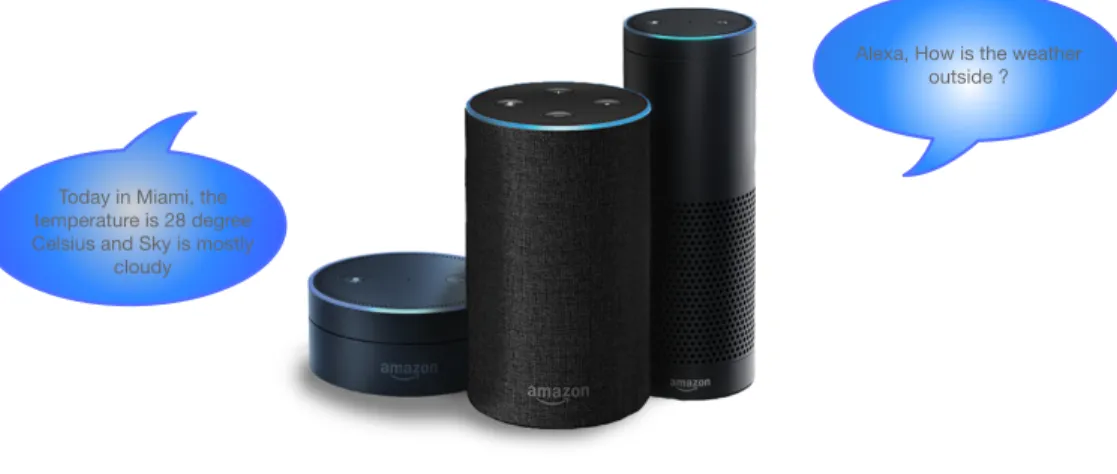
1.3 A sample conversation with Alexa (Amazon virtual assistant). . . 10
3.1 A sample review from Amazon . . . 23
3.2 Our hierarchical contextual sentiment classification (CSC) model . . . . 24
3.3 Distribution of yelp and Amazon data over 5 classes- The blue column is the real number of reviews for each class and the orange column is after data augmentation . . . 34
3.4 Frequency Number of Reviews . . . 39
4.1 System Architecture . . . 42
4.2 Bidirectional Gated Recurrent Unit . . . 44
4.3 Distribution of Extracted Features for a Digital Camera . . . 46
4.4 RevMap for Digital Camera Reviews . . . 48
5.1 Depending on the query interpretation the geocoder may infer different results. Top: Possible result for the query is {Fremont Seattle}. Bottom: Possible result for the query is {Fremont Ave North Seattle} 52 5.2 Address Parser Training Process . . . 55
5.3 Example of a Single Pointer query. The result (and the query) identifies one address point entity. One or more terms may be missing from the query. . . 57
5.4 Example of a Multi Pointer query. The where part after the separator can be a full or a partial address, or it can contain multiple entities itself. . . 58
5.5 Sequence to Sequence model architecture for sequence tagging task. The light red boxes are LSTM encoder and The blue boxes are LSTM decoder. . . 60
5.6 Our hierarchical neural network architecture for parsing address queries 62 6.1 The difference between cosine and euclidean similarity in vector space. . 70
6.2 This architecture is used for learning similarity function among two given pair of sentences/ questions [SM15]. Xq1 is the vector representation
for the first question/sentence and Xq2 is the same for the second
one. Xsim is the similarity function that is learned through
back-propagation. . . 72 6.3 AutoEncoder . . . 74 6.4 Text Preprocessing Pipeline . . . 81 6.5 Performance of different embedding and auto encoder model on the
MSR-paraphrase dataset . . . 83 6.6 Performance of different embedding and auto encoder model on Quora
dataset . . . 83 6.7 Performance of different embedding and auto encoder model on SICK
dataset . . . 84 6.8 Performance of different embedding and auto encoder model on SemEval
CHAPTER 1 INTRODUCTION
1.1
Background
As the web evolves even faster than expected, the exponential growth of users be-comes overwhelming. The total number of internet users increased from 16 million in December of 1995 to 4,157 million users in December 2017, which consist of 54.4 % population of the world 1. As the number of users increases, so does the amount of data.
Data and more specifically textual data is being generated at an ever-increasing pace via emails, documents on the web, tweets, online user reviews, blogs, logs, news and so on by users from all around the world. The size of digital data is expected to double every two years, a 50-fold growth from 2010 to 2020. A research study published from IDC in 2014 claimed that 90% of generated data is unstructured 2. As the amount of unstructured text data grows, so does the need for intelligently processing and understanding it. My overall research goal is to develop learning models that can automatically induce representations of human language to solve higher level language tasks.
In contrast to most conventional learning techniques, which employ certain shallow-structured learning architectures, deep learning is a newly developed ma-chine learning technique that uses supervised and/or unsupervised strategies to automatically learn hierarchical representations in deep architectures for classifica-tion [BB00, BC+08]. Deep learning was inspired by biological observations on
hu-1https://www.internetworldstats.com/emarketing.htm
2
man brain mechanisms for processing natural signals, and has attracted tremendous attention from the academic community in recent years due to its state-of-the-art performance in many research domains such as computer vision [KSH12, HSK+12], speech recognition [HDY+12], and natural language processing [CWB+11].
1.2
Motivation and Problem Statement
Building and designing intelligent systems which can understand and process hu-man languages as well as huhu-mans or even better than them is the ultimate goal of natural language processing. The technology behind all the virtual assistants such as Siri, Google Now, Cortana and Alexa are all competing with each other to exhibit intelligent communication with humans and at the final path pass the Turing test.
The focus of my thesis is on understanding short text data with deep learning techniques. I chose three applications of NLP which consist of understanding and tagging queries in map search, document classification which narrows down to senti-ment classification and paraphrase identification or semantic similarity of short text data.
These three tasks are all essential components of understanding human languages which are required for communicating like a human.
The rest of the Section 1.2 briefly discusses the challenges associated with short text data and the main reasons for choosing the neural network to address those challenges.
1.2.1
Short Text Data
All the research topics in my dissertation deal with short text documents. Short text documents are unlike traditional long text documents, due to their characteristics
in terms of length and conciseness. Short text data has some unique characteristics that make them more challenging to process and understand.
• Firstly, short texts such as search queries, do not always follow the syntax structure of a written language, which makes traditional NLP methods, such as syntactic parsing, less effective on processing and understanding short text data.
• Second, short texts contain a limited number of words/characters. For in-stance, tweets are limited to have only 140 characters. Majority of search queries have 3 words or less 3.
• Third, they are mostly generated based on colloquial phrases so they are usu-ally noisy and contains typos, misspelling errors and abbreviations.
The above characteristics of short text data make them difficult to understand and process. Driven by the challenges above, automatic and efficient techniques for understanding and processing short text data are pressingly demanded.
In recent years, deep learning has acquired great interest to address the different challenges in NLP [CW08, dSG14, SLMN11]. These neural network based models are employed for generating good representation from text data for each specific task.
1.2.2
Deep Learning
Deep learning is the foundation of a recent breakthrough in different research areas [HZRS16, CVMG+14, GMH13]. The fundamentals of deep learning techniques such as backpropagation through time (BPTT), long short-term memory (LSTM) date 3https : //www.slideshare.net/randf ish/keepng − up− wth − seo − n −2017 − beyond/11−Keyword ength f earch ueries1W ord
back to decades ago in the 1980s. Recently, they are popular again because of Graphical Processing Units (GPU) which can run experiments much faster than before and also the availability of a huge amount of data. (About 90% of the world’s data has been generated over the past two years.4)
Scales drive deep learning progress. The scale could refer to either the amount of data or the size of the neural network. As shown in Figure 1.1, the algorithm’s per-formance improves after increasing the amount of data for both traditional learning algorithms and neural networks. The performance of traditional learning algorithms such as a support vector machine (SVM) and regression improves for a while as you add more data but after a while the performance plateaus. However, if we train a very large neural network performance keeps getting better and better while the amount of data is increasing.
For hitting high performance, we need two elements. First, we should be able to train a large enough neural network to take advantage of the availability of a very large amount of data and the second is having the huge amount of data. Hence, scale drives deep learning progress, and scale refers to both size of the neural network with a lot of hidden layers and parameters and as well as the size of the data [Shr17].
In the following sections, the contributions of my dissertation along these research directions are briefly presented.
1.3
Contributions
My dissertation addresses the challenges relevant to the research topics outlined above, by designing and developing deep learning based techniques, with the purpose of understanding textual data. Primarily, the main outcomes of my dissertation are
Performance
Amount of labeled data
Large NN Medium NN
Small NN
Traditional Learning Algorithms
Figure 1.1: Scales drive deep learning progress [Shr17]
highlighted as follows: (1) A general contextual guided hierarchical model for fine-grained sentiment classification of short text data such as reviews by utilizing both content data in review text and the context knowledge from the user and product; (2) A unified framework for visualization and creation of a map to have a holistic view of text data; (3) An end-to-end system for parsing and tagging address queries in a map search; (4) An intelligent document recommendation system for active users. The detailed contributions for three research directions are provided in the remainder of Section 1.3.
1.3.1
Review Mining
The revolution in e-commerce and online shopping has facilitated people’s ability to express their opinions and hands-on experiences of products and services. Cus-tomers usually share their experience through reviews, comments or ratings on online shopping websites. Reviews contain information that benefits both consumers and producers.
They are favorable to consumers since the reviews from actual buyers can provide a more objective, comprehensive, and precise description of a product. Such reviews are highly influential in shaping the shopping behaviors of potential buyers.
The reviews can also be influential in strategic decision making such as improve-ment in the quality of service, product manufacturing, sales, and marketing. In the competitive business market, the reviews can also be beneficial to customer satisfaction.
There is an immense number of online user reviews for some favorite products. For instance, some famous books at Amazon 5 have more than 20,000 reviews, and even some restaurants in Yelp 6 have more than 10 thousand reviews!
On the one hand, having an abundant number of reviews is desirable for users because a large review corpus is more likely to offer more comprehensive and accurate assessments of the item. On the other hand, the sheer amount of reviews consume more time and might not be self-intuitive. Some reviews are rather lengthy and flooded with personal stories which are irrelevant to the product.
It is therefore time-consuming for a potential buyer to sift through the texts and make an informed decision. The biased view of a product might influence the users who consult few reviews and might not be able to gauge the overall opinions for the product.
Finally, the large amount of reviews also makes it hard for business personnel to keep track of customer opinions which can be used as a means for product develop-ment and quality assurance. As many products are sold from different venues, it is desirable to develop tools that collect, compile and extract useful information from user reviews and provide it as a simple bird’s-eye view picture.
5www.amazon.com
Customers usually read reviews on their smart phones for immediate decisions like choosing a nearby restaurant. Small screen display will also make the process of extracting a digest summary out of reviews more challenging. The huge amounts of lengthy reviews spread across different online stores’ websites might not be efficiently utilized in reasonable amount of time.
To address the above mentioned concerns, we propose a framework which ex-tracts opinions from a set of reviews, and displays them in an easy to comprehend manner. Our contributions related to this research direction are elaborately dis-cussed in Chapters 3 and 4. Our contributions related to this research direction are summarized as below.
1. Proposing a novel neural network architecture for text classification.
2. Utilizing contextual information and incorporating them into text classifica-tion.
3. Generating a structured map for presenting nugget of information in a useful and informative manner.
4. Consequently, the arising classification problem is solved by a hierarchical neural model. An extensive empirical study over an available public dataset was conducted to validate the effectiveness and efficiency of our method.
1.3.2
Tagging Address Queries
Map search is a major vertical in all popular search engines. It also plays an impor-tant role in personal assisimpor-tants on mobile, home or desktop devices. A significant fraction of map search traffic is comprised of “address queries” — queries where either the entire query or some terms in it refer to an address or part of an address (road segment, intersection etc.).
Address parser (AP) is a fundamental annotating process for geocoding service [FS69]. AP aims to predict a label for each element of address query. A simple example of parsing address query is provided below.
Address Query z }| { 510 HouseNumber W StreetType Fairlawn StreetName Savoy City 61801 PostalCode
In chapter 5, we demonstrate that correctly understanding and tagging address queries is critical for map search engines to fulfill them. We describe several recurrent sequence architectures for tagging such queries. We compare their performance on two subcategories of address queries — single entity (aka single point) addresses and multi entity (aka multi point) addresses, and finish by providing guidance on the best practices when dealing with each of these subcategories. Our contributions related to this research direction are summarized as below.
1. Proposing a hierarchical neural model for address parsing which mimics the structure of address queries (query from the word, word from the character). 2. We thoroughly examine the address data queries and identify two different
patterns in address queries and generate corresponding synthetic queries based on them.
3. An extensive empirical study over real address queries from Bing map logs and synthetic data are conducted to validate the effectiveness and efficiency of our proposed model. A case study from real scenario shows the usefulness of our proposed method in practice.
Figure 1.2: An example of application of semantic textual similarity which is in question-answer forms such as Quora [Sri].
1.3.3
Semantic Textual Similarity (STS)
Measuring the semantic similarity between text snippets sentences, paragraphs and documents plays an important component in various tasks such as information re-trieval [DDF+90], machine translation [MLS13], text summarization [MCS+06] and ambiguity problem in NLP [Res99]. However, the number of tasks that require com-puting the similarity between text segments are growing significantly which includes in personal digital assistants (PDAs), image search, query search and so many other applications [MDM07, LZLM07]. A real application of semantic textual similarity is on question-answering forums such as Quora or Stack Overflow (See Figure 1.2). Choosing the best phrasing of asked questions in QA forums will be effectively help the intent of the question which result in finding the best response. Another ap-plication of STS is within digital assisstants such as Siri, Cortana, Alexa, Google
Alexa, How is the weather outside ?
Today in Miami, the temperature is 28 degree Celsius and Sky is mostly
cloudy
Figure 1.3: A sample conversation with Alexa (Amazon virtual assistant).
Home and etc — See Figure 1.3. Our related contribution to this research area are listed below.
1. Considering the structure format of text data and not having enough and large corpus of labeled data, we first formulate the problem with unsupervised method such as auto-encoder.
2. Conducting benchmark experiments on publicly available dataset to compare the performance of popular embedding to choose among them.
3. Proposing a neural network model for paraphrase identification which employ semantic similarity measures of text vector representations as well.
4. Extensive empirical studies on real and synthetic data are conducted to demon-strate the effectiveness and the efficiency of the proposed method.
1.4
Summary and Roadmap
In order to facilitate the reading and understanding the research problems discussed, the organization of this dissertation is outlined as follows. First, we briefly presents the preliminaries and related work of the aforementioned three research directions in Chapter 2. To be continue, we study the problems related to these research directions in Chapter 3, Chapter 4, Chapter 5 and Chapter 6, respectively.
Particularly, in Chapter 3, the text classification problem is studied, where both the content and context knowledge are utilized. In Chapter 4, we focus on visual-ization framework (RevMap) of the review corpus for each item, where the RevMap facilitate the browsing through thousens of reviews. In Chapter 5, we study the problem about how to tag each word of address queries in map search. Those tags help the geocoding systems to return more accurate results. Chapter 6 discuss the problem of semantic similarity of textual data and identifying whether questions have the same intent. Finally, in Chapter 7, we conclude the work of this disserta-tion and discuss the future work along our research.
CHAPTER 2
PRELIMINARIES AND RELATED WORK
This dissertation studies the concrete problems along the aforementioned three re-search directions in natural language processing applications and the corresponding solutions are exhaustively discussed as well. In this chapter, we highlight existing literature studies that are related to our work in this dissertation. In particular, Section 2.1 reviews the existing work related to the problem determination as well as the relevant techniques such as text classification, sentiment classification, text visualization. Section 2.2 introduces different types of address queries used in the map search, and further describes the corresponding methodologies to understand these queries. Section 2.3 presents existing literature of semantic similarity of text documents.
2.1
Related Work on Review Mining
To summarize opinions or select a subset from reviews in an accurate way, many methods have been studied. In the following of this section, we will first intro-duce some of the existing work on review mining such as review selection, review summarization and review assessment and ranking.
Review Selection Review selection problem chooses a subset from the large cor-pus of reviews. There are different metrics to consider in the selection process. Yu and Zhang [YZHS13] consider selecting a subset of reviews which consider at-tribute coverage and opinion diversity while providing high rate quality reviews.The drawback of this approach is they do not consider to select high-quality reviews. Lappas and Gunopuls [LG10] approach select the representative set with the
ma-jority opinion on each feature. The shortcoming of this approach is that it neglects the minority opinion, without considering how important it is. Lappas and Crovella [LCT12] present an approach for selecting a characteristic set of reviews which pro-vide a good formalization of a review selection problem. They also prove that CRS problem is not only NP-hard but also NP-hard to approximate. They measure the closeness of selected subset with the target vector via L2 norm differences. They also apply different algorithms like greedy, Integer-regression and a randomized one to a large corpus of reviews and then compare the results of them for different size of the selected subset. One of the bugs of their solution is that they ignore to consider the quality of reviews as well. The selected subset needs to contain high-quality content. Tsaparas and Ntoulas [TNT11] adopted a generic framework to review the subset selection problem that covers the different attributes of the product with high-quality content that also contain different viewpoints. Their formulation pro-vides the subset with at least one positive and at least one negative opinion of the covered feature. The drawback of their method is that it does not consider the pro-portion of positive or negative opinions of a feature. In another word, They ignore the distribution of opinion on features of the product. Which may give the wrong idea or impression to users.
Review Summarization Review summarization extracts the statistical descrip-tion of the corpus of reviews and provides a summary of general ideas. Review summarization also has its own drawbacks, it actually sacrifices the immediacy and narrative structure of reviews. There have been several works on automatic sum-marization; most of them focus on extraction-based summarization. Hu and Liu [HL04], who first came up with review summarization solution; analyze the sen-tences sentimentally and consider the opinion sensen-tences as positive or negative and
then a statistical summary of the number of positive or negative sentences for a user. They do not consider opinions as biased which is one of the bugs in their job.
Review Assessment and Ranking. Salient research studies devoted to review-ing assessment and rankreview-ing. A rank is assigned to each review to define the quality rate of reviews. Reviews are being ranked according to their quality rating.[,,] In this method, they do not consider the quality rating of a selected group of reviews. The main disadvantage of these methods is in the selection process. High rated reviews do not reflect the distribution of entire corpus of reviews and these selected subsets could include repeated opinions on the same feature. Our method dominates these shortcomings by considering other criteria for selecting reviews.
2.1.1
Text Classification
Text classification have gained significant popularity over the past few years within the natural language processing. It has wide range of application such as sentiment analysis [Kim14, PL+08, MDP+11], topic modeling [WM12], email categorization and email spam filtering [SDHH98, CC05, CCM04, LK97, SDHH98] and language modeling [PC98, LM14, MSC+13, BDVJ03].
Current approaches for various aspects of text classification can be divided into two groups, one uses traditional NLP techniques and the recent methods which utilize deep neural network models. The approach taken in this work belongs to the second group.
Traditional Methodologies In traditional NLP methods, one technique that attracts great attention recently is word2vec [MSC+13], in which Mikolov et al.
introduce building representation of words into fixed length vector trained on the large corpus.
Much work has been done for training neural networks on text documents. Neu-ral networks were first introduced for text representation by Bengio [BDVJ03]. More recently, deep learning methods have been extensively studied for text classifica-tions [ZZL15, Kim14, dSG14, LXLZ15, SM15]. Convolution neural network was first used for sentence classification in [Kim14]. A deep model of character level convolution is presented in [ZZL15]. While the basic idea in these studies [ZZL15] and [Kim14] are pretty similar, with the main difference between these two is the number of layers and embedding channels. Temporal ConvNet model in [ZZL15] has 9 layers consist of 6 convolutions and 3 fully connected layers. Also the input text in this model is treated as a sequence of characters. The model in [Kim14] is much simpler with only one convolution layer and one fully connected layer. It also treats the input as a sequence of words instead of characters.
There is also some other similar work for learning representation of tweets for hashtag prediction [DZF+16] and for learning general purpose embedding [VVR16].
2.1.2
Sentiment Classification
The focus of my research is on the task of sentiment classification. In a sentiment classification task, we are looking to predict the expressed sentiment of each docu-ment.
Content based Sentiment Classification
Salient number of studies focus only on the content of documents for sentiment classification. Existing approaches for content-based sentiment classification can
be divided into two categories, one uses traditional NLP techniques and the other utilizes deep neural network models.
Neural Network based Methods: Neural networks for text representation were first introduced by Bengio [BDVJ03]. Recently, deep learning methods have been extensively studied for sentiment classification [Kim14, dSG14].
Context based Sentiment Classification
More recently methods leveraged contextual information as well as the content of the document for classification.
A user modeling neural network was presented by Tang et al. (2015), [TQLY15]. They employed user/product preference matrices in order to create personalized word embedding and employ in CNN models. A context-sensitive neural network has proposed by Ren et al.(2016), where they integrate the content with the contextual feature in the form of word embeddings vectors [RZZJ16]. (Chen et al.) proposed neural sentiment classification (NSC) model with the user and product attentions in both word and semantic levels [CST+16]. Seo et al. built vector representation of user and items by using attention based convolutional neural network [SHYL17].
2.1.3
Text Visualization
Mining customer reviews include review selection, summarization, review assessment and ranking, and visualization. We explored some of the studies that focused on review visualization.
Some of the existing studies [WWL+10], [CISSW06], [LHC05] applied visual an-alytics to present the extracted features of reviews. Chen et al. [CISSW06] used graphs and trees to visualize the conflicting opinions in texts. Liu et al. [LHC05]
proposed a framework with a visual component for analysis and comparison of con-sumer opinions on competitive products. The OpinionSeer framework from Wu et al. [WWL+10] provided an interactive system for visual analysis of hotel customers’ feedbacks. Their model focused on multi-dimensional visual representation which encoded the uncertainty information. They used feature based opinion mining and combined opinions with subjective logic and visualized the output in a radial layout. Our proposed framework not only extracts opinions from reviews but also explic-itly reflects temporal and statistical data. Our model has two significant differences from OpinionSeer [WWL+10]. Firstly, our fine-grained opinion mining is based on the hierarchical neural network model. Secondly, we generate a structured map to display extracted feature in an evolutionary timeline.
2.2
Related Work on Tagging Address Queries
It is crucial to tag each token of address queries correctly. There have been a few strands of works focusing on the category of address queries [WHY+16, LKWS14, CCLZ02, BDS01, SZ14, SMFCM18, RDA+17]. There are two general approach for tagging address queries in map search. The first trend approach the problem as toponym matching which is rely on pairing queries/strings that are The problem can be viewed as toponym matching or sequence tagging. [SMFCM18]
however, traditional rule-based address parser [CCLZ02] require domain knowl-edge and have been shown to be limited in classification accuracy. Probabilistic methods such as [WHY+16, LKWS14] which are based on HMM and CRF have been developed to improve the rule-based methods but they have some difficulties dealing with rich and complex features. In recent years RNN based models have shown state of the art results on sequence tagging problems [MH16]. In this work,
after formalizing the address tagging problem, we outline several recurrent architec-tures suitable for modeling it (Section 5.3). We analyze their performance on two structurally different query patterns that we find prevalent in map search logs(§5.5). We conclude with guidance on the practices for choosing a suitable architecture when working with such patterns (Section 5.7).
2.3
Related Work on Semantic Textual Similarity
Matching two potentially heterogeneous language sentences is essential in many nat-ural language processing applications such as paraphrase identification (PI), ques-tion answering (QA) and informaques-tion retrieval (IR) [XJC08, BGWB14, HLLC14].
Natural language sentence matching (NLSM) is the task of comparing two sen-tences and analyzing the relationship between them. Sensen-tences have complicated structures, both sequential and hierarchical, Hence, it is essential to understand their structure first and then compare and find the sentence matching.
Sentence matching is of central importance to many natural language tasks such as paraphrase identification (PI), image retrieval and etc [CF87]. One of the well studied and useful application in this field is paraphrase identification. Majority of the existing methods formulate this problem as a binary classification task. Given a pair of input text data and classify whether they convey the same meaning/concept or not. We will discuss some recent studies in this research direction below.
Paraphrase identification with noisy pretraining [TDT+17] They employed decomposable attention model[PTDU16] with the model trained on noisy dataset. Instead of using pertained word embedding, they applied sum of embedding char-acter n-grams.
BiMPM: Bilateral Multi-Perspective Matching for Natural Language Sen-tences In this study [WHF17] , they used joint feature models which use the cross sentence feature or attention from one sentence to another.
Facebook researchers in [CKS+17], demonstrated the effectiveness of the natural language inference (NLI) for transfer learning to various natural language processing tasks and computer vision. They studied learning universal representations of sen-tences trained on a large corpora and afterwards transfer to the other tasks such as entailment and semantic relatedness, caption-image retrieval, paraphrase detection, binary and multi-class classification. They studied whether a supervised learning can be leveraged instead of learning sentence encoder in an unsupervised manner [BDVJ03, CWB+11, MSC+13, PSM14].
2.4
Summary
This chapter highlights the existing works in the literature, which are strongly re-lated to the three research directions of my dissertation, i.e., document classification, tagging address queries in map search and intelligent document recommendation sys-tem with focus on semantic similarity. For each research direction, both the related approaches and evaluation metrics are exhaustively surveyed.
CHAPTER 3
SENTIMENT CLASSIFICATION
3.1
Introduction
Enabling a computer to precisely understand a document so that it can predict the sentiment is crucial, yet the unsolved goal of natural language processing (NLP)! There has been a great deal of effort spent on developing methodologies for text classification and, subsequently in sentiment classification.
The majority of existing methods classify text documents only based on the se-mantic of text data and ignore relevant contextual information. There are a few studies which take this data into account, but they suffer from model complex-ity. Thus, it’s essential to have to provide an efficient architecture for document classification which leverages both content and context data. [MLX18a]
3.1.1
Background
The task of text classification have gained significant popularity over the past few years in NLP. It has a wide range of applications such as sentiment analysis [Kim14, PL+08, MDP+11], topic modeling [WM12] and spam detection [SDHH98]. In this thesis, we focus on the task of sentiment classification in which accurate prediction of the expressed sentiment of each document is desired.
Motivated by impressive success of neural network in different disciplines such as computer vision [KSH12], speech recognition [GMH13] and natural language pro-cessing [Kim14], we propose a hierarchical neural network based model for contextual sentiment classification. Our approach is partly inspired by the success of utilizing image metadata in computer vision, which shows promising results for different
tasks: image annotation and image search [ZHH+10, GJL+13], and multi-modal learning representation of image and tags [SS12]. In this chapter, we introduce an attention-based hierarchical neural network method for sentiment classification by taking contextual information into account.
The rest of this chapter is organized as follows. We first formulate the sentiment classification problems to be studied in this paper. Then, after a brief review of gen-eral DNN-based text classification method, our approach with detailed descriptions of the techniques that incorporate contextual information into the neural network architecture is presented. Finally, experimental results with various evaluations are discussed.
3.2
Problem Description
The fine-grained document classification is a classic classification problem, in which we are given a document, in the form of a sequence of tokens w = (w1, w2, ..., wn),
and we are required to find the best sentiment class matches this document y. In this specific task, we two class and fine-grained! In this section, we formulate and describe the notations that will be used throughout the paper.
Preliminaries We denote R as a collection of reviews,
R ={r1, r2, ..., rn}. Each review as shown in figure 3.1 is associated with several
at-tributes such as content(Rt), reviewer(Ru), subject(Rp), helpful rate(Rh), date(Rd)
and score(Rs); r={Rt, Ru, Rp, Rh, Rd, Rs}.
• Reviewer/User (Ru) is the actual individual who left the review. Each
distinct reviewer in our datasets is represented by a unique random (hashed) string.
• Subject (Rp) is either a product/item on Amazon or a business on Yelp
dataset.
• Date (Rd)is the time that the review is written, which is further divided into
three fields: day, month and year.
• helpful Rate (Rh)is a number which measure the rating given by other users
to the review on one or several topics. On Amazon, this is the percentage of the users who found this review helpful, therefore hamazon ∈ [0,1]. On Yelp,
review rate has three fields: usefulness, coolness, and funniness. Each field of the review rate is represented as an integer number, hence hyelp ={uf, c, f}.
• Sentiment Score (Rs) is the quantitative number that a reviewer assigned
an overall rating of the subject. Score is usually a number in range of 1 to 5, s ∈S ={1,2,3,4,5}, in which 5 is the best feedback and 1 is the poorest. In some variations of this classification problem, score domain (SD) is polarized
to two values: negative and positive.
All of the discussed features are highlighted in Figure 3.1. The main goal of this study is to generate a general-purpose learning of representation of reviews that can be applied in a broad range of classification tasks.
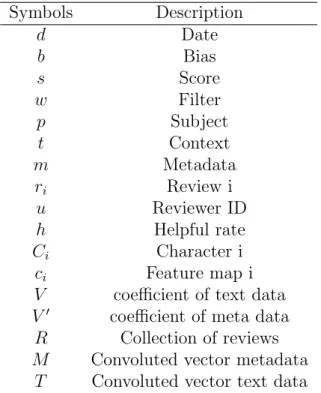
Notation and symbols applied are summarized in the following table.
3.3
Our End-to-End System
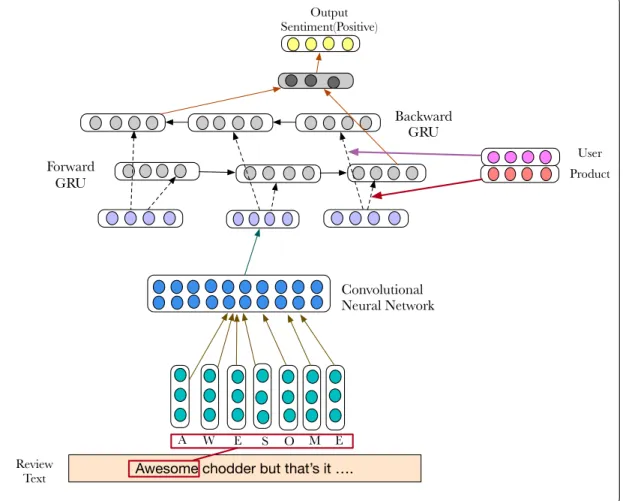
The overall architecture of our hierarchical attention model is shown in Figure 3.2. It consists of four main modules: content embedding layer, context embedding layer,
Figure 3.1: A sample review from Amazon
attention layer and the output layer. We describe the details of each component in the following sections.
3.3.1
Content Embedding Layer
This layer is computing features from content (review text) at different levels of granularity. We use a hierarchical neural model to capture two levels of syntactic and semantics representation of the content. Word level solely does not work well for informal text, misspelling words and out of vocabulary (OOV) words. Therefore, our model combines the benefits of character level and word level to learn better representation of informal content of reviews. Our content embedding layer uti-lize character-level convolutional neural [ZZL15] and bi-directional gated recurrent neural network [CGCB14] for word level embedding. Then, the concatenation of the character embedding and word embedding layer are fed to the highway network [SGS15].
Forward GRU Backward GRU Convolutional Neural Network User
Awesome chodder but that’s it ….
Product Output Sentiment(Positive) Review Text A W E S O M E
Table 3.1: Notion used in this article Symbols Description d Date b Bias s Score w Filter p Subject t Context m Metadata ri Review i u Reviewer ID h Helpful rate Ci Character i ci Feature map i
V coefficient of text data V0 coefficient of meta data
R Collection of reviews M Convoluted vector metadata
T Convoluted vector text data
Character Encoder Review content data (Rt) is treated as a sequence of words
[W1, W2, ..., W|R|] and each word is a sequence of characters [C1, C2, ..., C|W|] and
this layer is responsible for projecting each word to a fixed length vector encoding. As illustrated in Figure 3.2, we used convolutional to capture morphological infor-mation from characters of words. A convolution layer takes sequence of characters (represented as embeddings) as input and outputs a representation that learn local n-gram features.
Input characters of each word are converted into two dimension matrix with dimension of (first L characters) * (Character embedding length (N)). Where L is the length that will set empirically and N is the character embedding length. Longer reviews are truncated and shorter ones are zero padded so that all the input will have the same length. Word matrix wi ∈ IRL×N fed into the convolution layer to
in order to capture n-gram features and concatenating the extracted features. Wc=Cf1 ⊕Cf2 ⊕...⊕Cfn (3.1)
Pooling layer is right after convolution which select specific features from feature map. Features can be selected by using MAX or MIN or AVG. operation. We use max pooling layer in order to extract the most import feature in our model.
Wi = [c1, ..., c|Wi|] (3.2)
ˆ
Wi = max{Wi} (3.3)
We applied a dropout layer [SHK+14] before passing character embeddings input to convolution layers.
Word Encoder Given a review with sequence of words, we map each word to a vector space by using a pre-trained word embedding. We used Glove [PSM14] with dimension dw for our model. The outputs of character encoder (RWc) and word
encoder (RWw) concatenated through highway network [SGS15].
x= [Rww;Rwc] (3.4)
y=H(x, WH).T(x, WT) +x.(1−T(x, WT)) (3.5)
Afterwards, learning representation of review text (Rt) fed to the bidirectional grated
recurrent units (GRU)[CGCB14]. GRUs are variants of recurrent neural network (RNN) which are designed to cope with gradient vanishing/exploding problems. We chose GRU instead of long short term memory (LSTM), since it has fewer parameters and therefore less expensive computationally. Basically, a GRU unit is composed of two multiplicative gates which monitor the proportions of information to update and to pass on to the next unit. The formulas to update a GRU unit at time t are:
rt=σ(xtWr+Urht−1) (3.7)
h0t= tanh(W xt+rtU ht−1) (3.8)
ht= (ztht−1+ (1−zt)ht) (3.9)
Where σ is sigmoid function and stands for element-wise multiplication. xt and
ht are the input vector and hidden units at time t, respectively. Ur, Uz denote
the weight matrices for the hidden unit ht−1. Wr, Wz are the weight matrices of different gates for input xt.
3.3.2
Context Embedding Layer
In this layer, we utilizes contextual information available from user (Ru) and product
(Rp) to refine the embedding of the content. We project user and product context
data to vector space and couple them to produce one single contextual vector by passing through two layer highway neural network.
Context= [Ru;Rp] (3.10)
3.3.3
Attention Layer
Attention mechanism is motivated by human visual attention. It’s been widely used with neural networks specially in image recognition and more recently in NLP tasks. In this module, the objective is to compare the content embedding and contextual embedding, select the nugget of information that is relevant to context. We calculate a probability distributionαbased on the relevance between each word in the content (wi) and the contextC. The output vector (Oatt) is the weighted sum of all the words
in the document. Oatt = L X i=1 αiWi (3.11)
whereαi is the weight of each wordwi. Oatt produces a set of context-aware feature
vectors for each word in the content.
3.3.4
Output Layer
In the output layer, we have a fully connected network and softmax layer. After all the layer mentioned above, the general review embedding is passed through a fully connected layer in which neurons have full connection to all activation in the previous layer. The output from previous layers is flattened to a dense vector and passed to a fully connected softmax layer. In softmax layer, the probability distribution over the classes calculated as follows:
p(s=j|r) = e rTθ j PK k=1er Tθ k (3.12)
where θk is the weight vector for class of score k. r is the review dense feature
em-bedding which passed through different layers. We are optimizing the cross entropy loss function as the training goal between predicted and true label associated with each review. C =−log ΠNi=1p(si|ti,mi) +λkθk22 =− N X i=1 [silog(zi) + (1−si)log(1−zi)] +λkθk22 (3.13)
Whereti andmi is the content data and context data of the review. zis the
out-put from the softmax layer and θ contains all parameters optimized by the network including filter weights and biases of the convolution layers and biases and weights of fully connected layer and softmax, λ is a coefficient of L2 regularization.
3.4
Experiments
In this section, we introduce the experimental setup, empirical evaluation and results on the sentiment classification task. Our work focus is on sentiment classification of online user reviews.
3.4.1
Data
Our experiments are performed with data from two publicly available datasets, yelp academic dataset challenge (2013, 2014, 2015) and Amazon published by [ML13]. These datasets includes all the review characteristics required for our experiments, such as content, sentiment score and product properties. Integrating contextual information will enable the model to learn about users behavior and products as well. For instance, if a product is highly rated, one expects that most of the reviews about it to be positive.
Yelp: The yelp academic dataset is publicly available online1. This dataset has 4.1M reviews and 947K tips by 1M users for 144K businesses. 1.1M business attributes, e.g., hours, parking availability, ambience. Aggregated check-ins over time for each of the 125K businesses 200,000 pictures from the included businesses.
Amazon: We conduct experiments on SNAP Amazon dataset which was crawled from Amazon between May 1996 and July 2014, and includes 142.8 million reviews in total [MPL15, MTSvdH15]. The entire dataset is very large and unbalanced. We chose our data only from the categories such as Books, Electronics, Movies and TV, CDs and Vinyl.
Table 3.2: Data statistics of Yelp and Amazon datasets. Datasets are from [ZZL15]
Dataset Yelp P Yelp F Amazon P Amazon F
# Train 560K 650K 3600K 3000K
# Test 38K 50K 400K 650K
# of classes 2 5 2 5
In order to compare our performance with baselines discussed in 3.4.2, we also run experiments with data in [ZZL15]. However we are unable to use this dataset for our experiments since the contextual information was not provided. Therefore, we randomly select our data from Yelp and Amazon datasets and conduct our ex-periments.
Previous works have demonstrated the effectiveness of data augmentation in classifi-cation task with deep learning. Data augmentation is another method which can be used to reduce over-fitting of the models by replicating and increasing the amount of training data. In our case, we replaced some of the words in reviews with their syn-onyms and reproduced them. These synsyn-onyms are obtained from WordNet [Mil95] which contains words grouped together based on their meanings. The statistics of the datasets are depicted in Table 3.2.
Data Preprocessing WedefinedcharactersetincludingEnglishalphabets,digits and some of the special characters. Any character which is not in our defined character set such as emotion, HTML tag, etc. is removed from review text data. We also eliminate the English stop words in reviews. Text data varies on length of the input. We consider a fixed length for all the reviews in training and test datasets. Longerreviewsare truncatedand shorteronesare zero-paddedsothatall reviews in the dataset have the same length. For Yelp, the lengths of reviews are in the rangeof [0,32952]with mean value 540. ForAmazon,the lengths ofreviews
characters for review lengthin Yelp and Amazon.
3.4.2
Baseline
Methods
Wecompareourmodelwithseveralbaselinesapproachesincludingbothcontentand context based approaches; consisting of traditional methods such as Bag-of-words (BOW),SVMandneuralnetworklikeLSTM, character-levelCNN,word-levelCNN and etc.
BOW (Bag of Words) generatestextrepresentationbasedonthe occurrenceof words withina document.
Support Vector Machine (SVM) support vector machine classifiesdocument by using some features suchas unigrams and bigrams.
Paragraph Vector proposes the PVDM for document sentiment classification [LM14].
WordCNN wordbasedconvolutionalneuralnetworkwhichisproposedin[Kim14, KGB14]. They trained on top of pre-trained word vectors for sentence-level classi-fication tasks.
Char CNN character based convolutional neural network which is proposed in [ZZL15].
LSTM word-level long short term memory by using Word2vec [GL14] with 300 embedding dimension for embedding the words [HS97].
FastText compact architecture which build upon product quantization to store word embedding [JGB+16].
User Product Neural Network (UPNN) modifies the word embedding with preference matrix of users and products[TQL15]
NSC model documents through hierarchical structure, word-level, sentence-level and document-level. They adopt LSTM with user product attention to capture crucial semantic components for document representation[CST+16].
3.4.3
Experimental Setup
We implement our model with Tensorflow 0.11[AAB+16]. All the experiments are performed on a single machine with Intel Xeon CPU E5-2660, 64GB of memory, and GeForce GTX TITAN GPU.
We train all models for 10 epochs and choose the model that has the best per-formance in validation dataset. We apply L2 regularization to the weight matrices and apply dropout [SHK+14] with p= 0.2 for the hidden layers. We optimize using Adam method [KB14] with learning rate 10−3 and initialize the weight parameters using the same method as in [GB10].
Tuning Hyper-Parameters. For training our model, we eliminate the less fre-quent words from datasets (|v| < 5). We initialized the word embedding in word encoder by 100-dimensional pre-trained Glove word embedding.
The hidden size for GRU set to h = 200 and for convolution, we used filters with length 2,3,4. The parameters for attention were initialized with a uniform distribu-tion between (0.01, 0.01). We also choose the samples with mini-batch of size 32.
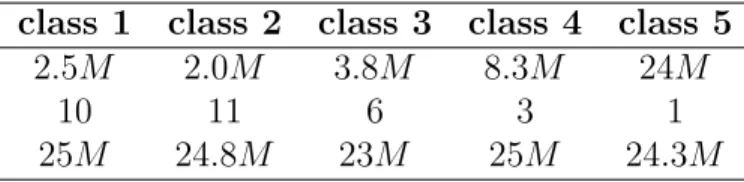
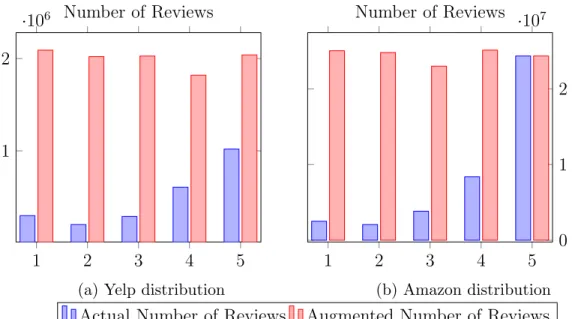
class 1 class 2 class 3 class 4 class 5
300K 200K 300K 600K 1M
7 10 7 3 2
2M 2M 2M 1.8M 2M
Table 3.3: Yelp Data distribution over 5 score classes class 1 class 2 class 3 class 4 class 5
2.5M 2.0M 3.8M 8.3M 24M
10 11 6 3 1
25M 24.8M 23M 25M 24.3M
Table 3.4: Amazon Data distribution over 5 score classes
We tuned the hyper parameters on validation dataset by random search. We run our model up to 50 epochs and then we choose the model which achieves the best accuracy on the validation dataset. We run our models 5 times independently with different random seeds and report average performance across the runs. We also report ensemble results which average the prediction probabilities of the 5 models.
Data Augmentation One of the challenges we faced was the skewness of collected data. The distribution of reviews over different score classes on Yelp and Amazon dataset is unbalanced; see e.g. Figure 3.3a for the distribution of reviews over 5-classes in our Yelp dataset. However, to improve the prediction accuracy we need to have almost equal number of reviews among all classes. If we trim the dataset in accordance with the class with minimum number of reviews, more than half of the original data would have been discarded. Data augmentation, in our context, refers to replicating reviews in classes that fall short of data, and replacing some of the words in the replicated ones with their synonyms. These synonyms are obtained from WordNet [Mil95, Fel98] which contains words grouped together based on their meanings.
1 2 3 4 5 1
2
·106 Number of Reviews
(a) Yelp distribution
1 2 3 4 5 0 1 2 ·107 Number of Reviews (b) Amazon distribution
Actual Number of Reviews Augmented Number of Reviews
Figure 3.3: Distribution of yelp and Amazon data over 5 classes- The blue column is the real number of reviews for each class and the orange column is after data augmentation
duct experiments withdatasetused in[ZZL15]. However weare unabletouse their dataset exactly because the metadata of their dataset are not available. We ran-domlyselectthesamenumberofsamplesfromYelpandAmazondatasetsin[ZZL15] and perform experiment with this randomly selecteddata.
3.4.4
Results
The results of our model and comparing with baselineson Yelp 2013 and 2014 are summarized in Table 3.5. The results on Yelp and Amazon dataset from [ZZL15] and with augmenteddata are showninTable 3.6. We evaluatedthe performanceof our model with baselines based on accuracy and root mean square error (RMSE) in order to measure the deviation between ground truth (Si) and the predicted
con-Table 3.5: Classification accuracy (Acc) and RMSE on Yelp 13 and Yelp 14 corpus. Results marked with †are reported from [TQL15] and those marked with‡are from [CST+16]. The best result in each group depicted in bold format.
Model 2013-Acc 2013-RMSE 2014-Acc 2014-RMSE
Majority † 0.411 1.060 0.392 1.097 Trigram † 0.569 0.814 0.577 0.804 Text Feature † 0.556 0.845 0.572 0.800 Avg Wordvec +SVM † 0.526 0.898 0.530 0.893 SSWE +SVM † 0.549 0.849 0.557 0.851 Paragraph Vector† 0.554 0.832 0.564 0.802 RNTN +Recurrent† 0.574 0.804 0.582 0.821 UPNN(CNN w/0 UP) † 0.577 0.812 0.585 0.808 NSC ‡ 0.627 0.701 0.637 0.686 NSC + LA ‡ 0.631 0.706 0.630 0.715 Our Model(CSC) 0.638 0.699 0.641 0.688 Trigram + UPF † 0.570 0.803 0.576 0.789 TextFeature + UPF † 0.561 0.822 0.579 0.791
JMARS † N/A 0.985 N/A 0.999
UPNN(CNN) ‡ 0.596 0.784 0.608 0.764
UPNN(NSC) ‡ 0.631 0.762 N/A N/A
sentiment score (Zi). RM SE = r Σn i=1(Zi−Si)2 N (3.14)
3.5
Data Analysis
In this section, we conduct an analysis of the review datasets in order to find the better design the model for the problem.
The distribution of number of review for some categories of Amazon products such as electronics, movies, books and Yelp data illustrated in Figure 3.4. As shown, Majority number of products have less than 10 reviews and there are limited number of products with high number of review.
After looking closer into data, we noticed that there are some reviews with same text but different rating. An example of such reviews are shown in Table 3.7. An
Table 3.6: Classification accuracy on Amazon and Yelp corpus which used in [ZZL15]. Numbers are in percentage.
Model Amazon F Amazon P Yelp F Yelp P
n-gram 54.27 92.02 56.26 95.64 n-gram (TF-IDF) 52.44 91.54 54.8 95.44 LSTM 59.47 94.34 58.17 94.74 Char-CNN 59.43 93.9 62.05 94.58 FastText.zip 59.9 94.5 63.6 95.6 OurModel(CSC) 60.11 95.1 64.03 93.1
OurModel(Augmented Data) N/A N/A 65.82 96.2
Table 3.7: Selected reviews which have same text data but different ratings
Review Rating
good stuff 4,5
They are usually very friendly and the restaurant is
a very nice environment. However, the last couple of times I went in, it was very busy
and the service and food was not that great. 3, 5 Fire Grilled Chicken, done whichever way you like:
burrito, tacos, salad, etc.
They have healthy ”Under 500 calorie” menu options. Individual combos for $7-$9 and Family Meals$20-$30.
Salsa bar with four fresh salsa options. 3,4
example review such as good stuff can be rated with 4 or 5 star. For such reviews especially those with short text data, more data is needed to predict the sentiment accurately.
Another example which that the same text data has been rated differently are spams! Although Yelp and Amazon have strong spam filtering detection, still some of them appear in the academic dataset.
3.6
Summary
This chapter provides an empirical study on the effectiveness of contextual infor-mation for text classification. We compared our approach with a large number of traditional methods and deep learning models on user reviews corpus from Yelp and Amazon. On one hand, experiments and deep analysis shows the effectiveness of our model and employing contextual data. On the other hand, there are many fac-tors affecting the performance in comparison, such as dataset size, types of context information, number of samples from each user or products.
100 101 102 103 104 100
101 102 103
104 Max: 8,796 Product with 5 Reviews
Number of Reviews Num b er of Pro ducts
(a) Amazon Electronics review corpus
100 101 102 103 104 100 101 102 103 104
Max: 5,751 Movie with 5 Reviews
Number of Reviews Num b er of Pro ducts
(b) Amazon Movie Review Corpus
100 101 102 103 104
100 101 102 103
104 Max: 11,572 CD and Vinyl with 5 Reviews
Number of Reviews Num b er of Pro ducts
100 101 102 103 104 100
101 102 103
104 Max: 10,906 Business with 3 Reviews
Number of Reviews Num b er of Businesses
(d) Yelp Academic Review Corpus
100 101 102 103 104 100 101 102 103 104
105 Max: 54,556 Books with 5 Reviews
Number of Reviews Num b er of Businesses
(e) Amazon Book Review Corpus
CHAPTER 4
REVIEW MAP VISUALIZATION
4.1
Motivation
Our daily digital life is surrounded by algorithmically selected content such as rec-ommendations, reviews and news feed. The process of extracting useful knowledge out of large corpus have a great impact on shaping the users life and experience. As the data becomes abundant, it becomes increasingly difficult to extract beneficial knowledge out of large data corpus.
In this chapter, we propose a unified framework to display a holistic view of online user review corpus. The framework provides a visual summary of reviews consider-ing the features of the related product and the evolution of reviews along the time. To this end, we present a novel approach, named RevMap, which first extracts fea-tures from reviews. Empirical analysis and extensive case studies on a large corpus of Amazon reviews demonstrate the efficacy of our proposed framework.[MLX18b]
4.2
Introduction
The revolution in e-commerce and online shopping have facilitated people to ex-press their opinions and hands-on experiences on products or services. The user reviews from actual buyers can provide more objective, comprehensive, and precise description of a product. Such reviews are highly influential in shaping the shop-ping behaviors of potential buyers. The reviews can also be influential in strategic decision making for the service quality improvement, product manufacturing, and sales and marketing. In the competitive business market, the reviews can also be very effective in customer satisfaction.
There is an immense number of online user reviews for some popular products. On the one hand, having an abundant number of reviews is desirable for users because large review corpus is more likely to offer more comprehensive and accurate assessments of the item. On the other hand, the sheer amount of reviews consume more time and might not be self-intuitive. Some reviews are rather lengthy and flooded with personal stories which are irrelevant to the product.
It is therefore time-consuming for a potential buyer to sift through the texts and make an informed decision. The biased view of a product might influence the users who consult few reviews and might not be able to gauge the overall opinions for the product. Finally, the large amount of reviews also makes it hard for business personnel to keep track of customer opinions which can be used as a means for product development and quality assurance. As many products are sold from dif-ferent venues, it is desirable to develop tools that collect, compile and extract useful information from user reviews and provide it as a simple bird’s-eye view picture.
The enormous amounts of lengthy reviews spread across different online stores’ websites might not be efficiently utilized in the reasonable amount of time. To address the concerns as mentioned earlier, we propose a framework which extracts opinions from a set of reviews and displays them in an easy to comprehend manner.
4.3
Proposed Framework
In this section, we describe the proposed framework. The high-level overview of the proposed unified framework is illustrated in Figure. ??.
Figure 4.1: System Architecture
4.3.1
Review Selection
For every item, the representative set of reviews are selected. The review selection can be made using this method [LCT12]. Lappas and Crovella in [LCT12] aim to select a characteristic set of reviews which is “close” to the original set of reviews, where they measure the closeness between two sets of reviews using L2 norm in the vector space.
4.3.2
Opinion Analysis
This module extracts opinions from the review summary. It applies the character based Bi-directional Gated Recurrent Unit [CVMBB14] neural network for learning the review embedding and computing distribution probabilities over opinions by projecting this embedding to a softmax output layer. A blueprint of our model is illustrated in Figure 4.2. The review context is treated as a sequence of characters [C1, C2, ...,C|R|] and one-hot vector encoding embeds each character.
R =C1+C2+...+C|R| (4.1)
The encoder consists of a forward-GRU and a backward-GRU. Both of them have the same architecture, except the backward-GRU processes the sequence in reverse
order. Each of the GRU units processes these vectors sequentially. Given the initial state h0, the sequenceh1, h2, ...hm is computed as follows:
z(t) =σ(W(z)x(t)+U(r)h(t−1)+bz) (4.2) r(t) =σ(W(r)x(t)+U(r)h(t−1)+br) (4.3) ˜ h(t) = tanh(W(h)x(t)+r(t)◦U h(t−1)+bh) (4.4) ˜ h(t)= (1−z(t))◦h˜(t)+z(t)◦h(t−1) (4.5)
The gates are updated using Equation 4.2 and are reset using Equation 4.3. The new memory ˜h(t) is the consolidation of the input character of reviewx(t) with past hidden state h(t−1). In above equations, the terms W and b refer to the weight and bias respectively. The final state from the forward GRU and the backward GRU are combined and passed through a fully connected layer. The review embedding is calculated by combining the final state from forward GRU (hfm) and backward GRU (hb
0):
r=Wfhfm+Wbhh0 (4.6)
Softmax
The output from previous layers is flattened to a dense vector and passed to a fully connected softmax layer. In the softmax layer, the probability distribution over the k classes is calculated as follows:
p(yt=k|r) = exp(wT kr+bk) PK k=1exp(w T kr+bk) (4.7)
Figure 4.2: Bidirectional Gated Recurrent Unit
wherer is the review embedding which is fed to the softmax layer. We also op
![Figure 1.1: Scales drive deep learning progress [Shr17]](https://thumb-us.123doks.com/thumbv2/123dok_us/367673.2540498/19.918.236.746.109.365/figure-scales-drive-deep-learning-progress-shr.webp)
![Figure 1.2: An example of application of semantic textual similarity which is in question-answer forms such as Quora [Sri].](https://thumb-us.123doks.com/thumbv2/123dok_us/367673.2540498/23.918.241.732.117.496/figure-example-application-semantic-textual-similarity-question-answer.webp)
![Table 3.2: Data statistics of Yelp and Amazon datasets. Datasets are from [ZZL15]](https://thumb-us.123doks.com/thumbv2/123dok_us/367673.2540498/44.918.238.722.144.236/table-data-statistics-yelp-amazon-datasets-datasets-zzl.webp)

![Table 3.6: Classification accuracy on Amazon and Yelp corpus which used in [ZZL15]. Numbers are in percentage.](https://thumb-us.123doks.com/thumbv2/123dok_us/367673.2540498/50.918.182.815.165.346/table-classification-accuracy-amazon-yelp-corpus-numbers-percentage.webp)
