Feature Regularization and
Learning for Human Activity
Recognition
By
Osayamwen Festus Osazuwa 212562369
A thesis submitted in fulfillment of the academic requirements for the Degree of Doctor of Philosophy in Computer Engineering in the School of Engineering
University of KwaZulu-Natal Durban, South Africa
UNIVERSITY OF KWAZULU-NATAL, COLLEGE OF
AGRICULTURE, ENGINEERING AND SCIENCE
DECLARATION
The research described in this thesis was performed at the University of KwaZulu-Natal under the supervision of Prof. Jules-Raymond Tapamo. I hereby declare that all materials incorporated in this thesis are my own original work except where acknowl-edgement is made by name or in form of reference. The work contained herein has not been submitted in part or whole for a degree at any other university.
Signed: . . . . Festus Osazuwa Osayamwen Date: December 2018
As the candidate’s supervisor, I have approved/disapproved this dissertation for submission.
Signed:. . . . Prof. Jules-Raymond Tapamo Date: December 2018
UNIVERSITY OF KWAZULU-NATAL, COLLEGE OF
AGRICULTURE, ENGINEERING AND SCIENCE
DECLARATION 1 -PLAGIARISM
I, FESTUS OSAZUWA OSAYAMWEN, declare that:
1. The research reported in this thesis, except where otherwise indicated, is my original research.
2. This thesis has not been submitted for any degree or examination at any other university.
3. This thesis does not contain other persons data, pictures, graphs or other infor-mation, unless specifically acknowledged as being sourced from other persons. 4. This thesis does not contain other persons writing, unless specifically
acknowl-edged as being sourced from other researchers. Where other written sources have been quoted, then
a. Their words have been re-written but the general information attributed to them has been referenced;
b. Where their exact words have been used, then their writing has been placed inside quotation marks, and referenced.
5. Where I have reproduced a publication of which I am an author, co-author or editor, I have indicated in detail which part of the publication was actually written by myself alone and have fully referenced such publications.
6. This thesis does not contain text, graphics or tables copied and pasted from the Internet, unless specifically acknowledged, and the source being detailed in the thesis and in the References sections.
UNIVERSITY OF KWAZULU-NATAL, COLLEGE OF
AGRICULTURE, ENGINEERING AND SCIENCE
DECLARATION 2 -PUBLICATIONS
I, FESTUS OSAZUWA OSAYAMWEN, declare that the following publications came out of this thesis
1. F. Osayamwen and J.R. Tapamo, Deep Learning Class Discrimination Based on Prior Probability for Human Activity Recognition, IEEE Access, Vol. 7, pp. 14747-14756, 2019.
2. F. Osayamwenand J.R. Tapamo, Improved Eigenspectrum Regularization for Human Activity Recognition, Int. J. Computational Vision and Robotics, Vol. 8, No. 4, 2018, pp. 435-454, 2018.
3. F. Osayamwen and J.R. Tapamo, Within-Class Subspace Regularization for Human Activity Recognition, in Proceedings of the 2016 IEEE International Con-ference on Industrial Technology (ICIT), Taipei, Taiwan, March 14-17, 2016, pp. 804-807, March 2016.
Dedication
I dedicate this work to God almighty for his mercies and love towards me, to my wife, mum, brother, sisters and my two lovely children Prosper and
Goodness. Also in remembrance of my father, late Mr. Wilfred Osayamwen, who thought me disciplines and life values.
Acknowledgements
I would like to acknowledge my supervisor and discipline leader, Department of Electrical, Electronic and Computer Engineering, Prof. Jules-Raymond Tapamo for his guidance, directions and financial support during the entire period of my doctoral research. I am highly indebted to the authority of the University of Benin and the federal government of Nigeria for their generosity in granting me a luxurious study leave and financial muscle to enable me to undertake this research. I also want to express my sincere gratitude to my lovely father late Mr.Wilfred Ajayi Osayamwen and mother Mrs Helen Osayamwen for their immense strength and encouragement that I received from them. To my late father, you were the source of my inspiration and your encouragement followed me through even in your glorious call. Many thanks to my amiable wife Praise Osayamwen and my two lovely children Prosper and Goodness. I thank you all for your understanding during my long absence from home when you needed me most. Special thanks to my brother Mr. Austin Osayamwen, and my two lovely sisters Mrs kuyenu Osamede, and Mrs Joy Omoruyi for their unfailing love and support in the journey so far. I like to acknowledge and appreciate my endless list of friends amongst who are, Dr.Andrew Eloka-Eboka, Dr.Uyi Igbinosa, Ireyuwa Igbinosa, Dr.Usiholo Irunasi, Mrs Kenalemang Nkwoji, Mr. Illama Oshiokayame, Mr. Soga Akinro and others who gave me moral and spiritual support during this research. Lastly, my sincere gratitude to almighty God who kept me alive, my source of light and strength whenever I am weak and tired. I say thanks be to God Almighty.
Abstract
Feature extraction is an essential component in the design of human activity recognition model. However, relying on extracted features alone for learn-ing often makes the model a suboptimal model. Therefore, this research work seeks to address such potential problem by investigating feature reg-ularization. Feature regularization is used for encapsulating discriminative patterns that are needed for better and efficient model learning. Firstly, a within-class subspace regularization approach is proposed for eigenfeatures extraction and regularization in human activity recognition. In this ap-proach, the within-class subspace is modelled using more eigenvalues from the reliable subspace to obtain a four-parameter modelling scheme. This model enables a better and true estimation of the eigenvalues that are dis-torted by the small sample size effect. This regularization is done in one piece, thereby avoiding undue complexity of modelling eigenspectrum dif-ferently. The whole eigenspace is used for performance evaluation because feature extraction and dimensionality reduction are done at a later stage of the evaluation process. Results show that the proposed approach has better discriminative capacity than several other subspace approaches for human activity recognition. Secondly, with the use of likelihood prior prob-ability, a new regularization scheme that improves the loss function of deep convolutional neural network is proposed. The results obtained from this work demonstrate that a well regularized feature yields better class dis-crimination in human activity recognition. The major contribution of the thesis is the development of feature extraction strategies for determining discriminative patterns needed for efficient model learning.
Contents
List of Figures vii
List of Tables ix
1 Introduction 1
1.1 Background . . . 1
1.2 Research Motivation . . . 6
1.2.1 The Main goal of the study . . . 9
1.2.2 Specific Objectives . . . 9
1.3 Thesis Overview . . . 9
1.4 Contributions . . . 10
2 Literature Review 12 2.1 A Brief Historical Review on Deep Learning . . . 19
2.2 Building Deep Representational Learning . . . 21
2.2.1 Related Works in Group Activity Recognition Using Deep Neural Network . . . 25
2.3 Different Classes of Deep Learning architecture . . . 27
2.3.1 Generative architecture . . . 27
2.3.2 Discriminative architecture . . . 29
2.4 Deep model Training and its challenges . . . 31
2.5 Summary and Discussion . . . 34
3 Image Detection, Extraction and Pre-processing 36 3.1 Introduction . . . 36
CONTENTS
3.2.1 Background Subtraction . . . 39
3.3 The Image Enhancement Process . . . 42
3.3.1 Extracting Silhouettes Images . . . 45
3.3.2 Extracting Grayscale Images . . . 45
3.4 Silhouettes Versus Grayscale Images . . . 47
3.5 Feature Extraction and Dimensionality Reduction . . . 48
3.5.1 Principal Component Analysis . . . 49
3.5.2 Fisher Linear Discriminant Analysis . . . 51
3.5.3 Silhouettes and grayscale feature evaluation on the weizmann dataset . . . 53
3.6 Results obtained using PCA and FLDA on both form of motion infor-mation representation . . . 53
3.7 Summary and Discussion . . . 56
4 Improved Eigenspectrum Regularization for Human Activity Recog-nition 57 4.1 Introduction . . . 57
4.2 Eigenspectrum Modeling . . . 60
4.2.1 The Problem of unregularised subspace . . . 62
4.2.2 Effect of Using Small Eigenvalues to Scaled Eigenvectors . . . 63
4.2.3 Extrapolation and Modeling of Within-Class Matrix Using Four-Parameters . . . 64
4.3 Regularization and Extraction of features . . . 67
4.4 Experimental Result and Discussion . . . 70
4.4.1 Results on the KTH Database . . . 73
4.5 Summary and Discussion . . . 76
5 Deep Learning and Feature regularization in Convolutional Architec-ture for Human Activity Recognition 77 5.1 Introduction . . . 77
5.2 Architectural Design of Convolutional Neural Network . . . 79
5.2.1 Convolution Layer . . . 80
CONTENTS
5.2.4 Rectified Unit . . . 82
5.2.5 Sigmoid Activation Function . . . 84
5.2.6 Tanh Activation Function . . . 86
5.2.7 Pooling Layer . . . 86
5.2.8 The Fully Connected Layer . . . 87
5.3 Deep Learning Class Discrimination in Human Activity Recognition . . 87
5.3.1 Challenges of Deep learning Class Discrimination with CNN . . . 88
5.4 Loss Function and Convolutional Neural Networks Optimization . . . . 89
5.4.1 Joint Supervisory Loss . . . 94
5.4.2 Our Proposed Method . . . 97
5.5 Experimental and CNN Detailed Setup . . . 100
5.5.1 Experimental results on Weizmann and KTH dataset . . . 101
5.6 Model Optimization . . . 106
5.6.1 Neural Network Dropout Model Description . . . 108
5.6.2 Empirical Results on the Dropout Regularization . . . 109
5.6.3 L2 feature Regulaization . . . 120
5.6.4 Effect of L2 regularization on KTH dataset . . . 122
5.7 Hyperparameter Learning for improving Recognition in Human Activity Recognition using Bayesian Optimization . . . 123
5.7.1 Learning Process . . . 126
5.8 Summary and Discussion . . . 132
6 Conclusion and Future works 135 6.1 Summary of work . . . 135
6.2 Future works . . . 139
List of Figures
1.1 Passive Cameras . . . 7
1.2 Intelligent Camera . . . 8
2.1 Different Human Action . . . 22
2.2 Feature Extraction and Training . . . 23
3.1 Background Subtraction for Video Information Recovery . . . 40
3.2 Video Information Extraction . . . 41
3.3 Image Preprocessing . . . 43
3.4 Graphical Illustration of Silhouette Preprocessing . . . 44
3.5 Bounding Box Localization of extracted Information . . . 45
3.6 Silhouette Images . . . 46
3.7 Grayscale Images . . . 47
3.8 Image Mean . . . 50
3.9 Eigenspectrum Representation . . . 51
4.1 Within Class Regularization Scheme . . . 58
4.2 Eigenspectrum obtained from the training data . . . 61
4.3 Unregularized Eigenspecrtum . . . 65
4.4 Regularized Eigenspectrum . . . 67
4.5 Different Eigenspectrum Modelling . . . 68
5.1 Graphical Representation of Deep Learning Process . . . 80
5.2 RELU Diagram . . . 84
LIST OF FIGURES
5.5 Softmax Loss Graphical Representation . . . 95
5.6 Center Loss Graphical Representation . . . 96
5.7 Proposed Joint Supervisory Loss Graphical Representation . . . 96
5.8 Weizman Images . . . 104
5.9 KTH Images . . . 104
5.10 Softmax Accuracy . . . 104
5.11 Center Loss Accuracy . . . 105
5.12 Proposed Model Accuarcy . . . 105
5.13 Dropout Visualization . . . 107
5.14 Dropout Effect on KTH . . . 115
5.15 Dropout Effect on Weizman . . . 118
5.16 Loss function Graph . . . 122
5.17 Accuracy Graph . . . 123
5.18 Regularized Cost . . . 124
5.19 Regularized Accuracy . . . 124
5.20 Convergence Graph . . . 130
5.21 Convergence Graph for 100 . . . 132
List of Tables
2.1 Summary Point of Related Articles in Human Activity Recognition . . . 17 3.1 Confusion matrix of the recognition evaluation in % using Principal
Com-ponent Analysis for silhouettes features extracted from the Weizmann database . . . 54 3.2 Confusion matrix of the recognition evaluation in % using Principal
Component Analysis for grayscale features extracted from the Weizmann database . . . 54 3.3 Confusion matrix of the recognition evaluation in % using Fisher Linear
Discriminant Analysis for silhouettes features extracted from the Weiz-mann database . . . 55 3.4 Confusion matrix of the recognition evaluation in % using Fisher Linear
Discriminant Analysis for grayscale features extracted from the Weiz-mann database . . . 55 4.1 Confusion matrix of the recognition evaluation in % using Principal
Com-ponent Analysis for different activities of the Weizmann database . . . . 72 4.2 Confusion matrix of the recognition evaluation in % using Linear
Dis-criminant Analysis for different activities of the Weizmann database . . 72 4.3 Confusion matrix of the recognition evaluation in % using three
param-eter modeling for different activities of the Weizmann database . . . 72 4.4 Confusion matrix of the recognition evaluation in % using four-parameter
eigenfeature regularization and extraction from various activities of the Weizmann database . . . 73
LIST OF TABLES
4.5 Confusion matrix of the recognition evaluation with our three parameter
using the ANN clasifier on the Weizmann database . . . 73
4.6 Confusion matrix of the recognition evaluation with our four parameter using the ANN clasifier on the Weizmann database . . . 74
4.7 Confusion matrix of the recognition evaluation in % using Principal Com-ponent Analysis for different activities of the KTH database . . . 74
4.8 Confusion matrix of the recognition evaluation in % using Linear Dis-criminant Analysis for different activities of the KTH database . . . 75
4.9 Confusion matrix of the recognition evaluation in % using three-parameter modeling for different activities of the KTH database . . . 75
4.10 Confusion matrix of the recognition evaluation in % using four-parameter eigenfeature regularization and extraction from various activities of the KTH database . . . 75
5.1 Model Architecture . . . 102
5.2 Accuracy score for different loss function method . . . 106
5.3 Key training summary of input parameters to the CNNs . . . 109
5.4 Model Architecture for convolutional neural networks with Weizmann dataset . . . 112
5.5 A summary of model evaluation for CNNs using KTH datasets . . . 113
5.6 Evaluation metrics with CNNs model for KTH dataset . . . 114
5.7 Confusion matrix of the recognition evaluation in % using convolutional neural networks for different activities of the KTH database . . . 114
5.8 A summary of model evaluation for CNNs using Weizmann datasets . . 117
5.9 Evaluation metrics with CNNs model with Weizmann dataset . . . 119
5.10 Confusion matrix of the recognition evaluation in % using convolutional neural networks for different activities of the Weizmann database . . . . 119
5.11 Hyper-parameters summary and dimensional search range . . . 128
5.12 Stochastic hyper-parameter selection for initial training . . . 128
5.13 A summary of CNNs evaluation using stochastic deafault hyper-parameter with KTH datasets . . . 129
5.14 Results associated with running hyper-parameters optimization on CNNs model for human activity recognition . . . 131
1
Introduction
1.1
Background
The recognition of human activity has become a popular area in computer vision sys-tems because of its numerous applications in the security sector, patients monitoring, human computer interaction and the gaming industry, to mention but a few. Recent advances in artificial intelligence have pushed the technological boundaries in all the computer vision sectors. In particular, there is an ever growing necessity and endeavours to improve automatic human activity recognition. A comprehensive feature engineering process is vital to the goal of improving computer vison systems, feature extraction and its engineering process are basic skills for crafting human activity recognition model. Computer vision is a branch of artificial intelligence that enables machines to mimic human vision. In other words, it aims to capacitate machines to make visual sense of their surroundings and thus take appropriate action(s) in the same way as humans do. Notably this field of study has received tremendous growth in recent times due to its potential application in almost every aspect of modern living [3, 99]. The proficiency of any vision system depends on the maneuverability of its pixel values, such that a coherent meaning and understanding of any scene can be recognized or classified [2]. Computer vision technology has found wider applications in industrial robotics, au-tonomous vehicles, object tracking, human activity recognition and face recognition. For the computer vision system to be good at making decisions like humans, a lot of feature engineering is needed for such system to be able to make adequate sense of its
1.1 Background
tures to promote adequate feature learning cannot be over emphasized. This is because discriminative features are vital for effective class labeling. This creates not only better classification, but also improves object recognition and allows complex body pose prob-lem experienced in human activity recognition to be overcome. Learned features from any vision systems can proportionately be affected by various factors such as: dimen-sionality, environmental factors, high pixel correlation, scaling and model complexity. These problems in their very least form can prevent successful crafting of discriminative features. The ability to leverage on domain knowledge in order to proffer adequate so-lutions to these mitigating factors is also very key for building effective computer vision systems [1–4]. Intelligent cameras like the one shown in Figure 1.2 are equipped with softwares that are capable of infusing automation to video recognition systems. These softwares provide the intelligence that gives the cameras the ability to detect and clas-sify numerous actions performed by humans or another object in an environment. Such camera systems have also found useful applications in robotics, video surveillance, in-telligent automobile and military equipment. Recent global security challenges in most places of the world have allowed greater investement to be channeled towards the study of criminal tendency. The benefits of human activity recognition can range from the surveillance of public places such as bus stations, patient monitoring to more complex scenes such as crowd monitoring and border security. The dynamics of criminality, terrorism and other negative vices that are inimical to the society are tremendously evolving. Hence, this thesis has endeavored to proffer the state-of-the art feature regu-larization solution to help improve the intelligence of the computer vision machine. The areas where these technologies are deployed are often deemed to be critical and nothing is left to chance. Therefore, to obtain maximum functionality of the computer vision model, there is need to provide reliable and sustainable state-of-the-art technology. In recent times, the computer vision and imaging communities have been awash with dif-ferent models for building intelligence for recognition. While a considerable amount of energy has been spent on this research, there still exist a huge gap in the feature learning process. For instance, considerable energy has been directed towards research in human activity recognition (HAR), human-computer interaction, entertainment, re-mote sensing, monitoring of elderly patients in care homes and hospitals[5–9]. The common challenges associated with human activity recognition (HAR) are the shape and posture representations, background clutter, image, viewpoint variation, excessive
1.1 Background
illumination and statistical image representation [10–13]. These challenges unduly in-troduce excessive complexity. Therefore, the task of building a complex model to solve complex issues in the field of computer vision has its own disadvantages. Firstly, such a complex model is susceptible to overfitting the model, a situation where the model fails to generalize well with the test data even though they have good recognition score with training data. Secondly, their convergence time to optimal solution is generally too poor. The two challenges described are major issues that open the wider discussion of feature regularization to have great discriminative features.
Earlier research in Computer Vision [14, 15] has shown that panoptic surveillance largely depends on human activities recognition and in some cases facial recognition. The recent ubiquitous security challenges are enormous and the quest for robust se-curity measures has become a key element in strategic policy implementation in most organizations, be it private, cooperate body or governmental institutions. Again, vul-nerable patients in most hospitals largely depend on monitoring gadget that are built from human recognition technology. Gadgets such as intelligent cameras are deployed for the monitoring of real time of the elderly, weak and in most cases children with spe-cial needs. So, lots of advantages are gained when practices that improve the science of obtaining accurate and high recognition score are projected to new technological frontiers. The regularization of the features is an efficient method that can be used to improve model recognition, while better generalization in the model is also an advantage drawn from the regularization of features.
Feature extraction and its engineering process are important skills for building hu-man activity recognition model. However, depending only on extracted the features for learning often leads to poor model generalization which is highly error prone when used for HAR [5]. In view of these limitations, this research work seeks to address such potential problem by introducing a feature regularization scheme. This feature regu-larization is used for encapsulating discriminative patterns that are needed for better and efficient model learning. Feature regularization creates means for model expressive characterization and recognition needed in most computer vision applications. Model complexity is one of the main reasons why representational and hand-crafted learning is difficult. The presence of excessive noise in the training data can introduce superficial complexities; the variances introduced by these complexities in the training set do not
1.1 Background
and test set are the main culprit that generates overfitting in machine learning model. These additional superficial complexities which are adequately modeled in the training sets are not necessarily accounted for in the test sets. This imbalance remains a major challenge in computer vision [87].
The main research goal is to answer the question on ”How to effectively improve the science of feature crafting and manipulation, through various regularization means for HAR”. As shown in Figure 1.2, video surveillance is deployed for observing most neighbourhood. The reason for having video cameras range from crime detection and prevention, data collection and other scientific researches [2]. In the past, video cameras were passive in their function, humans or law enforcement agencies would only proceed to analyze recorded scenes if a heinous crime had taken place. Figure 1.1 shows a surveillance camera technology at its earliest stage, with a recording device attached to the camera. Humans spend thousands of hours watching and observing behavioural activities recorded in the storage device. The footage analysis of these stored video frames are constantly being searched by humans for any information. This kind of footage perusal often became tedious and unreliable because fatigue and complacency are very common in the analysis of passive video cameras. The development of intelli-gent algorithm that can leverage on best feature crafting in shallow or deep network of computer vision system is important for accurate representation and interpretation of human actions
Similarly, with the popular demand in the use of computer vision technology, areas such as automobile company, hospitals, prisons and public space surveillance depart-ments have found great usefulness in computer vision algorithm. It has become critical to improve the techniques that are core in building such algorithms in machine models, and such improvements add to the general success in driving the frontiers of reliable detection and the recognition of human activities considered in this research.
Investment and large-scale research in deep learning architectural model has become very popular in the last decade. The concept of building shallow networks and creating handcrafted features for human activity recognition is receiving less popularity and this is because of a paradigm shift in the building of deep convolutional architecture that can extract and learn features in an end-to-end manner. Unlike the shallow architectures with simple layers capable of performing non-linear feature transformation, the deep layer architecture is more complex with the ability for learning convoluted non-linear
1.1 Background
features. Therefore, as computer vision application processes evolve over the years, it has become expedient to develop cutting-edge state-of-the art model that can increase the discriminative power of features from the deep learning model. Deep learning models are built to mimic the functionality of layers of neurons found in the neocortex, which is a part of the brain where higher-order functions such as sensory perception and all other cognitive processes are coordinated. The Deep learning model has become a variant subset of artificial neural network of choice for learning and recognizing digital, image and other data representation.
This study comprehensively explored the Convolutional Neural Networks (CNNs) and various means of features regularization, learning and building models that can efficiently recognize human activities or behavioural patterns. This kind of network has become the choice architecture because it is well suited for image and other object classification. Firstly, adopting this architecture enables quick and effective training of convolutional networks, thus providing the opportunity to learn directly from the images without the use of hand-crafted feature manipulation. Secondly, it also provides the ability for deeply training the many layers that may be present as this kind of deep training promotes better classification of images and learning hidden patterns present in the datasets.
In this study, an attempt was made to elucidate on hand-crafted and the deeply learned feature extraction methods has these two major ways of feature extraction are very common in computer vision. With the eigenspectrum regularization method, feature regularization is achieved through a meticulous effort of hand-designing features. Such features have shown to be very discriminative in the application of vision, [16– 20] Notably, the tasks of engineering such features are too tedious, time-consuming and require domain knowledge. A proper feature engineering process in any machine learning task is much more reliable in its predictions and its ability to generalize. With the deeply learned features, its feature engineering process is almost always done through an automatic process. The features are extracted with the help of numerous cascades of filter layers, activation functions, pooling layers and the dense layer attached to the output. A combination of these processes is what is called the deep learning model which is used for classification and recognition purposes. Both methods of feature extraction were examined and the commonality between these two methods is that
1.2 Research Motivation
to the problems of overfitting and poor generalization in the machine learning model. By the regularization scheme proposed in this work, a high level representation of extracted features can be obtained, thereby putting the designed model at their best performances.
The Principal component analysis (PCA), linear discriminant analysis (LDA), fisher linear discriminant analysis (FLDA) and other non-linear kernel subspace methods like the kernel principal component analysis (KPCA), kernel linear fisher linear discriminant analysis (KLDA) have been presented in most literatures that attempted to proffer concrete solutions for the effective recognition of human action [10, 21]. However, the commonalities among these methods are their shortcomings, examples of which are the inability of these models to handle high dimensional data effectively and singularity issues arising from the sample size and ineffective feature extraction methods.
1.2
Research Motivation
The global use of video information in virtually every technological sector has neces-sitated the incorporation of intelligent algorithm in most computer vision systems. In [22], it was projected that the analysis of activity (parsing temporal sequences of object observations to produce high-level description of agent actions and multi agent inter-actions) amongst similar detections, tracking and the analysis of human motion will be the most researched in the nearest future. The explosion of research in the area of human activity recognition in the last decades has not only confirmed this predic-tion but significant progress has also been achieved in the videos and scene analyses. The ubiquitous deployment of the video recording machine for strategic surveillance reasons (military intelligence, law enforcement and commercial purposes), is a pointer to the proposal of Lee et al. [22]. These are sectors where adequate response and in-telligence gathering are key for preventive and proactive purposes. The art of crafting and learning different methods of extracting high representational features is vital in reaching the goals of building the state-of-the-art recognition systems. Therefore, the main objective of this study was to develop efficient feature regularization methods that can improve the growth, accuracy and effective generalization of computer vision models. In this thesis, the computer vision subfield of human activity recognition is concentrated on.
1.2 Research Motivation
Figure 1.1: Passive Cameras- Diagrammatic Representation of a Surveillance System Using Traditional passive Cameras
1.2 Research Motivation
Figure 1.2: Intelligent Camera- Diagrammatic Representation of a Surveillance Sys-tem Using Intelligennt Cameras
1.3 Thesis Overview
1.2.1 The Main goal of the study
This study aimed to improve the recognition and classification of human action using our proposed improved regularization method. A new eigenspectrum regularization modelling scheme was developed to handle hand-crafted features. To realize these noble objectives of building an effective learning model that can discriminate human actions and interpret these actions from a scene, this thesis showcases the use of eigenspace reg-ularization to achieve better state-of-the-art results. The likelihood prior-probability regularization is introduced to regularize jointly supervised loss function of deeply learned features. Deeply learned features are better and effective in feature discrimi-nation. This study therefore limited its feature learning and regularization process to enhace human activity recognition recognition.
1.2.2 Specific Objectives
A summary of the objectives for this study were as follows:
1. To create intelligent algorithm for human activity recognition purpose.
2. To develop a four-parameter model for effective eigenfeature regularization to enhance classification and recognition in HAR.
3. To proffer better ways of feature extraction.
4. To show the effect of applying the likelihood prior-probability regularization in deep learning for extracting quality feature for classification purposes.
5. To investigate the effect of within-class matrix on the recognition model.
1.3
Thesis Overview
Six chapters were used to relate and discuss this thesis. The chapters highlight the contents, depth and empirical findings while undertaking this study. The chapters are structured to reflect progression and advances in computer vision and image processing fields.
recog-1.4 Contributions
Chapter one also highlights the introduction, research motivation, aim of the study and contribution to knowledge.
Chapter two describes a chronological narrative on previous studies that have been done in human activity recognition and diverse methods and approaches engaged. The traditional hand-crafted and the deep learning methods of feature extraction were re-viewed extensively to identify current challenges and possible solutions.
Chapter three provides a window that enables a concrete understanding of the concept of image information detection and preprocessing of such images. This chapter also underscores the need for image preprocessing to allow for accurate representation of information that will allow the formulation or adoption of a better recognition model. Chapter four discusses and investigates the effect of singularity problem associated with the within-class matrix in traditional linear discriminant analysis. The regulariza-tion of the within-class-matrix using a 4-parameter constant was extensively analyzed and results evaluated against state-of-the-art method.
Chapter five relates the concept of using deep learning model Convolutional Neural Networks (CNNs), for representational learning of human activity recognition. The CNNs hierarchical network model was robustly analyzed with each layer telling a unique story about every feature map extracted. Additionally, chapter five discusses the likelihood regularization parameters. Chapter five also delves on how different hyper-parameters can be used for the regularization and optimization of the recogni-tion model.
Chapter six concludes the study. An indepth review of the contributions made towards the research are highlighted and possible future research area annotated for further exploration.
1.4
Contributions
In this thesis, the study and its findings have contributed to knowledge as follows:
• The within-class matrix has significant influence on the accuracy of a model designed for human activity recognition using the subspace method. This work has demon-strated that such accuracy can be achieved by reconstruction of the true variances in the data by a unique method of modelling the eigenspectrum by a 4-parameter constant.
1.4 Contributions
•To underscore the relevance of feature scaling, this work highlighted the concept and principles of using scaling to improve feature extraction. This concept of scaling has shown better recognition when implemented for behavioural recognition and human action classification.
• The hierarchical nature of learning pattern representation from videos and still images of human activity are explicitly covered using the deep learning method. First, the use of Convolutional Neural Network has seemingly demonstrated its powerful and better feature extraction techniques. Secondly, a good concept of feature regularization showcased in deep learning loss function has demonstrated its uniqueness in improving recognition in HAR.
2
Literature Review
The complexities that surround recognition and classification in the field of machine learning are enormous. Challenging as it may be, this area of research has received diverse and dedicated attention from various computer vision and machine learning groups in recent years. Automated video surveillance (group or individual), computer-human interaction, remote sensing, image retrieval, entertainment and monitoring of the weak and vulnerable in homes and hospitals are some of the applications of com-puter vision and machine learning [5–9]. Recent global security challenges have also necessitated the incorporation of intelligent surveillance in major public places in the communities that we live in. However, the onerous task of having human resources to analyze this video sequence can be very expensive and prone to human error oc-casioned by human fatigue and lack of concentration. Secondly, these video recording machines are passive in action (lack proactive ability to prevent abnormal behaviour and activity classification). Consider the non-action sequences in the video frames, this could be boring for human interpretation. These disadvantages had fuelled the desire for effective and real time video interpretation for efficient classification and recogni-tion purposes. Holistic subspace approach has evolved over the years so much that significant results have been achieved in human recognition and classification purposes. Past developments in activity recognition have created lots of theoretical and em-pirical platforms that have given researchers many opportunities to explore. In the recognition task, many believe these tasks are decomposed into three major sub-tasks, motion analysis of human body parts, high-level tracking of human motion with mul-tiple camera or single camera and the use of tracking features extracted from motion
sequences for human activity recognition. In [2], a review on interpreting human motion was analyzed using these three major parts for recognizing human activity. However, while a lot of energy was focused on shape and geometrical characteristics for obtaining meaningful recognition results, little was said on how discriminative features would be extracted and processed for quick recognition and classification purposes. The use of both 2-D and 3-D shape characteristics is analogous to the contour and volumetric approach in capturing basic human shape orientation. The 2-D method was conceived to deal with modeling of human action with or without explicit shape. The charac-teristics and addition of the volumetric approach in the human body shape have given better description and details of the human body in a 3-D. This has better tracking of human motion [2, 23]. Object tracking is essential in behaviour recognition, but a quick analysis and correct classification of such objects and their actions add importance and colour to the tracking activity. Shape and motion-based classification have been used as methods for object classification. Lun Zhang [24], with different camera views for-mulated a method that performs real time object classification and this was achieved by applying appearance-based techniques. The multi block local binary pattern (MB-LBP) technique which is excellent for its ability to encode rectangular regions and label different image structure is used to encode the appearance of objects. With the enor-mous overhead associated with this method, it has become almost impracticable for real time classification to be true in automated feature learning and HAR. Therefore, Hota, [25], proposed a better method to overcome the limitation of MB-LBP and the method uses an online feature selection method. A subset of these online features is aggregated to be learned by a machine model for classification and object recognition. While most of the aforementioned techniques concentrated on the use of feature set for the classification of two or more classes[24], Gurwicz, [26] proposed a multi-class object multi-classification in both low and high-resolution images for real-time video surveillance architecture. In this method, several morphological, textural, temporal, and periodical features were used to boost the discriminative power of this multi-class multi-classification model. Another contributory factor to the success of this scheme was the abundance of dataset that were available for learning, making unconnected features which were less significant to become meaningful and contributive for image classification. In general, the task of action recognition can be grouped into three main
actions. These three steps are key for effective recognition after the detection stage has been finalized. Pixel values of images present high correlation and as such present multi-collinearity that affect the performance of the machine learning model. The collection and processing of millions of these kinds of highly correlated pixel can be very large and therefore difficult in terms of computational resources and this is a primary cause of poor classification in HAR. Therefore, most machine learning models have invested in data reduction techniques to actualize better recognition and classification of images in the computer vision field. The Principal component analysis (PCA), canonical correlation analysis (CCA), linear discriminant analysis, (LDA), have been used by most researchers for dimensionality reduction of data [7, 27–30] and the results show that a significant progress for data reduction was achieved. Feature extraction deals with the process of obtaining categories of features that are capable of describing expressively the meaningful information necessary for analysis and classification. In [31], feature extraction was grouped into two main categories and they are the local descriptor features and the holistic features. The methodology of the local descriptor leverage on the neighbourhood information to describe salient points associated with local motion rather than the shapes, while holistic features are used to capture shape features and other motion energy of images. The combination of hybrid features type for human activity recognition was performed by Sun et. al [31], the 2D and 3D SIFT local descriptors were combined with holistic feature obtained from the Zernike moments (single frame and motion energy image). The final combination of these two hybrid features shows that feature fusion has the capability to increase the performance of action recognition model. Wei et. al [32] investigated a much higher hybrid feature weight fusion for HAR purpose. In their work, a higher recognition rate was achieved when three descriptors were fused together to gain better recognition of HAR. Three feature combinations were clustered together, they are three-dimensional histogram of oriented gradient (HOG3D), a global descriptor based on frequency filtering (FDF) and the local descriptors based on spatial temporal interest points (STIP). PCA was then used for dimensionality reduction before support vector machine (SVM) and a multi class classifier was, therefore, used to establish the effective exploration of multi- class action. Again in [33], it was stated that curvelet transform technique offers unique directional and edge representation features. Therefore, in their work, a fusion of edge, texture and silhouette shape eigenfeatures were combined for the purpose of
the recognition purpose. A unified framework presented by Dinesh and Kuldeep [34], developed a technique based on the spatial distribution of the gradient (SDG) at several decomposition stages. This framework seeks to relate computational outcome of SDG on average energy silhouette images (AESIs) and the AESIs is used for estimating shapes and action in HAR. For effective description of AESIs, spatial distribution of gradients at different stages and the sum of the directional pixels (SDPs) deviations were calculated. The calculation of the temporal makeup of the shape information of the silhouettes was done by applying R-transform. Firstly, R-transform was extensively used in [27] for solving the problem of continuous distance change of an object as it relates directly with the size and posture of image character. Two viewpoints presented by two cameras of unequal distance can potentially result into having same image represented differently, this can become a major disadvantage in the representation and extraction of features. Therefore, the R-transform which can extract periodic, scale and translation invariant features is a better option for resolving different viewpoints and difficulties. Secondly, a nonlinear subspace method Kernel discriminant analysis (KDA) is introduced for extracting unique features that can discriminate similar activities. The training and recognition was done by applying the hidden markov model (HMM) classifier, and a 95.8 percent was recorded. The recognition of human activities in video was conducted in [35], and emphasis was centered on accurate and distinctive extraction of information feature vectors. These vectors were collected by the introduction of Directive Local Binary Pattern (DLBP) features. These kinds of features were more superlative in their orientational information than information captured by directional magnitude when handling binary silhouette recognition. The projected Directive Local Binary Pattern (DLBP) integrates coordination information with intensity variances of binary shape images. It is further pooled with Edge Orientation Histogram (EOH), producing better and unique feature set which can help in image and object recognition. The training and recognition were done by a support vector machine (SVM) and it was reported that this method can improve the limitations inherent in the Local Binary Pattern (LBP). Sabanadesan et al [36] developed limited feature-based activity images. The solid HOG (Histogram of oriented Gradients) and histogram of resemblance forms are mined from videos. Numerous forms of support vector machines were applied to construct distinct codebook for all activity class as compared to alternate single class.
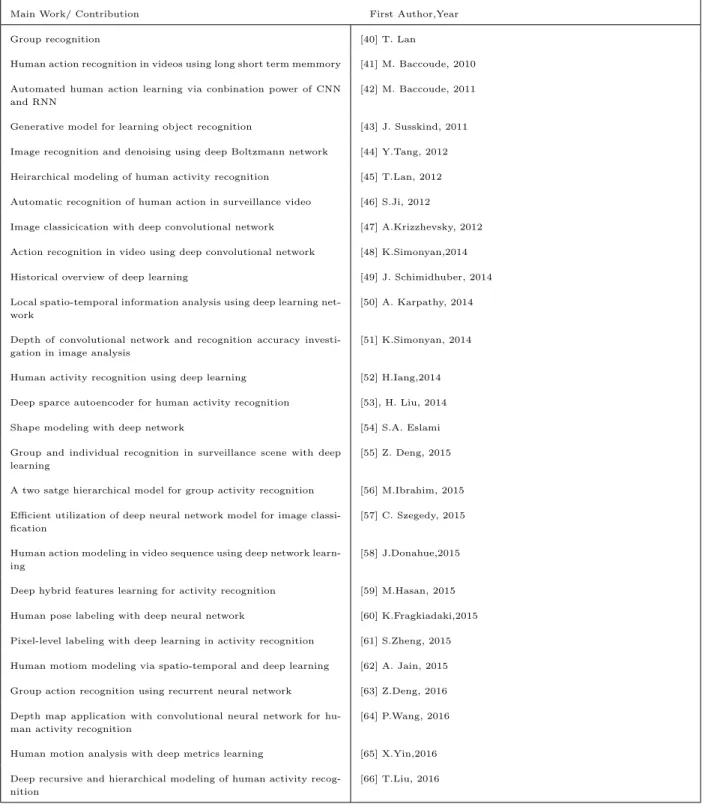
conjunction with codebook essentials and the combination of spatio-temporal features. This method enables a robust construction of the dictionary before SVM is applied for classification. Zhang et al [37] consolidated the conventional clustering method by developing the subspace clustering method for improving the difficulty experienced by the conventional clustering method inability to handle multidimensional dataset. These techniques make use of the density-based clustering method that is capable of obtaining clusters by utilizing axis-parallel subspace. Data collection is achieved by the sensor’s devices and features necessary for human activity recognition are gotten and clustered. The non-parametric similarity in the trajectory data motion feature in relation to the Bayesian network proposed by Neil et al [38] was used for the recognition of human activities. A tracker that functions well with colours is then used for data collection and the Hidden Markov Model is used for inferring different activities on the dataset [5, 7, 39]. Examples of these subspace methods are the principal component analysis (PCA), discriminant analysis (LDA) and the fisher linear discriminant analysis are the most common models that have gained popularity in the subspace method of recognition and classification of human actions. Other non-linear subspace methods that have also gained valuable recognition in computer vision sector are the kernel variants such as the kernel principal components analysis (KPCA) the kernel fisher linear discriminant analysis (KLDA) and these have also been applauded for their individual advances in human activity recognition [10, 21]. A summary point of some work done by previous researchers using similar subspace methods and other techniques have also been tabulated in Table (2.1) to give a clear direction on the human activity research work.
These subspace models became the focus of attention due to their successful results shown in face recognition [29, 67]. Hence, their extension to a more complex nature as human activity recognition. The PCA is a handy method that captures the variances associated with a data set and this variance is most significant along the principal axis. The uncorrelated principal components are drawn from the correlated data by projecting the entire data as orthogonal transformation to a much lower subspace and by this action, the variances in the data are then made explicit. These explicit principal components can point out the basic direction and differences in a data. The principal components in the newer lower subspace are able to preserve much of the variances in the data by a set of eigenvectors with the highest eigenvalues [68, 69]. While the
Table 2.1: Summary Point of Related Articles in Human Activity Recognition
Main Work/ Contribution First Author,Year Group recognition [40] T. Lan
Human action recognition in videos using long short term memmory [41] M. Baccoude, 2010 Automated human action learning via conbination power of CNN
and RNN
[42] M. Baccoude, 2011
Generative model for learning object recognition [43] J. Susskind, 2011 Image recognition and denoising using deep Boltzmann network [44] Y.Tang, 2012 Heirarchical modeling of human activity recognition [45] T.Lan, 2012 Automatic recognition of human action in surveillance video [46] S.Ji, 2012
Image classicication with deep convolutional network [47] A.Krizzhevsky, 2012 Action recognition in video using deep convolutional network [48] K.Simonyan,2014 Historical overview of deep learning [49] J. Schimidhuber, 2014 Local spatio-temporal information analysis using deep learning
net-work
[50] A. Karpathy, 2014
Depth of convolutional network and recognition accuracy investi-gation in image analysis
[51] K.Simonyan, 2014
Human activity recognition using deep learning [52] H.Iang,2014 Deep sparce autoencoder for human activity recognition [53], H. Liu, 2014 Shape modeling with deep network [54] S.A. Eslami Group and individual recognition in surveillance scene with deep
learning
[55] Z. Deng, 2015
A two satge hierarchical model for group activity recognition [56] M.Ibrahim, 2015 Efficient utilization of deep neural network model for image
classi-fication
[57] C. Szegedy, 2015
Human action modeling in video sequence using deep network learn-ing
[58] J.Donahue,2015
Deep hybrid features learning for activity recognition [59] M.Hasan, 2015 Human pose labeling with deep neural network [60] K.Fragkiadaki,2015 Pixel-level labeling with deep learning in activity recognition [61] S.Zheng, 2015 Human motiom modeling via spatio-temporal and deep learning [62] A. Jain, 2015 Group action recognition using recurrent neural network [63] Z.Deng, 2016 Depth map application with convolutional neural network for
hu-man activity recognition
[64] P.Wang, 2016
Human motion analysis with deep metrics learning [65] X.Yin,2016 Deep recursive and hierarchical modeling of human activity
recog-nition
principal components are vital and significant for retaining a major part of the original data, the non-principal components are assumed infinitesimal and are often discarded [29]. Therefore, discarding the eigenvectors that retain the non-principal components eigenvalues amount to losses in the PCA model and this is the primary cause of its poor recognition ability. Again, another disadvantage of the PCA method is the weakness in encoding class label information thereby making it a poor model for classification. The LDA model is another subspace method that has also gained relevance in human activity recognition. This method attempts to locate the best axis in the subspace which maximizes the distance between the label of dissimilar activities while minimizing the distance of similar activity. Encoding labels is a unique characteristic of LDA as this feature makes it a better technique for handling labeled datasets unlike its PCA subspace counterpart. The between class matrix accounts for the maximization of the variances between dissimilar activities, while the within-class matrix minimizes the variation of similar class. In the works of [29, 70, 71], LDA was reported to be more efficient than the PCA and that this was due to its feature extracting power. However, because of the problem of singularity common to high dimensional datasets like human activity dataset, this method suffers from the inability to have inverted within-class matrix. Taking the inverse of the within-class matrix is often too problematic because the covariance estimates cannot attain a full ranked status and, therefore, cannot be inverted. Fishers proposed the Fisher’s linear discriminant analysis (FLDA) to solve the singularity problem caused by small sample size on LDA and his idea was to use the PCA to reduce data dimension before performing LDA. At this stage, the bulk of the principal components are retained, and the non-principal components are discarded before the LDA method is implemented [5]. The application of PCA at the onset for data reduction seems to have solved the singularity problem. However, the trade-off was the loss of information with the PCA application at the initial stage. This trade-off has undermined the success recorded with the FLDA method. Another variant of the subspace method is the DLDA. This method has its within-class scatter matrix null space discarded while retaining eigenvectors with the least eigenvalues [72, 73]. The disadvantage of this method is the undue scaling characteristics obtained when smaller eigenvalues are used to scale their corresponding eigenvectors and this can affect the recognition results. Bappaditya et.al [5] offered a holistic technique of eigenspectrum regularization to enhance the recognition method using three parameter constants. A
2.1 A Brief Historical Review on Deep Learning
breakdown of the within-class eigenspace into three different sections is done and these sections are regularized from each other. The succinct and sure start and end limit of these three subspaces area can be very hard and challenging to determine. The three subspaces region formed by subdividing the complete eigenspace can also be too burdensome and susceptible to error. For that reason, one of our research questions was centered on how to advance the latest state of the art performance chronicled in [5]. A modeling of the within-class matrix using additional parameter was a conceivable idea and this work has produced a better feature extraction and representation. The variances related to the within-class matrix of our model was effective in capturing key information on the dataset and this has led to terrific discriminative power without having to discard useful eigenvectors as practiced in most subspace methods [49, 57, 74, 75].
2.1
A Brief Historical Review on Deep Learning
Until recently, many computer vision and machine learning techniques have been using simple non-hierarchical shallowed architecture for pattern recognition and classification purposes and tremendous success has been recorded with the use of these techniques. A notable characteristic of these shallow architectures contains a simple layer of non-linear feature transformation model which is a sharp contrast to its deep counterpart with much complex form of convoluted non-linear features. An example of commonly used shallow architectures are the hidden Markov models (HMM), conditional random fields (CRFs), support vector machine (SVM), Gaussian mixture models (GMMs), linear and non-linear dynamical systems, multi-layer perceptron (MLP) with a single hidden layer, maximum entropy (MaxEnt) models and Kernel regression. The uniqueness of these shallow architectures is their relative computational stage simplicity and typical arrangement with a single layer of transformation. This simple layer can map raw input from their immediate environment to a more separable feature sub-space than their original space. The SVM and other known conventional kernel methods illustrate this simple shallow architecture as its linear separation pattern is strengthened with a one or zero feature transformation layer often done with the help of the kernel tricks. While shallow architecture has demonstrated its strong capability of solving simple
2.1 A Brief Historical Review on Deep Learning
problem-solving skills become inadequate when more complex environments (natural language processing, computer vision system, human speech recognition, signal pro-cessing and so on) are to be modeled. Figure 2.1 illustrate different human actions ranging from simple action performed by individuals to more complex action under-taken by more persons. Designing the representation abstraction power is a function of each scene complexity and these complex scenes cannot be handled by shallow archi-tectures. Hence, this millennium has embraced the use of deep representational power of neural networks often referred to as deep learning in most literature[76]. This kind of learning has recently become prominent in extracting complex features and enables multiple level representation and having feature vector reuse ability. For example, a lot of computer vision systems are increasingly being designed with layered hierarchical structure that provides quick and real time pixels information processing in complex scenes thereby providing adequate in-depth interpretation of various actions in such environments[64, 77, 78]. Deep learning architecture are designed to have numerous layers of non-linear processing agents where the input to a layer above is an immedi-ate output from a layer beneath. For the purpose of classification, such higher layer of representations is used to develop key and important aspects of the input to aid discrimination, while suppressing less discriminative and redundant parts of the input. The great success achieved in the field of deep learning are partly because of their unique generative nature, also with the discriminative ability the additional layers of-fer. Secondly, the unsupervised pretraining procedure inherent in most deep learning architecture allows a huge number of unlabeled training data for the effective repre-sentation of structures and hidden patterns in the input features[75, 79]. Historically, the ubiquitous relevance of deep learning originated from artificial neural networks and it has witnessed a lot of transformational development over the years. Such models with concatenated non-linear layers of neurons have been in existence since the 1960s [80–83]. Models that exhibit this deep architecture are the feed forward neural network, MLPs with numerous latent layer and other deep model variants recently developed (see Section 2.2 and 2.3). Back-propagation, a well known weight adjustment method for NNs improvement and refining tricks have been in existence for long [84–86]. How-ever, it gained greater popularity in the 1980s. Fortunately, back-propagation method was no longer a panacea for accurate results in NNs as researchers quickly learnt about its numerous demerits in learning networks with more and complex hidden layers (
2.2 Building Deep Representational Learning
Review works of [87] and [88] attest to this. Back-propagation minimizes errors the through local gradient descent that initializes its start point randomly from any given point. With a greater depth of neural network connection, the error propagated get barreled in the local optima often called the local optima problem. This leads to a common error that causes gradient exponential shrinkage or growth often referred to as vanishing or exploding gradient respectively. The challenges posed by this gradient inefficiency has compelled researchers to walk away from using backpropagation for neural networks weight adjustments. More recently, researchers have turned to more efficient shallow models (SVNs CRFs and MaxEnt model) for obtaining robust global optima together with convex loss function. Nowadays, most researchers proceed first by training their models on shallow problems and then try to extrapolate their solu-tions to fit a deeper model. The introduction of unsupervised learning algorithms has helped steer the optimization of deep models to a positive direction and this was fully discussed and highlighted in [89, 90]. This kind of model is often generative and build-ing such deep models for optimization purpose has received great attention in recent times[16–20].
2.2
Building Deep Representational Learning
Geoff Hinton in 2006, expanded representational learning popularly referred to as deep learning in recent times. This representational learning is the primitive feature of learn-ing variants method that are useful in the holistic description of data structure. The importance of depth in representational learning underscores the need to highlight dif-ferent forms of building deep representational learning (see Section 2.3). The composite and heavy computational nature of network depth makes it more difficult for training purposes and a lot of research has been directed towards solving this particular problem in the computer vision sector [65, 76, 91–93].
Deep learning presents two major advantages to computer vision. Firstly, feature reuse in deep learning has been a formidable point that explains the strength inherent in distributed representations and theoretical gains recorded in multiple levels of rep-resentation or hierarchical feature learning. Secondly, deep architectures are capable of learning abstract features at higher layers of representation in a progressive form.
2.2 Building Deep Representational Learning
Figure 2.1: Different Human Action - (i) Single person action (ii) Two person interaction (iii) Group activity action.
2.2 Building Deep Representational Learning
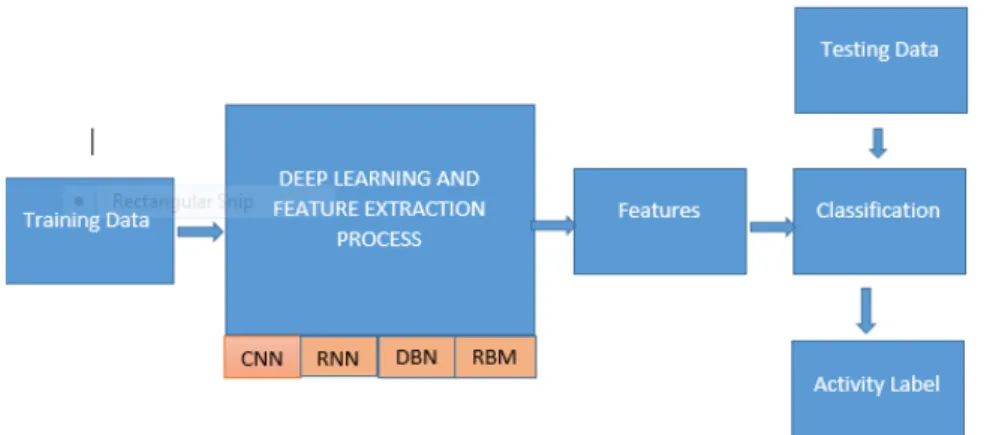
Figure 2.2: Feature Extraction and Training - Block Representation of Deep Learning Model
Theoretical results in [94–99], show clear directions of progress with deep learning rep-resentation efficiency than the shallow or insufficiently deep network model. The block illustration of deep learning stages as shown in Figure 2.2 is also like the traditional hand-crafted method of feature extraction except that the algorithm and techniques inherent in the black box are different CNN steps with multiple processing units for better feature extraction. In this chapter, the highlight of evolving practices in deep learning is discussed and particularly recent gains in human activity recognition. A significant milestone has been recorded in predicting various human activities, even in hierarchical complex environments such as group recognition have also benefited a great deal. While every effort has been made by different authors to present a better repre-sentational model capable of learning and exploring human actions and their primitives dynamics, there still exist a huge gap that needs to be bridged in the recognition and classification tasks. Such obvious gaps in the computer vision sector underscores the need to build robust and deep representational models.
Several research studies[89, 100, 101] were put forward by researchers in same year and many others have taken tremendous interest in deep learning including authors of [88, 102]. Learning of stacked features at one level at a time which was referred to as
2.2 Building Deep Representational Learning
feature learning for specific learning purpose at each level. The features learned at this level are used as input to subsequent immediate upper levels. A resultant effect of this action places additional layers of weights to deep neural networks. Furthermore, the combination of this unsupervised layer can then be used to initialize deep supervised neural networks. A generative model that reflects such initialization of deep supervised network is the deep Boltzmann machine (DBM) (Subsection 2.3.1). In [103, 104], it was observed that stacking of extracted features in a layer wise form is a veritable tool in harnessing deep and better representation of hard to model salient structure that improves recognition with less classification error and leverage on the quality of sample built from probabilistic model [105], or improving the invariance characteristics of the extracted feature [106]. The deep features obtained from the greedy layerwise unsupervised pretraining can be used to initialize a deep supervised neural network or as input to a purely supervised machine learning model like the support vector machine (SVM) [107]. An attempt has been made in combining layers of pretrained unsupervised learning so that an excellent and efficient unsupervised model can be created. However, while different methods have been proposed, there has not been a clear distinction as to which method performs the most. The earliest work done was stacking pretrained RBMs to form deep belief network [89] or DBN, in which the concept of Bernoulli-Bernoulli RBM learning of binary features creates an input from the probabilistic activation of the hidden layer. Thus, the output from one RBM machine acts as an input to another RBM layer. A first-hand implementation of the layer-by-layer greedy learning in [52] shows that this strategy is indeed efficient and helpful in human recognition and other classification tasks. Secondly, the autoencoder is another veritable model capable of building deep learning networks (Subsection 2.3). This method of deep learning attempts to model the system input to become the output by adjusting the weights of the hidden layers to perfect the encoding scheme. This is well suited for video streams because of its robustness in hierarchical distributed feature leaning method used. Also, it is well suited for modeling high dimensional time series events like human motions [53, 65]. Different methods of back-propagation types (for example conjugate gradient method, steepest descent, and so on) techniques are used for training the autoencoder. However, it has been observed that the back propagating error in a large deep network can become very tractable and this is a major disadvantage of this method. Another approach that has been proposed is the combination of RBM
2.2 Building Deep Representational Learning
parameters into the deep Boltzmann machine (DBM). The DBM is another known member of the Boltzmann machine family having its unit like the RBM arranged in layers. Unlike the RBM, its layers are of multiple hidden units. The goal is to half the RBM weights such that the DBM weight can be obtained. The likelihood maximization unlike the RBM is not done directly. Instead the lower bound likelihood is maximized by some chosen parameters [108].
2.2.1 Related Works in Group Activity Recognition Using Deep Neu-ral Network
The explosion of research in activity recognition of human behaviour has led to a fur-ther incursion into an in-depth study of human interactions with scene, object, and their spatial or temporal relationships with others (see Figure 2.1). The latter of these type of human interaction is commonly known as group activities. The concept of rea-soning about structures plays an important role in group activity recognition, effective representation and interpretation of group activity is aggregated from the dynamics of the individual persons in the group activity. The spatio-temporal description between individual and the scene is very vital to group activity recognition. Mostafa et al. [56] proposed a deep hierarchical architecture to model group activities using a structured temporal framework. A two-stage approach is used to implement this model. The temporal representation of information in the scene from both stages is based on the LSTM model. The first stage of their proposed method is modelling individual person temporal dynamics and secondly combining the person level information from the first model for inferring group activities. This model was reported to be successful in video surveillance, video retrieval and in sport analysis[56]. Considering the fact that com-petitive results can be achieved in human activity recognition by variants of deep neural networks, better classification results can be obtained when deep neural networks are combined with a probabilistic graphical model as conducted by Z. Deng et al[55]. The work of Deng et al.[55], focused on the combination of CNNs with the graphical model. The introduction of the graphical models as reported in [40, 45] allows hierarchical structures to be integrated into group activities modelling and other human interaction for the purpose of recognition and classification. The key components of the proba-bilistic graphical model are derived from the multi-step message passing neural network
2.2 Building Deep Representational Learning
Again, Deng et al.[63] in a similar combination of graphical and deep neural network was able to bridge the difficulty that exists in the use of low level concept output in interpreting high level compositional scenes. The use of a generative architecture (Re-current Neural Network) is used instead of using other traditional inference methods. Antic and Ommer [79] proposed the use of semi-local parts (latent constituent) in inter-preting group activities. This method is based on learning the classifier with parts that are functionally related which in general are the group activity constituents. Lan et al.[109] proposed three different approaches (adaptive structure learning, feature level learning and the combination of both learning methods) for finding the interactions between low level person-person relationship to a higher group-level interaction. The adaptive latent structure learning was modeled to reduce the redundant person actions that are not relevant in group activity modeling and recognition. Thus, this model dynamically decides inter-relationship between group members. Donahue et al. [58] proposed a ”doubly deep” model (spatially and temporally deep) capable of handling computer vision sequential interaction dynamics. In this model, a deep hierarchical like structure (CNN) in combination with LSTM for training a recognition model is devel-oped. The model can encode temporal state dependencies. The doubly deep model function by transforming visual input (video frame) to a fixed length feature vectors with the help of convolutional neural network, the output from the CNN becomes the input to the second non-linear model(LSTM) that is connected to an output for recog-nition and classification. The Network-in-Network proposed by Lin et al.[110] is used to leverage the representational power of neural networks by increasing the convolu-tional depth with a 1×1 convolution. While 1×1 convolution increases the depth, a better classification is reported. Szegedy et al. [57] introduced deep neural network architecture that is like that proposed by Lin et al. [110]. This model was able to capture representational power in their architecture, both in depth and width using the 1×1 convolution building blocks. The most remarkable aspect of this method is that it enhances the utilization of the computing assets of the network. Mohamed et al. [111] developed a deep graphical model that is able to represent long-range and higher-order spatiotemporal dependencies of video features using a robust inference model called Hierarchical Random Field (HiRF). The (HiRF) concept combines input features to form mid-level video representations which are reflective on its performances as a model that can be used for effective recognition and localization in group activity
2.3 Different Classes of Deep Learning architecture
modeling. Unique characteristics of this model are its abilities to perform collective foreground grouping while discarding features estimated as background noise. The Fu-sion of convolutional network proposed in [50] came in handy for its unique form of fusing different input layer frames with different deep networks. The combination of two streamed CNNs as proposed by [48] highlighted the effectiveness of combining a CNN with a priori RGB frames and another CNN trained with a pile of 10 flow frames. The state-of-the-art results recorded in the shallow model of HDMB [112] and UCF101 [113] is comparatively like the combinational averaging effect using both RGB and flow frames. Furthermore, the use of the Support Vector Machine (SVM) for fusing RGB and flow methods has improved the recognition results as opposed to the simple score aggregate as earlier mentioned. Like [56], however, with a 3D convolutional neural network, deep spatio-temporal features are also learned [46] and [42]. In [42] and [41], a comprehensive study is done on visual and motion features extraction and the use of recurrent network for shaping temporal dependencies.
2.3
Different Classes of Deep Learning architecture
Deep learning as earlier discussed, refers to the hierarchical composition of non-linear information processing paradigm. The techniques and architectural model intended for use are influenced by the complexity of recognition/classification task. This section captures an overview on different deep learning architecture and they can be categorized into two major classes (Generative and Discriminative).
2.3.1 Generative architecture
Generative deep architecture is a robust approach that is used for achieving high-order correlation features of observed data in most machine learning tasks. In this type of architecture, the process of feature learning is unsupervised since the labels for the data are never used for learning purposes. By so doing, the entire data hidden struc-ture is learnt dynamically. The advantage of generative architecstruc-ture is its ability to aid supervised learning by its ”pre-training” module. This enables the lower levels of deep neural networks to be trained layer by layer (bottom-up) before committing to the overall learning of the e