Journal of Arts and Sciences Say›: 6 / Aral›k 2006
Positive Integral Operators With
Analytic Kernels
Can Murat D‹KMEN1
Abstract
In this paper we construct examples of positive definite integral kernels which are also analytic. Key words:Integral operators, Cauchy integral formula, Positive definite kernels,
Abstract
Bu çal›flmada ayn› zamanda analitik olan pozitif tan›ml› integral çekirdek örneklerini oluflturaca¤›z. Anahtar Kelimeler: ‹ntegral operatörler, Cauchy integral formülü, Pozitif tan›ml› çekirdekler.
1. INTRODUCTION
To construct examples of positive definite integral kernels which are also analytic, we need to recall the following definitions (see [2], [3], [4], [5]).
Throughout, let us denote the inner product on any complex Hilbert space Hby
Definition 1.1.(i) Let denote any interval (finite or infinite) on the real line. L2(I)
is the space of Lebesgue measurable complex valued functions
–––––––––––––––––––––––––––––– .,.
¢ ². We let ¢f f, ²1/ 2 f and call it the norm of f .
:
which are square integrable, in the sense that
( )
2I
f t
dt
f
³
, with pointwise operations and inner product,
( ) ( )
If g
f t g t dt
¢
²
³
. So the norm off
is 2 2( )
If
³
f t
dt
f
.(ii) Given two intervals
I J
,
L I
2u
J
= all measurable complex valued functions k on
I
u
J
such that2
( , )
I J
k s u
duds
f
³ ³
.Definition 1.2. Let
H H
,
1 be Hilbert spaces. A linear operatorS H
:
1o
H
is bounded if there exists someM
¡
such that1
for all
Sf
d
M f
f
H
.A linear operator
S H
:
1o
H
is compact if given a bounded sequence 1(
f
n)
H
, there exists a subsequence(
)
,
r n n
f
f
g
H
such that r nSf
o
g
.We use
B H H
(
1,
)
andK H H
(
1,
)
for the space of all bounded linear operators and for all compact operators fromH
1 intoH
respectively.Theorem 1.1. If
S
B H H
(
1,
)
, there exists a uniqueS
B H H
( ,
1)
, called adjoint ofS
, such that1
,
H,
HSf g
f S g
¢
² ¢
²
.If
H
H
1 andS
S
, thenS
is called self-adjoint or symmetric.Definition 1.3. Let
T
be a self-adjoint linear operator on a Hilbert spaceH
, .,.
¢ ²
. ThenT
is called positive, writtenT
t
0
, if¢
Tf f
,
² t
0
for allf
H
. Definition 1.4. LetI J
,
¡
be intervals and supposek
L I
2(
u
J
)
, then the formula( )
( , ) ( )
J
Sf s
³
k s u f u du
where
s
I f
,
L J
2( )
, defines a compact linear operatorS
mappingL J
2( )
intoL I
2( )
. The adjointS
:
L I
2( )
o
L J
2( )
is given by( )
( ) ( , )
I
S g u
³
g t k t u dt
. RSo if
g
L I
2( )
( )
( ) ( , )
( ) ( , ) ( , )
( ) ( , )
J I J ISS g s
S g u k s u du
g t k t u k s u dtdu
g t K s t dt
³
³ ³
³
where( , )
( , ) ( , )
,
.
JK s t
³
k s u k t u du s t
I
Figure 1.1.It is well known that, because
k
L I
2(
u
J
)
, interchanging the order of integral is legitimate and thatK
L I
2u
I
.Theorem 1.2. Here
T
SS
is necessarily positive writtenT
t
0
meaning that,
0
Tf f
¢
² t
for allf
H
. Proof: 2 2 2 2 2 ( ) ( ) ( ) ( ),
,
,
0
L I L I L J L JTg g
SS g g
S g S g
S g
¢
²
¢
²
¢
²
t
.Similarly
S S
is positive operator onL J
2( )
.This gives us a method of constructing examples of positive integral operators on 2
( )
L I
. Wheneverk
L I
2(
u
J
),
T
SS
will be a positive integral operator on 2( )
L I
with kernel( , )
( , ) ( , )
.
JK s t
³
k s u k t u du
2( )
L J
2( )
L I
2( )
L I
t
T
SS
S
S
s
g
S g
f
Sf
Definition 1.5. Here
k
is called kernel ofS
andK
is called the kernel ofT
. Remark 1.3. Ifk s u
( , )
l s u h u
( , ) ( )
whereh u
( )
1
then( , ) ( , )
( , ) ( , )
.
J
k s u k t u du
Jl s u l t u du
³
³
Remark 1.4. A result analogous to theorem is true if the Lebesque measure on
J
is multiplied by a positive constantm
(usually1/ 2
S
). In this case we have( )
( , ) ( )(
)
JSf s
³
k s u f u mdu
wheres
I f
,
L J
2( )
and( )
( , ) ( )
IS g u
³
k s u g t dt
whereu
J t
,
I
and
g
L I
2( )
( )
( )
( , ) ( )
ITf s
SS f s
³
K s t g t dt
where( , )
( , ) ( , )(
)
JK s t
³
k s u k t u mdu
.Now, we will use this theorem to give examples of positive definite kernels
K
using kernels
k
which arise in a natural way in mathematical analysis. Specifically we considerk
's which arise from Cauchy's integral formula (C.I.F.).As a sequel we hope to give some more examples using same techniques considering the Fourier transformation and the Laplace transform (see [1]). In all cases
K
will be an analytic kernel ofs
andt
. 2. Examples suggested by C.I.F.In this section we will give some examples of positive integral operators suggested by Cauchy's integral formula which were obtained during my M.Sc. study (see [1] ).
We recall the parameterized Cauchy's integral formula. We parameterize the integral by taking
z
M
( )
u
.Figure 2.1.
Here Ȗ is a positively oriented rectifiable Jordan curve and
D
is its inner domain. Letf
be an analytic neighborhood of D ands
D
1
( )
( )
2
1
( ( )) ( )
.
2
( )
b af z
f s
dz
i
z
s
f
u
u
du
i
u
s
JS
M
M
S
M
c
³
³
Example 2.1. Suppose Ȗ is the unit circle,
I
[ , ]
a b
( 1,1).
Here we shall take[
, ].
J
S S
Figure 2.2.D
M
( )
u
M
a
u
b
J
C
1
J
I
a
b
z
ie
TM
S
T
S
We write the Cauchy's integral formula (C.I.F) to get our integral kernel
1
( )
( )
(
)
2
f z
f s
dz
s
I
i
z
s
S
³
w'
.If we substitute
z
e
iT thendz
ie d
iTT
and1
(
)
( )
.
2
i i if e
ie
f s
d
i
e
s
T T S T ST
S
³
This suggests the linear operator
S L
:
2([
S S
, ])
o
L I
2( )
defined by1
1
( )
( )
( , )
2
i id
Sf s
f
k s
e
s
e
s
S T T ST
T
T
S
§
·
¨
¸
©
¹
³
. Hence1
1
( )
( )
i( , )
i IS g
g t
dt
k t
e
Tt
e
Tt
T
T
§
·
¨
¸
©
¹
³
. Here 21
( , )
i(
)
k s
L I
J
e
Ts
T
u
.For this we need to show that they are square integrable:
2
1
Ie
is
dsd
S S TT
f
³ ³
(2.1) Then, equation (2.1) is true sincek s
( , )
T
is continuous onI
u
J
. So isk t
( , )
T
. SoSS
has kernel( , )
( , ) ( , )
1
.
e
ie
iK s t
k s t k t
d
d
s
t
S S S T T ST
T
T
³
³
(2.2)In general, if
h
is a function onw'
then(
)
=
( )
2
i idz
h e
ie d
h z
S T T ST
S
w'³
³
so that1
(
)
=
( )
2
idz
h e
d
h z
iz
S T ST
S
w'³
³
. (2.3) Now if we use (2.3) in (2.2), then we get 11
1
( , )
2
1
.
2
1
zdz
K s t
iz
z
s
t
dz
i
z
s
zt
S
S
w' w'§
·
¨
¸
©
¹
³
³
The poles of integrand are at
z
s
and
z
1/ .
t
Sinces t
,
I
, we know that1
s
,1/
t
!
1
. Then we have only one pole atz
s
. Therefore, 1 11
1
( , )
Re
( ),
.
2
1
zt
K s t
dz
s f z s
i
z
s
st
S
w'³
Since K is the kernel of
SS
, K is positive definite onL I
2( )
whereI
( 1,1)
. Now we will find another positive definite kernel for vertical strip.Example 2.2. Let
E
¡
and let D be the open half-plane^
z
£
: Re
z
!
E
`
. Let Ȗ be the boundary line of D and supposeI
[ , ]
a b
D
, (i.e.a
!
E
), so that,
s t
!
E
wheres t
,
I
.We shall now construct a positive integral operator on
L I
2( )
whose kernel is derived from the Cauchy integral formula for functions analytic in a neighborhood of D.Figure 2.3.
We can parameterize Ȗ by
J
M
( )
u
E
iu
, ( )
M
c
u
i
f f
u
.
Then we have by C.I.F.1
( )
1
(
).
( )
=
2
2
f z
f
iu i
f s
dz
du
i
z
s
i
s iu
E
S
S
E
f w' f³
³
.This suggests us the operator
S L
:
2( )
¡
o
L I
2( )
such that( )
( )
2
f u
du
Sf s
s iu
E
S
³
¡ so we have1
( , )
k s u
s iu
E
.Here we have that
k s u
( , )
L I
2(
u
¡
)
, because 2 2 21
1
IE
s iu
dsdu
IE
s
u
dsdu
³ ³
¡³ ³
¡ .¡
M
E
a
s
b
I
D
J
(R)Sf (s)
=
∫
R
(I
x R) because∫
R
R∫
R
∫
I
1 –––––––––––– dsdu. (β+ s)2+ u2Since the nearest point of
I
to the line Ȗ isa
, we have that(
E
s
)
2t
(
E
a
)
2 for alls
I
. Then, 2 2 2 2 2 21
1
(
)
.
Is
u
dsdu
Ia
u
dsdu
b a
du
a
u
E
E
E
d
f
³ ³
³ ³
³
¡ ¡ ¡ Hence 11
( , )
2
1
.
(
)
(
) 2
du
K s t
s iu
t
iu
du
u i
s
u i
t
E
E
S
E
E
S
³
³
¡ ¡ Figure 2.4.The pole in the upper half plane is at
i
(
E
t
)
. Say1
( )
(
)
(
)
h u
u i
E
s
u i
E
t
¡
(
)
i
E
s
(
)
i
E
t
∫
R
∫
I
∫
R
∫
I
1 –––––––––––––– dsdu (β+ a)2+ u2=
∫
R
∫
R
∫
R
Rthen 1
( , )
Re ( ( ), (
))
1
(
)
(
)
1
.
2
K s t
i
s h u i
t
i
i
t
i
s
s t
E
E
E
E
Since
K s t
1( , )
is the kernel ofSS
, (2.4) is positive definite onL I
2( )
.Suppose now
J
E
iu u
,
¡
and D is all points to the left of Ȗ, that is^
: Re
`
D
z
£
z
E
and thatI
[ , ]
a b
D
(i.e.b
E
).Figure 2.5.
In this case C.I.F. reads
1
( )
1
(
)
( )
=
2
2
f z
if
iu
f s
dz
du
i
z
s
i
iu
s
E
S
S
E
³
³
which suggests the linear operator
S L
:
2( )
¡
o
L I
2( )
such that( )
( )
.
2
f u
du
Sf s
iu
s
E
S
³
¡a
s
b
I
D
E
u
R (R)=
∫
R
Sf (s)Then we have 2
1
( , )
,
.
k s u
s
I u
iu
s
E
¡
Herek s u
2( , )
L I
2(
u
¡
),
because 2 2 2 2 2 2 21
1
1
(
)
.
I I Idsdu
dsdu
iu
s
s
u
dsdu
b
u
b a
du
b
u
E
E
E
E
d
f
³ ³
³ ³
³ ³
³
¡ ¡ ¡ ¡ So 21
( , )
2
1
.
(
)
(
) 2
du
K s t
iu
s
iu t
du
u i
s
u i
t
E
E
S
E
E
S
³
³
¡ ¡ Figure 2.6.The pole in the upper half plane is
i
(
E
s
)
. Say1
( )
(
)
(
)
h u
u i
E
s
u i
E
t
¡
(
)
i
E
t
(
)
i
E
s
R. (I x R), because∫
R
∫
I
∫
R
∫
I
1 –––––––––––––– dsdu (β+ a)2+ u2∫
R
∫
I
1 –––––––––––––– dsdu (β+ a)2+ u2K
2
(s,t)
=
∫
R
=
∫
R
R
Here k2(s,u) ∈L2=
∫
R
then
K s t
2( , )
i
Re ( ( ), (
s h u i
E
s
))
. Hence 21
( , )
.
2
K s t
s t
E
(2.5) SinceK
2 is kernel ofSS
, (2.5) is positive definite onL I
2( )
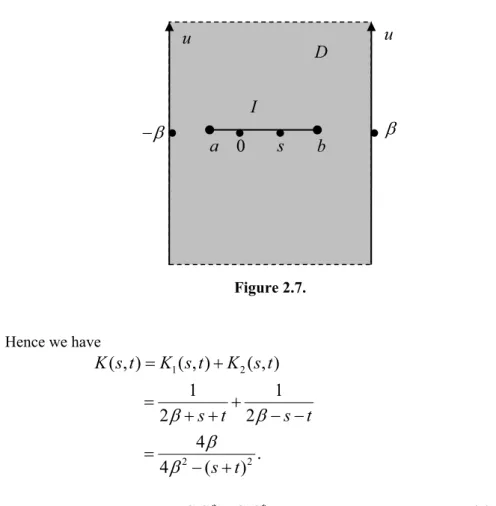
.For the last part of our example we use the fact that the sum of two positive operators is positive. So if
E
!
0
andI
[ , ]
a b
(
E E
, )
, we obtain a positive operator onL I
2( )
with kernelK s t
( , )
which is analytic inD D
u
.Figure 2.7. Hence we have 1 2 2 2
( , )
( , )
( , )
1
1
2
2
4
.
4
(
)
K s t
K s t
K s t
s t
s t
s t
E
E
E
E
(2.6)Again since
K
is kernel ofS S
1 1S S
2 2, (2.6) is positive definite onL I
2( )
. We now give another example which is similar to the last one. This timeD
will be the horizontal strip.a
s
b
I
D
E
u
E
u
0
Example 2.3. Let
E
!
0
and letD
1 be the open half-plane^
z
£
: Im
z
E
`
. Let Ȗ be the boundary line ofD
1 and supposeI
[ , ]
a b
D s t
1, ,
I
.
We shall now construct a positive integral operator on
L I
2( )
whose kernel is derived from the Cauchy integral formula for functions analytic in a neighborhood of1
D
.Figure 2.8.
This time C.I.F. reads
1
( )
( )
2
if z
f s
dz
i
Ez
s
S
³
¡ .If we put
z
i
E
u
then
dz
du
, then we get1
(
)
( )
2
f i
u
f s
du
i
i
u
s
E
S
E
³
¡ .This suggests the linear operator
S L
:
2( )
¡
o
L I
2( )
defined by( )
( )
2
f u
du
Sf s
i
E
u
s
S
³
¡ . Hence( )
( )
Ig t
S g u
dt
i
E
u t
³
.0
a
s
b
1D
I
i
E
∫
R
+i
β
f(z) ––––– dz. z – s f(iβ+ u) –––––––––– du. iβ+ u – s)∫
R
Sf (s)
=
∫
R
(R
)Then we have 1 1
1
1
( , )
and ( , )
k s t
k u t
i
E
u
s
i
E
u t
. Herek s u
1( , )
L I
2(
u
¡
)
, because 2 2 21
1
Ii
E
u
s
dsdu
Iu
s
E
dsdu
³ ³
¡³ ³
¡Let
u
s
E
tan and
T
du
E
sec
2T T
d
. Then, 2 / 2 2 2 / 2 2 2 2 / 2 / 21
sec
tan
1
(
)
.
b I a b a b adsdu
d ds
u
s
d ds
b a
ds
S S S SE
T
T
E
T E
E
T
E
S
S
E
E
f
³ ³
³ ³
³ ³
³
¡ Then we have 11
( , )
2
1
.
(
)
(
) 2
du
K s t
i
u
s
i
u t
du
u
s i
u
i
t
E
E
S
E
E
S
³
³
¡ ¡ Figure 2.9.¡
s i
E
t
i
E
∫
R
∫
R
K
1
(s,t) =
∫
R
=
∫
R
R (I x R), because=
∫
R
The pole in the upper half plane is
t
i
E
. Then, 1 2 2( , )
Re ( ( ),
)
2
2
.
4
K s t
i
s h u t
i
i
t
i
s i
i
t
s
i
i t
s
i
t
s
E
E
E
E
E
E
Hence 1 2 2 12
(
)
( , )
( , )
(
)
4
i t
s
K s t
K t s
t
s
E
E
.Here
K s t
1( , )
is symmetric and positive definite.For the second part of our example we again let
E
!
0
and letD
2 be the open half-plane^
z
£
: Im
z
!
E
`
. Let Ȗ be the boundary line ofD
2 and suppose2
[ , ]
, ,
.
I
a b
D
s t
I
We shall now construct a positive integral operator on 2( )
L I
whose kernel is derived from the Cauchy formula for functions analytic in a neighborhood ofD
2.Figure 2.10. We put
z
M
( )
u
i
E
u
and
dz
du
in C.I.F.i
E
0
a
s
b
2D
I
1
(
)
( )
.
2
f
i
u
f s
du
i
i
u
s
E
S
E
³
¡This suggests the linear operator
S L
:
2( )
¡
o
L I
2( )
such that( )
( )
(
)
2
f u
du
Sf s
i
E
s
u
S
³
¡ . Here 2 21
( , )
(
)
(
)
k s u
L I
i
E
s
u
u
¡
, because 2 2 21
1
by (2, 7).
(
)
Ii
E
s
u
dsdu
Iu
s
E
dsdu
f
³ ³
¡³ ³
¡ Then, 21
( , )
(
)
(
)
2
du
K s t
i
E
s
u
i
E
t
u
S
³
¡ . Figure 2.11. The pole in the upper half plane iss i
E
. Then, 2 2 2 2( , )
Re ( ( ),
)
(
)
1
2
(
)
2
( , ).
4
K s t
i
s h u s i
i
i
t
i
s
i t
s
i t
s
K t s
t
s
E
E
E
E
E
E
¡
t i
E
s
i
E
f (-i
β
+ u)
–––––––––– du.
–i
β
+ u – s
∫
R
=
∫
R
(
I
x
R
), because
∫
R
=
∫
R
∫
I
1 –––––––––––––– dsdu < ∞ by (2,7) (u – s)2+ β2∫
R
(R
) (R
Here
K s t
2( , )
is symmetric and positive definite onL I
2( )
.For the last part of our example, we again use the fact that the sum of two positive operators is positive. So if
E
!
0
andI
[ , ]
a b
¡
, we obtain a positive operator onL I
2( )
with kernelK s t
( , )
. Figure 2.12. 2 2 2 2 2 22
(
)
2
(
)
( , )
(
)
4
(
)
4
4
. (2.8)
4
(
)
i t
s
i t
s
K s t
t
s
t
s
s t
E
E
E
E
E
E
Then (2.8) is positive definite on
L I
2( )
. We will now consider more general half-planes.Example 3.4. Let
0
T S
/ 2
. We define the two half planes by^
`
^
`
1 2:
arg
:
arg
D
z
z
D
z
z
T
T S
T S
T
£
£
1 2[ , ],
0 so
I
a b
a
!
I
D
I
D
. LetJ
1w
D
1,
J
2w
D
2 and putZ
e
iT . We can parameterizeJ
1 byM
( )
u
Z
,
u u
¡
.i
E
0
a
s
b
D
I
i
E
R
(R
.Figure 2.13.
So C.I.F. for
D
1 can be written as1
( )
( )
2
f
u
f s
du
i
u
s
Z Z
S
³
¡Z
where we do not consider
Z
and1/ 2
S
since from Remark 1.3. and Remark 1.4. This suggests the linear operatorS
1:
L
2( )
¡
o
L I
2( )
defined by( )
( )
2
f u
du
Sf s
u
s
S
Z
³
¡ . Then, 2 11
( , )
(
)
k s u
L I
u
s
Z
u
¡
,because¡
M
0a
T
1D
b
I
∫
R
1
f(s)
–––––
2πi
Sf(s) =
∫
R
R
(R
) (I x R)1
1
cos
sin
1
2
cos
1
1 cos
(
)
(
)
1
.
(1 cos )
I I I Idsdu
dsdu
u
s iu
u
s
dsdu
u
s
us
dsdu
u
s
b a
u
a
T
T
Z
T
T
T
d
d
f
³ ³
³ ³
³ ³
³ ³
³
¡ ¡ ¡ ¡ ¡ So that we have 11
( , )
2
(
)(
)
1
.
2
(
)(
)
du
K s t
u
s
u t
du
u
s u
t
S
Z
Z
S
Z
Z
³
³
¡ ¡ Figure 2.14¡
t
Z
s
Z
0
∫
R
=
∫
R
∫
I
1
––––––––––––––––––
dsdu
|
u cos
θ
–s–iu sin
θ
|
=
∫
R
∫
I
≤
∫
R
∫
I
∫
R
=
∫
R
=
∫
R
RThe pole in the upper half plane is
Z
s
. Then, 1 1 2 2 2 2( , )
Re ( ( ),
)
(
) cos
(
) sin
1
(
) sin
(
) cos
(
) sin
(
) cos
( , ).
(
) sin
(
) cos
i
K s t
i
s h u
s
s
t
i
s t
i s t
s t
i s t
s t
i s t
K t s
s t
s t
Z
Z
Z
T
T
T
T
T
T
T
T
Then we know that
K s t
1( , )
is symmetric and positive definite onL I
2( )
.Now we will construct our kernel for
D
2. We can parameterizeJ
2 by( )
u
u u
,
M
Z
¡
. Figure 2.15.¡
M
0
I
2D
a
b
T
RR
.So C.I.F. for
D
2 can be written as1
( )
( )
.
2
f u
f s
du
i
u
s
Z
S
Z
³
¡This suggests us the operator
S
fromL
2( )
¡
toL I
2( )
such that( )
( )
2
f u
du
Sf s
u
s
Z
S
³
¡ . Hence( )
( )
Ig t
S g u
dt
u t
Z
³
. Similarly 2 21
( , )
(
)
k s u
L I
u
s
Z
u
¡
. Then we have 21
( , )
2
(
)(
)
1
.
2
(
)(
)
du
K s t
u
s
u t
du
u
s u
t
S
Z
Z
S
Z
Z
³
³
¡ ¡ Figure 2.16.¡
s
Z
t
Z
0
∫
R
1 f (s) = – ––––– 2πi Sf (s) =∫
R
(
I
x
R).
K2(s,t) =∫
R
=
∫
R
R (R
)The pole in the upper half plane is
Z
t
. Then, 2 2 2 2 2 2( , )
Re ( ( ),
)
(
) cos
(
) sin
1
(
) sin
(
) cos
(
) sin
(
) cos
( , ).
(
) sin
(
) cos
i
K s t
i
s h u
t
t
s
i
t
s
i t
s
t
s
i t
s
t
s
i t
s
K t s
s t
s t
Z
Z
Z
T
T
T
T
T
T
T
T
Then, we know that
K s t
2( , )
is symmetric and positive definite onL I
2( )
.Now for the last part of the example we use the fact that the sum of two positive operators is positive. Figure 2.17.
0
a
b
I
D
T
T
BIBLIOGRAPHY
C.M.Dikmen, Positive Integral Operators with Analytic Kernels.MSc. Thesis, The University of Manchester, 1997.
N.Young. An Introduction to Hilbert space. Cambridge University Press, Cambridge, 1988. W.Rudin. Real and Complex Analysis.McGraw-Hill Book Company, New York, 1966
H.Hochstadt. Integral Equations.John Wiley & Sons Inc., New York, 1973