1256
Wavelet-Based Color Histogram on Content-Based
Image Retrieval
Alexander , Jeklin Harefa* , Yudy Purnama , and Harvianto
Computer Science Department, School of Computer Science, Bina Nusantara University, Jakarta, Indonesia 11480
*Corresponding Author, email: [email protected]
Abstract
The growth of image databases in many domains, including fashion, biometric, graphic design, architecture, etc. has increased rapidly. Content Based Image Retrieval System (CBIR) is a technique used for finding relevant images from those huge and unannotated image databases based on low-level features of the query images. In this study, an attempt to employ 2ndlevel Wavelet Based Color Histogram (WBCH)
on a CBIR system is proposed. Image database used in this study are taken from Wang’s image database containing 1000 color images. The experiment results show that 2nd level WBCH gives better precision (0.777) than the other methods, including 1st level WBCH, Color Histogram, Color Co-occurrence Matrix, and Wavelet texture feature. It can be concluded that the 2ndLevel of WBCH can be applied to CBIR system.
Keywords: CBIR, Wavelet, Color Histogram
Copyrightc 2018 Universitas Ahmad Dahlan. All rights reserved.
1. Introduction
In this era, the large number of digital images have increased rapidly. This is because the large number of images data from various domains, such as fashion, biometric, graphic design, architecture, etc. are in demand. One of the techniques for digital image processing is Content Based Image Retrieval (CBIR). CBIR has been an active research area that helps to access and find the images from huge image database since 1990 [1]. The main idea of CBIR system is to extract the low-level features which are used to measure similarity [2]. It applies the computer vision techniques in image retrieval based on low-level features which can be automatically derived from the features presented in the images, such as color, texture, or shapes [3].
The general systems in CBIR usually only use the low-level features, such as color, texture, and shape, and it doesn’t include any semantic level. Color and Texture are the two most common features used in CBIR. The color histogram is the first technique introduced in pixel domain [4]. It is commonly used in image comparison because it is simple to compute and robust against small changes in camera viewpoint [5]. The texture is also claimed to be the essential feature in image retrieval because it can be decomposed into several parameters, such as coarseness, contrast, and directionality [6]. Thus, many researches have used color and texture features in building the CBIR system.
Youness et al. [7] proposed a novel method for retrieval system using Gabor filters and 2-D ESPRIT method. In this study, each image is characterized by the pair given using Gabor filters and the 2-D ESPRIT method applied to the original image. This experiment achieves average precision of 80.19% using Brodatz images database. Irianto [8] used the Region Growing Segmentation for searching and retrieve image from the database. Compared to Discrete Cosine Transform (DCT) images, this study can gain more efficient time and simplify the algorithm.
Lin et al. [9] introduced three image features which are: color, texture, and color distribution in order to develop a smart retrieval system. This experiment calculates Difference between Pixels of Scan Pattern (DBPSP), Color Histogram for K-mean (CHKM) and Color
Received December 23, 2016; Revised February 5, 2018 ; Accepted February 23, 2018 DOI : 10.12928/TELKOMNIKA.v16i3.7771
Co-occurrence Matrix (CCM) respectively and enhance the performance accuracy and simplified the image retrieval process. Ragupathi et al. [10] proposed a robust image retrieval system using the combination of different feature extraction methods, such as Color Histogram (CH), Gabor Transform (GT), the combination of CH and GT, Contourlet Transform and the combination of CH and Contourlet Transform. Hiremath and Pujari [11] have used the combination of color, texture and shape features within a multiresolution multigrid framework. The research provides a robust feature set and achive the highest precision compared to other retrieval systems.
Another research comes from Manimala and Hemachandran [12]. They introduced the Wavelet Based Color Histogram (WBCH) method in image retrieval which combines the HSV color and Gabor texture features of the image. The study gives a promising result which proved that WBCH has better an average precision compared to the other five methods (0.762). But this method only limited to the first level of WBCH. This paper attempts to improving the average precision of the retrieval system by changing the wavelet level from the first level to the second level and third level of the wavelet in order to obtain more precision.
2. Research Method 2.1. Materials
Data set used in this study is Wang’s image database which is also one of the standard databases for CBIR that contains 1000 images from the Corel image database represented with RGB color space. The images were divided into 10 categories which are African People, Beach, Buildings, Buses, Dinosaurs, Elephants, Flowers, Horses, Mountains, and Food with JPEG format and usually used in a general purpose image database for experimentation.
2.2. Methods
Basically, there are two steps for comparing each image in the database and query image, which are: Feature Extraction and Similarity Matching. For the feature extraction step, it is used to extract the images features for classifying the objects. Similarity Matching is used to get a result that is visually similar [13]. Feature that used in this study are color and texture, while for similarity matching using Histogram Intersection.
Based on the Figure 1, the proposed method will be applied to each database images and the query images. Firstly, every feature in each image will be extracted first and after that, the resemblance to the query image and the image in the database will be obtained. Here are several steps in feature extraction phase:
1. Image Decomposition using Haar Wavelet
In the first step, all Red, Green, and Blue component in database and query images are decomposed using 2nd level Haar Wavelet. The results of this step are: approximate coefficient and vertical, horizontal and diagonal detail coefficients. After that, the approximate coefficient, horizontal, and vertical coefficient of Red, Green, and Blue components are combined. The combined approximate coefficient assign with 0.01, horizontal with 0.008, and vertical with 0.008 (experimentally observed values).
2. Convert (LL, LH, and HL) of RGB to HSV
The frequency sub bands which get from image decomposition steps (approximate (LL), horizontal (LH), and vertical coefficients (HL) where L denotes low frequency and H denotes high frequency) are converted into HSV plane in order to extract the color feature.
3. Quantize HSV to (8,8,8)
For reducing the number of colors, the color is quantized using HSV color histogram by assigning 8 level each to Hue, Saturation, and Value components. So, the quantization will
Figure 1. Flow Diagram of the Proposed Method
After feature extraction phase has been completed, the next step is similarity matching. The steps of similarity matching consist of:
1. Similarity computation with Distance Function
After extracting the features of query image, the next step to be taken is computing the similarity feature of query image and all images in the database. The calculation is performed by using histogram intersection distance using the equation 1. Where |Q| represents the magnitude of the histogram for query image and |D| represents the magnitude of the histogram representative image in database.
dID=
Pn
i=1min[Q[i], D[i]]
min[|Q[i]|, D[i]] (1) 2. Retrieved Images
The 10 most relevant images (with most similar histogram) are shown as the result of retrieval.
3. Result and Analysis
The experiment shows that WBCH using 2ndlevel wavelet gives more precision than the others, including WBCH using the 1st and 3rd level wavelet. The 2nd level WBCH improves the average precision of CBIR system for 0.010.
The comparison of precision result between 2nd level WBCH and the other methods is shown on Table 1 (Wavelet Based Color Histogram / WBCH; Color Histogram /CH; Color-Texture and Color-Histogram based Image Retrieval System / CTCHIRS; Color and Texture Features for Content Based Image Retrieval / CTIRS; The combination of color, texture and shape features using image and its complement / CTSIRS; Content based Image Retrieval System based on Dominant Color and Texture Features / CTDCIRS). Table 1 shows the precision value of each category of the image and also the average precision, while the sample of retrieved images of every category is shown on Table 2.
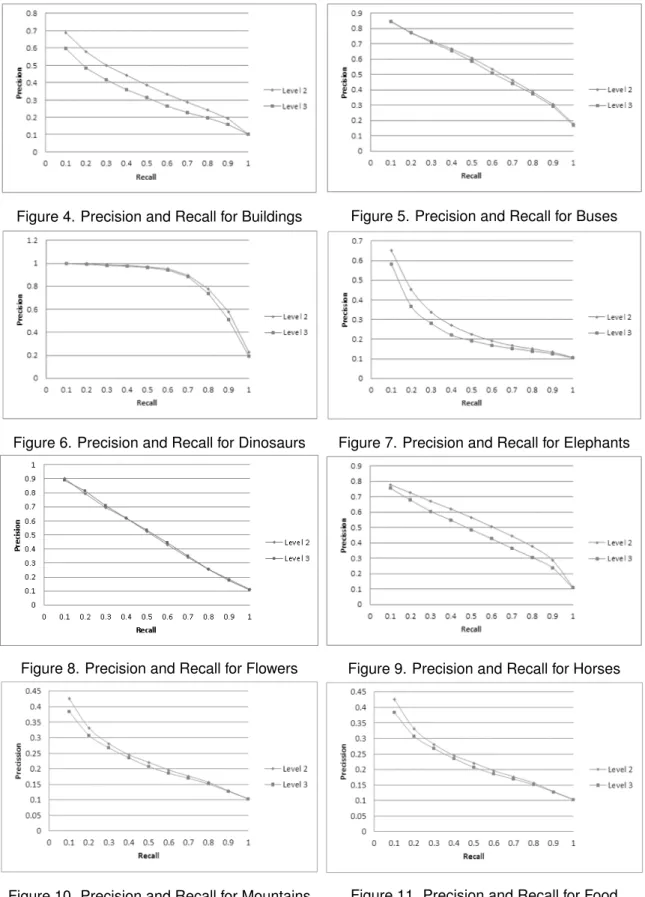
The comparison of precision and recall between 2nd and 3rd level WBCH are shown in figure 2, 3, 4, 5, 6, 7, 8, 9, 10, and 11.
Table 1. Precision Result using Different Methods Classes Category 3rd Level WBCH 2nd Level WBCH 1st Level WBCH [12] CH [12] CTC-HIRS [9] CTI-RS [10] CTS-IRS [11] CTD-CIRS [14] 1 African People 0.836 0.856 0.650 0.720 0.680 0.750 0.540 0.562 2 Beach 0.441 0.468 0.620 0.530 0.540 0.600 0.380 0.536 3 Buildings 0.642 0.729 0.710 0.610 0.560 0.430 0.300 0.610 4 Buses 0.859 0.851 0.920 0.930 0.890 0.690 0.640 0.893 5 Dinosaurs 0.996 0.997 0.970 0.950 0.990 1.000 0.960 0.984 6 Elephants 0.678 0.723 0.860 0.840 0.660 0.720 0.620 0.578 7 Flowers 0.922 0.911 0.760 0.660 0.890 0.930 0.680 0.899 8 Horses 0.776 0.799 0.870 0.890 0.800 0.910 0.750 0.780 9 Mountains 0.958 0.946 0.490 0.470 0.520 0.360 0.450 0.512 10 Food 0.462 0.485 0.770 0.820 0.730 0.650 0.530 0.694 Average Precision 0.757 0.777 0.762 0.742 0.726 0.704 0.585 0.705
Table 2. Sample Image Retrieval Results using 2ndlevel WBCH
Category Query Retrieved Images
African People
Beach
Category Query Retrieved Images Buses Dinosaurs Elephants Flowers Horses
Category Query Retrieved Images
Mountains
Food
Based on the precision and recall in figure 2-11, the wavelet level 2 gives slightly better precision than wavelet level 3. As can be seen on several categories, such as African People (Figure 2), Beach (Figure 3), Buses (Figure 5), Dinosaurs (Figure 6), Flowers (Figure 8), Mountains (Figure 10) and Foods (Figure 11), there are no significant difference between precision using wavelet level 2 and wavelet level 3. While the significant changes are highly visible on the categories of Buildings (Figure 4), Elephants (Figure 7) and Horses (Figure 9). This experiment proves that wavelet level 2 is mostly superior than wavelet level 3.
4. Conclusion
Based on the experiment conducted, it can be concluded that 2nd level Wavelet Based Color Histogram (2nd level WBCH) is a better CBIR method compared to 1st level WBCH, wavelet texture, color histogram, and color co-occurrence matrix. The average precision of 2nd level WBCH is 0.777, which improves the average precision of 1stlevel WBCH for 0.010. The 2nd level WBCH is also surpassing the average precision of the 3rd level WBCH. Since 2nd level
Figure 4. Precision and Recall for Buildings Figure 5. Precision and Recall for Buses
Figure 6. Precision and Recall for Dinosaurs Figure 7. Precision and Recall for Elephants
Figure 8. Precision and Recall for Flowers Figure 9. Precision and Recall for Horses
WBCH obtain promising result, we know that this method can be applied in a CBIR system for many domains.
For future work, in order to improve the precision of image retrieval, shape can be included as the feature to be evaluated.
References
[1] N. Parvin and P. Kavitha, “Content based image retrieval using feature extraction in jpeg domain and genetic algorithm,”Indonesian Journal of Electrical Engineering and Computer Science, vol. 7, no. 1, pp. 226–233, 2017.
[2] W. Zukuan, K. Hongyeon, K. Youngkyun, and K. Jaehong, “An efficient content based image retrieval scheme,” Indonesian Journal of Electrical Engineering and Computer Science, vol. 11, no. 11, pp. 6986–6991, 2013.
[3] N. G. Rao, V. V. Kumar, and V. V. Krishna, “Texture based image indexing and retrieval,”
IJCSNS International Journal of Computer Science and Network Security, vol. 9, no. 5, pp. 206–210, 2009.
[4] M. J. Swain and D. H. Ballard, “Color indexing,” International journal of computer vision, vol. 7, no. 1, pp. 11–32, 1991.
[5] X.-H. Han and Y.-W. Chen, “Imageclef 2010 modality classification in medical image retrieval: Multiple feature fusion with normalized kernel function.” in CLEF (Notebook Papers/LABs/Workshops), 2010.
[6] H. Tamura, S. Mori, and T. Yamawaki, “Textural features corresponding to visual perception,”
IEEE Transactions on Systems, man, and cybernetics, vol. 8, no. 6, pp. 460–473, 1978. [7] C. Youness, O. Mohammed, A. Brahim et al., “New method of content based image
retrieval based on 2-d esprit method and the gabor filters,”Indonesian Journal of Electrical Engineering and Computer Science, vol. 15, no. 2, pp. 313–320, 2015.
[8] S. Y. Irianto, “Segmentation for image indexing and retrieval on discrete cosines domain,”
TELKOMNIKA (Telecommunication Computing Electronics and Control), vol. 11, no. 1, pp. 119–126, 2013.
[9] C.-H. Lin, R.-T. Chen, and Y.-K. Chan, “A smart content-based image retrieval system based on color and texture feature,”Image and Vision Computing, vol. 27, no. 6, pp. 658–665, 2009. [10] G. Raghupathi, R. Anand, and M. Dewal, “Color and texture features for content based image retrieval,” inSecond International conference on multimedia and content based image retrieval, vol. 3, 2010, pp. 39–57.
[11] P. Hiremath and J. Pujari, “Content based image retrieval using color, texture and shape features,” inAdvanced Computing and Communications, 2007. ADCOM 2007. International
Conference on. IEEE, 2007, pp. 780–784.
[12] M. Singha and K. Hemachandran, “Content based image retrieval using color and texture,”
Signal & Image Processing, vol. 3, no. 1, p. 39, 2012.
[13] P. Suhasini, K. Krishna, and I. M. Krishna, “Cbir using color histogram processing.”Journal of Theoretical & Applied Information Technology, vol. 6, no. 1, 2009.

![Table 1. Precision Result using Different Methods Classes Category 3 rd Level WBCH 2 nd Level WBCH 1 st Level WBCH [12] CH [12] CTC-HIRS[9] CTI-RS[10] CTS-IRS[11] CTD-CIRS[14] 1 African People 0.836 0.856 0.650 0.720 0.680 0.750 0.540 0.562 2 Beach 0.441 0](https://thumb-us.123doks.com/thumbv2/123dok_us/377286.2541641/4.892.133.762.191.486/precision-result-different-methods-classes-category-african-people.webp)