Managing Supplier Involvement in New Product
Development: A Multiple-Case Study
Ferrie E.A. van Echtelt, Finn Wynstra,
Arjan J. van Weele and Geert Duysters
ERIM
R
EPORTS
ERIESR
ESEARCH INM
ANAGEMENT ERIM Report Series reference number ERS-2006-047-LISPublication August 2006
Number of pages 45
Persistent paper URL
Email address corresponding author [email protected]
Address Erasmus Research Institute of Management (ERIM)
RSM Erasmus University / Erasmus School of Economics Erasmus Universiteit Rotterdam
P.O.Box 1738
3000 DR Rotterdam, The Netherlands Phone: + 31 10 408 1182 Fax: + 31 10 408 9640 Email: [email protected] Internet: www.erim.eur.nl
Bibliographic data and classifications of all the ERIM reports are also available on the ERIM website: www.erim.eur.nl
ERASMUS RESEARCH INSTITUTE OF MANAGEMENT
REPORT SERIES
RESEARCH IN MANAGEMENT
A
BSTRACT ANDK
EYWORDSAbstract Existing studies of supplier involvement in new product development have mainly focused on project-related short-term processes and success-factors. This study validates and extends an existing exploratory framework, which comprises both long-term strategic processes and short-term operational processes that are related to supplier involvement. The empirical validation is based on a multiple-case study of supplier collaborations at a manufacturer in the copier and printer industry. The analysis of eight cases of supplier involvement reveals that the results of supplier-manufacturer collaborations and the associated issues and problems can best be explained by the patterns in the extent to which the manufacturer manages supplier involvement in the short-term ànd the long-term. We find that our initial framework is helpful in understanding why certain collaborations are not effectively managed, yet conclude that the existing analytical distinction between four different management areas does not sufficiently reflect empirical reality. This leads us to reconceptualize and further detail the framework. Instead of four managerial areas, we propose to distinguish between the Strategic Management arena and the Operational Management arena. The Strategic Management arena contains processes that together provide long-term, strategic direction and operational support for project teams adopting supplier involvement. These processes also contribute to building up a supplier base that can meet current and future technology and capability needs. The Operational Management arena contains processes that are aimed at planning, managing and evaluating the actual collaborations in a specific development project. The results of this study suggest that success of involving suppliers in product development is reflected by the firm’s ability to capture both short-term and long-short-term benefits. If companies spend most of their time on operational management in development projects, they will fail to use the ‘leverage’ effect of planning and preparing such involvement through strategic management activities. Also, they will not be sufficiently able to capture possible long-term technology and learning benefits that may spin off from individual projects. Long-term collaboration benefits can only be captured if a company can build long-term relationships with key suppliers, where it builds learning routines and ensures that the capability sets of both parties are aligned and remain useful for future joint projects.
Free Keywords New Product Development, Innovation, R&D Management, Supplier Relations, Purchasing Availability The ERIM Report Series is distributed through the following platforms:
Academic Repository at Erasmus University (DEAR), DEAR ERIM Series Portal
Social Science Research Network (SSRN), SSRN ERIM Series Webpage
Research Papers in Economics (REPEC), REPEC ERIM Series Webpage
Classifications The electronic versions of the papers in the ERIM report Series contain bibliographic metadata by the following classification systems:
Library of Congress Classification, (LCC) LCC Webpage
Journal of Economic Literature, (JEL), JEL Webpage
ACM Computing Classification System CCS Webpage
Managing supplier involvement in new product development:
a multiple-case study
Ferrie E.A. van Echtelt*, Finn Wynstra** a, Arjan J. van Weele***, Geert Duysters****
* Centrica, United Kingdom
** Erasmus Research Institute of Management, RSM Erasmus University, Netherlands *** Eindhoven Centre for Innovation Studies, Eindhoven University of Technology, Netherlands
**** UNU-MERIT and ECIS, The Netherlands
a Corresponding author: Finn Wynstra, RSM Erasmus University, PO Box 1738, 3000 DR
Rotterdam, Netherlands, Tel +31 (0)10 4081990, Fax +31 (0)10 4089014, Email: [email protected].
Managing supplier involvement in new product development:
a multiple-case study
Ferrie van Echtelt is a former PhD student at Eindhoven University of Technology and Océ,
and is currently working for Centrica, a global provider of energy and related services.
Finn Wynstra is NEVI Professor of Purchasing and Supply Management at RSM Erasmus
University. He is currently Editor of the Journal of Purchasing and Supply Management, and
a past Chair of the International Purchasing and Supply Education and Research Association
(IPSERA).
Arjan van Weele is NEVI Professor of Purchasing and Supply Management at the
Department of Technology Management, Eindhoven University of Technology. Before, he
worked for 15 years in management consultancy both at PriceWaterhouseCoopers and
Holland Consulting Group where he built his specialized consultancy in purchasing and
supply chain management.
Geert Duysters is Professorial Fellow at UNU-MERIT and Professor of Organization Science
at the Department of Technology Management, Eindhoven University of Technology. He
also acts as a global board member of the European Chapter of the Association of Strategic
Alliance Professionals (ASAP) and as an alliance expert for the European Commission and
the OECD.
Managing supplier involvement in new product development:
a multiple-case study
Abstract
Existing studies of supplier involvement in new product development have mainly focused on project-related short-term processes and success-factors. This study validates and extends an existing exploratory framework, which comprises both long-term strategic processes and short-term operational processes that are related to supplier involvement. The empirical validation is based on a multiple-case study of supplier collaborations at a manufacturer in the copier and printer industry. The analysis of eight cases of supplier involvement reveals that the results of supplier-manufacturer collaborations and the associated issues and problems can best be explained by the patterns in the extent to which the manufacturer manages supplier involvement in the short-term ànd the long-term. We find that our initial framework is helpful in understanding why certain collaborations are not effectively managed, yet conclude that the existing analytical distinction between four different management areas does not sufficiently reflect empirical reality. This leads us to reconceptualize and further detail the framework. Instead of four managerial areas, we propose to distinguish between the Strategic Management arena and the Operational Management arena. The Strategic Management arena contains processes that together provide long-term, strategic direction and operational support for project teams adopting supplier involvement. These processes also contribute to building up a supplier base that can meet current and future technology and capability needs. The Operational Management arena contains processes that are aimed at planning, managing and evaluating the actual collaborations in a specific development project. The results of this study suggest that success of involving suppliers in product development is reflected by the firm’s ability to capture both short-term and long-short-term benefits. If companies spend most of their time on operational management in development projects, they will fail to use the ‘leverage’ effect of planning and preparing such involvement through strategic management activities. Also, they will not be sufficiently able to capture possible long-term technology and learning benefits that may spin off from individual projects. Long-term collaboration benefits can only be captured if a company can build long-term relationships with key suppliers, where it builds learning routines and ensures that the capability sets of both parties are aligned and remain useful for future joint projects.
Key words: new product development; innovation; R&D management, supplier relations; purchasing.
The relevance of supplier involvement in product development
Over the past two decades, several studies have shown that product development has become an increasingly important vehicle in developing and maintaining a strong position in an increasingly competitive business arena (Cooper and Kleinschmidt, 1987; Schoonhoven et al., 1990; Gupta and Wilemon, 1990; Brown and Eisenhardt, 1995; Smith and Reinertsen, 1998). Consequently, the demands on product development performance, in terms of speed, performance and cost, have become more stringent. Companies are constantly subject to pressures to deliver superior value to their customers. This requires a set of processes to coordinate, improve and reconfigure their critical capabilities and resources. Increasingly, many of these capabilities and resources reside outside the boundaries of the focal firm.
Earlier and more extensive involvement of suppliers in product development is argued to be one of the ways to enhance product development performance in terms of productivity, speed and product quality (Clark, 1989; Gupta and Souder, 1998; Ragatz et al., 2002; Primo and Amundson, 2002). Suppliers have been shown to provide a source of innovative ideas and critical technologies (Håkansson, 1987; Bonaccorsi and Lipparini, 1994; Nishiguchi and Ikeda, 1996). At the same time, however, several studies have demonstrated that managing supplier involvement in product development poses quite some challenges (Birou, 1994; Hartley et al., 1997a).
The aim of this article is to increase our understanding of the specific processes that are necessary to effectively manage the involvement of suppliers in product development. Complementary to the majority of existing research, we argue that one of the main factors in achieving successful involvement of suppliers in new product development concerns the coherence between how firms deal with supplier involvement on a (development) project basis, and how they deal with more strategic and long-term processes such as technology road-mapping and alignment between suppliers and the firm. Most existing research in this area, however, is restricted to the context of single development projects. Such a strict focus on project-related processes and
preconditions, however, may fail to identify factors external to the project that also affect the success of supplier involvement in product development.
Our study uses the framework from Wynstra et al. (2003) as its basic conceptual model. That framework was the result of a number of exploratory case studies; case studies to “build theory” (Eisenhardt, 1989). The additional contribution of the current study lies in its explanatory nature. Explanatory research, or theory testing, is not one of the most frequent applications of case research, but is surely a viable one when certain conditions, such as an explicit (theoretical) sampling frame are being met (Hillebrand et al. 2001; Yin, 2003). Given the inherent flexibility of case study research to use ‘emerging findings’ inductively it can, however, seldom be classified as purely explanatory.
Others have referred to this when discussing case study research as ‘systematic combining’, a process where theoretical framework, empirical fieldwork and case analysis evolve simultaneously (Dubois and Gadde, 2002). Therefore, we prefer to speak here of theory refinement.
In a wider perspective, this article intends to contribute to theory on inter-organizational relations by focusing on the internal management and organization of manufacturer-supplier collaborations in new product development (Takeishi, 2001). The managerial processes and activities that the study deals with are all related to prioritizing, mobilizing and coordinating the resources that
suppliers may provide in the product development process (Bonaccorsi, 1992; Håkansson and Eriksson, 1993). This focus on resources has its primary origins in resource dependency theory (Pfeffer and Salancik, 1979) and the interaction approach (Håkansson, 1987; Axelsson and Easton, 1992).
The article is organized as follows. The following sections review the concept of supplier involvement and prior literature on supplier involvement and discuss the conceptual framework and its theoretical premises. Then, the research design and the industry and firm contexts are presented. The subsequent sections investigate the eight cases using the analytical framework and review the findings and their implications for our conceptual framework. The article concludes by discussing the implications for the study of supplier collaboration in new product development, and the limits and potential for further extension of this work.
Previous research on supplier involvement in product development
Various definitions of ‘supplier involvement in product development’ have been used in previous studies. It is, among others, viewed as ‘the integration of capabilities’ (Dowlatshahi, 1998) or as ‘the information suppliers provide and their participation in decision making’ (Handfield, 1999). In our definition, we propose to make a distinction between the supplier’s contributions, tasks and
responsibilities, to reflect the different dimensions of involvement:
‘Supplier involvement refers to the resources (capabilities, investments, information, knowledge,
ideas) that suppliers provide, the tasks they carry out and the responsibilities they assume regarding the development of a part, process or service for the benefit of a buyer’s current and/or future product
development projects.’
Objectives and results
Involving suppliers in product development has been argued to contribute to short-term project performance by improved product quality and a subsequent reduction in development time, and in development and product costs (Clark, 1989; Birou, 1994; Hartley, 1994; Ragatz et al., 1997, 2002; Primo and Amundson, 2002). In empirical studies, actual results of supplier involvement are indeed associated with improved quality, enhanced speed and a decrease in development costs (Imai et al., 1985; Clark, 1989; Wheelwright and Clark, 1992; Nishiguchi, 1994).
Besides these typical project related and short-term benefits, some authors have pointed at long-term and/or strategic benefits. First of all, a long-term relationship in which experience is accumulated between two partners can result in a more efficient and effective collaboration in future projects (Dyer and Ouchi, 1993; Ragatz, 1997; Sobrero and Roberts, 2002). Parties need to adapt to each other as they learn more about each other’s processes, true requirements and capabilities over time (Dyer and Ouchi, 1993). Consequently, the supplier can provide better-targeted suggestions, which allow for improvement of design and performance of parts and entire products. Supplier involvement may therefore also improve the ability of the manufacturer to differentiate products in
the market and to derive a competitive advantage (Rubenstein and Ettlie, 1979; Von Hippel, 1988; Gadde and Snehota, 2000).
A second long-term benefit is concerned with the creation of permanent access to suppliers’ (new) technologies, which may be of strategic importance for future product development activities (Monczka et al., 1998; Bonaccorsi, 1997; Wynstra et al., 2001). A third benefit suggested in the literature is the alignment of technology strategies with (key) suppliers through roadmaps and the like. Handfield et al. (1999) and Monczka et al. (2000) argue that to be able to exploit new market opportunities in the future, companies need to match future product and technological needs with the technological opportunities that become available in supplier markets. Technology roadmaps provide the opportunity to identify broader technological trends, but also enable an efficient discussion about the timing and direction of specific technological investments. Finally, the transfer of specific solutions developed during the collaboration to other projects can be seen as a fourth long-term benefit (Sobrero and Roberts, 2001).
Processes
Two streams of research provide valuable insights into the overall process of and pre-conditions for managing supplier involvement. First, there is a group of studies that argue that supplier involvement in product development is more effective when close and cooperative buyer-supplier relationships are adopted as opposed to adversarial approaches (Sako, 1993; Mohr and Spekman, 1994; Bruce and Leverick, 1995; Ellram, 1995; Bidault et al., 1998). These studies provide insights into various success-factors for effective collaboration. These factors include relationship characteristics such as high levels of trust, management commitment, and certain managerial practices such as information sharing and risk and reward sharing.
A second group of studies have shed more light on the role of the purchasing department in managing supplier involvement and the conditions enabling its effective involvement in product development (Anklesaria and Burt, 1987; Dowlatshahi, 1992; Atuahene-Gima, 1995). These conditions relate to the organizational structure of the purchasing department and the effective integration of buyers in development teams.
These two groups of studies, however, do not provide an integral perspective on managing supplier involvement in terms of specific activities and decision-making processes. For such a perspective, process-based models provide a more suitable conceptual framework (Dowlatshahi. 1998; Evans and Jukes, 2000; Takeishi, 2001). The following section presents such a process-based model, which makes an explicit distinction between strategic, long-term activities on the one hand and more operational, short-term (project related) activities on the other.
Conceptual framework
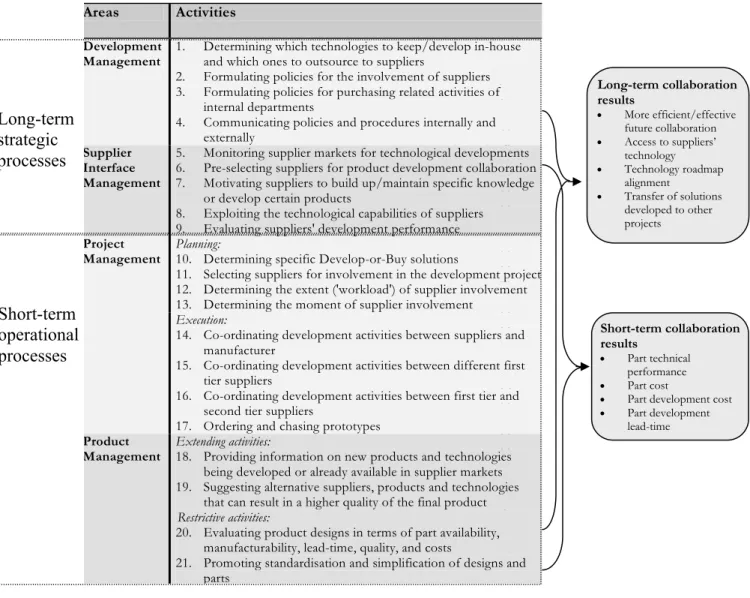
Based on several series of exploratory case studies, Wynstra et al. (2003) builds an activity-based framework that identifies roughly 20 managerial activities (Figure 1). In individual cases, these activities have been found to contribute to the effective and efficient supplier involvement in product developmenti. In line with our earlier argument, the framework distinguishes four management areas: Development Management and Supplier Interface Management, which comprise strategic, long-term
activities, and Project Management and Product Management, which entail project-related, short-term
activities.
Development Management focuses on establishing the general policies and guidelines for
supplier involvement in product development, and the technological areas in which to collaborate.
Supplier Interface Management focuses on the continuous efforts to build a network of suppliers that
can contribute to product development processes. Project Management is primarily concerned with
planning and implementing the involvement of suppliers in specific development projects, and
Product Management focuses on defining the actual product specifications within a development
project. The four management areas and activities can be regarded as sets of managerial processes that allow companies to coordinate, improve and transform configurations of internal and external capabilities and resources.
The main reason for adopting this particular model as a conceptual framework is that, compared to other models, it provides a more comprehensive overview of the managerial areas and activities involved, while firmly grounded in existing theories (i.e. the interaction approach and resource dependency theory).
This article subjects the framework to further validation through an in-depth, multiple-case study. Given the richness of the conceptual framework, theory refinement (theory testing ánd extension) through a qualitative explanatory study is a useful step before conducting any ‘pure’ theory testing of fully developed hypotheses such as commonly undertaken through a quantitative research design.
Research design and method
The empirical research is based on a four-year, intensive research project at one single firm. Océ is a Dutch manufacturer and provider of a wide range of products and services that enable customers to manage their documents efficiently and effectively, by offering innovative print and document management products and services. It mainly targets professional environments such as departmental and central reprographic document processing, electronic data processing (printing salary slips, telephone bills) engineering (printers for CAD and architectural drawings), print shops and publishing environments (books, billboard posters).
Océ strongly focuses on innovation, investing around 6% of its annual turnover in R&D, and has been following a niche strategy using unique technologies developed in-house. The firm is strongly dependent on suppliers for the production of parts and assemblies, reflected in a purchasing-to-sales ratio of more than 70%. Although in general, Océ products are in the mature phase of the product life cycle, product development and service development are becoming increasingly important and knowledge intensive due to the rapid digitization of printers, copiers and
communication technologies. These characteristics make this company and industry a particularly interesting and dynamic context for our study.
Overall design
The research has been executed as a longitudinal, embedded multiple-case study. A longitudinal case study provides a single setting with multiple observations over an extended period of time (Yin, 2003; Eisenhardt 1989). This allows us to study managerial actions regarding supplier involvement in-depth, on a retrospective as well as a real-time basis. Such a research method matches our goal of studying a phenomenon with a dynamic and process nature, and in which the unfolding events play an important role in building explanations (Pettigrew, 1992).
During the period 1999-2003, research was carried out at the company’s premises for two to three days per week by the first author, allowing the researcher to have access to the purchasing, manufacturing and R&D departments. This enabled many events and discussions to be observed in their natural setting, instead of solely relying on pre-arranged interviews. The researcher maintained a passive and unobtrusive presence, so as not to interfere with on-going events and activities. A steering committee was set up consisting of company representatives, including the Vice Presidents of Purchasing, R&D Engineering and Manufacturing & Logistics, and university representatives (including 2 of the authors). This committee met every 4-6 months to discuss outcomes of the studies and further areas of investigation.
Case study selection, sample and unit of analysis
Within the overall case study of Océ, we conducted eight embedded case studies that involved collaborations between Océ and a single supplier on the development of a specific part, component or module. These collaborations serve as our main unit of analysis. All of these collaborations – or sub-projects – were part of larger development sub-projects, usually encompassing the development of an entire printer or (copier system). The primary study object, in line with our conceptual framework, has been the management activities carried out during, in advance and after the collaboration between Océ
and each supplier, and the more general, strategic activities related to supplier involvement. Hence the need to study several organizational process levels, and to use an embedded case study design.
The case studies were selected in close consultation with managers from R&D, Manufacturing and Purchasing. Instead of random selection of cases, theoretical sampling was used in our selection approach to facilitate theoretical generalization (Hillebrand et al. 2001; Yin, 2003). This sampling used two main criteria.
First, the cases varied in terms of the degree of innovation of the development project in which the cases were embedded (measured by newness of components, configurations and product/manufacturing technologies). This sampling criterion was used because project degree of innovativeness has been found to affect the need for specific activities to manage the involvement of suppliers (McDermott and Handfield, 2000; Ragatz et al., 2002). Secondly, the collaborations themselves – or rather, the parts involved – varied in terms of technical development complexity. The variation in the degree of technical development complexity was based on the number of different product technologies and the degree to which a part determines the technical specifications and design of other parts (Wynstra and Ten Pierick, 2000). Please note, however, that the selected parts do not include a low development complexity part; usually, these parts require little supplier involvement and thus largely fall outside the relevant spectrum of development complexity.
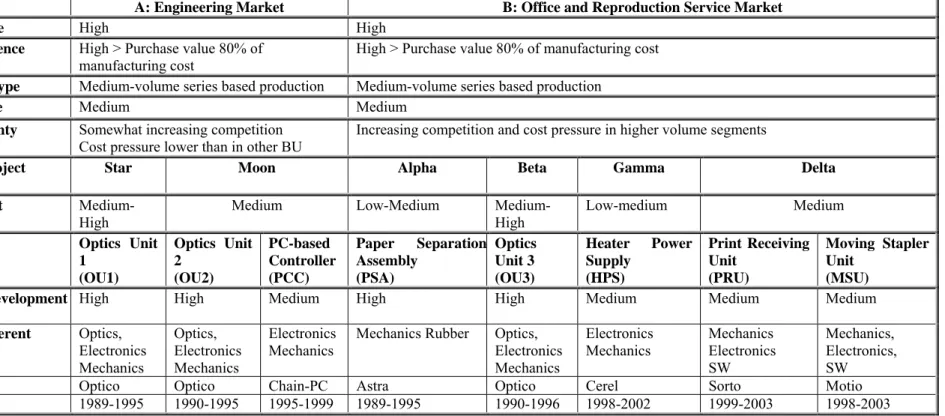
A secondary aim in the case selection was to create a representative sample of development projects going on at Océ. Of the eight collaborations in total, three collaborations were part of two development projects that served high-end engineering markets (business unit A). The remaining five collaborations took place in four development projects that served a variety of high-end office and reproduction service markets (business unit B). The selected parts covered the main technologies employed by Océ: mechanics, electronics, mechatronics and opto-electronicsii.
Given these theoretical sampling and representativeness criteria, eight case studies are considered as an appropriate number, keeping also in mind our desire to examine both retrospective and real-time cases. More cases would increase the practical and research complexity; a lower number of cases would reduce the variation on aforementioned criteria. An overview of the characteristics of
the selected parts, projects and business units is provided in Table 1. Appendix A provides further information on data collection and data analysis.
Insert Table 1 about here
Case analysis and findings
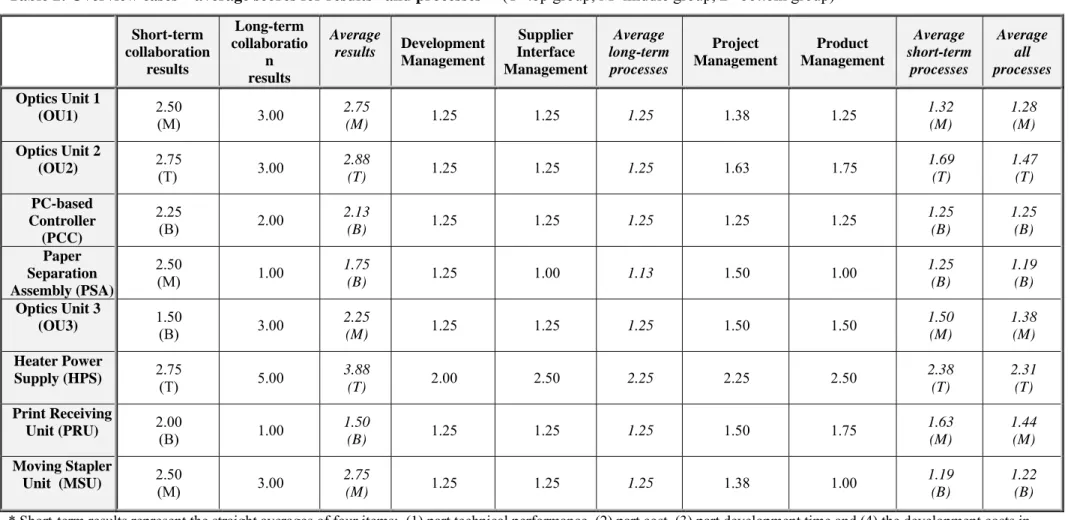
Our analysis of the eight cases first reviews the overall results of the collaborations (see Table 2). Subsequently, the results are linked to the management processes both at the operational and the strategic level. This analysis uses the main (and highest possible) level of aggregation in our framework. The scores reported in Table 2, hence, represent the average scores for the different groups of results and activities from our conceptual framework (Figure 1). Finally, we present a more detailed cross-case comparison, in which we highlight specific managerial activities and results. Appendix B provides details on the cases.
Insert Table 2 about here
Results
The first step in analyzing the cases is to assess the short-term collaboration results.
Collaboration performance is measured in terms of the degree of attainment of four typical measures of project performance (technical performance, material cost, development time and cost), and is based on the objective (written) data regarding targets and actual performance, whenever availableiii. (Further details regarding measurement are provided in the respective tables.)
First of all, it may be noted that in all cases, short-term results are below target (scores<3). This is largely due to the fact that the firm sets quite challenging project targets; actual results above target are very seldom. Therefore, it is more useful to look at the relative scores within this group of collaborations. Clustering the cases into three groups in terms of their short-term results, produces a
top group (OU2 and HPS), a middle group (OU1, PSA and MSU) and a bottom group (PCC, OU3 and PRU) (see Table 2). Clearly, there is variation in the extent to which these collaborations meet their short-term targets.
Reviewing the short-term results in more detailiv, the main problems appear to exist in relation to cost targets. Océ succeeded in meeting its technical performance targets in only half of the
collaborations. In just over one-third of the cases, the development time for parts did not result in any
time-to-market delays. Most striking is the pattern with respect to material and development costs;
Océ appears to meet both targets in only one-quarter of the collaborations. One can also see that in this respect, none of the collaborations performed much better than the initial targets, the exception being the part cost performance of the paper separation assembly (PSA).
In addition to measuring the degree to which the short-term development targets were met, a number of long-term benefits were measured. We asked the engineers and buyers involved to what extent they perceived the collaboration did result – or would likely result – in a number of long-term benefits. In some cases, there had not yet been any follow-up collaboration and ‘expected’ results were the only possible frame of reference.
Interestingly, five out of eight collaborations score better on long-term results than on short-term results. Partly, this may be explained by the fact that in some cases research participants may have, post-hoc, rationalized the lack of short-term results by indicating more positive (expected) long-term results. Still, the differences at least provide some indication that distinguishing and measuring both types of results could be helpful for a better understanding of these collaborations and an indication of how they are effectively and efficiently managed. In that light, a brief review of the different measures of long-term results and their relative scores may be instructive5.
First, a more efficient and effective future collaboration is expected to occur in several
collaborations as a result of the learning experiences of the people involved. Overall, this long-term benefit appears to be mentioned most frequently by the Océ representatives involved, as opposed to supplier representatives. Based on the problems and discussions encountered in the current collaborations, both buyers and engineers feel they will be able to work together on part design faster
and more effectively next time. Only in those collaborations with limited supplier involvement, no such learning experiences were observed (PSA).
In some collaborations, improved access to supplier’s technology and knowledge was
recorded, but only to a limited extent. In the case of Optico, the two initial projects increased the access to the supplier’s technology, and in particular to its Optics design and production technology. However, Océ had to develop most of the functional and design-related knowledge internally. Therefore, Océ did not improve its access to other capabilities as much as it would have liked. In the PRU case, access was not improved as much, as it depended on the experience of the supplier’s senior engineer and the divestment of internal plastic molding production.
The alignment of technology roadmaps was particularly important in the optics unit cases and
the PCC case. The collaborations regarding Optics Unit 1 and 3 did not immediately result in an aligned roadmap. However, in the years following, the growing production numbers (i.e. sales for the supplier) slowly increased the motivation to share somewhat more information with R&D. The dialogue on future technological needs and Optico’s investment planning grew more intensively in the years that followed. In the PC-based controller case, it took several years of collaboration before the exchange of information regarding future planning improved. In line with previous literature (Monczka et al., 2000) these observations suggest that it takes a considerable time to achieve roadmap alignment, because it is likely to require information sharing, which presupposes a willingness to share and also an appropriate channel by which to share and discuss.
There are not many instances of the transfer of solutions and concepts from one collaboration
to the other. Although the collaboration in the HPS case resulted in a solution that could be used in other projects, this had not yet occurred.
To summarize, a consistent pattern of time and resource consuming collaborations can be observed in which Océ encountered more technical and organizational problems than anticipated. One can also observe the presence of (potential) long-term collaboration benefits that could partly compensate for the negative short-term results, but by their very nature these benefits become only tangible over time.
Linking results to processes
Before going into a more detailed discussion of specific issues and activities, it may be useful to first analyze, on a general level, to what extent the cases support our basic model. Or, stated differently: can we find consistent correlations between the results and the management processes for the different cases? For that purpose, we group the cases both on the basis of their scores on the results and on their management activities, and investigate the relations between these. Doing that not for individual cases but for groups of cases not only helps to communicate the analysis, but more importantly it makes the analysis more robust by making it less vulnerable to incidental exceptions.
On the basis of the short-term collaboration results, we already split our cases into a top
group (OU2 and HPS), a middle group (OU1, PSA and MSU) and a bottom group (PCC, OU3 and PRU) (Table 2). Making similar groups of cases on the basis of their combined scores on Project Management and Product Management, i.e. short-term management processes, results in an identical top group (OU2 and HPS), but four cases have “traded places” between the middle group (OU1, OU3 and PRU), and the bottom group (PCC, PSA and MSU). In other words, the PSA, OU3, PRU and MSU do not follow our predicted pattern. This means that by just trying to explain the short-term results, one does not find a truly consistent pattern in relation to the extent to which the different short-term management activities have been carried out.
If we then do the same grouping on the basis of the scores on all the management activities,
the groups actually remain the same. Thus, taking into account the performance on Development Management and Supplier Interface Management activities do not seem to contribute additional explanation of the patterns in the short-term collaboration results.
However, if we not only take into account the short-term but also the long-term collaboration results, the top group still remains identical (OU2 and HPS), but the middle group (OU1, OU3 and MSU) and the bottom group (PCC, PSA and PRU) become more consistent with the (short-term plus long-term) activity-based clustering. In fact, now, only the PRU and MSU cases do not follow the
predicted patterns. PRU performs worse than one would predict on the basis of the management activities carried out, while MSU performs better than predicted.
Thus, these alternative analyses demonstrate that the combination of short-term, operational processes ánd long-term, strategic management processes is the best predictor of combined short-term and long-term results of involving suppliers in new product development projects.
Issues and problems
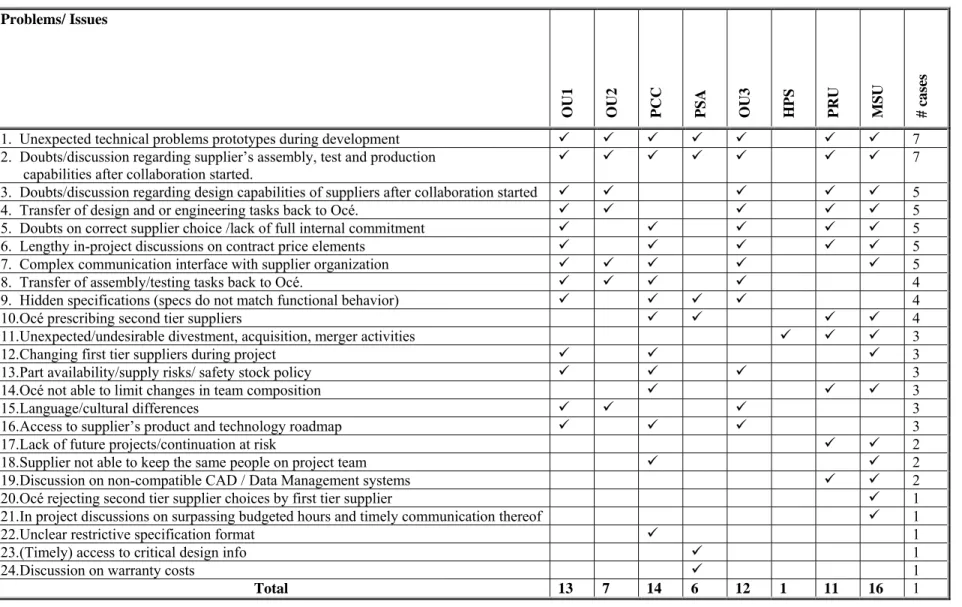
A review of the most significant issues and problems encountered during the collaborations can reveal the managerial activities that are most problematic. Table 3 presents a list of these issues and problems, which have been distilled from the case studies.
The case that clearly encountered the fewest issues is the HPS case and this results in meeting nearly all of its short-term collaboration targets. In contrast, the highest number of technical, commercial and project management related problems occurred in the MSU, PCC, OU1, OU3 and PRU cases. Note, however, that Table 3 just refers to the occurrence of a problem, and not to its severity or impact. While PCC is indeed a ‘low-performer’, consistent with our model, MSU performs better than predicted, also given the large number of problems. Moreover, PSA is a ‘low-performer’ consistent with our model, but has experienced just a limited number of problems. Hence, judging an individual collaboration on the number of problems is not advisable, but the overall frequency of specific problems across projects may provide some indication to more generic weaknesses in the firm’s management of collaborations with suppliers in NPD.
Insert Table 3 about here
When looking at the most frequently occurring issues one can observe that the occurrence of unexpected technical problems is one of the top ranking issues. These problems were related to a mixture of quality aspects such as functional performance, durability and conformance of delivered parts to the specifications.
Secondly, in more than half of the cases, discussions took place regarding the feasibility of assembly and design responsibilities assigned to the suppliers. During the process, often doubts arose even regarding the initial supplier selection. In some of these cases, these doubts resulted in a reduction in the extent of design outsourcing and in the level of assembly outsourcing. Sometimes, Océ decided, or was forced, to change suppliers during the project. In five cases, the part cost targets and development cost budgets required lengthy discussions late into the project. Océ was also confronted with high risks regarding part availability and obsolete components. Short component life cycles endangered the achievement of production targets but also necessitated an increased effort in validating the new components in the Océ-specific machine environment. The sharing of technology roadmaps and the access to critical design info were particularly important (but somewhat unique) issues in the PCC case.
These issues raise questions as to how Océ selects its suppliers and plans their involvement in different projects. Furthermore, what does Océ do to create internal commitment and foster long-term relationships when it sets out a strategy for increasing supplier involvement? How does it detect and mitigate the risks associated with developing parts with suppliers? In the next section, a detailed analysis of the managerial activities in the four areas across different cases should reveal which processes are most critical to capture the short and long-term benefits from supplier involvement.
Management activities
We further examine the issues identified above in terms of their connection with the various managerial activities in the four areas: the two short-term management areas Project Management (PJM) and Product Management (PDM), and the two long-term, strategic management areas of Development Management (DM) and Supplier Interface Management (SIM). We start by analyzing the short-term activities after which we extend the analysis to how these operational activities are embedded in and supported by the activities in the DM and SIM areas. Rather than investigating all cases, the analysis focuses on two extreme, exemplary cases: the HPS case as ‘high-performer’, and the PCC case as ‘low-performer’.
The success in the HPS case can be partially traced back to the combination of well-executed
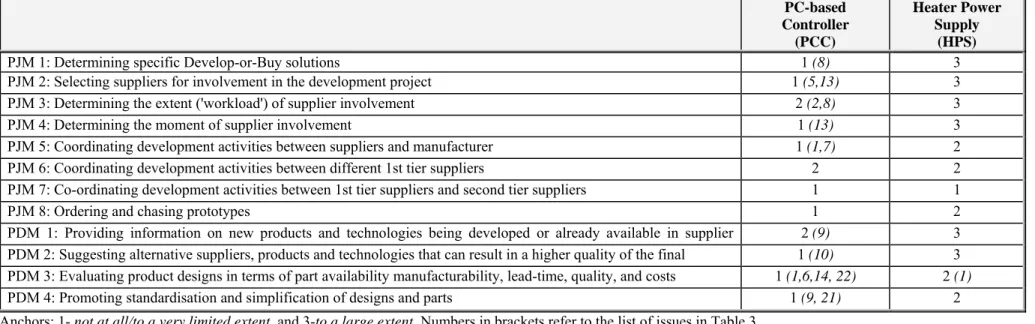
Project and Product Management activities (see Table 4). In the PCC collaboration and in most of the
other cases, Océ has been insufficiently able to anticipate and efficiently address the technical and organizational risks associated with particular supplier choices and workloads outsourced.
Insert Table 4 about here
One can observe that the Project Management activities were executed in significantly
different ways in the high-performing HPS case compared to the PCC case. The HPS collaboration is characterized by fast decision-making associated with the first four planning activities in the Project Management activities (see Figure 1). Moreover, these activities exhibited a high degree and timely moment of cross-functional involvement of key actors from R&D, Purchasing and Manufacturing. The clear demarcation of the heater power supply as a technology/function area and the presence of potential competent suppliers were particularly helpful in a speedy and effective start of the development. All departments agreed to the final supplier choice and its expected contribution was not subject to much discussion. The discussion focused on solving a potential European norm problem. The two different moments of involvement were also well timed and allowed the overall project to perform the machine tests with the prototypes delivered on time. The development activities with Cerel were coordinated efficiently, using a simple and effective communication interface. Although technical issues had to be addressed, they did not differ from the usual iterations that are necessary to realize a power supply. These decisions and activities largely ensured a smooth collaboration with Cerel in the Gamma project.
The choice for a standard PC as a controller was initially driven by R&D and Marketing. The selection of the first PC supplier was non-transparent, involving multiple senior managers and project members across R&D and Marketing but little Purchasing and Production involvement. There was a more substantial contribution from the Purchasing team when a second supplier had to be chosen. However, only a limited supplier assessment took place, underestimating the need to guide the integration of the R&D and production project teams and the strategic structuring of the relationship.
Although a standard product was initially chosen defining the extent of the involvement clearly, the modus operandi changed as soon as Océ had specific requirements on the PC configuration. R&D /Purchasing and production got involved in coordinating development and testing of prototypes activities between first and second tier supplier. Compared to the HPS case, the PCC case had to deal with the fact that the R&D led prototype cycles were not synchronized with the product and component life cycles of PCC and its second tier suppliers. As many different actors on both sides were involved to discuss the controller validation and assembly problems, the coordination of supplier development and production start up activities became more time-consuming than everyone had expected.
In general, Océ appears to carry out its Product Management activities in a well-organized
fashion. However, it is not always able to meet technical performance and cost price objectives (on time), let alone in an efficient way. For example, in the HPS case Oce’s project team did provide
information on new and alternative products, technologies and suppliers helping to solve the
technical problem on time, whereas in the PC-based controller case this information was not always immediately available and required in-project search effort. The evaluation of the part design appears
to be a core project execution activity, which points to a significant number of risks that needed to be addressed. The analysis suggests that these risks were largely anticipated in the HPS case but not in the PCC case. Consequently, Océ was forced to put more internal effort into the development of the parts than expected.
Finally, instead of sticking to standard and off-the-shelf parts, Océ appears to prefer customer-specific designs/customer-specifications, either selecting them from the start or moving towards them during the collaboration. The lack of a continued focus on simplification and standardization has therefore partially contributed to a slipping cost price and increased the co-ordination costs during and after the projects. With a dedicated purchasing account manager and later on different operational R&D and production/logistics improvement teams Océ did step up efforts to tackle the operational (project) problems it was facing.
Additional explanations for the difficulties in achieving effective and efficient supplier involvement at Océ can be found in the extent and way in which the firm managed supplier
involvement through execution of Development and Supplier Interface Management activities (see
Table 5).
Insert Table 5 about here
In the area of Development Management , Océ has been attempting to develop a simple policy
regarding the ‘in- outsourcing’ of technologies (DM1). In the early nineties a brief core policy
message emerged stating, ‘Océ buys, unless...’. This statement underlines the company’s general
outsourcing trend over the past two decades across all business units. Océ decided to keep the development of its own color technology and production activities of key components in-house because of their strategic importance. During the nineties, the electronics engineering group developed a policy for increased outsourcing of development and engineering tasks for parts such as power supplies technologies. The policy was well known among the people involved and reduced the number of develop-or-buy options to consider, thereby speeding up decision-making in the power supply case.
However, it is fair to state that the policy regarding the in- or outsourcing of development, engineering, production and assembly activities were certainly not predetermined at a great level of detail for all technologies and activities. As the PCC case shows there was still plenty of discretion to divert from a designated course.
Looking at Océ’s degree of active formulation and communication of guidelines for supplier
involvement and for IPDS-related activities of internal departments (DM 2-4), we observe that the
guidelines appear to be insufficiently available and communicated – with new suppliers in particular. In the PCC case, the supplier indicated that Océ’s organization and its procedures were not very transparent. This resulted in extra effort and misunderstandings, and thus prolonged the adaptation time of the Océ and suppliers’ organizations. Océ appears to be a particularly project-driven organization with respect to product development. Furthermore, the collaboration with suppliers was particularly hindered by the existence of a diverse set of terms in the various departments, with widely varying implicit assumptions and expectations about the role of suppliers in product development. All
this suggests that insufficient acknowledgement and attention was paid to the learning and adaptation time needed by the supplier and by Océ itself.
We did find that guidelines for internal decision-making are more advanced than those for collaborations with suppliers. For example, a description of the supplier selection procedure was present (in the purchasing department) and a portfolio instrument was used in project teams to identify and assess risks of buy parts. In the HPS case the buyer and head designer of Océ had a good collaboration routine when it came to selecting suppliers. However, we found that in the actual pattern of decision-making in the cases with new and more complex parts Océ deviated from this routine. Supplier selection and determining the extent of supplier involvement were not transparent suggesting that the current guidelines were apparently inadequate and or simply ignored (PCC case).
Examining the pattern of Supplier Interface Management activities reveals that in the HPS
case Océ was more pro-actively and persistently engaged in the various activities to build up a
capable supplier base. However, in the PCC case there appeared to be a lack of a clear and comprehensive approach to pre-qualifying suppliers for involvement in product development. As such we encountered varying support from these activities in the Project Management and Product Management areas. In particular, the provision of information and suggestions of alternative suppliers and technologies and the supplier selection activities have required significant in-project effort. Only the HPS case could benefit from access to three pre-qualified suppliers.
Pre-selection of suppliers was attempted by introducing an approved supplier list, although there was no clear definition of the required engineering and innovative capabilities of suppliers. This list did not appear fully attuned to the supplier categorization and supplier list that were initially developed within R&D.
The case studies also suggest that Océ considers motivating suppliers to be important but coordinates this in an ad hoc and unstructured way. In the HPS case it was clear that by consistently defining the projects and the design space in which the supplier could add value, the supplier could be called upon when faced with a particular norm problem. In the PCC case, Océ represented a pioneering learning environment for Chain-PC and this offered in principle some flexibility in deviating from the supplier’s usual standardized way of meeting customer’s demands. However, its
motivational tactics were relatively ad-hoc and specific investments or specific information sharing by the PC supplier was not easily realized.
Furthermore, Océ did not create the conditions to fully benefit from existing supplier products and designs in time. In other words, Océ resorted to adaptations of supplier-generated specifications or configurations. This undermined the speed and resource advantages that should be realized in developing the part, but also in logistics management, manufacturing and servicing for these parts.
Finally, evaluation of supplier performance tends to remain a one-off initiative, despite some attempts in the cases examined. Even in the PCC case, where at the end of the project various strategic and operational task forces were created, the information and experiences do not appear to be stored, transferred or followed-up in a structured fashion. The limited activity regarding in and post project evaluation with suppliers seem to have fostered only to some degree organisational learning and improvement of subsequent collaboration episodes (e.g. for some individuals involved).
We can therefore conclude that the lack of embedded routines for the various supplier interface management activities in the PCC case, in contrast to the HPS case, has not enabled a faster decision-making and effective execution of the collaboration. The next section further reflects upon the extent the analytical framework has effectively conceptualized and explained the management of supplier involvement in product development.
Discussion
Reflections on the analytical framework
The findings in the Océ cases demonstrate that the initial planning activities in the Project
Management area are critical in successfully anticipating and dealing with possible risks, and can
prevent unexpected higher development costs and time. The process of selecting the supplier and determining their extent of involvement are critical in anticipating and addressing the technical and organizational risks associated with particular choices about suppliers and workload outsourcing.
Product management activities are crucial in making the right trade-offs and integrating
(standard) supplier technologies in a specific project. They visibly affect the achievement of technical performance targets and the control over the cost price. Timely consideration of alternative solutions and an integrated evaluation of product design, involving the relevant representatives early on in the project, were important in all of the case studies. Product management activities can also result in higher development costs and time. An incorrect evaluation of a design with respect to issues such as costs, quality, part availability etc., increases the search for alternative suppliers and increases co-ordination costs. Failing to create the conditions for implementing the intended standardization of parts, or designing complex parts, increases the costs of co-ordination during development and increases the field service costs afterwards.
The analysis of the critical Development Management and Supplier Interface Management
activities reveals that a coherent and combined policy guideline with regard to supplier base development was effective for one specific technology category (i.e. the heater power supply category). The efforts invested in developing a clear in-outsourcing policy for technology and product development activities, and in pre-selecting and motivating suppliers, gave the buyer and engineer a head start in involving the right supplier quickly and effectively. Hence, Development Management and Supplier Interface Management, implemented as permanent activities, can indeed contribute to improved collaboration results.
Looking at the influence of the managerial activities on capturing the long-term collaboration benefits, we found that active execution of Develop Management helps to achieve these benefits in two ways. First, it provides a long-term view on the desired internal and external capabilities that need to be built up, allowing a particular specialization to be developed. It takes away extensive in-project discussions regarding which develop-or-buy solutions to choose. This subsequently allows the customer and supplier to gain experience in the context of a clear division of tasks. Secondly, it directs attention towards the type of efforts needed in the Supplier Interface Management area in order to align technology roadmaps. This benefit may only be significant for specific collaborations concerning technologies/parts with a high strategic impact (critical product differentiator or high cost impact).
We also contend that Supplier Interface Management activities allow potential learning experiences to be transferred to future collaboration episodes, thus contributing to a better match in the capabilities of the customer and supplier. Although Océ did indicate that it has learnt from its experiences in several cases, and other long-term results have been partially achieved, these benefits were not captured easily. Pressures to achieve short-term success and the failure to make these visible create an atmosphere in which the value of longer-term benefits is hardly considered. Follow-up collaborations may be affected by negative experiences in the current collaboration. Suppliers sense an internally divided view and a strong project driven culture, which affects their willingness to collaborate, and also their trust. The absence of a clear long-term relationship management structure for key suppliers to effectively set out the long-term path of collaboration and learn from current experiences hinders effective transfer to follow-up collaborations.
The case studies reveal the clear difficulties associated with the process of altering the resource base. Improving existing resource configurations close to the status quo is relatively easy. However, increased supplier involvement requires unlearning and adjustment in behavior in order to be able to integrate and reap the rents from new resource configurations. Short-term project driven management, a non-coherent vision on what to outsource and a lacking framework for defining the supplier’s contributions to strive for and the subsequent limited preparation provide a breeding-ground for recurrent operational problems.
Adaptations to the framework
Based on the case studies, we propose a number of adaptations to the original framework; the first focuses on the distinction of different management areas, and the second is related to the individual management activities within these areas.
Applying the framework to the case studies at Océ demonstrates that Development (DM) and Supplier Interface Management (SIM) activities, on the one hand, and the Project Management (PJM) and Product Management (PDM) activities on the other hand, take place in two quite different management ‘arenas’: the first two in a more strategic, long-term oriented setting and the latter two in a more operational, project-related short-term setting. Although the case studies clearly demonstrate
the links between these two management arenas and the detrimental impact of just performing managerial activities in one of these two arenas, it has become quite apparent that Océ has not yet fully achieved the desirable coherence between the two.
These findings also demonstrate that it may not be fully necessary or appropriate to distinguish between four management areas. In terms of the extent and the way they are carried out,
the activities in the Development Management and Supplier Interface Management areas were found to be much stronger related than previously argued (Wynstra et al., 1999; 2003). We argue that by merging the two areas, the model better reflects the strong connection between policy and guideline development and the creation of access to individual supplier resources and capabilities relevant for current and future projects.
As can be seen in Table 2, the level at which the processes in Development and Supplier Interface Management are executed tends to be strongly correlated for each of the eight projects. Development and Supplier Interface Management can be viewed as one shared ‘Strategic Management’ arena because of their similar long-term orientation and support functions in the management of supplier involvement in projects. The activities in both areas ensure that a learning and partially a transformation role can be fulfilled. The activities result in improved use of existing and in new configurations of internal and external resources, which better match with changing market conditions and technologies.
Furthermore, the original framework distinguished between Project and Product Management because the former contained activities with an organization and process character, while the latter encompassed activities that directly contributed to the improvement of the part design. The case studies suggest, however, that they are very strongly interrelated. The project is the vehicle and context in which various tasks are carried out and decisions are made affecting and related to the involvement of different suppliers. Content and process often go hand in hand and follow in practice to some extent a tight sequence of activities because of the interdependence between Project and Product Management activities. Hence, we propose to combine these two areas into one management arena, i.e. ‘Operational Management’.
As for the individual management activities, a number of the descriptions in the original analytical framework regard tightly related activities, such as formulating external, respectively internal, policies for supplier involvement. Our first adaptation is to combine a few activities, and to consider such a composite activity category as a managerial process. We consider the managerial
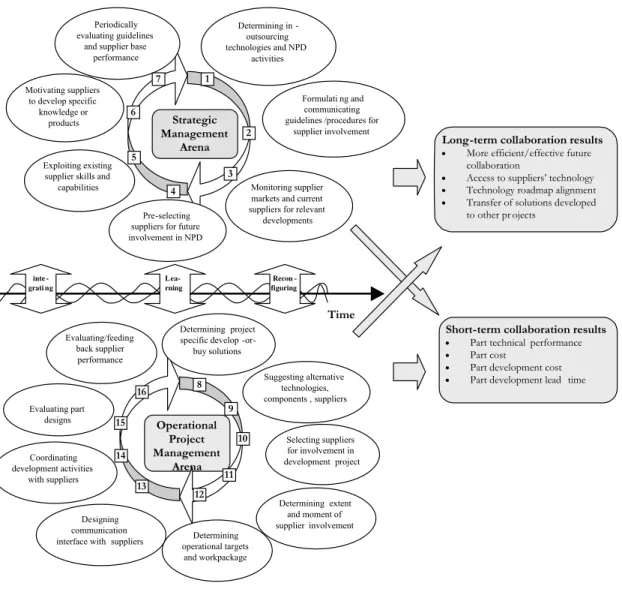
processes as basic categories of strategic and operational tasks decided on before, during or at the end of a development project. The proposed adaptation enables us to better study the relevant decisions and behavior related to managing supplier involvement. It simplifies the framework by reducing the number of activities, and at the same time provides more detail about the underlying activities. Figure 2 illustrates the proposed redefinition of the management areas.
The Strategic Management arena now contains seven processes in contrast to the nine activities in the original Development Management and Supplier Interface Management areas. These seven processes are considered in a cycle, which reflects the planning, execution and evaluative stages in developing policies and the desired supplier base. Although the processes are, in reality, considered to be executed in an iterative and interactive way, the sequence in the Strategic Management Processes serves as a reference for understanding their interrelations (see Figure 2).
Whereas the strategic management processes share their long-term and support focus before and across different projects, the Operational Management processes are the engine to effectively set up and manage different collaborations within a development project. We propose nine redefined managerial processes as opposed to the twelve activities grouped in the former Project and Product management areas. Moreover, we introduce a particular order in these processes, to reflect the general planning, execution and evaluation stages in new product development projects. Again, however, note that activities normally are iteratively and interactively executed and that this specific sequential representation is based upon observations that do not exclude the possibility of individual deviations.
Conclusions and implications
This study has addressed the question what it takes to effectively and efficiently manage supplier involvement and, in doing so, examined processes related to both short-term, operational decision-making and execution and long-term, strategic management activities. The analysis of the eight cases of supplier involvement revealed that the results of supplier-manufacturer collaborations and the associated issues and problems could best be explained by the patterns in the extent to which Océ managed supplier involvement in the short-term ànd the long-term. We found that our initial framework was helpful in understanding why certain collaborations were not effectively managed, yet concluded that the analytical distinction between the different management areas did not sufficiently reflect empirical reality.
This led us to reconceptualize and further detail the framework. Instead of four managerial areas, we propose to distinguish between the Strategic Management arena and the Operational
Management arena. The Strategic Management arena contains processes that together provide
long-term, strategic direction and operational support for project teams adopting supplier involvement. These processes also contribute to building up a willing and capable supplier base to meet the current
and changing future technology and capability needs. The Operational Management arena contains processes that are aimed at planning, managing and evaluating the actual collaborations in a specific development project.
The success of involving suppliers in product development as a strategy depends on the firm’s ability to capture both short-term and long-term benefits. If companies spend most of their time on operational management in development projects, they will fail to use the ‘leverage’ effect of planning and preparing such involvement through strategic management activities. Also, they will not be sufficiently positioned to capture possible long-term technology and learning benefits that may spin off from individual projects. Long-term collaboration benefits can only be captured if a company can build long-term relationships with key suppliers, where it builds learning routines and ensures that the capability sets of both parties are still aligned and are still useful for new joint projects.
To obtain such benefits, companies need a set of strategic decision-making processes that help to create this alignment. Having established explicit and extensive strategies, a company obviously still needs a set of operational management processes to identify the right partners and the appropriate level of supplier involvement for the various suppliers in a specific project, using the support from the strategic directions and guidelines. The two arenas are distinct yet strongly interrelated, as the interplay between short-term project interests and long-term strategic interests are managed in these arenas.
Limitations and recommendations for future research
To conclude, we acknowledge a number of limitations of this study. First, we have not analyzed who, i.e. which department, most effectively executes the various activities or processes. The specific skills of, and the interaction between, key representatives in the functional and project organization of the company, need to be further examined.
Secondly, we have not discussed the preconditions that are necessary in order to be able to fulfill the different processes (Wasti and Liker, 1997). Such enabling conditions could be analyzed at least at two different relevant levels in the organization: the strategic, organisational level and the operational, project level (Wynstra et al. 2000).
Thirdly, one can argue that an explicit contingency view on managing supplier involvement is
required, given the differences in the internal and external environment of both the customer’s or business unit organization and the specific project and parts/collaborations within a project. Analysis of contingency or driving factors at business unit, project and collaboration level could help us further
to determine whether specific processes need to be more actively executed to effectively deal with sources of complexity, risk or uncertainty (Eisenhardt and Tabrizi, 1995; Ragatz et al., 2002).
Finally, research efforts may be directed towards the investigation of appropriate informal and formal mechanisms that enable effective learning across different departments and with suppliers in the context of higher supplier involvement in product development. Informal socializing mechanisms and co-location of supplier engineers (residential engineering) in the project team are frequently mentioned as means to improve supplier involvement success (Lamming, 1993; Monczka et al., 2000;
Lewis et al., 2001). The question remains, however, whether these mechanisms are also effective in improving processes across departments and suppliers.
In this article, we aim to present a useful starting point for future research along these lines, in the form of a coherent conceptual framework of processes and short and long-term objectives of supplier involvement. The processes presented in the analysis framework, when properly executed, together form an important element in a company’s capability to integrate external suppliers’ resources in product development.
References
Anklesaria, Jimmy and Burt, David N. (1987). Personal factors in the purchasing/engineering interface. Journal of Purchasing and Materials Management 23 (1): 190–202.
Atuahene-Gima, Kwaku (1995). Involving organisational buyers in new product development.
Industrial `Marketing Management 24 (3): 215–226.
Axelsson, Björn and Easton, Geoff (1992). Industrial networks: a new view of reality. London:
Routledge.
Bidault, Francis, Despres, Charles and Butler, Christina (1998). The drivers of cooperation between buyers and suppliers for product innovation. Research Policy 26 (7/8): 719–732.
Birou, Laura M. and Fawcett, Stanley E. (1994). Supplier involvement in integrated product development: a comparison of US and European practices. International Journal of Physical Distribution and Logistics Management 24 (5): 4–14.
Birou, Laura M. (1994). The role of the buyer-supplier linkage in an integrated product development environment. Doctoral thesis, Michigan State University.
Bonaccorsi, Andrea (1992). A Framework for Integrating Technology and Procurement Strategy,
Conference Proceedings of the 8th IMP Conference, Lyon, 33-41.
Bonaccorsi, Andrea and Lipparini, Andrea (1994). Strategic partnerships in new product development: an Italian case study. Journal of Product Innovation Management 11 (1):
134-145.
Bonaccorsi, Andrea (1997). The External and Internal Integration of Resources: Evidence from a survey on procurement practices of medium and large manufacturing firms. Conference Proceedings of the 6th IPSERA Annual Conference, Ischia, 24-26 March, 1-20.
Brown, Steve L. and Eisenhardt, Kathleen M. (1995). Product development: Past research, present findings, and future. Academy of Management Review 20 (2): 343-379.
Bruce, Margaret, Leverick, Fiona, Littler, Dave and Wilson, Dave (1995). Success Factors for Collaborative Product Development: a Study of Suppliers of Information and Communication Technology. R&D Management 25 (1): 33-44.
Burns, Tom and Stalker, George.M. (1961). The Management of Innovation. London: Tavistock.
Clark, Kim B. (1989). Project Scope and project performance: the effects of parts strategy and supplier
involvement on product development. Management Science 35 (10): 1247-1263.
Clark, Kim B. and Fujimoto, Takahiro (1991). Product Development Performance: Strategy, Organization and Management in the World Auto Industry. Boston MS: Harvard Business
School Press.
Cooper, Robin J. and Kleinschmidt, Elko J. (1987). An Investigation in the New Product Process: Steps, Deficiencies and Impact. Journal of Product Innovation Management 4 (3): 71-85.
Dowlatshahi, Shad (1998). Implementing early supplier involvement: a conceptual framework.
International Journal of Operations and Production Management 18 (2): 143-167.
Dubois, Anna and Gadde, Lars-Erik (2002). Systematic combining: an abductive approach to case research. Journal of Business Research 55 (7): 553-560.
Dyer Jeffrey H. and Ouchi, William G. (1993). Japanese-style partnerships: giving companies a competitive edge. Sloan Management Review 35 (1): 51–63.
Eisenhardt, Kathleen M. (1989). Building theories from case study research. Academy of Management Review 14 (4): 488-511.
Eisenhardt, Kathleen M. and Tabrizi, Behnam N. (1995). Accelerating adaptive processes: Product innovation in the global computer industry. Administrative Science Quarterly 40 (1): 84-110.
Ellram, Lisa M. (1995). Partnering pitfalls and success factors. International Journal of Purchasing and Materials Management 31 (2): 36-44.
Evans, Stephen and Jukes, Sarah (2000). Improving co-development through process alignment.
International Journal of Operations and Production Management 20 (8): 979-988.
Gadde, Lars-Erik and Snehota, Ivan (2000). Making the most of supplier relationships. Industrial Marketing Management 29 (4): 305-316.
Gupta, Ashok K. and Wilemon, David (1990). Accelerating the Development of Technology-based New Products, California Management Review. 32 (2), 24-44.
Gupta, Ashok K. and Souder, William E. (1998). Key drivers of reduced cycle time. Research Technology Management 41 (4): 38-43.
Håkansson, Håkan (Editor) (1987). Industrial Technological Development. London: Croom Helm.
Håkansson, Håkan and Eriksson, Ann-Kerstin (1993). Getting innovations out of supplier networks.
Journal of Business-to-Business Marketing 1 (3): 3-34.
Handfield, Robert B., Ragatz, Gary L., Petersen, Kenneth J. and Monczka, Robert M. (1999). Involving Suppliers In New Product Development. California Management Review 42 (1):
59-82.
Hartley, Janet L. (1994). Understanding supplier involvement in their customer’s product development. Doctoral thesis, Department of Quantitative analysis and Operations
Management, University of Cincinnati.
Hartley, Janet L., Meredith, Jack E., McCutcheon, David and Kamath Rajan J. (1997a). Suppliers' contributions to product development: An exploratory survey. IEEE Transactions on Engineering Management 44 (3): 258-267.
Hartley, Janet L., Zirger, Billie J. and Kamath, Rajan R. (1997b). Managing the buyer-supplier interface for on-time performance in product development. Journal of Operations Management