Foreign language educators’ exposure to
research: reported experiences, exposure
via citations, and a proposal for action
Article
Accepted VersionMarsden, E. and Kasprowicz, R. (2017) Foreign language
educators’ exposure to research: reported experiences,
exposure via citations, and a proposal for action. The Modern
Language Journal, 101 (4). pp. 613642. ISSN 00267902 doi:
https://doi.org/10.1111/modl.12426 Available at
http://centaur.reading.ac.uk/79144/
It is advisable to refer to the publisher’s version if you intend to cite from the work. See Guidance on citing . To link to this article DOI: http://dx.doi.org/10.1111/modl.12426 Publisher: Wiley All outputs in CentAUR are protected by Intellectual Property Rights law, including copyright law. Copyright and IPR is retained by the creators or other copyright holders. Terms and conditions for use of this material are defined in the End User Agreement .www.reading.ac.uk/centaur
CentAUR
Central Archive at the University of Reading
Reading’s research outputs online1
Foreign Language Educators’ Exposure to Research: Reported Experiences, Exposure Via Citations, and a Proposal for Action
EMMA MARSDEN,1 and ROWENA KASPROWICZ2
1University of York, Centre for Research into Language Learning and Use, Department of
Education, York, YO10 5DD, United Kingdom Email:[email protected]
2University of York, Digital Creativity Labs, YO10 5DD, United Kingdom Email:
<A>ABSTRACT
The article reports on two connected studies that provide data about the flow of research to foreign language educators in majority Anglophone contexts. The first study investigated exposure to research among FL educators in the UK using two surveys (n = 391; n = 183). The data showed (a) some limited exposure to research via professional association
publications and events, (b) negligible direct exposure to Social Science Citation Indexed (SSCI) publications, (c) barriers to exposure caused by poor physical and conceptual access, despite generally positive perceptions of research, and (d) the importance of university-based teacher educators for research–practice interfaces.
The second study investigated the potential for indirect exposure to research from seven professional publications over five years in Australia, the UK and the United States. We systematically reviewed the extent to which these professional publications referenced 29 SSCI journals that aim to publish pedagogy-relevant research. In our corpus of 8,516
references in 284 articles in professional journals, the mean proportion of references per article to all 29 SSCI journals, combined, was 12.43%. The overall mean number of references to each SSCI journal was 0.17 per professional article.
The overall emerging picture is rather bleak, and we propose action from academic journals to promote a more international, systematic, and sustainable flow of research.
2
<END OF ABSTRACT>
Keywords: perceptions of research; research–practice interface; consumption of research;
citation; professional journals; teacher knowledge; teacher education
3
<A>BACKGROUND
The desire to facilitate the flow of information between research and practice is well established among journal editors (via ‘Aims and Scope’ sections), researchers (via articles and books), research associations (via mission statements, conference themes, invited plenaries), teachers (via professional associations, journals, conferences),
and policy-makers (via infrastructure, grey literature, schemes to incentivize researcher-practitioner communication). One way of enriching research–practice interfaces is via engaging practitioners in doing action, co-constructed or collaborative research, phenomena that have already received some attention. Another way, the focus of the current article, is via
disseminating research - arguably the main pursuit of academic researchers. Very little
empirical evidence exists about the extent and nature of teachers’ and teacher educators’ engagement with published research in the area of foreign language (FL) education in Anglophone contexts, despite much interest and investment in the potential relevance and applicability of research for practice. The current article begins to address this gap in two closely related studies: one investigating FL educators’ direct contact with research via a survey of reported behaviours and perceptions in the UK; and another study investigating indirect contact with research via citation of the research in professional publications in Australia, the UK, and the United States.
We first present key arguments for practitioner engagement with research put forward by the research community and policy-makers. We then provide a short narrative review of the limited number of extant investigations into the extent and nature of practitioners’ exposure to published research.
4
Instructed second language acquisition (ISLA) researchers repeatedly espouse inherent links between research and pedagogy (Hellerman, 2015). A persistent desire to nurture these links is clear at research conferences and in many publications (e.g. Belcher, 2007; Collins & Muñoz, 2016; Ellis, 2010, 2012; Lantolf & Poehner, 2015; Larsen–Freeman, 2009, 2015; Lightbown, 2000; Macaro, 2003; Pachler, 2003; Spada, 2015), aspiring to a reciprocal relationship in which teachers critically engage with research evidence and researchers engage with practice throughout the research process, that is, opening up a two-way street. Research engagement has been found to develop teachers’ sense of professional identity (Winch, Oancea, & Orchard, 2015), offer insight into technical, practical, and
theoretical aspects of pedagogical knowledge (Furlong et al., 2014), and provide new ways of seeing, doing, talking, knowing, and thinking (Borg, 2010, p. 414). Journal articles often suggest ‘pedagogical implications’, providing the opportunity for practitioners to assess the relevance of findings for their context (Chappelle, 2007; cf. Han 2007). Critical for the current study is that many academic journals explicitly state a mission to publish research of relevance to teaching. For example: Applied Linguistics (2016)states “Applied linguistics is viewed not only as the relation between theory and practice, but also as the study of language and language-related problems in specific situations in which people use and learn languages. . . . the journal welcomes contributions in such areas of current enquiry as: . . . first and additional language learning, teaching and use …”; the Modern Language Journal (MLJ) (2016) includes an aim to “link the findings of research to teaching and learning in a variety of settings and on all educational levels”; Language Learning (2016) is concerned with “fundamental theoretical issues in language learning such as child, second, and foreign language acquisition, language education, literacy…”; and Studies in Second Language
Acquisition (2016) contains “articles dealing with theoretical topics, some of which have
5
However, disparities between the pursuits and priorities of researchers and practitioners and a lack of interface between ISLA research and practice are frequently observed (Byrnes, 2016; Long, 2000). In some ways, publishing in academic journals serves only the academic community: For example, journal impact factors are academic
performance indicators, displayed on journal homepages and used in university promotion systems. Consequently, journal articles are very often linguistically, conceptually, and/or physically inaccessible to practitioners (Borg, 2013; Byrnes, 2000; Ellis, 2010; Lantolf, 2000; Macaro, 2003; McNamara, 2002). Montgomery and Smith (2015) observed that teachers often “express frustration with how “out of touch” academic articles seem to be with the day-to-day realities of [classrooms]” (p. 100) and Shkedi (1998) reported Israeli teachers’ lack of trust in research and the generalizations that are drawn, with perceptions such as “it’s
statistics, it’s not reflective of reality” (p. 567). Kiely (2014) highlighted that “if teachers feel researchers do not understand their task in classroom teaching, they are unlikely to be
persuaded to innovate or experiment” (p. 443). Probably as both a cause and a consequence of these issues, it has been argued that research is disseminated for peer researchers rather than practitioners (Montgomery & Smith, 2015; Pachler, 2003).
However, we have very little concrete data about the actual impact of this “often-times noxious research versus teaching dichotomy” (Byrnes, 2016, p. 7). A crucial question, rarely empirically investigated yet tightly related to understanding and improving research-practice relations, is the extent to which academic research finds (or has the potential to find) its way into the hands and minds of practitioners. The current study explored this topic by documenting direct and indirect exposure to (mainly written) academic research amongst language educators.
Our focus on written channels of communication therefore does not cover in detail all researcher–practitioner interfaces (e.g. professional development events). We also do not aim
6
to cover practitioners’ participation in action or co-constructed research and their developing cognition (e.g., Borg, 2003, Borg & Sanchez, 2015, Burns 2011; Lantolf & Poehner, 2015; Macaro, 2003); nor do we contribute to debates surrounding different conceptualisations of the roles and activities of FL teachers (Kubanyiova & Crookes, 2016). Rather, we
temporarily suspend such issues in order to provide data on the extent and manner in which research may reach FL educators in the first place.
<A>TOP-DOWN INITIATIVES RELATING TO RESEARCH–PRACTICE INTERFACES Repeated calls for research-informed teaching and teacher training are also made from school education policy perspectives (e.g., Coates et al., 2011). For example, Carter (2015) highlighted that engagement with research should be part of teacher education and
recommended a central, accessible database of world-leading research evidence (pp. 8–9), and Furlong et al. (2014) concluded that teachers and teacher educators should be discerning consumers of research (p. 5). Incentivisation for teachers to engage with published research is also apparent (DfE, 2016, p. 258, see also College of Teaching2).
In some contexts, governments establish ‘top-down’ incentivisation for academics. For example, Australian, UK and US funding systems, along with some promotion structures, encourage academics to make their research meaningful to non-academic users, often referred to as ‘impact’ (e.g., the American Association of Applied Linguistics’ Promotion and Tenure Guidelines, 2017; Australian Research Council (ARC), 2016; National Science Board, 2011; Research Excellence Framework (REF), 2011; Trounson, 2014). The aim is to facilitate and recognise the value of informing policy and practice and engaging non-academic users with research. However, these incentives largely relate to funding awarding mechanisms and do not directly incentivise the communication of individual academic studies, once completed, to non-academic users. For example, NSB (2011) included the principles that ‘broader
7
impacts’ should be treated more like ‘intellectual merit’ and may be better measured beyond the individual project – at the institutional level for instance (Holbrook, 2012: 17). Overall, the importance of writing for academic audiences still far outweighs indicators of impact, and journal articles remain the main pursuit for the clear majority of academics (for discussion see e.g. Chubb & Watermeyer, 2016; Holbrook & Hrotic 2013).
In England, an additional confound is at play as attempts were made to devolve teacher education from universities to schools (Furlong et al., 2014; Universities UK, 2014). In 2015/2016, 51% of trainees in England followed school-led routes, compared to 33% in 2013/14 (DfE, 2015). This has compounded concerns about research–practice interfaces, at odds with calls for a research-informed profession (Beauchamp et al., 2015; Bell, 2015; Lawes, 2003; Macrory, 2015) and with best practice internationally (Sahlberg, 2010; Swain, 2014; Tatto, 2015). Thus, it is important to know, at least for contexts in which teacher education can be school-led, the extent of exposure to research among school-based teachers and how this compares to non-school-based teacher educators.
In sum, the extent to which academics’ core activity (publishing) reaches FL
practitioners is worthy of investigation and yet, as discussed next, we have little data on the topic.
<A>LANGUAGE TEACHERS’ ‘CONSUMPTION’ OF RESEARCH
The flow of research findings has rarely been empirically investigated, with a “dearth of systematic surveys” (Leat, Reid, & Lofthouse, 2015, p. 271). In educational research, teachers’ engagement with research has received some attention (e.g., Bell et al., 2010; Cordingley, 2015). This has provided data about broad types of sources that teachers draw on, for example, in-service training, colleagues, reading material such as subject association publications (Ratcliffe, 2004; Williams & Coles, 2007); practitioner materials, assessments,
8
classroom observations (Montgomery & Smith, 2015; Pachler, 2003), and social media (Sanders et al., 2005). However, these do not tell us about the use of sources in which
published research is discussed (Leat et al., 2015, p. 271), about the extent and nature of
exposure, or about FL education specifically.
Several initiatives have aimed to boost teacher engagement with research, though their focus is often on general educational issues such as classroom management, socio-economic factors, ability grouping (e.g., in the UK, see the National Teacher Research Panel, CURREE,4 and National Foundation for Education Research; in the US, see the Great Lakes Centre for Education Research and Practice, and the What Works Clearing House). Often vulnerable to the political climate and without a sustained infrastructure, most initiatives have a relatively short shelf-life.5 Specific to language education, the research–practitioner
infrastructure ‘Centre for Information on Language Teaching and Research’ closed its
national centres in England in 2010 and in Wales in 2015, with centres currently remaining in Scotland and Northern Ireland. Graham and Macaro’s regional FL Professional Development Consortium stands out as a rare but fine example of research reaching practitioners, mainly through face to face network events funded in 2012–2015.6 In the United States, the Title VI Language Resource Centres, the Centre for Applied Linguistics and the Modern Language Association’s Digital Commons (https://digitalpedagogy.mla.hcommons.org/) provide many research–practice interfaces. Of relevance here, however, is that we could not locate data about the extent to which such initiatives provide links between academic publications and FL (non-English) school teachers.
A number of studies by Borg (2007, 2010, 2013) have explored ELT practitioners’ engagement with research. In an international survey of 1,160 ESL/EFL teachers, Borg (2010) found that 75% reported reading about research at least “sometimes” (p. 412). As Borg acknowledges, although a promising figure, the frequency and nature of reading remain
9
unclear. Also, we do not know how well these findings extend to non-English FL
practitioners. Contextual differences may be significant as (a) ELT professionals have many regional, national, and international associations (e.g., IATEFL, SEETA, TESOL), and (b) research on English as an L2/FL is more extensive than on any other single language (Collins & Muñoz, 2016; Plonsky, 2013).
In sum, although we are aware of a range of barriers that hinder engagement with research, the extent or severity of their impact is unclear. We do not have data about (a) the extent to which FL teachers and teacher educators are exposed to material that mentions or directly reports research, (b) the nature of publications they read, or (c) what those
publications, in turn, cite. As a consequence, we have a poor understanding about the flow of internationally peer-reviewed research from journals that claim relevance to instruction, either in terms of FL educators’ direct exposure (via reading such research) or indirect
exposure (via citation of research in publications that they read).
<A>AIMS
To begin to address these gaps, this study falls into two parts. Part 1 reports the results of a survey of UK FL practitioners’ access to material that mentions or reports research. Part 2 reports on a systematic review of references in FL practitioner publications in the UK and two other Anglophone contexts. Together, the aims were to document: (a) the amount and nature of research that school-based and non-school-based UK FL practitioners report
reading or hearing about, (b) the factors that UK practitioners’ report hinder engagement with research, (c) the extent to which practitioner journals in the UK, Australia, and the United States reference published academic research.
10
<B>Methods
Two online surveys were administered: the ‘full survey’ (approximately 20 minutes), and a shorter version with three questions adapted from the full survey (approximately 1–2 minutes, henceforth ‘short survey’). The short survey was administered in addition to the full survey in order to (a) gather data from more respondents for a subset of our key issues, and (b) elicit data about respondents’ experiences and behaviours in the last 12 months, whereas the full survey asked respondents for estimations of total experiences and behaviour to date.
<C>Participants. Our respondents all worked in the area of school (primary and secondary, ages 5–18) FL education in the UK, with a total final n of 183 respondents to the full survey and 391 to the short survey. The n for each subsection of the surveys varied due to some in-survey attrition (Appendix C).
The surveys elicited respondents’ main place of work and length of experience (Appendix D). For analyses, respondents were divided into two groups based on their Position (main role): School-Based practitioners (SB), who spent a majority of their time in the classroom teaching FLs; and Non-School-Based practitioners (NSB), who spent the majority of their time outside the classroom. Of the 48 NSB in the full survey, 42 (87.5%) were university-based teacher educators and 6 (12.5%) consultants or advisors. Of the 110 NSB in the short survey, 72 (65.5%) were university-based teacher educators and 38 (34.5%) consultants or advisors. Population size is difficult to estimate, but to give some indication we found internet records for 62 university-based teacher educators in the UK who deliver a FL Post-Graduate Certificate of Education, primary or secondary, suggesting a very high NSB response rate.
<C>The Survey Instruments. Most survey items were determined by the specific
behaviours we wished participants to report on, with response scales about frequency that we deemed answerable and appropriate for analysis. The items eliciting attitudes towards barriers
11
to research engagement used 0-100 sliding scales to allow expression of nuanced attitudes, and because it was difficult to express isolated intermediate categories as in a Likert-type scale. Although such data is not strictly interval data, it is equally, and arguably more, informative compared to scales with, say, five response categories. The survey underwent informal piloting with a small number of teachers. We acknowledge that the items pertaining to attitudes (latent variables), in particular, should have been more rigorously piloted.
Although our principle component analysis contributes to our understanding of instrument validity to some extent, we hope others will use our materials (found at
www.iris-database.org) to further investigate their validity and reliability.
First, the term ‘research’ was defined very clearly at the start of both surveys, and at various points throughout as an aide-memoire, as: "Systematic activity, that goes beyond normal teaching duties, and that aims to shed light on a particular phenomenon" [original emphasis]. ‘Research related activities’ were defined as “reading, listening to, discussing,
and doing research.” However, we acknowledge that the term remained open to some
individual interpretation, as with any self-report technique.
The current article focuses on two groups of items in the full survey(Appendix A). The first group related to the amount and nature of research that respondents reported being exposed to, both in written and face-to-face formats. The written formats named by
respondents were coded into three types: (a) SSCI journals (Thomson–Reuters, 2016); (b) practitioner-focused /non-SSCI journals; (c) magazines /newsletters / reports (d) other. Events were coded as: (a) professional subject association (e.g. Association for Language Learning, ALL), (b) local school cluster, (c) local authority, (d) university-based, and (e) other.
The second group of items in the full survey asked respondents to “rate the extent to
12
scale from 0 (does not prevent me at all) to 100 (prevents me very much indeed).
Respondents were also asked to indicate “in your opinion, is the research that you are aware
of relevant to everyday classroom practice?” by selecting “Not at all relevant”, “Somewhat
relevant”, or “Very relevant”.
The short survey had three closed response items (Appendix B). Two questions asked respondents approximately how many times in the last 12 months “you have read or heard
(1) something that mentions (i.e., refers indirectly to) research (e.g. newspapers, professional magazines etc.)”; and (2) “an original research report (i.e., a study written or presented by
those who did the research”). The third question asked respondents to “ratethe extent to
which [7] factors prevent you from engaging in (more) research activities” using a sliding
scale from 0 (does not prevent me at all) to 100 (prevents me very much indeed).
<C>Administration of the Surveys. The surveys were administered via Qualtrics and
disseminated via: UK practitioner associations (ALL, Network for Languages); email forums (CfBT, ITET-Languages7); practitioner events (Language World, ITET in London); and, social media (Facebook, Twitter).
<C>Analysis. Descriptive data (means, standard deviations, medians, ranges) were
calculated. Cohen’s d effect sizes are given for paired comparisons,8 and interpreted relative to Plonsky & Oswald’s (2014) general benchmarks for within- and between-subject
comparisons in second language research. Nominal data were analysed using a Chi-square test of Independence, with Position (SB or NSB) as an independent variable. The data
relating to factors hindering engagement were analysed using Principal Components Analysis (PCA) in order to reduce the items into a smaller number of variables (Conway & Huffcutt, 2003).9 Both datasets were deemed suitable for PCA, since the ratio of variables to
participants (full survey, k = 14, n = 162; short survey, k = 7, n = 333) was within most recommended ranges (Plonsky & Gonulal, 2015) and KMO statistics were sufficiently large
13
(full survey,KMO = .788; short survey, KMO = .741). Bartlett’s test of sphericity indicated a significant level of correlation between items for each dataset (Field, 2013). We retained all components with eigenvalues >1. An oblique (specifically, a direct oblimin) factor rotation was applied so that each item loaded maximally onto just one of the components (new variables) extracted. An overall percentage rating for each new variable per respondent was calculated as follows:10
=Σ(Ratings for items within new variable) (Total possible rating) x 100
A Multiple Analysis of Variance (MANOVA) was then used to compare the respondents’ ratings across the new variables based on their Position (SB/NSB).
The two surveys overlapped in their aims but we changed some of the items in the short survey, cutting or simplifying to obtain a higher n. As the surveys were administered anonymously online, we could not guarantee complete independence of data (some
respondents may have responded to both surveys, even though we asked them not to). For these reasons the two datasets were analysed separately throughout. However, for ease of interpretation results are presented here thematically (rather than the results of each survey presented sequentially).
<B>Results
<C>Hearing About Research at Face-to-Face Events. Respondents were asked for
details about the number and name of “conferences and professional development events
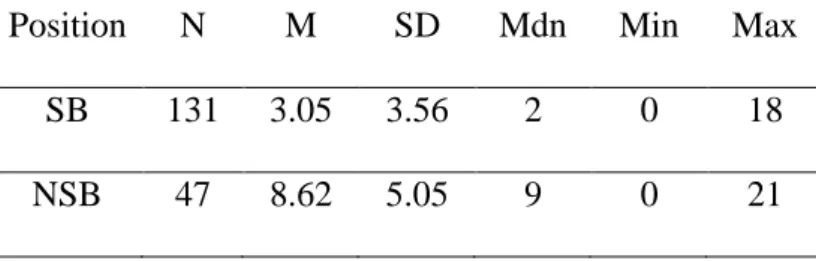
where some research was presented” (Table 1). NSB reported attending statistically
significantly more events than SB (U = 5016.00, z = 6.476, p = .001, d = 1.28, a large between-subject effect).
14
TABLE 1
Number of Events Ever Attended Where Research was Presented (Full Survey)
Position N M SD Mdn Min Max
SB 131 3.05 3.56 2 0 18
NSB 47 8.62 5.05 9 0 21
Table 2 shows the extent to which participants reported having attended at least one event where research was presented. A third of SB reported never having heard about any research at a face to face event.
Respondents named 330 events, which consisted of 123 unique events (coded into types in Appendix E). The most frequently mentioned—accounting for 30.3%—were the national subject association’s events. Research conferences were rarely mentioned: the British Association for Applied Linguistics, the European Second Language Association, and the British Education Research Association made up 3.3% of the total mentions, all made by nine out of the 42 university-based teacher educators surveyed.
TABLE 2
15
Have you ever…
<C>Reading About Research. Table 2 also shows the extent to which respondents reported
reading documents that mention research and reading original research reports, with NSB reporting statistically significantly more of both types than SB. Over half our SB and
approximately a quarter of NSB had never read an original research report. Table 3 specifies the average number of articles read11, with NSB reporting significantly more articles than SB (U = 5041.00, z = 5.760, p = .001, d = 1.18, a large effect).
TABLE 3
Mean Reported Number of Articles Ever Read in Magazines/Newsletters and Journals (Full Survey)
Position N M SD Mdn Min Max
SB 135 9.12 8.40 8 0 32
NSB 48 25.97 18.45 24 0 64
Note. SB = School-Based practitioners; NSB = Non-School-based practitioners.
The short survey results were broadly consistent with the full survey data (see Figure 1). Just over a third of SB reported that over the last 12 months they had read or heard between zero and 5 times something that mentioned research. A quarter of SB and about a half of NSB reported having read or heard something 20 or more times that mentioned
attended a conference or CPD event where research
was presented?
read about research in a professional magazine /
newsletter?
read about research in a journal?
Yes No Yes No Yes No
SB N 90 45 106 29 54 81
% 66.7 33.3 78.5 21.5 40 60
NSB N 44 4 44 4 35 13
% 91.7 8.3 91.7 8.3 72.9 27.1
16
research. In terms of reading or hearing an original account of research, 70% of SB reported zero to two, whereas 55% of NSB reported 6 or more. Again, there were statistical
relationships between Position and exposure to material that mentioned research (χ2(5) = 38.014, p = .001) and to original research reports (χ2(1) = 4.141, p = .042).
FIGURE 1
Reported Exposure in Last 12 Months (Short Survey)
Across all participants (N = 183, Full Survey), there were 357 mentions (raw counts) of having read about research, spanning 105 unique publications. The overwhelming majority (83.76%) of publications were either magazines / newsletters / reports (41.18%) or
practitioner-focussed / non-SSCI journals (42.58%). The most frequently mentioned publication was The Language Learning Journal, the official journal of the subject association, accounting for 16.81% of all mentions. Table 4 shows the 10 most frequently mentioned publications, which included three SSCI journals, each accounting for 1–2% of the mentions.
School-based (n = 281) Non-School-based (n = 110)
School-based (n = 281) Non-School-based (n = 110)
17
TABLE 4
Ten Most Frequently Mentioned Publications (full survey)
Publication Type # of
mentions %
Language Learning Journal practitioner / non-SSCI journal12 60 16.81
Times (Higher) Educational Supplement
magazine / newsletter / report 40 11.20
ALL publicationsa practitioner / non-SSCI journal 40 11.20
Languages Today magazine / newsletter / report 37 10.36
Francophonie practitioner / non-SSCI journal 17 4.76
(Scottish) Centre for Information on
Language Teaching magazine / newsletter / report 8 2.24
The Modern Language Journal SSCI journal 8 2.24
Applied Linguistics SSCI journal 7 1.96
Deutsch: Lehren und Lernen practitioner / non-SSCI journal 6 1.68
British Educational Research Journal SSCI journal 6 1.68
Total % of all mentions 64.15
Note. aWhen given by respondents, the label “ALL publications” could include The Language Learning Journal, the language specific journals of ALL (e.g., Francophonie, Vida Hispánica, Deutsch: Lehren und Lernen), the magazine Languages Today, and newsletters.
<C>Other Sources. Participants were asked in the full survey: How many reports about research from other sources have you read? Options were: On the internet; From a policy source (e.g., government document); From a circular sent to schools; Other (please specify). Figure 2 shows 67% of SB and 89% of NSB reported having read four or more research reports from the internet, with high proportions of respondents reporting eight or more. We did not collect more details but given the publications reported (Table 4), these internet sources were highly unlikely to be SSCI journals as almost none are entirely open
18
access (cost free for author and reader) (just two in Table 8) and schools do not hold subscriptions. (See Appendix F for data about the two other sources: policy documents and information sent directly to schools).
FIGURE 2
Total Number of Reports About Research Read From Internet Sources (Full Survey)
For "Other" sources, five respondents mentioned books: two SB and two NSB reported having read a total of 8 or more. Books were never mentioned in the other open fields provided in either survey.
<C>Factors Preventing Engagement with Research. The second set of survey items
elicited the reported impact of a number of factors (e.g., perceptions, funding, time, access) on engagement with research. Figure 3 presents the mean rating (between 0–100) given by SB and NSB for the full and short surveys.
19
FIGURE 3
Mean(SD) Ratings for Factors Preventing Engagement with Research
For the full surveydata, the PCA reduced the 14 items to four separate components (Table 5). Component 1 consisted of the items related to negative perceptions/attitudes to research (henceforth ‘Negative perceptions of research’). Components 2 (funding) and 3 (time and local regulation), each with two items, both related to what we deemed to be ‘Practical
constraints’. The fourth component was identified as relating to ‘Access and understanding’.
The 7 items in the short survey reduced to two separate components that were interpreted as consistent with Components ‘Negative perceptions of research’ and ‘Practical constraints’
also identified by the full survey analysis (Table 5). The PCAs accounted for 65.96% and 56.97% of the total variance in the data from the full and short surveys respectively, meeting Field’s (2009) recommended minimum of 55–65%.
School-based (N = 119) Non-School-based (N = 43)
full survey School-based (N = 229) short survey Non-School-based (N = 104)
20
In sum, two components emerged from both datasets (Negative perceptions of
research and Practical constraints) and one from additional items contained in the full
survey (Access and understanding).
<INSERT TABLE 5 ABOUT HERE> TABLE 5
Factor Loadings of Survey Items onto PCA Components and Proposed Reduced Variables Reduced Variable 1:
Negative Perceptions of Research
Reduced Variable 2: Practical Constraints
Reduced Variable 3: Access and Understanding
Component 1 (35.49% variance) Factor Loading Component 2 (13.75% variance) Factor Loading Component 4 (8.14% variance) Factor Loading ful l su rvey My lack of interest in research. 0.754 No money available to fund visits to conferences. 0.917 Lack of professional development in the teaching practice that is researched. −0.542 Research is not relevant to my practice. 0.828 No money available to fund me to carry out research projects. 0.947 Unaware of resources where I can find out about
research.
–0.817 Lack of confidence
(i.e. trust) in the research I read or hear
about.
0.575
Lack of awareness about what is and is
not research-based practice. −0.833 My own teaching experience is sufficient. 0.695 Component 3 (8.59% variance) Factor Loading My lack of authority to make decisions. –0.450 Research does not see
learning or teaching the way I do.
0.833 Lack of time. 0.8 Research terminology is not easily understood. 0.517 Regulation and guidance given at a local level. 0.767 Component 1 (39.85% variance) Factor Loading Component 2 (17.12% variance) Factor Loading shor t su rvey
Research isn't relevant
to my work 0.896 Limited time 0.592 Research isn't
important to my work compared to other
demands
0.771 Limited funding 0.726
Research isn't useful
for my work 0.889
Limited access (to reports, events,
journals)
0.713 My own knowledge,
21
To investigate the relative impact of these barriers, an overall percentage rating per
component was calculated for each respondent, separately for each survey (see Figure 4). For both surveys, SB and NSB respondents reported that Practical constraints were the greatest hindrance to research engagement, followed by ‘Access and understanding’, with ‘Negative
perceptions of research’ a relatively small hindrance. Differences in mean ratings were
statistical overall (F(2, 322) = 217.798, p = 0.001) and between each pair of components according to the Bonferroni pairwise comparisons: Negative perceptions of research <
Practical constraints (p = 0.001, d = 1.82, a large within-subject effect); Practical constraints
> Access and understanding (p = 0.001, d = 1.07, a medium-large effect); Negative perceptions of research < Access and understanding (p = 0.001, d = 0.64, a small effect). Thus although in the PCA the largest amount of the variance was accounted for by the component Negative perceptionsabout research—as respondents showed more varied opinions about these items—it was the other barriers that respondents felt were more of a hindrance to research engagement.
A MANOVA revealed a difference between SB and NSB ratings for each variable for both the full (F(3, 158) = 8.725, p = .001, Wilks’s Λ = .858), and short surveys (F(2, 330) = 17.898, p = .001, Wilks’s Λ = .902,). Across all components on both surveys, SB ratings were higher than NSB ratings, with small to medium effect sizes: Full survey: Perceptions of research (F(1, 160) = 16.775, p = .001, d = 0.80); Practical constraints (F(1, 160) = 6.752, p
= .001, d = 0.47); Access and understanding (F(1, 160) = 21.483, p = .001, d = 0.85). Short survey: Perceptions of research (F(1, 331) = 15.058, p = .001, d = 0.46); Practical
22
FIGURE 4
Mean(SD) Percentage Rating per Component
Consistent with findings about perception of research from both surveys were the responses to the question “In your opinion, is the research that you are aware of relevant to
everyday classroom practice?”, shown in Figure 5. Reassuringly for the research community,
only 5.0% of SB and zero NSB perceived research as not at all relevant. Perceived relevance of research to practice varied with Position (χ2(2) = 16.076, p = .001).
FIGURE 5
Perceived Relevance of Research to Classroom Practice (Full Survey) School-based (N = 119)
Non-School-based (N = 43) School-based (N = 119)
23
<B>Summary of Part 1.
We found exposure to written research was largely via professional association magazines /newsletters /reports and non-SSCI journals, with very little via SSCI publications or research conferences. Although perhaps unsurprising, to our knowledge these data provide the first evidence about the scale and nature of the interface with research for non-English FL educators.
Also as anticipated, across all questions in both surveys, NSB reported engaging in statistically significantly more ‘consumption of research’ than SB, with large to very large effect sizes. This provides much needed data that validates concerns that moving teacher education away from university-based programmes will weaken relations between research and practice. However, we also note that the reading of research, both original reports and through ‘mentions’ in other publications, was fairly low even among NSB, with 27.1% reporting never having read an article about research. This provides data for further debate about realistic roles, capacities and needs of teacher educators and professional development providers.
Consistent with findings from ESL/EFL practitioners (e.g., Borg, 2013), practical constraints, particularly a lack of time, were key barriers preventing engagement with research. Whilst negative perceptions about the potential relevance or usefulness of research were not a key factor, difficulties in physically accessing and understanding research reports were.
<A>PART 2: REFERENCES TO ACADEMIC JOURNALS FROM PRACTITIONER JOURNALS IN THREE ANGLOPHONE CONTEXTS
Although we found little evidence of direct exposure to the SSCI ISLA journals, it is possible that practitioners are indirectly exposed to such research via citations in
practitioner-24
oriented publications. That is, research from SSCI journals could be discussed in material that teachers have access to, and so is available in a ‘digested’, ‘cascaded,’ or ‘filtered’ form. For example, do articles in The Language Learning Journal, the source most commonly
mentioned by our respondents, cite the research findings reported in SSCI journals? To explore this question we carried out a ‘reference mapping’: a systematic review of the
references (i.e. content of bibliographies) in a selection of publications to which practitioners are likely to have potential access.
<B>Methods
<C>Selection of Professional Publications. We selected journals available to FL practitioners in three Anglophone contexts (Australia, UK, United States) that were published by professional associations and not on the SSCI. Authors of articles in these journals
frequently include university faculty (including internationally recognised researchers), university-based teacher educators (with varying research remits within their professional identities), as well as practising teachers in primary through to university sectors (some of whom may have completed an MA or PhD). The studies reported are usually related to the national context and situated, to varying extents, within an international body of research. From the UK, we chose The Language Learning Journal (2011, 39(1)–2015, 43(3)) and the three ALL language specific journals (Francophonie; Deutsch Lehren und Lernen; Vida
Hispánica)(all articles available online; 2012–2015). These are available through
membership to the ALL, and were the publications that our survey respondents mentioned most frequently (46% of all mentions). From Australia, we chose Babel, the journal of the Australian Federation of Modern Language Teachers Association (2010, 44(2)–2014, 50(1)), available with association membership. From the United States, we examined NECTFL
25
Review, the journal of the Northeast Conference on the Teaching of Foreign Languages (2011, #67–2016, #77), available open access online.13
Note that although our UK practitioner publications were the ‘most’ read by our survey respondents, 51.37% of respondents did not mention these publications at all. Thus, it is important to bear in mind the likely low overall exposure.
<C>Selection of Academic Journals. We identified the SSCI journals that explicitly endeavour to publish research relevant to instructed language learning. To do this, we
examined the Aims and Scope of each of the 179 journals in the SSCI Linguistics category to determine whether they self-identify as publishing research relevant to foreign or second language pedagogy, broadly defined. Journals were selected if their Aims included the following terms: (a) (foreign OR second) language (learning OR acquisition) AND (b) (pedagogy OR practice OR instruction OR teaching OR school OR applied linguistics). Criteria 1 restricted the type of language learning (excluding journals that addressed only bilingualism or first language learning) and criteria 2 ensured instructed contexts were within the journals’ scope. 29 journals (16.2%) met these criteria (see Table 8). For convenience, these are henceforth referred to as ‘ISLA journals’, though clearly these journals are not exclusively dedicated to instructed SLA research (see Discussion).
<C>Reference Mapping. The reference lists (bibliographies) in all articles from the last five years of the seven practitioner publications were analysed to determine the
proportions of different types of references. A unique reference was defined as one set of bibliographic information for a source that was cited in the text of an article. The references were almost always given in a reference section at the end of each article, though very occasionally in a foot- or endnote. Each reference was coded as either: ‘ISLA journal’, with sub-labels for each journal; ‘other journal article’; ‘book/book chapter’; ‘textbook’ (i.e., pedagogical material); ‘professional magazine/newsletter’; ‘policy document’; ‘other’. If a
26
journal or book was referenced more than three times in any one professional journal, this was documented to check whether specific journals or books were being referenced beyond our 29 ISLA journals.
<B>Results
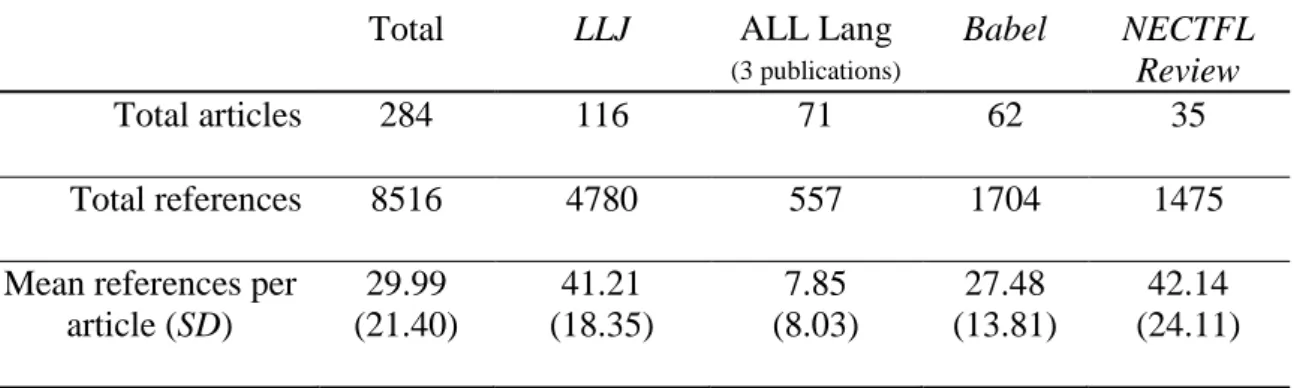
Table 6 details our corpus of references.
TABLE 6
Corpus of Professional Journal Articles
Total LLJ ALL Lang
(3 publications)
Babel NECTFL
Review
Total articles 284 116 71 62 35
Total references 8516 4780 557 1704 1475
Mean references per article (SD) 29.99 (21.40) 41.21 (18.35) 7.85 (8.03) 27.48 (13.81) 42.14 (24.11)
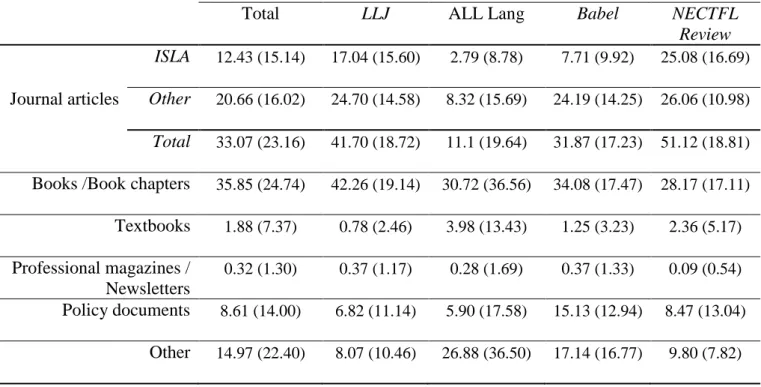
Table 7 shows the proportions of references of each type in each of our professional journals. The overall mean proportion of references to ISLA journals was 12.43%, with substantial variation both within and across the publications. In just over one third of the professional journals articles (37%, k = 105), the proportion of references to ISLA journals was zero. 3% (k = 8) of the articles contained 50% or more ISLA references. The means ranged from 2.79% in the ‘ALL language specific journals’ to 25.08% in the NECTFL Review.
27
TABLE 7
Proportion of References by Type
Mean % References Per Article (SD)
Total LLJ ALL Lang Babel NECTFL
Review
Journal articles
ISLA 12.43 (15.14) 17.04 (15.60) 2.79 (8.78) 7.71 (9.92) 25.08 (16.69)
Other 20.66 (16.02) 24.70 (14.58) 8.32 (15.69) 24.19 (14.25) 26.06 (10.98)
Total 33.07 (23.16) 41.70 (18.72) 11.1 (19.64) 31.87 (17.23) 51.12 (18.81)
Books /Book chapters 35.85 (24.74) 42.26 (19.14) 30.72 (36.56) 34.08 (17.47) 28.17 (17.11) Textbooks 1.88 (7.37) 0.78 (2.46) 3.98 (13.43) 1.25 (3.23) 2.36 (5.17) Professional magazines / Newsletters 0.32 (1.30) 0.37 (1.17) 0.28 (1.69) 0.37 (1.33) 0.09 (0.54) Policy documents 8.61 (14.00) 6.82 (11.14) 5.90 (17.58) 15.13 (12.94) 8.47 (13.04) Other 14.97 (22.40) 8.07 (10.46) 26.88 (36.50) 17.14 (16.77) 9.80 (7.82)
Table 8 details the mean raw number of references per article to each of our 29 ISLA journals, with some variation but almost all being far less than 1, indicating that on average these journals are referenced less than once per article. For example, 0.1 indicates that a mean of 1 in every 10 articles in the professional journal would contain a reference to that ISLA journal. The overall mean of the mean across all our professional journals (0.17, SD 0.19) indicates that on average a reference to any one of the ISLA journals occurs approximately one in every six articles.
28
TABLE 8
Mean (SD) Number of References per Article to ISLA Journals
Mean Number of References per Article in Professional Journal (SD)
ISLA Journals14 Total LLJ ALL Lang Babel NECTFL
Review
Applied Linguistics 0.42 (0.97) 0.78 (1.32) 0.03 (0.17) 0.23 (0.58) 0.31 (058) Applied Psycholinguistics 0.04 (0.30) 0.09 (0.45) 0 0.02 (0.13) 0.03 (0.17) Canadian Modern Language Review 0.18 (0.51) 0.34 (0.70) 0.01 (0.12) 0.05 (0.22) 0.17 (0.45) English for Specific Purposes 0.03 (0.20) 0.06 (0.30) 0.00 (0.00) 0 0.03 (0.17) Foreign Language Annals 0.67 (2.20) 0.28 (0.90) 0.03 (0.17) 0.11 (0.37) 4.20 (4.75)
Intercultural Pragmatics 0.01 (0.08) 0.01 (0.09) 0 0.02 (0.13) 0 Language and Intercultural
Communication
0.05 (0.60) 0.03 (0.16) 0 0 0.29 (1.69)
Language Awareness 0.09 (0.52) 0.14 (0.72) 0.01 (0.12) 0.03 (0.18) 0.17 (0.62) Language Learning 0.32 (0.97) 0.53 (1.32) 0.07 (0.35) 0.16 (0.41) 0.40 (1.04) *Language Learning and
Technology
0.19 (1.03) 0.28 (1.21) 0.01 (0.12) 0.02 (0.13) 0.51 (1.90)
Language Teaching 0.19 (0.57) 0.28 (0.59) 0 0.16 (0.41) 0.31 (1.05) The Modern Language Journal 0.74 (1.60) 0.67 (1.24) 0.06 (0.29) 0.47 (0.92) 2.86 (2.97)
*Porta Linguarum 0.01 (0.12) 0.03 (0.16) 0.01 (0.12) 0 0
Pragmatics and Society 0 0 (0) 0 0 0
ReCALL 0.09 (0.43) 0.16 (0.63) 0.01 (0.12) 0.05 (0.22) 0.09 (0.28) RELA/Spanish Journal of Applied
Lings
0.01 (0.08) 0.01 (0.09) 0.01 (0.12) 0 0 Studies in Second Language
Acquisition
0.25 (1.15) 0.52 (1.68) 0.03 (0.24) 0.03 (0.18) 0.17 (0.86)
System 0.31 (0.99) 0.67 (1.44) 0 0.02 (0.13) 0.26 (0.61) TESOL Quarterly 0.42 (0.91) 0.71 (1.14) 0.01 (0.12) 0.27 (0.73) 0.51 (0.92)
29
Vial-Vigo Internat. Journal of Applied Linguistics
0.01 (0.08) 0.02 (0.13) 0 0 0
Computer Assisted Language Learning
0.08 (0.41) 0.16 (0.56) 0 0 0.11 (0.53)
Annual Review of Applied Linguistics
0.07 (0.25) 0.12 (0.33) 0.01 (0.12) 0.03 (0.18) 0.06 (0.24)
Applied Linguistics Review 0.00 (0.06) 0.01 (0.09) 0 0 0 ELT Journal 0.25 (0.75) 0.46 (1.03) 0.01 (0.12) 0.16 (0.55) 0.23 (0.49) IRAL in Language Teaching 0.05 (0.25) 0.09 (0.34) 0 0.05 (0.22) 0.06 (0.24) Journal of French Language Studies 0.01 (0.15) 0.03 (0.23) 0 0 0
Language, Culture and Curriculum 0.09 (0.59) 0.10 (0.33) 0.01 (0.12) 0 0.34 (1.53) Language Teaching Research 0.24 (0.76) 0.42 (1.00) 0 0.16 (0.71) 0.23 (0.49) Language Testing 0.07 (0.46) 0.14 (0.66) 0 0.05 (0.28) 0.06 (0.34) Overall mean 0.17 (0.19) 0.25 (0.24) 0.01 (0.02) 0.07 (0.11) 0.39 (0.90) * Journals are completely open access, entirely free to authors and readers.
NECTFL Review contained the highest proportion of references to ISLA journals
(mean 25.08%, SD 16.69, per article). About one third of these (mean 32.42%, SD 25.27) were to Foreign Language Annals (FLA) and a quarter (28.03%, SD 28.35) to The Modern
Language Journal (MLJ). To benchmark against our other professional publications: the
overall mean proportion of their ISLA references to FLA was 2.78% and to the MLJ was 8.15% (Appendix G). Therefore, NECTFL Review’s overall higher proportion of ISLA references was largely (60.45%) due to references to two journals (linked to national associations, American Council of Teachers of Foreign Languages and National Federation of Modern Language Teachers Associations). Excluding these, the proportion of references to ISLA journals was 9.17%, closer to the other practitioner journals.
30
It is of course possible that some ISLA journals themselves provide a link between research and practitioners. For example, FLA is the official journal of a professional teaching association but did not meet our criteria for a practitioner publication because it is in the SSCI. To probe a little deeper into potential ‘cascading’ effects, we examined the references within FLA itself.
Between 2011–2015, FLA published 190 articles with 8,713 references, a mean of 45.86 (SD = 19.43) references per article, shown in Table 9 by type.
TABLE 9
Reference Types in FLA
Mean % of Total References per Article M(SD) Journal articles ISLA 26.06 (15.30) Other 25.76 (14.53) All 51.82 (17.00)
Books / Book chapters 34.43 (15.67)
Textbooks 0.66 (1.57)
Professional magazines /
Newsletters 0.31 (0.94)
Policy documents 4.14 (7.14)
Other 8.23 (8.02)
Closely reflecting the pattern of references in NECTFL Review, a mean of 26.06% (SD = 15.30) were to the ISLA set. Of these, over a quarter were to FLA (27.69%, SD= 26.43) and a fifth to MLJ (20.85%, SD = 20.22), leaving approximately 13% to other ISLA journals, closer to the overall mean. This again demonstrates an influence of research reported in the MLJ and
FLA, but leaves little evidence of a strong flow of research findings from the other 27 ISLA journals.
31
<A>DISCUSSION
Addressing Aim 1, our UK FL practitioners reported a small amount of exposure to material that mentioned research, and very low amounts of reading first hand reports in academic ISLA journals. Approximately a third of SB practitioners reported reading or hearing zero to five times material that mentioned research over the last 12–month period, and 70% reported reading or hearing fewer than two original research reports. SB
respondents reported a mean total of 9 publications (of all types) ever read compared to 26 for NSB, with the vast majority of these being practitioner publications and
magazines/newsletters (84%). Our data should be interpreted in the light of a probable self-selection bias in our sample - connection to the networks through which we administered our survey and willingness to complete a “Research and MFL teaching” survey may correlate positively with exposure to research. Despite this probable skew, we found severely limited amounts of exposure to research.
Our data suggested a role for the national professional subject association, with a third of publications and events mentioned being affiliated with ALL, and other sources being relatively ad hoc and smaller in number.
The data also suggested greater exposure to research for NSB practitioners, a strong indication that shifts to school-based teacher education would likely erode existing interfaces between research and practice without sustained infrastructure or action to mitigate against this, validating concerns raised by Lawes (2003) and Macrory (2015).
Addressing Aim 2, reported barriers to research engagement bunched into three types:
practical constraints, limited physical and conceptual access, and negative perceptions of
research. Practical constraints (e.g., time, funding) were the biggest inhibitory factor, followed by issues related to physical and conceptual access. This corroborates data from
32
EFL teachers (e.g. Borg, 2007; Ellis, 2010) who identified practical difficulties of locating written research (e.g., knowing where to look, journal subscriptions, time constraints) and conceptual difficulties of evaluating the applicability of research to the local context
(Williams & Coles, 2007). Our respondents made suggestions about addressing these issues in an open response item in our survey (which we are unable to present in detail due to space constraints): 34 (40%) of the 86 offering a response suggested that distilling research findings into non-technical summaries which are disseminated via practitioner outlets would facilitate access. 19 other respondents made suggestions such as provide easier access to findings, disseminate research via practitioner outlets, and provide web links to research findings.
The third type of barrier related to negative perceptions of research, but was a less important hindrance. Arguably, perceptions about relevance or usefulness could be
invalidated by respondents’ limited experience of research in the first place. Nevertheless, the survey item explicitly directed respondents to consider research that they had read or heard. In any case, it is perhaps reassuring that at least a priori negative prejudices are unlikely to be a significant hindrance. To us, this suggested a more positive picture of the potential of the research–practice interface than some previous studies (Kiely, 2014; Montgomery & Smith, 2015, Shkedi, 1998), indicating that increased effort in our communication infrastructure would, therefore, be worthwhile.
Addressing Aim 3, we found references to research in SSCI journals that aim to publish some pedagogically relevant research constituted about 12% of the bibliographies in professional journals. Although we have no benchmark against which to evaluate this (there is no ‘optimum’), we consider this to be a surprisingly and worryingly low proportion. It is an indication that a considerable amount of tax-funded, often high quality research is far from achieving its potential exposure for practitioners to then evaluate its relevance to their own professional lives. However, there was considerable variability both within and across
33
professional journals. In line with our UK survey data, we found evidence for some influence of national professional associations (and/or, perhaps, of the effort associated with the history and origins of their journals): in the US, references in The NECTFL Review to two journals (the MLJ and FLA, both associated with professional associations) increased the proportion of references to SSCI ISLA journals from 10.32% to 25.08%, a pattern closely mirrored by references within FLA itself. However, we note that the Language Educator, the professional magazine of the American Council on the Teaching of Foreign Languages (ACTFL, the largest organisation in the USA dedicated to foreign language teaching), did not use sufficient references to research publications to be included in our review.
One potential explanation for the low proportion of references to SSCI ISLA journals could be the oft discussed ‘lack of connection with the classroom’ (Byrnes, 2016, pp. 7–8). But several arguments counter this as a complete explanation for poor flow of published research. First is the explicit intention of journals and researchers to publish research relevant to practice. Second, although ISLA research cannot provide directly relevant ‘technical solutions for effectiveness’, there is general consensus that it has relevance in terms of
enriching reflectiveness and pedagogical decision-making. Third, our UK survey respondents did not express severe concerns about a lack of relevance or usefulness. Finally, we argue that there is a great deal of potentially relevant research, as found by two recent survey articles. First, 97 intact classroom studies were found by Collins and Muñoz (2016) in just one of our 29 journals—the MLJ—in the last 14 years. Second, Rose & McKinley (2016),
surveying only one year (2015) of just 10 self-identified applied linguistics journals, found that language-pedagogy-related studies constituted 32 per cent of articles (approximately 108/336). A further illustration of this point is as follows: The overall mean number of references to, for example, the SSCI journal Language Teaching Research was 0.24 per article in our professional publications (Table 8). If this was a reflection of the amount of
34
relevance, this would suggest that only one in every four articles in our corpus of professional publications would find relevant research in the publishing history of Language Teaching
Research, that is, approximately 456 articles (1997–2017); we believe that is highly unlikely
(see also Barkhuizen, 2013), though we acknowledge this is an empirical question.
Our findings, from both Parts of the study, remind researchers not to ‘drop the ball’ of communicating our research. The current “methodological turn” (Byrnes, 2013, p. 825) in our field has the long term ambition of increasing relevance and usefulness by improving the insights that research can offer practice (e.g., synthesising findings, replicating, broadening our participant demographics, strengthening study designs, and improving methodological transparency, instrument reliability and statistical reporting, e.g. Marsden, Mackey, & Plonsky, 2016; Marsden, Morgan-Short, Thompson & Abugaber, under review; Marsden & Torgerson, 2012; Ortega, 2005; Plonsky & Derrick, 2016; Plonsky & Oswald 2014).
However, systematic, sustained effort in the research–practice interface is needed to make this effort worthwhile perhaps, as relevance and usefulness were in fact much less of a concern than time and physical and conceptual access, for our respondents at least.
Our study focused on one step: exposure to research. Another issue relates to
research literacy and empowering practitioners to evaluate relevance to context (Borg, 2010; Cordingley, 2004; Ellis, 2010; Hammersley, 2003; Hatch, 1978; Larsen–Freeman, 2009, 2015; McMillan & Wergin, 2010; Ortega, 2012; Pachler, 2003). We emphatically do not use our data to recommend that school-based practitioners should read articles in SSCI journals. Nor are we arguing for a radical change in the nature or aims of research in SSCI ISLA journals (we acknowledge for example that theory-driven questions can require isolation from ‘real world problems’ (Brumfit, 1995)). We propose, rather, a small addition to the ISLA field’s publication practices that may help increase physical and conceptual access to a
35
body of research that has been conducted and reviewed with a certain degree of rigour (if we perceive citation indices as one marker of quality).
In sum, the action that we now propose was informed by each of the following key findings: (a) the limited practitioner exposure to peer reviewed published research, (b) the barriers caused by lack of time and physical and conceptual accessibility, (c) the relatively positive perceptions about the relevance and usefulness of research, (d) a potential role of subject associations and affiliated publications, (e) the stated aims of 29 SSCI journals, and (f) the low proportion of SSCI ISLA research referred to in professional journals.
<A>A CALL FOR ACTION: JOURNAL-INITIATED LAY SUMMARIES
SSCI journals who publish pedagogically relevant research, however broadly defined, could encourage, or ideally request, their authors, where appropriate, to reframe their
academic publications into summary formats that are both physically and conceptually accessible to practitioners. Open access distribution of these brief (one page) “lay
summaries” could be via international research and professional umbrella associations, such as AILA and FIPLV, and/or posted on one sustained, searchable web resource. All interested organisations, such as national teacher associations, could link to this one platform. Materials that could be useful to practitioners could be made available via, for example, the IRIS repository (www.iris-database.org). Open access distribution would likely occur via social media (recall that high proportions of our respondents reported accessing material via the internet, whilst only two of our 29 ISLA journals are open access). This could be a cost-effective mechanism for reducing barriers relating to time, funding, and both physical and conceptual access, and for increasing the likelihood of exposure to internationally peer-reviewed research.
36
Our proposal may also help to address other issues identified at the start of this article. First, a journal-led approach may be necessary to address the problem that researchers are rarely incentivised to do this from other quarters. Note that the ‘impact agendas’ in Australia, the UK and the USA do not incentivise isolated acts such as publishing in a professional outlet. In the UK, for example, to qualify as ‘impact’ concrete evidence of observable effects on non-academic users is required. Further, our data from the UK and Australia, contexts where the impact agenda is more embedded, did not suggest a better flow of academic publications to professional interfaces compared to our data from the USA, a context with a less explicitly developed impact agenda.
Second, the discipline specific (i.e., language education) nature of our proposal may be necessary given that generaleducation infrastructures and initiatives have tended to be short-lived and seem to be more sensitive to political climates than academic journals, many of which have enjoyed relative longevity.
Mechanisms related to the one we are proposing are in place in some FL contexts. For example, the Paul Pimsleur (ACTFL-NFMLTA) and Birkmaier (NFMLTA) Awards
recognise FL education research (though to our knowledge neither require the recipients to disseminate their research to practitioners). The Language Educator’s (ACTFL’s magazine) produces 5–10 line summaries of FLA articles. As noted, however, in FLA approximately 13% of the references were to other SSCI ISLA journals (i.e. excluding MLJ and FLA), and so these summaries do not address the gaps we have identified with the wider body of international ISLA research. What we propose here would (a) cover more research, from more journals, (b) serve a more international audience, (c) incentivise researchers, and (d) provide more information about each study to help readers determine relevance more easily.
Establishing such an infrastructure would be in line with movements across the life sciences and psychology. There are now over 50 journals and societies that publish plain
37
language summaries (eLife, 2017). But this will not be a trivial undertaking for our domain. It requires sensitive consideration of many matters affecting feasibility and ultimate
usefulness, such as journal and professional association take-up, author/editorial
responsibilities for the content and style of summaries, ownership of intellectual property and relations with publishing houses. For example, eLife has now published over 2,400 plain language digests (King, Pewsey & Shailes, 2017), but the burden of work falls on a group of feature editors who write the summaries and then collaborate with the original authors for fine-tuning. Other examples include: Archives of Scientific Psychology’s lay abstracts
alongside their scientific abstracts; Perspectives in Medical Education (an open access journal) has short plain language “What this article adds” sections in each article;
Proceedings of National Academy of Sciences have short ‘Significance Statements’ inserts in
every article, which are then also released in a weekly open access publication; the American
Educational Research Association annually publishes 4-5 line summaries of the twenty most
downloaded education research articles, giving open access to each of these articles. To our mind, none of these provide a ‘model’ initiative, one key concern being the extent to which they take action to reach practitioner networks. Nevertheless, they offer food for thought.
Our proposal, which will hopefully springboard discussion in the field, is that journal Editors would encourage or require authors of relevant articles to create one page lay
summaries and forward these to a central point (such as AILA, FIPLV, or one web resource), to which interested networks would link. Variation between journals would be expected: some may prefer Editorial oversight, others may prefer author autonomy; some may ‘encourage’ and some may ‘require’ author participation; some publishers may put the summaries open access on their websites to increase visibility; some may disseminate annually following Editorial board meetings, others more frequently; some may also engage directly with specific practitioner groups. But, we suggest, an overarching infrastructure, in
38
terms of journal policy and one collection point, would bring essential momentum and economy of scale.
<A>LIMITATIONS
We have proposed that professional associations would be one effective conduit to increase the flow of written research, given the data from our surveys and reference mapping. Of course, other communication channels deserve systematic study to ascertain the extent to which they facilitate flow, such as books, social media, and face to face events. However, our school-based respondents reported hearing about research at events a mean of just three (median two) times over their career and very few mentioned reading books, suggesting these do not constitute a strong link to research. Nevertheless, 35% of references in our
professional journals were to books, so it is possible that these references a) link to research reported in books (albeit often less rigorously peer-reviewed than some journals), and b) link indirectly to research reported in ISLA journals, that is, citations to books that in turn cite journals.
A related limitation of our study is that research may be communicated via, for example, CPD events, without overt recognition (or even awareness on the part of the CPD provider) that it is ‘research’, and so such potential interfaces are neglected by our
investigation. Documenting such interfaces would require the investigators themselves to decide the extent to which the content of CPD events or material was informed by research; a valuable exercise. However, such implicit/covert communication of ‘research’ may not promote practitioners’ awareness and criticality about what research can reasonably claim, or their own evaluation of its usefulness, validity or reliability.
Our review of professional journals probably over-estimates exposure to research via their citations therein. First, we did not quantify the repetition of references across articles,
39
and although we did not find obvious examples of this, some amount of overlap was inevitable. Second, given the small amounts of reading reported in our UK survey, such indirect exposure is limited in its reach. Third, although these professional publications were the most frequently mentioned (almost half of all mentions) in our UK survey, further
research is required to ascertain the extent to which U.S. and Australian practitioners read the publications we reviewed (but we suspect that findings would be similar to our UK data).
We recognise that not all research published in our ISLA journals is directly relevant to school FL teachers (e.g., we did not exclude ‘English’ or artificial languages) and that findings from research could rarely if ever be adopted wholesale in the classroom, as influence is indirect in that it raises awareness and informs innovation. However, adopting different views about research–practice relations would not, we think, greatly alter the implications of our findings. For example, whether we adopt a spiralling
outwards/‘implications and applications’ view of research to pedagogy, or a case-study approach whereby socio-educational contextual factors are critical to interpretation of the study, or an awareness-raising/ reflective-practitioner model, or a co-constructed approach in which practitioner involvement is fully embedded throughout (Byrnes, 2016; Ellis &
Shintani, 2013; Long, 2000; Norris & Manchón, 2012; Lantolf & Poehner, 2015), our data indicate that these models would be similarly ill-served by the current flow of published academic research. Our point is more general: If any potential pedagogical relevance is claimed (by authors or editorial mission statements), the research could better find its way into practitioners’ communities of practice, for evaluation by them. Looking even further ahead, it is possible that improvements in this dimension could, in turn, produce a kind of ‘washback’ that affects the aims, construction and design of ISLA research itself.