(will be inserted by the editor)
Quantitative Analysis of Apache Storm Applications: The
NewsAsset Case Study
Jos´e I. Requeno · Jos´e Merseguer · Simona Bernardi · Diego Perez-Palacin · Giorgos Giotis · Vasilis Papanikolaou
Received: date / Accepted: date
Abstract The development of Information Systems to-day faces the era of Big Data. Large volumes of in-formation need to be processed in realtime, for exam-ple, for Facebook or Twiter analysis. This paper ad-dresses the redesign of NewsAsset, a commercial prod-uct that helps journalists by providing services, which analyze millions of media items from the social net-work in realtime. Technologies like Apache Storm can help enormously in this context. We have quantita-tively analyzed the new design of NewsAsset to assess whether the introduction of Apache Storm can meet the demanding performance requirements of this media product. Our assessment approach, guided by the Uni-fied Modeling Language (UML), takes advantage, for performance analysis, of the software designs already used for development. In addition, we converted UML into a domain-specific modeling language (DSML) for Apache Storm, thus creating aprofilefor Storm. Later, we transformed said DSML into an appropriate lan-guage for performance evaluation, specifically, stochas-tic Petri nets. The assessment ended with a successful software design that certainly met the scalability re-quirements of NewsAsset.
Keywords Apache Storm · UML · Petri nets · Software Performance·Software Reuse
Jos´e Ignacio Requeno, Jos´e Merseguer, Simona Bernardi and Diego Perez-Palacin
Dpto. de Inform´atica e Ingenier´ıa de Sistemas Universidad de Zaragoza (Spain)
E-mail:{nrequeno,jmerse,simonab,diegop}@unizar.es Giorgos Giotis and Vasilis Papanikolaou
Athens Technology Center, ATC (Greece) E-mail:{g.giotis, v.papanikolaou}@atc.gr
1 Introduction
Innovative practices for Information Systems develop-ment, like Big Data technologies, Model-Driven Engi-neering techniques or Cloud Computing processes have penetrated in the media domain. News agencies are already feeling the impact of these technologies (e.g., transparent distribution of information, sophisticated analytics or processing power) for facilitating the de-velopment of the next generation of applications. Espe-cially, considering interesting media and burst events, which is out there in the digital world, these technolo-gies can offer very efficient processing capabilities and can provide an added value to journalists.
Apache Storm (Apache, 2017a) is a free and open source distributed realtime computation system that can process a million tuples per second per node. Storm helps for improving real-time analysis, news and adver-tisements, the customization of searches, and the opti-mization of a wide range of online services that require low-latency processing. Today, the volume of informa-tion in Internet increases exponentially, especially that of interest for the media. For example, in the case of natural disasters, social or sportive events, the traffic of tweets or messages may rise up to 10 or 100 times with respect to the number of messages in a normal situa-tion (Ranjan, 2014). Hence, applicasitua-tions developed us-ing Apache Storm need to be very demandus-ing in terms of performance and reliability.
This paper addresses, using Apache Storm, the re-design of NewsAsset, a commercial product developed by the Athens Technological Center (ATC, 2018). To this end, we apply a quality-driven methodology, that we already introduced in (Requeno et al., 2017), for the performance assessment of Apache Storm applications. For ATC the redesign also means toreusecoding of the
current version of the NewsAsset, then trying to impact only on the stream processing for leveraging Apache Storm. The simulation-based approach that we apply here is useful for predicting the behavior of the appli-cation for future demands, and the impact of the stress situations in some performance parameters (e.g., appli-cation response time, throughput or device utilization). Consequently, ATC gets, before reimplementation and deployment of the full application, a valuable feedback which saves coding and monetary efforts.
In particular, this paper extends the approach in (Requeno et al., 2017) with respect to the quality-driven methodology in different aspects. First, we improve the UML profile of the methodology for introducing a relia-bility characterization of Storm. Consequently, we con-vert UML into a DSML1 for performance and reliabil-ity of Apache Storm applications. Second, we propose new transformations, into stochastic Petri nets (SPN), for some performance parameters of Storm not already addressed in (Requeno et al., 2017). Moreover, we in-troduce computation of reliability metrics by means of the UML profile. Consequently, our approach enables the performance and reliability assessment of Apache Storm applications. Finally, the application of the method-ology to the NewsAsset case study has been useful to validate the approach in a real scenario and to assess ATC about its scalability.
On the modeling side, our DSML allows to work with the Apache Storm performance and reliability pa-rameters in the very same model used for the workflow and deployment specifications. Moreover, the developer takes advantage of all the facilities provided by a UML software development environment. These reasons rec-ommend the UML modeling, instead of doing it directly with the SPN, that can be merely obtained by trans-formation.
Regarding the related work, (Ranjan, 2014) discusses the role of modeling and simulation in the era of big data applications and defends that they can empower practitioners and academics in conducting “what-if” analyses. (Singhal and Verma, 2016) develop a frame-work for efficiently set-up heterogeneous MapReduce environments and (Nalepa et al., 2015a,b) address the need of modeling and performance assessment in stream applications. More in particular, a generic profile for modeling big data applications is defined for the Palla-dio Component Model (Kroß et al., 2015). In (Kroß and Krcmar, 2016), the authors model and simulate Apache Spark streaming applications. Mathematical models for predicting the performance of Spark applications are introduced in (Wang and Khan, 2015). Some of these works use variants of the Petri nets, but they are
ap-1 Domain Specific Modeling Language.
plied in a generic context for stream processing (Nalepa et al., 2015b) or distributed systems (Samolej and Rak, 2009; Rak, 2015). Generalised stochastic Petri nets (Chi-ola et al., 1993), the formalism for performance analy-sis that we adopt here, have been already used for the performance assessment of Apache Hadoop MapReduce (et al., 2016). A recent publication uses fluid Petri nets for the modeling and performance evaluation of Apache Spark applications (et al., 2017). However, the work in (Requeno et al., 2017) was the first entirely devoted to the Apache Storm performance evaluation, combining a genuine UML profile and GSPNs, and the present work validates and extends it as aforementioned.
The rest of the paper is organized as follows. Sec-tion 2 introduces the NewsAsset case study. SecSec-tion 3 recalls the basics on Apache Storm for performance and reliability and defines the DSML. Section 4 presents our performance modeling approach with focus on the case study. Section 5 is devoted to the performance analy-sis of NewsAsset. Finally, Section 6 draws a conclusion. Appendix A details the transformation to get perfor-mance models. Appendix B explains the computation of reliability metrics in a Storm design. Appendix C re-calls basic notions of Generalized stochastic Petri nets (Chiola et al., 1993).
2 A Case Study in the Media Domain
Heterogeneous sources like social or sensor networks are continuously feeding the world of Internet with a variety of real data in a tremendous pace: media items describ-ing burst events, traffic speed on roads, or air pollution levels by location. Journalists are able to access these data aiding them in all manner of news stories. It is the social networks like Twitter, Facebook or Instagram that people are using to watch the news ecosystem and try to learn what conditions exist in real-time. Subse-quently, news agencies have realized that social-media content is becoming increasingly useful for news cover-age and can benefit from this trend only if they adopt current innovative technologies that effectively manage such volume of information. Thus, the challenge is to catch up with this evolution and provide services that can handle the new situation in the media industry.
NewsAsset is a commercial product positioned in the news and media domain, branded by Athens Tech-nology Center (ATC), a SME2located in Greece. NewsAs-set suite constitutes an innovative management solu-tion for handling large volumes of informasolu-tion offering a complete and secure electronic environment for stor-age, management and delivery of sensitive information
in the news production environment. The platform pro-poses a distributed multi-tier architecture engine for managing data storage composed by media items such as text, images, reports, articles or videos.
NewsAsset is built on the achievements of a EU-funded project, namely SocialSensor (et al., 2012), which managed to develop a framework for enabling real-time multimedia indexing and search in the Social Web. So-cialSensor deployed an open source platform capable of collecting, processing, and aggregating big streams of social media data and multimedia.
As a commercial product, the NewsAsset is in con-tinuous evolution, extending the original suite with new upgrades and functionalities. The NewsAsset needs to be constantly updated for handling efficiently the in-creasing volume of data. On the other hand, the NewsAs-set application must continue satisfying a NewsAs-set of quality standards defined in terms of reliability and efficiency. Therefore, the system needs to adopt runtime scalabil-ity methods to manage temporal peaks of high compu-tational demand (i.e., during the peaks of a bust event).
2.1 Objetive of the Performance Analysis
The ATC team identified several functional and non-functional quality-driven requirements that are not ad-dressed by the current status of the platform (Reqs., DICE Consortium, 2016). The ultimate goal is to mod-ernize the existing commercial product NewsAsset. The main foreseen challenges are:
– Refactoring of the old-fashioned engine related to cloud processing and Big Data technologies, – Reconfiguration of the obsolete architecture with
re-spect to quality-driven metrics, and
– Managing the complexity real-time responsiveness for temporal peaks of high computational demand. The part of the NewsAsset framework that poten-tially creates a major bottleneck, and therefore it must be redesigned, is the News Orchestrator application. The time behavior of the News Orchestrator application is quite critical since the analyzed information, regard-ing the trendregard-ing topics extracted, should be indexed and exposed by the User Interface in real time, enhanc-ing in this way the importance of the identified news topics. We will focus on this part in this work.
The idea is to re-engineer the architecture and in-troduce Big Data technologies where this is possible. Essentially, the core is replacing the batch processing, that is now the current approach, with stream process-ing. Then, the logical choice for the Big Data technology to accomplish this purpose is Apache Storm. It would definitely affect the accuracy and processing time of
the system. The goal is to optimize the existing pro-cessing time by means of not only minimizing the time slot duration to reflect real time processing but also by maximizing the crawling capacity of the social networks crawler, giving us the potential to collect and analyze as much social networks content as possible.
By identifying and analyzing quality-driven metrics we expect to detect bottlenecks in the architecture and redesign those critical parts by introducing more com-putational resources and/or adjusting configuration pa-rameters of Apache Storm.
3 A DSML for Apache Storm
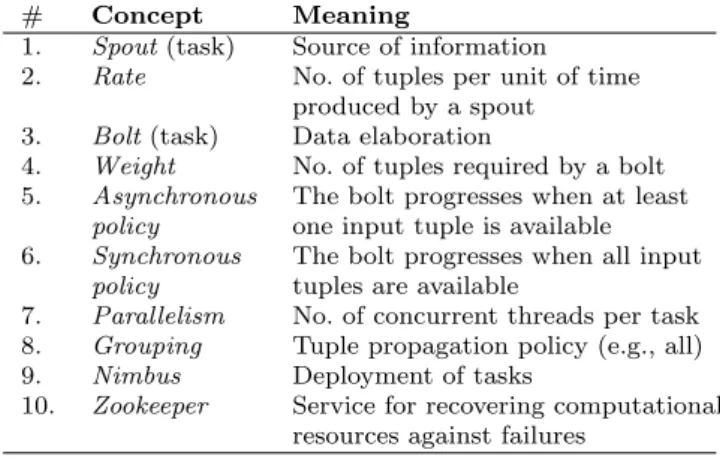
In the following, the main concepts of the Storm tech-nology related to performance and reliability are re-vised. In fact, the Apache Storm framework offers con-figuration parameters, that when correctly tuned allow one to improve the performance and the reliability of the Storm applications. Consequently, these parameters are essential for the performance or reliability analysis of the Storm applications. Table 1 summarizes all these parameters.
Storm applications are directed acyclic graphs (DAG) withnodesandedges, see Figure 1.Nodesare the points where the information is generated or processed. They can bespouts, sources of information that injectstreams of data at a certainrate, orbolts, that elaborate input data and produce results which, in turn, are emitted towards other bolts. Theedgesdefine the transmission of data from one node to another. By default, a Storm application runs indefinitely until killed.
spout_1
spout_2
weight=5 grouping=allbolt_1
bolt_2
parallelism=2 synchronous parallelism=2 asynchronousbolt_3
weight=5 grouping=shuffle weight=5 grouping=shuffle Fig. 1 A Storm ApplicationThe computation of a bolt requiresntuples for pro-ducing m results. Such asymmetry is captured by the weightsin the arcs of the DAG, that represent the num-ber of tuples the next bolt requires for emitting a new message. The notions oftuples and messages are then equivalent. A bolt can select different synchronization policies. When it receives messages from two or more sources, it can a) progress, if at least a tuple from any of the sources is available (asynchronously), or b) wait
for a message from all the sources (synchronously). The parallelism specifies the number of concurrent threads executing the same task (spout or bolt).
Specifically for the edges. Besides theweights, the groupingdetermines the way a message is propagated to and handled by the receiving nodes. By default, a mes-sage is broadcast to every successor of the current node. Once the message arrives to a bolt, it is either redirected randomly to any of the multiple internal threads (shuf-fle), copied to all of them (all) or copied to a specific subset of threads according to some criteria (e.g, field orglobal).
The Storm Nimbus is the cluster master node. It statically deploys the spouts and bolts to the computa-tional resources of the cluster, at the beginning of the execution. Complex schedulers may take into account the available computational resources and the software requirements (memory and CPU consumption) for defin-ing an optimal distribution of the tasks. The Apache Zookeeper is a service used by the cluster to moni-tor, coordinate and recover the computational resources against failures.
Table 1 Storm Concepts for Performance and Reliability
# Concept Meaning
1. Spout(task) Source of information
2. Rate No. of tuples per unit of time
produced by a spout
3. Bolt(task) Data elaboration
4. Weight No. of tuples required by a bolt 5. Asynchronous The bolt progresses when at least
policy one input tuple is available 6. Synchronous The bolt progresses when all input
policy tuples are available
7. Parallelism No. of concurrent threads per task 8. Grouping Tuple propagation policy (e.g., all) 9. Nimbus Deployment of tasks
10. Zookeeper Service for recovering computational resources against failures
3.1 A UML Profile for Apache Storm
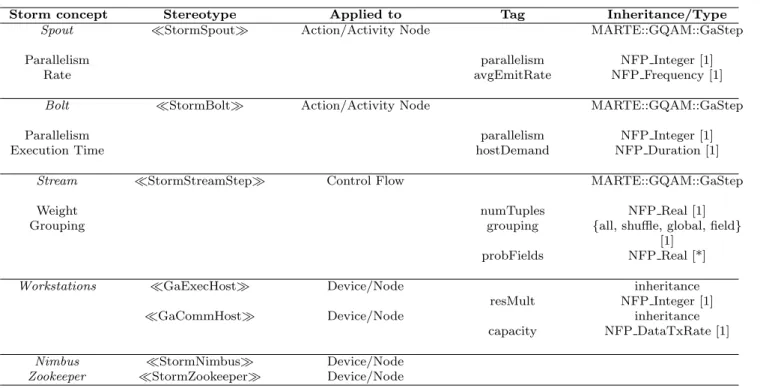
A UML profile is a set of stereotypes, and corresponding tags, that extend the semantics of the UML diagrams when they are applied to the elements of a model. Here we present an extension of the UML profile for Apache Storm introduced in (Requeno et al., 2017), which is the first and only one in the literature devoted to Apache Storm, to the best of our knowledge. This profile ex-tends UML with the Storm concepts identified in Ta-ble 1. Then, according to (Selic, 2007) and (Lagarde et al., 2007), we are creating a DSML for specifying the
properties that affect the performance and reliability of the Apache Storm applications designed with UML.
The Storm profile provides the stereotypes collected in Table 2. The attributes of the stereotypes may have multiplicity one (e.g., [1]) or multiple (e.g., [*] for un-bounded arrays). For the concepts of spout and bolt we introduce the StormSpoutand StormBolt stereotypes. They share theparallelism, i.e., number of concurrent threads executing the task, which is speci-fied by the tag parallelism. Spouts also add the tag
avgEmitRate, which represents the rate at which the spout produces tuples.
The concept ofstreamis captured by the Storm-StreamStepstereotype, which owns three tags:
– numTuples matches the weight concept. It
repre-sents the number of tuples required by the target bolt for emitting a tuple. A value $nT between 0 and 1 means that the next bolt produces 1/$nT
messages per input.
– groupingmatches thegroupingconcept; and
– probFields is a n-dimensional array of reals that is used when the type of groupingis equal tofield. The array specifies the probabilitiespi that a mes-sage, transmitted through theStormStreamStep, ar-rives to the threads ti of the target bolt. The value ofpican be estimated or obtained at runtime exper-imentally, i.e., by tracing the messages grouped by the bolt thread.The dimension of the array depends on the parallelism of the target bolt.
StereotypesStormNimbusandStormZookeeper are devoted to reliability analysis, so they are treated in Appendix B. The rest of the stereotypes in Table 2 are described in Section 4 in the context of the modeling. Profile Inheritance
The standard MARTE3profile provides a complete frame-work for quantitative analysis, while the DAM4 pro-file addresses the reliability analysis. In particular, the GQAM sub-profile of MARTE is specialized for perfor-mance analysis. These are the reasons why the Apache Storm profile inherits from MARTE and DAM.
The stereotypes for bolts, spouts and streams in-herit from MARTE::GQAM::GaStep. So, they can be treated as computational steps and the bolts can use thehostDemandtag from GaStep for defining the task execution time.
MARTE also offers the NFPs and VSL sub-profiles. The NFP sub-profile aims to describe the non-functional
3 Modelling and Analysis of Real Time and Embedded
Sys-tems (OMG, 2011a).
4 Dependability Modelling and Analysis (Bernardi et al.,
Storm concept Stereotype Applied to Tag Inheritance/Type
Spout StormSpout Action/Activity Node MARTE::GQAM::GaStep
Parallelism parallelism NFP Integer [1]
Rate avgEmitRate NFP Frequency [1]
Bolt StormBolt Action/Activity Node MARTE::GQAM::GaStep
Parallelism parallelism NFP Integer [1]
Execution Time hostDemand NFP Duration [1]
Stream StormStreamStep Control Flow MARTE::GQAM::GaStep
Weight numTuples NFP Real [1]
Grouping grouping {all, shuffle, global, field}
[1]
probFields NFP Real [*]
Workstations GaExecHost Device/Node inheritance
resMult NFP Integer [1]
GaCommHost Device/Node inheritance
capacity NFP DataTxRate [1]
Nimbus StormNimbus Device/Node
Zookeeper StormZookeeper Device/Node Table 2 Apache Storm Profile
properties of a system, performance and reliability in our case. The VSL sub-profile, provides a concrete tex-tual language for specifying the values of metrics, con-straints, properties, and parameters related to perfor-mance, in our particular case.
VSL expressions are useful for:
(i) specifying the input parameters in the model. An example:
expr=$b, unit=ms, statQ=mean, source=est
(1) (2) (3) (4)
This expression, applied to a bolt, specifies its demand
$b(1)milliseconds (2) of processing time, whose mean value (3) will be obtained from an estimation in the real system (4). $b is a variable that can be set with concrete values during the analysis of the model. (ii) specifying the metrics that will be computed for the model. An example:
expr=$util, unit=%, statQ=mean, source=calc
(1) (2) (3) (4)
This expression, applied to a resource, specifies that its
utilization (4) is computed as a percentage of time
(2), whose mean value (3) will be assigned to variable
$util(1).
4 NewsAsset Performance Modeling 4.1 System Workflow Description
As explained in Section 2.1, the News Orchestrator is the part of the NewsAsset product that manages large volumes of information. In particular, the topic-detector, within the News Orchestrator, defines the workflow that exposes the system to handle the realtime Big Data in-formation, hence the critical data-intensive computa-tion part of the system. The main purpose of topic-detector is in fact the extraction of trending topics contained in items shared through social networks. By trending topics we refer to frequent features (n-grams, named entities or hashtags) that exhibit an abnormal increase on the current time slot compared to others.
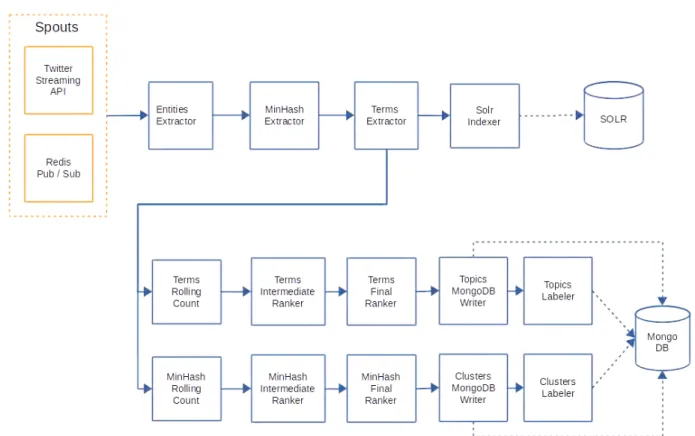
The main workflow of the topic-detector is depicted in Figure 2. It has been refactored, from the current version, as an Apache Storm topology, for the sake of reusing the code pipelined forwardly. The backend of the system consists of several processes running contin-uously on a 24/7 basis as persistent loops.
In Figure 2 we observe that the input stream con-sists of two spouts that inject items in the topology: a) one waiting for incoming items from Twitter’s Stream-ing API, and b) one that listens to a Redis message broker following the Publish/Subscribe pattern. The first bolt in the topology extracts named entities from the text of the messages injected, for this procedure
Fig. 2 Workflow of the topic-detector
Stanford NER extractor is used. The next bolt extracts a signature from the text based on the MinHash al-gorithm. Intuitively, items with similar text will have identical signatures. The next bolt extracts terms from the items i.e. n-grams and hashtags. TheSolr indexer bolt used to index the items in a running instance of Solr database.
At that point, the topology splits into two parallel pipelines: the first one is used to extract trending top-ics based on trending terms, while the second is used to cluster items based on minhash signature. Both of these pipelines use the same sequence of bolts, but operate on a different field of the items (terms and minhash signa-ture respectively). The first bolt, TermsRollingCount-Boltperforms rolling counts of incoming objects (terms or minhash). Rolling means that by using a sliding win-dow the bolt keeps track of statistics of an object to the current time window compared to the previous ones. At the end of each time window, the bolt emits a rolling count tuple per object, consisting of the object itself, its latest rolling count, a metric that indicates how trend-ing is the object and the actual duration of the slidtrend-ing window (just for testing as the length of the windows is constant).
As each object can be emitted from multiple nodes in a distributed topology, the next two bolts aggregate and rank the objects, in a map-reduce fashion. The final ranking bolt emits a ranking of top objects (terms or minhash) for the current time window. Finally, each of the objects in the rank is stored in a MongoDB instance. The time stamp of the current window is also stored in order to keep track of the evolution of these objects over time.
4.2 UML Performance Design
Once the system workflow has been defined, we need to introduce the performance parameters, that will even-tually enable a performance analysis of the system. For this reason, we defined in Section 3 a DSML for Apache Storm applications. In particular, we need to model: i) the Storm topology, i.e., the DAG; ii) the perfor-mance parameters, and iii) the deployment of the sys-tem, where the resources will be defined.
i)Modeling the Storm topology
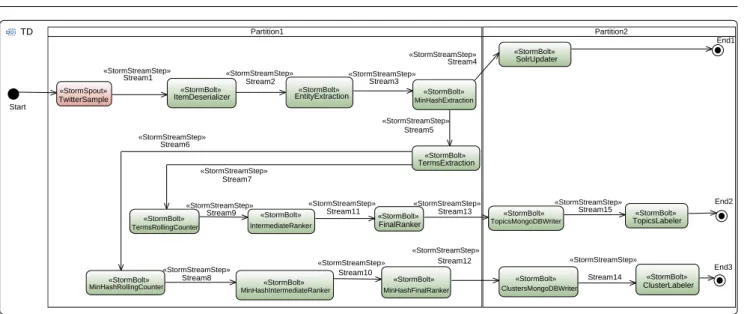
For this purpose our approach proposes the UML activity diagram, which is interpreted as a DAG. It
ba-«StormBolt» «StormBolt»
«StormBolt» «StormBolt»
«StormBolt»
«StormBolt» «StormBolt» «StormBolt» «StormBolt» «StormBolt» «StormBolt» «StormBolt» «StormBolt» «StormSpout» «StormBolt» «StormBolt» Partition» TopicsMongoDBWriter TopicsLabeler ClusterLabeler Partition2 TwitterSample
Stream» Stream2 Stream3
MinHashExtraction Stream4 SolrUpdater End» End2 End3 TD Start Stream6 Stream7 Stream5 TermsExtraction
TermsRollingCounter IntermediateRanker FinalRanker
Stream9 Stream»» Stream»3 Stream»5
Stream8 Stream»«
MinHashRollingCounter MinHashIntermediateRanker
«StormStreamStep» «StormStreamStep» «StormStreamStep» «StormStreamStep» «StormStreamStep» «StormStreamStep» «StormStreamStep» «StormStreamStep» «StormStreamStep» «StormStreamStep» «StormStreamStep» «StormStreamStep» «StormStreamStep» «StormStreamStep» «StormStreamStep» Stream»2 Stream»4 MinHashFinalRanker ClustersMongoDBWriter ItemDeserializer EntityExtraction
Fig. 3 Activity diagram for the topic-detector workflow, with profile annotations
«device» «GaExecHost» Core_1 resMult=(expr=$c1) «device» «GaExecHost» Core_2 resMult=(expr=$c )2 «StormBolt» SolrUpdater «StormBolt» ItemDeserializer «StormBolt» ... «StormBolt»...
Fig. 4 Deployment diagram
sically mimics the workflow of the system, although the semantics we adopt is slightly different from the stan-dard one of the UML activity diagram. In our approach, a UML activity diagram will always start with a set of initial nodes connected to the spout tasks since they are the sources of information responsible of inserting tuples in the topology. The rest of the tasks (i.e., bolts) will follow according to the Stormsynchronization pol-icy declared for them. Besides, the arcs connecting ac-tivities do not represent a logical succession of actions, as in standard UML, but a communication channel be-tween two tasks (i.e., spouts and/or bolts). Figure 3 depicts the model for the topics-detector.
ii)Modeling the performance parameters
They represent input parameters and the metrics to compute and obviously are introduced in the model using the stereotypes and tags already defined in Ta-ble 2. In Figure 3, we observe that the activities and transitions have been stereotyped accordingly to their semantics. The tags that detail these stereotypes, i.e., the input parameters appear in Tables 3 and 4.
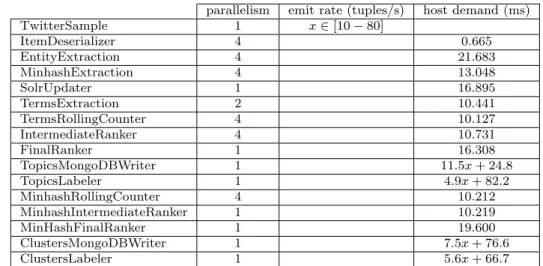
Table 3 introduces the variables associated to the tags of the spouts and bolts stereotypes in the UML activity diagram.The first column includes the level of parallelism (number of threads) for each spout (bolt) of the system. The second column shows the expected average execution time, in milliseconds, required by a spout (bolt) for creating (processing) a tuple. The total execution time depends on the number of input tuples needed for emitting an output.
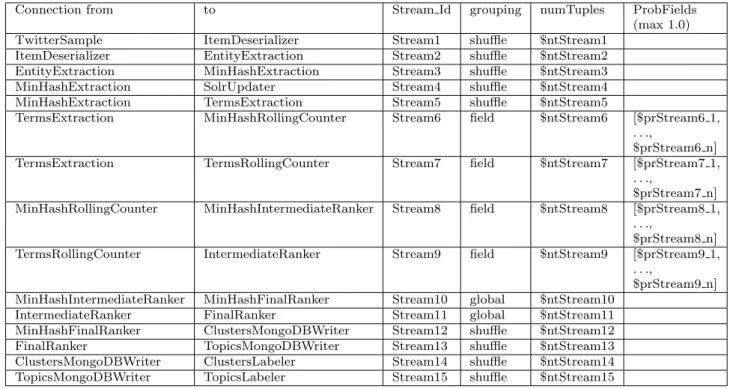
Table 4, shows the grouping policies, weights and probabilities associated to the communication streams linking spouts and bolts. The weight corresponds to the number of messages consumed by the following bolt in order to generate a new message. The probabilities are associated to theprobFields tag. The size of the array of probabilities depends on the parallelism of the target bolt (i.e., it shows the probability of receiving a tuple by the i-th thread).
iii)Deployment modeling
The bolts of the activity diagram are mapped to the computational resources where they will execute upon deployment. This modeling is of great importance since resources may turn into system bottlenecks. Fig-ure 4 shows the deployment diagram, which comple-ments the previous activity diagram. Each computa-tional resource is stereotyped asGaExecHost, inherited from MARTE, and defines its resource multiplicity, i.e., number of cores. Table 5 defines variables for specifying the number of available cores in each workstation of the cluster.
Initializing the values of the model parameters The vari-ables already defined in the Tvari-ables 3, 4 and 5, i.e., tags
of the stereotypes, are initialized according to the ac-tual parameters of the running Storm application. The parallelism andgrouping parameters are statically de-termined by the configuration of the Storm application when the DAG is defined for execution. Part of the weight parameters are also specified statically, while the rest has been dynamically extracted by monitoring. In most of the cases, the bolts need a single incoming tuple. The average execution times are also extracted from the Storm web monitoring platform. The values of theprobfFelds array are set according to observed dis-tribution of the messages in the tasks receiving a field stream. Section 5 presents the actual configurations of the NewsAsset used for analysis purposes.
4.3 Complex Storm Applications
Naturally, more complex Storm topologies – such as diamonds or stars – can also be modeled using our approach. However, the topology is not enough when we want to represent complex behavior for tasks (i.e., spouts and bolts). So far we assumed a task to be a black box and, then, modeled by an action of the ac-tivity diagram. Nevertheless, UML offers nesting mod-eling capabilities of activity nodes, i.e., modmod-eling the internals of an activity with another UML activity di-agram. Consequently, we use this UML feature to al-low the designer to model in detail the subset of tasks which are of interest for performance evaluation. These Storm tasks are just java programs that can be mod-eled with the usual interpretation of the activity di-agram (e.g., sub-activities, choices, synchronizations, etc.). Moreover, this specification of the spout or bolt can be annotated using MARTE then gaining a detailed performance specification.
5 Experimentations
The UML design, presented in Subsection 4.2, has been first calibrated and validated using monitored data from the deployed Storm topic-detector application (Subsec-tion 5.1). Then, simula(Subsec-tion experiments have been con-ducted with the validated model to predict the scala-bility of the application (Subsection 5.2).
The experiments in this section have been carried out using the performance model in Figure 11. Ap-pendix A details how an Apache UML design is trans-formed in a performance model.
5.1 Model Calibration and Validation
To calibrate and validate the UML design we have de-ployed a prototype of the Storm application under dif-ferent workload assumptions, where the emission rate of the spouts ranges in the interval [10−80] tuples/sec.. We then monitored performance indexes (i.e., bolt uti-lizations, total number of tuples generated by the spout and produced by the topic-detector) for a total period of two hours per scenario.
Each scenario has been launched and monitored three times for removing environmental noise. The monitor-ing has been carried out by a Linux script shell that pe-riodically polls the Storm Web UI through the REST API. The execution environment where the NewsAs-set application was launched consists of a NewsAs-set of four workstations for running the computations and basic Storm services (e.g., Nimbus, Zookeeper) and a single workstation for hosting the databases (MongoDB and Solr). The workstations dedicated to running the com-putations are virtual AMD CPUs (4x2.60GHz) with 4GBytes of RAM. The workstation dedicated to host-ing the databases is a virtual AMD CPU (2x2.60GHz) with 4GBytes of RAM. All workstations are deployed on the Flexiant cloud (Flexiant, 2017) and they have a Gigabit ethernet and Ubuntu Linux (version 14.04) OS.
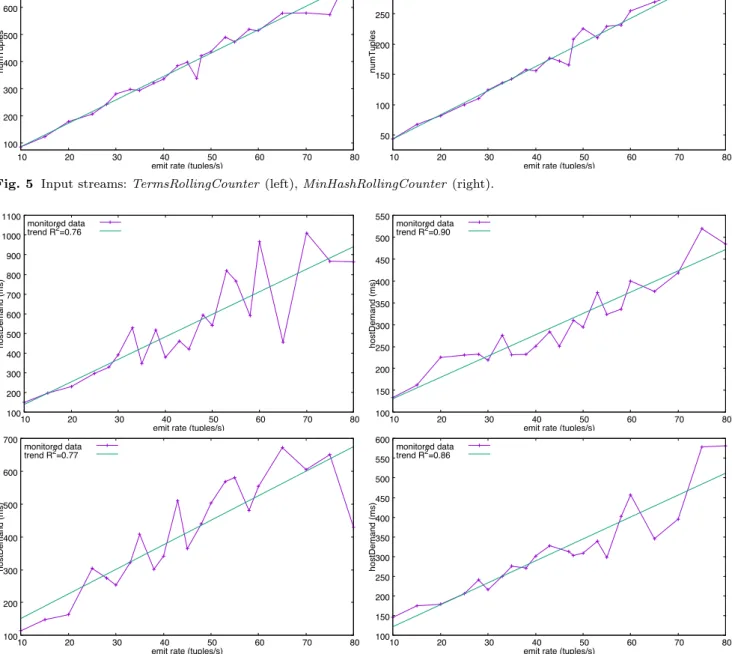
Independent sets of monitored data have been used to calibrate and validate the model. In the calibration phase, we have set the values of the performance input parameters that were not explicitly provided in the con-figuration of NewsAsset, i.e., the host demands of the bolts (Table 6, third column), the probabilities for the field grouping policy streams and the number of input tuples of some of the bolts (Table 7, items in bold font). In particular, from the monitored data, we observed that some input parameters were linearly dependent on the spout emission rate. This is the case of the in-put streams of the two boltsTermsRollingCounter and MinHashRollingCounter (Figure 5), due to an ad-hoc implementation of a time window which enables to col-lect the tuples generated by theTermsExtraction bolt and send them in bunches to the mentioned bolts.
The host demands of the bolts accessing the databases are also linearly depend on the emission rate of the spout, as shown in Figure 6. The database writing scales linearly with respect to the emission rate of the spout because of the increasing size of the sliding window that accumulates tuples in bolts TermsRollingCounter and MinHashRollingCounter.
The calibrated model has been validated using the paired-t approach in Averill (2015), based on the com-putation of the confidence interval for the mean of the
Table 3 Configuration of spouts and bolts
parallelism Expected execution time (ms)
TwitterSample $pTwitterSample $tTwitterSample
ItemDeserealizer $pItemDeserializer $tItemDeserealizer
EntityExtraction $pEntityExtraction $tEntityExtraction
MinhashExtraction $pMinHashExtraction $tMinHashExtraction
SolrUpdater $pSolrUpdater $tSolrUpdater
TermsExtraction $pTermsExtraction $tTermsExtraction
TermsRollingCounter $pTermsRollingCounter $tTermsRollingCounter
IntermediateRanker $pIntermediateRanker $tIntermediateRanker
FinalRanker $pFinalRanker $tFinalRanker
TopicsMongoDBWriter $pTopicsMongoDBWriter $tTopicsMongoDBWriter
TopicsLabeler $pTopicsLabeler $tTopicsLabeler
MinhashRollingCounter $pMinHashRollingCounter $tMinHashRollingCounter
MinhashIntermediateRanker $pMinHashIntermediateRanker $tMinHashIntermediateRanker
MinHashFinalRanker $pMinHashFinalRanker $tMinHashFinalRanker
ClustersMongoDBWriter $pClustersMongoDBWriter $tClustersMongoDBWriter
ClustersLabeler $pClustersLabeler $tClustersLabeler
Table 4 Configuration of streams
Connection from to Stream Id grouping numTuples ProbFields
(max 1.0)
TwitterSample ItemDeserializer Stream1 shuffle $ntStream1
ItemDeserializer EntityExtraction Stream2 shuffle $ntStream2
EntityExtraction MinHashExtraction Stream3 shuffle $ntStream3
MinHashExtraction SolrUpdater Stream4 shuffle $ntStream4
MinHashExtraction TermsExtraction Stream5 shuffle $ntStream5
TermsExtraction MinHashRollingCounter Stream6 field $ntStream6 [$prStream6 1,
. . .,
$prStream6 n]
TermsExtraction TermsRollingCounter Stream7 field $ntStream7 [$prStream7 1,
. . .,
$prStream7 n]
MinHashRollingCounter MinHashIntermediateRanker Stream8 field $ntStream8 [$prStream8 1,
. . .,
$prStream8 n]
TermsRollingCounter IntermediateRanker Stream9 field $ntStream9 [$prStream9 1,
. . .,
$prStream9 n]
MinHashIntermediateRanker MinHashFinalRanker Stream10 global $ntStream10
IntermediateRanker FinalRanker Stream11 global $ntStream11
MinHashFinalRanker ClustersMongoDBWriter Stream12 shuffle $ntStream12
FinalRanker TopicsMongoDBWriter Stream13 shuffle $ntStream13
ClustersMongoDBWriter ClustersLabeler Stream14 shuffle $ntStream14
TopicsMongoDBWriter TopicsLabeler Stream15 shuffle $ntStream15
Table 5 Configuration of Workstations
Workstation resMult (nCores)
Core 1 $c1
Core 2 $c2
differences between two sets ofN observations. In par-ticular, for each performance index of interest, we have collected two sets of independent observations: one set
X includes the values of the performance index mon-itored by running the deployed application under dif-ferent workload assumption (within the interval range [10−80] tuples/sec.); and the other setY includes the values of the performance index obtained via simulation
of the calibrated model under the same workload as-sumptions. Then, for each performance index, we have constructed a 95% confidence interval for the sample mean of the difference ¯µ = ¯µX−µ¯Y with the aim of evaluating its statistical and practical significance.
Table 8 summarizes the validation results for the performance indexes of interest (one per column). Con-cretely, the utilization of the bolts belonging to the first
parallelism emit rate (tuples/s) host demand (ms) TwitterSample 1 x∈[10−80] ItemDeserializer 4 0.665 EntityExtraction 4 21.683 MinhashExtraction 4 13.048 SolrUpdater 1 16.895 TermsExtraction 2 10.441 TermsRollingCounter 4 10.127 IntermediateRanker 4 10.731 FinalRanker 1 16.308 TopicsMongoDBWriter 1 11.5x+ 24.8 TopicsLabeler 1 4.9x+ 82.2 MinhashRollingCounter 4 10.212 MinhashIntermediateRanker 1 10.219 MinHashFinalRanker 1 19.600 ClustersMongoDBWriter 1 7.5x+ 76.6 ClustersLabeler 1 5.6x+ 66.7
Table 6 Configuration of Spout and Bolt Elements: parallelism, emit rate/host demand
Connection from to Stream Id grouping numTuples ProbFields
(Pipi= 1)
TwitterSample ItemDeserializer Stream1 shuffle 1
ItemDeserializer EntityExtraction Stream2 shuffle 1
EntityExtraction MinHashExtraction Stream3 shuffle 1
MinHashExtraction SolrUpdater Stream4 shuffle 10
MinHashExtraction TermsExtraction Stream5 shuffle 0.2857
TermsExtraction MinHashRollingCounter Stream6 field 4x+3 [0.16, 0.24, 0.27, 0.33]
TermsExtraction TermsRollingCounter Stream7 field 9x+1 [0.12, 0.12, 0.27, 0.49]
MinHashRollingCounter MinHashIntermediateRanker Stream8 field 59 [1.0]
TermsRollingCounter IntermediateRanker Stream9 field 27 [0.18, 0.26, 0.27, 0.29]
MinHashIntermediateRanker MinHashFinalRanker Stream10 global 1
IntermediateRanker FinalRanker Stream11 global 3
MinHashFinalRanker ClustersMongoDBWriter Stream12 shuffle 0.06
FinalRanker TopicsMongoDBWriter Stream13 shuffle 0.06
ClustersMongoDBWriter ClustersLabeler Stream14 shuffle 1
TopicsMongoDBWriter TopicsLabeler Stream15 shuffle 1
Table 7 Configuration of Streams: number of tuples and probability fields
Utilization Throughput ratio (XEndi/XT witterSample)
Item Entity MinHash Solr Terms
End1 End2 End3
Deserializer Extraction Extraction Updater Extraction
¯
µ 0.0906 -0.3378 -0.2826 -1.2475 -1.3607 -2.553E-3 -1.523E-4 -2.258E-4
¯
σ 0.1750 1.1474 1.4331 15.5080 1.3761 3.104E-2 1.946E-4 1.899E-4
lb 0.0130 -0.8467 -0.9181 -8.1246 -1.9709 -1.632E-2 -2.386E-4 -3.100E-4
ub 0.1682 0.1710 0.3529 5.6296 -0.7504 1.121E-2 -6.604E-5 -1.416E-4
(%) 19.93 3.50 6.34 11.57 8.84 1.67 12.27 16.41
Table 8 Validation of the UML model
part of the workflow, and the ratio of the tuples pro-duced by each branch of theNews Orchestrator work-flow with respect to the input stream generated by the spoutTwitterSample. In the UML model, the latter in-dexes correspond to the throughput ratios XEndi
XT witterSample.
The rows of the table indicate: the difference sam-ple mean ¯µ(first row), the sample standard deviation of the difference ¯σ (second row), the lower and
up-per bounds of the 95% confidence interval5 (third and fourth rows, respectively), and the maximum relative errormax( lb
¯ µX,
ub ¯
µX), where ¯µXis the sample mean of the
index computed from the monitored data (fifth row). From the validation results, we observe that all the sample means, but the one related to the utilization of theItemDeserializer, are negative meaning that the UML model produces an underestimation of the
con-5 The Student t-distribution with N-1=21 degrees of
���� ���� ���� ���� ���� ���� ���� ���� ��� ��� ��� ��� ��� ��� ��� ��� ��������� �������������������� �������������� ������������� ��� ���� ���� ���� ���� ���� ���� ��� ��� ��� ��� ��� ��� ��� ��� ��������� �������������������� �������������� �������������
Fig. 5 Input streams:TermsRollingCounter(left),MinHashRollingCounter (right).
���� ���� ���� ���� ���� ���� ���� ���� ���� ����� ����� ��� ��� ��� ��� ��� ��� ��� ��� ���������� � ���� �������������������� �������������� ������������� ���� ���� ���� ���� ���� ���� ���� ���� ���� ���� ��� ��� ��� ��� ��� ��� ��� ��� ���������� � ���� �������������������� �������������� ������������� ���� ���� ���� ���� ���� ���� ���� ��� ��� ��� ��� ��� ��� ��� ��� ���������� � ���� �������������������� �������������� ������������� ���� ���� ���� ���� ���� ���� ���� ���� ���� ���� ���� ��� ��� ��� ��� ��� ��� ��� ��� ���������� � ���� �������������������� �������������� �������������
Fig. 6 Host Demand:TopicsMongoDB(top-left),TopicsLabeler (top-right),ClusterMongoDB(bottom-left),ClusterLabeler
(bottom-right).
sidered performance indexes with respect to the de-ployed application. However, analyzing the confidence intervals, we can infer that the differences between the monitored values and the simulated ones for the utiliza-tion of the EntityExtraction, MinHashExtraction, Sol-rUpdaterand the throughput ratio of the first branch of the workflow (End1) might be caused by sampling fluc-tuation and they are not statistically significant (i.e., 0∈[lb, ub]). Although the differences for the rest of the performance indexes could be statistically significant
(i.e., 06∈[lb, ub]), they are not considered significant in practice by the domain experts.
5.2 Performance Predictions
The UML model, calibrated and validated under differ-ent workload assumptions of the NewsAsset, has been used to assess the performance requirements identified by ATC (Reqs., DICE Consortium, 2016):
– Scalability of the current topology. The software ar-chitects are interested in figuring out whether the
�� ��� ��� ��� ��� ��� ��� ��� ��� ��� ���� ��� ��� ��� ��� ��� ��� ��� ��� �������������������� ���������������� ���������������� ����������������� ����������� ��������������� ������������������� ��������������������� �� ��� ��� ��� ��� ���� ��� ��� ��� ��� ��� ��� ��� ��� �������������������� ������� �������
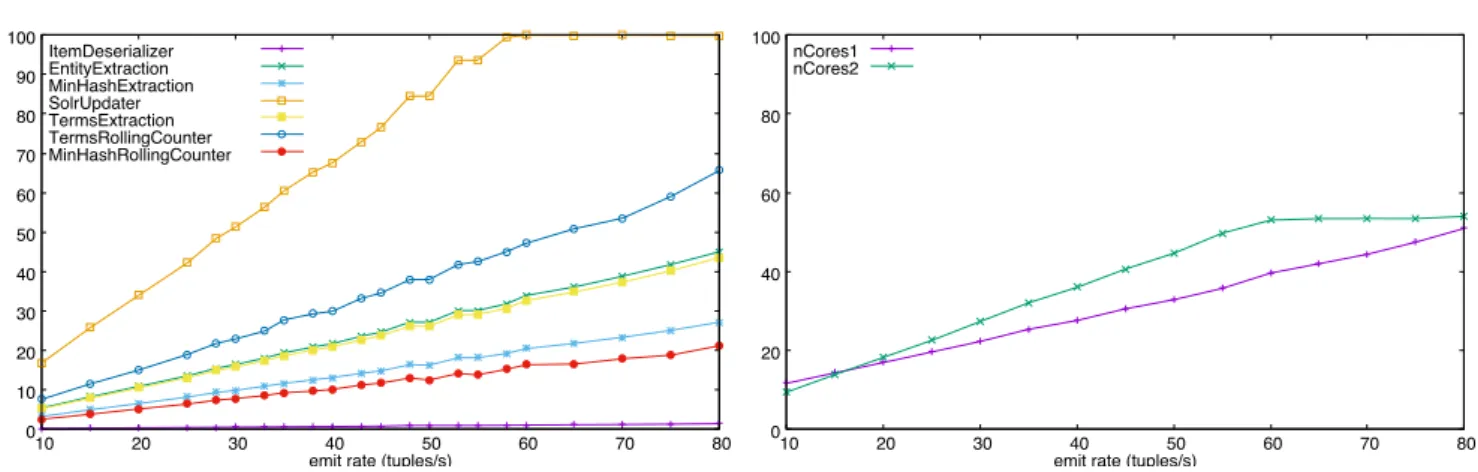
Fig. 7 Utilization (%) of bolts on the left, and utilization (%) of cores on the right.
system is linearly scalable and it scales out rather than up, meaning that performance problems can be solved by simply adding more cores. This goal implies the detection of system bottlenecks in or-der to identify the type of resources that need to be increased.
– Performance of alternative architectures. The soft-ware quality engineers are interested in measuring the impact of different architecture alternatives based on performance and cost.
In the following paragraphs, we describe the perfor-mance experiments (parameter configuration and mea-sures to compute) to assess the performance goals. 5.2.1 Scalability of the current topology
To assess the first performance goal, we have conducted a bottleneck analysis considering both the hardware (i.e., the cluster CPUs) and software resources (i.e., bolts). During the calibration and validation of the UML model for different spout emission rates, we already de-tected a potential bottleneck in theSolrUpdaterbolt. In particular, theSolrUpdaterbecomes a bottleneck when the emission rate is higher than 60 tuples/sec. (see Fig-ure 7 on the left), whereas the utilization6 of the other bolts is lower than 60%. Besides, the utilization of the cluster CPU’s is always less than 53% for the worksta-tions hosting the spout and bolts; and less than 55% for the workstation hosting the databases (see Figure 7 on the right).
Therefore, unlike the expectation of the software ar-chitects, the design does not scale out, since the bot-tleneck is not a hardware resource. Figure 8 confirms that the increase in the number of cores (workstation Core 2) does not improve the system performance. In particular, for a given emission rate, the utilization of 6 Figure 7 does not show the utilizations of the bolts that
are below 5%.
theSolrUpdaterbolt remains constant. Indeed, the lim-iting factor for the maximum production rate of the topic-detector is the parallelism of the bolt SolrUp-dater (software bottleneck). Therefore, we initially rec-ommended to ATC the redesign of the algorithms of this bolt module to achieve the performance objective, that did not turn out to be an easy task.
�� �� �� �� �� ��� ��������� ������ ������ ������ ��� ��� ��� ��� ��� ��� ��� ��� ��� ���� ������ ��������������������
Fig. 8 Utilization (%) of SolrUpdater, with one thread, un-der different number of cores and workload.
5.2.2 Performance of alternative architectures
The objective of the second experiment is to evaluate the impact of different architecture alternatives of the News Orchestrator, based on the Apache Storm per-formance features. In particular, we aimed at reaching a practical solution for the bottleneck detected in the boltSolrUpdater.
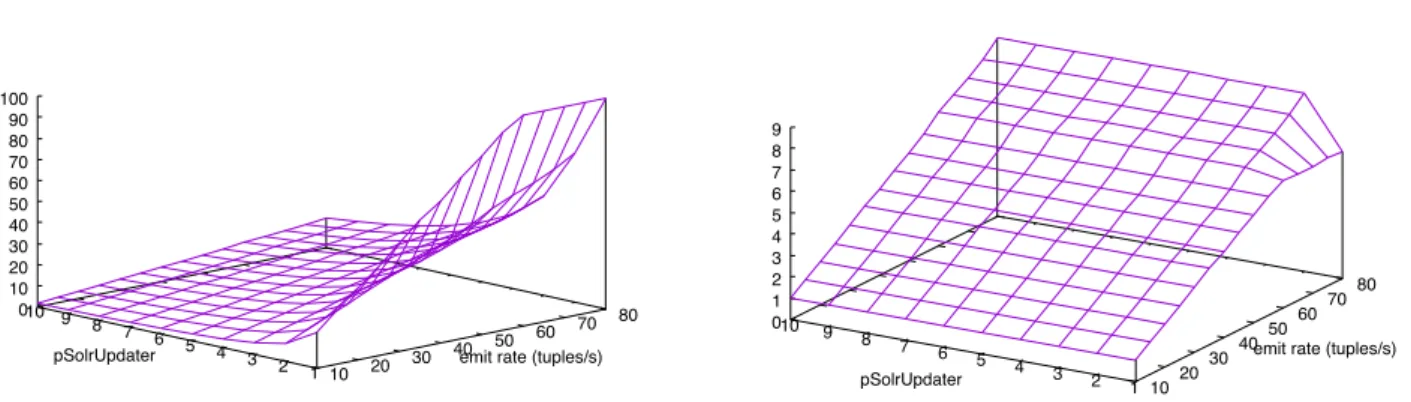
For this purpose, we considered the basic configu-ration of the UML model used in the calibconfigu-ration and validation phases (Tables 6 and 7). In order to analyze the sensitivity of the performance indices to the Storm configuration, the varying parameters are the level of parallelism of theSolrUpdater([1−10] threads) and the
��� ��� ��� ��� ��� ��� ��� ��� �� �� �� �� �� �� �� �� �� ��� �� ��� ��� ��� ��� ��� ��� ��� ��� ��� ���� �������������������� ������������ ������ ������ ������ ������ �� �� �� �� �� �� �� �� �� ��� �� �� �� �� �� �� �� �� �� �� �������������������� ������������
Fig. 9 Utilization (%) ofSolrUpdateron the left, and throughput (tuples/ms) ofSolrUpdater on the right.
emission rate ([10−80] tuples/s). Figure 9 shows the utilization (left plot) and the throughput (right plot) of the SolrUpdater. In particular, considering high spout emission rates (that is, an emission rate greater than 60 tuples/s), we can observe that the utilization of the SolrUpdateris reduced by at least a 30% when just two threads are set for the bolt and it is drastically reduced by a 90% for 10 threads. On the other hand, two threads for the bolt are sufficient to increase the throughput of the first branch of the topic-detector workflow and to avoid the system saturation under the considered workload assumption (for more than one thread, the throughput increases linearly with respect to the in-crease of the emission rate).
Therefore, the ATC software quality engineers should consider this alternative configuration to guarantee an optimal throughput under high workloads.
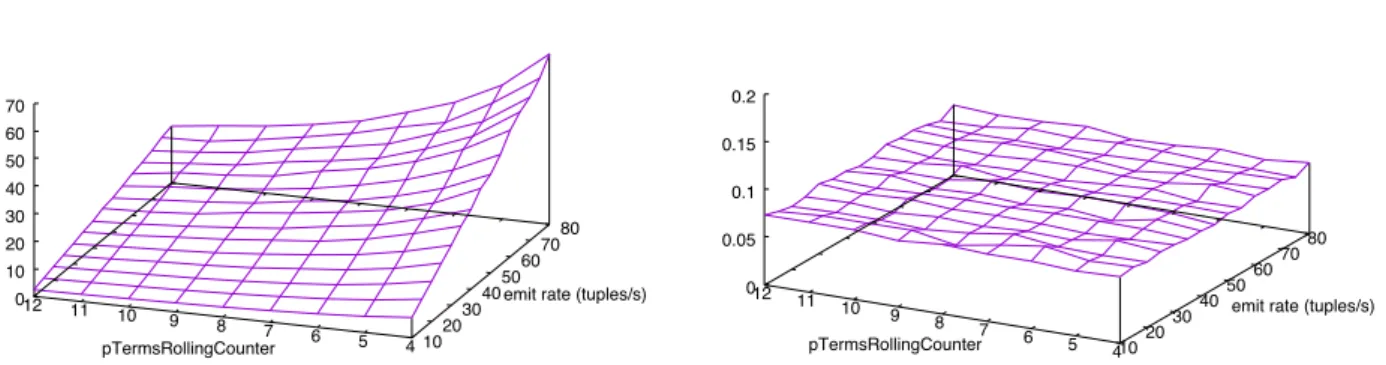
For the sake of offering alternative choices to the ATC engineers, we carried out additional experiments. A similar sensitivity analysis was conducted consid-ering the second potential bottleneck for high work-loads identified in the first experiment, that is, the bolt TermsRollingCounter (see Figure 7, left plot). The goal was to figure out how to change the Storm configura-tion in order to improve also the throughput of the second branch of the topic-detector workflow, i.e., the throughput ofEnd2in the activity diagram in Figure 3. In this case, the level of parallelism of TermsRolling-Counter ranged from 4 to 12 threads (in the basic configuration, the level of parallelism of the bolt was set to 4). Figure 10 shows the utilization (left plot) of theTermsRollingCounter and the throughput ofEnd2 (right plot). For high workloads (i.e., emission rate greater than 60 tuples/sec.), the utilization of the bolt is re-duced by a half when the number of threads is doubled and it is reduced by two-thirds when the number of threads is tripled. Nevertheless, as shown by the plot on the right, the increase of the level of parallelism of this
bolt does not improve the throughput ofEnd2, which remains basically constant. Thus, increasing the level of parallelism of the TermsRollingCounter is not a good solution if the aim is increasing the throughput ofEnd2.
6 Conclusion
The work in (Requeno et al., 2017) presents, and val-idates synthetically, an approach for the performance analysis of Apache Storm applications. Now, we have extended the approach for addressing also the reliabil-ity analysis in the same context. Therefore, this work has presented a quality-driven methodology, for Apache Storm applications, that can be used by practitioners as a blueprint for development. In our view, an important contribution is that we have applied the methodology to a commercial product, working together with the engi-neers of the Athens Technological Center (ATC), which means a real validation of the methodology.
ATC needed to refactor the NewsAsset application in order to satisfy highly demanding performance re-quirements, in the context of processing large volumes of data in realtime from the social network. The results of the performance assessment helped to modernize, re-design and correctly tune the core of NewsAsset using Apache Storm. Several issues, bottlenecks and bad con-figurations where identified, but not initially supposed, some of them have been reported in this paper.
We also consider important that the methodology is currently usable by practitioners since we have de-veloped a complete framework that automates it, the DICE Simulation tool (DICE Consortium, 2017). This tool includes the Apache Storm profile, the transfor-mation of the Apache Storm designs into GSPN and the computation of performance metrics (utilization, throughput and response time) and reliability metrics (availability and MTTF).
�������������������� �������������������� �� ��� ��� ��� ��� ��� ��� ��� �� �� �� �� �� �� ��� ��� ��� ������ ������ ������ ������ �������������������� �������������������� �� ����� ���� ����� ���� �� �� �� �� �� �� ��� ��� ��� ������ ������ ������ ������
Fig. 10 Utilization (%) ofTermsRollingCounteron the left, and throughput (tuples/ms) ofEnd2 on the right.
References
Apache. Apache Storm Website, 2017a. URL
http://storm.apache.org/.
Rajiv Ranjan. Modeling and Simulation in Performance Optimization of Big Data Processing Frameworks. IEEE Cloud Computing, 1(4):14–19, 2014.
ATC. Athens Technology Center Website, 2018. URL
https://www.atc.gr/default.aspx?page=home.
Jos´e Ignacio Requeno, Jos´e Merseguer, and Simona Bernardi. Performance Analysis of Apache Storm Applications using Stochastic Petri Nets. In Proceed-ings of the 5th International Workshop on Formal Methods Integration, 2017.
Rekha Singhal and Abhishek Verma. Predicting Job Completion Time in Heterogeneous MapReduce En-vironments. In Proceedings of the 30th IEEE Inter-national Parallel and Distributed Processing Sympo-sium Workshops, pages 17–27. IEEE, 2016.
Filip Nalepa, Michal Batko, and Pavel Zezula. Model for Performance Analysis of Distributed Stream Pro-cessing Applications. In Proceedings of the 20th In-ternational Conference on Database and Expert Sys-tems Applications, pages 520–533. Springer, 2015a. Filip Nalepa, Michal Batko, and Pavel Zezula.
Per-formance Analysis of Distributed Stream Processing Applications Through Colored Petri Nets. In Pro-ceedings of the 10th International Doctoral Workshop on Mathematical and Engineering Methods in Com-puter Science, pages 93–106. Springer, 2015b. Johannes Kroß, Andreas Brunnert, and Helmut
Krc-mar. Modeling Big Data Systems by Extending the Palladio Component Model. Softwaretechnik-Trends, 35(3), 2015.
Johannes Kroß and Helmut Krcmar. Modeling and Simulating Apache Spark Streaming Applications. Softwaretechnik-Trends, 36(4), 2016.
Kewen Wang and Mohammad Maifi Hasan Khan. Per-formance prediction for Apache Apark platform. In 2015 IEEE 17th International Conference on High Performance Computing and Communications (HPCC), 2015 IEEE 7th International Symposium on Cyberspace Safety and Security (CSS), and 2015 IEEE 12th International Conferen on Embedded Soft-ware and Systems (ICESS), pages 166–173. IEEE, 2015.
Slawomir Samolej and Tomasz Rak. Simulation and Performance Analysis of Distributed Internet Sys-tems using TCPNs. Informatica, 33(4), 2009. Tomasz Rak. Response Time Analysis of Distributed
Web Systems using QPNs. Mathematical Problems in Engineering, 2015, 2015.
Giovanni Chiola, Marco Ajmone Marsan, Gianfranco Balbo, and Gianni Conte. Generalized Stochastic Petri nets: A Definition at the Net Level and its Im-plications.IEEE Transactions on Software Engineer-ing, 19(2):89–107, 1993.
Danilo Ardagna et al. Modeling Performance of Hadoop Applications: A Journey from Queueing Networks to Stochastic Well Formed Nets. In Jesus Carretero et al., editor, Proceedings of the 16th Int. Conf. on Algorithms and Architectures for Parallel Processing, pages 599–613, Cham, 2016. Springer. ISBN 978-3-319-49583-5.
Eugenio Gianniti et al. Fluid Petri Nets for the Perfor-mance Evaluation of MapReduce and Spark Applica-tions. ACM SIGMETRICS Performance Evaluation Review, 44(4):23–36, 2017.
Sotiris Diplaris et al. SocialSensor: sensing user gener-ated input for improved media discovery and experi-ence. In Proceedings of the 21st International Con-ference on World Wide Web, pages 243–246. ACM, 2012.
DICE Consortium. Requirement Specification. Technical report, European Union’s Horizon 2020
research and innovation program, 2016. URL
http://wp.doc.ic.ac.uk/dice-h2020/wp-content/ uploads/sites/75/2015/08/
D1.2 Requirement-specification.pdf.
Bran Selic. A Systematic Approach to Domain-Specific Language Design Using UML. In Proceedings of the 10th IEEE International Symposium on Object-Oriented Real-Time Distributed Computing, pages 2– 9. IEEE Computer Society, May 2007.
Fran¸cois Lagarde, Hu´ascar Espinoza, Fran¸cois Terrier, and S´ebastien G´erard. Improving UML profile design practices by leveraging conceptual domain models. In R. E. Kurt Stirewalt, Alexander Egyed, and Bernd Fischer, editors,Proceeedins of the 22nd IEEE/ACM International Conference on Automated Software En-gineering (ASE 2007), Atlanta (USA), pages 445– 448. ACM, November 2007.
OMG. UML Profile for MARTE:
Model-ing and Analysis of Real-time Embedded Systems, Version 1.1, Juny 2011a. URL
http://www.omg.org/spec/MARTE/1.1/.
Simona Bernardi, Jos´e Merseguer, and Dorina C. Petriu. A Dependability Profile within MARTE. Software & Systems Modeling, 10(3):313–336, 2011. Flexiant. Flexiant Cloud Orchestator Website, 2017.
URLhttps://www.flexiant.com/.
M. Law Averill. Simulation Modeling and Analysis. McGraw-Hill, 2015.
DICE Consortium. DICE Simulation Tool, 2017.
https://github.com/diceproject/DICE -Simulation/.
DICE Consortium. Storm profile, Oct., 2016. url:
https://github.com/dice-project/DICE-Profiles.
OMG. Meta Object Facility (MOF) 2.0
Query/View/Transformation Specifica-tion, Version 1.1, January 2011b. URL
http://www.omg.org/spec/QVT/1.1/.
ISO. Systems and software engineering – High-level Petri nets – Part 2: Transfer format. ISO/IEC 15909-2:2011, International Organization for Standardiza-tion, Geneva, Switzerland, 2008.
Dipartimento di informatica, Universit`a di Torino. GRaphical Editor and Analyzer for Timed and Stochastic Petri Nets, Dec., 2015. url:
http://www.di.unito.it/∼greatspn/index.html.
Armin Zimmermann.Modelling and Performance Eval-uation with TimeNET 4.4, pages 300–303. Springer International Publishing, Cham, 2017.
Apache. Apache Zookeeper Website, 2017b. URL
https://zookeeper.apache.org/.
Algirdas Avizienis, Jean-Claude Laprie, Brian Ran-dell, and Carl E. Landwehr. Basic concepts and taxonomy of dependable and secure
comput-ing. IEEE Trans. Dependable Sec. Comput., 1(1): 11–33, 2004. doi: 10.1109/TDSC.2004.2. URL
https://doi.org/10.1109/TDSC.2004.2.
Marco Ajmone Marsan, G. Balbo, Gianni Conte, S. Do-natelli, and G. Franceschinis. Modelling with Gener-alized Stochastic Petri nets. John Wiley & Sons, Inc., New York, NY, USA, 1st edition, 1994.
A Transformation of a UML Design to a Performance Model
For evaluating performance metrics (utilization, throughput and response time), we need to transform the UML Apache Storm design into a performance model. We choose as tar-get performance model Generalized Stochastic Petri Nets (see
Appendix C). In the following, we recall thetransformation
patterns proposed in Requeno et al. (2017). Each pattern takes as input a part of the Storm design and produces a GSPN subnet.
A.1 Activity Diagram Transformation
Tables 9–11 show the patterns for the activity and deploy-ment diagrams. For each figure, the left hand side presents the input of the pattern, i.e., the UML model elements, pos-sibly stereotyped with the Storm profile. The right hand side indicates the corresponding GSPN subnet. For an easier un-derstanding of the transformation, we depicted: a) text in bold to match input and output elements; b) interfaces with other patterns as dotted grey elements, because they actually do not belong to the pattern.
Patterns P1 andP2 map spout and bolt tasks,
respec-tively. Both spout and bolt subnets become structurally
sim-ilar when the bolt subnet is merged with aP3–P5 pattern.
The subnet consists of two places, a timed transition, an
im-mediate transition, and a set of arcs. Places pA1 and pA2
represent, respectively, the idle state and the processing state
of incoming messages. The placepA1is marked with as many
tokens as theparallelismtagged-value associated to the task denotes ($n0). The rate of the timed transition is equal to either the emission rate ($rate) of the spout or the inverse of
the host demand of the bolt (1/$time). The timed
transi-tions have an infinite server semantics because the production of tuples is already constrained by the number of available threads (tokens) defined by the parallelism. The immediate transition in the spout subnet does not have source places because it models the continuous arrival of new messages.
PatternsP3,P4 andP5 map the reception of a stream
of tuples by a bolt. InP3 the source of the stream is only one task, whereas inP4andP5there are multiple sources. In
par-ticular, the patternP4 represents the synchronous case and
the patternP5 is the asynchronous one. InP3–P5 subnets,
the interface transitiontArefers to the transition inP2 with
the same name. Pattern P6 maps the final node to a
tran-sition without output places. This is a sink trantran-sition that represents the end of the stream processing and could poten-tially act as interface with subsequent systems (i.e., injecting tuples in another Storm application).
PatternsP8–P11 detail the transformation of the
num-Tuples and grouping tagged-values of a given stream step. Therefore, these patterns refine patternsP3,P4andP5. The
Table 9 Transformation Patterns for Storm-profiled UML Activity Diagrams (Node Elements)
UML Pattern Petri net Pattern
P1 A «StormSpout» =(expr=$rate, unit=Hz, source=est, statQ=mean) parallelism=$n0 avgEmitRate A1 M(p )=$n0 pA1 tA r(tA)=$rate pA2 P2 A «StormBolt» hostDemand=(expr=$time, unit=s,
source=est, statQ=mean) parallelism=$n0 A1 M(p )=$n0 pA1 tA r(tA)=1/$time pA2 P3
A
B
B1 M(p )=$n0 pB2 pB1 tA P4 A B C C1 M(p )=$n0 pC2 pC1 tA tB P5 A C B pC1 C1 M(p )=$n0 pC2 tA tB P6 A tAnumTuples indicates the number of input tuples that the re-ceiving bolt requires for producing a message. Then, such a value is mapped to the weight of the arcsa2(P8 subnet),a1
(P9–P10 subnets), andai(P11 subnet).
Additionally, thegroupingdefines how the stream should be partitioned among the next bolt’s threads. If the grouping is set to all, every thread of the receiving bolt will process
a copy of the tuple, then the weight of the arc a1 in the
GSPN subnet is equal to theparallelismof the boltB(P8). Otherwise, only one thread of the receiving bolt will process the tuple, therefore, the weight will be set to the default value (i.e., 1). If the grouping policy isshuffle, the target execution thread ofBis selected randomly among the idle ones (P9).
In the case of global policy, the entire stream goes to the
bolt’s thread with the lowest id (P10). The initial marking
of place pBG, in the GSPN subnet, is set to a single token
for restricting the access to just one thread. Finally, thefield
grouping policy divides the outgoing stream of A by value
(P11) and all the messages having the same value are sent to the same threads of the receiving bolt. The transformation
creates a GSPN subnet withnbasic subnets, wherenis the
number of different stream values. This number is limited by the number of parallel threads (parallelismtagged-value) in
B. When an incoming message arrives to the receiving bolt,
it is redirected to one of the basic subnets according to the
probabilities $probi assigned to the immediate transitions
tB1i.
A.2 Deployment Diagram Transformation
Pattern P7 (Table 11) illustrates the modifications
intro-duced in the GSPN model by the profile extensions in the de-ployment diagram. The Storm tasks are first logically grouped into partitions in the activity diagram, later they are deployed
as artifacts and mapped to physical execution nodes (
GaEx-ecHoststereotype) in the deployment diagram. In particular,
P7 maps theGaExecHost to a new place pR in the GSPN,
with an initial marking that represents the number of compu-tational cores of the node (resMult tagged-value). The addi-tion of such place restricts the logical concurrency, that is the number of threads of the Storm tasks, to the number of avail-able cores. The pattern corresponds to the acquire/release operations of the cores by the spouts and bolts.
A.3 Performance Model and Implementation
Figure 11 shows the final GSPN model for the Storm design in Figures 3 and 4. It has been obtained by applying the pat-terns and combining the subnets through the interfaces. The image of the GSPN model has been simplified for readability purposes. For instance, the input (output) arcs of the tran-sitions that acquire (release) tokens from (to) the resource
placesCore 1 andCore 2 are shown as broken arcs.
The UML Profile for Apache Storm can be downloaded from DICE Consortium (Oct., 2016). The transformation of
Table 10 Transformation Patterns for Storm-profiled UML Activity Diagrams (Stream Policies)
UML Pattern Petri net Pattern
P7
«StormStreamStep»
numTuples=$n1
grouping=all
A
B
1 W(a )=B.parallelism a1 a2 W(a )=2 $n1 M(pB1)=$n0 pB2 pB1 tA P8«StormStreamStep»
numTuples=
$n1
grouping=
shuffle
A
B
a1 W(a )=1 $n1 B1 M(p )=$n0 pB2 pB1 tA P9«StormStreamStep»
numTuples=
$n1
grouping=
global
A
B
a1 W(a )=1 $n1 B1 M(p )=$n0 pBG2 pB1 tA tBG BG1 M(p )=1 BG1 p r(tBG)=r(tB) P10«StormStreamStep»
numTuples=
$n1
probFields=[
$prob
1,...,$prob
n]
grouping=
field
A
B
a1 W(a )=i $n1 tA tB2_1 r(tB2_i)=r(tB) an B2_1 p B1_i M(p )=$n0/n B2_n p tB2_n pB1 tB1_1 tB1_n Prob(tB1_i)=$probi B1_1 p B1_n pTable 11 Transformation Patterns for Storm-profiled UML Deployment Diagrams
UML Pattern Petri net Pattern
P11 Partition(R) A ctivit y A Dep loyment «GaExecHost» resMult= (expr=$size) Node(R) A M(p )=R $size pA2 A1 M(p )=$n0 pA1 tA pR
the UML models to GSPN, as well as the evaluation of the performance metrics, have been automatized in the DICE Simulation tool (DICE Consortium, 2017), they are publicly available. The transformation uses QVT-MOF 2.0 OMG (2011b) to obtain a Petri Net Markup Language file (PNML) ISO (2008), an ISO standard for XML-based interchange format for Petri nets. Later on, a model-to-text (M2T) transforma-tion from PNML into a GSPN tool specific format, concretely for the GreatSPN tool (Dipartimento di informatica, Univer-sit`a di Torino, Dec., 2015), has been performed. Other tools, such as TimeNet (Zimmermann, 2017), also could be used, although not integrated in the framework yet.
B Computation of Reliability Metrics
The DICE Simulation tool (DICE Consortium, 2017), used in this work, also computes reliability metrics. In particular, the availability and mean time to failure for UML Apache Storm designs stereotyped using the Apache Storm profile presented in Section 3.
Many of the technologies covered for data-intensive ap-plications (DIAs), such as Apache Storm, are designed as fault-tolerant, which means that their failures are internally handled and are not visible to users. Therefore, the metrics are calculated from the properties of the resources used by the technologies, rather than from the activities executed by
pClustersLabeler bClustersLabeler pClustersMongoDBW bClustersMongoDBW pMinHashFinalRanker bMinHashFinalRanker bMinHashIR1 bMinHashIR4 bMinHashIR3 bMinHashIR2 pMinHashIntermRanker bMinHashRC3 bMinHashRC4 bMinHashRC1 bMinHashRC2 pTermsRollingCounter 4 bTermsRC1 bTermsRC4 bTermsRC3 bTermsRC2 pTopicsLabeler bTopicsLabeler pTopicsMongoDBW bTopicsMongoDBW pFinalRanker bFinalRanker pIntermRanker 4 bIntermRanker qMinHashFinalRanker pMinHashRollingCounter4 pSolrUpdater bSolrUpdater bTermsExtraction pTermsExtraction pMinHashExtraction bMinHashExtraction pItemDeserializer 4 bItemDeserializer pEntityExtraction bEntityExtraction pTwitterSample bTwitterSample
tMinHashFinalRanker tClustersMongoDBW tClustersLabeler
tMinHashIR4 tMinHashIR3 tMinHashIR2 tMinHashIR1 tMinHashRC4 tMinHashRC3 tMinHashRC2 tMinHashRC1 tTopicsLabeler tTopicsMongoDBW tFinalRanker tIntermRanker tTermsRC1 tTermsRC2 tTermsRC3 tTermsRC4 tSolrUpdater tTermsExtraction tMinHashExtraction tItemDeserializer tEntityExtraction tTwitterSample End2 t30 prMinHashIR4 prMinHashIR3 prMinHashIR2 prMinHashIR1 prMinHashRC4 prMinHashRC3 prMinHashRC2 prMinHashRC1 prTermsRC4 prTermsRC3 prTermsRC2 prTermsRC1 End3 27 End1 10 3 59 59 59 59 4 4 2 4x+3 9x+1 4x+3 4x+3 4x+3 9x+1 9x+1 9x+1 17 17 3
Core_1 Core_1 Core_1 Core_1 Core_1 Core_1
Core_1 Core_1
Core_1
Core_1
Core_2 Core_2
Core_1 Core_1 Core_1 Core_1 Core_2 Core_2 Core_2 Core_2
Core_1 Core_1 Core_2 Core_2 Core_2 Core_2
Core_1 Core_1
Core_1 Core_1 Core_1 Core_1
Core_1 Core_1 Core_1 Core_1 Core_2 2 Core_1 16
Fig. 11 GSPN for the design in Fig. 3 and 4.
the applications. The following paragraphs detail how each metric is computed.
B.1 Computation of the Mean Time to Failure
Apache Storm applications are fault-tolerant and the progress of the computation of elements in the input streams is man-aged and stored by a differentiated software, Zookeeper (Apache, 2017b). Therefore, for the failure of a Storm application, the important concept to consider is the failure of the cluster of Zookeeper nodes, rather than the failure of spouts and bolts. In this case resources that execute Zookeeper service have to be stereotyped with<<StormZookeeper>> to point out their functionality and with<<DaComponent>>, inherited from the DAM profile, to specify their multiplicity with the “resMult” attribute and the estimated MTTF of the resource with the “failure” attribute.
To compute the MTTF, the DICE Simulation tool tra-verses all Nodes and Devices represented in the Deployment Diagram of the application looking for the element stereo-typed as<<StormZookeeper>>. When it finds this element, it gets from it the information in its<<DaComponent>> stereo-type regarding the number of resources used for the Zookeeper cluster and the estimated MTTF of each of them. Finally, the computation of the global MTTF considers that the Storm DIA takes place when all the resources dedicated to execute Zookeeper cluster have failed.
B.2 Computation of the availability
The availability of a system is defined as the readiness for correct service (Avizienis et al., 2004). We compute the per-centage of time that a system is available, i.e., the perper-centage of time that the system is ready for executing a correct ser-vice for its users (steady state availability). It is defined as the mean time that the system is working correctly between two consecutive failures (i.e., MTTF) with respect to the Mean Time Between two consecutive Failures (called MTBF). In turn, MTBF is defined as the mean time of correct service until a failure plus the Mean Time to Repair (MTTR). There-fore, the steady state availability is calculated using the for-mula:
Availability= M T T F
M T T F+M T T R·100.
We opted to offer a computation of the system availabil-ity when users choose to use preemptable resources, such as Amazon AWS EC2 spot instances. Users need to fill the a) expected amount of time that a preemptable resource will be granted for utilization, and b) the expected amount of time required to choose an alternative affordable set of resources, boot them, set up and configure the technology (i.e., repair time of the application). This information is provided by the attributes “failure” and “repair” of the<<DaComponent>> stereotype. Information a) is filled into field MTTF of “fail-ure” attribute and information b) is filled into field MTTR
of “repair” attribute. The computation of the availability is computed from these two values.
C Petri Nets
A GSPN (Generalized Stochastic Petri Net, Marsan et al., 1994) is a Petri net with a stochastic time interpretation. Therefore a GSPN is a modeling formalism suitable for per-formance analysis purposes. A GSPN model is a bipartite graph, consisting of two types of vertices: places and transi-tions.
Places are graphically depicted as circles and may con-tain tokens. A token distribution in the places of a GSPN, namely a marking, represents a state of the modeled system. The dynamic of the system is governed by the transition en-abling and firing rules, where places represent pre- and post-conditions for transitions. In particular, the firing of a transi-tion removes (adds) as many tokens from its input (output) places as the weights of the corresponding input (output) arcs. Transitions can be immediate, those that fire in zero time; or timed, those that fire after a delay which is sampled from a (negative) exponentially distributed random variable. Immediate transitions are graphically depicted as black thin bars while timed ones are depicted as white thick bars.