4
Thomas Madritsch1, Matthias Ebinger2
Performance Measurement in Facility Management
The Environment Management Maturity Model BEM3
Performance appraisal in businesses has often traditionally been associated with accounting and the financial success of the organization. Historically, the functions of Facility Management and Real Estate (FM/RE) tended to belong there too. FM/RE activities were measured on the basis of operational efficiency, such as operational and maintenance costs per m? However, in the past few years the perception of the added value of facility management and the real estate function has changed. The focus is no longer exclusively placed on cost savings for the company and the perception of FM/RE as a cost centre, but increasingly attention is paid to the added value that FM/RE provides to the organization as a strategic function on its own right. The goal of this research project was the development and practical implementation of a maturity measurement tool to review an organization's FM capability to generate strategic value. The paper summarizes the findings of an exploratory research study of over 50 firms in US and Europe. Using the principles of the "Capability Maturity Model", which in turn draws from the premises of Quality Management, the team developed a process model and overlaid it with a maturity assessment tool. The resulting "Built Environment Management Maturity Model" (BEM3) enables FM departments to professionalize Facility Management functions, by highlighting the strategic value of FM/RE processes, and by identifying potentials to raise the efficiency of organizational processes. <M10<Built Environment Management<Facility Management <Organizational Maturity Measurement<Performance Measurement Organizations can look at their real property portfolio from two perspectives. On the one side, real property land and improvements is considered a cost center, draining resources from the organizations core business. Facilities managers in organizations with this perspective must justify and defend the level of expenses associated with real property. After all, these expenses constitute in most organizations the second largest expense category. On the other side, real property is understood to be a capital asset, an investment that contributes directly to the vision and mission of the organization. This second perspectives considers facilities management to be more than just a cost center, but an important function delivering strategic value to the organization (Madritsch, 2009a). Facility manage ment activities are part of the value chain and are associated with critical success factors of the core business. This perspective focuses on the return on investment from its fixed assets, it ensures that buildings are constructed or leased to further organizational goals and it strives to provide an optimal environment within which the highest productivity is delivered. 1University of Applied Sciences FH Kufstein Tirol & University for Health Sciences, Medical Informatics and Technology UMIT, AUSTRIA 2Pratt Institute, New York City & New York Presbyterian Hospital, Facilities & Real Estate, USA Comprehensive assessment tools to visualize and bench mark the added value of FM performance are emerging, but are still fragmented and limited. Facilities management and real estate associations, as well as academicians have published and continue to work on models and definitions that could fill this gap. The International Facilities Manage ment Organization provides a knowledgebased FM frame work that is organized around eleven core competencies (IFMA 2010) and publishes comprehensive benchmarking surveys. The new European FM standard contains a set of definitions focusing on service delivery, quality manage ment, process development and space and cost standard ization (EN15221, 20062009). The Institute of Asset Management (2008) organizes relevant knowledge in its recently published Competency Framework. The Associ ation of Physical Plant Administrators (APPA), serving the needs of institutions in higher Education, offers a body of knowledge with four core competencies and manages a comprehensive database of comparative performance metrics (APPA, 2010). The National Research Council proposes a comprehensive, multidimensional Framework for Facilities Asset Management (NRC 2004). Multiple other professional organizations, such as BIFM, EuroFM, FMA, IREM, CoreNet or ASHE, to name just a few, produce often extensive FM/RE knowledge, in most cases as direct responses to the specific business needs of their members (Then 2004). The academic world also has made important contributions to the discussion of how to leverage the FM function as a strategic resource. Chotipanich and Nutt developed an inventory of FM functions and assessed how to best position these functions within an organizational context to generate strategic value (Chotipanich, 2004; Chotipanich and Nutt, 2008). Then (1999, 2004) proposes a set of integration models and process sequences to facilitate the alignment of facilities demand and supply. Becker (2003) borrows the concept of portfolio management to develop an FM model that can effectively respond to fast changing corporate environments. Dettbarn et. al. (2005) introduces the concept of Key Process Areas and Process Maturity, borrowed from Capability Maturity Models, to define a model that integrates the strategic, operational, and tactical aspects of managing real property portfolios. The need for a concise conceptual framework, that could outline in a simple, yet comprehensive manner the manage ment functions related to the built environment and, even more important, how these functions generate specific value for the larger organizational context, is becoming increas ingly apparent. Then formulated already in 1999 the need for strategic business planning to incorporate and, indeed, integrate the facilities dimensions of business delivery. In 2004, the US Government identified the management of its real property as a high risk area, and called for a framework to overhaul real property business practices (Teicholz et al. 2005). Dettbarn et al. (2005) identified the need to integrate the strategic, operational, and tactical aspects of
www.researchjournals.co.uk
5
managing real property portfolios to increase the perfor mance of the real property function in supporting the organizations mission. Shoet (2006) describes a need for the development of methods for the strategic manage ment and maintenance of buildings. The International Facilities Management Association identified in 2007 the linking of Facility Management to an organizations strategy as one of the most important current FM trends. In Europe, various FM organizations have been working since the early 2000s on a comprehensive standardization effort (CEN 20062009, Kloet et al. 2008). In 2008, EuroFM identified the potential for FM/RE to play a leading role in managing the built environment and embarked on a multiyear research project to develop a program to advance knowl edge in facilities management (Keith 2009). Performance appraisal in businesses has traditionally been associated with accounting and the financial success of the organisation. Historically, the success of Facility and Real Estate Management tended to be assessed on the basis of operational efficiency, such as operational and maintenance costs, often benchmarked per area or head count. (Lind holm, 2006) However, in the past few years a shift of focus within the Facility Management and the Real Estate (FM/RE) industry has occurred. The emphasise is no longer primarily on cost savings for the company and the perception of FM/RE as a cost centre, but more on the added value generated by the department in its own right (Madritsch, 2008). FM/RE has parted from the perception of real property as a purely tangible asset and is considering its value as an immaterial asset with longterm earnings expectations. This shift necessitates the development of metrics to highlight the strategic value of FM/RE, along with its impact on the financial statement (Keith, 2005). Manage ment will hesitate to consider FM/RE as a function adding strategic value until the description of facility management activities is associated with the critical success factors that are relevant to the core business.
In 1999 Then formulated the need for strategic business planning to incorporate and, indeed, integrate the facilities dimensions of business delivery. In 2004, the US Govern ment identified the management of its real property as a high risk area, and called for a framework to overhaul real property business practices (Teicholz et. al. 2005). Dett barn (2005) identified the need to integrate the strategic, operational, and tactical aspects of managing real property portfolios to increase the performance of the real property function in supporting the organizations mission. Shoet (2006) describes a need for the development of methods for the strategic management and maintenance of buildings. The International Facilities Management Asso ciation identified in 2007 the linking of Facility Management to an organizations strategy the most important trend for the upcoming future (IFMA 2007). In Europe, various FM organizations have been working since the early 2000s on a comprehensive standardization effort, and in 2008, EuroFM identified the potential for FM/RE to play a leading role and embarked on a multiyear research project to develop a program to advance knowledge in facilities management (Keith, 2009).
Despite the wealth of available research, FM knowledge remains fragmented across a large number of institutions and research groups. FM lacks a comprehensive and generally accepted framework that could be used to orga nize and classify the available knowledge. This paper presents an industryneutral process framework that could be used by a wide range of FM constituencies and that may facilitate the alignment of FM knowledge across industries. The framework defines a set of generic Key Process Areas (KPAs) that are applicable to most if not all facility manage ment environments. The proposed process framework can serve as a platform for three purposes.
· First, it is possible to measure the organizational
maturity of each process within the model. The understanding if a process is run on an adhoc basis vs. in a highly organized fashion is an important
starting point when attempting to develop
performance improvements (CMMI 2010).
· Second, cataloguing the inputs and outputs of the
process model leads to a comprehensive library of FM
management products, such as Facilities
Long/Medium/Short Range Plans, Project Charters, Project Commissioning Documentation or Service
Level Agreements. The standardization of
management products could help the FM discipline to establish and compare bestpractice approaches across industry boundaries (OGC 2010).
· Third, since each process has a clearly defined scope,
measures can be used to measure the performance of each process. A library of Key Performance Metrics, organized by Key Process Area, can be established (Cable, Davis 2004).
· Fourth and lastly, a set of skills and qualifications can
be defined for each process area.
The framework is being developed in the context of a research project between Pratt Institute in New York and the University of Applied Science in Kufstein. In the first part of the research project, the process framework, named Built Environment Management Model (BEM2) was developed. This process model was overlaid with a tool to assess the organizational maturity: the Built Environment Management Maturity Model (BEM3). This paper presents BEM2 and BEM3, as well as the results from the use of BEM3 in maturity study in Europe and North America. The second, third and fourth layers for the process model are currently being researched and are not included in this paper.
Development of the process model
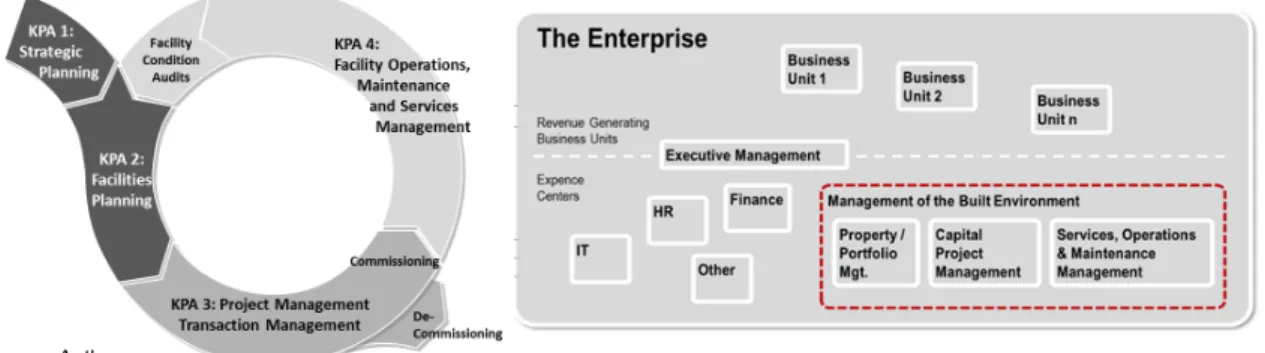
The research team developed the overall parameters for BEM2 in an interactive approach. The model started with a process classification similar to the classification used in the Capital Project Portfolio Management Model proposed by Dettbarn et. al. (2005), but developed a more sequential process definition by borrowing principles developed for Portfolio, Program and Project Management (Project Man agement Institute, 2006, 2008; Office of Government Com merce 2005, 2006), as well as from the Information Technology Information Libraries (Office of Government Commerce 2010). In addition, the team applied principles from the Carnegie Mellon Capability Maturity Model, which suggests that the business functions can document and diagrammed as interrelated Key Process Areas (KPAs). The team reviewed each revision of the emerging model with a wide range of facilities practitioners and consultants and incrementally refined the framework. At the same time, it was tested in a largescale reengineering process of a Facilities Organization (Reuter, Ebinger 2009). The starting point for the development of the BEM2 process sequence was the simple facilities lifecycle diagram (Figure 1). Recognizing that every organization manages the built Performance Measurement in Facility Management The Environment Management Maturity Model BEM3 www.researchjournals.co.uk
6
Performance Measurement in Facility Management The Environment Management Maturity Model BEM3 www.researchjournals.co.uk Figure 1: The Facilities Asset Lifecycle & Figure 2: Typical functions within the organizational context to manage the Built Environment environment in some fashion (Figure 2), the lifecycle model was unrolled and overlaid over the generic organizational structure (Figure 3). In the highlevel BEM2 process model (Figure 4), this overlay is further refined by identifying three perspectives impacted by the Facilities Management Func tion: strategic, portfoliolevel and tactical. Value streams are shown in Figure 4 as vertical stacks. Each vertical stackidentifies how tactical FM functions generate strategic value. A more granular breakdown of BEM2 model with a total of 30 identified processes was developed, but not included in this paper because of space limitations.
The Maturity Measurement Overlay
Once the process model was complete, the team used principles from the Capability Maturity Model (CMM) to
Figure 3: The life cycle function overlaid over the organizational context
Figure 4: The simplified Built Environment Management Model (BEM3) Source: Authors
Source: Authors
7
Performance Measurement in Facility Management The Environment Management Maturity Model BEM3
www.researchjournals.co.uk
Figure 5: Maturity levels for BEM3
develop a tool to measure organizational maturity for each of the identified process areas. The Capability Maturity Model was initially developed to assist software companies to manage the lifecycle of a software product, but the model has been adopted by numerous other management disci plines. The model is based on the work of Quality Manage ment. Its basic tenet is that increased reliability of processes (higher maturity) leads to a higher quality in the total system (Carnegie Mellon University, 2006). The team chose a simplified approach and measured process maturity individ ually for each process, using five maturity levels (Figure 5).
A questionnaire was developed to systematically assess maturity levels for each process area. The questionnaire consisted of a set of statements and used a 4level Likert scale to obtain feedback from Facilities Practitioners (Figure 7). The researchers assigned a maturity weight to each question, ranging from 1 (adhoc business processes) to 4 (highly mature, i.e. measured and selfoptimizing business processes). For each statement, the value of the Likert scale was multiplied by the weight, and an average score calculated for all questions within a process area. Questions answered with n/a were excluded from the average. Finally, a relative score was calculated, with 100% representing the highest rating in each statement, and 0% representing the lowest. The result was plotted on a spider diagram that roughly represented the Facility life cycle (Figure 8). The Survey
More than 50 organizations with major real estate portfolios in the North America and Europe from a wide range of industries have been assessed this far (Table 1).
The procedure of the survey can be divided into three phases. A personal interview with one or several staff members responsible for the FM/RE of the company is
Table 1: Survey Participants Industry Number of Participants Health Care 16 Higher Education 8 Real Estate 6 Hospitality 4 Financial Institutions 3 Other industries 16 Total 53 conducted initially. Phase two consists of the data analysis and the graphic visualization of the feedback. Phase three is optional and includes an interpretive summary of the findings and recommendations for areas of improvements.
Figure 6: Assess Process Sequence
Phase I: Interview / Completion of Questionnaire
The basis of the interview consists of a questionnaire with two main parts. The first section includes open questions about the interviewee, company size and budgetary vol umes, staffing and management responsibility, as well as organization of the FM/RE departments. The second part of the questionnaire includes 55 statements to systematically analyze the organizational maturity of the BEM2 processes areas. Interviewees identify if they agree or disagree with the applicability of the provided statements in their organi zation (Figure 7). Figure 7: Excerpts of the BEM3 Questionnaire Phase II: Analysis and Visualization The information is recorded in a data base, which calculates relative maturity scores based on the interviewee's feed back. The resulting "maturity profile" can be compared against peer participants, or similar industry groups to establish a relative strengthweakness pattern of the inter viewee's FM/RE environment. The "maturity profile" includes a visual summary with and a detailed comparison of each statement. The visual summary is a spider diagram summa rising the findings and displaying them on a percentage scale. Organisations that indicated higher maturity levels have higher percentage scores, while organizations with more informal or impromptu (less mature) processes have lower scores (Figure 8). Source: Authors Source: Authors Source: Authors Source: Authors
8
Performance Measurement in Facility Management The Environment Management Maturity Model BEM3 www.researchjournals.co.uk Figure 8: A sample Maturity Profile (US Healthcare Organization) Figure 9: Comparative analysis of each statement The second part of the analysis compares each statement evaluated by the interviewee against the peer group and all participants (Figure 9). The lefthand columns list the statements with corresponding answers by the interviewee. This answer is compared against the average value of the peer group. The comparison against all participants shows how far the responses were spread, and if the interviewee's feedback was above or below the average plus/minus 1 Standard Deviation. The symbols highlight answers in round green those statements where the interviewee was above average, and show in red diamonds where responses are significantly lower than the overall average. Phase III: Identification of Best Practice and Recommenda tions for Areas of Improvement The last step of the maturity assessment is the interpretation of the variance of the subject organization's maturity profilefrom the benchmark (peer group, or different industry). Above average scores indicate the existence of "best practices", while lower scores pose the question if improve ment of maturity (i.e. implementation of better defined and measured processes) could improve organizational perfor mance.
Exemplary Review of Findings
The methodology and approach has received positive feedback from participating organization. The BEM3 tool appears to be a reliable measure of organizational FM maturity and helps organizations to obtain a highlevel overview of their performance. While the current sample size of some 50 participating organization doesn't allow for a thorough statistical analysis yet, initial reviews the findings data is posing interesting questions. Comparing the maturity profiles between Higher Education and Health Care, on
Source: Authors
9
Performance Measurement in Facility Management The Environment Management Maturity Model BEM3 www.researchjournals.co.uk Figure 10: Comparison of FM Maturity in Healthcare vs. Higher Education Figure 12: Best Practices areas of selected organizations Figure 11: Comparison of FM Maturity in Austria vs. USA average FM in Health Care appears to be more mature than FM in Higher Education, except for "Facilities Client Satis faction Assessment" and "Services Management",where FM in Higher Education appears to be more mature (Figure 10). Comparing FM functions in the US against peers in Europe, it appears that European Facilities Manager are placing a stronger emphasize on strategic planning and Maintenance and Operations Management (Figure 11). While the above findings will only be reliable when based on significantly larger sample sizes, BEM3 is providing helpful results to participating organizations.Source: Authors
Source: Authors
10
Performance Measurement in Facility Management The Environment Management Maturity Model BEM3
www.researchjournals.co.uk
In addition, a few interesting trends are emerging: Ÿ Nonprofit organizations tend to have strong longterm
planning capacities. This finding is supported by the fact that the development of new facilities for the studied nonprofit organizations is significantly more complex than for the studied nonprofit organizations. Ÿ Processing and manufacturing industries tend to have higher maturity scores than service industries. Ÿ While healthcare organizations have consistently high maturity scores for maintenance and operations, they have great maturity variances in the process areas for planning and project implementation.
Ÿ Higher education organizations have high maturity variances in all areas.
It is helpful to note that higher process maturity comes at a significant cost. Defining, measuring and visualizing process performance is an expensive undertaking and may turn out to be too costly for certain business functions. It is therefore helpful for organizations to understand their maturity position relative to a comparable peer group, and then to assess if investments in increased maturity could lead to a comparative advantage.
Both the "Built Environment Management Model" (BEM2), as well as its complementing assessment tool, the "Built Environment Management Maturity Model" (BEM3), present industry neutral instruments to classify and assess the management functions related to the built environment. The purpose of the models is to help organisations understand the interdependencies of facilityrelated processes and their impact on organizational strategy and performance. The assessment tools BEM2 and BEM3 aim to allow for compre hensive and at the same time cost effective evaluations of FM/RE functions. BEM2 and BEM3 are primarily aimed at real property but are theoretically applicable to other types of capital assets such as production assets or information technology assets. The assessment tool BEM3 in its current form captures an actual situation and highlights strengths and weaknesses, whereas the other models (Balanced Scorecard, EFQM, 7smodel, Six Sigma, Deming, Malcolm Baldrige, St. Galler Management Model) aim to change the actual state.
It is important to recognize that high maturity levels are not necessarily best for the organization. High maturity scores necessitate significant investments in business maturity (business automation, information processing and change management). For stable, high volume business environ ments these investments are necessary, but other environ ments may be too fluid to justify the investments. The research authors realize that "appropriateness" of process maturity may be more important than the absolute score. The researchers recommend that companies review the variance of the company's maturity capability profile from the peer group, rather than focusing on the absolute score. With increasing numbers of organizations recognizing the usefulness of a systematic Facility Management function (Madritsch, 2009b), this research could help to determine the appropriate level of investments in Facility Management functions so that it can serve the organization most effi ciently. The resulting maturity profiles provide a highlevel overview of current practices in Facilities Management. The results allow organizations to benchmark their FM maturity against peer groups, as well as against best practice industries. By assessing the level of process maturity, the profile allows organization to develop "winnable" improve ment initiatives to increase the strategic value of the Facility Management function.
In developing the BEM2/BEM3 frameworks further, the research team will increase the sample size and refine the taxonomy of FM/RE processes and knowledge. The findings will help to further professionalize Facility Management functions to raise the efficiency of organizational processes.
Association of Physical Plant Administrators (2010): Facilities Perfor mance Indicators (FPI), available at: http://www.appa.org/research/FPI (accessed on October 27, 2010).
Cable Davis (2010): "Key Performance Indicators for Federal Facilities Portfolios", Federal Facilities Council Technical Report #147, The National Academies Press, Washington, D.C.
Carnegie Mellon University (2006), "Capability Maturity Model Integration (CMMI) Version 1.2 Overview", available at http://www.sei.cmu.edu/library /abstracts/presentations/cmmiv12overview.cfm (accessed 27 October 2010).
Chotipanich, S. (2004): "Positioning facility management", Facilities, Vol. 22 No. 13/14, pp. 364372.
Chotipanich, S., Nutt, B.(2008), "Positioning and repositioning FM", Facilities, Vol. 26, No. 9/10, pp. 347388.
Dettbarn, J., Ibbs, C.W., Murphree, E.L. (2005), "Capital Project Portfolio Management for Federal Real Property", Journal of Management in Engineering, Vo. 21, No. 1, pp. 4453.
European Committee for Normalization (20062009): Facility manage ment Norm EN15221, published by CEN National Members.
IFMA (2010), "Competency Areas", available at: http://www.ifma.org/l earning/fm_credentials/competencies.cfm (accessed on October 27, 2010).
Institute of Asset Management (2008), IAM PAS 55:2008 Competence Framework (Part 1 and 2), IAM, London.
Keith, A. (2009), The Next Generation, European Facilities Management Association, Naarden, Netherlands.
Keith, A., Atkin, B., Bröchner, J. (Eds.). (2005): Facilities Management / Innovation and Performance, Spon Press, New York.
Kloet F., Timmerman, A., Shah, S. et al (2008): "The FM 6pack: the benchmarking of European corporate real estate and facilities manage ment can start", in: essential FM Report, Nov/Dec 2008, p. 28. Lindholm, A.L., Gibler, K.M. (2006): Measuring the Added Value of Corporate Real Estate Management, in: Pacific Rim Real Estate Society Meeting, Auckland.
Madritsch, T. (2009a): "Best Practice Betriebskostenanalyse bei Alter sheimen", in: Facility Management FM Lösungen erkennen, beraten, möglich machen, VDE Verlag, Frankfurt am Main, ISBN 9783800731510, pp.439448.
Madritsch, T. (2009b), "Best practice benchmarking in order to analyze operating costs in the health care sector", in: Journal of Facilities Management, ISNN 14725967, Vol.7 No.1, pp.6173.
Madritsch, T., Steixner, D., Ostermann, H., Staudinger, R. (2008), "Operating cost analyses of long term care facilities", in: Journal of Facility Management, ISNN 14725967, Vol.6 No.2, pp.152170.
National Research Council (2008): Core Competencies for Federal Facilities Asset Management Through 2020: Transformational Strategies. The National Academic Press. Washington, D.C.
Office of Government Commerce (2006): Portfolio, Program & Project Management Maturity Model (P3M3). London: OGC.
Office of Government Commerce (2010), "Information Technology Infor mation Libraries (ITIL) the Basics", available at http://www.best managementpractice.com/gempdf/ITIL_The_Basics.pdf (accessed on 28 October 2010).
Project Management Institute (20062), The Standard for Portfolio Management, Project Management Institute, Newton Square, PA. Project Management Institute (2008), A Guide to the Project Management Body of Knowledge. Fourth Edition, Project Management Institute, Newton Square, PA. Reuter, F., Ebinger, M. (2009): "An American Approach to Capital Asset Lifecycle Management" in: EuroFM Conference Proceedings, Amsterdam. Shoet (2006), "Key Performance Indicators for Strategic Healthcare Facilities Maintenance", Journal of Construction Engineering and Man agement, Vol. 132, No. 4, pp. 345352.
Teicholz, E., Nofrei, C., Thomas, G. (2005), "Executive Order #13327 for Real Property Asset Management". IFMA Journal, Nov/Dec issue. Then, D. (1999), "An integrated resource management view of facilities management", Facilities, Vol. 17, No. 12/13, pp. 462 469.
Then, D. (2004), "The Future of Professional Facility Management Education in the AsiaPacific Region", paper presented at "New World Order in Facility Management Conference", June 2004, Hong Kong.