PLASTIC AS A SOIL STABILISER
Ankit Yaduvanshi
1, Ankur Tayal
2, Aman Bhatnagar
3, Varun Aggarwal
4, Vishal Singh
5, Sahil
Raturi
61,2
Assistant Professor, Department of Civil Engineering, Dr. Akhilesh Das Gupta Institute of Technology and
management, New Delhi
3,4,5,6
Student, Department of Civil Engineering, Dr. Akhilesh Das Gupta Institute of Technology and management,
New Delhi
---***---Abstract - Soil Stabilization is the alteration of soils toenhance their physical properties. Stabilization can increase the shear strength of a soil and/or control the shrink-swell properties of a soil, thus improving the load bearing capacity of a sub-grade to support pavements and foundations. Soil Stabilization can be utilized on roadways, parking areas, site development projects, airports and many other situations where sub-soils are not suitable for construction. Stabilization can be used to treat a wide range of sub-grade materials, varying from expansive clays to granular materials. This process is accomplished using a wide variety of additives, including lime, fly-ash, and Portland cement. Along with these conventional additives these are various other waste materials that have been used for soil stabilization. One such material is plastic which has raised a lot of concerns for the environment. Use of plastic products such as polythene bags, bottles etc. is increasing day by day leading to various environmental concerns. Therefore the disposal of plastic in a way that will not pose any hazard to the environment has become a serious need. Thus using plastic waste in the stabilization of soil can prove to be beneficial and economical in the same time.
Key Words: Soil Stabilization, CBR, OMC, MDD, Plastic fibers.
1. INTRODUCTION
Increased use of plastics in day to day consumer applications has resulted in the municipal solid waste, an ever growing fraction of plastic materials which were used for a short time and then discarded. The linear consumption patterns of plastic bags involving single usage and then disposal has led to environmental challenges such as diminishing landfill space, marine and urban littering. There is, therefore a growing need to find alternative uses of reclaimed plastic bag waste to lengthen the usage time of the plastic material and thereby save the degrading environment. The concept of reinforcing soil masses with strips of plastic cover may be relatively, a new development. In contrast, the use of random-materials as reinforcement for soil is probably not older than written history, but only sparsely represented. The pursuit for improved soil structure and its cost-effectiveness in construction and in slope stabilization forms the basis of
this research. This study explored the possibility of utilizing reclaimed plastic material from plastic covers as tensile inclusions to reinforce soil for ground improvement schemes in geotechnical engineering applications such as embankments, slope stabilization, foundation slabs, dams, sea walls, bridge abutment and retaining walls. The specialty of soil reinforcement is its flexibility, which enables construction on poor foundation soil, rapid construction and low cost. Soil stabilization can be done in many ways. But the stabilization using plastic waste fibers is an economic method since the stabilizer used here is waste plastic materials, which are easily available. A plastic waste is any of wide range of synthetic or semi-synthetic organic solids that are mouldable. Plastics are typically organic plastics of high molecular mass, but they often contain other substances. They are usually synthetic, most commonly derived from petrochemicals, but many are partially natural.
2. OBJECTIVES
1. To study the effect of inclusion of plastic fiber over compaction and CBR parameters of soil. 2. To arrive at the optimum percentage of plastic
fibers to be introduced in the soil. 3. MATERIALS
1.
Plastic in shredded form.2.
Soil taken from college premises.4. METHODOLOGY
The materials taken were soil and plastic waste fibers.
First we took the soil sample from college premises (beside of block 1) and the soil was kept in oven for 24 hrs.
After 24 hrs. we took the soil from oven and firstly performed sieving of soil. The soil which passed from the sieve of 4.75mm was taken for performing further tests on soil.
© 2019, IRJET | Impact Factor value: 7.211 | ISO 9001:2008 Certified Journal
| Page 4867
determination of water content in soil, liquidlimit by cassagrande’s apparatus, plastic limit, and specific gravity by pycnometer.
The sample from plastic limit and liquid limit tests and put the samples into oven for 24 hrs. Due to the change in water content in the soil
the liquid and plastic limit were determined. After this standard proctor test was performed
on unreinforced soil or original soil for determination of its optimum moisture content (OMC).
We took 3 kg of 19mm sieved soil for performing standard proctor test and for preparing of sample 4% of water by weight of soil was added initially into the soil.
Weight of the empty mould with base plate of standard proctor test was taken.
Then soil was filled in mould in three layers with twenty five blows in each layer with the rammer of 2.89 kg and weighs it again with filled soil and the weight of mould and soil was taken.
The weight of soil and mould after compaction was taken.
The sample of this compacted soil was taken and kept in the oven for 24 hrs.
Remove the soil from the mould and add 3% water by weight of soil.
For each addition of 3% of water the corresponding weight and sample were taken. The process was repeated until the weight of
mould+soil was less than the previous weight. After 24 hrs., the sample was taken out from
oven and was weighed.
From the initial weight and final weight of the respected sample the dry density value were determined.
Corresponding to the maximum dry density the corresponding moisture content i.e. optimum moisture content (OMC) was determined from the graph plotted between dry density and moisture content.
For different oven dried sieved soil samples their corresponding optimum moisture content (OMC) the water was added to the soil sample and California bearing ratio (CBR) test was performed.
5 kg of soil sample was taken and water content till OMC was added at proper limits.
The weight of empty mould was taken along with the base plate and the soil was filled in the mould in 3 layers with 56 blows each by
rammer of 2.89 kg.
After filling it upto top the collar was removed and extra soil was removed by spatula.
The mould was now placed in the cbr machine and the load was determined for settlement corresponding to 0, 0.5, 1, 1.5, 2, 2.5, 5, 7.5, 10 and 12.5 mm.
The graph was plotted between load applied and settlement in mm.
The test was performed for unreinforced soil and soil having plastic waste fiber of 2%, 2.5% and 3% by weight of soil.
5. RESULTS AND DISCUSSION
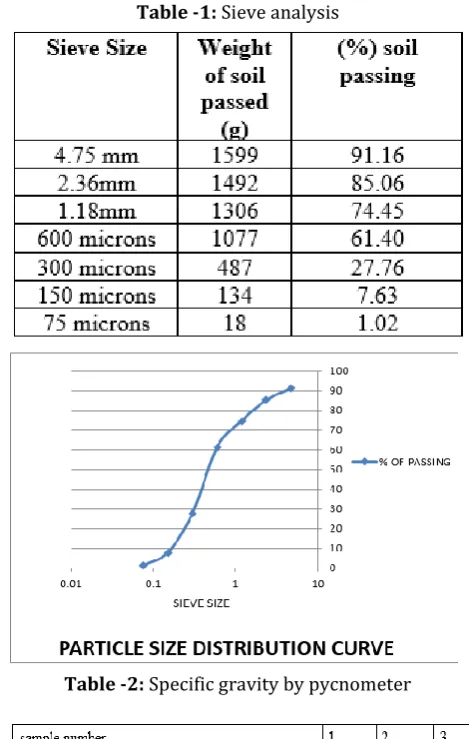
Table -1: Sieve analysis
[image:2.595.313.548.278.648.2]
Chart-1: Particle size distribution curve
Table -2: Specific gravity by pycnometer
Chart-2: MC vs DD curve for no plastic content
Chart-4: MC vs DD curve for 2.5% plastic content
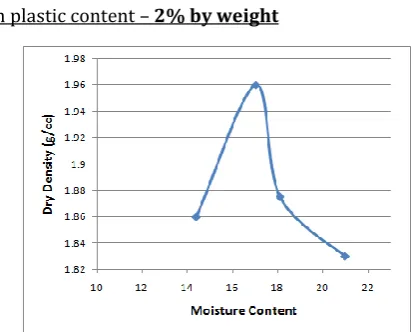
[image:3.595.323.530.120.286.2] [image:3.595.332.535.354.513.2]Chart-5: MC vs DD curve for 3% plastic content Chart-3: MC vs DD curve for 2% plastic content Table -3: Liquid Limit
Table -4: Plastic Limit
Plasticity Index:
Ip= WL – WP = 33.33 – 24.33 = 9
5.1 Standard proctor test
Without plastic content
Optimum Moisture Content (OMC) = 12.9% Maximum Dry Density (MDD) = 1.88g/cc
With plastic content – 2% by weight
Optimum Moisture Content (OMC) = 17.02% Maximum Dry Density (MDD) = 1.96 g/cc
With plastic content – 2.5% by weight
Optimum Moisture Content (OMC) = 17.6% Maximum Dry Density (MDD) = 1.91 g/cc
With plastic content – 3% by weight
From the figure on the left side, it is evident that, Based on,
Liquid Limit and Plasticity Index This soil can be classified as:-
© 2019, IRJET | Impact Factor value: 7.211 | ISO 9001:2008 Certified Journal
| Page 4869
Chart-7: Load vs Penetration curvefor 2% plastic content Chart-6: Load vs Penetration curve
for no plastic content
Chart-7: Load vs Penetration curve for 2.5% plastic content
Chart-8: Load vs Penetration curve for 3% plastic content Optimum Moisture Content (OMC) = 17.02%
Maximum Dry Density (MDD) = 1.96 g/cc Optimum Moisture Content (OMC) = 18.18% Maximum Dry Density (MDD) = 1.725 g/cc
5.2 CBR Test
Without plastic content
At 2.5mm Penetration 11*4.88/1370 = 3.91% At 5mm Penetration 16*4.88/2055 = 3.79% CBR Value = 3.91%
With plastic content – 2% by weight
At 2.5mm Penetration 7*4.88/1370 = 2.49% At 5mm Penetration 10*4.88/2055 = 2.37% CBR Value = 2.49%
With plastic content – 2.5% by weight
At 2.5mm Penetration 10*4.88/1370 = 3.56% At 5mm Penetration 14*4.88/2055 = 3.324% CBR Value = 3.56%
With plastic content – 3% by weight
At 2.5mm Penetration 19*4.88/1370 = 6.76% At 5mm Penetration 28*4.88/2055 = 6.64% CBR Value = 6.76%
6. CONCLUSIONS
1. In areas where the wheel load intensity is low and the soil is of silty nature, 2% plastic fiber content can be added to stabilize the soil followed by light compaction thus ensuring that maximum dry density is obtained enabling the soil to carry the wheel load safely
2. For areas with silty soil and having high wheel load intensity it is recommended to add 3% plastic fiber content along with heavy compaction thus ensuring high subgrade strength as well as high dry density.
7. REFERENCES
[1] Soil Stabilization by using Plastic Waste BY: Arpitha G,Dayanandha B V , Kiran kumar patil ,Shruti Neeralagi
[2] Soil Stabiliisation Using Raw Plastic Bottles- Proceedings of Indian Geotechnical Conference December 15-17, 2011, Kochi (Paper No. H-304) [3] Sand Stabilization Using Waste Plastics By Dana
Lynn Owsiany- The University of Arizona, 1993 [4] Soil stabilisation using raw plastic bottles,
Proceedings of Indian Geotechnical Conference, Kochi, Paper number (H-304)
[5] Plastic as a soil stabilizer, AS Aswathy, Greeshma VR, Arunachala College of Engineering for Women [6] S.A. Naeini and S.M. Sadjadi, (2008) “effect of waste
plastic materials on shear strength of unsaturated clays”, EJGE journal, vol. 13, bndk(1-12).
[7] Puppala, A.J., and Musenda, C. (2000) “Effect of fiber reinforcement on strength and volume change behavior of two expansive soils,” Transportation research record: Journal of the transportation research board, Vol.1736, pp 134‐ 140.
[8] Pandian, N.S., Krishna, K.C., and Sridharan, A. (2001) “California bearing ratio behavior of soil/fly ash mixtures,” Journal of Testing and Evaluation, ASTM, Vol. 29, No. 2, pp 220–226. [9] Malekzadeh.M.Bilse.H. (2012) “Effect of
polypropylene fiber on mechanical behavior of expansive soils,” Electronics Journal of Geotechnical Engineering, EJGE, Vol.17, Bund.A, pp 55-63.
[10] Shish Pal International Journal of Innovative Research in Science, Engineering and technologyvol. 4, Issue 11, November 2015
[11] IS:2720 (Part I) 1983 - Preparation of dry sample (soil)
[12] IS:2720 (Part III) 1980 Section/1-Determination of water content (moisture content)
[13] IS: 2720 (Part. III) 1980 Section/2- Determination of specific gravity of fine, medium & coarse grained soil
[14] IS: 2720 (Part.V) 1985- Determination of Liquid
and plastic limit
[15] IS: 2720 (Part. VII) 1980- Determination of water content -dry density relation using light compaction