O
VERVIEW OF2001
This section reviews 2001 and the main results of Forfás surveys under the following headings:
• Economy / Employment
• Agency Supported Firms Spending in the Economy
• Corporation Tax Payments
• Investment in Enterprise Development
• Cost Per Job Sustained
• Community Innovation Survey
• Business Expenditure on Research & Development Survey
General Economic Environment
The overall economic situation in 2001 was one characterised by strong growth in the first part of the year giving way to a sharp deceleration as the year progressed. Overall, real GDP growth for the year is estimated at 6.75 %1, down from the 11.5 % high of 2000. Real GNP growth for the year is estimated at 5.25 %, a significant decrease on the 10.4 % realised in 2000. This is still significantly ahead of the growth projections for our main trading partners, and the EU-15 average of 1.7% growth in GDP in 2001.
The slowdown in activity in 2001 is also reflected in other macroeconomic indicators. Overall employment growth is estimated at 2.8 % for 2001, down from 4.7 % in 2000. However, unemployment only rose marginally, to 4% of the labour force in 2001, and is expected to average no more than 4.75% in 2002. Exports of goods and services are estimated to have grown by 8.2 % in real terms in 2001, down from the 17.8 % witnessed in 2000. Import growth is also estimated to have moderated, increasing by 7.2 % in 2001 compared with 16.6 % in the previous year. This easing in economic activity impacted positively on the rate of inflation. Using the harmonised European measure (HICP)2, inflation is estimated at 4.0 % in 2001, compared to the 5.3 % recorded in 2000, and is expected to moderate further in 2002.
The slow-down in economic activity also impacted on employment in manufacturing and internationally traded and financial services. Preliminary results from the Forfás Annual Employment Survey 2001 show that total employment in these sectors in agency-supported companies3 declined (-1.9%) in 2001. However, numbers employed stood at 313,000 at the end of 2001, which is 6% above the average for the past 5 years, and the second highest level of employment on record.
1
Source: Ireland – Stability Programme December 2001 Update – Department of Finance 2
HICP: EU Harmonised Index of Consumer Prices 3
Chart 1
Trends in Permanent and Temporary Employment 1992 - 2001 Manufacturing and Internationally Traded / Financial Services
192,831 12,831
195,028 15,559
201,258 20,647
210,878 23,935
222,154 22,618
237,185 27,186
250,450 29,594
264,202 31,303
288,172 31,093
285,358 27,773
0 50,000 100,000 150,000 200,000 250,000 300,000 350,000
1992 1993 1994 1995 1996 1997 1998 1999 2000 2001
Permanent Full-time Employment Temporary Part-time Employment
Source: Forfás Annual Employment Survey
New full-time jobs created in agency-supported firms amounted to over 27,300 in 2001, a good performance given the economic difficulties encountered during the year. New jobs were recorded in all sub-sectors of manufacturing. New job creation was split evenly between Irish-owned and foreign-owned firms. Internationally-traded/financial services continued to be one of the main areas of growth with over 9,000 gross job gains in 2001, and a net increase in full-time jobs of more than 4,500, when losses in the sector are taken into account.
Chart 2
Gross Gains and Losses in Permanent Full-Time Employment
Manufacturing and Internationally Traded / Financial Services 1992 - 2001
-40,000 -30,000 -20,000 -10,000 0 10,000 20,000 30,000 40,000 50,000
1992 1993 1994 1995 1996 1997 1998 1999 2000 2001
Gross Job Gains
Gross Job Losses Net Change
Source: Forfás Annual Employment Survey
The down-turn in the economy was reflected in a rise in the number of jobs lost in 2001. Many sectors experienced an increase in job losses in 2001, particularly firms involved in labour intensive and lower value added activities. This reinforces the point that firms in Ireland must move up the value chain and re-position themselves in market sectors with more potential for profitable growth. The strategies of the enterprise development agencies are now firmly fixed on building, and providing the infrastructure for, high value-added and knowledge-intensive industries. The dip in net employment growth in 2001 only serves to emphasise the importance of continuing with such strategies.
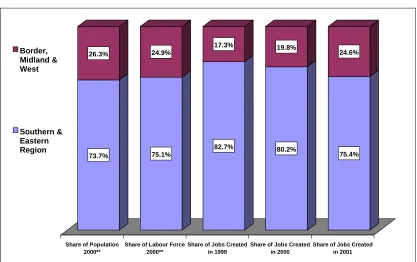
Industrial policy is also focused on bringing about an improved regional distribution of employment. The Border, Midlands and West (BMW)4 region has tended in the past to perform less satisfactorily than the rest of the country in terms of increasing and sustaining its employment in manufacturing and internationally-traded services.
Chart 3 provides encouraging signs that the policies being adopted by the enterprise development agencies to promote the development of the BMW region are having an impact. The chart shows that the BMW region accounts for 26.3 % of the population (aged 15+) and 24.9 % of the labour force. In 1999, the region accounted for 17.3 % of gross job gains in agency-supported companies. The latest figure for 2001 shows a
4
significant increase with 24.6 % of gross job gains accruing to the BMW region. Forfás will continue to monitor this trend to determine the impact of policies aimed at improving the regional distribution of employment.
Chart 3
Share of Gross Job Gains in Agency Supported Companies* by Region Relative to Share of Population and Labour Force
73.7% 26.3%
75.1% 24.9%
82.7% 17.3%
80.2% 19.8%
75.4% 24.6%
Share of Population 2000**
Share of Labour Force 2000**
Share of Jobs Created in 1999
Share of Jobs Created in 2000
Share of Jobs Created in 2001
Border, Midland & West
Southern & Eastern Region
*Source: Forfás Annual Employment Survey (Excludes Shannon Development and Údarás na Gaeltachta)
** CSO data
Expenditure of Agency Supported Firms
Manufacturing and internationally-traded services companies under the remit of IDA Ireland, Enterprise Ireland, Shannon Development and Údarás na Gaeltachta make a direct contribution to the Irish economy in terms of their expenditure on payroll costs, Irish-produced raw materials and bought-in services. Forfás and the
[image:4.595.90.507.186.448.2]Table 1 Direct Expenditure of Agency Supported Firms in the Irish Economy
Irish-owned Firms
Foreign-owned Firms
All Firms
1999 2000 1999 2000 1999 2000 Change
Sales €m 19,507 22,000 48,909 59,684 68,416 81,685 19.4%
Payroll Costs €m 3,439 4,031 4,916 5,568 8,355 9,598 14.9% Irish sourced Materials €m 6,839 7,787 6,033 7,504 12,872 15,291 18.8% Irish sourced Services €m 2,189 2,493 3,663 4,245 5,852 6,738 15.1%
Direct Expenditure in
the Economy €m 12,467 14,311 14,613 17,316 27,080 31,627 16.8% Direct Expenditure as
% Sales % 63.9 65.0 29.9 29.0 39.6 38.7 -0.9%
Source: Annual Business Survey of Economic Impact, Forfás
Payroll costs account for €9.6bn (30.4%) of this expenditure, Irish-produced raw materials account for €15.3bn (48.4%) and bought-in services account for the
remaining €6.7bn (21.2%). In total, Irish-owned companies accounted for €14.3bn of direct expenditure in the economy, equating to 65% of the value of its sales. Foreign-owned companies accounted for the remaining €17.3bn, and this equates to 29% of the value of its sales. The survey shows that foreign-owned manufacturing industry5 sourced 28% of its raw material requirements in Ireland in 2000, up from 18% at the beginning of the 1990s. This is an encouraging indicator of the “embeddedness” of foreign-owned multinationals in the economy.
Corporation Tax Payments
In addition to their expenditure in the economy, manufacturing and internationally traded and financial services companies provide a very significant direct return to the exchequer by way of corporation tax payments.
• The total corporation tax take is estimated at €4,289 million in 20016. This represents a rise of 618 % in real terms in the period 1988 to 2001 (16.4 % per annum).
• Corporation tax paid at the 10% rate by manufacturing and internationally-traded and financial services companies, according to a survey by Forfás, amounted to €1,815 million in 2000, equivalent to 47 % of total corporation tax receipts.
• The overall burden of taxation in Ireland has been progressively reduced and amounted to 29.4 % of GDP in 20017. This has boosted economic activity and employment. Low corporation tax rates have also benefited firms directly and
5
Excludes Food, Drink & Tobacco 6
Source: Budget 2002 – Department of Finance 7
have led to the situation where the low corporation tax rate has been followed by a higher corporation tax yield – see Chart 4 below.
Chart 4
Corporation Tax Payments
(Constant Prices)
0 500 1,000 1,500 2,000 2,500 3,000 3,500 4,000
1989 1990 1991 1992 1993 1994 1995 1996 1997 1998 1999 2000 2001
0 1,000 2,000 3,000 4,000 5,000
Total Corporation Tax
Manufacturing & Intn'l. Traded and Financial Services
IR£ millions euro millions
* Source: Forfás Corporation Tax Survey
Increased Investment in Enterprise Development
Forfás undertakes an annual analysis of Agency investment programmes to promote the development of the enterprise sector and create employment in Ireland. The latest estimates indicates that:
• The gross cost of support in real terms to the enterprise sector in the form of direct expenditure (all costs of operating the development agencies, financial supports etc.) was approximately €786 million in 2000, and is estimated at €846.4 million for 2001. This represents a rise of 50 % in real terms over the period 1988-2001;
• Over the same period, 1988 to 2001, growth in gross Government expenditure (current plus capital) of 94 % in real terms was recorded. The growth in GNP in real terms over this period was 167 %;
Chart 5
State Expenditure on Enterprise Development
(Constant Prices)
0 100 200 300 400 500 600 700
1988 1989 1990 1991 1992 1993 1994 1995 1996 1997 1998 1999 2000 2001 0 100 200 300 400 500 600 700 800
IR£ million euro million
Cost Per Job Sustained
The average cost per job sustained8 in agency supported companies over the seven year period ending in 2001 amounted to approximately €11,492 which is less than half of the figure that applied in the 1980s (when measured in constant prices). The downward trend in this measure is due to a number of factors including the improved value for money approach to projects pursued by the agencies, a significant increase in the return to Enterprise Ireland from its equity shareholdings, the continued growth of internationally traded services projects where investment costs are generally lower than manufacturing projects, and the favourable economic environment for enterprise development.
8
Data excludes companies under the remit of Shannon Development and Údarás na Gaeltachta. The cost per job is calculated by taking into account all direct Enterprise Ireland and IDA Ireland
Chart 6
Trends in Cost Per Job Sustained (Constant Prices)
0 5,000 10,000 15,000 20,000 25,000 30,000
0 5,000 10,000 15,000 20,000 25,000 30,000 35,000
IR£ euro
Source: Forfás
Research & Development in the Business Sector
The Forfás Survey of Research and Development in the Business Sector in 1999 was completed during 2001. The results show that business expenditure on research and development (BERD) continued to grow in aggregate terms between 1997 and 1999. Total BERD accounted for €784 million in 1999 which is equal to 0.88% of GDP, compared to €612 million in 1997 (0.9% of GDP) as indicated in Chart 7.
Chart 7: Business Expenditure on Research & Development 1991-1999
0 .8 8 % 0 .9 1 %
0 .8 9 % 0 .7 9 %
0 .5 9 % 2 2 3
3 4 3
4 7 0
6 1 2
7 8 4 7 8 4
6 3 7
5 0 5
3 8 7
2 6 3
0 1 0 0 2 0 0 3 0 0 4 0 0 5 0 0 6 0 0 7 0 0 8 0 0 9 0 0
1 9 9 1 1 9 9 3 1 9 9 5 1 9 9 7 1 9 9 9
The annual rate of growth for the period 1991-1999 was 14.6%. However, for the period 1997-1999 growth slowed to 11% per annum. BERD as a percentage of GDP also increased over the period 1991 to 1995 but has remained around 0.9% from 1995–1999. In 1999 the BERD as a percentage GDP figures for the EU and the OECD were at 1.2% and 1.5%, respectively.
Among the major findings of the survey are the following:
• The number of firms spending significant amounts of money (€1.3m or £1m) on R&D increased from 75 in 1997 to 98 in 1999. The number of foreign-owned firms increased from 50 to 55, while 43 indigenous firms spent more than this amount compared to 25 in 1997.
• Foreign-owned firms accounted for two-thirds of BERD in 1999, which is in line with previous years.
• On a sectoral basis the key indicator of the level of research is the ratio of R&D to total output. For manufacturing industry as a whole this ratio is low at 0.8%, compared to the EU average of 2.4%. Iindigenous sections, such as electrical and electrical equipment and instruments, have R&D intensities which are above the OECD average levels.
• R&D activity in the context of numbers of business sector researchers sees Ireland at 3.1 researchers per 1000 labour force, which is above the EU average of 2.5 and is ranked 10th out of 25 OECD countries. There are current and potential skills shortages for researchers in knowledge-based industries. This is despite the relatively high number of science and engineering graduates.
M
AJORI
SSUES FOR2002
Some of the issues which will be important for economic development and therefore for Forfás in 2002 are considered in this section under the following headings:
• World Economic Slowdown
• Competitiveness
• Skills
• Trade – WTO Agreement
• e-Business and Telecommunications
• Infrastructure
• Research & Development
• Biotechnology
World Economic Slowdown
In 2001, the global economy experienced its most severe deceleration since the 1974 oil price shock. In 2000 global growth averaged 4.7%, the fastest rate of growth since 1998. But in 2001 world growth is likely to have slowed to just 2.2%, the slowest performance since 1992. Sparked by the crash in the Information and Communications Technology (ICT) industry, the downturn began in the USA, but quickly spread to Asia and Europe. The already slowing U.S. and global economies were further undermined by the terrorist attacks against the USA on September 11 2001, mostly reflecting the impact of the attacks on consumer and business confidence. According to the most forecasts, global growth will average just 2.9% in 2002 and OECD growth just 1.5%. Output is expected to remain weak in the first half of 2002, but a recovery is likely to gradually take hold in the USA and most other industrialised countries in the second half.
There is a risk, however, that the rising U.S. unemployment and falling consumer and investor confidence will lead to the USA undergoing a far deeper and longer recession that currently expected. The global implications of an even deeper U.S. downturn would be significant. First, the direct trade impact would be even greater than now expected, with U.S. imports falling sharply through much of 2002 and into 2003. Secondly, the impact on the financial market would be far greater. Equity prices in the USA would fall further, and capital-market liquidity would dry up even for borrowers. Other equity markets around the world would fall sharply as a result, depressing balance sheets in Europe and Japan, and forcing a retrenchment by the private sector. Indeed, it is hard to avoid the conclusion that the risks to global economic growth are now higher than at any time for a decade.
the prospects for 2002 are uncertain. On the basis of the U.S. and European economies recovering in the second half of next year, and on the basis of only a modest appreciation of the euro against the dollar, we expect real GDP growth in 2002 of 4-5%, following growth of around 6.0% in 2001. The risks to this forecast are, however, mostly on the downside. A sharp appreciation of the euro, or a deeper global recession than currently expected, could spell a more severe slowdown in Irish economic growth than currently anticipated.
While little can be done in the short-term to counter the difficulties that will likely be faced in the coming 6-12 months, the downturn should add increased impetus to ongoing efforts to address major deficiencies in the Irish business environment, particularly regarding infrastructure provision (telecoms, roads, electricity, air access and waste management), education and the support structures for research and innovation. It is also important to distinguish between cyclical economic trends, and the continuing dramatic restructuring of the global economy as a result of technological advancements in information and communication technologies (ICT), biotechnology and nanotechnology. Despite recent setbacks over the last year, particularly in the ICT sector, it remains our conviction that scientific advances in these sectors have paved the way for a new economic revolution, promising a sustained period of higher than historic increases in global productivity and economic growth into the medium-term. With the proper policy mix in the areas of education and skills, research and development and physical infrastructure, Ireland has the potential to become a global leader in many of these areas.
Competitiveness
The global slowdown of 2001, exacerbated by the events of September 11, has clearly demonstrated the increasing integration of the world economy and the sensitivity of its response to change. However, in spite of the faltering pace of world economic growth in 2001, many commentators still expect a recovery in 2002. Ireland’s competitiveness challenge is to ensure that it is well placed to take advantage of an upturn in the world economy when it occurs.
Trade, investment and other measures of economic integration will be increasingly important in the years ahead. In Europe, the EU enlargement process is now fully under way, and accordingly the countries of Central and Eastern Europe compete actively for trade and inward investment. The world economy will continue to be an ever more competitive market place, with growing numbers of lower-income countries seeking success in international markets and also with larger and more sophisticated economies among the developed countries anxious also to maintain their positions. Critical challenges included telecommunications, infrastructure, regulatory reform and that introduction of the euro.
Another key competitiveness issue for 2002 is regulatory reform, and the need to follow-up on the recommendations of the OECD report in this field. Key objectives include the need for further liberalisation in a number of sectors, the introduction of regulatory impact analysis, and the preparation of a national policy statement on the role and operation of the regulatory process. The challenge for 2002 will be to ensure that competition in all sectors grows and leads to better and cheaper services for consumers. More generally, the Government processes themselves, the means by which laws and regulations are drawn up will also need to be reviewed, to ensure that the system is responsive enough to the needs of consumers and to the demands of the international arena.
The introduction of euro notes and coins on 1 January 2002 marks the final stage of EMU. With the withdrawal of national notes and coins thereafter, the functional and formal aspects of the changeover will have been completed. Irish firms will need to examine their strategies for export diversification, improved sourcing of raw materials and services, and to seek partnership opportunities across the eurozone to best take advantage of the opportunities that the euro provides.
Skills
The skills and flexibility of the Irish workforce are becoming increasingly important in ensuring sustained economic growth in a competitive global economy. Available evidence indicates the presence of a tight labour market situation in the medium term. In this context, the issue of future skills needs in the labour market generally, and the requirements of those skills, will be of prime importance. Demographics and declining numbers entering and leaving school are also an important consideration.
An ongoing analysis of the labour market is of prime importance to allow for more comprehensive policy recommendations to be drawn up. Within the labour market some sectors are of particular importance. Biotechnology is of strategic importance and the sector is likely to undergo fundamental change in Ireland in the medium term. The specific skills required to accommodate this change will have to be identified. The ICT sector and the construction sector are also under going change, in the context of the recent economic slowdown, and therefore require ongoing monitoring.
Trade – WTO Agreement
while negotiations on investment and trade facilitation are expected to begin in 2003/04.
These negotiations will potentially affect companies in Ireland that currently sell, or plan to begin selling, goods or services into non-European Union (non-EU) markets through exports or overseas investment. They will also potentially affect companies in Ireland that are dependent on imported inputs from non-EU markets, or that are vulnerable to import competition from outside the EU in the event of the elimination or reduction of EU import barriers. In September 2001, Forfás and the Department of Enterprise, Trade and Employment, in conjunction with the development agencies, jointly launched a WTO Industry Consultation Process designed to alert industry in Ireland to the implications of a new round of trade liberalisation negotiations, and to provide an opportunity for industry to make their views known on the main issues. The consultation process can be accessed at www.openmarkets.ie. The feedback from companies during this consultation process will enable Irish trade negotiators to draw up a detailed list of Ireland’s priorities in the WTO negotiations.
e-Business & Telecommunications
e-Business continues to be one of the major issues facing businesses today. How quickly they adapt, how well they adapt, and how flexible they respond to changes in technology, in business relationships and in customer behaviour will determine their success, and indeed their ability to survive. The adoption of e-Business is even more important for Irish businesses as we enter a global economic downturn. Research has shown that firms who use e-Business effectively are able to generate revenue increases of 10% to 20%, and cut costs by 20% to 45%9. Despite the slowdown, worldwide e-business revenues are growing at between 30-40%, which continues to present major opportunities for indigenous firms and to attract further foreign direct investment.
The downturn in the world economy and the technology markets has significantly dampened the hype surrounding e-Business. It is critical that this does not lead to complacency within Government or the business sector in Ireland. Many governments are using this period to advance beyond or to catch up with leading countries, in terms of producing an environment conducive to the growth of e-Business. It is critical that Irish businesses respond dynamically to the changed environment by developing their e-business capabilities, and that in 2002 the Government acts to:
• promote investment in information technology and advanced communications services;
• promote a greater understanding of the potential of e-Business to become integrated into key business functions and to boost revenues and reduce costs; • create a critical mass of business critical applications – for example, Government
e-Procurement.
Deterioration in the world economy and the technology markets also having significant implications on investment in broadband infrastructure and services in Ireland. A number of key operators have ceased trading. Critical issues require to be
9
resolved in relation to the costs, quality and availability of advanced telecommunications services for businesses. Key issues for 2002 include:
• the establishment of a strong and effective, pro-competitive/pro-consumer regulatory regime through the enactment of the Communications Bill;
• the effective, and co-ordinated, deployment of regional broadband infrastructures and services through the extension of open-access, diverse, resilient and advanced broadband and dark fibre backbone infrastructures further throughout Ireland and the development of competitive local access infrastructures for the provision of broadband services.
• that the planning guidelines for road opening are consistent and fair, that infrastructure sharing is encouraged, and where technically feasible, provision should be made for the bundling of ducting for telecommunications with other infrastructures.
Infrastructure
A major theme of enterprise and broader economic policy in recent years has been the need for additional investment in physical infrastructure. Dramatic growth in the economy in the last decade has placed increasing demands upon the country’s infrastructure and resulted in growing capacity constraints. These capacity problems have been especially evident in transportation, housing and energy. To address the issue, the National Development Plan (NDP) 2000-2006 included a specific operational programme for Economic and Social Infrastructure and allocated €22,361 million for investment over the life of the plan. On-going monitoring of implementation of the NDP and investment in infrastructure will be required to ensure that necessary progress is being achieved and to advise the Government and the development agencies on resolving any difficulties as they arise. Two infrastructures of particular significance for enterprise development are roads and energy and they will merit special attention next year.
Roads
In April 1999, Forfás recommended substantial State investment in the national road network. This recommendation was based upon extensive consultations with the development agencies, business associations, regional organisations and the enterprise sector. These consultations highlighted the importance of access infrastructure for enterprise development both nationally and in the regions. Subsequently, the Government allocated €5.96 billion for investment in national roads as part of the National Development Plan. Given the volume of funds made available for road development, the National Roads Authority (NRA) has made significant progress in designing, planning and commencing construction on a large number of road projects and especially those linking Dublin with key centres in the regions.
road infrastructure will be an important issue in 2002 with a view to preparing a progress report on the national road building programme.
Energy
The electricity and gas markets in Ireland are in a period of profound change. New legislation has introduced a process of market liberalisation and incumbent firms are undertaking considerable re-organisation in anticipation of increased competition and heightened regulatory oversight. Recent work by Forfás on electricity has drawn attention to supply-demand issues in generation, together with an assessment of deficiencies and investment requirements in transmission and distribution infrastructures. Issues to be addressed include concerns about a lack of new entrants into the power generation market and whether the current market opening and trading framework is investor friendly. The case for an Ireland-Wales electricity interconnector to increase electricity supply and competition in the domestic market will also be a key issue for 2002.
Research & Development
Third Level Research
In its statement (February 2001) Commercialisation of Publicly Funded Research, the Irish Council for Science, Technology and Innovation (ICSTI) made recommendations on developing a more supportive framework for commercialisation of research in colleges and research institutions e.g. through greater resourcing of the industry/college liaison function, increased management commitment, fiscal measures and rewards and training for researchers.
With the notable recent changes to the funding of research in Ireland, most significantly the establishment of Science Foundation Ireland (SFI) and the increase of funding under the Programme for Research in Third Level Institutions (PRTLI), the opportunities for commercialisation of publicly funded research are increasing. There is a pressing need to address any limiting factors in a timely and effective manner.
Enterprise Research & Development
The main indicator of industrial R&D is BERD. Highlights from the most recent BERD survey (1999), carried out by Forfás, are covered on page 8 of this Review and Outlook Statement. Business R&D is concentrated in sectors that have been the key drivers of Ireland’s economic growth. The conclusion can be drawn from the 1999 BERD analysis that there is an urgent need to increase the amount of R&D undertaken by firms in Ireland, and also to increase the numbers of firms undertaking R&D activities. In the context of the current significant slow-down in the US economy and the knock-on effects already evident in the Irish economy, this policy objective has assumed a new urgency.
There are a range of possible policy instruments that can have a positive effect on the share of GDP that is invested in R&D. Direct measures include the direct funding of R&D; investment in human capital; tax credits for R&D, tax friendly Intellectual Property (IP) regime and indirect measures include competition and regulation policies.
Under the NDP, the direct funding of R&D in the enterprise sector is provided for by two particular schemes – the Research Technology & Innovation (RTI) Grants scheme (focused on product and process development) and the R&D Capability Grants scheme aimed at significantly enhancing a firm’s R&D capability. Previous Forfás evaluations of business R&D support schemes put a question mark over how tenable the current approach, which favours the direct funding of business R&D over fiscal mechanisms, can be in the medium term. It is timely to consider whether traditional instruments for promoting technological innovation in companies need to be supplemented by other measures in the context of the increasing internationalisation of R&D.
Biotechnology
Biotechnology is an area which has great potential for growth and for delivering major social and economic benefits. Developments in these areas are already having and will increasingly have an important impact on many sectors including healthcare, medical science, pharmaceuticals, food, agriculture, industrial processes and waste treatment. The Technology Foresight exercise completed by ICSTI identified biotechnology as an area of strategic importance for future economic growth and for positioning Ireland as a knowledge based economy.
Following the recommendation of the Foresight exercise, Science Foundation Ireland (SFI) has been established. Science Foundation Ireland, the National Foundation for Excellence in Scientific Research aims to establish Ireland as a centre of research excellence in strategic areas relevant to economic development, particularly Biotechnology and Information and Communications Technologies. IDA Ireland and Enterprise Ireland have also focused their attention on biotechnology with the development of specific strategies which aim to ensure that the sector realises and maximises its full potential. This is a two pronged approach, EI on indigenous industry and high potential start ups whereas IDA Ireland will focus on foreign direct investment especially where this investment is value added -i.e. R&D only facilities.
F
ORFÁSA
CTIVITIES IN2001
The work performed by Forfás in 2001 can be classified under three headings
•
Policy
•
Co-ordination
•
Monitoring & Review
During the course of the year Forfás prepared policy recommendations on a diverse range of issues influencing the development of enterprise, trade, science, technology and innovation in Ireland. Some of these recommendations were formulated in partnership with other bodies established by the Government and included the Expert Group on Future Skills Needs, the Irish Council for Science, Technology & Innovation and the National Competitiveness Council for each of which Forfás provided research support and secretariat. An outline of the work is provided below.
P
OLICYForfás, as part of its 2001 Work Programme prepared policy recommendations on a variety of issues including the following:
• Competitiveness
• Skills
• Trade
• Infrastructure
• Telecommunications & e-Business
• Taxation & Finance
• Climate Change
• Indigenous Industry Strategy
• Science Foundation Ireland
• Science & Research Policy
• International Science Policy
• EU Affairs
• Creativity and Innovation
• Regulatory Reform
Competitiveness
The National Competitiveness Council (NCC) considered a wide number of issues that impact on competitiveness including labour supply, social partnership, electricity/gas, the Kyoto Protocol, implementation of the NDP, regulatory reform, preparations for the euro, sustainable development, telecommunications, e-government, social partnership, science in education and cost issues including PRSI, the role of competition in the economy and the labour market participation of the over-55s, the last in joint work with the Expert Group on Future Skills Needs
and proposed a number of recommendations for urgent action to improve competitiveness in the light of the changed economic environment. The “Annual Competitiveness Report 2001” was prepared incorporating new indices that summarise Ireland’s ranking with respect to key determinants of competitiveness, and published on 12 December 2001.
Work was undertaken to monitor progress on the implementation of the National Development Plan, particularly with regard to progress in the road infrastructure and public transport projects. Work was initiated in international benchmarking focusing on international best practice in the provision of infrastructure and public transport systems, as well as outlining priorities for benchmarking in the project implementation field. The Council participated in the preparation of a report on North-South competitiveness for a meeting of the North South Ministerial Council. A detailed review of all NCC recommendations was undertaken to identify priorities and appropriate monitoring mechanisms.
Skills
During 2001, the Expert Group on Future Skills Needs, and its various sub-groups addressed a number of individual sectors and issues ranging from e-business to the construction sector. The Group published its Third Report of the Expert Group of Future Skills Needs on 30th June 2001. The report is wider in scope then its predecessor and analysed the labour market in terms of the availability of labour generally and in the lower skill occupations. While recognising that other sectors are experiencing skills shortages, the Group carried out specific studies on IT skills, the construction sector, research skills, over 55s age group, labour market, and logistics.
The conditions affecting demand and supply of IT skills over the period 2001-2005 were reviewed in light of the events of September 11th 2001 and the industry slowdown. The key recommendations were that a strategic investment of €165m be made in the third-level provision of IT skills to ensure that Ireland retains its competitive edge and promotes a knowledge based economy.
The Construction Study addressed the shortage in manpower at all levels, including management, professional and craft skills within the sector. The report also examined the issue of career development and life-long learning with a view to encouraging people to enter and stay in the industry.
A study of participation rates of the over 55s in the labour market was carried out by the Expert Group in cooperation with the NCC. The study focuses on obstacles to participation and proposes policy recommendations for their removal. The main findings were presented to the conference on Employment and Retirement among the “Over 55s”, 26 September 2001, organised jointly by the Expert Group on Future Skills Needs and the National Council on Ageing and Older People. The Conference was opened by Minister Tom Kitt. Proceedings of the conference have been published and presented to the appropriate ministers.
the establishment of a Labour Research Unit in FAS. FAS has also completed a study of Logistics.
The Research Skills Study pointed out that the demand for researchers in Ireland will be significantly influenced by new support measures including those of Science Foundation Ireland (SFI), the Higher Education Authority (HEA) and the expansion of the research activities of industry. Under the National Development Plan, significant research funding is to be made available on an increasing basis up to 2006.
A critical policy issue concerns the number of doctorates awarded in science and engineering. While this increased between 1996 and 1999, the Irish level per head of population remains well below leading nations such as Switzerland and Finland.
In view of a projected skills gap between the demand for researchers with a PhD degree and the probable supply from within Ireland over the coming years, the Expert Group believes that it will become increasingly necessary to attract suitably qualified people from abroad. It therefore commissioned a benchmarking study of mechanisms and strategies which other countries use to attract researchers from abroad. This has been published by Forfás and the HEA.
Trade
A web-based industry consultation project on the World Trade Organisation (WTO) was launched by Minister for Trade Tom Kitt on 3 September 2001. The results helped to inform the Irish Delegation at the WTO Talks in Doha in November 2001. The draft Ministerial Declaration agreed in Doha is broadly balanced, with the “New Round” negotiating agenda including all the main areas of interest from an Irish enterprise policy perspective, particularly, with investment, trade facilitation and government procurement in the negotiating agenda.
The second Forfás International Trade and Investment Report was completed in December 2001, examining and monitoring Irish trends in a global context and raising international trade and investment issues for policy discussion.
In order to evaluate the impact of the downturn on the ICT (electronics) sector in Ireland, and to identify the main threats to the ICT industry here, between May and July Forfás and IDA staff interviewed major IDA-supported ICT companies in Ireland and in the USA. Forfás prepared an action plan to improve the environment for ICT multinationals in Ireland, based on the problem issues identified during the interviews, as well as on the future visions outlined by the Irish operations.
A Forfás Statement on Outward Direct Investment was published in early October 2001. The purpose of the Statement is to develop greater awareness of, and debate over, the implications of growing levels of Outward Direct Investment (ODI) for the Irish economy.
Ireland, the Department of Enterprise, Trade and Employment and the industry representative bodies to monitor implementation of a SourceEuro strategy.
Infrastructure
The National Spatial Strategy (NSS)
During the year, Forfás established a working group across the development agencies which completed a detailed examination of the enterprise policy dimensions of the National Spatial Strategy (NSS) and co-ordinated the development of a formal submission on the strategy to the Minister for the Environment and Local Government. This submission provided an enterprise development perspective on the NSS and outlined the policy imperatives, which the agencies wish to see incorporated into the strategy. These included the following:
• Provide a Framework for Action: The NSS should provide a framework for action with clear objectives, goals, priorities, targets and outcomes and be positioned at the apex of all national, regional and local planning processes to shape spatial outcomes in ways that are consistent with the overall goal of the strategy;
• Address Specific Needs of Enterprise Sector: Specific sectors have specific needs in terms of infrastructures, access, education and skills and these need to be recognised and planned for in the NSS. The NSS also needs to identify the social and economic investments required to promote economic development in the regions if the objective of counter-balancing the impact of the growth of the Greater Dublin Area and eastern seaboard is to be achieved. This will require a significant reallocation of resources and population between areas sufficient to produce a step change in the framework conditions and performance of the lagging areas;
• Determine Development Priorities for Different Parts of the Country: The NSS should identify the different responses required in different areas in building on the comparative strengths of each area and allow each to play different and unique roles. This should include the strategic development of certain centres/nodes to become catalysts for economic development within regions and their surrounding hinterlands through effective and efficient infrastructure and resource development to achieve the agglomeration economies required for certain high level functions and support internationally traded activities;
• Promote Regional Innovation: The NSS should identify and seek to harness the potential of third level institutions and universities to develop a dynamic for knowledge creation, innovation, clustering and agglomeration in key regional centres.
The Forfás Regional Database of Infrastructure
the framework conditions for economic growth, localised development and social progress.
The Forfás Regional Database was developed with funding from the Government’s Information Society Fund. The Database is an Internet-based databank of tables and maps of physical and social infrastructures, relating to enterprise development and promotion, containing details of the agency-supported enterprise base in 123 locations around Ireland, (towns with a population in excess of 1,500, according to the CSO, 1996 Census).
The database includes various categories of infrastructure that are considered essential and significant for the development of the enterprise sector. These infrastructures can be selected for each of the towns and described by reference to a list of indicators that identify their quantity, quality and sophistication The physical and social infrastructure data is supplemented by further details outlining the number of manufacturing/internationally-traded services plants, supported by the industrial development agencies and their employment details, as they apply to each town and sector.
The database is accompanied by a Geographical Information System (GIS) facility which displays maps of certain physical infrastructure, for example, electricity, telecommunications, gas, seaports, airports etc. In addition, the database acts as an internet “portal” that can link the user to the web sites of relevant sources of data, infrastructure providers, agencies and departments see www.infrastructure.ie.
Key Waste Management Issues in Ireland
The current waste management infrastructure in Ireland is proving to be inadequate to effectively treat the increasing waste volumes. The competitiveness of the Irish industrial sector may be severely impacted if the current situation is not addressed.
In order to expedite the development of a sustainable integrated approach to waste management, Forfás established a Waste Management Task Force with representatives of the Environmental Protection Agency (EPA), the Department of Environment & Local Government (DoELG), the Industrial Development Agency (IDA), Enterprise Ireland (EI), the Department of Enterprise, Trade & Employment (DETE), the Irish Business and Employers Confederation (IBEC) and business interests. The Forfás report, published in December details recommendations under three main headings:
• Build Consensus and Improving Co-ordination on Waste Management:
- Establish a two-way communication programme and a technical expert group to create a national vision for an integrated waste management strategy;
• Accelerate the Planning Process in the development of Waste Infrastructure:
- Strategic Environmental Assessment should be used in developing the new waste infrastructure specified in the national, regional and county plans, and all plans be incorporated into the framework of the National Spatial Strategy; - Pre-designated “Waste Management Centres” should be established, based on a
concept contained in the Planning and Development Act 2000;
- A formal framework should be put in place for the designation of incentives for communities who host waste management facilities.
• Deliver integrated Programmes and Infrastructure:
- Demonstration programmes and best practice guidelines should be put in place to promote waste prevention and minimisation programmes;
-
Recycling projects should be encouraged and measures put in place to ensure effective segregation of waste streams at source;-
The establishment of a national thermal treatment facility for non-hazardous/ hazardous waste should be facilitated.Energy
In early 2001 Forfás completed a review of the electricity sector in Ireland entitled ‘Electricity Supply in the Irish Economy: Key Competitiveness Issues and Policy Requirements’ which was submitted to the Cabinet Sub-Committee on Infrastructure and Public Private Partnerships.
The review presented an overview of the key competitiveness issues concerning Ireland’s electricity system following concerns about its ability to accommodate high rates of economic growth and to adequately respond to the needs of high energy-intensive e-business foreign investment projects, in particular Internet Data Centres.
The analysis concluded that there were serious difficulties in electricity generation, transmission10 and distribution systems. It noted that these difficulties with the country’s electricity system have potentially serious implications for current and future enterprise development at national, regional and sectoral levels. Critically, it identified an increasingly small projected surplus (margin) of reserve generating capacity relative to demand, which is reducing the security and reliability of power supply.
During 2001, at the request of the Tanaiste, Forfás completed a review of proposals by Bord Gáis to Department of Public Enterprise (DPE) for a second gas interconnector between Ireland and Scotland including a review of the gas supply and demand situation to 2003. A review of future tariff regime was undertaken in April for DETE and a review of Gas (Interim) (Regulation) Bill 2001 and related policy requirements was also completed in Autumn.
A review of progress on implementing recommendations in the Forfás submission to the Cabinet sub-committee noted that while good progress was being made on addressing the supply-demand balance for Winter 2001/02 and on agreeing
10
investment plans there are a number of key issues which now require a focus given the long lead times required for their delivery:
• Electricity Generation Capacity: Over the medium term, the margin between electricity supply and demand will remain below acceptable generating security standards. It is estimated that Ireland will require the equivalent of a new 400 MW electricity plant every two years to 2010 if is to achieve a margin equivalent to the Generating Security Standard.
• Transmission Network Development: Many of the towns prioritised by the development agencies and the emerging National Spatial Strategy (NSS), for the development of flagship business parks and as gateway towns will not have capacity to support extra demand over the medium term. An initial assessment of sixteen key regional cities/towns indicates that only six could accommodate a load growth of 10MW over the period to 2008.
Given the long lead times of up to four years for the planning and construction of new generating plants and up to seven years for planning and deployment of transmission network infrastructures, it was recommended that:
• the Department of Public Enterprise request Eirgrid to initiate the development of a long term plan for the transmission network in the context of the regional industrial development priorities of the agencies and the emerging priorities of the National Spatial Strategy;
• the Department of Public Enterprise and the Commission for Electricity Regulation (CER) undertake an assessment of the attractiveness of the Irish market for investment in electricity generating plants and introduce changes to regulatory environment and other areas as required;
• the financing options for putting infrastructure investment in place ahead of demand to promote economic and social development be examined and forward provision be made as required for priority areas from Exchequer funding;
• Eirgrid undertake a review of the system of transmission credits, and amend as appropriate, to promote smaller scale distributed generation close to areas of demand.
Telecommunications & e-Business
The past year has seen considerable changes in the environment for e-Business in Ireland and internationally. With the major stock market correction in April 2000, and subsequent global economic downturn in 2001, e-Business hype has fallen dramatically.
respond dynamically to the challenges that e-Business brings, may find themselves at a competitive disadvantage relative to e-enabled companies and countries, when the world economy improves. Forfás also undertook reviews of the Internet Data Centres sector, of e-Marketplaces and e-Procurement, and of the growth of the digital content and m-Commerce sectors
The optimism before the current slowdown fuelled the rapid rise in investment in telecommunications in Ireland and overseas. There are now over forty operators providing services in the Irish market, with six tier one providers, and a number of internet data centres located here. Forfás has continued to benchmark the price, quality, availability, and adoption of telecommunications services for businesses relative to that in competitor countries.
The current lack of confidence in telecoms stocks is slowing the rollout of telecoms infrastructure across the world. Ireland is no exception to this rule. In 2001, Forfás competed a review of the development agencies regional broadband needs going forward, and prioritised key requirements of the development agencies in order to promote industrial development. These priorities were incorporated in the Department of Public Enterprise’s call for proposal to ensure that NDP funding for telecommunications would specifically address their needs by improving the network physically, and by promoting further competition. A total of 31 proposals were submitted to the Department of Public Enterprise by the closing date of October 19th, and are currently being assessed.
Forfás also reviewed developments in the telecommunications market since the publication of the Forfás report ‘Broadband Investment in Ireland’11, and the liberalisation of the market. While significant progress has been achieved, Ireland compares poorly to other countries on a number of metrics monitoring the price, quality, and availability of telecommunications services. For example, Ireland is ranked in the last quartile in the OECD for the availability of flat-rate always-on Internet access (see chart 8).
Chart 8: Rollout of Broadband in the OECD
A number of long standing critical issues require action, including:
11
• the Communications Regulation Bill approved by Government for drafting remains to be published;
• unbundling of the local loop, in effect in other countries for 2 to 3 years, has yet to be implemented in the Irish market;
• the development of a coordination mechanism to leverage current and future State investment in telecommunication in the regions;
• poor quality and delivery of services by operators for leased line and ISDN connections and large cost differentials between regions for leased line;
Taxation and Finance
Progress continues to be made in a number of areas that are key to developing the enterprise sector and improving our competitiveness.
• Reduction of the Overall Tax Burden on Enterprise
Forfás has espoused the policy of lowering the burden of taxation on the enterprise sector in order to create a pro-business culture and boost economic activity. Significant progress has been made in this area through tax reductions contained in the past five Budgets, including Budget 2002. Taxation12 in Ireland, at 32.2% of GDP, was significantly below the OECD average of 37% in 199813, and had fallen further to 29.4% in 200114. This has provided a more competitive base for the private sector in Ireland.
• Reduced Tax Wedge
Reductions in the burden of personal taxation and PRSI have assisted the competitive position of employers in Ireland, compared with their counterparts in the UK. This is measured by the extent of the “tax wedge”, which is the difference between the cost to an employer of employing someone and that person’s net pay. The tax wedge has been reduced significantly in Ireland compared with the UK. For a single person earning €19,000 per annum, the tax wedge now amounts to 22% in Ireland compared with 27.9% in the UK. In 1994/95, the tax wedge for a single person on the average industrial wage was 19% higher in Ireland.
• VAT on Basic Research and E-Business
As a result of a considerable amount of work done by Forfás and Science Foundation Ireland (SFI), the Finance Act 2001 (supplemented by a Statement of Practice) contained measures to ensure that basic research activities undertaken by SFI are exempt from VAT. Forfás is also monitoring developments at EU level on the application of VAT on e-business transactions.
• Increase in the Supply of Seed and Venture Capital
12
Includes social security contributions 13
OECD Revenue Statistics 2000.1998 is the most recent year for which comparable statistics are available
14
Enterprise Ireland, supported by Forfás, has announced its intention of establishing a new Seed and Venture Capital Scheme to cover the period 2001-2006 in partnership with the private sector. Under the scheme, funds will be allocated to qualifying venture capital firms for investment in smaller emerging firms with good growth potential, in all regions and all sectors. The initiative will provide a welcome additional source of finance for development in the current climate.
Climate Change and the Enterprise Sector
Climate change and resulting warming by anthropogenic greenhouse gas (GHG) emissions is acknowledged as the most threatening global environmental problem. After recent negotiations in Marrakesh, it is anticipated that the Kyoto Protocol will be ratified by the necessary 55 nations that are responsible for 55% of GHG emissions.
Irish emission of GHG in 1990 were equivalent to 53.75 million tonnes of carbon dioxide (CO2) and under the Kyoto Protocol and burden sharing arrangements among
EU member states, Ireland’s commitment is to limit net growth to 13% above 1990 levels during the commitment period of 2008-2012.
Following publication of the Department of the Environment and Local Government National Climate Change Strategy, Forfás and the Department of Enterprise Trade and Employment initiated studies in relation to the industrial sector to assess how taxation, negotiated agreements, emissions trading (ET) and investment in international GHG reduction projects (joint implementation (JI)/clean developments mechanisms (CDM)) could be implemented in Ireland while maintaining the competitiveness of the enterprise sector. Some of the main recommendations are set out below:
• Taxation and Negotiated Agreements:
- Priority should be given to non-taxation measures to achieve the largest contribution of industry’s targets;
- Detailed negotiated agreements between Government and individual companies or sectors should be introduced as a priority;
- Tax measures should be postponed until there is sufficient time for firms to plan responses.
• Emissions Trading and Investment Credits:
- Ireland should participate in the EU Emissions Trading Scheme projected to start in 2005;
Indigenous Industry Strategy
Irish-owned industry performed relatively well in 2001, despite the sharp slowdown in the economy during the year. Preliminary figures from the Forfás Annual Employment Survey 2001 show that Irish-owned firms achieved a modest net increase in employment in manufacturing and internationally traded services activities in 2001. This may reflect the fact that few indigenous Irish firms, with the exceptions of companies in the giftware and technology sectors, have yet been directly impacted by the sharp slowdown in U.S. import demand over the first nine months of the year. This position, however, may change. Weakening demand conditions are now spreading from the USA to all of Ireland’s largest export markets – a development that seems certain to be reflected in slowing export growth by indigenous Irish companies in 2002. Other major risk factors presented by the global economic slowdown over the coming 6-12 months include: a downturn in Irish economy expenditures by multinationals in Ireland; an appreciation of the euro against sterling and the dollar; a further deterioration in equity prices; a decline in domestic Irish business and consumer spending and increased price competition in global markets.
As part of its next three-year business plan, Enterprise Ireland is proposing measures to address the threats being faced by the indigenous sector in the current economic climate and to intensify its engagement with client companies in order to grow exports and enhance competitiveness and product innovation. Forfás worked with Enterprise Ireland on some aspects of the Plan. The actions being taken, or proposed, include:
• intensifying international marketing activities;
• the creation of a “Competitiveness Fund” to support client productivity initiatives; • strengthening the flow of new start-ups with export potential;
• enhancing the flow of private equity to industry.
In the context of the rapidly slowing economy, other areas of agency and public policy relevant to indigenous industry that will also be considered in 2002 include: enhancing market access for Irish companies through outward direct investment; support structures for applied research and preparing for a euro appreciation.
Science Foundation Ireland
The year 2001 saw the completion of the launch of Science Foundation Ireland with the arrival of the new Director General, Dr. William C. Harris, who started in the third quarter of the year. The membership of the Board was announced and this, together with the announcement of the Director of the Information and Communications Technologies Division and the Director of the Biology and Biotechnology Division, completed the top management structure of the Foundation.
Investigators are heading up teams carrying out leading edge international research in Ireland. Principal Investigators can benefit by up to €1.3m per annum over a three to five year period to fund their research teams of possibly up to 12 people.
The research programmes currently being carried out by the Principal Investigators and their teams are:
Biotechnology
• The biological mechanisms underlying programmed cell death and its role in diseases such as cancer and autoimmune disorders;
• Examining how the immune system protects against infectious agents and disease with a view to developing more effective medicines and vaccines;
• Integrating biology and information technology to study the fundamental evolutionary relationships between organisms.
Information and Communications Technologies
• Investigating the electronic properties of magnetic materials leading to an industrial shift from semiconductor devices to magnetic devices in meeting the storage demands of information technology in the 21st century;
• Research into methods for solving very complex problems that conventional computer programming techniques often cannot handle – these will have applications in bioinformatics, computer and telecommunications networks and e-commerce;
• Developing new, practically useful methods for the analysis and design of interacting computer controlled systems which will have future applications in the aerospace, automotive, bioscience and telecommunications industries;
• Investigating new techniques that can effectively optimise the scarce resources of broadband communications networks, operating systems and parallel processors; • Research enabling the design of innovative photonic devices which use light
instead of electrons to communicate leading to the development of systems with increased bandwidth which will enable the communication of much larger quantities of information;
• Developing the key tools and materials for working at the molecular level, atom by atom, to create structures with a fundamentally new molecular organisation. The potential applications from this work span many areas of science and technology including, for example, improved faster and more powerful electronic and photonic devices;
• Investigating the surfaces and interfaces of magnetic materials, leading to the development of magnetic devices which are smaller and faster than corresponding semi-conductor devices and will enable the design of more powerful computers.
National Science and Research Policy
The Irish Council for Science, Technology and Innovation (ICSTI) Secretariat is provided by Forfás. The Council advises the Government on the strategic direction of science, technology and innovation (STI) policy. Its advice encompasses all aspects of STI policy including: primary, second and third-level education; scientific research; technology and research, development and innovation in industry; prioritisation of State spending and public awareness of STI issues. See www.forfas.ie
In the period under review, the Council completed three priority areas and commenced work on three new areas:
• Commercialisation of Publicly Funded Research
This Statement makes recommendations aimed at improving the means, circumstances and conditions for the transfer and commercialisation of publicly-funded research activities and outcomes in the higher education and public research institutions. The Council identified a need for Government Departments and agencies to support commercialisation, and for research institutions to give it management backing.
• Modern Biotechnology
The objective of the work of the Biotechnology Task Force was to prepare advice for the Council on policies related to modern biotechnology issues relevant to Ireland. Biotechnology is an enabling technology with implications for many areas of business and medicine that are very important to the economic growth of the Irish economy and the wellbeing of Irish society. It is a critical technology for the future. This was highlighted in a number of the Technology Foresight Panel Reports.
• Metrics and Impact of Science and Technology
The report surveys the principal indicators and techniques used internationally to measure STI policy activities and to assess their impacts. The report also provides an account of the current position in Ireland in respect of the provision of STI indicators and the application of evaluation techniques.
Those areas of the Council’s activities on which work began are:
• Industrial Design and Development
• Lifelong Learning
• Sustainable Development
International Science Policy
Inter-governmental Research Organisations
capacity of any one country to fund on its own. Consequently, some large-scale research facilities have been built involving numerous national Governments in their funding and who, through their annual subscriptions, continue to fund the ongoing running costs of such research organisations.
The Department of Enterprise, Trade and Employment asked Forfás in 2001 to assess the case for Irish membership of four such inter-governmental research organisations (IGROs). The four were CERN, European Organisation for Nuclear Research; EMBL, European Molecular Biology Laboratory; ESO, The European Southern Observatory and ESRF, European Synchrotron Research Facility.
Forfás engaged the Technology Policy and Assessment Centre (TPAC) of the Georgia Institute of Technology, Atlanta to work on this assessment that involved the development of criteria that could be applied generically in decisions to join or not to join IGROs.
In undertaking this exercise, TPAC and Forfás undertook wide-spread consultation with the scientific and business sectors and with the industrial development agencies throughout the assessment.
The Forfás Board recommend that Ireland should join EMBL and subject to negotiations about membership type (full or associate) Ireland should also consider joining ESRF and ESO.
The conclusion in relation to CERN was that, despite the many positive features of the organisation, Ireland should not join CERN at this point as the capability is not sufficiently developed to fully exploit the very expensive CERN membership.
Forfás will in the coming months engage with the Royal Irish Academy’s CERN – Ireland Committee and other Government Departments who have an interest in CERN membership to develop a plan of action that would address many of the capability issues that currently limit the full realisation of CERN membership to Ireland.
European Research Area
In its Communication “Towards a European Research Area” of January 2000, the EU Commission outlined the objectives and scope of a new strategy. The vision was clearly expressed in that strategy of having a fully developed, functioning and interconnected research space, in which barriers would disappear, collaboration would flourish, and where a functional integration process would take place. In the last year, the European Research Area (ERA) has become the reference framework for research policy issues in Europe.
Work will continue throughout 2002 on this benchmarking project. Preliminary results are expected to be complete by mid-year, followed by workshops and discussions to develop useful actions. A final report will be prepared by the end of 2002 for submission to the Research Council.
In parallel with this benchmarking work the EU Commission is undertaking, with the help of the High Level Group of representatives from the Member States, a mapping of research excellence throughout the Union. A pilot study in three broad areas is currently under way and an international conference will be held during 2002 to discuss the results and the next steps.
The implementation and funding of the European Union’s research and technology development policy is done through multi-annual Framework Programmes. The Sixth Framework Programme 2002-2006 – which is currently under negotiation, will contribute to the integration of research efforts and activities on a European scale as well as contributing to the structuring of the various dimensions of the European Research Area. Forfás provides policy advice to the DETE in respect of EU RTD policy, specifically the EU Framework Programmes for Research, Technology Development and Innovation (FPs). Associated with this, the Division monitors Irish participation in FPs and co-ordinates the National Delegates and National Contact Points for each of the specific programmes within the FP.
EU Affairs
Forfás responded to a request from the National Forum on Europe to make a submission on Ireland's experience of and evolving relationship with the European Union. The submission emphasised that in the interest of social, economic and political development Ireland should develop closer economic integration with an enlarged EU. The submission covered enterprise policy, science and technology and trade and investment. It highlighted the significance of membership in boosting economic growth and catch-up with the EU, expanding the R&D base and transforming the regulatory environment with benefits to producers, workers and consumer. The long-term benefits of access to the single market and the importance of macroeconomic disciplines and policy co-ordination to Ireland were emphasised.
Enlargement of the EU, now in train, is expected to increase competition and trade and investment opportunities. In particular, it creates opportunities for Outward Direct Investment from Ireland.
Regulatory Reform
report carried forward a number of policy proposals originally identified by Forfás and the NCC.
At the launch of the report, the Taoiseach announced an action plan that includes the development of a national policy statement on Regulatory Reform, as well as other priorities that had been identified by Forfás and the NCC. A High Level Group on Regulation was established to give urgent consideration to the full range of issues raised in the OECD Report and on which Forfás is represented. Among the first areas to be examined by the Group are the development of a national policy statement on regulatory reform: a sub-group, on which Forfás is also represented, is engaged with this question. The Group is also making preparations for the introduction of regulatory impact analysis, and reviewing progress in a number of sectoral areas including the professional services sector, l