Proceedings of the Third Workshop on Abusive Language Online, pages 70–79 70
Pay “Attention” to Your Context when Classifying Abusive Language
Tuhin Chakrabarty† Kilol Gupta† Smaranda Muresan†‡
†Department of Computer Science, Columbia University ‡Data Science Institute, Columbia University
{tc2896, kilol.gupta, smara}@columbia.edu
Abstract
The goal of any social media platform is to facilitate healthy and meaningful interactions among its users. But more often than not, it has been found that it becomes an avenue for wanton attacks. We propose an experi-mental study that has three aims: 1) to pro-vide us with a deeper understanding of current datasets that focus on different types of abu-sive language, which are sometimes overlap-ping (racism, sexism, hate speech, offensive language and personal attacks); 2) to investi-gate what type of attention mechanism (con-textual vs. self-attention) is better for abusive language detection using deep learning archi-tectures; and 3) to investigate whether stacked architectures provide an advantage over simple architectures for this task.
1 Introduction
Any social interaction whether in online forums, comment sections or micro-blogging platforms such as Twitter often involves an exchange of ideas or beliefs. Unfortunately, we often see that users resort to verbal abuse to win an argument or overshadow someone’s opinion.
Natural Language Processing (NLP) could aid in the process of detecting and flagging abusive language and thus signaling abusive behaviour on-line. This is a particularly challenging task due to the noisiness of user-generated text and the diverse types of abusive language ranging from racism, sexism, and hate speech to harassment and per-sonal attacks (Zeerak et al., 2017; Waseem and Hovy,2016;Golbeck et al.,2017;Davidson et al.,
2017;Djuric et al., 2015; Badjatiya et al., 2017;
Park and Fung, 2017; Pavlopoulos et al., 2017).
Zeerak et al. (2017) point out that different types of abusive language can be reduced to two primary factors:
1. Obama is kinder toislamthan any other future western leader is likely to be
2.
you can not even imagine how i think because i cannot imagine how anyone would take such a vile religion asislam
Table 1: Tweets where the word “islam” is used in two separate contexts: the top tweet is labeled as None while the bottom as Racism (Waseem and Hovy,2016).
• Is the language directed towards a specific in-dividual or entity or is it directed towards a generalized group?
• Is the abusive content explicit or implicit?
Table 1 shows two examples of tweets from the first large-scale Twitter abusive language detection dataset, where the second tweet expresses racism, while the first one does not (Waseem and Hovy,
2016). The usage of words in a particular context is important in determining the author’s intended meaning. For example, the contexts of the word “islam” in the two tweets in Table 1 are different (a non-racist vs. a racist use of the word, respec-tively). Traditional bag-of-words models or sim-ple deep learning models often cannot distinguish and handle such differences. This motivates us to explore deep learning models that usecontextual attentionfor detecting abusive language and com-pare their performance against models with self-attention.
We make the following contributions:
out-performs state of the art approaches on all the existing datasets.
• Investigate what type of attention mecha-nism in deep learning architectures (contex-tual attention vs. self-attention) is better for abusive language detection. We show that contextual attention models outperform self-attention models on most cases (datasets and architectures), and present a thorough error analysis showing how contextual attention works better than self-attention particularly when it comes to modeling implicit abusive content.
• Investigate whether stacked architectures are better than simple architectures for abusive language detection when using Biderectional Long Short Term Memory (Bi-LSTM) net-works. We show that stacked architec-tures are better than simple architecarchitec-tures on all datasets. In addition, we discuss the importance of pre-trained word em-beddings for deep learning models. We make the code and all the experimental se-tups available inhttps://github.com/ tuhinjubcse/ALW3-ACL2019.
2 Related Work
Work on abusive language detection has focused on specific types. Waseem and Hovy (2016) present a dataset of 16k tweets annotated as be-longing to SEXISM, RACISM or NONE class and provide a feature engineered machine learning approach to classify tweets in the three classes.
Davidson et al.(2017) uses a similar handcrafted feature engineered model to identify OFFEN-SIVE LANGUAGE and distinguish it from HATE SPEECH.Wulczyn et al.(2017) have contributed a Wikipedia Attacks dataset consisting of 115k En-glish wiki talk page comments labeled as PER-SONAL ATTACKS orNONE, while Golbeck et al.
(2017) introduced a dataset labeled as HARASS-MENT or NON-HARASSMENT. We present the first empirical investigation across all these exist-ing datasets.
In recent years, deep learning models have been proposed for detecting different types of abusive language (Djuric et al., 2015; Badjatiya et al.,
2017;Park and Fung,2017). Djuric et al.(2015) propose an approach that learns low-dimensional, distributed representations of user comments in
or-der to detect expressions of hate speech. Bad-jatiya et al.(2017) experiment with multiple deep learning architectures for the task of hate speech detection on Twitter using the same data set as
Waseem and Hovy (2016) and report best F1-scores using Long Short Term Memory Networks (LSTM) and Gradient Boosting. Park and Fung
(2017) use a Hybrid Convolution Neural Network (CNN) with the intuition that character level in-put would counter the purposely or mistakenly misspelled words and made-up vocabularies. Fi-nally,Pavlopoulos et al.(2017) exploit deep learn-ing methods with attention for abuse detection, where they use a self-attention model to detect abuse in news portals and Wikipedia. In this pa-per, we present an empirical study that investigates what type of attention mechanism (contextual vs. self-attention) is better for this task and whether stacked architectures are better than simple archi-tectures.Yang et al.(2016) introduced a hierarchi-calcontextual attentionin a GRU architecture for document classification. The attention in this hi-erarchical model is both at the word and sentence level. For our study we use contextual attention only at word level because our Twitter datasets contains mostly single sentence tweets. Unlike
Yang et al.(2016), we use a stacked Bidirectional Long-Short Term Memory (Bi-LSTM) network, and show that it is superior to using a single Bi-LSTM network.
3 Types of Abusive Language and Datasets
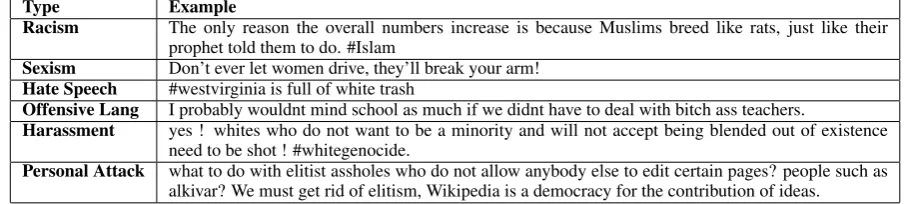
Abusive language can be of different types, and previous literature and datasets have focused on some of these types. Before introducing the ex-isting datasets we use in our study, we provide the definitions for the types of abusive language used in existing work and examples for each type (Table
2):
• Racism: a belief that race is the primary de-terminant of human traits and capacities and that racial differences produce an inherent su-periority of a particular race.
• Sexism: prejudice or discrimination based on sex; especially: discrimination against women.
Type Example
Racism The only reason the overall numbers increase is because Muslims breed like rats, just like their prophet told them to do. #Islam
Sexism Don’t ever let women drive, they’ll break your arm!
Hate Speech #westvirginia is full of white trash
Offensive Lang I probably wouldnt mind school as much if we didnt have to deal with bitch ass teachers.
Harassment yes ! whites who do not want to be a minority and will not accept being blended out of existence need to be shot ! #whitegenocide.
[image:3.595.71.526.64.166.2]Personal Attack what to do with elitist assholes who do not allow anybody else to edit certain pages? people such as alkivar? We must get rid of elitism, Wikipedia is a democracy for the contribution of ideas.
Table 2: Examples of different types of abusive language.
is intended to be derogatory, to humiliate, or to insult the members of the group (Davidson et al.,2017).
• Offensive Language: is a kind of abuse that causes someone to feel hurt, angry, or upset. It is usually rude or insulting and often very unpleasant.
• Harassment: is a type of abuse that is con-structed with the identity of sincerely wish-ing to be part of the group in question, in-cluding professing, or conveying pseudosin-cere intentions, but its real intention(s) is/are to cause disruption and/or to trigger or exac-erbate conflict for the purposes of amusement (Golbeck et al.,2017).
• Personal Attack: is a type of abuse that usu-ally involves insulting or belittling one’s op-ponent to invalidate his or her argument, but can also involve pointing out factual but os-tensible character flaws or actions which are irrelevant to the opponent’s argument.
We experiment with four benchmark datasets currently used in the related work on abusive lan-guage detection. Three of them are from Twitter (Table3) and the fourth one from Wikipedia (Ta-ble 4), and together they showcase all the above mentioned types of abusive language.
• D1 (Waseem and Hovy, 2016) — This is the first large-scale dataset for abusive tweet detection. Each of the 15,844 tweets in the dataset is classified into three classes: RACISM, SEXISM, and NONE. Waseem and Hovy(2016) bootstrapped the corpus collec-tion by performing an initial manual search of common slurs.
• D2 (Davidson et al., 2017) — This dataset contains a total of25,112tweets, each clas-sified into one of the three classes: HATE
SPEECH, OFFENSIVE LANGUAGE, and NEI-THER. Davidson et al. (2017) began with a hate speech lexicon containing words and phrases identified by internet users as hate speech, compiled by Hatebase.org. They crawled 85.4 million using words from these lexicons before taking a random sample of 25k tweets manually coded by CrowdFlower (CF) workers.
• D3 (Golbeck et al., 2017) — This dataset consists of 20,362 tweets, with binary
classes: HARASSMENT, and
NON-HARASSMENT. Golbeck et al. (2017) (2017) settled on the following list of search terms (“#whitegenocide”, “#fuckniggers”, “#WhitePower”, “#WhiteLivesMatter”, “you fucking nigger”, “fucking muslim”, “fucking faggot”, “religion of hate”, “the jews”, “feminist”). Though it produced a higher rate of tweets from alt-right / white nationalist tweeters, they were willing to accept a corpus that was not necessarily representative of all harassing content in order to achieve higher density.
• D4(Wulczyn et al.,2017) — The Wikipedia attacks dataset contains approximately 115K English Wikipedia talk page comments with binary classes: PERSONAL ATTACK, and NONE. Wulczyn et al. (2017) used a cor-pus that contains 63M comments from dis-cussions relating to user pages and articles dating from 2004-2015. In order to get reli-able estimates of whether a comment is a per-sonal attack, each comment was labeled by at least 10 different Crowdflower annotators.
Class-wise Tweets Total
D1 Racism Sexism None 15844
1924 3058 10862
D2 Offensive Hate None 25112
19326 1428 4288
D3 Harass N-harass 20362
[image:4.595.83.279.62.136.2]5235 15127
Table 3: Statistics of the Twitter datasets (D1,D2,D3).
D4 None Personal Attack Total Train 61,447 8,079 69,526
Dev 20,405 2,755 23,160
Test 20,442 2,756 23,178
Table 4: Statistics of the Wikipedia dataset (D4).
Wikipedia comments labeled as PERSONAL AT-TACKS orNONE (ourD4 dataset) divided among train, dev and test splits.
4 Methods
Long Short Term Memory Networks (LSTMs) (Hochreiter and Schmidhuber, 1997) are one of the most used deep learning architectures for dif-ferent NLP tasks because of their ability to cap-ture long-distance dependencies. For our task, we use Bidirectional LSTMs because of their inherent capability of capturing information both from the past and the future states.
Graves et al.(2013) show that LSTMs can ben-efit from stacking multiple recurrent hidden layers on top of each other. Thus, we choose to compare the simple Bi-LSTM architecture with a stacked Bi-LSTM architecture.
Attention mechanisms for deep learning mod-els, including LSTMs serve two benefits: they of-ten result in better performance in terms of met-rics, and they provide insights into which words contribute to the classification decision which can be of value in applications and (error) analysis. There are several types of attention mechanisms. The key difference between contextual attention introduced byYang et al.(2016) and self-attention is that it uses a word level context vectoructhat is randomly initialized and jointly learned during the training process (equation (2) vs. equation (3)).
ui=tanh(Wh.hi+bh) (1)
acontextuali =
exp(uT iuc)
PT
j=1exp(uTjuc)
(2)
aselfi = exp(u
T i)
PT j=1exp(u
T j)
(3)
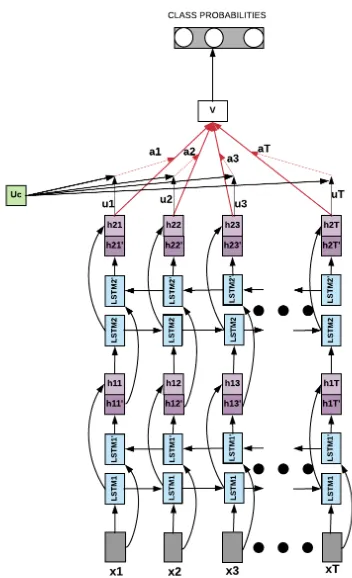
Figure 1: Architecture for Stacked BiLSTM + Word Level Contextual Attention. Figure is inspired by (Yang et al.,2016)
In this paper, we compare the effect of contex-tual attention as compared to self attention on both simple Bi-LSTMs and stacked Bi-LSTMs. Figure
1shows the high-level architecture of our stacked Bi-LSTM model with contextual attention. The Bi-LSTM outputhiof each wordxiis fed through a Multi Layer Perceptron to get ui as its hidden representation.ucis our word level context vector
that is a randomly initialized parameter of the neu-ral network and is learned as we train our network. Onceuiis obtained we calculate the importance of
[image:4.595.314.490.72.361.2]fully-connected Softmax layer to obtain the class probabilities.
4.1 Implementation Details
We pre-process the text usingEkphrasis1— a text processing tool built specially for social media platforms such as Twitter.
For the Twitter datasets we experimented with word vectors that are initialized with pre-trained Twitter-specific embeddings (Baziotis et al.,
2017), as well as ELMo embeddings (Peters et al.,
2018), which are deep contextualized word repre-sentations modeling both complex characteristics of word use (e.g., syntax and semantics), and us-age across various linguistic contexts.
For the Wikipedia Attacks dataset we relied on both fastText embeddings (Bojanowski et al.,
2017) and ELMo embeddings. Out of vocabu-lary issues in pre-trained word embeddings are a major limitation for sentence representations. To solve this, we use fastText embeddings ( Bo-janowski et al.,2017), which rely on subword in-formation. Also, these embeddings were trained on Wikipedia.
The embedding dimension of the words in our model for pre-trained Twitter embeddings and fastText embedding is set to 300, while for ELMo its set to 1024. We use a dropout rate of0.25and train the network using a learning rate of0.001for 10epochs.
The results are reported by averaging over 10-fold cross-validation for datasets D1andD3 and 5-fold cross-validation for D2. These protocols are consistent with all previously published results on the datasets. We report weighted-F1 scores for all the datasets to minimize the effect of class im-balance. For D4we train for 10 epochs and per-form early stopping on a validation set. In order to be consistent with previous results we also report AUC scores forD4when comparing with state-of-the-art.
5 Results and Error Analysis
Our experimental study looks at several issues: the effect of contextual attention compared to self-attention; the stacked Bi-LSTM architecture com-pared to the simple Bi-LSTM architecture; the ef-fect of pre-trained word embeddings; the efef-fect of cross-datasets training/testing; and comparison of
1https://github.com/cbaziotis/ekphrasis
Bi-LSTM + Self Attention
Bi-LSTM + Context Attention
Stacked Bi-LSTM + Self Attention
Stacked Bi-LSTM + Context Attention
D1 83.34 83.24 83.69 84.25
D2 89.27 89.83 89.95 91.10
D3 69.18 70.01 70.57 72.75
[image:5.595.308.519.61.148.2]D4 94.22 94.87 95.11 95.48
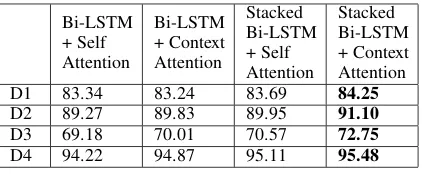
Table 5: Weighted F1 scores on all datasets for all models.
the best model against state-of-the-art results on each dataset.
Contextual vs. Self-Attention. Table 5 show all our models: simple Bi-LSTMs with self and contextual attention (column 2 and 3) as well as stacked Bi-LSTM models with self and contex-tual attention (column 4 and 5). We can see that contextual attention models outperform the self-attention models for both simple and stacked ar-chitectures on all datasets except on D1 for simple BiLSTM (i.e., columns 5 vs. 4, and 3 vs. 2; re-sults are statistically significant withp≤.001 us-ing Chi Squared Test). For datset D1 and D2, we have several classes of abusive language (RACISM, SEXISM for D1; and HATE SPEECH and
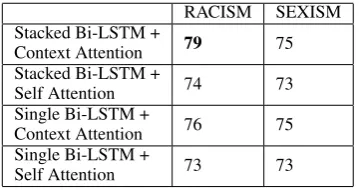
OFFEN-SIVE LANGUAGEinD2). Thus, we wanted to see the performance of the contextual vs self-attention on these finer grained classes (Tables 7 and 8). Table7 shows that the contextual attention els have significant improvement over the mod-els with self-attention when it comes to identify-ingRACISM andSEXISM. For theD2 dataset we see that the most affected class isHATE SPEECH, the primary reason for this being that the percent-age of data labeled as hate-speech is really small (5.6%). Even then the contextual attention models perform better than the ones using self-attention as shown in Table8.
One of the main questions is Why contextual attention is better than self attention? What is there in the structure of context attention that leads to performance improvements over self attention? As discussed in Section 4, the context vector can be treated as global importance measure of words in text because it takes into account which word to attend to based on how that word has been used in different contexts while training on the entire training set. To highlight this behavior, in Table6
TWEET TRUE
LABEL POTENTIAL EXPLANATION FOR PREDICTION
D1 Turkey and Egypt used to be mostly Christian and the muslims have mostly exterminated them
Racism
There are no jews in Saudi or many of the gulf states because the muslims exterminated them
Jews used to live on 40% of the Arabian peninsula. muslims have virtually exterminated them
D1 Science was moving forward in India and Persia before islam , islam only slowed it down
Racism
People were making scientific discoveries , including algebra , before islam
And notice that the Persian culture was more advanced and advancing and discovering before islam
D1 I don’t think women can make tough military decisions. notice hilary’s face during the bin laden raid
Sexism
i am not trying to be sexist but i do not think women should announce football games
call me sexist but i do not think women should be allowed to grow beards
D2 Sonnen is a faggot HateSpeech Kanye West is a faggot
[image:6.595.84.516.61.226.2]Joshua is a faggot . just suspend him on those grounds
Table 6: Examples correctly classified by : Context Attention (CA) but mis-classified by Self Attention (SA)
RACISM SEXISM Stacked Bi-LSTM +
Context Attention 79 75 Stacked Bi-LSTM +
Self Attention 74 73
Single Bi-LSTM +
Context Attention 76 75 Single Bi-LSTM +
[image:6.595.92.272.270.365.2]Self Attention 73 73
Table 7: F1 scores of RACISMand SEXISMonD1on one of the test splits
HS OL NONE
Stacked Bi-LSTM +
Context Attention 40 95 90 Stacked Bi-LSTM +
Self Attention 35 95 88
Single Bi-LSTM +
Context Attention 38 95 88 Single Bi-LSTM +
Self Attention 34 95 86
Table 8: F1 scores of OFFENSIVELANGUAGE(OL) and HATESPEECH(HS) and NONEonD2
on one of the test splits.
by Self attention. The first three tweets were pre-dicted as NONEby the self attention model while the last tweet was labeled as OFFENSIVE LAN-GUAGE. The “potential explanation for predic-tion” column shows tweets from the training data that have the same gold label and that are simi-lar to the tweets in the test set shown in column 2, suggesting that the context attention indeed en-capsulates the information by looking at examples globally through the training data, unlike self at-tention which only focuses on words for that par-ticular tweet while trying to classify it.
DataSet ELMo (Wiki) Glove Twitter
D1 83.10 84.25
D2 88.44 91.10
D3 68.78 72.75
Table 9: Weighted F1 scores comparing pre-trained embeddings on the Twitter datasets.
Stacked vs Simple Bi-LSTM. Table 5 shows that the stacked Bi-LSTM models outperformed the simple Bi-LSTM models, when using the same type of attention mechanism on all datasets (columns 5 vs. 3 and 4 vs. 2; results are statisti-cally significant, withp≤.001using Chi Squared Test). When looking at Table7and8, we notice that the stacked Bi-LSTM models do better than the simple Bi-LSTMs when using the same type of attention, only for theRACISMclass and theHATE SPEECH class. The best performing model is the stacked Bi-LSTM with contextual attention.
Effect of pre-trained embeddings. The models presented above in Table 5 used Twitter-specific pre-trained embeddings for datasets D1, D2 and
[image:6.595.332.499.271.315.2] [image:6.595.93.268.424.521.2]Training Dataset Weighted F1
D1+D2 64.50
D3 72.75
Table 10: Cross-datasets training (same CV test splits of D3)
method of training) on the performance of the deep network architectures. Table 9 shows that using the ELMo pre-trained embeddings instead of Twitter pre-trained embeddings lead to a statis-tically significant decrease in performance on all the Twitter datasets, with the biggest drop onD2
andD3, which are the datasets on hate speech and harassment.
Cross datasets training/testing. The definition of the category HARASSMENT in the D3 dataset states that it refers to language that is deeply racist, misogynistic or homophobic, bigoted, involved threats or hate speech. Given that the datasets D1 and D2 contain the categories RACISM, SEXISM andHATE SPEECH and are also from Twitter, we wanted to conduct a study where we train onD1
and D2 and test on D3. We considered data la-belled asRACISM, SEXISMandHATE SPEECH as HARASSMENTandNONEasNON-HARASSMENT. This led to consistent class balance across train and test. The cross validation setting used for in-dividual experiments on D3 was maintained here as well. Table10 demonstrates that cross dataset training leads to worse performance when it comes to abusive language detection, showing that each dataset has its own particularities on defining and collecting the data.
Comparison with State-of-the-Art. We com-pare our best model (stacked Bi-LSTM with contextual attention) with various state-of-the-art models developed for each of the datasets we con-sidered. For the Twitter datasets we compared against (1) an n-gram model with various linguis-tic features (Waseem and Hovy, 2016), (2) an-other model with hand-crafted features including n-grams, POS tags (Davidson et al., 2017); (3) a hybrid CNN model (Park and Fung, 2017), and (4) an LSTM model with an additional classifier using Gradient Boosting trees with LSTM embed-dings as features (Badjatiya et al.,2017). Table11
shows the weighted-F1 obtained by the models on the three Twitter datasets (D1,D2,D3). Note that none of the existing approaches show results on all the datasets. Thus, we report results using their
D1 D2 D3
Majority Baseline 56.0 66.0 63.0 (Waseem and Hovy,
2016)
73.8† 82.3 63.0
(Davidson et al.,2017) 78.0 90.0† 63.8 (Park and Fung,2017) 82.7† 88.0 68.6 (Badjatiya et al.,2017) 93.1† NA NA (Badjatiya et al.,
2017) OurRep
81 88.0 67.4
[image:7.595.312.522.61.178.2]Our Model 84.2 91.1 72.7
Table 11: Comparison of our best model with state-of-the-art models on the three Twitter datasets. †Results as reported in the respective papers.
METHOD DEV TEST
[image:7.595.329.502.240.295.2]Majority Baseline 51.23 50.40 Our best model 97.39 97.44 (Wulczyn et al.,2017) 96.59 96.71 (Pavlopoulos et al.,2017) 97.46 97.68
Table 12: Comparisons with state-of-the-art models on D4DEV and TEST.
publicly available implementations on the remain-ing datasets, and highlight for which datasets they report results in their work.
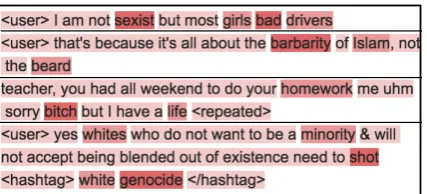
Figure 2: Attention heat map visualization demonstrat-ing the focus on abusive-language signaldemonstrat-ing words in various tweets.
For theD4dataset which is Wikipedia, we com-pared our best model (stacked Bi-LSTM with con-textual attention) with the existing models on this dataset. Wulczyn et al. (2017) use a Multilayer Perceptron over char n-grams as features and re-ported results only on the Dev set. We use their online implementation to report results on the test set. Pavlopoulos et al.(2017) use a deeper self at-tention mechanism and report results both on the Dev and Test sets. Both approaches report results using AUC. Table12shows that our model outper-forms (Wulczyn et al.,2017) and is comparable to (Pavlopoulos et al.,2017).
6 Visualizing the Contextual Attention Weights
The contextual attention mechanism enables our model to focus on the relevant parts of the text (e.g., tweet) while performing the prediction task. As shown in Figure2and3our model learns to fo-cus on relevant keywords that govern the abusive nature of a text. The color intensity here denotes the relative weight assigned to words. In figure
2, we see four tweets where the first tweet is la-beled asSEXISMand the second tweet is labeled as RACISMfrom theD1dataset (Waseem and Hovy,
2016). The third tweet is a tweet from the D2
dataset (Davidson et al.,2017) labeled as OFFEN-SIVE LANGUAGE and correctly identified by our model. The last tweet is from theD3dataset ( Gol-beck et al., 2017) labeled as HARASSMENT and correctly identified by our model. Figure3shows two such comments from the Wikipedia attacks dataset (D4), which were classified correctly by our model.
[image:8.595.75.289.61.158.2]Moreover, it it encouraging to see that the con-textual attention assigns higher weight to poten-tially abusive words when used with an abusive meaning. For example, refer to the two tweets
Figure 3: Attention heat map visualization demonstrat-ing the focus on abusive words in Wikipedia Personal Attacks dataset.
Figure 4: Attention weights learned by our model for the same word “islam” on two tweets.
in figure 4. The first tweet belongs to the NONE class while the second tweet belongs to RACISM class. The word “islam” may appear in the realm of racism as well as in any normal conversation. We find that our model successfully identifies the two distinct contextual usages of the word “is-lam” in the two tweets, as demonstrated by a much higher attention weight in the second case and a relatively smaller one in the first case.
7 Conclusion
analysis of the results and a visualization of the contextual attention weights — an important step towards better interpretation of any deep learning models.
While we notice that the visualization of atten-tion weights is indicative of the classifier deci-sion for multiple examples based on our context-attention model, some recent work has claimed that attention is not explanation (Jain and Wal-lace, 2019). As a future step, we would like to conduct experiments to measure the correlation between the highest attention weights chosen by models and humans (Ghosh et al., 2017) to fur-ther strengthen the interpretability of the attention-based models.
References
Pinkesh Badjatiya, Shashank Gupta, Manish Gupta, and Vasudeva Varma. 2017. Deep learning for hate speech detection in tweets. In Proceedings of the 26th International Conference on World Wide Web Companion, pages 759–760. International World Wide Web Conferences Steering Committee.
Christos Baziotis, Nikos Pelekis, and Christos Doulk-eridis. 2017. Datastories at semeval-2017 task 4: Deep lstm with attention for message-level and topic-based sentiment analysis. In Proceedings of the 11th International Workshop on Semantic Evalu-ation (SemEval-2017), pages 747–754. Association for Computational Linguistics.
Piotr Bojanowski, Edouard Grave, Armand Joulin, and Tomas Mikolov. 2017. Enriching word vectors with subword information. Transactions of the Associa-tion for ComputaAssocia-tional Linguistics, 5:135–146.
Thomas Davidson, Dana Warmsley, Michael Macy, and Ingmar Weber. 2017. Automated hate speech detection and the problem of offensive language. In (ICWSM 2017), pages 3952–3958. Proceedings of the Eleventh International AAAI Conference on Web and Social Media.
Nemanja Djuric, Jing Zhou, Robin Morris, Mihajlo Gr-bovic, Vladan Radosavljevic, and Narayan Bhamidi-pati. 2015. Hate speech detection with comment embeddings. In Proceedings of the 24th interna-tional conference on world wide web, pages 29–30. ACM.
Debanjan Ghosh, Alexander Richard Fabbri, and Smaranda Muresan. 2017. The role of conversa-tion context for sarcasm detecconversa-tion in online interac-tions. In Proceedings of the 18th Annual SIGdial Meeting on Discourse and Dialogue, pages 186– 196, Saarbr¨ucken, Germany. Association for Com-putational Linguistics.
Jennifer Golbeck, Zahra Ashktorab, Rashad O Banjo, Alexandra Berlinger, Siddharth Bhagwan, Cody Buntain, Alicia A Cheakalos, Paul Geller, Quint Gergory, Rajesh Kumar Gnanasekaran, Raja Ra-jan Gunasekaran, Kelly M Hoffman, Jenny Hot-tle, Vichita Jienjitlert, Shivika Khare, Ryan Lau, Marianna Martindale, J Shalmali Naik, Heather L Nixon, Piyush Ramachandran, Kristine M Rogers, Lisa Rogers, Meghna Sardana Sarin, Jayanee Sha-hane, Gaurav Thanki, Priyanka Vengataraman, Zi-jian Wan, and Derek Michael Wu. 2017. A large human-labeled corpus for online harassment re-search. InACM, pages 229–233. Proceedings of the 2017 ACM on Web Science Conference.
Alex Graves, Abdel-rahman Mohamed, and Geoffrey Hinton. 2013. Speech recognition with deep recur-rent neural networks. International Conference on Acoustics, Speech, and Signal Processing.
Sepp Hochreiter and Jurgen Schmidhuber. 1997. Long short-term memory. In Neural computation, 791, pages 1735–1780.
Sarthak Jain and Byron C. Wallace. 2019. Attention is not explanation. In
https://arxiv.org/abs/1902.10186.
Ji Ho Park and Pascale Fung. 2017. One-step and two-step classification for abusive language detection on twitter.
John Pavlopoulos, Prodromos Malakasiotis, and Ion Androutsopoulos. 2017. Deeper attention to abu-sive user content moderation. InProceedings of the 2017 Conference on Empirical Methods in Natural Language Processing.
Matthew E. Peters, Mark Neumann, Mohit Iyyer, Matt Gardner, Christopher Clark, Kenton Lee, and Luke Zettlemoyer. 2018. Deep contextualized word rep-resentations. InProc. of NAACL.
Zeerak Waseem and Dirk Hovy. 2016. Hateful sym-bols or hateful people? predictive features for hate speech detection on twitter. In Proceedings of the NAACL student research workshop, pages 88–93.
Ellery Wulczyn, Nithum Thain, and Lucas Dixon. 2017. Ex machina: Personal attacks seen at scale. InProceedings of the 26th International Conference on World Wide Web, pages 1391–1399. International World Wide Web Conferences Steering Committee.
Zichao Yang, Diyi Yang, Chris Dyer, Xiaodong He, Alex Smola, and Eduard Hovy. 2016. Hierarchi-cal attention networks for document classification. InProceedings of the 2016 Conference of the North American Chapter of the Association for Compu-tational Linguistics: Human Language Technolo-gies, pages 1480–1489. Association for Computa-tional Linguistics.