Proceedings of the 57th Annual Meeting of the Association for Computational Linguistics: System Demonstrations, pages 189–194 189
A Modular Tool for Automatic Summarization
Valentin Nyzam
LIASD - Universit Paris 8 [email protected]
Aur´elien Bossard
LIASD - Universit Paris 8
Abstract
This paper introduces the first fine-grained modular tool for automatic summarization. Open source and written in Java, it is designed to be as straightforward as possible for end-users. Its modular architecture is meant to ease its maintenance and the development and inte-gration of new modules. We hope that it will ease the work of researchers in automatic sum-marization by providing a reliable baseline for future works as well as an easy way to evaluate methods on different corpora.
1 Introduction
Automatic summarization (AS) is studied since the late 1950s (Luhn, 1958). Automatic summa-rization methods were mostly extractive until re-cently, where abstractive methods have emerged thanks to the recent breakthrough in neural net-works. Abstractive automatic summarization methods are for the most part supervized. How-ever, because of the automatic summarization task complexity, huge corpora made of pairs of docu-ments and their associated summary are needed. For example, the CNN and Dailymail news cor-pora on which are based the first neural-based news automatic summarizers are composed of more than 200,000 pairs of document and sum-mary. Other summarization tasks can also be pro-vided with large corpora, such as scientific articles summarization. However, most of real-life sum-marization tasks come without any learning cor-pus. The cost in human resources to build such corpora is such that unsupervized summarization methods cannot be excluded from the research field.
In the last decades, efforts have been made in different fields of computer science to release open source systems that encode several methods.
GATE1(Dowman et al., 2005) platform is an ex-ample of such an open source system for NLP. Other research fields such as machine learning benefit from several open source modular systems, e.g., Weka (Hall et al., 2009), SPMF (Fournier-Viger et al., 2014), or Orange (Demˇsar et al., 2013). To our knowledge, no such tool exists for AS. A modular and open source tool for automatic summarization could allow to easily test ent automatic summarization methods on differ-ent tasks / corpora. If such a tool is proven to be reliable, it can also be used as an acknowledged baseline for new systems – abstractive or extrac-tive – to compare to. In fact, we found that some recent papers in neural abstractive summarization compare their results with naive extractive base-lines or even no extractive baseline at all (e.g. (See et al.,2017) with a lead-based extractive baseline, (Chopra et al.,2016) with no extractive baseline at all). These works could have sorely benefited from a straightforward and easy-to-use summarization platform to establish fair comparisons to older ex-tractive systems.
In this paper, we present an open source modular tool dedicated to automatic summariza-tion. Written in Java, it is designed to first answer the lack of such a tool and so pro-vide the community with an easy-to-use summa-rization tool, to allow a straightforward mainte-nance of existing modules and development of new modules, and to allow methods compari-son in a unified framework. The tool is
avail-able on GitHub : https://github.com/
ToolAutomaticSum/MOTS. We also present a study on DUC, TAC, CNN and Dailymail cor-pora.
2 Related Work
Open source summarizers can be classified into two categories: systems that only implement one or more methods defined by their authors as results of research and systems conceived as a way to im-plement existing methods. In the first category, one can cite MEAD (Radev et al., 2004a) that originally implemented centroid-based extraction method (Radev et al., 2004b) and later imple-mented LexRank (Erkan and Radev,2004). How-ever, this system does not seem to be available anymore. Among the other systems in that cat-egory, one can cite ICSISUMM (Gillick et al., 2009) that implements ILP-based summarization and MUSEEC (Litvak et al.,2016). However, sys-tems in this first category cover only a few meth-ods among existing methmeth-ods, so there was a need for platforms with a better summarization meth-ods coverage. SUMMA (Saggion,2014) is a sum-marization toolkit implemented with GATE. It in-cludes several sentence scorers, such as LexRank, Centroid and shallow features based. It benefits from GATE NLP methods. Sumy2is a more com-plete toolkit that implements eight different ex-traction methods, including baseline systems (ran-dom, first sentences only). As for PKUSum-Sum3, (Zhang et al.,2016) implements ten differ-ent methods and handles three differdiffer-ent summa-rization tasks: mono-document, multi-document and topic-based multi-document summarization. Modularity for these two system is however lim-ited to tokenization/stemming and the choice of extraction method which is not decomposed itself in modules. This is the main asset of our tool: it is modular on a fine-grained level so automatic sum-marization methods are not defined globally but as a combination of small interchangeable mod-ules. Table 1 shows details about the summa-rization methods implemented by SUMMA, Sumy and PKUSumSum.
3 Architecture
3.1 Modularity
Our tool is modular on a fine-grained level. Be-cause of the modularity and the need of mod-ule compatibility definition, we made the choice of Java as programming language. Our tool can handle mono and multi-document summarization,
2
https://github.com/miso-belica/sumy 3https://github.com/PKULCWM/PKUSUMSUM
Multicorpus
SummarizationMethod
Abstracts
ROUGE evaluation
Genetic Algorithm
List<Process> PreProcess
PostProcess
List<CharacteristicsBuilder> List<IndexBuilder>
List<ScoringMethod>
SelectionMethod Configuration
file
[image:2.595.306.525.61.155.2]List<Fitness>
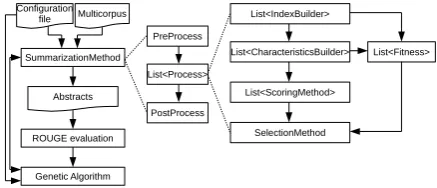
Figure 1: Architecture and workflow of our tool
topic-based or not. It embeds a genetic algo-rithm to tune hyperparameters. The summariza-tion modules are all language-independent for multilingual summarization. Its architecture is conceived for both extractive, semi-extractive and abstractive paradigms. Also, using it as an end-user is straightforward.
It is divided in two branches: one for traditional greedy extractive methods, and one for global search algorithms such as genetic or knapsack al-gorithms (cf Figure1). Our system can also handle fully abstractive methods.
The greedy branch is divided in four steps:
• IndexBuilder: an index is built using uni-grams or n-uni-grams for which a set of features is built;
• CharacteristicsBuilder: a set of features is computed for every text chunk4based on one or more indexes;
• SentenceScoring: score computation for ev-ery text chunk based on previous features;
• SelectionMethod: text chunks extraction with a method using previous scores.
The global search algorithms branch is divided in two steps:
• FitnessScore: a score computed for a candi-date summary;
• SelectionMethod: the search algorithm itself guided by the fitness.
The four steps (or atomic processings) of a sum-marization method are independent, and they com-municate via the Process class that controls their execution and compatibility. Input and output of the atomic processings are specified via inheri-tance of a specific method and the implementation of interfaces defined and documented in our tool. These interfaces make the Process class able to use Java methods to adapt input and output between each atomic processing. All atomic processings are independent and follow compatibility rules, so
our system architecture is completely modular.
3.2 Embedded evaluation
If the gold standard summaries are provided with the corpus to summarize, our tool can perform a call to ROUGE (Lin, 2004) in order to instantly retrieve the results of a summarization method on a specific corpus.
3.3 Embedded genetic algorithm
All summarization methods have parameters that influence the quality of the summaries. Optimiz-ing these parameters for a specific task is crucial. Litvak et al.(2010);Bossard and Rodrigues(2011) have shown that a genetic algorithm (GA) can be efficient for this kind of optimization. Our tool in-tegrates a GA to optimize summarization methods hyperparameters. We specified a dna syntax for the definition of methods hyperparameters that can be used by any module implemented in our tool. The GA uses ROUGE-2 as objective function, but it can be overrided using the modular architecture of our tool. The GA is launched using a XML con-figuration file that sets the hyperparameters to be optimized.
4 Implemented modules
The IndexBuilder class defines what the tokens are and how they are represented. We can use uni-grams or n-uni-grams and each of them can be asso-ciated with a frequency, a tf.idf value, or a vector representation computed with LSA or word em-beddings.
The CharacteristicsBuilder class defines the representation of a text chunk (most of the time, text chunks are sentences). We can use a bag-of-words representation, the mean vector (the mean vector of all the tokens in a text chunk), the matrix composed of all tokens vectors, the co-occurrence graph (Rousseau and Vazirgiannis, 2013), the k-core representation (Batagelj and Za-versnik,2003), or a clustering based on any repre-sentation (Bossard and Rodrigues,2011).
The SentenceScore class defines how to com-pute a score for a text chunk depending on the characteristics computed previously. We can choose the sum of tf.idf above a threshold, the sim-ilarity with a vector or a matrix (to emulate (Radev et al.,2004b)), the position of the text chunk in a document.
The SelectionMethod class defines how the sen-tences are selected. We can chose greedy algo-rithms such as MMR (Carbonell and Goldstein, 1998), CSIS (Radev et al., 2004a), an extraction method based on a previous clustering (Bossard, 2013) or a naive extraction of the best sentences, or global search algorithms such as Knapsack (Gillick et al.,2008), a genetic algorithm (Bossard and Rodrigues,2017), ILP (Gillick et al.,2009) or a reinforcement algorithm (Ryang and Abekawa, 2012).
Our tool can also call an abstractive external summarization method, retrieve the results and use them for postprocessing or evaluation purposes. This is not trivial as the index has to be updated in order to take into account out of vocabulary words. Combining these modules, we can emulate most of the most known summarization methods. Table1shows a comparison between our tool and other summarization tools introduced in Section2. It shows that, to our knowledge and at the moment we write this paper, our tool covers the most of the summarization methods covered by other known summarizers. Moreover, two of the three methods not yet implemented: Manifold rank (Wan et al., 2007) and Submodular functions (Lin and Bilmes, 2011) are currently under development and should be released soon.
5 Using our tool
Using our tool as an end user is straightforward. It only requires a configuration file that describes the summarization method to use by defining every module used and their parameters, and a descrip-tor file for the multicorpus to summarize. Even if a configuration file can be written from scratch, we supply standard configuration files that encode the most known and used summarization methods.
6 Study
We evaluated some summarization methods from our tool on different corpora: DUC 2006 and 2007 and TAC 2008, 2009 and 2010 corpora (multidoc-ument news summarization) and CNN/Dailymail corpus.
Luhn Edmundson Lead Centroid LexRank TextRank KL incr. Manifold Rank Clust. ILP LDA Submodular Knapsack Genetic Pointer Generator
SUMMA 3 3 3 3 7 7 7 7 7 7 7 7 7 7 7
Sumy 3 3 7 7 3 3 3 7 7 7 3 7 7 7 7
PKUSumSum 7 7 3 3 3 3 7 3 3 3 7 3 7 7 7
[image:4.595.87.511.60.105.2]Our tool 3 7 3 3 3 3 3 7 3 3 3 7 3 3 3
Table 1: Comparison of systems summarization methods handling capabilities
of 100 and 50 words, because we found out that Pointer-Generator often produces only 50 words long summaries.
As DUC and TAC corpora do not provide enough data to train a neural network, we used the model learned on CNN/Dailymail to generate a summary for DUC and TAC and applied it on the most recent newswire article of each set of docu-ments.
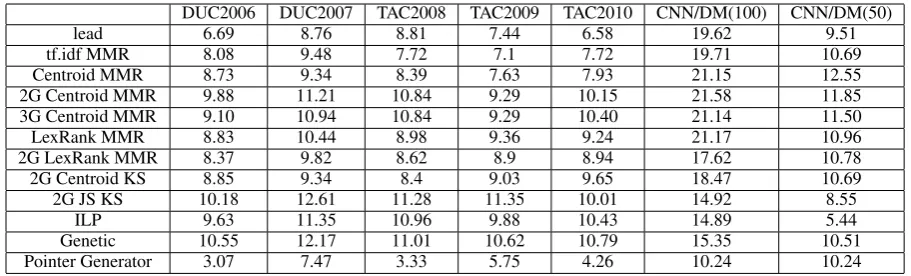
Table 2 shows the results of a small sample of methods from our tool on DUC, TAC and CNN/DailyMail corpora. We made the choice of selecting methods that show the modularity of our tool:
• lead: the first n words of a document (for DUC and TAC the first n words of the most recent document);
• tf.idf MMR: sentences are scored with the sum of tf.idf scores and selected with MMR;
• Centroid MMR: sentences are scored with the Centroid method and selected with MMR;
• 2G Centroid MMR: sentences are scored with the Centroid method on bigrams and se-lected with MMR;
• 3G Centroid MMR: sentences are scored with the Centroid method on trigrams and se-lected with MMR;
• LexRank MMR: sentences are scored with the LexRank method on unigrams and se-lected with MMR;
• 2G LexRank MMR: sentences are scored with the LexRank method on bigrams and se-lected with MMR;
• 2G Centroid KS: sentences are scored with the LexRank method on bigrams and selected with a knapsack algorithm;
• 2G JS KS: sentences are extracted with a knapsack algorithm that uses the Jensen-Shannon divergence as fitness and bigrams as tokens;
• ILP: sentences are extracted with an ILP based solver under the constraints of (Gillick et al.,2009);
• Genetic: sentences are extracted with a ge-netic algorithm that uses the Jensen-Shannon divergence as fitness and bigrams as tokens;
• Pointer Generator: our tool calls the Pointer Generator (See et al.,2017) and retrieves its results.
DUC and TAC were evaluated using the best ROUGE parameters for these corpora in Graham (2015)’s study. CNN/Dailymail tasks were eval-uated using a standard configuration of ROUGE: recall as score, bigrams as tokens, no stemming, removal of stop words.
As one can see in Table 2, 2G JS KS, ILP and Genetic methods perform badly on the CNN/DailyMail task. This is due to the fact that ILP method is designed for multidocument sum-marization. 2G JS KS and Genetic use the same fitness: a Jensen-Shannon divergence. We hypoth-esize that the CNN/DailyMail documents are too small for such a fitness based on the bigrams prob-ability distribution. Without any suprise, Pointer Generator performs badly on DUC and TAC cor-pora. Even if the corpora are close (newswire arti-cles for both DUC/TAC and CNN/DailyMail), the task is not exactly the same. This confirms that sometimes, unsupervized extractive methods are the only solution available, and that such methods shall not yet be laid aside by the research commu-nity.
7 Conclusion
se-DUC2006 DUC2007 TAC2008 TAC2009 TAC2010 CNN/DM(100) CNN/DM(50)
lead 6.69 8.76 8.81 7.44 6.58 19.62 9.51
tf.idf MMR 8.08 9.48 7.72 7.1 7.72 19.71 10.69
Centroid MMR 8.73 9.34 8.39 7.63 7.93 21.15 12.55
2G Centroid MMR 9.88 11.21 10.84 9.29 10.15 21.58 11.85
3G Centroid MMR 9.10 10.94 10.84 9.29 10.40 21.14 11.50
LexRank MMR 8.83 10.44 8.98 9.36 9.24 21.17 10.96
2G LexRank MMR 8.37 9.82 8.62 8.9 8.94 17.62 10.78
2G Centroid KS 8.85 9.34 8.4 9.03 9.65 18.47 10.69
2G JS KS 10.18 12.61 11.28 11.35 10.01 14.92 8.55
ILP 9.63 11.35 10.96 9.88 10.43 14.89 5.44
Genetic 10.55 12.17 11.01 10.62 10.79 15.35 10.51
[image:5.595.69.525.61.199.2]Pointer Generator 3.07 7.47 3.33 5.75 4.26 10.24 10.24
Table 2: Results on DUC, TAC and CNN/Dailymail corpora
lection. As we write this paper, and to our knowl-edge, our tool covers more automatic summariza-tion methods than the three other existing summa-rizers.
As an end-user, using our tool,
avail-able on GitHub (https://github.com/
ToolAutomaticSum/MOTS), is straightfor-ward. It only needs a description of the corpus to summarize and a configuration file that describes the modules to use. We provide configuration files for the most known summarization methods.
For this paper, we evaluated a small sample of the methods that can be ran with our tool. Except for three methods that are really specific to mul-tidocument summarization, the evaluated summa-rization methods beat the naive baseline that ex-tracts the n first words from a document. This is still a competitive baseline when summarizing newswire articles.
Due to its ease of use and to its results on differ-ent summarization tasks, our tool can be used as a baseline for forthcoming research on automatic summarization.
Acknowledgement
This work is supported by a public grant overseen by the French National Research Agency (ANR) as part of the “Young researchers program” (refer-ence : ANR-16-CE38-0008 ASADERA).
References
Vladimir Batagelj and Matjaz Zaversnik. 2003. An o(m) algorithm for cores decomposition of net-works.CoRR, cs.DS/0310049.
Aur´elien Bossard. 2013. Generating update sum-maries: Using an unsupervized clustering algorithm to cluster sentences. In Multi-source, Multilingual Information Extraction and Summarization, Theory
and Applications of Natural Language Processing, pages 205–227. Springer.
Aur´elien Bossard and Christophe Rodrigues. 2011. Combining a multi-document update summarization system–cbseas–with a genetic algorithm. In Com-binations of intelligent methods and applications, pages 71–87. Springer.
Aur´elien Bossard and Christophe Rodrigues. 2017.An evolutionary algorithm for automatic summariza-tion. InProceedings of the International Conference Recent Advances in Natural Language Processing, RANLP 2017, pages 111–120, Varna, Bulgaria. IN-COMA Ltd.
Jaime Carbonell and Jade Goldstein. 1998. The use of mmr, diversity-based reranking for reordering doc-uments and producing summaries. InProceedings of the 21st annual international ACM SIGIR confer-ence on Research and development in information retrieval, pages 335–336. ACM.
Sumit Chopra, Michael Auli, and Alexander M. Rush. 2016. Abstractive sentence summarization with at-tentive recurrent neural networks. InProceedings of the 2016 Conference of the North American Chap-ter of the Association for Computational Linguistics: Human Language Technologies, pages 93–98, San Diego, California. Association for Computational Linguistics.
Janez Demˇsar, Tomaˇz Curk, Aleˇs Erjavec, ˇCrt Gorup, Tomaˇz Hoˇcevar, Mitar Milutinoviˇc, Martin Moˇzina, Matija Polajnar, Marko Toplak, Anˇze Stariˇc, Miha ˇStajdohar, Lan Umek, Lan ˇZagar, Jure ˇZbontar, Marinka ˇZitnik, and Blaˇz Zupan. 2013. Orange: Data mining toolbox in python.Journal of Machine Learning Research, 14:2349–2353.
Mike Dowman, Valentin Tablan, Hamish Cunningham, and Borislav Popov. 2005.Web-assisted annotation, semantic indexing and search of television and ra-dio news. InProceedings of the 14th International World Wide Web Conference, Chiba, Japan.
P. Fournier-Viger, A. Gomariz, T. Gueniche, A. Soltani, C. Wu., and V. S. Tseng. 2014. SPMF: a Java Open-Source Pattern Mining Library. Journal of Machine Learning Research (JMLR), 15:3389–3393.
Daniel Gillick, Benoit Favre, and Hakkani-T¨ur. 2008. The icsi summarization system at tac 2008. InProc. of the Text Analysis Conference workshop.
Daniel Gillick, Benoit Favre, Dilek Hakkani-T¨ur, Berndt Bohnet, Yang Liu, and Shasha Xie. 2009. The icsi/utd summarization system at tac 2009. In
Proc. of the Text Analysis Conference workshop, Gaithersburg, MD (USA).
Yvette Graham. 2015. Re-evaluating automatic sum-marization with bleu and 192 shades of rouge. In
Proceedings of the 2015 Conference on Empirical Methods in Natural Language Processing, pages 128–137, Lisbon, Portugal. Association for Compu-tational Linguistics.
Mark Hall, Eibe Frank, Geoffrey Holmes, Bernhard Pfahringer, Peter Reutemann, and Ian H. Witten. 2009. The weka data mining software: An update.
SIGKDD Explor. Newsl., 11(1):10–18.
Chin-Yew Lin. 2004. Rouge: A package for auto-matic evaluation of summaries. InText summariza-tion branches out: Proceedings of the ACL-04 work-shop, volume 8. Barcelona, Spain.
Hui Lin and Jeff Bilmes. 2011. A class of submodu-lar functions for document summarization. In Pro-ceedings of the 49th Annual Meeting of the Associ-ation for ComputAssoci-ational Linguistics: Human Lan-guage Technologies-Volume 1, pages 510–520. As-sociation for Computational Linguistics.
Marina Litvak, Mark Last, and Menahem Friedman. 2010. A new approach to improving multilingual summarization using a genetic algorithm. In Pro-ceedings of the 48th annual meeting of the associ-ation for computassoci-ational linguistics, pages 927–936. Association for Computational Linguistics.
Marina Litvak, Natalia Vanetik, Mark Last, and Elena Churkin. 2016. Museec: A multilingual text sum-marization tool. InProceedings of ACL-2016 Sys-tem Demonstrations, pages 73–78. Association for Computational Linguistics.
H. P. Luhn. 1958. The automatic creation of literature abstracts.IBM J. Res. Dev., 2(2):159–165.
Dragomir R Radev, Timothy Allison, Sasha Blair-Goldensohn, John Blitzer, Arda Celebi, Stanko Dimitrov, Elliott Drabek, Ali Hakim, Wai Lam, Danyu Liu, et al. 2004a. Mead-a platform for multidocument multilingual text summarization. In
LREC.
Dragomir R Radev, Hongyan Jing, Małgorzata Sty´s, and Daniel Tam. 2004b. Centroid-based summa-rization of multiple documents. Information Pro-cessing & Management, 40:919–938.
Franc¸ois Rousseau and Michalis Vazirgiannis. 2013. Graph-of-word and tw-idf: new approach to ad hoc ir. In Proceedings of the 22nd ACM international conference on Information & Knowledge Manage-ment, pages 59–68. ACM.
Seonggi Ryang and Takeshi Abekawa. 2012. Frame-work of automatic text summarization using rein-forcement learning. In Proceedings of the 2012 Joint Conference on Empirical Methods in ral Language Processing and Computational Natu-ral Language Learning, pages 256–265. Association for Computational Linguistics.
Horacio Saggion. 2014. Creating summarization sys-tems with summa. InProceedings of the Ninth In-ternational Conference on Language Resources and Evaluation (LREC’14), Reykjavik, Iceland. Euro-pean Language Resources Association (ELRA).
Abigail See, Peter J. Liu, and Christopher D. Manning. 2017.Get to the point: Summarization with pointer-generator networks. InProceedings of the 55th An-nual Meeting of the Association for Computational Linguistics, ACL 2017, Vancouver, Canada, July 30 - August 4, Volume 1: Long Papers, pages 1073– 1083.
Xiaojun Wan, Jianwu Yang, and Jianguo Xiao. 2007. Manifold-ranking based topic-focused multi-document summarization. In Proceedings of the 20th International Joint Conference on Artifical In-telligence, IJCAI’07, pages 2903–2908, San Fran-cisco, CA, USA. Morgan Kaufmann Publishers Inc.