1777
Reliability and Learnability of Human Bandit Feedback
for Sequence-to-Sequence Reinforcement Learning
Julia Kreutzer1 and Joshua Uyheng3∗and Stefan Riezler1,2 1Computational Linguistics &2IWR, Heidelberg University, Germany
{kreutzer,riezler}@cl.uni-heidelberg.de
3Departments of Psychology & Mathematics, Ateneo de Manila University, Philippines [email protected]
Abstract
We present a study on reinforcement learn-ing (RL) from human bandit feedback for sequence-to-sequence learning, exem-plified by the task of bandit neural ma-chine translation (NMT). We investigate the reliability of human bandit feedback, and analyze the influence of reliability on the learnability of a reward estimator, and the effect of the quality of reward esti-mates on the overall RL task. Our anal-ysis of cardinal (5-point ratings) and ordi-nal (pairwise preferences) feedback shows that their intra- and inter-annotator α -agreement is comparable. Best reliabil-ity is obtained for standardized cardinal feedback, and cardinal feedback is also easiest to learn and generalize from. Fi-nally, improvements of over 1 BLEU can be obtained by integrating a regression-based reward estimator trained on cardinal feedback for 800 translations into RL for NMT. This shows that RL is possible even from small amounts of fairly reliable hu-man feedback, pointing to a great potential for applications at larger scale.
1 Introduction
Recent work has received high attention by suc-cessfully scaling reinforcement learning (RL) to games with large state-action spaces, achieving human-level (Mnih et al., 2015) or even super-human performance (Silver et al., 2016). This success and the ability of RL to circumvent the data annotation bottleneck in supervised learning has led to renewed interest in RL in sequence-to-sequence learning problems with exponential
∗
The work for this paper was done while the second au-thor was an intern in Heidelberg.
output spaces. A typical approach is to com-bine REINFORCE (Williams, 1992) with poli-cies based on deep sequence-to-sequence learn-ing (Bahdanau et al., 2015), for example, in ma-chine translation (Bahdanau et al.,2017), seman-tic parsing (Liang et al.,2017), or summarization (Paulus et al., 2017). These RL approaches fo-cus on improving performance in automatic eval-uation by simulating reward signals by evalua-tion metrics such as BLEU, F1-score, or ROUGE, computed against gold standards. Despite coming from different fields of application, RL in games and sequence-to-sequence learning share firstly the existence of a clearly specified reward func-tion, e.g., defined by winning or losing a game, or by computing an automatic sequence-level evalu-ation metric. Secondly, both RL applicevalu-ations rely on a sufficient exploration of the action space, e.g., by evaluating multiple game moves for the same game state, or various sequence predictions for the same input.
The goal of this paper is to advance the state-of-the-art of sequence-to-sequence RL, exempli-fied by bandit learning for neural machine trans-lation (NMT). Our aim is to show that successful learning from simulated bandit feedback (Sokolov et al.,2016b;Kreutzer et al.,2017;Nguyen et al.,
differ-ently, depending on many contextual and personal factors. Secondly, exploration of the space of pos-sible translations is restricted in real-world scenar-ios where a user judges one displayed translation, but cannot be expected to rate an alternative trans-lation, let alone large amounts of alternatives.
In this paper we will show that despite the fact that human feedback is ambiguous and partial in nature, a catalyst for successful learning from hu-man reinforcements is the reliability of the feed-back signals. The first deployment of bandit NMT in an e-commerce translation scenario conjectured lacking reliability of user judgments as the rea-son for disappointing results when learning from 148k user-generated 5-star ratings for around 70k product title translations (Kreutzer et al., 2018). We thus raise the question of how human feed-back can be gathered in the most reliable way, and what effect reliability will have in downstream tasks. In order to answer these questions, we measure intra- and inter-annotator agreement for two feedback tasks for bandit NMT, using car-dinal feedback (on a 5-point scale) and orcar-dinal feedback (by pairwise preferences) for 800 trans-lations, conducted by 16 and 14 human raters, respectively. Perhaps surprisingly, while relative feedback is often considered easier for humans to provide (Thurstone, 1927), our investigation shows that α-reliability (Krippendorff, 2013) for intra- and inter-rater agreement is similar for both tasks, with highest inter-rater reliability for stan-dardized 5-point ratings.
In a next step, we address the issue of machine learnability of human rewards. We use deep learn-ing models to train reward estimators by regres-sion against cardinal feedback, and by fitting a Bradley-Terry model (Bradley and Terry,1952) to ordinal feedback. Learnability is understood by a slight misuse of the machine learning notion of learnability (Shalev-Shwartz et al., 2010) as the question how well reward estimates can approx-imate human rewards. Our experiments reveal that rank correlation of reward estimates with TER against human references is higher for regression models trained on standardized cardinal rewards than for Bradley-Terry models trained on pairwise preferences. This emphasizes the influence of the reliability of human feedback signals on the qual-ity of reward estimates learned from them.
Lastly, we investigate machine learnability of the overall NMT task, in the sense ofGreen et al.
(2014) who posed the question of how well an MT system can be tuned on post-edits. We use an RL approach for tuning, where a crucial difference of our work to previous work on RL from human re-wards (Knox and Stone, 2009; Christiano et al.,
2017) is that our RL scenario is not interactive, but rewards are collected in an offline log. RL then can proceed either by off-policy learning using logged single-shot human rewards directly, or by using es-timated rewards. An expected advantage of esti-mating rewards is to tackle a simpler problem first — learning a reward estimator instead of a full RL task for improving NMT — and then to de-ploy unlimited feedback from the reward estimator for off-policy RL. Our results show that significant improvements can be achieved by training NMT from both estimated and logged human rewards, with best results for integrating a regression-based reward estimator into RL. This completes the ar-gumentation that high reliability influences quality of reward estimates, which in turn affects the qual-ity of the overall NMT task. Since the size of our training data is tiny in machine translation propor-tions, this result points towards a great potential for larger-scaler applications of RL from human feedback.
2 Related Work
Function approximation to learn a “critic” instead of using rewards directly has been embraced in the RL literature under the name of “actor-critic” methods (see Konda and Tsitsiklis (2000), Sut-ton et al.(2000),Kakade(2001),Schulman et al.
(2015),Mnih et al. (2016), inter alia). In differ-ence to our approach, actor-critic methods learn online while our approach estimates rewards in an offline fashion. Offline methods in RL, with and without function approximation, have been pre-sented under the name of “off-policy” or “coun-terfactual” learning (seePrecup et al.(2000), Pre-cup et al. (2001), Bottou et al. (2013), Swami-nathan and Joachims (2015a), Swaminathan and Joachims (2015b), Jiang and Li (2016), Thomas and Brunskill (2016), inter alia). Online actor-critic methods have been applied to sequence-to-sequence RL by Bahdanau et al. (2017) and
RL from human feedback is a growing area.
Knox and Stone (2009) and Christiano et al.
(2017) learn a reward function from human feed-back and use that function to train an RL system. The actor-critic framework has been adapted to interactive RL from human feedback by Pilarski et al.(2011) andMacGlashan et al.(2017). These approaches either update the reward function from human feedback intermittently or perform learn-ing only in rounds where human feedback is pro-vided. A framework that interpolates a human cri-tique objective into RL has been presented by Ju-dah et al. (2019). None of these works system-atically investigates the reliability of the feedback and its impact of the down-stream task.
Kreutzer et al. (2018) have presented the first application of off-policy RL for learning from noisy human feedback obtained for determinis-tic logs of e-commerce product title translations. While learning from explicit feedback in the form of 5-star ratings fails, Kreutzer et al.(2018) pro-pose to leverage implicit feedback embedded in a search task instead. In simulation experiments on the same domain, the methods proposed by
Lawrence et al.(2017) succeeded also for neural models, allowing to pinpoint the lack of reliabil-ity in the human feedback signal as the reason for the underwhelming results when learning from hu-man 5-star ratings. The goal of showing the effect of highly reliable human bandit feedback in down-stream RL tasks was one of the main motivations for our work.
For the task of machine translation, estimat-ing human feedback, i.e. quality ratestimat-ings, is re-lated to the task of sentence-level quality estima-tion (sQE). However, there are crucial differences between sQE and the reward estimation in our work: sQE usually has more training data, often from more than one machine translation model. Its gold labels are inferred from post-edits, i.e. cor-rections of the machine translation output, while we learn from weaker bandit feedback. Although this would in principle be possible, sQE predic-tions have not (yet) been used to directly reinforce predictions of MT systems, mostly because their primary purpose is to predict post-editing effort, i.e. give guidance how to further process a trans-lation. State-of-the-art models for sQE such as (Martins et al., 2017) and (Kim et al., 2017) are unsuitable for the direct use in this task since they rely on linguistic input features, stacked
architec-Figure 1: Rating interface for 5-point ratings.
Figure 2: Rating interface for pairwise ratings.
tures or post-edit or word-level supervision. Sim-ilar to approaches for generative adversarial NMT (Yu et al.,2017;Wu et al.,2017) we prefer a sim-pler convolutional architecture based on word em-beddings for the human reward estimation.
3 Human MT Rating Task
3.1 Data
We translate a subset of the TED corpus with a general-domain and a domain-adapted NMT model (see §6.2 for NMT and data), post-process the translations (replacing special charac-ters, restoring capitalization) and filter out identi-cal out-of-domain and in-domain translations. In order to compose a homogeneous data set, we first select translations with references of length 20 to 40, then sort the translation pairs by difference in character n-gram F-score (chrF,β = 3) (Popovi´c,
2015) and length, and pick the top 400 translation pairs with the highest difference in chrF but lowest difference in length. This yields translation pairs of similar length, but different quality.
3.2 Rating Task
Inter-rater Intra-rater
Type α Meanα Stdev.α
5-point 0.2308
0.4014 0.1907 5-point norm. 0.2820
5-point norm. part. 0.5059 0.5527 0.0470 5-point norm. trans. 0.3236 0.3845 0.1545
Pairwise 0.2385 0.5085 0.2096
Pairwise filt. part. 0.3912 0.7264 0.0533 Pairwise filt. trans. 0.3519 0.5718 0.2591
Table 1: Inter- and intra-reliability measured by Krippendorff’sαfor 5-point and pairwise ratings of 1,000 translations of which 200 translations are repeated twice. The filtered variants are restricted to either a subset of participants (part.) or a subset of translations (trans.).
repetition. This produced a total of 1,000 indi-vidual translations, with 600 occurring once, and 200 occurring twice. The translations were shuf-fled and separated into five sections of 200 trans-lations, each with 120 translations from the unre-peated pool, and 80 translations from the reunre-peated pool, ensuring that a single translation does not oc-cur more than once in each section. For a pair-wise task, the same 100 pairs were repeated from the original 400 translation pairs. This produced a total of 500 translation pairs. The translations were also shuffled and separated into five sections of 100 translation pairs, each with 60 translation pairs from the unrepeated pool, and 40 translation pairs from the repeated pool. None of the pairs were repeated within each section.
We recruited 14 participants for the pairwise rating task and 16 for the 5-point rating task. The participants were university students with fluent or native language skills in German and English. The rating interface is shown in Figures 1and2. Rating instructions are given in the supplementary material. Note that no reference translations were presented since the objective is to model a realistic scenario for bandit learning.1
4 Reliability of Human MT Ratings
4.1 Inter-rater and Intra-rater Reliability
In the following, we report inter- and intra-rater re-liability of the cardinal and ordinal feedback tasks described in §3 with respect to Krippendorff’s α
1The collection of ratings can be downloaded from http://www.cl.uni-heidelberg.de/ statnlpgroup/humanmt/.
(Krippendorff,2013) evaluated at interval and or-dinal scale, respectively.
As shown in Table 1, measures of inter-rater reliability show small differences between the 5-point and pairwise task. The inter-rater reliabil-ity in the 5-point task(α= 0.2308)is roughly the same as that of the pairwise task (α= 0.2385). Normalization of ratings per participant (by stan-dardization to Z-scores), however, shows a marked improvement of overall inter-rater reliability for the 5-point task (α = 0.2820). A one-way analysis of variance taken over inter-rater reli-abilities between pairs of participants suggests statistically significant differences across tasks
(F(2,328) = 6.399, p <0.01), however, a post hoc Tukey’s (Larsen and Marx,2012) honest sig-nificance test attributes statistically significant dif-ferences solely between the 5-point tasks with and without normalization. These scores indicate that the overall agreement between human ratings is roughly the same, regardless of whether partici-pants are being asked to provide cardinal or ordi-nal ratings. Improvement in inter-rater reliability via participant-level normalization suggests that participants may indeed have individual biases to-ward certain regions of the 5-point scale, which the normalization process corrects.
In terms of intra-rater reliability, a better mean was observed among participants in the pair-wise task (α= 0.5085) versus the 5-point task
(α= 0.4014). This suggests that, on average, hu-man raters provide more consistent ratings with themselves in comparing between two translations versus rating single translations in isolation. This may be attributed to the fact that seeing multi-ple translations provides raters with more cues with which to make consistent judgments. How-ever, at the current sample size, a Welch two-sample t-test (Larsen and Marx, 2012) between 5-point and pairwise intra-rater reliabilities shows no significant difference between the two tasks
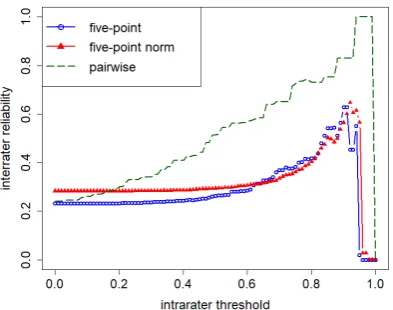
Figure 3: Improvements in inter-rater reliability usingintra-rater consistencyfilter.
Figure 4: Improvements in inter-rater reliability usingitem variancefilter.
4.2 Rater and Item Variance
The succeeding analysis is based on two assump-tions: first, that human raters vary in that they do not provide equally good judgments of translation quality, and second, rating items vary in that some translations may be more difficult to judge than others. This allows to investigate the influence of rater variance and item variance on inter-rater re-liability by an ablation analysis where low-quality judges and difficult translations are filtered out.
Using intra-rater reliability as an index of how well human raters judge translation quality, Fig-ure 3 shows a filtering process whereby human raters withα scores lower than a moving thresh-old are dropped from the analysis. As the relia-bility threshold is increased from 0 to 1, overall inter-rater reliability is measured. Figure4shows a similar filtering process implemented using vari-ance in translation scores. Item varivari-ances are nor-malized on a scale from0to1and subtracted from
1 to produce an item variance threshold. As the threshold increases, overall inter-rater reliability is likewise measured as high-variance items are pro-gressively dropped from the analysis.
As the plots demonstrate, inter-rater reliability generally increases with consistency and variance filtering. For consistency filtering, Figure3shows how the inter-rater reliability of the 5-point task experiences greater increases than the pairwise task with lower filtering thresholds, especially in the normalized case. This may be attributed to the fact that more participants in the 5-point task had low intra-rater reliability. Pairwise tasks, on the other hand, require higher thresholds before large gains are observed in overall inter-rater reliabil-ity. This is because more participants in the pair-wise task had relatively high intra-rater reliability. In the normalized 5-point task, selecting a thresh-old of 0.49 as a cutoff for intra-rater reliability re-tains 8 participants with an inter-rater reliability of 0.5059. For the pairwise task, a threshold of 0.66 leaves 5 participants with an inter-rater reliability of 0.3912.
The opposite phenomenon is observed in the case of variance filtering. As seen in Figure 4, the overall inter-rater reliability of the pairwise task quickly overtakes that of the 5-point task, with and without normalization. This may be at-tributed to how, in the pairwise setup, more items can be a source of disagreement among human judges. Ambiguous cases, that will be discussed in§4.3, may result in higher item variance. This problem is not as pronounced in the 5-point task, where judges must simply judge individual trans-lations. It may be surmised that this item variance accounts for why, on average, judges in the pair-wise task demonstrate higher intra-rater reliabil-ity than those in the 5-point task, yet the overall inter-rater reliability of the pairwise task is lower. By selecting a variance threshold such that at least
70%of items are retained in the analysis, the im-proved inter-rater reliabilities were 0.3236 for the 5-point task and 0.3519 for the pairwise task.
4.3 Qualitative Analysis
[image:5.595.72.269.270.425.2]as-pects of the tasks they found difficult: The biggest challenge for 5-point ratings seemed to be the weighing of different error types and the rating of long sentences with very few, but essential errors. For pairwise ratings, difficulties lie in distinguish-ing between similar, or similarly bad translations. Both tasks showed difficulties with ungrammatical or incomprehensible sources.
Comparing items with high and low agreement across raters allows conclusions about objective
difficulty. We assume that high inter-rater agree-ment indicates an ease of judgagree-ment, while diffi-culties in judgment are manifested in low agree-ment. A list of examples is given in the supple-mentary material. For 5-point ratings, difficul-ties arise with ungrammatical sources and omis-sions, whereas obvious mistakes in the target, such as over-literal translations, make judgment easier. Preference judgments tend to be harder when both translations contain errors and are similar. When there is a tie, the pairwise rating framework does not allow to indicate whether both translations are of high or low quality. Since there is no normaliza-tion strategy for pairwise ratings, individual biases or rating schemes can hence have a larger negative impact on the inter-rater agreement.
5 Learnability of a Reward Estimator from MT Ratings
5.1 Learning a Reward Estimator
The numbers of ratings that can be obtained di-rectly from human raters in a reasonable amount of time is tiny compared to the millions of sen-tences used for standard NMT training. By learn-ing a reward estimator on the collection of human ratings, we seek to generalize to unseen transla-tions. The model for this reward estimator should ideally work without time-consuming feature ex-traction so it can be deployed in direct interaction with a learning NMT system, estimating rewards on the fly, and most importantly generalize well so it can guide the NMT towards good local optima.
Learning from Cardinal Feedback. The inputs to the reward estimation model are sourcesxand their translationsy. Given cardinal judgments for these inputs, a regression model with parameters
ψ is trained to minimize the mean squared error (MSE) for a set ofnpredicted rewardsrˆand
judg-mentsr:
LM SE(ψ) = 1 n
n X
i=1
(r(yi)−rˆψ(yi))2.
In simulation experiments, where all translations can be compared to existing references,r may be computed by sentence-BLEU (sBLEU). For our human 5-point judgments, we first normalize the judgments per rater as described in§4, then aver-age the judgments across raters and finally scale them linearly to the interval[0.0,1.0].
Learning from Pairwise Preference Feedback.
When pairwise preferences are given instead of cardinal judgments, the Bradley-Terry model al-lows us to train an estimator ofr. Following Chris-tiano et al.(2017), letPˆψ[y1 y2]be the
proba-bility that any translationy1is preferred over any other translationy2by the reward estimator:
ˆ
Pψ[y1 y2] =
exp ˆrψ(y1)
exp ˆrψ(y1) + exp ˆrψ(y2)
.
LetQ[y1 y2]be the probability that translation y1is preferred over translationy2by a gold
stan-dard, e.g. the human raters or in comparison to a reference translation. With this supervision signal we formulate a pairwise (PW) training loss for the reward estimation model with parametersψ:
LP W(ψ) =−1
n n X
i=1
Q[y1i y2i] log ˆPψ[yi1yi2]
+Q[y2i y1i] log ˆPψ[yi2yi1].
For simulation experiments — where we lack a genuine supervision for preferences — we com-pute Q comparing the sBLEU scores for both translations, i.e. translation preferences are mod-eled according to their difference in sBLEU:
Q[y1y2] = expsBLEU(y 1)
expsBLEU(y1) + expsBLEU(y2).
When obtaining preference jugdments directly from raters,Q[y1y2]is simply the relative fre-quency ofy1being preferred overy2 by a rater.
5.2 Experiments
Model Feedback ρ
MSE Simulated -0.2571 PW Simulated -0.1307
MSE Human -0.2193
PW Human -0.1310
MSE Human filt. -0.2341 PW Human filt. -0.1255
Table 2: Spearman’s rank correlation ρ between estimated rewards and TER for models trained withsimulated rewards andhumanrewards (also filtered subsets).
same set of translations. In order to augment this very small collection of ratings, we leverage the available out-of-domain bitext as auxiliary train-ing data. We sample translations for a subset of the out-of-domain sources and store sBLEU scores as rewards, collecting 90k out-of-domain training samples in total (see supplementary material for details). During training, each mini-batch is sam-pled from the auxiliary data with probabilitypaux, from the original training data with probability
1−paux. Adding this auxiliary data as a
regu-larization through multi-task learning prevents the model from overfitting to the small set of human ratings. In the experimentspauxwas tuned to 0.8.
Architecture. We choose the following neu-ral architecture for the reward estimation (details see supplementary material): Inputs are padded source and target subword embeddings, which are each processed with a biLSTM (Hochreiter and Schmidhuber, 1997). Their outputs are concate-nated for each time step, further fed to a 1D-convolution with max-over-time pooling and sub-sequently a leaky ReLU (Maas et al.,2013) output layer. This architecture can be seen as a biLSTM-enhanced bilingual extension to the convolutional model for sentence classification proposed byKim
(2014). It has the advantage of not requiring any feature extraction but still models n-gram features on an abstract level.
Evaluation Method. The quality of the reward estimation models is tested by measuring Spear-man’sρ with TER on a held-out test set of 1,314 translations following the standard in sQE eval-uations. Hyperparameters are tuned on another 1,200 TED translations.
Results. Table2reports the results of reward es-timators trained on simulated and human rewards. When trained from cardinal rewards, the model of simulated scores performs slightly better than the model of human ratings. This advantage is lost when moving to preference judgments, which might be explained by the fact that the softmax over sBLEUs with respect to a single reference is just not as expressive as the preference proba-bilities obtained from several raters. Filtering by participants (retaining 8 participants for cardinal rewards and 5 for preference jugdments, see Sec-tion4) improves the correlation further for cardi-nal rewards, but slightly hurts for preference judg-ments. The overall correlation scores are relatively low — especially for the PW models — which we suspect is due to overfitting to the small set of training data. From these experiments we con-clude that when it comes to estimating translation quality, cardinal human jugdments are more useful than pairwise preference jugdments.
6 Reinforcement Learning from Direct and Estimated Rewards in MT
6.1 NMT Objectives
Supervised Learning. Most commonly, NMT models are trained with Maximum Likelihood Es-timation (MLE) on a parallel corpus of source and target sequencesD={(x(s),y(s))}S
s=1:
LM LE(θ) = S X
s=1
logpθ(y(s)|x(s)).
The MLE objective requires reference translations and is agnostic to rewards. In the experiments it is used to train the out-of-domain baseline model as a warm start for reinforcement learning from in-domain rewards.
Reinforcement Learning from Estimated or Simulated Direct Rewards. Deploying NMT in a reinforcement learning scenario, the goal is to maximize the expectation of a reward r over all source and target sequences (Wu et al., 2016), leading to the following REINFORCE (Williams,
1992) objective:
RRL(θ) =Ep(x)pθ(y|x)[r(y)] (1)
≈
S X
s=1
k X
i=1
[image:7.595.105.257.63.180.2]The rewardrcan either come from a reward esti-mation model (estimated reward) or be computed with respect to a reference in a simulation setting (simulated direct reward). In order to counteract high variance in the gradient updates, the running average of rewards is subtracted fromr for learn-ing. In practice, Equation1is approximated with
ksamples frompθ(y|x)(see Equation 2). When
k = 1, this is equivalent to the expected loss minimization inSokolov et al.(2016a,b);Kreutzer et al.(2017), where the system interactively learns from online bandit feedback. For k > 1 this is similar to the minimum-risk training for NMT pro-posed in Shen et al. (2016). Adding a tempera-ture hyper-parameterτ ∈(0.0,∞]to the softmax over the model output o allows us to control the sharpness of the sampling distributionpτ
θ(y|x) =
softmax(o/τ), i.e. the amount of exploration dur-ing traindur-ing. With temperatureτ <1, the model’s entropy decreases and samples closer to the one-best output are drawn. We seek to keep the explo-ration low to prevent the NMT to produce samples that lie far outside the training domain of the re-ward estimator.
Off-Policy Learning from Direct Rewards.
When rewards can not be obtained for samples from a learning system, but were collected for a static deterministic system (e.g. in a production environment), we are in anoff-policy learning sce-nario. The challenge is to improve the MT sys-tem from a logL ={(x(h),y(h), r(y(h)))}H
h=1 of rewarded translations. FollowingLawrence et al.
(2017) we define the following off-policy learning (OPL) objective to learn from logged rewards:
ROP L(θ) = 1 H
H X
h=1
r(y(h)) ¯pθ(y(h)|x(h)),
with reweighting over the current mini-batch B:
¯
pθ(y(h)|x(h)) = pθ(y
(h)|x(h))
PB
b=1pθ(y(b)|x(b)).
2 In contrast to
the RL objective, only logged translations are re-inforced, i.e. there is no exploration in learning.
6.2 Experiments
Data. We use the WMT 2017 data3 for training a general domain (here:out-of-domain) model for
2
Lawrence et al. (2017) propose reweighting over the whole log, but this is infeasible for NMT. HereBH.
3Pre-processed data available at http://www.
statmt.org/wmt17/translation-task.html.
WMT TED
Model BLEU METEOR BEER BLEU METEOR BEER
[image:8.595.308.525.65.109.2]WMT 27.2 31.8 60.08 27.0 30.7 59.48 TED 26.3 31.3 59.49 34.3 34.6 64.94
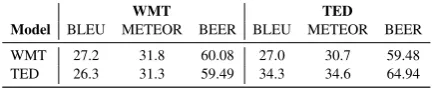
Table 3: Results on test data for in- and out-of-domainfully-supervisedmodels. Both are trained with MLE, the TED model is obtained by fine-tuning the WMT model in TED data.
translations from German to English. The train-ing data contains 5.9M sentence pairs, the devel-opment data 2,999 sentences (WMT 2016 test set) and the test data 3,004 sentences. Forin-domain
data, we choose the translations of TED talks4 as used in IWSLT evaluation campaigns. The training data contains 153k, the development data 6,969, and the test data 6,750 parallel sentences.
Architecture. Our NMT model is a standard subword-based encoder-decoder architecture with attention (Bahdanau et al.,2015). An encoder Re-current Neural Network (RNN) reads in the source sentence and a decoder RNN generates the tar-get sentence conditioned on the encoded source. We implemented RL and OPL objectives in Neu-ral Monkey (Helcl and Libovick´y, 2017).5 The NMT has a bidirectional encoder and a single-layer decoder with 1,024 GRUs each, and subword embeddings of size 500 for a shared vocabulary of subwords obtained from 30k byte-pair merges (Sennrich et al., 2016). For model selection we use greedy decoding, for test set evaluation beam search with a beam of width 10. We samplek= 5
translations for RL models and set the softmax temperatureτ = 0.5. Further hyperparameters are given in the supplementary material.
Evaluation Method. Trained models are eval-uated with respect to BLEU (Papineni et al.,
2002), METEOR (Denkowski and Lavie, 2011) using MULTEVAL (Clark et al.,2011) and BEER (Stanojevi´c and Sima’an,2014) to cover a diverse set of automatic measures for translation quality.6 We test for statistical significance with approxi-mate randomization (Noreen,1989).
4
Pre-processing and data splits as described inhttps: //github.com/rizar/actor-critic-public/ tree/master/exp/ted.
5The code is available in the Neural Monkey fork https://github.com/juliakreutzer/ bandit-neuralmonkey/tree/acl2018.
Model Rewards BLEU METEOR BEER
Baseline - - 27.0 30.7 59.48
RL D S 32.5?
±0.01 33.7?±0.01 63.47?±0.10 OPL D S 27.5? 30.9? 59.62?
RL+MSE E S 28.2?±0.09 31.6?±0.04 60.23?±0.14 RL+PW E S 27.8?
±0.01 31.2?±0.01 59.83?±0.04
OPL D H 27.5? 30.9? 59.72?
RL+MSE E H 28.1?±0.01 31.5?±0.01 60.21?±0.12 RL+PW E H 27.8?
±0.09 31.3?±0.09 59.88?±0.23
RL+MSE E F 28.1?
±0.20 31.6?±0.10 60.29?±0.13
Table 4: Results on TED test data for training with
estimated(E) anddirect(D) rewards from simula-tion (S), humans (H) and filtered (F) human rat-ings. Significant (p ≤ 0.05) differences to the baseline are marked with?. For RL experiments we show three runs with different random seeds, mean and standard deviation in subscript.
The out-of-domain model is trained with MLE on WMT. The task is now to improve the gener-alization of this model to the TED domain. Ta-ble 3 compares the out-of-domain baseline with domain-adapted models that were further trained on TED in a fully-supervised manner ( super-vised fine-tuningas introduced byFreitag and Al-Onaizan(2016);Luong and Manning(2015)). The supervised domain-adapted model serves as an up-per bound for domain adaptation with human re-wards: if we had references, we could improve up to 7 BLEU. What if references are not available, but we can obtain rewards for sample translations?
Results for RL from Simulated Rewards. First we simulate “clean” and deterministic rewards by comparing sample translations to references using GLEU (Wu et al., 2016) for RL, and smoothed sBLEU for estimated rewards and OPL. Table 4
lists the results for this simulation experiment in rows 2-5 (S). If unlimited clean feedback was given (RL with direct simulated rewards), im-provements of over 5 BLEU can be achieved. When limiting the amount of feedback to a log of 800 translations, the improvements over the base-line are only marginal (OPL). When replacing the direct reward by the simulated reward estimators from§5, i.e. having unlimited amounts of approx-imately clean rewards, however, improvements of 1.2 BLEU for MSE estimators (RL+MSE) and 0.8 BLEU for pairwise estimators (RL+PW) are found. This suggests that the reward estimation
model helps to tackle the challenge of generaliza-tion over a small set of ratings.
Results for RL from Human Rewards. Know-ing what to expect in an ideal settKnow-ing with non-noisy feedback, we now move to the experiments with human feedback. OPL is trained with the logged normalized, averaged and re-scaled human reward (see§5). RL is trained with the direct re-ward provided by the rere-ward estimators trained on human rewards from §5. Table 4 shows the re-sults for training with human rewards in rows 6-8: The improvements for OPL are very similar to OPL with simulated rewards, both suffering from overfitting. For RL we observe that the MSE-based reward estimator (RL+MSE) leads to sig-nificantly higher improvements as a the pairwise reward estimator (RL+PW) — the same trend as for simulated ratings. Finally, the improvement of 1.1 BLEU over the baseline showcases that we are able to improve NMT with only a small num-ber of human rewards. Learning from estimated filtered 5-point ratings, does not significantly im-prove over these results, since the imim-provement of the reward estimator is only marginal (see§5).
7 Conclusion
In this work, we sought to find answers to the questions of how cardinal and ordinal feedback differ in terms of reliability, learnability and ef-fectiveness for RL training of NMT, with the goal of improving NMT with human bandit feedback. Our rating study, comparing 5-point and prefer-ence ratings, showed that their reliability is com-parable, whilst cardinal ratings are easier to learn and to generalize from, and also more suitable for RL in our experiments.
Our work reports improvements of NMT lever-aging actual human bandit feedback for RL, leav-ing the safe harbor of simulations. Our experi-ments show that improveexperi-ments of over 1 BLEU are achievable by learning from a dataset that is tiny in machine translation proportions. Since this type of feedback, in contrast to post-edits and references, is fast and cheap to elicit from non-professionals, our results bear a great potential for future applications on larger scale.
Acknowledgments.
References
Dzmitry Bahdanau, Philemon Brakel, Kelvin Xu, Anirudh Goyal, Ryan Lowe, Joelle Pineau, Aaron Courville, and Yoshua Bengio. 2017. An actor-critic algorithm for sequence prediction. InProceedings of the International Conference on Learning Repre-sentations (ICLR). Toulon, France.
Dzmitry Bahdanau, Kyunghyun Cho, and Yoshua Ben-gio. 2015. Neural machine translation by jointly learning to align and translate. In Proceedings of the International Conference on Learning Represen-tations (ICLR). San Diego, CA, USA.
L´eon Bottou, Jonas Peters, Joaquin Qui˜nonero-Candela, Denis X. Charles, D. Max Chickering, Elon Portugaly, Dipanakar Ray, Patrice Simard, and Ed Snelson. 2013. Counterfactual reasoning and learning systems: The example of computational ad-vertising. Journal of Machine Learning Research
14:3207–3260.
Ralph Allan Bradley and Milton E. Terry. 1952. Rank analysis of incomplete block designs: I. the method of paired comparisons. Biometrika 39(3-4):324– 345.
Paul F. Christiano, Jan Leike, Tom Brown, Miljan Mar-tic, Shane Legg, and Dario Amodei. 2017. Deep reinforcement learning from human preferences. In
Advances in Neural Information Processing Systems (NIPS). Long Beach, CA, USA.
Jonathan H. Clark, Chris Dyer, Alon Lavie, and Noah A. Smith. 2011. Better hypothesis testing for statistical machine translation: Controlling for op-timizer instability. InProceedings of the 49th An-nual Meeting of the Association for Computational Linguistics: Human Language Technologies (ACL-HLT). Portland, OR, USA.
Michael Denkowski and Alon Lavie. 2011. Meteor 1.3: Automatic metric for reliable optimization and evaluation of machine translation systems. In Pro-ceedings of the Sixth Workshop on Statistical Ma-chine Translation (WMT). Edinburgh, Scotland.
Markus Freitag and Yaser Al-Onaizan. 2016. Fast domain adaptation for neural machine translation.
CoRRabs/1612.06897.
Spence Green, Sida I. Wang, Jason Chuang, Jeffrey Heer, Sebastian Schuster, and Christopher D. Man-ning. 2014. Human effort and machine learnabil-ity in computer aided translation. In Proceedings the onference on Empirical Methods in Natural Lan-guage Processing (EMNLP). Doha, Qatar.
Jindˇrich Helcl and Jindˇrich Libovick´y. 2017. Neural Monkey: An Open-source Tool for Sequence Learn-ing. The Prague Bulletin of Mathematical Linguis-tics(107):5–17.
Sepp Hochreiter and J¨urgen Schmidhuber. 1997. Long short-term memory. Neural Computation
9(8):1735–1780.
Nan Jiang and Lihong Li. 2016. Doubly robust off-policy value evaluation for reinforcement learning. InProceedings of the 33rd International Conference on Machine Learning (ICML). New York, NY, USA.
Kshitij Judah, Saikat Roy, Alan Fern, and Thomas G. Dietterich. 2019. Reinforcement learning via prac-tice and critique advice. InProceedings of the 24th AAAI Conference on Artificial Intelligence. Atlanta, GA, USA.
Sham Kakade. 2001. A natural policy gradient. In
Advances in Neural Information Processing Systems (NIPS). Vancouver, Canada.
Hyun Kim, Jong-Hyeok Lee, and Seung-Hoon Na. 2017. Predictor-estimator using multilevel task learning with stack propagation for neural quality estimation. In Proceedings of the Second Confer-ence on Machine Translation (WMT). Copenhagen, Denmark.
Yoon Kim. 2014. Convolutional neural networks for sentence classification. InProceedings of the 2014 Conference on Empirical Methods in Natural Lan-guage Processing (EMNLP). Doha, Qatar.
W. Bradley Knox and Peter Stone. 2009. Interac-tively shaping agents via human reinforcement: The TAMER framework. InProceedings of the Interna-tional Conference on Knowledge Capture (K-CAP). Redondo Beach, CA, USA.
Vijay R. Konda and John N. Tsitsiklis. 2000. Actor-critic algorithms. In Advances in Neural In-formation Processing Systems (NIPS). Vancouver, Canada.
Julia Kreutzer, Shahram Khadivi, Evgeny Matusov, and Stefan Riezler. 2018. Can neural machine trans-lation be improved with user feedback? In Pro-ceedings of the 16th Annual Conference of the North American Chapter of the Association for Computa-tional Linguistics: Human Language Technologies - Industry Track (NAACL-HLT). New Orleans, LA, USA.
Julia Kreutzer, Artem Sokolov, and Stefan Riezler. 2017. Bandit structured prediction for neural sequence-to-sequence learning. In Proceedings of the 55th Annual Meeting of the Association for Com-putational Linguistics (ACL). Vancouver, Canada.
Klaus Krippendorff. 2013. Content Analysis. An Intro-duction to Its Methodology. Sage, third edition.
Richard Larsen and Morris Marx. 2012. An Introduc-tion to Mathematical Statistics and Its ApplicaIntroduc-tions. Prentice Hall, fifth edition.
Chen Liang, Jonathan Berant, Quoc Le, Kenneth D. Forbus, and Ni Lao. 2017. Neural symbolic ma-chines: Learning semantic parsers on freebase with weak supervision. In Proceedings of the 55th An-nual Meeting of the Association for Computational Linguistics (ACL). Vancouver, Canada.
Minh-Thang Luong and Christopher D. Manning. 2015. Stanford neural machine translation systems for spoken language domains. InProceedings of the International Workshop on Spoken Language Trans-lation (IWSLT). Da Nang, Vietnam.
Andrew L Maas, Awni Y Hannun, and Andrew Y Ng. 2013. Rectifier nonlinearities improve neural net-work acoustic models. InICML Workshop on Deep Learning for Audio, Speech and Language Process-ing. Atlanta, GA, USA.
James MacGlashan, Mark K. Ho, Robert Loftin, Bei Peng, Guan Wang, David L. Roberts, Matthew E. Taylor, and Michael L. Littman. 2017. Interactive learning from policy-dependent human feedback. In
Proceedings of the 34th International Conference on Machine Learning (ICML). Sydney, Australia.
Andr´e Martins, Marcin Junczys-Dowmunt, Fabio Ke-pler, Ram´on Astudillo, Chris Hokamp, and Roman Grundkiewicz. 2017. Pushing the limits of transla-tion quality estimatransla-tion. Transactions of the Associ-ation for ComputAssoci-ational Linguistics (TACL)5:205– 218.
Volodymyr Mnih, Adri`a Puigdom`enech Badia, Mehdi Mirza, Alex Graves, Timothy P. Lillicrap, Tim Harley, David Silver, and Koray Kavukcuoglu. 2016. Asynchronous methods for deep reinforce-ment learning. In Proceedings of the 33rd Inter-national Conference on Machine Learning (ICML). New York, NY, USA.
Volodymyr Mnih, Koray Kavukcuoglu, David Silver, Andrei A. Rusu, Joel Veness, Marc G. Bellemare, Alex Graves, Martin Riedmiller, Andreas K. Fidje-land, Georg Ostrovski, Stig Petersen, Charles Beat-tie, Amir Sadik, Ioannis Antonoglou, Helen King, Dharshan Kumaran, Daan Wierstra, Shane Legg, and Demis Hassabis. 2015. Human-level con-trol through deep reinforcement learning. Nature
518:529–533.
Khanh Nguyen, Hal Daum´e, and Jordan Boyd-Graber. 2017. Reinforcement learning for bandit neural ma-chine translation with simulated feedback. In Pro-ceedings of the Conference on Empirical Methods in Natural Language Processing (EMNLP). Copen-hagen, Denmark.
Eric W. Noreen. 1989. Computer Intensive Methods for Testing Hypotheses. An Introduction. Wiley.
Kishore Papineni, Salim Roukos, Todd Ward, and Wei-Jing Zhu. 2002. Bleu: a method for automatic eval-uation of machine translation. InProceedings of the 40th Annual Meeting of the Association for Compu-tational Linguistics (ACL). Philadelphia, PA, USA.
Romain Paulus, Caiming Xiong, and Richard Socher. 2017. A deep reinforced model for abstractive sum-marization.CoRRabs/1705.04304.
Patrick M. Pilarski, Michael R. Dawson, Thomas De-gris, Farbod Fahimi, Jason P. Carey, and Richard S. Sutton. 2011. Online human training of a myoelec-tric prosthesis controller via actor-critic reinforce-ment learning. In Proceedings of the IEEE In-ternational Conference on Rehabilitation Robotics. Z¨urich, Switzerland.
Maja Popovi´c. 2015. chrf: character n-gram f-score for automatic mt evaluation. InProceedings of the Tenth Workshop on Statistical Machine Translation (WMT). Lisbon, Portugal.
Doina Precup, Richard S. Sutton, and Sanjoy Dasgupta. 2001. Off-policy temporal-difference learning with function approximation. InProceedings of the Eigh-teenth International Conference on Machine Learn-ing (ICML). Williams College, MA, USA.
Doina Precup, Richard S. Sutton, and Satinder P. Singh. 2000. Eligibility traces for off-policy policy eval-uation. In Proceedings of the Seventeenth Inter-national Conference on Machine Learning (ICML). San Francisco, CA, USA.
John Schulman, Sergey Levine, Philipp Moritz, Michael I. Jordan, and Pieter Abbeel. 2015. Trust region policy optimization. In Proceedings of the 31st International Conferene on Machine Learning (ICML). Lille, France.
Rico Sennrich, Barry Haddow, and Alexandra Birch. 2016. Neural machine translation of rare words with subword units. InProceedings of the 54th Annual Meeting of the Association for Computational Lin-guistics (ACL). Berlin, Germany.
Shai Shalev-Shwartz, Ohad Shamir, Nathan Srebro, and Karthik Sridharan. 2010. Learnability, stabil-ity and uniform convergence. Journal of Machine Learning Research11:2635–2670.
Shiqi Shen, Yong Cheng, Zongjun He, Wei He, Hua Wu, Maosong Sun, and Yang Liu. 2016. Minimum risk training for neural machine translation. In Pro-ceedings of the 54th Annual Meeting of the Associ-ation for ComputAssoci-ational Linguistics (ACL). Berlin, Germany.
Artem Sokolov, Julia Kreutzer, Christopher Lo, and Stefan Riezler. 2016a. Learning structured predic-tors from bandit feedback for interactive NLP. In
Proceedings of the 54th Annual Meeting of the Asso-ciation for Computational Linguistics (ACL). Berlin, Germany.
Artem Sokolov, Julia Kreutzer, Christopher Lo, and Stefan Riezler. 2016b. Stochastic structured predic-tion under bandit feedback. InAdvances in Neural Information Processing Systems (NIPS). Barcelona, Spain.
Miloˇs Stanojevi´c and Khalil Sima’an. 2014. Fit-ting sentence level translation evaluation with many dense features. In Proceedings of the 2014 Con-ference on Empirical Methods in Natural Language Processing (EMNLP). Doha, Qatar.
Richard S. Sutton, David McAllester, Satinder Singh, and Yishay Mansour. 2000. Policy gradient methods for reinforcement learning with function approxima-tion. In Advances in Neural Information Process-ings Systems (NIPS). Vancouver, Canada.
Adith Swaminathan and Thorsten Joachims. 2015a. Counterfactual risk minimization: Learning from logged bandit feedback. In International Confer-ence on Machine Learning (ICML). Lille, France.
Adith Swaminathan and Thorsten Joachims. 2015b. The self-normalized estimator for counterfactual learning. In Advances in Neural Information Pro-cessing Systems (NIPS). Montreal, Canada.
Philip S. Thomas and Emma Brunskill. 2016. Data-efficient off-policy policy evaluation for reinforce-ment learning. In Proceedings of the 33nd Inter-national Conference on Machine Learning (ICML). New York, NY, USA.
Louis Leon Thurstone. 1927. A law of comparative judgement. Psychological Review34:278–286.
Ronald J. Williams. 1992. Simple statistical gradient-following algorithms for connectionist reinforce-ment learning. Machine Learning8:229–256.
Lijun Wu, Yingce Xia, Li Zhao, Fei Tian, Tao Qin, Jianhuang Lai, and Tie-Yan Liu. 2017. Adversarial neural machine translation. CoRRabs/1704.06933.
Yonghui Wu, Mike Schuster, Zhifeng Chen, Quoc V. Le, Mohammad Norouzi, Wolfgang Macherey, Maxim Krikun, Yuan Cao, Qin Gao, Klaus Macherey, Jeff Klingner, Apurva Shah, Melvin Johnson, Xiaobing Liu, Lukasz Kaiser, Stephan Gouws, Yoshikiyo Kato, Taku Kudo, Hideto Kazawa, Keith Stevens, George Kurian, Nishant Patil, Wei Wang, Cliff Young, Jason Smith, Jason Riesa, Alex Rudnick, Oriol Vinyals, Greg Corrado, Macduff Hughes, and Jeffrey Dean. 2016. Google’s neural machine translation system: Bridging the gap between human and machine translation. CoRR
abs/1609.08144.