4366
Distilling Discrimination and Generalization Knowledge for Event
Detection via
∆-Representation Learning
Yaojie Lu1,3, Hongyu Lin1,3, Xianpei Han1,2∗, Le Sun1,2
1Chinese Information Processing Laboratory 2State Key Laboratory of Computer Science
Institute of Software, Chinese Academy of Sciences, Beijing, China
3University of Chinese Academy of Sciences, Beijing, China
{yaojie2017,hongyu2016,xianpei,sunle}@iscas.ac.cn
Abstract
Event detection systems rely on discrimina-tion knowledge to distinguish ambiguous trig-ger words and generalization knowledge to detect unseen/sparse trigger words. Cur-rent neural event detection approaches fo-cus on trigger-centric representations, which work well on distilling discrimination knowl-edge, but poorly on learning generalization knowledge. To address this problem, this pa-per proposes a ∆-learning approach to dis-till discrimination and generalization knowl-edge by effectively decoupling, incrementally learning and adaptively fusing event represen-tation. Experiments show that our method significantly outperforms previous approaches on unseen/sparse trigger words, and achieves state-of-the-art performance on both ACE2005 and KBP2017 datasets.
1 Introduction
Event detection (ED) aims to identify triggers of specific event types. For instance, an ED system will identifyfiredas an Attack event trigger in the sentence “An American tank fired on the Palestine Hotel.” Event detection plays an important role in Automatic Content Extraction (Ahn,2006), Infor-mation Retrieval (Allan, 2012), and Text Under-standing (Chambers and Jurafsky,2008).
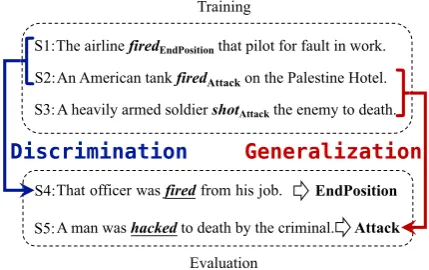
Due to the ambiguity and the diversity of natural language expressions (Li et al.,2013;Nguyen and Grishman, 2015), an effective approach should be able to distill both discrimination and general-ization knowledge for event detection. Discrimi-nation knowledge aims to distinguish ambiguous triggers in different contexts. As shown in Figure
1, to identify fired in S4 as an EndPosition trig-ger rather than an Attack trigtrig-ger, an ED system needs to distill the discrimination knowledge from S1 and S2 that (fired, Attack) usually co-occurs
∗
Corresponding Author
The airline firedEndPositionthat pilot for fault in work.
S1:
An American tank firedAttackon the Palestine Hotel.
S2:
A man was hackedto death by the criminal. Attack
S5:
Discrimination Generalization
S3:A heavily armed soldier shotAttackthe enemy to death. Training
Evaluation
[image:1.595.309.524.223.358.2]S4:That officer wasfiredfrom his job. EndPosition
Figure 1: Examples of event instances. Identifing am-biguous wordfiredrequires discrimination knowledge and identifing unseen wordhackedrequires generaliza-tion knowledge.
with{tank, death, enemy, ...} and (fired, EndPo-sition) usually co-occurs with {work, fault, job, ...}. Unlike discrimination knowledge, generaliza-tion knowledge aims to detect unseen or sparsely labeled triggers, thus needs to be transferred be-tween different trigger words. For example, to identify the unseen wordhacked in S5 as an At-tack trigger, an ED system needs to distill the gen-eralized Attack pattern “[Trigger] to death” from S3.
Currently, most neural network ED methods (Chen et al., 2015;Nguyen and Grishman,2015,
Models OOV OOL Other
DMCNN 34.3 8.8 76.1 Bi-LSTM 35.3 9.3 75.5
[image:2.595.97.265.62.119.2]ELMo 31.3 9.0 75.7
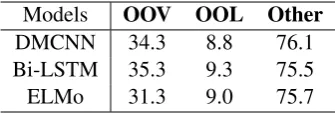
Table 1: F1 Scores of previous approaches on differ-ent types of triggers (ACE2005), where OOV words are the out-of-vocabulary words in the training corpus, OOL words are the out-of-label words, i.e., an instance whose (word, event type) never occurs in the training corpus but the word is not OOV. DMCNN (Chen et al.,
2015) refers to dynamic multi-pooling based CNN; Bi-LSTM (Duan et al.,2017) refers to bidirectional LSTM based RNN. ELMo refers to the fixed task-independent word representations proposed byPeters et al.(2018).
large-scale training data also limits the generaliza-tion ability of learned models. Table1also shows the performance of using general pre-trained word representation – ELMo (Peters et al.,2018). We can see that, this task-independent lexical-centric representation achieves nearly the same perfor-mance to task-specific representations.
In this paper, we propose a ∆-representation learning approach, which can incrementally dis-till both discrimination and generalization knowl-edge for event detection. ∆-representation learn-ing aims todecouple,learn, andfusealterable∆ -parts for event representation, instead of learning a single comprehensive representation. Specif-ically, we decouple an event representation red into three partsred = rwLrdLrg (Section2), whererwis the pre-trained word representation of trigger words,rdis the lexical-specific event rep-resentation which captures discrimination knowl-edge for distinguishing ambiguous triggers, rg is the lexical-free event representation which cap-tures generalization knowledge for detecting un-seen/sparse triggers, andL
is the fusion function to fuse different parts. Hererdandrg are the∆ -parts of our representation, i.e., they are indepen-dently learned starting from rw and are intended for capturing incremental knowledge for event de-tection. To incrementally learn the∆-partsrdand rg, we propose a∆-learning framework (Section
3), i.e., a lexical enhanced ∆-learning algorithm is designed to learn the discrimination knowledge rdwhich is both event-related and lexical-relevant part, and a lexical adversarial ∆-learning is de-signed to learn the generalization knowledge rg which is event-related but lexical-irrelevant part. Finally, a lexical gate fusion mechanismL
(Sec-Decoupled Representations
That officer was firedfrom his job. Lexical
Gate Fusion
Lexical-Free Representation !w
Trigger Candidate
EndPosition
Enhanced
Δ-Learning
Adversarial
Δ-Learning
Δ Δ
Lexical-Specific Representation
!d !g
Lexi
Δ-Learning
Figure 2: The framework of our∆-learning approach. Dashed lines indicate the learning process; solid lines indicate the event detection process.
tion 2.3) is proposed to adaptively fuse these learned representations. Figure2shows the archi-tecture of our method.
We conduct experiments1 on two standard event detection datasets: ACE20052 and TAC KBP 2017 Event Nugget Detection Evaluation3 (KBP2017). Experimental results show that the proposed method significantly improves the per-formance on sparsely labeled triggers, and retains a high performance on densely labeled triggers.
The main contributions of this paper are: 1. We propose a new representation learning framework - ∆-learning, which can incremen-tally distill both discrimination and generalization knowledge during representation learning. Since the ambiguity and the diversity problem of nat-ural language expressions are common in NLP, our framework can potentially benefit many other NLP tasks.
2. We design a new event detection approach. By effectively decoupling, independently learn-ing, and adaptively fusing event representation, our approach works well on both sparsely and densely labeled triggers and achieves the state-of-the-art performance on both ACE2005 and KBP2017 datasets.
2 Decoupling Lexical-Specific and
Lexical-Free Representations for Event Detection
To distill both discrimination and generalization knowledge, this section decouples event
represen-1
Our source code is openly available at https://www.github.com/luyaojie/delta-learning-for-ed.
2
https://catalog.ldc.upenn.edu/LDC2006T06
[image:2.595.308.525.67.208.2]tation into three parts: red = rwLrdLrg, where rw is the word representation of trigger words, such as word embeddings/ELMo (noted that rw is fixed during all our training process); rdis a lexical-specific event representation which captures discrimination knowledge;rgis a lexical-free representation which captures generalization knowledge. By decoupling event representations, rdandrg will be independently learned using our ∆-learning algorithm in Section 3. Finally, a gate mechanism is proposed to adaptively fuse the above representations for event detection.
Formally, an event detection instance is a pair of trigger candidate and its context, i.e., x = (t, c), where t is a trigger candidate, and c =
{c−m, ..., c−1, c1, ..., cm}is its context. For exam-ple, (fired, “That officer was from his job.”) is an instance for candidatefired.
Following previous work (Nguyen and Grish-man, 2015; Liu et al., 2018a), given an instance x, we embed each token ti asti = [pw;pp;pe], where pw is its word embedding, pp is its posi-tion embedding, and pe is its entity tag embed-ding. Thereforet0 is the representation of trigger
candidate. In this paper, lexical-specific modelΘd and lexical-free model Θg use independent em-beddings.
2.1 Lexical-Specific Representation
Lexical-specific representation aims to capture discriminative information for distinguishing am-biguous trigger words. For example, we want our representation to capture {officer, job, ...} clues for distinguishing (fired, EndPosition) from (fired, Attack), and{tank, soldiers,...}for distinguishing (fired, Attack) from (fired, EndPosition).
To capture discriminative clues for trigger can-didates, we design a lexical-centered context se-lection attention. And we refer it as ATT-RNN and describe it as follows.
Lexical-Centered Context Selection. To select discriminative context words, the attentive context selection mechanism models the association be-tween the trigger candidate and its context words. For instance, we want our attention mechanism to capture the association between “work” andfired
in S1, and between “tank” andfiredin S2.
Concretely, we first feed [t−m, ...,t0, ...,tm] into a bidirectional GRU to get all tokens’ context-aware token encoding[h−m, ...,h0, ...,hm]. Then our attention mechanism models (trigger, context
word) pair’s relevance with a Multi-Layer Percep-tron (MLP), and uses a softmax function normal-izing relevance scores to attention weights:
αi=
exp(MLP([h0;hi]))
P
j∈cexp(MLP([h0;hj]))
(1)
Given the attention weights, the lexical-specific context representation is summarized as c0 = P
i∈Cαi ·hi. And the final lexical-specific rep-resentation of instance x is the concatenation of its token representationh0and the lexical-specific
context representationc0, i.e.,rd= [h0;c0].
The lexical-specific representation can effec-tively disambiguate trigger words by capturing (trigger, context word) associations. However, this representation is lexical-specific, thus hard to gen-eralize well to sparse/unseen words.
2.2 Lexical-Free Representation
In contrast to lexical-specific representation, lexical-free event representation rg aims to cap-ture generalization knowledge for ED, which can be transferred between different trigger words. For example, we want to capture the trigger word-irrelevant knowledge such as “[Trigger] to death” being a strong trigger pattern for Attack event, which can be used to detect many different trig-ger words, such asfired,hacked,beat. In this way, even an unseen trigger candidate t can be easily identified by leveraging such knowledge.
Obviously, the lexical-free event representation rg should be lexical-irrelevant, but event-specific. To this end, we represent all tokens in x as ti, then employ a lexical-independent context selec-tion module for rg. We simply use DMCNN (Chen et al.,2015) as our lexical-independent con-text selection module, but design a new adversar-ial∆-learning algorithm in Section3.2which can eliminate lexical-relevant information fromrg. Lexical-Independent Context Selection. To se-lect lexical-independent but event-relevant context words, we employ the same CNN architecture as
Chen et al.(2015). For instance, we want to cap-ture “to death” and “criminal” being relevant for Attack event in S5.
Given token sequence[t−m, ...,t0, ...,tm], ah -width convolutional layer captures local context featurelifromti:i+h−1:li =tanh(w·ti:i+h−1+
and right context featuresllef t,lright:
llef t= max
j<0 lj,l
right= max
j≥0 lj (2)
Finally, we concatenate the left context feature llef t and the right context feature lright as our lexical-free representationrg = [llef t;lright].
2.3 Lexical Gate Mechanism for Representation Fusion
The above two representations are complementary to each other: rd captures discrimination knowl-edge, and rg captures generalization knowledge. However, simple concatenation is not effective for event detection: for frequently labeled trigger words in training data, lexical-specific representa-tion is more useful; and for sparsely labeled or un-seen trigger words, lexical-free representation is more helpful. Based on this observation, our sys-tem needs to rely more on rd to detect frequent candidatefired, but more onrg to detect the OOV candidatehacked. That is, we need to adaptively fuse different representations for different words, rather than simply concatenate them.
To adaptively fuse lexical-specific representa-tion rd, lexical-free representation rg and word representationrw, we design a lexical gate mech-anism to fuse different representations: red = rwLrdLrg, where L is the fusion gate, and red is the final event representation. Concretely, we first map these representations to a universal space:
r0d=fSpec→U(rd) r0g =fF ree→U(rg) r0w=fLexi→U(rw)
(3)
where fSpec→U(·), fF ree→U(·) and fLexi→U(·) are linear layers with a nonlinear function; then we fuse them via the gated mechanism:
˜
gi =fU→G(r0i), i∈ {d, g, w}
gi=
exp(˜gi)
P
j∈{d,g,w}exp(˜gj)
(4)
gi (i ∈ {d, g, w}) correspondingly indicates the confidence of the evidences provided by r0s, r0f andr0l;giand˜gihave the same dimensions asr0i; fU→G(·) is a linear layer with a nonlinear func-tion. Finally, we combine all representations:
red =gdr0d+ggr0g+gwr0w (5)
whereis element-wise multiplication.
After fusion, red will be fed to the event de-tection classifier, which computes a classification
(a) Lexical-Enhanced Event Detection Classifier Binary
Lexical Classifier
Lexical-specific Representation
Learning
Event Detection Classifier
Lexical-free Representation
Learning Lexi
Binary Lexical Classifier
(b) Lexical-Adversarial
EventType EventType 1/0
1/0
Lexi
(t, c) t / w t / w (t, c)
+Lexi −Lexi
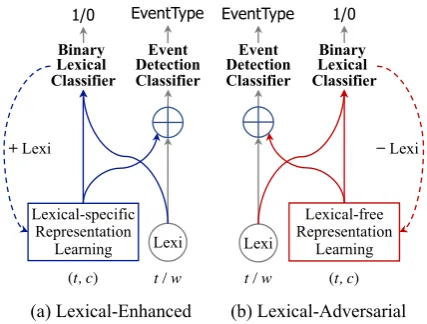
Figure 3: The framework of our ∆-learning algo-rithms.
probability for each event typeyt (including NIL for not a trigger):
P(yt|x) =
exp(wt·red+bt)
PT
t=1exp(wt·red+bt)
(6)
wherewt is the weight vector, andbt is the bias term. In this way, we identify trigger words of all pre-defined event types.
3 Distilling Discrimination and Generalization knowledge via
∆-Learning
This section describes our∆-learning framework, which can learn lexical-specific representationrd and lexical-free representation rg independently. To distill discrimination knowledge tord, we de-sign a lexical-enhanced∆-learning algorithm. To distill generalization knowledge torg, we design a lexical adversarial∆-learning algorithm. Finally, we fine-tune the full event detection model in Fig-ure2.
3.1 Distilling Discrimination Knowledge via Lexical-Enhanced∆-Learning
[image:4.595.310.524.66.228.2]To achieve the above goal, we remove the lexical-free part in Figure2and show the lexical-enhanced∆-learning framework in Figure3 (a). The input of our lexical-enhanced learning frame-work is a triple (t,c, w), wheretis the trigger,c is its context, andwis a sampled word. The out-put is two-fold: the event classifier will outout-put the event type of (t,c), and the auxiliary lexical classi-fier will output 1 ift=wand 0 otherwise. In this way, the event classifier can propagate the event type supervision signal to our lexical-specific rep-resentation learning component, and the auxiliary lexical binary classifier ensures that the learned representationrdis lexical-specific.
Specifically, for each ED instance x = (t, c), we generate a positive lexical-enhanced training instance(t, c, t) with label(y,1), and nnegative instances4(t, c, w)with label(y,0), wherewis a word randomly sampled from contextc.
For each ED instance x = (t, c) in the train datasetD, the event classifier loss is:
Levent=− X
(xk,yk)∈D
logP(yk|xk) (7)
and the lexical binary classifier loss is:
Llexical = X
xk∈D
−logP(1|xk, t)
− n
X
j=1
logP(0|xk, wkj) (8)
Therefore, the loss function of lexical-enhanced ∆-learning is:
Lenhance=Levent+Llexical (9)
By adding the auxiliary lexical classification task, this learning algorithm will ensure the learned representation be both event-related and lexical-relevant.
3.2 Distilling Generalization Knowledge via Lexical-Adversarial∆-Learning
In contrast to lexical-specific representation rd, the lexical-free representation rg needs to elimi-nate lexical-specific information, so that it can be transferred between different words. To achieve this goal, we adopt adversarial techniques and de-sign a lexical-adversarial∆-learning algorithm.
Specifically, we remove the lexical-specific part in Figure 2 and show the lexical-adversarial ∆ -learning framework in Figure3 (b). We can see
4In this paper, we setn= 1.
that, the input and the output of our adversarial∆ -learning framework are still(t, c, w)and(y,1/0). The event classifier is used to propagate the event type supervision signal to our lexical-free repre-sentation learning component, so thatrgwill cap-ture event related information. The difference be-tween Figure 3(a) and 3(b) is that they use dif-ferent auxiliary tasks: Figure3(a) uses a lexical-enhanced auxiliary task, and Figure 3 (b) uses a lexical-adversarial auxiliary task.
To eliminate lexical-specific information, we design a two-player min-max game (Goodfellow et al., 2014) for the lexical-adversarial auxiliary task. Given(t, c, w), our binary lexical classifier ΘDeLexiattempts to predict whetherrg is specific tow, but the lexical-free model Θg tries to pro-ducergto confuseΘDeLexi. The min-max objec-tive function for lexical-adversarial∆-learning is:
Lminmax =
X
xk∈D
−logP(1|xk, t)
− n
X
j=1
logP(0|xk, wkj)
ˆ
θ= min
ΘDeLeximaxΘg Lminmax
(10)
In this way, we can remove the lexical-specific in-formation fromrg.
The above adversarial loss leads two different optimized directions forΘg andΘDeLexi, which can be implemented by a gradient reversal layer (Ganin et al.,2016) during backpropagation. That is,Lminmaxis jointly optimized with the main ED task objectiveLevent, while gradients from adver-sarial loss are reversed with the factorλadv when they reach rg. By this means, we can unify the optimized directions of these components. There-fore, the loss function of our lexical-adversarial ∆-learning is:
Ladversary=Levent+Lminmax (11)
Following Liu et al. (2019), we divide the lexical-adversarial∆-learning into two stages:
1. In the pretraining stage, we first updateΘg using the main ED task objective, then freezeΘg and updateΘDeLexiusing the Equation10.
2. In the adversarial learning stage, we update parameters using Equation11.
50%). In this paper, λadv is set as1−3, and the accuracy of our binary lexical classifierΘDeLexi always keep over 75% in the adversarial learning stage.
By adding the auxiliary lexical-adversarial task, this learning algorithm will ensure the learned rep-resentation be event-related but lexical-irrelevant.
3.3 Full Model Fine-Tuning
Given the pre-trained lexical-specific representa-tion modelΘdand the pre-trained lexical-free rep-resentation modelΘg, we finally fine-tune the full modelΘin Figure2by optimizing the event clas-sification loss function:
L(Θ) =Levent+λreg· kΘk2 (12)
whereλregis the weight coefficient of regulariza-tion item and Θindicates all parameters. L(Θ)
can be optimized using mini-batch based stochas-tic gradient descent algorithms, such as Adadelta (Zeiler,2012).
4 Experiments
4.1 Experimental Settings
Dataset. We conduct experiments on two stan-dard English event detection datasets: ACE2005 and KBP2017.
ACE2005 (LDC2006T06) contains 599 docu-ments annotated with 33 event types. Following previous studies (Liao and Grishman, 2010; Li et al., 2013; Chen et al., 2015; Liu et al., 2017,
2018a), we use the same 529/30/40 train/dev/test document splits in our experiments. We use ACE2005 as the primary dataset, as the same as previous studies (Nguyen and Grishman,2018).
KBP2017 (LDC2017E55) contains 500 docu-ments with RichERE annotations for TAC KBP 2017 evaluation. For model training, we use pre-viously annotated RichERE datasets, including LDC2015E29, LDC2015E68, LDC2016E31 and TAC KBP 2015-2016 Evaluation datasets. Fol-lowing previous work (Lin et al.,2018a), we ran-domly sample 20 documents from the 2016 evalu-ation dataset as the development set.
We evaluate different event detection sys-tems using precision, recall, and F1-score. For ACE2005, we compute these criteria as the same as previous work (Li et al., 2013; Chen et al.,
2015). For KBP2017, because TAC KBP2017 al-lows each team to submit 3 different runs, to make our results comparable with the evaluation results,
we select 3 best runs of each system on the de-velopment set and report the best test performance among them using the official evaluation toolkit5, which is referred as Best3 in previous work (Lin et al.,2018a).
Baselines. We compare our approach with three types of baselines:
Feature based Approachesrely on rich hand-designed features, including: MaxEnt (Li et al.,
2013) which employs hand-designed features and uses Max-Entropy Classifier;Combined PSL(Liu et al.,2016b) – the best reported feature-based sys-tem which combines global and latent features us-ing Probabilistic Soft Logic framework.
Representation Learning based Approaches
employ neural networks to automatically extract features for event detection, including: DMCNN
(Chen et al.,2015) which uses CNN as sentence feature extractor and concatenates sentence fea-ture and lexical feafea-ture for event detection clas-sifier; NC-CNN (Nguyen and Grishman, 2016) which extends traditional CNN by modeling skip-grams for exploiting non-consecutive k-skip-grams; Bi-RNN(Nguyen et al.,2016) which embeds each to-ken using additional dependency features for bi-directional RNN feature extractor, and jointly ex-tracts triggers with its arguments.
External Resource based Approaches aim to enhance event detection with external resources, including: SA-ANN-Arg (Liu et al., 2017) which injects event arguments information via super-vised attention mechanism; GCN-ED (Nguyen and Grishman,2018) which exploits syntactic in-formation to capture more accurate context using Graph Convolutional Networks (GCN);GMLATT
(Liu et al.,2018a) which exploits the multi-lingual information for more accurate context modeling;
HBTNGMA (Chen et al.,2018) which fuses both sentence-level and document-level information, and collectively detects different events in a sen-tence.
For our approach and all baselines, we adopt the pre-trained word embedding using Skip-gram 6 and the open released ELMo models7. We also
report the performance of ELMo as a baseline for demonstrating the performance of universal pre-trained representations. All hyper-parameters are tuned on development set.
5
https://github.com/hunterhector/EvmEval
6
https://code.google.com/archive/p/word2vec
P R F1 Feature based Approaches
MaxEnt 74.5 59.1 65.9 Combined-PSL 75.3 64.4 69.4
Representation Learning based Approaches
DMCNN 75.6 63.6 69.1 Bi-RNN 66.0 73.0 69.3
NC-CNN - - 71.3
External Resource based Approaches
SA-ANN-Arg (+Arguments) 78.0 66.3 71.7 GMLATT (+Multi-Lingual) 78.9 66.9 72.4 GCN-ED (+Syntactic) 77.9 68.8 73.1 HBTNGMA (+Document) 77.9 69.1 73.3
Our Approach
ELMo 75.6 62.3 68.3
∆concatw2v 71.8 70.8 71.3
∆concatELM o 73.7 71.9 72.8
∆w2v 74.0 70.5 72.2
[image:7.595.75.288.61.299.2]∆ELM o 76.3 71.9 74.0
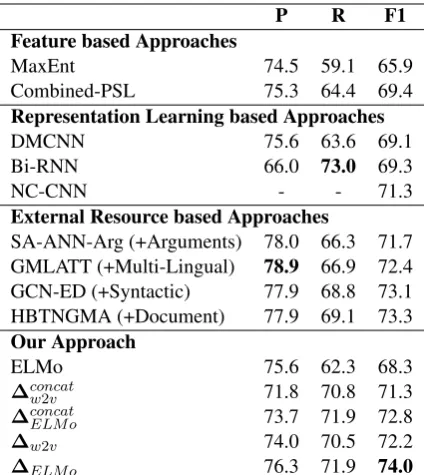
Table 2: Experiment results on ACE 2005. For a fair comparison, the results of baselines are adapted from their original papers.
4.2 Overall Performance
Table2shows the overall ACE2005 results of all baselines and our approach. For our approach, we show the results of four settings: our approach using word embedding as its word representa-tion rw – ∆w2v; our approach using ELMo as rw- ∆ELM o; our approach simply concatenating
[rd,rg,rw] as instance representation - ∆concat∗ .
From Table2, we can see that:
1. By distilling both discrimination and generalization knowledge, our method achieves state-of-the-art performance. Compared with the best feature system, ∆w2v and ∆ELM o gain 2.8 and 4.6 F1-score improvements. Compared to the representation learning based baselines, both ∆w2v and∆ELM o outperform all of them. No-tably,∆ELM ooutperforms all the baselines using external resources.
2. By incrementally distilling generalization knowledge, our method can achieve both high recall and high precision. Our method obtains a high recall – 71.9, which outperforms most meth-ods by a large margin, and retains a high precision – 76.3. We believe this is because the generaliza-tion knowledge is incrementally distilled using∆ -learning, so there is no need to make the precision-recall tradeoff during training.
3. The lexical gate provides an effective mechanism for adaptively fusing
discrimina-P R F1
Top 3 in TAC 2017 ED Track
3rd in TAC 2017 54.27 46.59 50.14 2nd in TAC 2017 52.16 48.71 50.37 1st in TAC 2017 56.83 55.57 56.19
Our Approach
∆w2v 62.84 50.36 55.91
[image:7.595.322.516.61.173.2]∆ELM o 62.30 53.77 57.72
Table 3: Experiment results on TAC KBP 2017 evalua-tion datasets.
tion and generalization knowledge. Compared with the naive fusion baselines -∆concat
∗ , ∆w2v and∆ELM o correspondingly gain 0.9 and 1.2 F1 improvements. This means that an adapative fu-sion mechanism can get benefits from both dis-crimination and generalization knowledge, rather than make tradeoff between them.
4. Although universal pre-trained repre-sentations can achieve a good performance, task-specific representations are still crucial.
Compared with the strong universal representa-tion baseline ELMo, our task-specific event detec-tion representadetec-tions all achieve a significant per-formance improvements. This also verifies that ∆-learning is an effective way for incrementally learning task-specific representation.
Table 3 further compares our method with the Top 3 systems in TAC 2017 Event Detection Track (Mitamura et al., 2017). Because these teams had no access to gold entity information during evaluation, we exclude entity embedding in our KBP2017 experiments for a fair comparison. We can see that, the proposed method can significantly outperform the best ED systems in TAC 2017, de-spite these systems are ensemble models which have leveraged various external resources.
4.3 Detailed Analysis
To analyze the effect of our method in detail, Table
4shows the performance of our method on differ-ent types of trigger words, including:
OOV (out-of-vocabulary) and OOL (out-of-label) are of the same as in Table1.
Sparseinstance means the event trigger rate of the given wordP(e|w) = #(#(e,ww)) is less than 10% in training corpus, i.e,<10%occurrences of word w are labeled with the event typee(NIL includ-ing).
OOL and Sparse. LetL
be our lexical gate, Table4shows the re-sults of following settings:rd
L
rw,rg
L
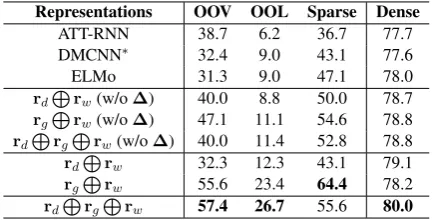
rwand rdLrgLrw (i.e., our full model). To demon-strate the effects of ∆-learning, Table 4 also shows the results of the non-∆-learning version of rdLrw,rgLrw andrdLrgLrw. In this set-ting,rdandrg are trained without using auxiliary tasks. From Table4, we can see that:
1. Previous approaches work well on dis-tilling discrimination knowledge, but poorly on distilling generalization knowledge. Previous approaches achieve high F1-scores on Dense in-stances, but their performance on sparsely labeled instances is poor. The task specific representation (ATT-RNN and DMCNN) merely achieves a sim-ilar performance with the general word represen-tationrw(ELMo).
2. ∆-learning is effective for incrementally distilling knowledge. Compared with its non-∆-learning version, rgLrw can distill general-ization knowledge, i.e., gains 8.5, 12.3 and 9.8 F1 improvements on OOV, OOL and Sparse in-stances. Andrd
L
rwcan distill more discrimina-tion knowledge than its non-∆-learning version.
3. The decomposition strategy, i.e, learn-ing and fuslearn-ing independent knowledge is ef-fective for representation learning. Through decomposition, rgLrw can capture generaliza-tion knowledge,rd
L
rw can capture discrimina-tion knowledge, which are complementary to each other. Starting from rw, our method can incre-mentally distill knowledge in both rd and rg via ∆-learning. By fusing the independent knowl-edge in rd and rg via an effective lexical gate, rd
L
rgLrw achieves the best performance on OOV, OOL and Dense instances.
5 Related Work
Event Detection. In recent years, neural ap-proaches have achieved significant progress in event detection. Most neural approaches focus on learning effective instance representations (Chen et al., 2015;Nguyen and Grishman, 2015, 2016;
Nguyen et al., 2016; Feng et al., 2016; Ghaeini et al.,2016;Lin et al.,2018b). The main drawback of these methods is that they mostly only learn a single and lexical-specific representation, which works well on distilling discrimination knowledge but poorly on generalization knowledge.
Some approaches enhance representation
learn-Representations OOV OOL Sparse Dense
ATT-RNN 38.7 6.2 36.7 77.7
DMCNN∗ 32.4 9.0 43.1 77.6
ELMo 31.3 9.0 47.1 78.0
rdLrw(w/o∆) 40.0 8.8 50.0 78.7
rgLrw(w/o∆) 47.1 11.1 54.6 78.8
rdLrgLrw(w/o∆) 40.0 11.4 52.8 78.8
rdLrw 32.3 12.3 43.1 79.1
rgLrw 55.6 23.4 64.4 78.2
[image:8.595.308.525.62.172.2]rdLrgLrw 57.4 26.7 55.6 80.0
Table 4: The results (F1-scores) of different represen-tations (ELMo as word representationrw) on different
types of trigger words. For a fair comparison, different from standard DMCNN (Chen et al.,2015) in Table1
and Table2, DMCNN∗excludes lexical feature but in-cludes entity feature.
ing using external resources. One strategy is to employ extra knowledge for better representation learning, such as document (Duan et al., 2017;
Chen et al., 2018; Liu et al., 2018b), syntactic information (Nguyen and Grishman, 2018; Sha et al., 2018; Orr et al., 2018; Liu et al., 2018c), event arguments (Liu et al., 2017), knowledge bases (Yang and Mitchell,2017;Lu and Nguyen,
2018) and multi-lingual information (Liu et al.,
2018a). The other strategy is generating addi-tional training instances from extra knowledge bases (Liu et al.,2016a;Chen et al.,2017) or news paragraph clusters (Ferguson et al., 2018). Our method does not use any external resources, which could be a good complementary to these methods.
Representation Learning via Auxiliary Learn-ing. In recent years, many auxiliary learning techniques have been proposed for better repre-sentation learning. Self-supervised learning learns representation by designing auxiliary tasks rather than using manually labeled data. Examples in-clude colorization in vision tasks (Doersch and Zisserman,2017), language modeling in text tasks (Rei,2017). Adversarial learning attempts to fool models through malicious input (Kurakin et al.,
2016), it has been broadly used in many scenar-ios, e.g., domain adaptation (Zeng et al., 2018), knowledge distillation (Qin et al., 2017) and at-tribute cleaning (Elazar and Goldberg,2018).
ad-versarial ∆-learning algorithm to eliminate lexi-cal information in event representation so that both discrimination and generalization knowledge can be incrementally distilled.
6 Conclusions
This paper proposes a new representation learn-ing framework – ∆-learning, which can distill both discrimination and generalization knowledge for event detection. Specifically, two effective ∆-learning algorithms are proposed to distill dis-crimination and generalization knowledge inpendently, and a lexical gate mechanism is de-signed to fuse different knowledge adaptively. Ex-perimental results demonstrate the effectiveness of our method. Representation learning is a funda-mental technique for NLP tasks, especially for re-solving the ambiguity and the diversity problem of natural language expressions. For future work, we plan to investigate new auxiliary∆-learning algo-rithms using our∆-learning framework.
Acknowledgments
We sincerely thank the reviewers for their valu-able comments. Moreover, this work is supported by the National Key R&D Program of China un-der Grant 2018YFB1005100; the National Nat-ural Science Foundation of China under Grants no. 61433015, 61572477 and 61772505; and the Young Elite Scientists Sponsorship Program no. YESS20160177.
References
David Ahn. 2006. The stages of event extraction. In
Proceedings of the Workshop on Annotating and Reasoning about Time and Events, pages 1–8, Syd-ney, Australia. Association for Computational Lin-guistics.
James Allan. 2012. Topic detection and tracking: event-based information organization, volume 12. Springer Science & Business Media.
Nathanael Chambers and Dan Jurafsky. 2008. Unsu-pervised learning of narrative event chains. In Pro-ceedings of ACL-08: HLT, pages 789–797. Associa-tion for ComputaAssocia-tional Linguistics.
Yubo Chen, Shulin Liu, Xiang Zhang, Kang Liu, and Jun Zhao. 2017. Automatically labeled data gener-ation for large scale event extraction. In Proceed-ings of the 55th Annual Meeting of the Association for Computational Linguistics (Volume 1: Long Pa-pers), pages 409–419, Vancouver, Canada. Associa-tion for ComputaAssocia-tional Linguistics.
Yubo Chen, Liheng Xu, Kang Liu, Daojian Zeng, and Jun Zhao. 2015. Event extraction via dy-namic multi-pooling convolutional neural networks. In Proceedings of the 53rd Annual Meeting of the Association for Computational Linguistics and the 7th International Joint Conference on Natural Lan-guage Processing (Volume 1: Long Papers), pages 167–176, Beijing, China. Association for Computa-tional Linguistics.
Yubo Chen, Hang Yang, Kang Liu, Jun Zhao, and Yan-tao Jia. 2018. Collective event detection via a hier-archical and bias tagging networks with gated multi-level attention mechanisms. In Proceedings of the 2018 Conference on Empirical Methods in Natural Language Processing, pages 1267–1276. Associa-tion for ComputaAssocia-tional Linguistics.
Carl Doersch and Andrew Zisserman. 2017. Multi-task self-supervised visual learning. InThe IEEE In-ternational Conference on Computer Vision (ICCV), pages 2051–2060.
Shaoyang Duan, Ruifang He, and Wenli Zhao. 2017.
Exploiting document level information to improve event detection via recurrent neural networks. In
Proceedings of the Eighth International Joint Con-ference on Natural Language Processing (Volume 1: Long Papers), pages 352–361. Asian Federation of Natural Language Processing.
Yanai Elazar and Yoav Goldberg. 2018. Adversarial removal of demographic attributes from text data. In Proceedings of the 2018 Conference on Empiri-cal Methods in Natural Language Processing, pages 11–21. Association for Computational Linguistics.
Xiaocheng Feng, Lifu Huang, Duyu Tang, Heng Ji, Bing Qin, and Ting Liu. 2016. A language-independent neural network for event detection. In
Proceedings of the 54th Annual Meeting of the As-sociation for Computational Linguistics (Volume 2: Short Papers), pages 66–71. Association for Com-putational Linguistics.
James Ferguson, Colin Lockard, Daniel Weld, and Hannaneh Hajishirzi. 2018. Semi-supervised event extraction with paraphrase clusters. In Proceed-ings of the 2018 Conference of the North American Chapter of the Association for Computational Lin-guistics: Human Language Technologies, Volume 2 (Short Papers), NAACL ’2018, pages 359–364. As-sociation for Computational Linguistics.
Yaroslav Ganin, Evgeniya Ustinova, Hana Ajakan, Pascal Germain, Hugo Larochelle, Franc¸ois Lavio-lette, Mario Marchand, and Victor Lempitsky. 2016.
Domain-adversarial training of neural networks. J. Mach. Learn. Res., 17(1):2096–2030.
Reza Ghaeini, Xiaoli Fern, Liang Huang, and Prasad Tadepalli. 2016. Event nugget detection with forward-backward recurrent neural networks. In
Short Papers), pages 369–373, Berlin, Germany. As-sociation for Computational Linguistics.
Ian Goodfellow, Jean Pouget-Abadie, Mehdi Mirza, Bing Xu, David Warde-Farley, Sherjil Ozair, Aaron Courville, and Yoshua Bengio. 2014. Generative ad-versarial nets. In Advances in Neural Information Processing Systems, pages 2672–2680. Curran As-sociates, Inc.
Yu Hong, Wenxuan Zhou, Jingli Zhang, Qiaoming Zhu, and Guodong Zhou. 2018. Self-regulation: Employing a generative adversarial network to im-prove event detection. InProceedings of the 56th Annual Meeting of the Association for Computa-tional Linguistics, pages 515–526. Association for Computational Linguistics.
Alexey Kurakin, Ian J. Goodfellow, and Samy Bengio. 2016.Adversarial machine learning at scale.CoRR, abs/1611.01236.
Qi Li, Heng Ji, and Liang Huang. 2013. Joint event extraction via structured prediction with global fea-tures. InProceedings of the 51st Annual Meeting of the Association for Computational Linguistics (Vol-ume 1: Long Papers), pages 73–82, Sofia, Bulgaria. Association for Computational Linguistics.
Shasha Liao and Ralph Grishman. 2010. Using doc-ument level cross-event inference to improve event extraction. InProceedings of the 48th Annual Meet-ing of the Association for Computational LMeet-inguis- Linguis-tics, pages 789–797. Association for Computational Linguistics.
Hongyu Lin, Yaojie Lu, Xianpei Han, and Le Sun. 2018a. Adaptive scaling for sparse detection in in-formation extraction. InProceedings of the 56th An-nual Meeting of the Association for Computational Linguistics, pages 1033–1043. Association for Com-putational Linguistics.
Hongyu Lin, Yaojie Lu, Xianpei Han, and Le Sun. 2018b. Nugget proposal networks for chinese event detection. InProceedings of the 56th Annual Meet-ing of the Association for Computational LMeet-inguis- Linguis-tics, pages 1565–1574. Association for Computa-tional Linguistics.
Jian Liu, Yubo Chen, and Kang Liu. 2019. Exploit-ing the ground-truth: An adversarial imitation based knowledge distillation approach for event detection. In The Thirty-Third AAAI Conference on Artificial Intelligence, AAAI ’2019. Association for the Ad-vancement of Artificial Intelligence.
Jian Liu, Yubo Chen, Kang Liu, and Jun Zhao. 2018a.
Event detection via gated multilingual attention mechanism. InThe Thirty-Second AAAI Conference on Artificial Intelligence, AAAI ’2018, pages 4865– 4872, New York, NY, USA. Association for the Ad-vancement of Artificial Intelligence.
Shaobo Liu, Rui Cheng, Xiaoming Yu, and Xueqi Cheng. 2018b. Exploiting contextual information via dynamic memory network for event detection. In Proceedings of the 2018 Conference on Empiri-cal Methods in Natural Language Processing, pages 1030–1035. Association for Computational Linguis-tics.
Shulin Liu, Yubo Chen, Shizhu He, Kang Liu, and Jun Zhao. 2016a. Leveraging framenet to improve automatic event detection. In Proceedings of the 54th Annual Meeting of the Association for Compu-tational Linguistics (Volume 1: Long Papers), pages 2134–2143, Berlin, Germany. Association for Com-putational Linguistics.
Shulin Liu, Yubo Chen, Kang Liu, and Jun Zhao. 2017.
Exploiting argument information to improve event detection via supervised attention mechanisms. In
Proceedings of the 55th Annual Meeting of the Association for Computational Linguistics (Volume 1: Long Papers), pages 1789–1798, Vancouver, Canada. Association for Computational Linguistics.
Shulin Liu, Kang Liu, Shizhu He, and Jun Zhao. 2016b.
A probabilistic soft logic based approach to exploit-ing latent and global information in event classifi-cation. InProceedings of the Thirtieth AAAI Con-ference on Artificial Intelligence, AAAI’16, pages 2993–2999. AAAI Press.
Xiao Liu, Zhunchen Luo, and Heyan Huang. 2018c.
Jointly multiple events extraction via attention-based graph information aggregation. In Proceed-ings of the 2018 Conference on Empirical Methods in Natural Language Processing, pages 1247–1256. Association for Computational Linguistics.
Weiyi Lu and Thien Huu Nguyen. 2018. Similar but not the same - word sense disambiguation improves event detection via neural representation matching. In Proceedings of the 2018 Conference on Empiri-cal Methods in Natural Language Processing, pages 4822–4828. Association for Computational Linguis-tics.
Teruko Mitamura, Zhengzhong Liu, and Eduard H Hovy. 2017. Events detection, coreference and se-quencing: What’s next? overview of the tac kbp 2017 event track.InTAC.
Thien Huu Nguyen, Kyunghyun Cho, and Ralph Gr-ishman. 2016. Joint event extraction via recurrent neural networks. InProceedings of the 2016 Con-ference of the North American Chapter of the As-sociation for Computational Linguistics: Human Language Technologies, pages 300–309, San Diego, California. Association for Computational Linguis-tics.
on Natural Language Processing (Volume 2: Short Papers), pages 365–371, Beijing, China. Associa-tion for ComputaAssocia-tional Linguistics.
Thien Huu Nguyen and Ralph Grishman. 2016. Mod-eling skip-grams for event detection with convolu-tional neural networks. InProceedings of the 2016 Conference on Empirical Methods in Natural Lan-guage Processing, pages 886–891, Austin, Texas. Association for Computational Linguistics.
Thien Huu Nguyen and Ralph Grishman. 2018. Graph convolutional networks with argument-aware pool-ing for event detection. InThe Thirty-Second AAAI Conference on Artificial Intelligence, AAAI ’2018, pages 5900–5907, New York, NY, USA. Association for the Advancement of Artificial Intelligence.
Walker Orr, Prasad Tadepalli, and Xiaoli Fern. 2018.
Event detection with neural networks: A rigorous empirical evaluation. In Proceedings of the 2018 Conference on Empirical Methods in Natural Lan-guage Processing, pages 999–1004. Association for Computational Linguistics.
Matthew Peters, Mark Neumann, Mohit Iyyer, Matt Gardner, Christopher Clark, Kenton Lee, and Luke Zettlemoyer. 2018. Deep contextualized word repre-sentations. InProceedings of the 2018 Conference of the North American Chapter of the Association for Computational Linguistics: Human Language Technologies, Volume 1 (Long Papers), pages 2227– 2237. Association for Computational Linguistics.
Lianhui Qin, Zhisong Zhang, Hai Zhao, Zhiting Hu, and Eric Xing. 2017. Adversarial connective-exploiting networks for implicit discourse relation classification. In Proceedings of the 55th Annual Meeting of the Association for Computational Lin-guistics (Volume 1: Long Papers), pages 1006– 1017, Vancouver, Canada. Association for Compu-tational Linguistics.
Marek Rei. 2017. Semi-supervised multitask learn-ing for sequence labellearn-ing. In Proceedings of the 55th Annual Meeting of the Association for Com-putational Linguistics (Volume 1: Long Papers), pages 2121–2130, Vancouver, Canada. Association for Computational Linguistics.
Lei Sha, Feng Qian, Baobao Chang, and Zhifang Sui. 2018. Jointly extracting event triggers and argu-ments by dependency-bridge rnn and tensor-based argument interaction. In The Thirty-Second AAAI Conference on Artificial Intelligence, AAAI ’2018, pages 5916–5923, New York, NY, USA. Association for the Advancement of Artificial Intelligence.
Bishan Yang and Tom Mitchell. 2017. Leveraging knowledge bases in lstms for improving machine reading. In Proceedings of the 55th Annual Meet-ing of the Association for Computational LMeet-inguistics (Volume 1: Long Papers), pages 1436–1446. Asso-ciation for Computational Linguistics.
Matthew D. Zeiler. 2012.Adadelta: An adaptive learn-ing rate method.CoRR, abs/1212.5701.
Jiali Zeng, Jinsong Su, Huating Wen, Yang Liu, Jun Xie, Yongjing Yin, and Jianqiang Zhao. 2018.