Compositional Sequence Labeling Models for Error Detection
in Learner Writing
Marek Rei
The ALTA Institute Computer Laboratory University of Cambridge
United Kingdom
Helen Yannakoudakis
The ALTA Institute Computer Laboratory University of Cambridge
United Kingdom
Abstract
In this paper, we present the first exper-iments using neural network models for the task of error detection in learner writ-ing. We perform a systematic comparison of alternative compositional architectures and propose a framework for error detec-tion based on bidirecdetec-tional LSTMs. Ex-periments on the CoNLL-14 shared task dataset show the model is able to outpform other participants on detecting er-rors in learner writing. Finally, the model is integrated with a publicly deployed self-assessment system, leading to perfor-mance comparable to human annotators.
1 Introduction
Automated systems for detecting errors in learner writing are valuable tools for second language learning and assessment. Most work in recent years has focussed on error correction, with er-ror detection performance measured as a byprod-uct of the correction output (Ng et al., 2013; Ng et al., 2014). However, this assumes that systems are able to propose a correction for every detected error, and accurate systems for correction might not be optimal for detection. While closed-class errors such as incorrect prepositions and determin-ers can be modeled with a supervised classification approach, content-content word errors are the 3rd most frequent error type and pose a serious chal-lenge to error correction frameworks (Leacock et al., 2014; Kochmar and Briscoe, 2014). Eval-uation of error correction is also highly subjec-tive and human annotators have rather low agree-ment on gold-standard corrections (Bryant and Ng, 2015). Therefore, we treat error detection in learner writing as an independent task and propose a system for labeling each token as being correct
or incorrect in context.
Common approaches to similar sequence label-ing tasks involve learnlabel-ing weights or probabilities for context n-grams of varying sizes, or relying on previously extracted high-confidence context pat-terns. Both of these methods can suffer from data sparsity, as they treat words as independent units and miss out on potentially related patterns. In ad-dition, they need to specify a fixed context size and are therefore often limited to using a small window near the target.
Neural network models aim to address these weaknesses and have achieved success in various NLP tasks such as language modeling (Bengio et al., 2003) and speech recognition (Dahl et al., 2012). Recent developments in machine transla-tion have also shown that text of varying length can be represented as a fixed-size vector using convolutional networks (Kalchbrenner and Blun-som, 2013; Cho et al., 2014a) or recurrent neu-ral networks (Cho et al., 2014b; Bahdanau et al., 2015).
In this paper, we present the first experiments using neural network models for the task of er-ror detection in learner writing. We perform a systematic comparison of alternative composi-tional structures for constructing informative con-text representations. Based on the findings, we propose a novel framework for performing er-ror detection in learner writing, which achieves state-of-the-art results on two datasets of error-annotated learner essays. The sequence labeling model creates a single variable-size network over the whole sentence, conditions each label on all the words, and predicts all labels together. The effects of different datasets on the overall perfor-mance are investigated by incrementally provid-ing additional trainprovid-ing data to the model. Finally, we integrate the error detection framework with a publicly deployed self-assessment system, leading
to performance comparable to human annotators.
2 Background and Related Work
The field of automatically detecting errors in learner text has a long and rich history. Most work has focussed on tackling specific types of errors, such as usage of incorrect prepositions (Tetreault and Chodorow, 2008; Chodorow et al., 2007), ar-ticles (Han et al., 2004; Han et al., 2006), verb forms (Lee and Seneff, 2008), and adjective-noun pairs (Kochmar and Briscoe, 2014).
However, there has been limited work on more general error detection systems that could handle all types of errors in learner text. Chodorow and Leacock (2000) proposed a method based on mu-tual information and the chi-square statistic to de-tect sequences of part-of-speech tags and func-tion words that are likely to be ungrammatical in English. Gamon (2011) used Maximum En-tropy Markov Models with a range of features, such as POS tags, string features, and outputs from a constituency parser. The pilot Helping Our Own shared task (Dale and Kilgarriff, 2011) also evaluated grammatical error detection of a num-ber of different error types, though most systems were error-type specific and the best approach was heavily skewed towards article and preposition er-rors (Rozovskaya et al., 2011). We extend this line of research, working towards general error de-tection systems, and investigate the use of neural compositional models on this task.
The related area of grammatical errorcorrection
has also gained considerable momentum in the past years, with four recent shared tasks highlight-ing several emerghighlight-ing directions (Dale and Kilgar-riff, 2011; Dale et al., 2012; Ng et al., 2013; Ng et al., 2014). The current state-of-the-art approaches can broadly be separated into two categories:
1. Phrase-based statistical machine translation techniques, essentially translating the incor-rect source text into the corincor-rected version (Felice et al., 2014; Junczys-Dowmunt and Grundkiewicz, 2014)
2. Averaged Perceptrons and Naive Bayes clas-sifiers making use of native-language error correction priors (Rozovskaya et al., 2014; Rozovskaya et al., 2013).
Error correction systems require very specialised models, as they need to generate an improved ver-sion of the input text, whereas a wider range of
tagging and classification models can be deployed on error detection. In addition, automated writing feedback systems that indicate the presence and location of errors may be better from a pedagogic point of view, rather than providing a panacea and correcting all errors in learner text. In Section 7 we evaluate a neural sequence tagging model on the latest shared task test data, and compare it to the top participating systems on the task of error detection.
3 Sequence Labeling Architectures
We construct a neural network sequence labeling framework for the task of error detection in learner writing. The model receives only a series of tokens as input, and outputs the probability of each token in the sentence being correct or incorrect in a given context. The architectures start with the vector representations of individual words, [x1, ..., xT],
where T is the length of the sentence. Different composition functions are then used to calculate a hidden vector representation of each token in con-text,[h1, ..., hT]. These representations are passed
through a softmax layer, producing a probability distribution over the possible labels for every to-ken in context:
pt=softmax(Woht) (1)
whereWois the weight matrix between the hidden
vectorhtand the output layer.
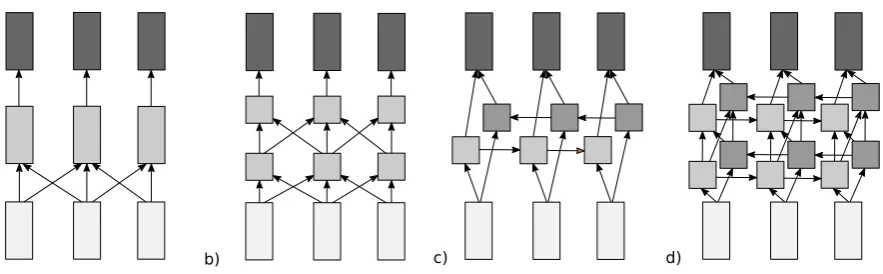
We investigate six alternative neural network ar-chitectures for the task of error detection: con-volutional, bidirectional recurrent, bidirectional LSTM, and multi-layer variants of each of them. In the convolutionalneural network (CNN, Fig-ure 1a) for token labeling, the hidden vector ht
is calculated based on a fixed-size context win-dow. The convolution acts as a feedforward net-work, using surrounding context words as input, and therefore it will learn to detect the presence of different types of n-grams. The assumption behind the convolutional architecture is that memorising erroneous token sequences from the training data is sufficient for performing error detection.
The convolution uses dw tokens on either side
of the target token, and the vectors for these tokens are concatenated, preserving the ordering:
ct=xt−dw :...:xt+dw (2)
Figure 1: Alternative neural composition architectures for error detection. a) Convolutional network b) Deep convolutional network c) Recurrent bidirectional network d) Deep recurrent bidirectional net-work. The bottom layers are embeddings for individual tokens. The middle layers are context-dependent representations, built using different composition functions. The top layers are softmax output layers, predicting a label distribution for every input token.
then passed through a non-linear layer to produce the hidden representation:
ht=tanh(Wcct) (3)
The deep convolutional network (Figure 1b) adds an extra convolutional layer to the architec-ture, using the first layer as input. It creates con-volutions of concon-volutions, thereby capturing more complex higher-order features from the dataset.
In arecurrentneural network (RNN), each hid-den representation is calculated based on the cur-rent token embedding and the hidden vector at the previous time step:
ht=f(W xt+V ht−1) (4) where f(z) is a nonlinear function, such as the sigmoid function. Instead of a fixed context win-dow, information is passed through the sentence using a recursive function and the network is able to learn which patterns to disregard or pass for-ward. This recurrent network structure is referred to as an Elman-type network, after Elman (1990). Thebidirectional RNN(Figure 1c) consists of two recurrent components, moving in opposite di-rections through the sentence. While the unidirec-tional version takes into account only context on the left of the target token, the bidirectional ver-sion recursively builds separate context represen-tations from either side of the target token. The left and right context are then concatenated and used as the hidden representation:
h→t =f(Wrxt+Vrh→t−1) (5)
h←t =f(Wlxt+Vlh←t+1) (6)
ht=h→t :h←t (7)
Recurrent networks have been shown to per-form well on the task of language modeling (Mikolov et al., 2011; Chelba et al., 2013), where they learn an incremental composition function for predicting the next token in the sequence. However, while language models can estimate the probability of each token, they are unable to differentiate between infrequent and incorrect to-ken sequences. For error detection, the compo-sition function needs to learn to identify seman-tic anomalies or ungrammaseman-tical combinations, in-dependent of their frequency. The bidirectional model provides extra information, as it allows the network to use context on both sides of the target token.
Irsoy and Cardie (2014) created an extension of this architecture by connecting together mul-tiple layers of bidirectional Elman-type recurrent network modules. Thisdeep bidirectional RNN (Figure 1d) calculates a context-dependent rep-resentation for each token using a bidirectional RNN, and then uses this as input to another bidi-rectional RNN. The multi-layer structure allows the model to learn more complex higher-level fea-tures and effectively perform multiple recurrent passes through the sentence.
two separate hidden vectors to pass information between different time steps, and includes gat-ing mechanisms for modulatgat-ing its own output. LSTMs have been successfully applied to var-ious tasks, such as speech recognition (Graves et al., 2013), machine translation (Luong et al., 2015), and natural language generation (Wen et al., 2015).
Two sets of gating values (referred to as the in-putandforgetgates) are first calculated based on the previous states of the network:
it=σ(Wixt+Uiht−1+Vfct−1+bi) (8)
ft=σ(Wfxt+Ufht−1+Vfct−1+bf) (9)
wherextis the current input,ht−1 is the previous hidden state,bi andbf are biases,ct−1 is the pre-vious internal state (referred to as thecell), andσ
is the logistic function. The new internal state is calculated based on the current input and the pre-vious hidden state, and then interpolated with the previous internal state usingftanditas weights:
e
ct=tanh(Wcxt+Ucht−1+bc) (10)
ct=ftct−1+itcet (11)
where is element-wise multiplication. Finally, the hidden state is calculated by passing the inter-nal state through atanhnonlinearity, and weight-ing it withot. The values ofotare conditioned on
the new internal state (ct), as opposed to the
previ-ous one (ct−1):
ot=σ(Woxt+Uoht−1+Voct+bo) (12)
ht=ottanh(ct) (13)
Because of the linear combination in equation (11), the LSTM is less susceptible to vanishing gradients over time, thereby being able to make use of longer context when making predictions. In addition, the network learns to modulate itself, ef-fectively using the gates to predict which operation is required at each time step, thereby incorporating higher-level features.
In order to use this architecture for error de-tection, we create a bidirectional LSTM, mak-ing use of the advanced features of LSTM and in-corporating context on both sides of the target to-ken. In addition, we experiment with adeep bidi-rectional LSTM, which includes two consecu-tive layers of bidirectional LSTMs, modeling even
more complex features and performing multiple passes through the sentence.
For comparison with non-neural models, we also report results using CRFs (Lafferty et al., 2001), which are a popular choice for sequence labeling tasks. We trained the CRF++ 1
imple-mentation on the same dataset, using as features unigrams, bigrams and trigrams in a 7-word win-dow surrouding the target word (3 words before and after). The predicted label is also conditioned on the previous label in the sequence.
4 Experiments
We evaluate the alternative network structures on the publicly released First Certificate in En-glish dataset (FCE-public, Yannakoudakis et al. (2011)). The dataset contains short texts, writ-ten by learners of English as an additional lan-guage in response to exam prompts eliciting free-text answers and assessing mastery of the upper-intermediate proficiency level. The texts have been manually error-annotated using a taxonomy of 77 error types. We use the released test set for evaluation, containing 2,720 sentences, leaving 30,953 sentences for training. We further separate 2,222 sentences from the training set for develop-ment and hyper-parameter tuning.
The dataset contains manually annotated error spans of various types of errors, together with their suggested corrections. We convert this to a token-level error detection task by labeling each token inside the error span as being incorrect. In order to capture errors involving missing words, the error label is assigned to the token immediately after the incorrect gap – this is motivated by the intuition that while this token is correct when considered in isolation, it is incorrect in the current context, as another token should have preceeded it.
As the main evaluation measure for error de-tection we use F0.5, which was also the measure adopted in the CoNLL-14 shared task on error cor-rection (Ng et al., 2014). It combines both pre-cision and recall, while assigning twice as much weight to precision, since accurate feedback is often more important than coverage in error de-tection applications (Nagata and Nakatani, 2010). Following Chodorow et al. (2012), we also report raw counts for predicted and correct tokens. Re-lated evaluation measures, such as theM2-scorer (Ng et al., 2014) and the I-measure (Felice and
Development Test
P R F0.5 predicted correct P R F0.5
CRF 62.2 13.6 36.3 914 516 56.5 8.2 25.9
CNN 52.4 24.9 42.9 3518 1620 46.0 25.7 39.8
Deep CNN 48.4 26.2 41.4 3992 1651 41.4 26.2 37.1
Bi-RNN 63.9 18.0 42.3 2333 1196 51.3 19.0 38.2
Deep Bi-RNN 60.3 17.6 40.6 2543 1255 49.4 19.9 38.1
Bi-LSTM 54.5 28.2 46.0 3898 1798 46.1 28.5 41.1
[image:5.595.70.530.64.202.2]Deep Bi-LSTM 56.7 21.3 42.5 2822 1359 48.2 21.6 38.6
Table 1: Performance of the CRF and alternative neural network structures on the public FCE dataset for token-level error detection in learner writing.
Briscoe, 2015), require the system to propose a correction and are therefore not directly applica-ble on the task of error detection.
During the experiments, the input text was low-ercased and all tokens that occurred less than twice in the training data were represented as a single
unk token. Word embeddings were set to size
300and initialised using the publicly released pre-trained Word2Vec vectors (Mikolov et al., 2013). The convolutional networks use window size 3
on either side of the target token and produce a 300-dimensional context-dependent vector. The recurrent networks use hidden layers of size 200 in either direction. We also added an extra hid-den layer of size 50between each of the compo-sition functions and the output layer – this allows the network to learn a separate non-linear trans-formation and reduces the dimensionality of the compositional vectors. The parameters were opti-mised using gradient descent with initial learning rate0.001, theADAMalgorithm (Kingma and Ba,
2015) for dynamically adapting the learning rate, and batch size of 64 sentences. F0.5 on the devel-opment set was evaluated at each epoch, and the best model was used for final evaluations.
5 Results
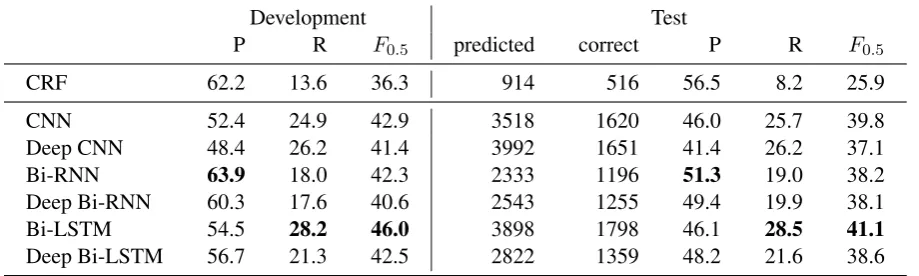
Table 1 contains results for experiments compar-ing different composition architectures on the task of error detection. The CRF has the lowest F0.5 score compared to any of the neural models. It memorises frequent error sequences with high pre-cision, but does not generalise sufficiently, result-ing in low recall. The ability to condition on the previous label also does not provide much help on this task – there are only two possible labels and the errors are relatively sparse.
The architecture using convolutional networks performs well and achieves the second-highest re-sult on the test set. It is designed to detect error patterns from a fixed window of 7 words, which is large enough to not require the use of more advanced composition functions. In contrast, the performance of the bidirectional recurrent network (Bi-RNN) is somewhat lower, especially on the test set. In Elman-type recurrent networks, the context signal from distant words decreases fairly rapidly due to the sigmoid activation function and diminishing gradients. This is likely why the Bi-RNN achieves the highest precision of all sys-tems – the predicted label is mostly influenced by the target token and its immediate neighbours, allowing the network to only detect short high-confidence error patterns. The convolutional net-work, which uses 7 context words with equal at-tention, is able to outperform the Bi-RNN despite the fixed-size context window.
The best overall result and highest F0.5 is achieved by the bidirectional LSTM composition model (Bi-LSTM). This architecture makes use of the full sentence for building context vectors on both sides of the target token, but improves on Bi-RNN by utilising a more advanced composition function. Through the application of a linear up-date for the internal cell representation, the LSTM is able to capture dependencies over longer dis-tances. In addition, the gating functions allow it to adaptively decide which information to include in the hidden representations or output for error de-tection.
Ir-Training data DevF0.5 TestF0.5
FCE-public 46.0 41.1
+NUCLE 39.0 41.0
+IELTS 45.6 50.7
+FCE 57.2 61.1
+CPE 59.0 62.1
+CAE 60.7 64.3
Table 2: Results on the public FCE test set when incrementally providing more training data to the error detection model.
soy and Cardie (2014), who experimented with Elman-type networks and found some improve-ments using multiple layers of Bi-RNNs. The dif-ferences can be explained by their task benefiting from alternative features: the evaluation was per-formed on opinion mining where most target se-quences are longer phrases that need to be identi-fied based on their semantics, whereas many errors in learner writing are short and can only be iden-tified by a contextual mismatch. In addition, our networks contain an extra hidden layer before the output, which allows the models to learn higher-level representations without adding complexity through an extra compositional layer.
6 Additional Training Data
There are essentially infinitely many ways of com-mitting errors in text and introducing additional training data should alleviate some of the prob-lems with data sparsity. We experimented with in-crementally adding different error-tagged corpora into the training set and measured the resulting performance. This allows us to provide some con-text to the results obtained by using each of the datasets, and gives us an estimate of how much annotated data is required for optimal performance on error detection. The datasets we consider are as follows:
• FCE-public – the publicly released subset of FCE (Yannakoudakis et al., 2011), as de-scribed in Section 4.
• NUCLE – the NUS Corpus of Learner En-glish (Dahlmeier et al., 2013), used as the main training set for CoNLL shared tasks on error correction.
• IELTS – a subset of the IELTS examina-tion dataset extracted from the Cambridge
Learner Corpus (CLC, Nicholls (2003)), con-taining 68,505 sentences from all proficiency levels, also used by Felice et al. (2014).
• FCE – a larger selection of FCE texts from the CLC, containing 323,192 sentences.
• CPE – essays from the proficient examination level in the CLC, containing 210,678 sen-tences.
• CAE – essays from the advanced examina-tion level in the CLC, containing 219,953 sentences.
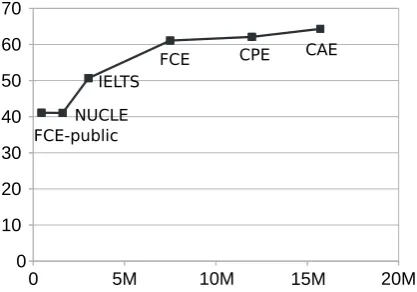
[image:6.595.312.521.443.589.2]Table 2 contains results obtained by incremen-tally adding training data to the Bi-LSTM model. We found that incorporating the NUCLE dataset does not improve performance over using only the FCE-public dataset, which is likely due to the two corpora containing texts with different domains and writing styles. The texts in FCE are writ-ten by young intermediate students, in response to prompts eliciting letters, emails and reviews, whereas NUCLE contains mostly argumentative essays written by advanced adult learners. The differences in the datasets offset the benefits from additional training data, and the performance re-mains roughly the same.
Figure 2:F0.5measure on the public FCE test set, as a function of the total number of tokens in the training set.
Annotation 1 Annotation 2 predicted correct P R F0.5 correct P R F0.5
Annotator 1 2992 - - - - 1800 60.2 42.9 55.7
Annotator 2 4199 1800 42.9 60.2 45.5 - - -
-CAMB 2170 731 33.7 24.4 31.3 1052 48.5 25.1 40.8
CUUI 1582 550 34.8 18.4 29.5 755 47.7 18.0 35.9
AMU 1260 479 38.0 16.0 29.8 643 51.0 15.3 34.8
P1+P2+S1+S2 887 388 43.7 13.0 29.7 535 60.3 12.7 34.5 Bi-LSTM (FCE-public) 4449 683 15.4 22.8 16.4 1052 23.6 25.1 23.9 Bi-LSTM (full) 1540 627 40.7 21.0 34.3 911 59.2 21.7 44.0
Table 3: Error detection results on the two official annotations for the CoNLL-14 shared task test dataset.
high-proficiency essays in CPE and CAE only pro-vides minor further improvements.
Figure 2 also showsF0.5on the FCE-public test set as a function of the total number of tokens in the training data. The optimal trade-off between performance and data size is obtained at around 8 million tokens, after introducing the FCE dataset.
7 CoNLL-14 Shared Task
The CoNLL-14 shared task (Ng et al., 2014) focussed on automatically correcting errors in learner writing. The NUCLE dataset was pro-vided as the main training dataset, but participants were allowed to include other annotated corpora and external resources. For evaluation, 25 stu-dents were recruited to each write two new essays, which were then annotated by two experts.
We used the same methods from Section 4 for converting the shared task annotation to a token-level labeling task in order to evaluate the mod-els on error detection. In addition, the correction outputs of all the participating systems were made available online, therefore we are able to report their performance on this task. In order to con-vert their output to error detection labels, the cor-rected sentences were aligned with the original in-put using Levenshtein distance, and any changes proposed by the system resulted in the correspond-ing source words becorrespond-ing labeled as errors.
The results on the two annotations of the shared task test data can be seen in Table 3. We first eval-uated each of the human annotators with respect to the other, in order to estimate the upper bound on this task. The averageF0.5 of roughly 50% shows that the task is difficult and even human experts have a rather low agreement. It has been shown
before that correcting grammatical errors is highly subjective (Bryant and Ng, 2015), but these results indicate that trained annotators can disagree even on the number and location of errors.
In the same table, we provide error detection re-sults for the top 3 participants in the shared task: CAMB (Felice et al., 2014), CUUI (Rozovskaya et al., 2014), and AMU (Junczys-Dowmunt and Grundkiewicz, 2014). They each preserve their relative ranking also in the error detection evalu-ation. The CAMB system has a lower precision but the highest recall, also resulting in the highest
F0.5. CUUI and AMU are close in performance, with AMU having slightly higher precision.
After the official shared task, Susanto et al. (2014) published a system which combines several alternative models and outperforms the shared task participants when evaluated on error correction. However, on error detection it receives lower re-sults, ranking 3rd and 4th when evaluated onF0.5 (P1+P2+S1+S2 in Table 3). The system has de-tected a small number of errors with high preci-sion, and does not reach the highestF0.5.
When trained on all the datasets from Section 6, the model achieves the highestF0.5 of all sys-tems on both of the CoNLL-14 shared task test annotations, with an absolute improvement of3%
over the previous best result. It is worth noting that the full Bi-LSTM has been trained on more data than the other CoNLL contestants. However, as the shared task systems were not restricted to the NUCLE training set, all the submissions also used differing amounts of training data from vari-ous sources. In addition, the CoNLL systems are mostly combinations of many alternative models: the CAMB system is a hybrid of machine transla-tion, a rule-based system, and a language model re-ranker; CUUI consists of different classifiers for each individual error type; and P1+P2+S1+S2 is a combination of four different error correction systems. In contrast, the Bi-LSTM is a single model for detecting all error types, and therefore represents a more scalable data-driven approach.
8 Essay Scoring
In this section, we perform an extrinsic evalua-tion of the efficacy of the error detecevalua-tion system and examine the extent to which it generalises at higher levels of granularity on the task of auto-mated essay scoring. More specifically, we repli-cate experiments using the text-level model de-scribed by Andersen et al. (2013), which is cur-rently deployed in a self-assessment and tutoring system (SAT), an online automated writing feed-back tool actively used by language learners.2
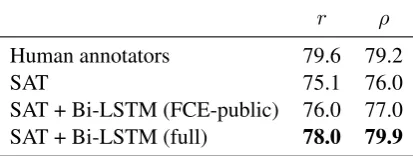
The SAT system predicts an overall score for a given text, which provides a holistic assessment of linguistic competence and language proficiency. The authors trained a supervised ranking percep-tron model on the FCE-public dataset, using fea-tures such as error-rate estimates from a language model and various lexical and grammatical prop-erties of text (e.g., word n-grams, part-of-speech n-grams and phrase-structure rules). We replicate this experiment and add the average probability of each token in the essay being correct, accord-ing to the error detection model, as an additional feature for the scoring framework. The system was then retrained on FCE-public and evaluated on correctly predicting the assigned essay score. Table 4 presents the experimental results.
The human performance on the test set is
cal-2
http://www.cambridgeenglish.org/learning-english/free-resources/write-and-improve/
r ρ
Human annotators 79.6 79.2
SAT 75.1 76.0
[image:8.595.313.520.64.142.2]SAT + Bi-LSTM (FCE-public) 76.0 77.0 SAT + Bi-LSTM (full) 78.0 79.9
Table 4: Pearson’s correlation r and Spearman’s correlationρon the public FCE test set on the task of automated essay scoring.
culated as the average inter-annotator correlation on the same data, and the existing SAT system has demonstrated levels of performance that are very close to that of human assessors. Nevertheless, the Bi-LSTM model trained only on FCE-public complements the existing features, and the com-bined model achieves an absolute improvement of around 1% percent, corresponding to 20-31% rela-tive error reduction with respect to the human per-formance. Even though the Bi-LSTM is trained on the same dataset and the SAT system already includes various linguistic features for capturing errors, our error detection model manages to fur-ther improve its performance.
When the Bi-LSTM is trained on all the avail-able data from Section 6, the combination achieves further substantial improvements. The relative er-ror reduction on Pearson’s correlation is 64%, and the system actually outperforms human annotators on Spearman’s correlation.
9 Conclusions
In this paper, we presented the first experiments using neural network models for the task of er-ror detection in learner writing. Six alternative compositional network architectures for modeling context were evaluated. Based on the findings, we propose a novel error detection framework us-ing token-level embeddus-ings, bidirectional LSTMs for context representation, and a multi-layer archi-tecture for learning more complex features. This structure allows the model to classify each token as being correct or incorrect, using the full sen-tence as context. The self-modulation architecture of LSTMs was also shown to be beneficial, as it al-lows the network to learn more advanced composi-tion rules and remember dependencies over longer distances.
datasets. We found that the largest benefit was ob-tained from training on 8 million tokens of text from learners with varying levels of language pro-ficiency. In contrast, including even more data from higher-proficiency learners gave marginal further improvements. As part of future work, it would be beneficial to investigate the effect of au-tomatically generated training data for error detec-tion (e.g., Rozovskaya and Roth (2010)).
We evaluated the performance of existing error correction systems from CoNLL-14 on the task of error detection. The experiments showed that suc-cess on error correction does not nesuc-cessarily mean success on error detection, as the current best cor-rection system (P1+P2+S1+S2) is not the same as the best shared task detection system (CAMB). In addition, the neural sequence tagging model, spe-cialised for error detection, was able to outperform all other participating systems.
Finally, we performed an extrinsic evaluation by incorporating probabilities from the error detec-tion system as features in an essay scoring model. Even without any additional data, the combina-tion further improved performance which is al-ready close to the results from human annotators. In addition, when the error detection model was trained on a larger training set, the essay scorer was able to exceed human-level performance.
Acknowledgments
We would like to thank Prof Ted Briscoe and the reviewers for providing useful feedback.
References
Øistein E. Andersen, Helen Yannakoudakis, Fiona Barker, and Tim Parish. 2013. Developing and test-ing a self-assessment and tutortest-ing system. Proceed-ings of the Eighth Workshop on Innovative Use of NLP for Building Educational Applications.
Dzmitry Bahdanau, Kyunghyun Cho, and Yoshua Ben-gio. 2015. Neural Machine Translation by Jointly
Learning to Align and Translate. In International
Conference on Learning Representations.
Yoshua Bengio, R´ejean Ducharme, Pascal Vincent, and Christian Janvin. 2003. A Neural Probabilistic
Lan-guage Model Yoshua. Journal of Machine Learning
Research, 3.
Christopher Bryant and Hwee Tou Ng. 2015. How Far are We from Fully Automatic High Quality
Gram-matical Error Correction? In Proceedings of the
53rd Annual Meeting of the Association for Compu-tational Linguistics and the 7th International Joint Conference on Natural Language Processing.
Ciprian Chelba, Tom´aˇs Mikolov, Mike Schuster, Qi Ge, Thorsten Brants, Phillipp Koehn, and Tony Robin-son. 2013. One Billion Word Benchmark for Mea-suring Progress in Statistical Language Modeling. InarXiv preprint.
Kyunghyun Cho, Bart van Merrienboer, Dzmitry Bah-danau, and Yoshua Bengio. 2014a. On the Prop-erties of Neural Machine Translation:
Encoder-Decoder Approaches. InEighth Workshop on
Syn-tax, Semantics and Structure in Statistical Transla-tion.
Kyunghyun Cho, Bart van Merrienboer, Caglar Gul-cehre, Dzmitry Bahdanau, Fethi Bougares, Holger Schwenk, and Yoshua Bengio. 2014b. Learn-ing Phrase Representations usLearn-ing RNN Encoder-Decoder for Statistical Machine Translation. In
Conference on Empirical Methods in Natural Lan-guage Processing (EMNLP 2014).
Martin Chodorow and Claudia Leacock. 2000. An unsupervised method for detecting grammatical er-rors. InProceedings of the first conference on North American chapter of the Association for Computa-tional Linguistics.
Martin Chodorow, Joel R. Tetreault, and Na-Rae Han.
2007. Detection of grammatical errors
involv-ing prepositions. In Proceedings of the 4th
ACL-SIGSEM Workshop on Prepositions.
Martin Chodorow, Markus Dickinson, Ross Israel, and Joel Tetreault. 2012. Problems in evaluating
gram-matical error detection systems. InCOLING 2012.
George. E. Dahl, Dong Yu, Li Deng, and Alex Acero. 2012. Context-Dependent Pre-Trained Deep Neu-ral Networks for Large-Vocabulary Speech
Recog-nition. IEEE Transactions on Audio, Speech, and
Language Processing, 20.
Daniel Dahlmeier, Hwee Tou Ng, and Siew Mei Wu. 2013. Building a large annotated corpus of learner
English: The NUS corpus of learner English.
Pro-ceedings of the Eighth Workshop on Innovative Use of NLP for Building Educational Applications. Robert Dale and Adam Kilgarriff. 2011. Helping Our
Own: The HOO 2011 Pilot Shared Task. In
Pro-ceedings of the 13th European Workshop on Natural Language Generation.
Robert Dale, Ilya Anisimoff, and George Narroway. 2012. HOO 2012: A report on the Preposition and
Determiner Error Correction Shared Task. In The
Seventh Workshop on Building Educational Appli-cations Using NLP.
Jeffrey L. Elman. 1990. Finding structure in time.
Mariano Felice and Ted Briscoe. 2015. Towards a standard evaluation method for grammatical error
detection and correction. InThe 2015 Annual
Con-ference of the North American Chapter of the ACL. Mariano Felice, Zheng Yuan, Øistein E. Andersen,
He-len Yannakoudakis, and Ekaterina Kochmar. 2014. Grammatical error correction using hybrid systems
and type filtering. Conference on Computational
Natural Language Learning: Shared Task (CoNLL-2014).
Michael Gamon. 2011. High-Order Sequence
Model-ing for Language Learner Error Detection.
Proceed-ings of the Sixth Workshop on Innovative Use of NLP for Building Educational Applications.
Alex Graves, Navdeep Jaitly, and Abdel Rahman Mo-hamed. 2013. Hybrid speech recognition with
Deep Bidirectional LSTM. In IEEE Workshop on
Automatic Speech Recognition and Understanding (ASRU 2013).
Na-Rae Han, Martin Chodorow, and Claudia Leacock. 2004. Detecting Errors in English Article Usage with a Maximum Entropy Classifier Trained on a
Large, Diverse Corpus. Proceedings of the 4th
In-ternational Conference on Language Resources and Evaluation.
Na-Rae Han, Martin Chodorow, and Claudia Leacock. 2006. Detecting errors in English article usage by
non-native speakers. Natural Language
Engineer-ing, 12.
Sepp Hochreiter and J¨urgen Schmidhuber. 1997. Long
Short-term Memory.Neural Computation, 9.
Ozan Irsoy and Claire Cardie. 2014. Opinion Mining
with Deep Recurrent Neural Networks. In
EMNLP-2014.
Marcin Junczys-Dowmunt and Roman Grundkiewicz.
2014. The AMU System in the CoNLL-2014
Shared Task: Grammatical Error Correction by Data-Intensive and Feature-Rich Statistical Machine
Translation. Proceedings of the Eighteenth
Confer-ence on Computational Natural Language Learn-ing: Shared Task (CoNLL-2014).
Nal Kalchbrenner and Phil Blunsom. 2013. Recurrent
Continuous Translation Models. InProceedings of
the 2013 Conference on Empirical Methods in Nat-ural Language Processing (EMNLP 2013).
Diederik P. Kingma and Jimmy Lei Ba. 2015. Adam:
a Method for Stochastic Optimization. In
Interna-tional Conference on Learning Representations. Ekaterina Kochmar and Ted Briscoe. 2014.
De-tecting Learner Errors in the Choice of Content Words Using Compositional Distributional
Seman-tics. InProceedings of COLING 2014, the 25th
In-ternational Conference on Computational Linguis-tics: Technical Papers.
John Lafferty, Andrew McCallum, and Fernando Pereira. 2001. Conditional random fields: Prob-abilistic models for segmenting and labeling
se-quence data. In Proceedings of the 18th
Interna-tional Conference on Machine Learning. Citeseer.
Claudia Leacock, Martin Chodorow, Michael Gamon,
and Joel R. Tetreault. 2014. Automated
Grammati-cal Error Detection for Language Learners: Second Edition.
John Lee and Stephanie Seneff. 2008. Correcting
mis-use of verb forms. InProceedings of the 46th
An-nual Meeting of the ACL.
Mnih-Thang Luong, Hieu Pham, and Christopher D. Manning. 2015. Effective Approaches to
Attention-based Neural Machine Translation. InProceedings
of the 2015 Conference on Empirical Methods in Natural Language Processing.
Tom´aˇs Mikolov, Stefan Kombrink, Anoop
Deo-ras, Luk´aˇs Burget, and Jan ˇCernock´y. 2011.
RNNLM-Recurrent neural network language
mod-eling toolkit. InASRU 2011 Demo Session.
Tom´aˇs Mikolov, Greg Corrado, Kai Chen, and Jeffrey Dean. 2013. Efficient Estimation of Word
Rep-resentations in Vector Space. Proceedings of the
International Conference on Learning Representa-tions (ICLR 2013).
Ryo Nagata and Kazuhide Nakatani. 2010. Evaluating performance of grammatical error detection to max-imize learning effect. Coling 2010: Poster Volume.
Hwee Tou Ng, Yuanbin Wu, and Christian Hadiwinoto. 2013. The CoNLL-2013 Shared Task on
Grammat-ical Error Correction. Computational Natural
Lan-guage Learning (CoNLL), Shared Task.
Hwee Tou Ng, Siew Mei Wu, Ted Briscoe, Christian Hadiwinoto, Raymond Hendy Susanto, and Christo-pher Bryant. 2014. The CoNLL-2014 Shared Task
on Grammatical Error Correction. InProceedings of
the Eighteenth Conference on Computational Natu-ral Language Learning: Shared Task.
Diane Nicholls. 2003. The Cambridge Learner Cor-pus - error coding and analysis for lexicography and ELT. Proceedings of the Corpus Linguistics 2003 Conference.
Alla Rozovskaya and Dan Roth. 2010. Training Paradigms for Correcting Errors in Grammar and
Usage. Human Language Technologies: The 2010
Annual Conference of the North American Chapter of the Association for Computational Linguistics.
Alla Rozovskaya, Mark Sammons, Joshua Gioja, and Dan Roth. 2011. University of Illinois System in
HOO Text Correction Shared Task. Proceedings of
Alla Rozovskaya, Kai-Wei Chang, Mark Sammons, and Dan Roth. 2013. The University of Illinois
System in the CoNLL-2013 Shared Task. In
Pro-ceedings of the Seventeenth Conference on Compu-tational Natural Language Learning: Shared Task. Alla Rozovskaya, Kai-Wei Chang, Mark Sammons,
Dan Roth, and Nizar Habash. 2014. The Illinois-Columbia System in the CoNLL-2014 Shared Task.
Proceedings of the Eighteenth Conference on Com-putational Natural Language Learning: Shared Task (CoNLL-2014).
Raymond Hendy Susanto, Peter Phandi, and Hwee Tou Ng. 2014. System Combination for Grammatical
Error Correction. Proceedings of the 2014
Con-ference on Empirical Methods in Natural Language Processing (EMNLP-2014).
Joel R. Tetreault and Martin Chodorow. 2008. The Ups and Downs of Preposition Error Detection in
ESL Writing. Proceedings of the 22nd International
Conference on Computational Linguistics (Coling 2008).
Tsung-Hsien Wen, Milica Gasic, Nikola Mrksic, Pei-Hao Su, David Vandyke, and Steve Young. 2015. Semantically Conditioned LSTM-based Nat-ural Language Generation for Spoken Dialogue
Sys-tems. EMNLP 2015.
Helen Yannakoudakis, Ted Briscoe, and Ben Medlock. 2011. A New Dataset and Method for
Automati-cally Grading ESOL Texts. In Proceedings of the