Robust Feature Extraction to Utterance Fluctuation of Articulation Disorders
Based on Random Projection
Toshiya Yoshioka, Tetsuya Takiguchi, Yasuo Ariki
Graduate School of System Informatics, Kobe University, Japan
[email protected], [email protected], [email protected]
Abstract
We investigated the speech recognition of a person with an ar-ticulation disorder resulting from the athetoid type of cerebral palsy. The articulation of the first speech tends to become un-stable due to strain on speech-related muscles, and that causes degradation of speech recognition. In this paper, we introduce a robust feature extraction method based on PCA (Principal Com-ponent Analysis) and RP (Random Projection) for dysarthric speech recognition. PCA-based feature extraction performs re-ducing the influence of the unstable speaking style caused by the athetoid symptoms. Moreover, we investigate the feasibil-ity of random projection for feature transformation in order to gain more performance in dysarthric speech recognition task. Its effectiveness is confirmed by word recognition experiments. Index Terms: articulation disorders, speech recognition, PCA, random projection, ROVER
1. Introduction
Recently, the importance of information technology in the welfare-related fields has increased. For example, sign language recognition using image recognition technology [1][2][3], text-reading systems from natural scene images [4][5][6], and the design of wearable speech synthesizers for voice disorders [7] [8] have been studied.
There are 34,000 people with speech impediments associ-ated with articulation disorders in Japan alone, and it is hoped that speech recognition systems will one day be able to recog-nize their voices. One of the causes of speech impediments is cerebral palsy. Cerebral palsy results from damage to the central nervous system, and the damage causes movement disorders. Three general times are given for the onset of the disorder: be-fore birth, at the time of delivery, and after birth. Cerebral palsy is classified as follows: 1) spastic type 2) athetoid type 3) ataxic type 4) atonic type 5) rigid type, and a mixture of types [9].
In this paper, we focused on a person with an articula-tion disorder resulting from the athetoid type of cerebral palsy. Athetoid symptoms develop in about 10-15% of cerebral palsy sufferers. In the case of a person with this type of articulation disorder, the first movements are sometimes more unstable than usual. That means, in the case of speaking-related movements, the first utterance is often unstable or unclear due to the athetoid symptoms, and that causes degradation of speech recognition. Therefore, we recorded speech data for a person with an artic-ulation disorder who uttered each of the words five times, and investigated the influence of the unstable speaking style caused by the athetoid symptoms.
The goal of front-end speech processing in ASR is to ob-tain a projection of the speech signal to a compact parameter space where the information related to speech content can be
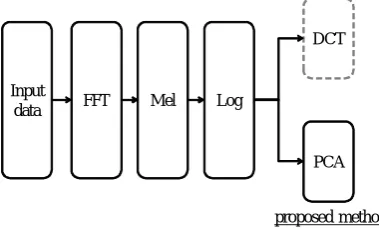
ex-tracted. In current speech recognition technology, MFCC (Mel-Frequency Cepstrum Coefficient) is being widely used. The fea-ture is uniquely derived from the mel-scale filter-bank output by DCT (Discrete Cosine Transform). The low-order MFCCs ac-count for the slowly changing spectral envelope, while the high-order ones describe the fast variations of the spectrum. There-fore, a large number of MFCCs is not used for speech recogni-tion because we are only interested in the spectral envelope, not in the fine structure. In [10], PCA-based feature extraction has been studied. Also, [11] proposed a robust feature extraction method based on PCA instead of DCT in a dysarthric speech recognition task, where the main stable utterance element is projected onto low-order features while fluctuation elements of speech style are projected onto high-order ones. Therefore, the PCA-based filter will be able to extract stable utterance features only (Fig. 1). The proposed method improved the recognition accuracy, but the performance was not sufficient when com-pared to that of persons with no disability.
Random projection has been suggested as a means of space mapping, where a projection matrix is composed of the columns defined by the random values chosen from a probability distri-bution. In addition, the Euclidean distance of any two points is approximately preserved through the projection. Therefore, random projection has also been suggested as a means of dimen-sionality reduction [12]. In contrast to conventional techniques such as PCA, which find a subspace by optimizing certain cri-teria, random projection does not use such criteria; therefore, it is data independent. Moreover, it represents a computation-ally simple and efficient method that preserves the structure of the data without introducing significant distortion [13]. Goel et al [13] have reported that random projection has been applied to various types of problems, including information retrieval (e.g., [14]), image processing (e.g., [15][16]), machine learning (e.g., [17][18][19]), and so on. Although it is based on a simple idea, random projection has demonstrated good performance in a number of applications, yielding results comparable to con-ventional dimensionality reduction techniques, such as PCA.
feature.
The rest of this paper is organized as follows. Section 2 describes a PCA-based feature extraction method. In Section 3, the proposed feature projection method using random or-thogonal matrices, and, a vote-based combination method are explained. Results and discussion for the experiments on a dysarthric speech recognition task are given in Section 4. Sec-tion 5, concludes the paper with a summary of our proposed method, contribution, and future work.
1st utterance 2nd~5th utterances
Unstable because of athetoid symptoms
More stable than 1st utterance
[image:2.595.72.262.317.432.2]adapt
Figure 1: Corrective strategy for articulation disorders.
Input
data FFT Mel Log
PCA DCT
[image:2.595.331.519.550.699.2]proposed method
Figure 2: Feature extraction using PCA.
2. Feature extraction using PCA
Robust feature extraction was proposed based on PCA with the more stable utterance data instead of DCT (Fig. 2), where PCA is applied to the mel-scale filter bank output [11].
In this paper, we computed the filter (eigenvector matrix) using the more stable utterance. Then we applied the filtering operation to the first utterance (unstably articulated utterance) in the log-spectral domain. Given the frame of short-time analysis tand frequencyω, we represent the first utteranceYt(ω)as the
multiplication of the stable speechXt(ω) and the fluctuation
element of speaking styleH(ω)in the linear-spectral domain:
Yt(ω) =Xt(ω)·H(ω) (1)
The multiplication can be converted to addition in the log-spectral domain as follows:
logYt(ω) = logXt(ω) + logH(ω) (2)
Next, we use the following filtering based on PCA in order to extract the feature of stable speech only:
ˆ
X=VTYlog (3)
For the filter (eigenvector matrix),Vis derived by the eigen-value decomposition of the centered covariance matrix of a sta-ble speech data set, in which the filter consists of the eigenvec-tors corresponding to theDdominant eigenvalues.
3. Proposed method
3.1. RP-based feature projection methodThis section presents a feature projection method using random orthogonal matrices. The main idea of random projection arises from the Johnson-Lindenstrauss lemma [21]; namely, if origi-nal data are projected onto a randomly selected subspace using a random matrix, then the distances between the data are ap-proximately preserved.
Random projection is a simple yet powerful technique, and it has another benefit. Dasgupta [17] has reported that even if distributions of original data are highly skewed (have ellipsoidal contours of high eccentricity); their transformed counterparts will be more spherical.
First, we choose ann-dimensional random vector,p, and letP(l)be thel-thn
×dmatrix whose columns are vectors,p(1l),
p(2l), . . . ,p (l)
d . Then, an originaln-dimensional vector, x, is
projected onto ad-dimensional subspace using thel-th random matrix, P(l), where we compute a d-dimensional vector, x′, whose coordinates are the inner productsx′1=p(1l)·x, . . . ,x′d
=p(dl)·x.
x′=P(l)Tx (4)
In this paper, we investigate the feasibility of random pro-jection for speech feature transformation. As described above, a random projection fromndimensions tod(=n) dimensions is represented by ann×dmatrix,P. It has been shown that if the random matrixPis chosen from the standard normal distribu-tion (with mean 0 and variance 1, referred to asN(0,1)), then the projection preserves the structure of the data [21]. In this paper, we useN(0,1)for the distribution of the coordinates. The random matrix,P, can be calculated using the following algorithm [13][17].
• Choose each entry of the matrix from an independent and identically distributed (i.i.d.)N(0,1)value.
• Make the orthogonal matrix using the Gram-Schmidt al-gorithm, and then normalize it to unit length.
Orthogonality is effective for feature extraction because the HMMs used in speech recognition experiments consist of di-agonal covariance matrices. Fig. 3 shows examples of random matrices fromN(0,1).
2222 4444 6666 8888 10101010 12121212 2222 4444 6666 8888 10 10 10 10 12 12 12 12
2222 4444 6666 8888 10101010 12121212 2222 4444 6666 8888 10 10 10 10 12 12 12 12
2222 4444 6666 8888 10101010 12121212 2222 4444 6666 8888 10 10 10 10 12 12 12 12
2222 4444 6666 8888 10101010 12121212 2222 4444 6666 8888 10 10 10 10 12 12 12 12 -0.4 -0.4-0.4 -0.4 -0.2 -0.2-0.2 -0.2 0000 0.2 0.20.2 0.2 0.4 0.40.4 0.4 0.6 0.60.6 0.6 -0.4 -0.4-0.4 -0.4 -0.2 -0.2-0.2 -0.2 0000 0.2 0.20.2 0.2 0.4 0.40.4 0.4 0.6 0.60.6 0.6 -0.4 -0.4 -0.4 -0.4 -0.2 -0.2 -0.2 -0.2 0000 0.2 0.2 0.2 0.2 0.4 0.4 0.4 0.4 0.6 0.6 0.6 0.6 -0.4 -0.4 -0.4 -0.4 -0.2 -0.2 -0.2 -0.2 0000 0.2 0.2 0.2 0.2 0.4 0.4 0.4 0.4 0.6 0.6 0.6 0.6
X
● ● ●
● ● ●
Various random matrices
Original feature space
Projected feature space
(1) X
(2) X
(3) X
24681012
2
4
6
8
10
12
24681012
2
4
6
8
10
12
24681012
2
4
6
8
10
12
(2) (1)
(3)
Figure 4: Random projection on the feature domain. An origi-nal feature is transformed to various features using various ran-dom matrices. (Eq. 4)
3.2. Vote-based combination
As mentioned in the previous section, we can make many (infi-nite) random matrices fromN(0,1)(Fig. 4). Since there may be some possibility of finding a random matrix that gives bet-ter performance, we will have to select the optimal matrix or the optimal recognition result from them. To obtain the optimal result, a majority vote-based combination is introduced in this paper, where ROVER combination is applied to the results from the ASR systems created from each RP-based feature.
Fig. 5 shows an overview of the vote-based combination. First, random matrices, P(l) (l = 1, ..., L), are chosen from the standard normal distribution, with mean 0 and variance 1. Speech features are projected using each random matrix. An acoustic model corresponding to each random matrix is also trained. For the test utterance, using each acoustic model, an ASR system outputs the best scoring word by itself. To obtain an optimal result from among all the results for random projec-tion, voting is performed by counting the number of occurrences of the best word for each RP-based feature.
For example, in the case ofL= 20, 20 kinds of new feature vectors are calculated using 20 kinds of random matrices. Then, we train the 20 kinds of acoustic models using 20 kinds of new feature vectors. In the test process, 20 kinds of recognition re-sults are obtained using 20 kinds of acoustic models. To obtain a single hypothesis from among 20 kinds of recognition results, voting is performed.
Speech feature
● ● ●
Random matrix: 1
Random matrix: 2
Random matrix: L
ASR
Best result
ASR
ASR
/result 1/
/result 2/
/result L/ ●
● ●
● ●
● V
o
ti
n
g
m
o
d
u
le
24681012
2
4
6
8
10
12
24681012
2
4
6
8
10 12
24681012
2
4
6
8
10 12
Figure 5: Overview of the vote-based combination.
4. Evaluation
4.1. Experimental conditions
The proposed method was evaluated on a word recognition task for one male with an articulation disorder. For the con-ducted experiments, we recorded 210 words included in the ATR Japanese speech database. Each of the 210 words was repeated five times (Fig. 6). The speech signal was sampled at 16 kHz and windowed with a 25-msec Hamming window every 10 msec.
It was difficult to recognize an utterance of an articulation disorder using an acoustic model trained by utterances of phys-ically unimpaired persons. Therefore, in this paper, we trained the acoustic model using the utterances of a person with an ar-ticulation disorder. When we recognized the 1st utterance, the 2nd through 5th utterances were used for training. We iterated this process for each utterance. The acoustic models consist of a HMM set with 54 context-independent phonemes and 8 mix-ture components for each state. Each HMM has three states and three self-loops.
A
m
p
li
tu
d
e
Time [sec]
[image:3.595.64.285.74.197.2]1st 2nd 3rd 4th 5th
Figure 6: Example of recorded speech data.
4.2. Experiment 1
In Experiment1, recognition results were obtained for each ut-terance of a person with an articulation disorder using speaker-dependent model.
[image:3.595.323.508.311.401.2]The system was trained using 24-dimensional feature vec-tors consisting of 12-dimensional MFCC parameters, along with their delta parameters.
Table 1: Recognition results [%] for each utterance in Experi-ment 1
1st 2nd 3rd 4th 5th 75.7 86.7 92.9 90.5 88.6
[image:3.595.63.299.578.700.2]4.3. Experiment 2
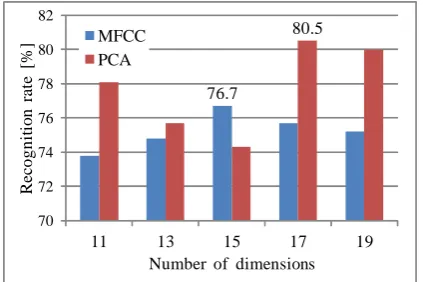
The aim of Experiment 2 is to evaluate the improvement intro-duced by the use of a PCA-based feature extraction method. For Experiment 2, PCA was applied to 24 mel-scale filter bank out-put. Then, we computed the filterVusing the 2nd through 5th utterances (the more stable utterances). We experimented on the number of principal components, using 11, 13, 15, 17, and 19 dimensions. Then, the delta coefficients were also computed. Comparison results between the baseline method (MFCC) and the PCA-based feature extraction method for the 1st utterance were shown in Fig. 7.
As can be seen in Fig. 7, the use of PCA instead of DCT improved the recognition rate for the 1st utterance from 76.7% (15-dimensional MFCC and their delta) to 80.5% (17-principal components and their delta). This results gives the evidence of the improvement introduced by the use of PCA instead of DCT when dealing with the 1st utterance. In addition, the recognition rates of the other utterances were equal to those of MFCC.
76.7
80.5
70 72 74 76 78 80 82
11 13 15 17 19
R
ec
o
g
n
it
io
n
r
at
e
[
%
]
Number of dimensions MFCC
[image:4.595.311.545.129.201.2]PCA
Figure 7: Comparison of DCT and PCA for the 1st utterance in Experiment 2.
4.4. Experiment 3
In order to test the effectiveness of a RP-based feature projec-tion method, in Experiment 3, two RP-based features were eval-uated. Each feature description was found below:
1. PCA[17]→RP[17] +∆RP[17]:
Random projection is applied to PCA-based features at thet-th frame,x(t)∈R17, and the new feature,y(t)
∈
R17, is obtained.
y(t) =P(l)Tx(t) (5)
Then, the new feature also has the delta parameter of projected feature,y(t). The final system feature dimen-sionality is 34.
2. PCA[17]→RP[17] +∆PCA[17]:
Random projection is applied to PCA-based features,
x(t) ∈ R17, and the new feature,y(t) ∈ R17, is ob-tained. Then, the new feature also has the delta coeffi-cient of original feature,x(t). The final system feature dimensionality is 34.
We investigated the performance of random projections for various random matrices (l = 20, 40, 60, 80, and 100) sam-pled fromN(0,1). Tables 2 and 3 show the recognition rate versus the number of random matrices for each feature. The
Table 2: Word recognition rate (%) for the 1st utterances using feature 1 in various random matrices. (The recognition rate of PCA-based features is 80.5%)
Number of RP combination RP w/o combination
random matrices based on ROVER Max. Mean Min.
20 79.5% 80.5% 76.5 % 72.9%
40 80.0% 81.0% 76.8% 72.9%
60 80.5% 83.3% 76.8% 72.9%
80 80.5% 83.3% 76.8% 72.4%
[image:4.595.66.278.279.420.2]100 80.5% 83.3% 76.8% 72.4%
Table 3: Word recognition rate (%) for the 1st utterances using feature 2 in various random matrices. (The recognition rate of PCA-based features is 80.5%)
Number of RP combination RP w/o combination
random matrices based on ROVER Max. Mean Min.
20 83.3% 81.9% 79.5% 76.7%
40 85.2% 83.8% 79.6% 71.9%
60 85.2% 83.8% 79.5% 71.9%
80 84.8% 83.8% 79.5% 71.9%
100 84.8% 83.8% 79.5% 71.9%
results of “RP w/o combination” show the maximums, means, and minimums obtained from each random projection without ROVER-based combination.
Table 2 shows the performance results obtained using fea-ture 1 in Experiment 3. As can be seen in Table 2, the max-imums of random projections without ROVER-based combi-nation for 60, 80, and 100 random matrices were higher than the recognition rate of PCA-based features. However, even if ROVER-based combination is applied, we could not show fur-ther performance increases in our experiments using feature 1.
The recognition results obtained using feature 2 are shown in Table 3. As can be seen in Table 3, the results for feature 2 in-dicated that the vote-based random-projection combination im-proved the recognition rate from 80.5% (17-dimentional PCA and their delta) to 85.2% using the combination of 40 or 60 ran-dom matrices, although the means of ranran-dom projections with-out combination for some random matrices was lower than the recognition rate of the original features.
[image:4.595.311.542.286.358.2]5. Conclusions
As a result of this work, a method for recognizing dysarthric speech using a robust PCA-based feature extraction and trans-formation based on random projection has been developed. In the feature extraction, PCA is applied to the mel-scale filter bank output. It can be expected that PCA will project the main stable utterance elements onto low-order features, while ele-ments associated with fluctuations in speaking style will be pro-jected onto high-order features. Moreover, the proposed method transforms the PCA-based features using various random ma-trices. It also introduces a vote-based combination method to obtain an optimal result from the ASR systems created from each RP-based feature. Word recognition experiments were conducted to evaluate the proposed method for one male with an articulation disorder. The results of the experments showed that a method based on random projection outperformed both a baseline method (using MFCC) and a PCA-based feature ex-traction method.
As future work, we will continue to investigate how to se-lect the optimal basis vector from a random matrix.
6. References
[1] T. Starner, J. Weaver, and A. Pentland, “Real-Time American
Sign Language Recognition Using Desk and Wearable Computer
Based Video,”IEEE Transactions on Pattern Analysis and
Ma-chine Intelligence, 20(12), pp. 1371–1375, 1998.
[2] J. Lin, W. Ying, and T.S. Huang, “Capturing human hand motion
in image sequences,” IEEE Workshop on Motion and Video Com-puting, pp. 99–104, 2002.
[3] G. Fang, W. Gao, and D. Zhao, “Large vocabulary sign language
recognition based on hierarchical decision trees,”International
Conference on Multimodal Interaction, pp. 125–131, 2003.
[4] V. Wu, R. Manmatha, and E. M. Riseman, “Textfinder: an
auto-matic system to detect and recognize text images,”IEEE
Trans-actions on Pattern Analysis and Machine Inteligence, 21(11), pp. 1224–1229, 1999.
[5] M.K. Bashar, T. Matsumoto, Y. Takeuchi, H. Kudo, and N.
Ohnishi, “Unsupervised Texture Segmentation via Wavelet-based Locally Orderless Images (WLOIs) and SOM,” International Con-ference on Computer Graphics and Imaging, pp. 279–284, 2003.
[6] N. Ezaki, M. Bulacu, and L. Schomaker, “Text Detection from
Natural Scene Images: Towards a System for Visually Impaired
Persons,”International Conference on Pattern Recognition, pp.
683–686, 2004.
[7] T. Ohsuga, Y. Horiuchi, and A. Ichikawa, “Estimating Syntactic
Structure from Prosody in Japanese Speech,” IEICE Transactions on Information and Systems, 86(3), pp. 558–564, 2003.
[8] K. Nakamura, T. Toda, H. Saruwatari, and K. Shikano, “Speaking
Aid System for Total Laryngectomees Using Voice Conversion of Body Transmitted Artificial Speech,” Annual Conference of the International Speech Communication Association, pp. 1395– 1398, 2006.
[9] S.T. Canale, and W.C. Campbell, “Campbell’s Operative
Or-thopaedics,” Mosby-Year Book, 2002.
[10] S-M. Lee, S-H. Fang, J-W. Hung, and L-S. Lee, “Improved MFCC Feature Extraction by PCA-Optimized Filter Bank for Speech Recognition,” IEEE Workshop on Automatic Speech Recognition and Understanding, pp. 49–52, 2001.
[11] H. Matsumasa, T. Takiguchi, Y. Ariki, I. LI, and T. Nakabayashi, “PCA-Based Feature Extraction for Fluctuation in Speaking Style of Articulation Disorders,” Annual Conference of the Interna-tional Speech Communication Association, pp. 1150–1153, 2007.
[12] Ella Bingham, and Heikki Mannila, “Random projection in
di-mensionality reduction: applications to image and text data,”
Knowledge Discovery and Data Mining, pp. 245–250, 2001.
[13] N. Goel, G. Bebis, and A. Nefian, “Face recognition experiments with random projection,” Storage and Retrieval for Image and Video Databases, pp. 426–437, 2005.
[14] P. Thaper, S. Guha, and N. Koudas, “Dynamic multidimensional histograms,” International Conference on Management of Data, pp. 428–439, 2002.
[15] L. Liu, P. Fieguth, G. Kuang, and H. Zha, “Sorted Random
Projec-tions for robust texture classification,”IEEE International
Con-ference on Computer Vision, pp. 391–398, 2011.
[16] H. T. Ho, and R. Chellappa, “Automatic head pose estimation
us-ing randomly projected dense SIFT descriptors,”IEEE
Interna-tional Conference on Image Processing, pp. 153–156, 2012.
[17] S. Dasgupta, “Experiments with random projection,” Uncertainty in Artificial Intelligence, pp. 143–151, 2000.
[18] X.Z. Fern, and C.E. Brodley, “Random projection for high
dimen-sional data clustering: A cluster ensemble approach,”
Interna-tional Conference on Machine Learning, pp. 186–193, 2003.
[19] S. Lee, and A. Nedic, “Distributed Random Projection Algo-rithm
for Convex Optimization,”IEEE Journal of Selected Topics in
Signal Processing, 7(2), pp. 221–229, 2013.
[20] J.G. Fiscus, “A post-processing system to yield reduced word er-ror rates: Recogniser output voting erer-ror reduction (rover),” IEEE Workshop on Automatic Speech Recognition and Understanding, pp. 347–352, 1997.
![Table 1: Recognition results [%] for each utterance in Experi-ment 1](https://thumb-us.123doks.com/thumbv2/123dok_us/1518897.694280/3.595.323.508.311.401/table-recognition-results-utterance-experi-ment.webp)