
R92
Research
Does the tube-compensation function of two modern mechanical
ventilators provide effective work of breathing relief?
Yoshiko Maeda
1, Yuji Fujino
2, Akinori Uchiyama
2, Nobuyuki Taenaka
3, Takashi Mashimo
4and Masaji Nishimura
51Graduate student, Intensive Care Unit, Osaka University Medical School, Suita, Osaka, Japan 2Assistant Professor, Intensive Care Unit, Osaka University Hospital, Suita, Osaka, Japan
3Associate Professor, Department of Anesthesiology, Osaka University Medical School, Suita, Osaka, Japan 4Professor, Department of Anesthesiology, Osaka University Medical School, Suita, Osaka, Japan
5Associate Professor, Intensive Care Unit, Osaka University Hospital, Suita, Osaka, Japan
Correspondence: Masaji Nishimura, [email protected]
Introduction
Mechanically ventilated patients usually show significantly increased respiratory resistance [1–3]. Almost all
venti-lated patients are intubated and positive pressure ventila-tion is most commonly applied to assist patient effort. The endotracheal tube (ETT) constitutes a greater resistance
DE4 = Dräger Evita 4; DT = delay time; ETT = endotracheal tube; NPB 840 = Nellcor Puritan-Bennett 840; Paw= airway pressure; PI = inspiratory trigger pressure; Ppl= pleural pressure; PSV = pressure support ventilation; PTP = pressure–time product; Ptr= tracheal pressure; TC = tube com-pensation; VT= tidal volume; WOB = work of breathing.
Abstract
ObjectiveAn endotracheal tube (ETT) imposes work of breathing on mechanically ventilated patients. Using a bellows-in-a-box model lung, we compared the tube compensation (TC) performances of the Nellcor Puritan-Bennett 840 ventilator and of the Dräger Evita 4 ventilator.
Measurements and resultsEach ventilator was connected to the model lung. The respiratory rate of the model lung was set at 10 breaths/min with 1 s inspiratory time. Inspiratory flows were 30 or 60 l/min. A full-length 8 mm bore ETT was inserted between the ventilator circuit and the model lung. The TC was set at 0%, 10%, 50%, and 100% for both ventilators. Pressure was monitored at the airway, the trachea, and the pleura, and the data were recorded on a computer for later analysis of the delay time, of the inspiratory trigger pressure, and of the pressure–time product (PTP). The delay time was calculated as the time between the start of inspiration and minimum airway pressure, and the inspiratory trigger pressure was defined as the most negative pressure level. The same measurements were performed under pressure support ventilation of 4 and 8 cmH2O.
The PTP increased according to the magnitude of inspiratory flow. Even with 100% TC, neither ventilator could completely compensate for the PTP imposed by the ETT. At 0% TC the PTP tended to be less with the Nellcor Puritan-Bennett 840 ventilator, while at 100% TC the PTP tended to be less with the Dräger Evita 4 ventilator. A small amount of pressure support can be equally effective to reduce the inspiratory effort compared with the TC.
ConclusionAlthough both ventilators provided effective TC, even when set to 100% TC they could not entirely compensate for a ventilator and ETT-imposed work of breathing. The effect of TC is less than that of pressure support ventilation. Physicians should be aware of this when using TC in weaning trials.
Keywords: endotracheal tube, mechanical ventilation, pressure support ventilation, tube compensation, work of breathing
Received: 24 January 2003 Revisions requested: 9 April 2003 Revisions received: 9 May 2003 Revisions requested: 29 May 2003 Revisions received: 3 June 2003 Accepted: 3 June 2003 Published: 14 August 2003
Critical Care2003, 7:R92-R97 (DOI 10.1186/cc2343) This article is online at http://ccforum.com/content/7/5/R92 © 2003 Maeda et al., licensee BioMed Central Ltd
(Print ISSN 1364-8535; Online ISSN 1466-609X). This is an Open Access article: verbatim copying and redistribution of this article are permitted in all media for any purpose, provided this notice is preserved along with the article's original URL.
R93
than does the supraglotic airway [4]. Once the patient starts making efforts to breathe, resistance imposed by the ETT increases the resistive work of breathing (WOB) during both the inspiration and the expiration. It is prudent for physicians to recognize the importance of imposed WOB due to an ETT during the weaning process. In clini-cal practice, pressure support ventilation (PSV) is popular to compensate for an ETT. The pressure difference across the ETT changes proportionate to the gas flow. When a patient generates a high flow with a strong inspiratory effort, the pressure difference across the ETT can be con-siderably great, and PSV cannot compensate for imposed WOB due to the ETT. Sometimes 10 or 15 cmH2O PSV is needed to compensate for WOB due to an ETT in a patient with high minute ventilation [5].
To alleviate the WOB due to tube resistance, two manufac-turers have recently released ventilators that, by increasing pressure at the proximal end of the tube, are able to compen-sate for tube resistance [6–8]. This function is known as tube compensation (TC). The object of TC is to give the patients the feeling that they are not intubated from the viewpoint of WOB, and it is sometimes described as ‘electric extubation’. If TC works in theory, WOB due to an ETT is compensated
regardless of inspiratory efforts. However, new ventilatory modes are sometimes very good in theory but do not work in practice. The purpose of the study was to investigate whether TC worked both in normal and high inspiratory flow, and whether the TC performance of two sophisticated ventilators worked in the same manner.
Methods
Model lung and ventilators
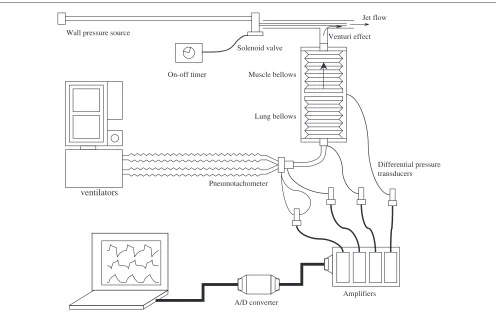
To simulate spontaneous breathing we used a custom-built bellows-in-a-box model lung, details of which have been described elsewhere [8,9] (Fig. 1). Briefly, a pair of bellows are set in a rigid box: one simulates the muscles and the other simulates the lungs. Negative pressure acts on the muscle compartment by the Venturi effect. The space between the box and the bellows simulates the pleural space. The source gas (O2at 345 kPa) was connected to a
[image:2.612.57.553.392.707.2]custom-made pressure regulator and a proportional solenoid valve (SMC 315; SMC Co., Tokyo, Japan). The opening of the solenoid valve was controlled by a function generator (H3BF; Omron, Tokyo, Japan). The inspiratory flow, the inspiratory time, and the respiratory rate were controlled by setting the regulator on the model lung. The compliance of the model lung was adjusted to 46.8 ml/cmH2O.
Figure 1
Experimental setup. Spontaneous breathing was simulated with a bellows-in-a-box model lung. All data were recorded on a computer via an analogue–digital (A/D) converter. See text for details.
ventilators
A/D converter Solenoid valve
On-off timer Wall pressure source
Jet flow
Muscle bellows
Lung bellows
Venturi effect
Differential pressure transducers
R94
The model lung was set for spontaneous breathing (respira-tory rate, 10 breaths/min; inspira(respira-tory time, 1.0 s; peak inspira-tory flow, 30 or 60 l/min). Two commercially available ventilators that incorporate TC functions, the Nellcor Puritan-Bennett 840 (NPB840) ventilator (Pleasanton, CA, USA) and the Dräger Evita 4 (DE4) ventilator (Lübeck, Germany), were connected to the model lung via a standard ventilator circuit (Dar SpA, Milandola, Italy) with full-length 8 mm bore ETT (Portex, Hythe, UK). Operating the TC function involves spec-ifying the size and type of the tubes and then selecting the degree of TC. Compensation settings vary from 100% to 10% with the NPB 840 ventilator, and from 100% to 1% with the DE4 ventilator. To compare the actual TC performance of the two ventilators, TC was monitored on both machines at settings of 10%, 50%, and 100%. The tube length was the same for both machines and so is not considered significant to the comparative results. We did not shorten the tubes in the present study. PSV was originally developed to overcome the WOB imposed by ETTs, so we also carried out, with the same settings on the model lung, trials with PSV set at 4 and 8 cmH2O on either ventilator. The trigger sensitivity on both ventilators was set at 1 l/min. Settings for the rising time and the expiratory sensitivity were a support sensitivity of 0.2 s and an expiratory sensitivity of 25% for the NPB 840 ventila-tor, and a flow acceleration of 90% and an expiratory sensitiv-ity of 25% for the DE4 ventilator.
Measurements
The airway pressure at the proximal end of the ETT (Paw), the pressure at the distal end of ETT (Ptr), and the pleural pressure (Ppl) were measured with differential pressure transducers (DP45; Validyne, Northridge, CA, USA). The flow at the airway opening was measured with a pneumotachometer (model 4700, 0–160 l/min: Hans-Rudolph Inc., Kansas City, MO, USA) connected to a differential pressure transducer (DP45; Validyne). The flowmeter was calibrated using a syringe with a plunger that was moved by a linear slider programmed to adjust flow to precisely 1 l/s. Accuracy was confirmed by the integration of flow signal for 1 s. Pressure transducers were calibrated at 10 cmH2O with a water manometer. The tidal volume (VT) was calculated by digital integration of flow data.
All signals were led to an analogue–digital converter (DI-220; Dataq Instruments Inc., Akron, OH, USA) via amplifiers (CD19A High Gain Carrier Demodulator; Validyne), and were saved at 100 Hz/channel signal frequency on an IBM-compati-ble computer using WINDAQ (Dataq Instruments Inc.) data acquisition software. At each experimental setting, three breaths were analysed and average values were used.
Data analysis
Figure 2 shows the measurements of the pressure–time product (PTP), the inspiratory delay time (DT), and the inspi-ratory trigger pressure (PI). The PTP is indicated by the area below the baseline pressure between the initiation of inspira-tion and the time for the pressure to return to the baseline. These calculations were performed for Paw, Ptr, and Ppl. The
DT was calculated as the time between the start of inspiration and minimum airway pressure. During the inspiratory trigger, the PI was defined as the most negative pressure level.
Statistical analysis
The VT, the DT, the PI, and the PTP were analysed as depen-dent variables. For each variable, two-way analysis of variance was performed for TC, with PSV support levels and ventila-tors as the repeated measures. When statistical significance was indicated, it was further examined by post hocanalysis (Scheffé test). A statistics software package (STATISTICA 5.1; StatSofa Inc.,Tulsa, OK, USA) was used and signifi-cance was set at P< 0.05.
Results
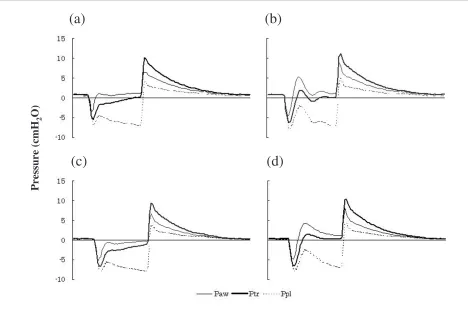
Figure 3 shows pressure tracings for each ventilator during TC of 0% and 100%. At TC of 0% the NPB840 ventilator increased the Pawabove baseline after triggering of the inspira-tory effort, while the DE4 ventilator did not increase Pawabove baseline during the entire inspiratory phase. The tracheal pres-sures of both ventilators were below baseline during the whole inspiration. At 100% TC, the tracheal pressure was close to baseline during the latter phase of inspiration with the NPB840 ventilator and at the end of inspiration with the DE4 ventilator.
The PTPs were calculated with Paw, Ptr, and Ppl. A higher inspiratory flow resulted in greater PTPs for both ventilators. With 0%, 10%, and 50% TC there were no significant differ-ences between PTPs. At 100% TC, both the PTPs calculated with Ptrand with Ppl decreased significantly compared with other settings. Figure 4 shows PTPs at each support level of TC for both ventilators. At all settings, 4 and 8 cmH2O PSV
increased the VTby more than 10% (Table 1), although the VT
did not increase more than 10% above the baseline VT in 10% TC and 50% TC but it did in 100% TC with DE4. The DT, at all experimental settings for both ventilators, did not
Figure 2
Definition of measured parameters. Delay time (DT), the time elapsed from the beginning of inspiration to the bottom of the pressure cycle; inspiratory trigger pressure (PI), the pressure difference between the baseline and the bottom; pressure–time product (PTP), the area on the graph where the pressure is below the baseline.
P [cmH2O]
time (s)
0
DT
PI
R95
differ significantly with increasing TC. The inspiratory flow did not significantly influence the DT, and consequently com-bined data for the DT at 30 and 60 l/min inspiratory flow are presented. Increases in TC, at any experimental settings, did not cause significant changes in the PI. As expected, the PI increased as inspiratory flow increased. Table 2 presents data only for 60 l/min inspiratory flow.
PTPs were larger with the DE4 ventilator than with the NPB840 ventilator at TC of 0%. At 0% and 10% TC the VT
was significantly less with the DE4 ventilator than with the
NPB840 ventilator, and at 50% and 100% TC the VT was significantly larger with the DE4 ventilator than with the NPB840 ventilator. On comparing these two ventilators, the DT did not vary significantly.
Discussion
[image:4.612.66.534.99.409.2]There are two major findings of the present study. First, with both the DE4 and the NPB840 ventilators, PTPs during inspi-ration decreased as TC support increased. Second, at 0% TC the PTP calculated with Ptrwas less with the NPB840 ventilator than that with the DE4 ventilator.
Figure 3
Representative pressure tracings from 60 l/min inspiratory flow. Airway pressure (Paw), tracheal pressure (Ptr), and pleural pressure (Ppl) tracings at: (a) 0% tube compensation (TC) with the Nellcor Puritan-Bennett 840 ventilator, (b) 100% TC with the Nellcor Puritan-Bennett 840 ventilator, (c) 0% TC with the Dräger Evita 4 ventilator, and (d) 100% TC with the Dräger Evita 4 ventilator.
(a) (b)
Pressure (cmH
2
O)
(c) (d)
Table 1
Effects on the tidal volume of tube compensation (TC) and pressure support ventilation (PSV) provided by the two ventilators
Inspiratory flow 0% TC 10% TC 50% TC 100% TC 4 cmH2O PSV 8 cmH2O PSV
30 l/min
NPB840 282 ± 3 282 ± 2 281 ± 1 278 ± 3 382 ± 1 506 ± 2
DE4 244 ± 1 244 ± 2 254 ± 1 262 ± 1 361 ± 1 489 ± 2
60 l/min
NPB840 577 ± 4 574 ± 2 573 ± 2 591 ± 2 648 ± 2 742 ± 3
DE4 541 ± 1 546 ± 2 572 ± 1 613 ± 1 631 ± 2 731 ± 1
[image:4.612.52.558.499.591.2]R96
Invasive positive pressure ventilation requires an ETT, the presence of which imposes additional WOB according to
bore and inspiratory flow [10,11]. The burden is heavy enough to induce respiratory muscle fatigue. To compensate for the WOB imposed by the ETT, the most popular ventila-tory strategy is PSV. A PSV of 5–7 cmH2O for adult patients
[12] and a PSV of 4–8 cmH2O for children [13] are reported to compensate for the imposed work. Ventilators with selec-table TC settings have more recently been developed to com-pensate the WOB imposed by an ETT. At a setting of 100% TC it would be natural to assume that the ventilator was com-pletely cancelling the extra burden imposed by the resistance of the small-bore tube. Despite being set to 100%, neither of the two ventilators tested was able to completely compen-sate for PTP calculated with Ppl.
Patients have to trigger the ventilator in patient-triggered ven-tilation modes. This effort requires significant WOB [14,15]; the effort may even exceed the total WOB of healthy human beings. The technique of TC is also dependent on patient-triggered ventilation and trigger work is still necessary during TC. This is one of the major reasons why, with the tested ven-tilators, TC did not completely compensate ETT-imposed PTP calculated with Ppl.
[image:5.612.57.299.91.372.2]As TC support increased, PTPs decreased. As already described, however, TC did not fully compensate for PTPs imposed by ETT resistance. This result raises doubts about the lower range of overall TC support that is actually provided in clinical situations. In clinical settings, because of secretions deposited inside the ETT or because of deformity of the ETT, or both, ETT resistance tends to increase the longer the intu-bation continues. In the present study, the ETT was allowed to assume a natural curve and was not subject to any twisting or deformation. Neither was a humidifier used. The ETT was kept dry, so neither condensation in, nor deformity of, the ETT
Figure 4
The pressure–time product (PTP) at each ventilator setting: (a) 30 l/min peak inspiratory flow, and (b) 60 l/min inspiratory flow. The numerals 0, 10, 50, and 100 under each graph represent tube compensation support levels of 0%, 10%, 50%, and 100%, respectively. The PTP was calculated from the airway pressure (Paw), the tracheal pressure (Ptr), and the pleural pressure (Ppl).
0 2 4 6 8
0% 10% 50% 100% 0% 10% 50% 100%
0 2 4 6 8
0% 10% 50% 100% 0% 10% 50% 100%
Paw Ptr Ppl
(a)
(b)
PT
P (
cm
H2
O·
s)
PT
P (
cm
H2
O·
s)
NPB840 DE4
[image:5.612.60.556.531.713.2]NPB840 DE4
Table 2
Effects on the delay time and inspiratory trigger pressure of tube compensation (TC) of the two ventilators
Delay time (ms) Inspiratory trigger pressure (cmH2O)
0% TC 100% TC 0% TC 100% TC
Airway pressure
NPB840 61 ± 11 77 ± 5 4.84 ± 0.10 4.84 ± 0.10
DE4 60 ± 6 58 ± 5 5.89 ± 0.34 5.89 ± 0.34
Tracheal pressure
NPB840 91 ± 31 108 ± 17 6.52 ± 0.08 7.06 ± 0.05
DE4 108 ± 43 95 ± 20 7.11 ± 0.06 7.14 ± 0.12
Pleural pressure
NPB840 139 ± 109 121 ± 22 7.39 ± 0.06 8.19 ± 0.02
DE4 176 ± 131 110 ± 25 8.14 ± 0.02 8.19 ± 0.14
R97
could have impeded the ideal functioning of TC. Furthermore, 4 cmH2O PSV decreased PTPs by the same amount as 100% TC and raises the question whether TC technology yet provides any advantage over other ventilatory modes. PSV is a well known and widely practiced technique to alleviate WOB imposed by an ETT for mechanically ventilated patients [12]. As Fig. 3 shows, Pawwas high at the beginning of inspi-ration and decreased as the inspiratory flow decreased with 100% TC. PSV is designed to keep Pawconstant during the
inspiratory effort of spontaneous breathing. This is one of the reasons why only a small amount of PSV was as effective as 100% TC. From the viewpoint of decreasing WOB, the clini-cal importance of TC may be doubtful.
Once triggered by the patient’s breath, the ventilators deliver fresh gas according to the programming for the set ventilatory modes. Each manufacturer uses its own algorithms to control delivery of inspiratory gas. The technical strategies applied to deliver gas mean that different brands of ventilator will behave differently in practice. At 100% TC, the DE4 ventilator decreased PTPs more than did the NPB840 ventilator. This suggests that the ventilators use different TC algorithms and that neither of these algorithms is actually able to provide 100% compensation.
This is an in vitro study with a model lung, and our results should not be considered applicable to patients directly. TC is a mode to support inspiration, and we did not evaluate the expiratory WOB. We set the respiratory rate of simulated spontaneous breathing at 10 breaths/min to prevent air-trapping inside the bellows. However, in the clinical setting, the respiratory rate is not necessarily low enough to avoid air-trapping. Two levels of inspiratory efforts (30 and 60 l/min inspiratory flow of the model lung) were investigated, but they were constant during data acquisition. The inspiratory effort of patients differs breath by breath in clinical settings, and the effect was not evaluated in the present study. The respiratory mechanics of patients may also influence the performance of TC, and we did not evaluate this from the data of the present study. Positive end expiratory pressure could also affect TC performance. We therefore repeated the whole study at 5 cmH2O positive end expiratory pressure, and the data did not reveal any differences without positive end expiratory pressure. We presented the data at zero positive end expira-tory pressure.
In conclusion, TC did not compensate for the PTPs imposed by ETT resistance. TC is a patient-triggered ventilation
tech-nique, and patients have to work to trigger the ventilator. TC cannot compensate for these triggering PTPs. A small amount of PSV was as effective as 100% TC. This inability restricts the usefulness of this new ventilator function. Before we can be confident of the clinical advantages of TC, more hands-on experience is needed.
Competing interests
None declared.
References
1. Pelosi P, Cereda M, Foti G, Giacomini M, Pesenti A: Alterations of lung and chest wall mechanics in patients with acute lung injury: effects of positive end-expiratory pressure.Am J Respir Crit Care Med 1995, 152:531-537.
2. Pesenti A, Pelosi P, Rossi N, Virtuani A, Brazzi L, Rossi A: The effects of positive end-expiratory pressure on respiratory resistance in patients with the adult respiratory distress syn-drome and in normal anesthetized subjects. Am Rev Respir Dis 1991, 144:101-107.
3. Mols G, Kessler V, Benzing A, Lichtwarck-Aschoff M, Geiger K, Guttmann J: Is pulmonary resistance constant, within the range of tidal volume ventilation, in patients with ARDS? Br J Anaesth2001, 86:176-182.
4. Straus C, Louis B, Isabey D, Lemaire F, Harf A, Brochard L: Com-parison of the endotracheal tube and the upper airway to breathing workload.Am J Respir Crit Care Med1998, 157 :23-30.
5. Fabry B, Haberthür C, Zappe D, Guttmann J, Kuhlen R, Stocker R: Breathing pattern and additional work of breathing in sponta-neously breathing patients with different ventilatory demand during inspiratory pressure support and automatic tube com-pensation.Intensive Care Med1997, 23:545-552.
6. Haberthür C, Elsasser S, Eberhard L, Stocker R, Guttmann J: Total versus tube-related additional work of breathing in ven-tilator-dependent patients. Acta Anaesthesiol Scand 2000, 44:749-757.
7. Guttmann J, Bernhard H, Mols G, Benzing A, Hofmann P, Haberthür C, Zappe D, Fabry B, Geiger K: Respiratory comfort of automatic tube compensation and inspiratory pressure support in conscious human.Intensive Care Med 1997, 23: 1119-1124.
8. Fujino Y, Uchiyama A, Mashimo T, Nishimura M: Spontaneously breathing lung model comparison of work of breathing between automatic tube compensation and pressure support. Respir Care2003, 48:38-45.
9. Miyoshi E, Fujino Y, Mashimo T, Nishimura M: Performance of transport ventilator with patient-triggered ventilation. Chest 2000, 118:1109-1115.
10. Bolder PM, Healy TEJ, Bolder AR, Beatty PCW, Kay B: The extra work of breathing through adult endotracheal tubes.Anesth Analg1986, 65:853-859.
11. Shapiro M, Wilson K, Casar G, Bloom K, Teague RB: Work of breathing through different sized endotracheal tubes. Crit Care Med1986, 14:1028-1031.
12. Brochard L, Rua F, Lorino H, Lemaire F, Harf A: Inspiratory pres-sure support compensates for the additional work of breath-ing caused by the endotracheal tube.Anesthesiology1991, 75: 739-745.
13. Takeuchi M, Imanaka H, Miyano H, Kumon K, Nishimura M: Effect of patient-triggered ventilation on respiratory workload in infants after cardiac surgery. Anesthesiology2000, 93 :1238-1244.
14. Sassoon CS, Lodia R, Rheeman CH, Kuei JH, Light RW, Mahutte CK: Inspiratory muscle work of breathing during flow-by, demand-flow, and continuous-flow systems in patients with chronic obstructive pulmonary disease. Am Rev Respir Dis 1992, 145:1219-1222.
15. Sassoon CS, Del Rosario N, Fei R, Rheeman CH, Gruer SE, Mahutte CK: Influence of pressure- and flow-triggered syn-chronous intermittent mandatory ventilation on inspiratory muscle work.Crit Care Med1994, 22:1933-1941.
Key message
![Figure 4bore and inspiratory flow [10,11]. The burden is heavyenough to induce respiratory muscle fatigue](https://thumb-us.123doks.com/thumbv2/123dok_us/1520203.694491/5.612.57.299.91.372/figure-inspiratory-burden-heavyenough-induce-respiratory-muscle-fatigue.webp)
