A Method for Experimental Events that
Break Cointegration: Counterfactual
Simulation
Bell, Peter N
University of Victoria
7 February 2014
Online at
https://mpra.ub.uni-muenchen.de/53523/
A Method for Experimental Events that Break
Cointegration: Counterfactual Simulation
Peter Bell
University of Victoria
A Method for Experimental Events that Break Cointegration:
Counterfactual Simulation
Peter Bell
Abstract: In this paper I develop a method to estimate the effect of
an event on a time series variable. The event is framed in a
quasi-experimental setting with time series observations on a treatment variable,
which is affected by the event, and a control variable, which is not. Prior to
the event, the two variables are cointegrated. After the event, they are not.
Since the event only affects the treatment variable, the method uses
observations on the control variable after the event and the distribution of
difference in differences before the event to simulate values for the
treatment variable as-if the event did not occur; hence the name
counterfactual simulation. I describe theoretical properties of the method
and show the method in action with purpose-built data.
Keywords: Quasi-experiment, cointegration, time series,
counterfactual, simulation
1. Introduction
In this paper I develop a method to estimate the effect of an event on a time series variable.
I describe the method in terms of a quasi-experiment, with observations on treatment and control
variables, before and after the event occurs. There are many situations in economics where this
method may be helpful, from comparing stock prices to unemployment levels between countries.
I intend to apply the method to farmland ownership restrictions in Saskatchewan as part of my
I refer to my method as Counterfactual Simulation because it produces a distribution for
the treatment variable as-if the event never occurred. However, I recognize that this term was
used before in an influential paper by Christian Upper at the Bank for International Settlements
(2007). It is fair to re-use the term here because our methods and topics are different, but I
recognize the initial contribution by Dr. Upper. Writing at the beginning of the global financial
crisis in August 2007, Upper focuses on risks of contagion within interbank markets. With
remarkable prescience he notes that researchers have little data for events of interest because
important banks are often bailed-out (2007, p. 9). He provides a way forward: “Counterfactual simulations, by contrast, allow researchers to more or less freely specify the scenario they are
interested in, without regard to whether similar events have happened in the past” (2007, p. 3). Although this may seem like an obvious type of risk management activity, it is a sophisticated
process that requires a large number of assumptions, which allow for criticisms that the results
do not have a “gentlemanly distance” from the assumptions (2007, p. 18). I hope that such criticism does not impede the value that Upper’s methods can offer to studies of systemic risk.
My Counterfactual Simulation (CS) method uses an experimental design with observations
on treatment and control groups, before and after an intervention. This design is a classical
concept in the applied econometrics literature, as described in the popular textbook by Joshua
Angrist and Jörn-Steffen Pischke (2009). In particular, Angrist and Pischke use this design to
introduce difference-in-differences (diff-diff) models. The basic diff-diff setting compares the
effect of an intervention across two dimensions (treatment/control, before/after event) but it can
be generalized to include an arbitrary number of dimensions (p. 241). My CS method adds a
third dimension (time), which opens the discussion to time series econometrics.
Cointegration is a classic method from time series econometrics pioneered by Robert Engle
& Clive Granger (1987) for situations where multiple variables share similar growth rates. For
the cases I consider here, cointegration means that the diff-diff is stationary (no unit root in U(t)). The reader may notice an immediate connection between cointegration and quasi-experiments,
which is reflected in the substantial literature on structural breaks in cointegration; for example,
the textbook on Unit Roots, Cointegration, and Structural Change (Maddala & Kin, 1998). Such attention is well deserved because a structural break can confound estimation. Allen Gregory
and Bruce Hansen (1996) propose a test for structural breaks in cointegration and use it to find
discussion shows that cointegration can provide an important set of tools to model economic
variables that have dynamic statistical relationships.
My paper focuses on events that break cointegration. As I showed above, there is research
on events that move variables from one cointegration relationship to another, but it is more
difficult to gain analytic traction when the model leaves behind the stationary assumptions. New
thinking is starting to improve the situation. In particular, Ole Peters develops a new solution to
the ancient St. Petersburg paradox. Peters’ new solution resolves a problematic assumption in a cornerstone of modern economic theory by giving careful consideration to time averages versus
ensemble averages, which are different in non-stationary or non-ergodic settings (2011a, 2011b).
In this paper I use ensemble averages to make draws from the distribution of the diff-diff and
simulate data for the treatment variable. I intend to use time averages in future research.
The CS method uses simulation to develop economic insight. I do not make inference
from coefficients in a regression model; rather, I calculate distributions for variables of interest
directly and compare the simulated distributions with observed values. This focus on
simulation-based methods is related to a controversial debate in economics around the methodological risks
of strict statistical methods and imprecise distinctions between statistical significance and
economic significance (McCloskey & Ziliak, 1996).
In this paper I introduce the CS method in a theoretical framework and provide an example
of the method in action with purpose-built data. In Section 2 I introduce the CS method and
describe some basic properties with algebraic and numerical analysis. In Section 3 I build a
dataset where the CS method applies and show how to use the method to estimate the effect of an
event using an asymptotically large number of paths. I provide an appendix which contains
Matlab code to replicate all of the numerical results used in the paper.
2. Model for Data with and without Cointegration
The basic cointegration model has observations on two time series variables, X(t) and Y(t). I construct U(t) as the difference between them in Equation (1) and 𝑑𝑈
𝑑𝑡 as the diff-diff in Equation
(1) 𝑋(𝑡) − 𝑌(𝑡) = 𝑈(𝑡)
(2) 𝑑𝑈
𝑑𝑡 = 𝑑𝑋
𝑑𝑡− 𝑑𝑌 𝑑𝑡
To set the stage for my CS method, I specify the data generating process for X(t) and Y(t)
in terms of first-differences. Throughout, X(t) represents the control variable and Y(t) represents the treatment variable. I assume each variable has an individual noise term that is independent
and identically distributed over time (𝜀𝑋, 𝜀𝑌~𝑖𝑖𝑑).
Before the event, I assume that both X(t) and Y(t) have a slow moving, trend growth rate that I denote 𝛼. Think of 𝛼 as a random variable with significant autocorrelation. Since 𝛼 is the
trend growth rate for both X(t) and Y(t), as shown in Equations (3) and (4), the trends cancel in the diff-diff, Equation (5). It follows that the diff-diff is stationary.
(3) 𝑑𝑋
𝑑𝑡 = 𝛼 + 𝜀𝑋
(4) 𝑑𝑌
𝑑𝑡 = 𝛼 + 𝜀𝑌
(5) 𝑑𝑈
𝑑𝑡 = 𝜀𝑋− 𝜀𝑌
After the event I assume the treatment variable follows a different trend, which I denote 𝛽
in Equation (6). The control variable is still described by Equation (3). The trend growth rates
(𝛼, 𝛽) do not cancel in the diff after the event, as in Equation (7), and it follows that the
diff-diff is non-stationary (U(t) has a unit root). I provide an example of data with such properties in Section 3.
(6) 𝑑𝑌
𝑑𝑡 = 𝛽 + 𝜀𝑌
(7) 𝑑𝑈
𝑑𝑡 = 𝛼 − 𝛽 + 𝜀𝑋− 𝜀𝑌
To describe my CS method, I introduce three new variables. The first variable is the
change for the treatment variable at a certain time after the event as-if the event did not occur
(𝑑𝑌
𝑑𝑡(𝑡)
̃), which is the counterfactual variable. The second variable is an observation on the
control variable for a specific time after the event (𝑑𝑋
𝑑𝑡(𝑡)), which is the benchmark for the
simulation. The first and second variables are associated with the same point in time. The third
variable is a draw from the distribution of the diff-diff before the event (𝑑𝑈
𝑑𝑡
̃), which is stationary.
I combine the second and third variable to get a hypothetical value for the treatment variable at a
(8) 𝑑𝑌
𝑑𝑡̃ =(𝑡) 𝑑𝑋
𝑑𝑡(𝑡) − 𝑑𝑈
𝑑𝑡
̃
To establish properties of the counterfactual variable (𝑑𝑌
𝑑𝑡̃(𝑡)), I replace the two terms on
the right hand side of Equation (8) with their definitions. The observation for the control
variable (𝑑𝑋
𝑑𝑡) is based on Equation (3) and the draw from the diff-diff ( 𝑑𝑈
𝑑𝑡
̃) is based on Equation
(5). Together, this produces Equation (9).
(9) 𝑑𝑌
𝑑𝑡̃ = 𝛼 + 𝜀(𝑡) 𝑋− 𝜀𝑋̃+ 𝜀𝑌
To move one step further, I recall the assumption that the noise terms are independent.
Independence means that random draw of the sum of variables is equal to a sum of two random
draws (𝜀𝑋̃ = 𝜀+ 𝜀𝑌 ̃ + 𝜀𝑋 ̃𝑌). This insight yields Equation (10), which reveals important properties of the counterfactual variable and the CS method.
(10) 𝑑𝑌
𝑑𝑡̃ = (𝛼 + 𝜀(𝑡) ̃) + (𝜀𝑌 𝑋− 𝜀̃)𝑋
In Equation (10), the first term (𝛼 + 𝜀̃)𝑌 behaves like the true variable (𝑑𝑌
𝑑𝑡(𝑡)) from
Equation (4). However, the second term (𝜀𝑋− 𝜀̃𝑋) has different behaviour that I describe as
estimation error. This estimation error has zero mean because the terms are drawn from the same distribution (𝜀𝑋, 𝜀̃~𝑖𝑖𝑑𝑋 ) but is not equal to zero because the variables represent two different draws from the same distribution. The estimation error has variance that is twice as
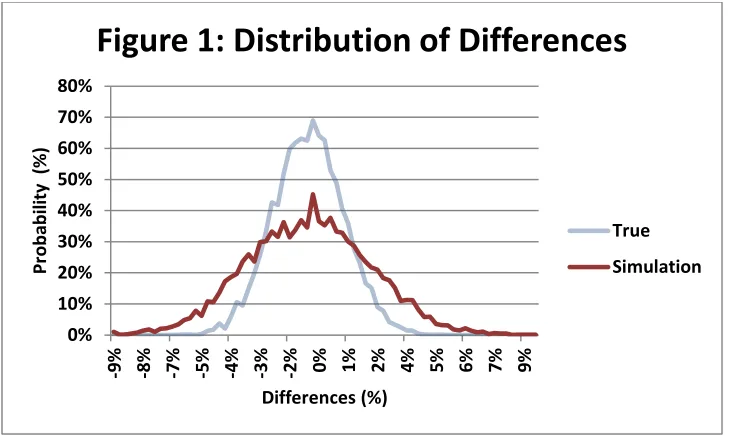
Figure 1 shows that the counterfactual variable does indeed have larger variance than the
true variable. To calculate this result I assume the noise terms have a normal distribution with
standard deviation 1.5% (𝜀𝑋, 𝜀𝑌~𝑖𝑖𝑑 𝑁(0,0.015)). The soft-blue “True” line represents the model in Equation (4), differences for the treatment variable before the event. The dark-red
“Simulation” line represents the distribution of the counterfactual variable ( 𝑑𝑌
dt̃(𝑡)) from
Equation (8).
(11) 𝑌(𝑇)̃ = 𝑌(𝑆) ∏ [1 +𝑑𝑌
𝑑𝑡̃ ](𝑡) 𝑇
𝑡=𝑆+1
So far I have only described the counterfactual variable in terms of differences. However,
the CS method provides a way to calculate the levels for the counterfactual variable. Equation
(11) describes how to use the method to simulate the level of the counterfactual variable. In
Equation (11), time t=S denotes the time when the event occurs, time t=T denotes the time that we want to simulate the counterfactual for (T>S). I calculate the level at time T by compounding the differences of the counterfactual differences from time S+1 to T, which is a standard
calculation for compounding growth rates. Equation (11) shows that the CS method creates an
entire distribution for the levels of the treatment variable at a certain time as-if the event did not
occur (𝑌(𝑇)̃).
Based on Figure 1, I expect that the simulated levels will have different properties from the
true levels for the treatment variable. I explore this using simulation in Figure 2.
0% 10% 20% 30% 40% 50% 60% 70% 80%
-9% -8% -7% -5% -4% -3% -2% 0% 1% 2% 4% 5% 6% 7% 9%
Pr
o
b
ab
il
ity
(
%
)
[image:8.612.125.490.71.293.2]Differences (%)
Figure 1: Distribution of Differences
True
Figure 2 shows the distribution for the level of the treatment variable under simulation.
The diagram shows the distributions for a specific point in time (t=100), which may vary over time if the levels are non-stationary. Again, “True” refers to the treatment variable under Equation (4) and “Simulation” refers to data generated by the CS method (𝑌(100)̃ ). Notice that the two distributions have very similar centers, but the distribution from my CS method clearly
has larger variance. This suggests the estimation error identified in Equation (10) accumulates in
the differences and appears in the levels, as in Equation (11). Together, Figures 1 and 2 show
that data produced by the CS method has two sources of noise – the true noise in the data
generating process and additional noise (estimation error) introduced through the construction of
the counterfactual.
3. Simulation Example
I briefly describe the data generating process in simple terms. Before the event, I assume
that growth rates for both the treatment and control variables have a flat trend. After the event,
the treatment series (Y(t)) begins to follow a new trend with more frequent and larger decreases. This resembles a situation where two economic variables are similar at first, then an event
adversely affects one variable and causes it to deteriorate over time. I assume that I know all the
0% 2% 4% 6% 8% 10% 12% 14%
40 55 70 85 100 115 130 145 016 175 190 205 220 235 250
Pr
o
b
ab
il
ity
(%
)
[image:9.612.124.490.91.307.2]Levels ($)
Figure 2: Distribution of Levels
True
relevant distributions for this demonstration but, in empirical applications, researchers will have
to contend with uncertainty about their estimates.
I construct data for the period before the event based on Equation (3) and (4) as follows. I
assume that 𝜀𝑋, 𝜀𝑌~𝑖𝑖𝑑 𝑁(0, 0.015). To build trend growth rates (𝛼) with autocorrelation, I use a moving average. Denote 𝑎(𝑖)~𝑖𝑖𝑑 𝑈(−0.05, 0.05) and 𝑘 = 10, then I define 𝛼(𝑡) by
Equation (12).
(12) 𝛼(𝑡) = ∑ 𝑎(𝑖)
𝑘 𝑡
𝑖=𝑡−𝑘
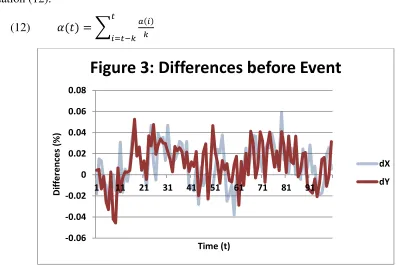
Figure 3 shows one round of data generated by my model for variables before the event.
Visual inspection suggests the two variables have similar growth rates, but do they pass a
statistical test for cointegration? I use the Dickey-Fuller test in Equation (13) to check this. The
null hypothesis for the test is is that the slope coefficient (b) is zero, which implies that the diff-diff are stationary (no unit root in U(t)) and the X, Y data are cointegrated. The alternative is that the slope is non-zero, the diff-diff are non-stationary and the data are not cointegrated.
(13) 𝑑𝑈
𝑑𝑡(𝑡) = 𝑎 + 𝑏 𝑑𝑈
𝑑𝑡(𝑡 − 1) + 𝑒(𝑡)
I find that, yes, the data in Figure 3 are cointegrated. The estimation results presented in
Table 1 show that the slope coefficient (b) is not different from zero at a 95% confidence level. My data generating process is working as intended for the period before the event.
-0.06 -0.04 -0.02 0 0.02 0.04 0.06 0.08
1 11 21 31 41 51 61 71 81 91
D
iff
e
re
n
ce
s
(%
)
[image:10.612.90.493.185.450.2]Time (t)
Figure 3: Differences before Event
dX
Table 1: Cointegration Test with Data Before Event
Coefficient Estimate 95% Lower Bound 95% Upper Bound
Intercept (a) -0.001 -0.005 0.003
Slope (b) 0.027 -0.175 0.229
To create data without cointegration, I introduce a new trend for the treatment variable (𝑑𝑌
𝑑𝑡).
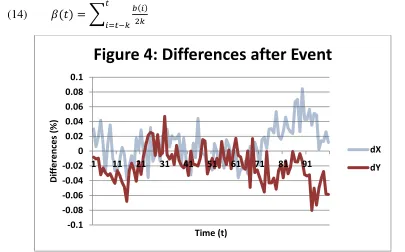
This new trend has higher probabilities of larger decreases, which can be seen in Figure 4: the
treatment variable has repeated decreases larger than 5% around time 90, which is different from
the behaviour of the treatment variable in Figure 3. The control variable (𝑑𝑋
𝑑𝑡) follows the same
trend as before, Equation (12). I denote the new trend as 𝛽 and construct it as a different path
from the same family of 𝛼. Let 𝑏(𝑖)~𝑖𝑖𝑑 𝑈(−0.05,0.05), then 𝛽(𝑡) is defined by Equation (14).
(14) 𝛽(𝑡) = ∑ 𝑏(𝑖)
2𝑘 𝑡
𝑖=𝑡−𝑘
Figure 4 shows one round of data for the variables after the event. The data is clearly
different from Figure 3 at some time intervals, such as times 70—90, but it is not clear if the differences are sufficient to register as not-cointegrated within the Engle-Granger framework.
Therefore, I use the Dickey-Fuller test to determine if the diff-diff in Figure 4 are stationary.
Table 2 shows that the data in Figure 4 is, indeed, not cointegrated. Technically, the diff-diff has
significant (positive) autocorrelation, which means it is not-stationary. This provides evidence
that my data generating process is working as intended for the period after the event.
-0.1 -0.08 -0.06 -0.04 -0.02 0 0.02 0.04 0.06 0.08 0.1
1 11 21 31 41 51 61 71 81 91
D
iff
e
re
n
ce
s
(%
)
[image:11.612.93.498.298.550.2]Time (t)
Figure 4: Differences after Event
dX
Table 2: Cointegration Test with Data After Event
Coefficient Estimate 95% Lower Bound 95% Upper Bound
Intercept (a) 0.014 0.006 0.022
Slope (b) 0.523 0.350 0.696
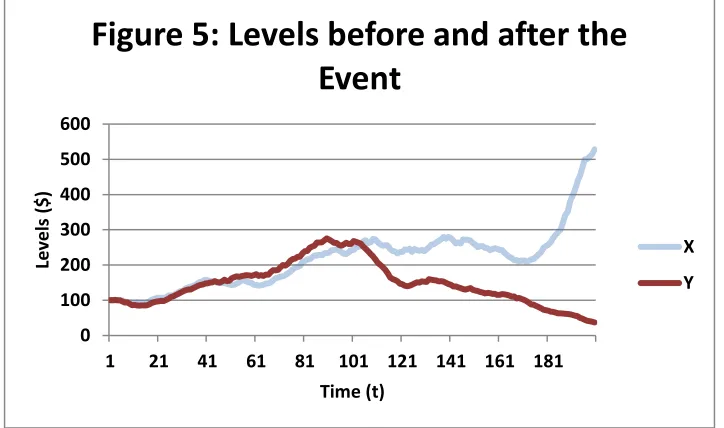
Figure 5 shows the levels for X(t) and Y(t) based on the differences shown in Figures 3 and 4. The Figure shows the entire simulation, which is 200 time steps long. The event occurs at
time 100. Notice how X(t) and Y(t) start to diverge after time 100 – this is because Y(t) is following a new trend with downward-bias.
Figure 6 shows an example of the CS method in action. The Figure zooms in on the
second half of Figure 5, after the event occurs. The dotted line (Y-Hat) is one version of the counterfactual variable from Equation (11). Notice how the dotted line tracks closely around the
control variable (X(t)), this occurs because the dotted line is built from the trend growth (𝛼) in the control group (X(t)). The simulated data (Y-Hat)has very different behaviour than the
observed data (Y-Observed), which illustrates the type of results that my CS method can produce. However, Figure 6 only shows a single path from the CS method. The method can
produce arbitrarily many paths. In fact, the method can produce an entire distribution for the
treatment variable ((𝑌(100)̃ ). I simulate 10,000 paths to estimate the distribution at each time
step. There are several ways to use this distribution to estimate the effect of the event ( event-effect). One way to measure the event-effect is to compare the observed level (Y(T)) and the
0 100 200 300 400 500 600
1 21 41 61 81 101 121 141 161 181
Level
s
($)
[image:12.612.126.488.243.457.2]Time (t)
Figure 5: Levels before and after the
Event
X
median simulated value (𝑌(𝑇)̅̅̅̅̅̅), which is appropriate because it is robust to outliers. I denote this
measure for event-effect as E(T) and define it in Equation (15). (15) 𝐸(𝑇) = 𝑌(𝑇) − 𝑌(𝑇)̅̅̅̅̅̅
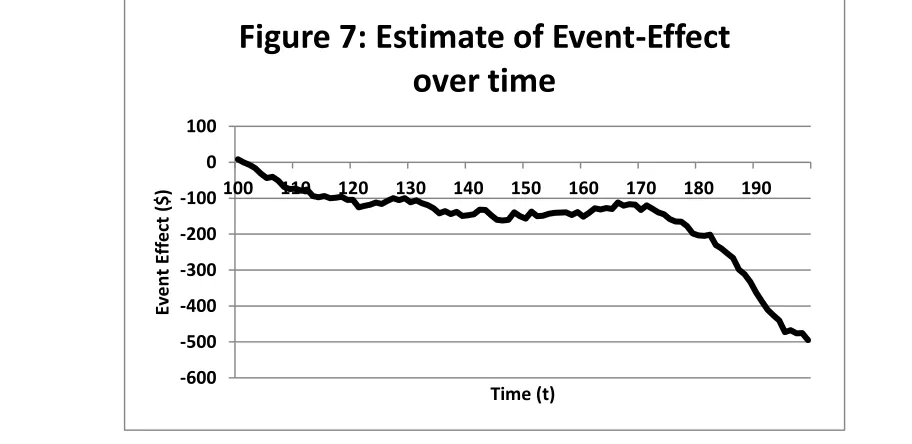
Since the measure of event-effect (E(T)) depends on time, the CS method provides a way to explore how the event-effect varies over time. Figure 7 shows the event-effect (E(T)) over the entire period after the event (100<T<200) using my simulations. Notice how the event-effect takes large negative values around time 190, which is the same time that the control variable
(X(t)) increases and the treatment decreases (Y(t)). This is the precisely the type of behaviour that the CS method is designed to capture.
0 100 200 300 400 500 600 700
100 110 120 130 140 150 160 170 180 190
Level
s
($)
[image:13.612.107.494.83.355.2]Time (t)
Figure 6: Example of Single Path from
Method
X
Y-Observed
Y-Hat
-600 -500 -400 -300 -200 -100 0 100
100 110 120 130 140 150 160 170 180 190
E
v
e
n
t
E
ff
e
ct
($)
Time (t)
[image:13.612.81.537.491.713.2]Figure 7 provides evidence to address the original research question: how has the event
affected the treatment variable over time and where would the treatment variable be if the event
never occurred?
4. Conclusion
In this paper I develop a method for quasi-experiments where an event breaks cointegration.
This is not just a structural change within a cointegration relationship; rather, it can deal with
situations where there is no cointegration after the event. The method extends the distribution of
the diff-diff before the event to the period after the event to simulate values for the treatment
variable as-if the event never occurred, hence the name Counterfactual Simulation (CS). I
explore properties of the CS method using analytic and numerical analysis. I show that the
counterfactual variable has two sources of noise: noise from the true data generating process, and
noise from estimation error. I argue that the simulated variable will have larger variance based
on theoretical grounds and show that this is true in simulation.
I also demonstrate how to use the method with purpose-built data. I simulate a time series
with length 100 both before and after the event, and show that the diff-diff are indeed stationary
before but not after. I show a single path for the counterfactual variable and discuss how to use
the distribution of the counterfactual variable to estimate the effect of the event over time. I
present a measure for the event-effect and show that it has intuitive behaviour in simulation.
This paper provides a foundation for the CS method that can be enhanced in several ways.
For example, it is possible to model uncertainty around the estimates of the distribution of the
diff-diff before the event or develop a formal testing procedure to determine if an event is
significant and conduct power analysis for the test. Both of these endeavours would be valuable
precursors to empirical applications of the method, of which there are many in our data-rich
world. The method raises other questions for me, such as the need for certain assumptions in the
classic model of cointegration (does each variable have to be individually stationary?) or the
References
Angrist, J.D. & Pischk, J.S. (2009). Mostly Harmless Econometrics. Princeton, NJ: Princeton University Press.
Bell, P. (2014). Farmland Ownership Restrictions: Between a Rock and a Hard Place.
Unpublished manuscript. University of Victoria, Canada. Retrieved from
http://mpra.ub.uni-muenchen.de/53033/
Engle, R.F. & Granger, C.W.J. (1987). Cointegration and error correction: Representation,
estimation, and testing. Econometrica, 55, 251—276.
Gregory, A.W. & Hansen, B.E. (1996). Residual-based tests for cointegration in models with
regime shifts. Journal of Econometrics, 70(1), 99—126.
Maddala, G.S. & Kin, In-Moo (1998). Unit Roots, Cointegration, and Structural Change. Cambridge, UK: Cambridge University Press.
McCloskey, D., Ziliak S.T. (1996). The Standard Error of Regressions. Journal of Economic Literature, 34, 97–114.
Peters, O. (2011a). The time resolution of the St. Petersburg paradox. Philosophical Transactions of the Royal Society A, 369(1956). 4913-4931.
Peters, O. (2011b). Menger 1934 Revisited. Unpublished manuscript, Imperial College London. Retrieved from http://arxiv.org/abs/1110.1578
Upper, C. (2007). Using Counterfactual simulations to assess the danger of contagion in
interbank markets. BIS Working Paper No. 234. Retrieved from
Code Appendix:
Counterfactual Simulation
Peter Bell
University of Victoria
% Code has three sections. Code written for Matlab 2010. %
%
%% Section 1: Simulate a single path to show breakpoint in cointegration.
% Set random seed to allow replication of results.
s = RandStream('mcg16807','Seed',0) RandStream.setDefaultStream(s)
% Set length of path and trend growth rates.
% Note: a~U(-0.1,0.1) and b~U(-0.12,0.08) to reflect beta is down-trend.
n1 = 100; n2 = 100; k = 10;
a = (randi(20,[n1+n2+k,1])-10)/100; b = (randi(20,[n1+n2+k,1])-12)/100;
for i = 1:n1+n2
alpha(i) = mean(a(i:i+k)); beta(i) = mean(b(i:i+k));
end
% The idiosyncratic noise terms are iid, N(0,0.015).
sigmaX=0.015; sigmaY=0.015; epsX=sigmaX*randn(n1+n2,1); epsY=sigmaY*randn(n1+n2,1);
% The differences before the event (dX0) have the same trend.
dX0 = alpha(1:n1)' + epsX(1:n1); dY0 = alpha(1:n1)' + epsY(1:n1); dU0 = dX0 - dY0;
% The differences after the event (dX1) have different trends.
dX1 = alpha(n1+1:n1+n2)' + epsX(n1+1:n1+n2); dY1 = beta(n1+1:n1+n2)' + epsY(n1+1:n1+n2); dU1 = dX1 - dY1;
% I preform regression on the diff-diff before and after the event.
dU0Lag = lagmatrix(dU0,1);
regB0 = [ones(n1-1,1), dU0Lag(2:n1)]; [b0,bInt0] = regress(dU0(2:n1), regB0); dU1Lag = lagmatrix(dU1,1);
regB1 = [ones(n1-1,1), dU1Lag(2:n1)]; [b1,bInt1] = regress(dU1(2:n1), regB1);
% I build the levels of the variables to show affects of the event.
X(1)=100; Y(1)=100;
dX = [dX0; dX1]; dY = [dY0; dY1]
for i = 2:n1+n2
Y(i) = Y(i-1)*(1+dY(i-1)) X(i) = X(i-1)*(1+dX(i-1))
end
% To collect key data variables together.
coint1 = [b1,bInt1];
%% Section 2: demonstrate method. %
% First I simulate a single path with the CS method.
% I build the diff-diff as-if I know it's true distribution.
dUHat = sigmaX*randn(n2,1)-sigmaY*randn(n2,1);
% I build hypothetical changes based on observed control and diff-diff.
dYHat = dX(n1+1:n1+n2)+dUHat; YHat(1) = Y(n1)
for timeCount = 2:n2
YHat(timeCount) = YHat(timeCount-1)*(1+dYHat(timeCount-1));
end
% To collect key variables.
simPath = [X(n1+1:n1+n2)' Y(n1+1:n1+n2)' YHat']
% Second I show how to calculate policy-effect using the CS method.
numSim = 100;
for i = 1:numSim
dUHat = sigmaX*randn(n2,1)-sigmaY*randn(n2,1); dYHat = dX(n1+1:n1+n2)+dUHat;
YHat(1) = Y(n1); for timeCount = 2:n2
YHat(timeCount) = YHat(timeCount-1)*(1+dYHat(timeCount-1)); end
simLevel(i,1)=YHat(5);
end
% To collect key variables.
simResults = [ Y(n1+5) median(simLevel) mean(simLevel)]
% Third, I calculate levels-effect over time
for j = 1:100 numSim = 100; for i = 1:numSim
dUHat = sigmaX*randn(n2,1)-sigmaY*randn(n2,1); dYHat = dX(n1+1:n1+n2)+dUHat;
YHat(1) = Y(n1); for timeCount = 2:n2
YHat(timeCount) = YHat(timeCount-1)*(1+dYHat(timeCount-1)); end
simLevel(i,1)=YHat(j); end
simEffect(j,1) = Y(n1+j)-median(simLevel)
end
clear all
% As in Section 1.
s = RandStream('mcg16807','Seed',0) RandStream.setDefaultStream(s) n2 = 100; k = 10;
sigmaX = 0.015; sigmaY = 0.015;
% First simulation: differences. This is one step in each path, simualted % ten thousand times. Shows the difference of distribution of treatment % (dy) as if no event and as estimated using my method.
aPrime = (randi(20,[k,1])-10)/100; alphaPrime = mean(aPrime);
numSimDiff = 10000
for i =1:numSimDiff
epsX1=sigmaX*randn(1,1); epsX2=sigmaX*randn(1,1); epsY=sigmaY*randn(1,1);
dYObs = alphaPrime(1) + epsY; dYHat = dYObs + epsX1 - epsX2; simDiffs(i,1) = dYObs;
simDiffs(i,2) = dYHat;
end
% Second simulation, levels. Each path has 100 time steps and I simulate % ten thousand paths. The results shows the distribution for the Y
% variable as-if there was no event, and as-estimated using my method.
numSimDiff = 10000; nStep=100; k=10;
for simCount =1:numSimDiff
aPrime = (randi(20,[nStep+k,1])-10)/1000; for aCount = 1:nStep
alphaPrime(aCount) = mean(aPrime(aCount:aCount+k)); end
epsX1=sigmaX*randn(nStep,1); epsX2=sigmaX*randn(nStep,1); epsY=sigmaY*randn(nStep,1); dYObs = alphaPrime' + epsY; dYHat = dYObs + epsX1 - epsX2; YObs(1)=100; YHat(1)=100; for levelCount = 2:nStep
YObs(levelCount) = YObs(levelCount-1)*(1+dYObs(levelCount-1)); YHat(levelCount) = YHat(levelCount-1)*(1+dYHat(levelCount-1)); end
simLevels(simCount,1) = YObs(nStep); simLevels(simCount,2) = YHat(nStep);
end