Munich Personal RePEc Archive
Stress Testing and Modeling of Rating
Migration under the Vasicek Model
Framework - Empirical approaches and
technical implementation
Yang, Bill Huajian and Du, Zunwei
18 June 2015
Online at
https://mpra.ub.uni-muenchen.de/65168/
Stress Testing and Modeling of Rating Migration
under the Vasicek Model Framework
- Empirical approaches and technical implementation
(Pre-typeset version)
(Final version is published in "Journal of Risk Model Validation", Vol.9 / No.2, 2015)
Bill Huajian Yang Zunwei Du
Abstract
Under the Vasicek asymptotic single risk factor model, stress testing based on rating transition probability involves three components: the unconditional rating transition matrix, asset correlations, and stress testing factor models for systematic downgrade (including default) risk. Conditional transition probability for stress testing given systematic risk factors can be derived accordingly. In this paper, we extend Miu and Ozdemir’s work ([14]) on stress testing under this transition probability framework by assuming different asset correlation and different stress testing factormodel for each non-default rating. We propose two Vasicek models for each non-default rating, one with a single latent factor for rating level asset correlation, and another multifactor Vasicek model with a latent effect for systematic downgrade risk. Both models can be fitted effectively by using, for example, the SAS non-linear mixed procedure. Analytical formulas for conditional transition probabilities are derived. Modeling downgrade risk rather than default risk addresses the issue of low default counts for high quality ratings. As an illustration, we model the transition probabilities for a corporate portfolio. Portfolio default risk and credit loss under stress scenarios are derived accordingly. Results show, stress-testing models developed in this way demonstrate desired sensitivity to risk factors, which is generally expected.
Keywords: Stress testing, systematic risk, asset correlation, rating migration, Vasicek model, bootstrap aggregation
1. Introduction
Stress testing is important for financial institutions either for regulatory requirements or for internal capital allocation ([1], [3], [7], [18]). In practice, stress testing focuses on systematic risk, with shocks originating from the market or macroeconomic factors ([5], [7], [19]).
Let
{
R
i|
1
i
k
}
denote a rating system with k ratings, with lower indexes i indicating lower default risk. ThusR
1is the best quality rating andR
kis the worst rating, i.e., the default rating.For a credit portfolio, stress testing can be implemented through modeling the conditional transitional probabilities under systematic risk ([2], [14]). The transition probabilities for an entity with a non-default rating
R
iare assumed to be governed by a latent random variablez
i, called the firm’snormalized asset value, which splits into two parts as:
where
s
i represents the systematic risk (i.e., the common risk to all entities in the rating), while
irepresents the idiosyncratic risk. The constant
i is called the asset correlation. It is assumed that
Bill Huajian Yang, and Zunwei Du, Enterprise Stress Testing, Royal Bank of Canada
Mail address: 155 Wellington Street W 16th floor, Toronto, ON, Canada, M5V 3K7
The views expressed in this article are not necessarily those of Royal Bank of Canada or any of its affiliates. Please direct any comments to [email protected], phone: 416-313-1245
) 1 , 0 ( ~ ), 1 , 0 ( ~ , 1 0
,
1 s N N
s
there exist threshold values{bij}such that a firm’s rating migrates from
R
itoRj or worse (calleddowngrade (including default) risk) when
z
ifalls below the threshold value bi(kj1).Modeling for stress testing purposes for a credit portfolio under this framework involves: (a) Determining the threshold values{bij}(or equivalently, the unconditional transition
probabilities).
(b) Estimating the asset correlation
ifor each non-default rating.(c) Modeling the downgrade risk by a multifactor model for each non-default rating. (d) Deriving conditional transition probabilities given scenario risk factors thus assessing
portfolio level credit loss.
While threshold values{bij}can be estimated by using historical point-in-time migration matrices (see
section 2), the estimation of asset correlations and modeling of conditional downgrade risk by factor models are more challenging. Miu and Ozdemir ([14]) propose approaches to deriving the conditional transition probabilities based on a factor model for the systematic risk s:
s f(x1,x2,...,xm)e, e~ N(0,
e2) (1.2)by assuming the same systematic risk and same asset correlation for all non-default ratings. Miu and Ozdemir also show how parameters of model (1.2) and those from (a)-(c), including threshold values
}
{bij , can be estimated simultaneously in one single process of likelihood maximization.
We extend Miu and Ozdemir’s work to a more granular rating level, by assuming different asset correlation
i and different systematic risks
i for each default rating. Specifically, for anon-default rating
R
i, letd
i(
s
i)
denote the downgrade probability given systematic risks
i. We proposedtwo Vasicek models, each with a latent random effect, for stress testing purposes:
d
i(
s
i)
(
a
i0
a
i1s
i)
,
s
i~
N
(
0
,
1
)
(1.3)
( ) ( ), ~ (0, 2( ))
2 1 1
0 i i s im m i i i
i i
i s a a x a x a x e e N e
d
(1.4)
where
denotes the standard normal cumulative distribution, and
x
1,
x
2,
...,
x
mare scenario ormacro risk factors. As shown in later sections, asset correlation
i and conditional transitionprobabilities can be derived accordingly from these two stress testing models, given the threshold values {bij} (see Lemma 3.1 and Theorem 3.3).
The advantages for the proposed approaches are the following:
(1) Asset correlations and stress testing factor models are differentiated between non-default ratings, achieving desired risk sensitivity for the stress testing models under stress scenarios. (2) Similar to the results by Miu and Ozdemir ([14]), analytical formulas for conditional transition
probabilities are derived.
(3) Parameters in (a)-(c) are estimated separately, expert judgements and adjustments for threshold values {bij}and asset correlations are made possible.
Models (1.3)-(1.4) can be fitted effectively by using, for example, SAS non-linear mixed procedure ([21]), assuming a binomial distribution for the event count given the event probability. We will propose a two-step fitting procedure in section 3.3 for training the model (1.4): first by a master model for all non-default ratings targeting the portfolio default risk, and then calibrating this master model to rating level for each non-default rating, targeting the downgrade risk.
The paper is organized as follows: We review in section 2 the Vasicek asymptotic single risk factor model (ASRF) for modeling of rating migration. In section 3, we propose the stress testing models (1.3)-(1.4), and derive the analytical formulas for conditional transition probabilities. Parameter estimation methodologies, including the bootstrap aggregation technique (called bagging, for addressing the time series serial correlation), are reviewed in section 4. In section 5, we validate the proposed approaches by building stress testing models for a US corporate portfolio. Portfolio credit loss and default risk on stress scenarios are assessed accordingly.
The author thanks Dr. Clovis Sukam for his critical reading of the manuscript.
2. Rating Migration under the Vasicek Asymptotic Single Risk Factor Model Framework 2.1. The Vasicek Asymptotic Single Risk Factor Model
Under the Vasicek asymptotic single risk factor model ([2], [9], [11], [12], [13], [14], [20]), default risk for an entity is driven by a latent variable z, the normalized asset value of the entity.Adefault event occurs in horizon if this normalized asset value falls below a threshold value,called default point. For a group of risk homogenous entities, z splits into two parts:
where s represents the systematic risk (i.e., the common risk), common to all entities in the group, while
represents the idiosyncratic risk. The constant
is called the asset correlation of the group.2.2. The Unconditional Rating Migration Matrix
We assume that entities in the same rating are risk homogeneous. Thus model (2.1) applies. Given a non-default rating
R
i, we assume that there exist k threshold valuesbi1 bi2 ...bi(k1) bik() (2.2)
such that an entity will migrate to ratingRjor worse in horizon if z falls below bi(kj1),
i.e.,zbi(kj1).
Denote bypij the unconditional transition probability of migrating from
R
i toRj, anddijtheunconditional transition probability from
R
i toRjor worse. This meansp
ik(
d
ik)
is theunconditional default probability for rating
R
i. The following propositions hold and can be found in([2], [14]).
Proposition 2.1
. (a) If
j
1
,
dij 1.
(b) If
j
1
,
dij P(zbi(kj1)(bi(kj1))) 1 . 2 ( ) 1 , 0 ( ~ ), 1 , 0 ( ~ , 1 0
,
1 s N N
s
Proposition 2.2
(a)
p
ik
d
ik
(
b
i1)
and
pi1 1(bi(k1))(b) If
1
j
k
then
pij (bi(kj1))(bi(kj))dij di(j1)
.
Consequently, given the unconditional transition matrixT (pij), the threshold values{bij}in (2.2)
can be determined sequentially, first
b
i1 by Proposition 2.2 (a), thenb
i2 by Proposition 2.2 (b) andProposition 2.1 (b), and so on.
2.3. Calibration of the Unconditional Rating Migration Matrix
The unconditional transition probabilities{pij}
can be estimated using the historical
point-in-time migration matrices.
This is because:dij P(zbi(kj1)) Es(P(zbi(kj1) |s))
)
3
.
2
(
)]
|
(
[
))]
|
(
)
|
(
[
) 1 ( )
(
) ( )
1 ( ) 1 (
s
b
z
b
P
E
s
b
z
P
s
b
z
P
E
d
d
p
j k i j
k i s
j k i j
k i s
j i ij ij
where
E
s(
)
denotes the expectation with respect to s. SinceP(bi(kj) zbi(kj1)|s)
is the point-in-time transition probability of migrating from
R
itoRjgiven the systematic risk s, weconclude that the unconditional transition probabilitypijcan be estimated by taking the average of the
historical transition rate of moving from rating
R
i to ratingRj.This average migration matrix, estimated from historical point-in-time transition matrices as above, are usually subjected to experts’ reviews. Adjustments may be required before it is used to derive the threshold values{bij}. In general, the following rules are imposed:
(a) Transition probabilities pij have to be floored at a positive number to ensue that the threshold
values {bij}are different for a given rating
R
i.(b) The unconditional default probability
p
ikis an increasing function of i, i.e., better qualityratings have lower default probabilities
(c) Given a risk rating
R
i, the transition probabilitypijis a decreasing (not necessarily strict)function for the distance
|
i
j
|
between i and j, wherei
j
. This means an entity is more likely to migrate to a closer rating than a farther away rating in the same direction.
2.4. Conditional Rating Migration Given Systematic Risk
Given model (2.1), let pij(s) denote the transition probability of moving from
R
i toRj conditionalsystematic risk s. The two propositions below for dij(s) and pij(s)follow similarly as Propositions
2.1 and 2.2 via model (2.1), and can be found in ([2], [14]).
Proposition 2.3
(a) If
j
1
,
dij(s)1.
(b) If
j
1
,
d
ij(
s
)
[(
b
i(kj1)
s
)
/
1
]
Proposition 2.4.
(a)
pik(s)dik(s)[(bi1s
)/ 1
](b)
p
i1(
s
)
1
[(
b
i(k1)
s
)
/
1
]
(c) If
1
j
k
then
p
ij(
s
)
[(
b
i(kj1)
s
)
/
1
]
[(
b
i(kj)
s
)
/
1
]
d
ij(
s
)
d
i(j1)(
s
)
3. Stress Testing Models 3.1 The Vasicek Models
For simplicity, we denote the downgrade probability di(i1)(s)for a non-default rating
R
i byd
i(
s
)
.Given a non-default rating
R
i, we propose two Vasicek models for stress testing purposes:
d
i(
s
)
(
a
0
a
1s
)
,
s
~
N
(
0
,
1
)
(3.1)
di(s)(a0 a1x1a2xs amxm e), e~ N(0,
e2)(3.2)
where
x
1,
x
2,
...,
x
mare macro variables or market factors in horizon, subjected to an appropriatetransformation by
1when necessary. The latent random residual e is independent ofx
1,
x
2,
...,
x
m.With the model (3.2), we are required to estimate parameters
a
0,
a
1,
a
2,
...,
a
mand
e. Note that,models (3.1) and (3.2) are at rating level. We are required to fit models (3.1) and (3.2) for each non-default rating independently.
With the rating level Vasicek model (3.1), the asset correlation
can be calculated as in the next lemma below.Lemma 3.1 ([17]) (a)
E
s[
(
a
0
a
1s
)]
(
a
0/
1
a
12)
, wheres
~
N
(
0
,
1
)
(b) ([22])
i a12/(1a12) under model (3.1).3.2 Conditional Transition Probabilities Given Factor Model (3.2)
Given model (3.2) for a rating
R
i, leti i m
i
x
a
a
u
1
0
Denote by
d
i(
x
1,
x
2,
...,
x
m)
the downgrade probability for the ratingR
i given the macro condition mx
x
Proposition 3.2
. ([22])d
i(
x
1,
x
2,
...,
x
m)
E
(
(
u
e
)
|
x
1,
x
2,
...,
x
m)
(
u
/
1
e2)
Let bi bi(ki), the threshold value corresponding to the downgrade probability for rating
R
i. Giventhreshold values {bij}and the market condition
x
1,
x
2,
...,
x
m, the conditional migration probabilitiescan be derived (using models (3.1)-(3.2)) as in the theorem below. We get similar but slightly different from the results by Miu and Ozdemir ([14]).
Theorem 3.3. The following statements hold under model (3.2):
(a)
(
,
,
...,
)
1
[
/
1
(
( 1))
/
(
1
)(
1
2)
]
22 1
1 m e ik i e
i
x
x
x
u
b
b
p
(b)
(
,
,
...,
)
[
/
1
(
1)
/
(
1
)(
1
2)
],
.
22
1 m e i i e
ik
x
x
x
u
b
b
p
(c) If
1
j
k
then
]
)
1
)(
1
(
/
)
(
1
/
[
]
)
1
)(
1
(
/
)
(
1
/
[
)
...,
,
,
(
2 ) ( 2 2 ) 1 ( 2 2 1 e i j k i e e i j k i e m ijb
b
u
b
b
u
x
x
x
p
Proof. By model (3.2), and Proposition 2.3 (b), we have
1 / 1 / 1 / ) ( i i b e u s e u s bWe just prove the statements (b) and (c), the proof for (a) is similar. By Proposition 2.4 (a), we have
] ) 1 )( 1 ( / ) ( 1 / [ ) ..., , , ( ] 1 / ) ( [ ] 1 / ) [( ) ( 2 1 2 2 1 1 1 e i i e m ik i i i ik b b u x x x p b b e u s b s p
by Lemma 3.1 (a). This proves statement (b). For statement (c), we have
] 1 / ) ( [ ] 1 / ) ( [ ] 1 / ) [( ] 1 / ) [( ) ( ) ( ) 1 ( ) ( ) 1 (
i j k i i j k i j k i j k i ij b b e u b b e u s b s b s pby Proposition 2.4 (c) for
1
j
k
.) ..., , ,
( 1 2 m
jk x x x
p
] ) 1 )( 1 ( / ) ( 1 / [ ] ) 1 )( 1 ( / ) ( 1 /
[u e2 bi(k j 1)bi e2 u e2 bi(k j)bi e2
by Lemma 3.1 (a). This proves statement (c) □
3.3 Two-Step Fitting Procedure for the Multifactor Vasicek Model (3.2)
(i) Let
p
all(
s
)
denote the portfolio level default probability given systematic risk s.First, fit a model over the portfolio for all non-default ratings, targeting the portfolio level default probability
p
all(
s
)
:
(
)
(
)
(
),
~
(
0
,
2)
10 i i e
m
i
all
s
a
a
x
e
w
e
e
N
p
(3.3) where w sums up the fixed effects, and e is the model residual.
(ii) Next, calibrate the above model to each non-default rating
R
i targeting the downgradeprobability as:
d
i(
s
)
(
c
iw
e
i),
e
i~
N
(
0
,
ei2)
(3.4)where
e
i denotes the model residual.Master model (3.3) captures the sensitivity with respect to the portfolio level default risk, ensuring fair risk weights are allocated among risk factors. In general, default is barely observed for high quality ratings, a model targeting default risk has to be fitted on portfolio level. With model (3.4), the master model is calibrated back to the rating level for each non-default rating, targeting the
downgrade risk.
4
Parameter Estimation4.1 Binomial Likelihood Approaches
Let
S
{(
x
1i,
x
2i,
...,
x
mi,
k
i,
n
i}
,i
1
,
2
,
...,
N
, be a time series sample, wherex
1,
x
2,
...,
x
maremarket or macroeconomic variables, and
n
i,
k
i are respectively the numbers of entities and numbersof downgrades in one-year horizon at time index i. Given the downgrade event probability
p
(
s
)
(
u
ce
),
e
~
N
(
0
,
1
)
where u is a deterministic linear function of
x
1,
x
2,
...,
x
m, the likelihood of observing k downgradesfor a non-default rating with n entities is: k n k
s
p
s
p
k
n
))
(
1
(
)
(
Its expected value with respect to random factor e gives the unconditional likelihood:
de e e u e u k n de e s p s p k n n k bin k n k k n k ) ( )) ( 1 )( ( ) ( )) ( 1 ( ) ( ) , (
where
(
)
denotes the standard normal density. The negative natural logarithmic likelihood is given by the sum ([6], [10], [14]):With the maximum likelihood parameter estimation approach, we are required to estimate the model parameters for models (3.1) and (3.2) by minimizing -log L. SAS non-linear mixed procedure (NLMIXED, [21]) provides a tool for fitting this type of models, while maximizing the binomial likelihood.
4.2 The Serial Correlation and Bootstrap Aggregation Methodologies
A model describes the joint distribution between the target and explanatory variables. Given a modeling sample, independence between data points is generally expected. However, serial correlation for a times series sample is in general significant. This causes an issue for parameter estimation ([15], [16, pp.159-175]).
Instead of fitting the models (3.1) and (3.2) directly on the time series sample, we propose a bootstrap approach, assuming that the time series variables are stationary. This approach is analogous to the bagging (bootstrap aggregation) technique ([4], [8]):
(a) Generate B (a sufficiently large number, for example, 200) bootstrap samples using the original time series. Each bootstrap sample is of the same size as the original sample, and is created by randomly sampling from the original sample with replacement. Block sampling may be required when variables used are not evaluated at the same time.
(b) For each bootstrap sample, fit a model of form (3.1).
(c) Calculate the average of each parameter over all bootstrapped models, and select the model with parameters that are the closest to these parameter averages.
For model (3.2), we follow the two-step fitting procedure proposed in section 3.3, and sequentially fit the models (3.3) and (3.4) using the bootstrap technique proposed as above.
5
An Empirical Example: Stress Testing for a Corporate PortfolioIn this section, we validate our proposed approaches to stress testing a corporate portfolio. The sample is created synthetically for a US corporate portfolio. The sample includes the portfolio quarterly data covering the years between 2001 and 2013 in one-year horizon: the first one-year observation period starts at the beginning of the 1st quarter 2001 and ends at 4-th quarter 2001, the second one-year observation period starts at the beginning of the 2nd quarter of 2001 and ends at 1st quarter 2002, and so on. The last one-year observation period starts at the beginning of the 1st quarter 2013 and ends at 4-th quarter 2013.
This is a low default portfolio, with an average portfolio default rate below 1%. There are 21 ratings, with the first rating 1 as the best; and the last rating 21 as the default rating.
Our stress testing for the portfolio follows the steps as proposed in section 1.
(a) Determining the threshold values {bij}
Using all the historical point-in-time migration matrices, we calculate the average migration matrix, and take it as the preliminary unconditional transition matrixT (pij). Minor adjustments are made
(b) Estimating the asset correlation
i for each non-default ratingWe estimate asset correlation for each non-default rating by using Lemma 3.1 (b) via model (3.1). Model (3.1) is fitted using the bootstrap technique as proposed in section 4.2. The two tables below show the estimated asset correlations for all 20 non-default ratings: the asset correlation is over 30% for ratings between 17-20, is about 20% for ratings 1-2 and 16, and is around 10% for ratings 3-15.
Table A. Sample asset correlation for non-default ratings 1-10
RTG 1 2 3 4 5 6 7 8 9 10
Asset Corr 0.20 0.21 0.07 0.13 0.07 0.11 0.11 0.09 0.07 0.09
Table B. Sample asset correlation for non-default ratings 11-20
RTG 11 12 13 14 15 16 17 18 19 20
Asset Corr 0.13 0.08 0.10 0.09 0.12 0.19 0.30 0.58 0.64 0.49
(c) Fitting the multifactor model (3.2) for each non-default rating
The risk factors we select are the following:
(1) US Growth GDP
(2) US Unemployment Rate
(3) US Government 10-year bond yield
(4) US 30-year BBB corporate bond credit spread
We follow the two-step fitting procedure proposed in section 3.3 and the bootstrap technique
proposed in section 4.2: First fit a master model of the form (3.3) for all non-default ratings targeting portfolio level default risk, using the bootstrap technique; then calibrate the selected master model (3.3) to model (3.4) for each non-default rating, targeting downgrade risk and using the bootstrap technique.
(d) Deriving conditional transition probabilities and assessing portfolio credit loss
We derive the conditional transition probabilities by using Theorem 3.3. Conditional portfolio level default rate and loss are calculated respectively as:
i i
i i
i i
i
i
n
n
loss
p
EAD
LGD
n
p
p
/
,
(
)(
)
20
1 20
1
where for a given rating
R
i, the numbersn
i,
p
i are respectively the size and the model predictedprobability of default, and
EAD
i,
LGD
i are the exposure at default (EAD) and loss given default,and n is the portfolio size. .
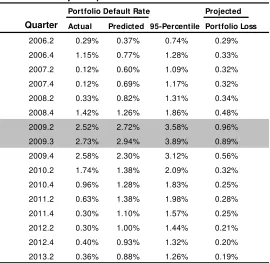
The table below shows the results for model projected portfolio loss and model predicted portfolio default rate.
probability given by the predicted portfolio level default probability. The last column shows the model projected portfolio scenario loss, reported as a percentage of the portfolio total EAD. As shown in the table below, both the model predicted and realized portfolio default rates peak at 2009.3. The projected loss peaks at 2009.2 rather than 2009.3. Note that, projected loss is not necessarily 100% concordant to the predicted default probability due to the LGD factor. The loss rate is generally higher for the entities that get hit in the first round of market shocks. As market moves further into the downturn period, more entities, including those with better risk profiles, start to default, resulting in a relatively higher portfolio default rate but slightly lower loss rate.
[image:11.612.156.426.200.463.2]Table C. Projected portfolio default rate and loss
Portfolio Default Rate Projected
Quarter Actual Predicted 95-Percentile Portfolio Loss
2006.2 0.29% 0.37% 0.74% 0.29%
2006.4 1.15% 0.77% 1.28% 0.33%
2007.2 0.12% 0.60% 1.09% 0.32%
2007.4 0.12% 0.69% 1.17% 0.32%
2008.2 0.33% 0.82% 1.31% 0.34%
2008.4 1.42% 1.26% 1.86% 0.48%
2009.2 2.52% 2.72% 3.58% 0.96%
2009.3 2.73% 2.94% 3.89% 0.89%
2009.4 2.58% 2.30% 3.12% 0.56%
2010.2 1.74% 1.38% 2.09% 0.32%
2010.4 0.96% 1.28% 1.83% 0.25%
2011.2 0.63% 1.38% 1.98% 0.28%
2011.4 0.30% 1.10% 1.57% 0.25%
2012.2 0.30% 1.00% 1.44% 0.21%
2012.4 0.40% 0.93% 1.32% 0.20%
2013.2 0.36% 0.88% 1.26% 0.19%
Conclusion. Risk sensitivity is a key measure for a stress-testing model. In this paper, we
differentiate asset correlations between non-default ratings, and fit stress testing factor models at the rating level, targeting the downgrade risk. We thus achieve desired risk sensitivity and robustness for the stress testing models under stress scenarios. By targeting the downgrade risk rather than default risk, we address the issue of low default counts for high quality ratings. The proposed models can be fitted effectively by using, for example, SAS non-linear mixed procedure. Bootstrap aggregation technique is used to address the serial correlation issue for the time series sample. We believe the proposed approaches provide a step-by-step, effective, and practical tool for practitioners in the fields of financial stress testing.
REFERENCES
[1] Basel Committee on Banking Supervision (2009). Principles for Sound Stress Testing Practices and Supervision
http://www.bis.org/publ/bcbs155.pdf
[3] Blaschke, W., Jones , M. T., Majnoni, G., and Peria, S. M.(2001). Stress Testing of Financial Systems: An Overview of Issues, Methodologies, and FSAP Experiences, IMF Working Paper, WP/01/88
http://www.imf.org/external/pubs/ft/wp/2001/wp0188.pdf
[4] Breiman, L. (1996). Bagging Predictors. Machine Learning 24: 123-140 http://www.cs.utsa.edu/~bylander/cs6243/breiman96bagging.pdf
[5] Bunn, P. (2005). Stress testing as a tool for assessing systematic risks, Financial Stability Review, 2005:6, pp.116-126
http://www.bankofengland.co.uk/publications/Documents/fsr/2005/fsr18art8.pdf
[6] Demey, P., Jouanin, J., Roget, C, and Roncalli, T. (2004). Maximum likelihood estimate of default correlations, Risk, November 2004
http://thierry-roncalli.com/download/risk-mledc.pdf
[7] Drehmann, M. (2008). Stress tests: Objectives, challenges and modelling choices, Economic Review, 2008:Vol 60 (2), pp. 60-92
http://www.riksbank.se/Upload/Dokument_riksbank/Kat_publicerat
/Artiklar_PV/2008/drehmann2008_2_eng.pdf
[8] Friedman, J., Hastie, T., and Tibshirani, R. (2008). The Elements of Statistical Learning, 2nd edition, Springer
[9] Gordy, M. B. (2003). A risk-factor model foundation for ratings-based bank capital rule. Journal of Financial Intermediation12, pp.199-232.
[10] Gordy, M., Heitfield, E. (2002). Estimating default correlations from short panels of credit rating performance data. Federal Reserve Board Working paper, January 2002 [11] Jacobson, T., Linde, J., Roszbach, K. (2011) Firm Default and Aggregate Fluctuations, Board of Governors of the Federal Reserve System, August 2011
[12] Merton, R. (1974). On the pricing of corporate debt: the risk structure of interest rates. Journal of Finance, Volume 29 (2), 449-470
http://www.jstor.org/discover/10.2307
/2978814?uid=2129&uid=2&uid=70&uid=4&sid=21102236625247
[13] Meyer, C. (2009). Estimation of intra-sector asset correlation. The Journal of Risk Model validation, Volume 3 (3), Fall
http://www.risk.net/digital_assets/5021/jrm_v3n3a3.pdf
[14] Miu, P., Ozdemir, B. (2009). Stress testing probability of default and rating migration rate with respect to Basel II requirements, Journal of Risk Model Validation, Vol. 3 (4) Winter 2009, pp
.3-38
[15] Miu, P., Ozdemir, B. (2008). Estimating and validating long-run probability of default with respect to Basel II requirements. The Journal of Risk Model validation, Volume 2/Number 2, 3-41
http://www.risk.net/digital_assets/5008/jrm_v2n2a1.pdf
[16] Pindyck, R. S., Rubinfeld, D. L. (1998). Econometric Models and Economic Forecasts, 4th Edition, Irwin/McGraw-Hill
[17] Rosen, D., Saunders, D. (2009). Analytical methods for hedging systematic credit risk with linear factor portfolios. Journal of Economic Dynamics & Control, 33 (2009), 37-52 http://www.r2-financial.com/wp-content/uploads/2010/07/LinearFactor.pdf
[18] Sorge, M. (2004). Stress-testing financial systems: an overview of current methodologies, BIS Working papers, No. 165
[19] Tarashev, N., Borio, C., and Tsatsaronis, K. (2010). Attributing systematic risk to individual institutions,” Technical Report Working Papers No 308, BIS, May 2010.
http://www.bis.org/publ/work308.pdf
[20] Vasicek, O. (2002). Loan portfolio value. RISK, December 2002, 160 - 162.
SAS Institute Inc.
http://www.ats.ucla.edu/stat/sas/library/nlmixedsugi.pdf