Cause-Effect Relation Learning
Zornitsa Kozareva
USC Information Sciences Institute 4676 Admiralty Way Marina del Rey, CA 90292-6695
Abstract
To be able to answer the question What causes tumors to shrink?, one would re-quire a large cause-effect relation repos-itory. Many efforts have been payed on
is-aandpart-of relation leaning, however few have focused on cause-effect learn-ing. This paper describes an automated bootstrapping procedure which can learn and produce with minimal effort a cause-effect term repository. To filter out the erroneously extracted information, we in-corporate graph-based methods. To evalu-ate the performance of the acquired cause-effectterms, we conduct three evaluations: (1) human-based, (2) comparison with ex-isting knowledge bases and (3) applica-tion driven (SemEval-1 Task 4) in which the goal is to identify the relation between pairs of nominals. The results show that the extractions at rank 1500 are89% ac-curate, they comprise61%from the terms used in the SemEval-1 Task 4 dataset and can be used in the future to produce addi-tional training examples for the same task.
1 Introduction
Over the years, researchers have successfully shown how to build ground facts (Etzioni et al., 2005), semantic lexicons (Thelen and Riloff, 2002), encyclopedic knowledge (Suchanek et al., 2007), and concept lists (Katz et al., 2003). Among the most well developed repositories are those focusing on is-a (Hearst, 1992) and part-of (Girju et al., 2003; Pennacchiotti and Pantel, 2006) relations. However, to be able to answer the question “What causes tumors to shrink?”, one re-quires knowledge aboutcause-effectrelation.
Other applications that can benefit from cause-effectknowledge are the relational search engines
which have to retrieve all terms relevant to a query like: “find all X such that X causes wrinkles” (Ca-farella et al., 2006). Unfortunately to date, there is no universal repository of cause-effect relations that can be used or consulted. However, one would still like to dispose of an automated procedure that can accurately and quickly acquire the terms ex-pressing this relation.
Multiple algorithms have been created to learn relations. Some like TextRunner (Etzioni et al., 2005) rely on labeled data, which is used to train a sequence-labeling graphical model (CRF) and then the system uses the model to extract terms and relations from unlabeled texts. Although very accurate, such methods require labeled data which is difficult, expensive and time consuming to cre-ate. Other more simplistic methods that rely on lexico-syntactic patterns (Hearst, 1992; Riloff and Jones, 1999; Pasca, 2004) have shown to be equally successful at learning relations, temporal verb order (Chklovski and Pantel, 2004) and en-tailment (Zanzotto et al., 2006). Therefore, in this paper, we have incorporated an automated boot-strapping procedure, which given a pattern rep-resenting the relation of interest can quickly and easily learn the terms associated with the relation. In our case, the pattern captures the cause-effect
relation. After extraction, we apply graph-based metrics to rerank the information and filter out the erroneous terms.
The contributions of the paper are:
• an automated procedure, which can learn terms expressingcause-effectrelation.
• an exhaustive human-based evaluation.
• a comparison of the extracted knowledge with the terms available in the SemEval-1 Task 4 dataset for interpreting the relation be-tween pairs of nominals.
The rest of the paper is organized as follows. The next section describes the term extraction pro-cedure. Section 3 and 4 describe the extracted data
and its characteristics. Section 5 focuses on the evaluation and finally we conclude in Section 6.
2 Cause-Effect Relation Learning
2.1 Problem Formulation
The objectives of cause-effect relation learning are similar to those of any general open domain rela-tion extracrela-tion problem (Etzioni et al., 2005; Pen-nacchiotti and Pantel, 2006). The task is formu-lated as:
Task: Given acause-effectsemantic relation expressed through lexico-syntactic pattern and a seed example for which the relation is true, the objective is to learn from large unstructured amount of texts terms associated with the relation.
For instance, given the relation causeand the term virus for which we know that it can cause something, we express the statement in a recursive pattern1“* and virus cause *” and use the pattern to learn new terms that cause or have been caused by something. Following our example, the recur-sive pattern learns from the Web on the left side terms like {bacteria, worms, germs}and on the right side terms like{diseases, damage, contami-nation}.
2.2 Knowledge Extraction Procedure
For our study, we have used the general Web-based class instance and relation extraction frame-work introduced by (Kozareva et al., 2008; Hovy et al., 2009). The procedure is minimally super-vised and achieves high accuracy of the produced extractions.
Term Extraction:To initiate the learning process,
the user must provide as input a seed termY and a recursive pattern“X∗and Y verb Z∗”from which terms on theX∗andZ∗positions can be learned. The input pattern is submitted to Yahoo!Boss API as a web query and all snippets matching the query are retrieved, part-of-speech tagged and used for term extraction. Only the previously unexplored terms found on X∗ position are used as seeds in the subsequent iteration, while the rest of the terms2are kept. The knowledge extraction termi-nates when there are no new extractions.
Term Ranking: Despite the specific
lexico-syntactic construction of the pattern, erroneous
1
A recursive pattern is a lexico-syntactic pattern for which one of the terms is given as input and the other one is an open slot, allowing the learned terms to replace the initial term directly.
2Including the terms found onZ∗position.
extractions are still produced. To filter out the information, we incorporate the harvested terms on X∗ and Y∗ positions in a directed graph G=(V, E), where each vertex v ∈ V is a candidate term and each edge (u, v) ∈ E
indicates that the term vis generated by the term
u. An edge has weight w corresponding to the number of times the term pair (u, v)is extracted from different snippets. A node u is ranked by u=(P
∀(u,v)∈Ew(u, v) +
P
∀(v,u)∈Ew(v, u))
which represents the weighted sum of the outgo-ing and incomoutgo-ing edges to a node. The confidence in a correct argument uincreases when the term discovers and is discovered by many different terms. Similarly, the terms found onZ∗ position are ranked by the total number of incoming edges
from the XY pairs z= P
∀(xy,z)∈E0w(xy, z).
We assume that in a large corpus as the Web, a correct term Z∗ would be frequently discovered by variousXY term pairs.
3 Data Collection
To learn the terms associated with a cause-effect relation, the user can use as input any verb ex-pressing causality3. In our experiment, we used the verb cause and the pattern “* and <seed>
cause *”, which was instantiated with the seed
term virus. We submitted the pattern to
Ya-hoo!Boss API as a search query and collected all snippets returned during bootstrapping. The snip-pets were cleaned from the html tags and part-of-speech tagged (Schmid, 1994). All nouns (proper names) found on the left and right hand side of the pattern were extracted and kept as potential candi-date terms of the cause-effect relation.
Table 1 shows the total number of terms found for thecausepattern onX∗andZ∗positions in 19 bootstrapping iterations. In the same table, we also show some examples of the obtained extractions.
Term Position #Extractions Examples
Xcause 12790 pressure, stress, fire, cholesterol, wars, ice, food, cocaine, injuries bacteria
causeZ 52744 death, pain, diabetes, heart disease, damage, determination, nosebleeds chain reaction
Table 1:Extracted Terms.
4 Characteristic of Learning Terms
An interesting characteristic of the bootstrapping process is the speed of leaning, which can be mea-sured in terms of the number of unique terms ac-quired on each bootstrapping iteration. Figure 1 shows the bootstrapping process for the“cause”
relation. The term extraction starts of very slowly and as bootstrapping progresses a rapid growth is observed until a saturation point is reached. This point shows that the intensity with which new el-ements are discovered is lower and practically the bootstrapping process can be terminated once the amount of newly discovered information does not exceed a certain threshold. For instance, instead of running the algorithm until complete exhaus-tion (19 iteraexhaus-tions), the user can terminate it on the 12th iteration.
!"#$%&'(
)%'#*(+,-,&(./"*,01'( 2"1,3$,4#%1,(./"*,01'(
21,3%5/"'(
6(
/7
(#1
,$
'(
&,
%3
",
4(
8(1,3$'(
9(1,3$'(
[image:3.612.329.503.255.385.2]8:(%"4(;(.%<',(9:(
Figure 1: Learning Curve.
The speed of leaning depends on the way the
X andY terms relate to each other in the lexico-syntactic pattern. For instance, the more densely connected the graph is, the shorter (i.e., fewer iter-ations) it will take to acquire all terms.
5 Evaluation and Results
In this section, we evaluate the results of the term extraction procedure. To the extend to which it is possible, we conduct a human-based evalua-tion, we compare results to knowledge bases that have been extracted in a similar way (i.e., through pattern application over unstructured text) and we show how the extracted knowledge can be used by NLP applications such as relation identification between nominals.
5.1 Human-Based Evaluation
For the human based evaluation, we use two an-notators to judge the correctness of the extracted terms. We estimate the correctness of the pro-duced extractions by measuring Accuracy as the number ofcorrectlytagged examples divided by the total number of examples.
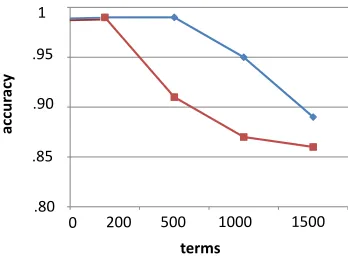
Figure 2, shows the accuracy of the bootstrap-ping algorithm with graph re-ranking in blue and without graph re-ranking in red. The figure shows that graph re-ranking is effective and can separate out the erroneous extractions. The overall extrac-tions produced by the algorithm are very precise, at rank 1500 the accuracy is 89%.
!"#$%&
&'(()
#'(*
&
!"#$ !"#%$ !"&$ !"&%$ '$
'$ ($ )$ *$
"(!!$ "%!!$ '!!!$ '%!!$ ""#%$
"'$
""&%$
""&!$
""#!$ "!$
Figure 2: Term Extraction Accuracy.
Next, in Table 2, we also show a detailed eval-uation of the extracted X and Z terms. We de-fine five types according to which the humans can classify the extracted terms. The types are: Phys-icalObject, NonPhysicalObject, Event, State and
Other. We usedOtherto indicate erroneous ex-tractions or terms which do not belong to any of the previous four types. The Kappa agreement for the produced annotations is0.80.
XCause A1 A2 CauseZ A1 A2
PhysicalObj 82 75 PhysicalObj 15 20 NonPhysicalObj 69 66 NonPhysicalObj 89 91
Event 21 24 Event 72 72
State 29 31 State 50 50
Other 3 4 Other 5 4
[image:3.612.105.292.300.449.2]Acc. .99 .98 Acc. .98 .98
Table 2:Term Classification.
5.2 Comparison against Existing Resources
[image:3.612.322.509.540.600.2](Suchanek et al., 2007) and TextRunner (Etzioni et al., 2005). Although these bases contain mil-lions of facts, it turns out that NELL and Yago do not have information for the cause-effect rela-tion. While the online demo of TextRunner has query limitation, which returns only the top 1000 snippets. Since we do not have the complete and ranked output of TextRunner, comparing results in terms of relative recall and precision is impossible and unfair. Therefore, we decided to conduct an application driven evaluation and see whether the extracted knowledge can aid an NLP system.
5.3 Application: Identifying Semantic
Relations Between Nominals
Task Description(Girju et al., 2007) introduced
the SemEval-1 Task 4 on the Classification of Se-mantic Relations between Nominals. It consists in given a sentence: “People in Hawaii might be feeling<e1>aftershocks</e1>from that power-ful <e2>earthquake</e2>for weeks.”, an NLP system should identify that the relationship be-tween the nominalsearthquakeandaftershocksis
cause-effect.
Data Set(Girju et al., 2007) created a dataset for
seven different semantic relations, one of which is
cause-effect. For each relation, the nominals were manually selected. This resulted in the creation of140training and80testing cause-effect exam-ples. From the train examples 52.14% were pos-itive (i.e. correct cause-effect relation) and from the test examples 51.25% were positive.
Evaluation and ResultsThe objective of our
ap-plication driven study is to measure the overlap of the cause-effect terms learned by our algorithm and those used by the humans for the creation of the SemEval-1 Task4 dataset. There are 314
unique terms in the train and test dataset for which thecause-effectrelation must be identified. Out of them190were also found by our algorithm.
The 61%overlap shows that either our cause-effect extraction procedure can be used to auto-matically identify the relationship of the nominals or it can be incorporated as an additional feature by a more robust system that relies on semantic and syntactic information. In the future, the ex-tracted knowledge can be also used to create addi-tional training examples for the machine learning systems working with this dataset.
Table 3 shows some of the overlapping terms in our system and the (Girju et al., 2007) dataset.
tremor, depression, anxiety, surgery, exposure, sore throat, fulfillment, yoga, frustration, inhibition, inflammation, fear, exhaustion, happiness, growth, evacuation,
earthquake, blockage, zinc, vapour, sleep deprivation, revenue increase, quake
Table 3:Overlapping Terms.
6 Conclusion
We have described a simple web based procedure for learning cause-effect semantic relation. We have shown that graph algorithms can successfully re-rank and filter out the erroneous information. We have conduced three evaluations using human annotators, comparing knowledge against existing repositories and showing how the extracted knowl-edge can be used for the identification of relations between pairs of nominals.
The success of the described framework opens up many challenging directions. We plan to ex-pand the extraction procedure with more lexico-syntactic patterns that express thecause-effect re-lation4such astrigger,lead to,resultamong oth-ers and thus enrich the recall of the existing repos-itory. We also want to develop an algorithm for extracting cause-effect terms from non contigu-ous positions like “stress is another very impor-tant cause of diabetes”. We are also interested in studying how the extracted knowledge can aid a commonsense causal reasoner (Gordon et al., 2011; Gordon et al., 2012) in understanding that if a girl wants to wear earrings it is more likely for her to get her ears pierced rather then get a tattoo. This example is taken from the Choice of Plausi-ble Alternatives (COPA) dataset5, which presents a series of forced-choice questions such that each question provides a premise and two viable cause or effect scenarios. The goal is to choose a cor-rect answer that is the most plausible cause or ef-fect. Similarly, the cause-effect repository can be used to support a variety of applications, includ-ing textual entailment, information extraction and question answering
Acknowledgments
We would like to thank the reviewers for their comments and
suggestions. The research was supported by DARPA contract
number FA8750-09-C-3705.
4These patterns can be acquired from an existing para-phrase system.
References
Michael Cafarella, Michele Banko, and Oren Etzioni. 2006. Relational Web Search. InWorld Wide Web Conference, WWW 2006.
Andrew Carlson, Justin Betteridge, Estevam R. Hr-uschka Jr., and Tom M. Mitchell. 2009. Coupling semi-supervised learning of categories and relations. InProceedings of the NAACL HLT 2009 Workskop on Semi-supervised Learning for Natural Language Processing.
Timothy Chklovski and Patrick Pantel. 2004. Verbo-cean: Mining the web for fine-grained semantic verb relations. In Proceedings of EMNLP 2004, pages 33–40.
Oren Etzioni, Michael Cafarella, Doug Downey, Ana-Maria Popescu, Tal Shaked, Stephen Soderland, Daniel S. Weld, and Alexander Yates. 2005. Un-supervised named-entity extraction from the web: an experimental study. Artificial Intelligence, 165(1):91–134, June.
Roxana Girju, Adriana Badulescu, and Dan Moldovan. 2003. Learning semantic constraints for the auto-matic discovery of part-whole relations. InProc. of the 2003 Conference of the North American Chapter of the Association for Computational Linguistics on Human Language Technology, pages 1–8.
Roxana Girju, Preslav Nakov, Vivi Nastaste, Stan Sz-pakowicz, Peter Turney, and Deniz Yuret. 2007. SemEval-2007 task 04: Classification of semantic relations between nominals. InSemEval 2007. Andrew Gordon, Cosmin Bejan, and Kenji Sagae.
2011. Commonsense causal reasoning using mil-lions of personal stories. In Proceedings of the Twenty-Fifth Conference on Artificial Intelligence (AAAI-11).
Andrew Gordon, Zornitsa Kozareva, and Melissa Roemmele. 2012. Semeval-2012 task 7: Choice of plausible alternatives: An evaluation of common-sense causal reasoning. InProceedings of the 6th In-ternational Workshop on Semantic Evaluation (Se-mEval 2012).
Marti Hearst. 1992. Automatic acquisition of hy-ponyms from large text corpora. In Proc. of the 14th conference on Computational linguistics, pages 539–545.
Eduard Hovy, Zornitsa Kozareva, and Ellen Riloff. 2009. Toward completeness in concept extraction and classification. InProceedings of the 2009 Con-ference on Empirical Methods in Natural Language Processing, pages 948–957.
Boris Katz, Jimmy Lin, Daniel Loreto, Wesley Hilde-brandt, Matthew Bilotti, Sue Felshin, Aaron Fernan-des, Gregory Marton, and Federico Mora. 2003. Integrating web-based and corpus-based techniques for question answering. In Proceedings of the
twelfth text retrieval conference (TREC), pages 426– 435.
Zornitsa Kozareva, Ellen Riloff, and Eduard Hovy. 2008. Semantic class learning from the web with hyponym pattern linkage graphs. InProceedings of ACL-08: HLT, pages 1048–1056.
Marius Pasca. 2004. Acquisition of categorized named entities for web search. InProc. of the thirteenth ACM international conference on Information and knowledge management, pages 137–145.
Marco Pennacchiotti and Patrick Pantel. 2006. On-tologizing semantic relations. InACL-44: Proceed-ings of the 21st International Conference on Com-putational Linguistics and the 44th annual meeting of the Association for Computational Linguistics, pages 793–800.
Ellen Riloff and Rosie Jones. 1999. Learning dic-tionaries for information extraction by multi-level bootstrapping. InAAAI ’99/IAAI ’99: Proceedings of the Sixteenth National Conference on Artificial in-telligence.
Helmut Schmid. 1994. Probabilistic part-of-speech tagging using decision trees.
Fabian M. Suchanek, Gjergji Kasneci, and Gerhard Weikum. 2007. Yago: a core of semantic knowl-edge. InWWW ’07: Proceedings of the 16th inter-national conference on World Wide Web, pages 697– 706.
Michael Thelen and Ellen Riloff. 2002. A Bootstrap-ping Method for Learning Semantic Lexicons Using Extraction Pattern Contexts. InProc. of the 2002 Conference on Empirical Methods in Natural Lan-guage Processing, pages 214–221.