COMPARATIVE EVALUATION OF THE MICRO
COMPOSITE MATERIALS CURED WITH HALOGEN AND LED LIGHT CURING UNITS
Chein Shee Antoinette Yen, *Dr. Roseline Meshramkar
Department of Prosthodontics,
ARTICLE INFO ABSTRACT
Resin based composite restorations placed instead of amalgam continue to increase owing to their esthetics and good functional propertie
good clinical performance depends on the physical and chemical properties which are directly related to conversion of the monomers into polymers. Compressive strength is important for clinical success since it directly affects the physical properties and lon
conversion of resin composite can be measured using different testing techniques methods. In the present invitro
compressive strengt
Aim: Evaluate and compare
composite cured with QTH (quartz tungsten halogen) and LED (light emitting diode) light curing units.
Materials
were obtained from a transparent teflon mould. The specimens were divided into 2 main groups, each specimen then being filled with a light cure composite resin (3M ESPE bulkfill and nano
cured with L
compressive strength and surface micro hardnes
Result:
significant difference from each other when the level of significance was set at 0.05. Conclusion:
and micro
Copyright © 2017, Chein Shee Antoinette Yen et al. This unrestricted use, distribution, and reproduction in any medium
INTRODUCTION
There has been an existential increase in the use of resin based composites in dentistry predominantly due to their esthetics and good physical properties. Since its initiation in the 1960s, countless attempts have been made to improve the clinical practicality of this restorative material (Eliades 1987). The composition and techniques have improved eventuating in increased longevity and strength of the composite restorations, notwithstanding these improvements dentists still face problems while placing posterior restorations that are not only time consuming but also technique sensitive, necessitating the advancement of a procedure that must not only be swiftly performed but also meticulously done (Sarrett 2005). The clinical success of a composite resin is analogou to the polymerization process. Due to an upsurge in the use of
*Corresponding author:Dr. Roseline Meshramkar,
ISSN: 0975-833X
Vol.
Article History:
Received 25th September, 2017
Received in revised form 10th October, 2017
Accepted 22nd November, 2017
Published online 27th December, 2017
Citation: Chein Shee Antoinette Yen, Dr. Roseline Meshramkar, Dr.
micro-hardness and compressive strength of two composite materials cured with halogen and led light curing units”
Research, 9, (12), 62797-62803. Key words:
Bulkfill composite resin, Compressive Strength, LED Light Curing units, Micro-hardness,
Nano-hybrid composite resin, QTH Light curing units.
RESEARCH ARTICLE
COMPARATIVE EVALUATION OF THE MICRO-HARDNESS AND COMPRESSIVE STRENGTH OF TWO
COMPOSITE MATERIALS CURED WITH HALOGEN AND LED LIGHT CURING UNITS
Roseline Meshramkar, Dr. Lekha, K. and
Department of Prosthodontics, SDM College of Dental Sciences and Hospital, Dharwad
ABSTRACT
Resin based composite restorations placed instead of amalgam continue to increase owing to their esthetics and good functional properties, in restorations involving
od clinical performance depends on the physical and chemical properties which are directly related to conversion of the monomers into polymers. Compressive strength is important for clinical success since it directly affects the physical properties and longevity of restorations. The degree of monomer conversion of resin composite can be measured using different testing techniques
methods. In the present invitro-study indirect methods such as surface micro compressive strength were used
Evaluate and compare - micro hardness and compressive strength of Bulkfill and Nano composite cured with QTH (quartz tungsten halogen) and LED (light emitting diode) light curing
Materials and Methods: 80 specimens of standard dimension (4mm diameter and 1.5mm depth) were obtained from a transparent teflon mould. The specimens were divided into 2 main groups, each specimen then being filled with a light cure composite resin (3M ESPE bulkfill and nano
cured with LED and QTH light curing units for 40 seconds each. Physical properties like the compressive strength and surface micro-hardness was evaluated using Instron machine, Vickers hardness testing machine as specified in the ISO standard for resin based composite
Result: Statistical analysis was employed using Student t-test. All the tested groups showed a significant difference from each other when the level of significance was set at 0.05.
Conclusion: Composites when cured using LED light curing units appear to have better compressive and micro-hardness levels thus validate a greater potential in clinical applications.
This is an open access article distributed under the Creative Commons medium, provided the original work is properly cited.
There has been an existential increase in the use of resin based composites in dentistry predominantly due to their esthetics and good physical properties. Since its initiation in the mid 1960s, countless attempts have been made to improve the clinical practicality of this restorative material (Eliades et al., The composition and techniques have improved eventuating in increased longevity and strength of the s, notwithstanding these improvements dentists still face problems while placing posterior restorations that are not only time consuming but also technique sensitive, necessitating the advancement of a procedure that must not t also meticulously done (Sarrett, The clinical success of a composite resin is analogous Due to an upsurge in the use of
composite resin as a restorative material there has been a rapid increase in the number of light activation units
2003) As of now four types of polymerization sources have been developed and applied –
lamps, Light emitting diode (LED)units, Plasma Argon-ion lasers (Hervas-Garcia
Halogen lights and LED lights are overwhelmingly applied in day to day practice (Vandewalle
that halogen lamps generate excessive heat and has a short shelf-life of 100 hours, they are considered as standard curing lamps for the polymerization of the resin materials. In addition to being economical they have a broad emission spectrum that allows the polymerization of all the known resin materials (Price et al., 2005; Solderholm
QTH light curing units liberate light with an intensity of 400 to 900 mW/cm2 (Rueggeberg et al
composite forms the basis of a successful restoration which in turn depends on some variables
International Journal of Current Research Vol. 9, Issue, 12, pp.62797-62803, December, 2017
Chein Shee Antoinette Yen, Dr. Roseline Meshramkar, Dr. Lekha, K. and Dr. Ramesh K. Nadiger, 2017. hardness and compressive strength of two composite materials cured with halogen and led light curing units”
HARDNESS AND COMPRESSIVE STRENGTH OF TWO
COMPOSITE MATERIALS CURED WITH HALOGEN AND LED LIGHT CURING UNITS
. and Dr. Ramesh K. Nadiger
and Hospital, Dharwad – 580 009
Resin based composite restorations placed instead of amalgam continue to increase owing to their s, in restorations involving both anterior and posterior teeth. A od clinical performance depends on the physical and chemical properties which are directly related to conversion of the monomers into polymers. Compressive strength is important for clinical success gevity of restorations. The degree of monomer conversion of resin composite can be measured using different testing techniques- direct or indirect study indirect methods such as surface micro-hardness and
micro hardness and compressive strength of Bulkfill and Nano-hybrid composite cured with QTH (quartz tungsten halogen) and LED (light emitting diode) light curing
ard dimension (4mm diameter and 1.5mm depth) were obtained from a transparent teflon mould. The specimens were divided into 2 main groups, each specimen then being filled with a light cure composite resin (3M ESPE bulkfill and nano-hybrid) and ED and QTH light curing units for 40 seconds each. Physical properties like the hardness was evaluated using Instron machine, Vickers ndard for resin based composite, ISO 4049:2000.
test. All the tested groups showed a significant difference from each other when the level of significance was set at 0.05.
Composites when cured using LED light curing units appear to have better compressive hardness levels thus validate a greater potential in clinical applications.
Commons Attribution License, which permits
composite resin as a restorative material there has been a rapid increase in the number of light activation units (Soh et al., 2003) As of now four types of polymerization sources have –quartz tungsten halogen (QTH) lamps, Light emitting diode (LED)units, Plasma-arc lamps and Garcia et al., 2006) among these Halogen lights and LED lights are overwhelmingly applied in e (Vandewalle etal., 2005) Despite the fact that halogen lamps generate excessive heat and has a short
life of 100 hours, they are considered as standard curing lamps for the polymerization of the resin materials. In addition ey have a broad emission spectrum that allows the polymerization of all the known resin materials Solderholm et al., 1996; Jandt et al., 2000) QTH light curing units liberate light with an intensity of 400 to
al., 1994). The polymerization of composite forms the basis of a successful restoration which in turn depends on some variables:-hue, translucency, filler INTERNATIONAL JOURNAL
OF CURRENT RESEARCH
intensity and light source distance (Burgess et al., 2002; Kanca
et al.,1986; Pires et al., 1993). In order to overcome the
drawbacks of the QTH light in the 1900s R.W.Mills proposed a light emitting diode which was in the solid state (LED).The technology made use of, Gallium Nitride –that produces narrow spectrum of light (400-500) with electroluminescence that falls closely within the absorption range of camphorquinone that initiates polymerization of the resin monomer (Mills et al.,1999) Despite the fact, that both LED and QTH are competent in the curing of the resin some discrepancies are observed in the performance of the cured resin (Althoff et al., 2000). Furthermore, the composite resin used and the time it has been cured for has a substantial correlation with the resulting degree of polymerization. Hence the purpose of this study was to evaluate the physical properties – Micro-hardness and the compressive strength of dental composite cured using halogen and LED light.
MATERIALS AND METHODS
i. Sample preparation
Abiding to the prescribed methodology prescribed by the
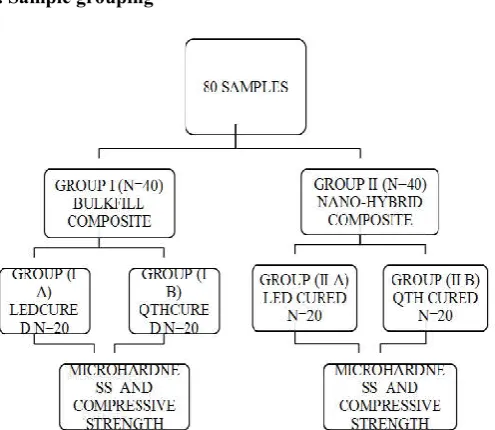
manufacturer a small amount of composite resin (Filtek Bulkfill Posterior Restorative; 3M ESPE, St.Paul MN, USA and Nano-Hybrid Voco, Cuxhaven Germany 3M ESPE St.Paul, MN USA) shade A2 was dispensed onto a mixing paper pad. Then resin was packed into a custom made teflon mould of 4mm diameter and 1.5mm depth using a plastic spatula. Inorder to obtain uniform surface smoothness on the bottom, the mould was placed on a glass slide of 2mm thickness and a thin polyester strip (0.05mm thick) (Prodvits Dentaires S.A. CA-1800 Vevey/Swiss)was placed on the top of the mould. 2mm excess of composite material was intentionally placed into the mould which was then overlaid with a glass slide. Finger pressure was used to extrude the excess material forming a flat surface. Simultaneously, the polyester strip on the top surface was removed and each sample was immediately irradiated with both QTH (Hangzhou Yinya, new materials, China) and LED curing lamps (Changsha Deyve, High Tech, China) depending on the sample grouping shown below. The composite was cured for 40seconds each using both the curing units (Fig 1-4)
ii. Sample grouping
iii.Hardness testing
The top and bottom surfaces of the resin samples of 4 mm
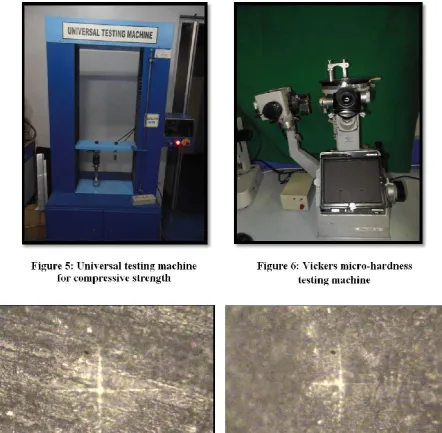
diameter and 1.5 mm depth were polished using HA264031 finishing bur (Toboom Shanghai precise abrasive tool Co. Ltd. China) after which they were kept in a dark room at a room temperature of 31-33◦C for 24 hours and then tested for hardness. A digital micro-hardness tester (Reichert Austria Make SrNo:-363798) was used to obtain the Vickers Hardness Number, VHN. The Vickers indenter was subjected to a load of 100 gms to the surface for a dwell time of 15 seconds. On each surface 3 different square pyramid indentations were made thus acquiring the horizontal and vertical diameters. A specially designed table was used which read the paralleling Vickers Hardness number. One reading per indentation corresponded to the mean values of the vertical and horizontal VHN readings and one representative reading of the bottom as well as top surface was calculated by obtaining the mean of the sum of indentations per surface. Depth of cure =bottom/top ×100 (Fig. 5-6)
iv.Compressive strength testing
Using a Universal load testing machine (ACME Engineers,
India Model Number –UNITEST-10) compressive load was applied at a cross head speed of 10mm/min. Load in increasing amounts was concentrated in a vertical direction with the composite sample facing the compressing machine .The amount of load against the displacement curve during the testing procedure was plotted using a calibrated drive chart connected to the testing apparatus.
v. Statistical analysis
The data was analyzed using PAS W version 21 software. Student t-test was employed to find the difference between the compressive strength and micro-hardness of two composite light curing materials cured with QTH and LED light curing units. The level of significance was set at 0.05.
RESULTS
Table 1 depicts: LED produced samples with hardness ratios higher than QTH light curing units irrespective of the composite material used with significant values of Bulkfill composite at 0.007 while nano-hybrid had significant value of 0.005. Statistical analysis, of the results with paired t-test revealed non-significant values when Bulk fill and Nano-hybrid composite was both cured using LED light curing units.
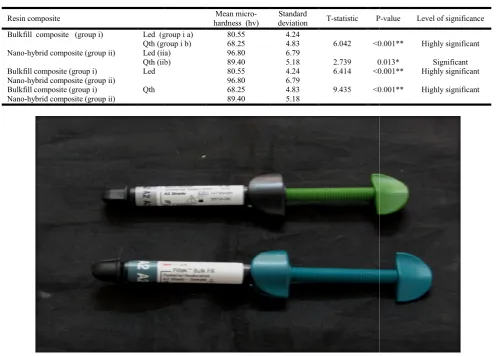
Table 2 shows : VHNS were higher in samples that cured with LED than samples cured with QTH .This value was highly significant for Bulkfill composites <0.001 while Nano-hybrid composite showed a significant value of <0.013 .Nano-hybrid composites showed a better surface hardness as compared to Bulkfill composites irrespective of the curing lights used with a highly significant value of <0.00.
Scanning Electron Microscope Image for composites when cured with LED light curing units (Fig 7-8)
Scanning Electron Microscope Image for composites when cured with QTH light curing units (Fig 9-10)
[image:2.595.42.290.570.785.2]Table 1. Mean and standard deviations of compressive strengths (depth of cure) of bulkfill and nano
Resin composite
Bulkfill composite (group i) Led (group ia)
Qth (group i b)
Nano-hybrid composite (group ii) Led (groupiia)
Qth (groupiib)
Bulkfill composite (group i) Led
Nano-hybrid composite (group ii)
Bulkfill composite (group i) Qth
[image:3.595.50.548.226.582.2]Nano-hybrid composite (group ii)
Table 2. Mean and standard deviations of micro
Resin composite
Bulkfill composite (group i) Led (group i a)
Qth (group i b)
Nano-hybrid composite (group ii) Led (iia)
Qth (iib)
Bulkfill composite (group i) Led
Nano-hybrid composite (group ii)
Bulkfill composite (group i) Qth
Nano-hybrid composite (group ii)
Figure 1. Bulkfill and Nano
n and standard deviations of compressive strengths (depth of cure) of bulkfill and nano with LED and QTH light curing units
Mean compressive strength (mpa)
Standard
deviation T-statistic P-value
Led (group ia) 123.04 25.36
3.058 0.007*
Qth (group i b) 90.64 21.89
Led (groupiia) 137.05 38.73
2.122 0.005*
Qth (groupiib) 108.74 16.69
123.04 25.36
0.957 0.353
137.05 38.73
90.64 21.89
2.079 0.005*
108.74 16.69
Table 2. Mean and standard deviations of micro-hardness values (VHN) for bulkfill and nanohybrid composites when cured with LED and QTH light curing units
Mean micro-hardness (hv)
Standard
deviation T-statistic P
Led (group i a) 80.55 4.24
6.042 <0.001**
Qth (group i b) 68.25 4.83
Led (iia) 96.80 6.79
2.739 0.013*
Qth (iib) 89.40 5.18
80.55 4.24 6.414 <0.001**
96.80 6.79
68.25 4.83 9.435 <0.001**
89.40 5.18
Bulkfill and Nano-hybrid composite samples (A2) shade
n and standard deviations of compressive strengths (depth of cure) of bulkfill and nano-hybrid composite when cured
value Level of significance
0.007* Significant
0.005* Significant
0.353 Not very significant
0.005* Significant
bulkfill and nanohybrid composites when cured with
P-value Level of significance
<0.001** Highly significant
0.013* Significant
<0.001** Highly significant
[image:3.595.58.543.609.802.2]Figure 7. Bulkfill composite LED cured Figure 8. Nano-hybrid composite LED cured
Figure 9. Bulkfill composite QTH cured Figure 10. Nano-hybrid composite QTH cured
DISCUSSION
Constant improvement in dental restorative materials and light curing adhesive technology has refined the way dentist use light to cure their resin based restorations. Nowadays, with the introduction of nano-technology, a new class of resin composites called the ‘nano-filled composite resin’ is available to the clinicians. This nano-filled composite resin has the ability to provide a high initial polish combined with superior polish and gloss retention (Poggio et al., 2012). Resin composites are constantly under masticatory stress since they are very commonly used in restorative dentistry and posterior restoration. Hence, resin composites with better mechanical properties have evolved and are made available today. One of the most important parameters deciding the resin composites resistance to stress is the depth of cure (Yap et al., 2005). The depth of cure is the depth at which composite resin preserves 80% of its surface hardness and after that the composite resin has no sufficient polymerization (Komori et al., 2010). Clinicians have begun to understand the principles of light curing because unbound monomers are cytotoxic. Chen et al
stated that composite resins have a dynamic behavior as the monomers are converted into polymer chains because of the changing of the refractive index of the monomers while they are being photo activated and converted into polymers (Price et al., 2005). Clinical success of a resin composite restoration is highly dependant on the optimal degree of curing throughout the bulk of a visible light activated dental resin composite. Unfortunately, dentists have no means of monitoring the cure of the resin surfaces which are not directly exposed to the curing lights (Koupis et al., 2006). Increased light exposure ensures increased depth of cure, increased conversion or polymerization and increased hardness. Hardness test has been the most popular method for investigating factors that influence the degree of conversion of composite resin. Light curing units are of great importance since sufficient polymerization is essential to achieve acceptable physical properties. There is controversy over defining the depth of cure for QTH units in comparison to LED units. Based on previous studies, LED is superior to QTH units due to its higher curing depths. As a result, more polymerization occurs on the composite resin. A possible explanation for this quality might be the presence of emitted wave spectrum of led to the absorption spectrum of camphorquinone (Alaghemand et al., 2016).
After the polymerization process, monomers that are not participating in reactions cause a decrease in the hardness levels and the hardness of inorganic fillers directly affect the overall micro-hardness of the materials. In order to avoid the toxic monomer release, it is required to achieve the highest degree of conversion through the curing of the composite via a light source as yearn (Yearn, 1985) has specified in his work evaluation of resin composite. Polymerization can be applied using several methods; traditionally 3 main hardness tests were proposed for testing the micro-hardness level of resin composite Barcol, Knoop and Vickers test (Rueggerberg et al., 1988). This study incorporated Vickers micro-hardness tester as a method of testing. Hammoda (Hammouda, 2010) states that the micro-hardness levels of composite specimens polymerized with LED light sources are higher than the composites polymerized with halogen light sources. In the present research conducted we have discovered that the micro-hardness levels of specimens which were polymerized with
study’s conclusion with other researches (Topcu et al., 2010; Park et al., 2005) conclusions. The reason for the halogen light being a better polymerization tool is that halogen light sources have higher energy density when compared to LED light sources and that halogen light sources have longer application time, which in turn result in a better polymerization thus a higher micro-hardness level. Clinicians currently have few choices in the broadband light category for curing dental composites restorations. Careful evaluation of the requirements for the wide variation in light curing applications and material variations should make the choice easy. The plan calls for the development of guideline for effective light curing, increased awareness of issues associated with dental resin photopolymerization, instructions for dental professionals in the safe and effective use of a curing light and the development of restorative materials that are less technique sensitive than currently available resin composites. In the present in vitro-study the curing effectiveness was measured using indirect methods such as depth of cure and surface hardness testing. The drawbacks of using direct methods that assess the degree of conversion (infrared spectroscopy and laser raman spectroscopy) are not only complex but expensive as well as time consuming. The depth of cure and surface microhardness are considered essential physical properties of composite resin materials, which are relevant to the clinical technique of incremental packing and curing. Hardness is “resistance of a material to indentation or penetration” this property is highly related to a materials strength, used to evaluate the wear resistance and determine to which degree a material will deform under load. Thus multiple parameters can play a role in the effectiveness of curing depth –some directly related to the material itself such as thickness or the composition of the filler particle type, size, and quantity –while others to the light source such as intensity and time of light cure device .Studies have demonstrated that enamel and dentine have Vickers hardness values as 348VHN and 80VHN respectively inorder to assure an optimum clinical performance of the restorations. It is important to use materials with hardness at least similar to that of dentine not only superficially but also in deeper layers.
In our study compressive strength was higher when cured with LED unit as compared to QTH units as the halogen lamps were found to exhibit irradiance near 460nm and the LED LCUs at approximately 480nm which matches better the most efficient wavelength for activation of the camphorquinone present in the resin. In a study done by (Batu et al., 2011) and (Sahar et al., 2012) their findings were found to be similar to our study. In a study done by (Giselle et al., 2012) the compressive strength was higher when cured with QTH light curing units, in contrast with the findings of our study this was because the composite resin hardness after polymerization is affected by some factors, including composition of composite resin, type of light initiator, light unit and the amount of light energy with a suitable wavelength (Aravamudan et al., 2006). In our study micro-hardness cured with LED was more in nano-hybrid than bulkfill and it was statistically significant. This was due to the higher light intensity of the newer LEDs devices with their narrow spectral output makes them even more efficient than conventional halogen light curing units There were similar findings in other studies:
• C.M Felix Oper Dent 35(1)2010, 58-68
• Orhan Murat Dogan. Dental Materials Journal 26(6), 2007, 845-853
A study conducted by (William J Dunn., 2000) showed that Halogen light curing units produced harder surfaces for resin based composites than LED light curing units which is in contrast to our study which is due to the decreased light output of LED for resin –based composite polymerization. In our study we found that when cured with LED and QTH lights; NANO-HYBRID composites showed a higher compressive strength as well as micro-hardness compared to BULKFILL composites.
Conclusion
Due to the inherent advantages of the light emitting diode principle and swift progress in semiconductor technology, light emitting diode light curing units appear to have greater potential in clinical applications. In this study compressive strength and micro-hardness was tested with limited number of composite resin, more research is required to evaluate the depth of cure, polymerization shrinkage, etc. Long term studies evaluating clinical performance of nano-hybrid and Bulkfill composite resin cured with LED and QTH should be done to further validate the findings.
REFERENCES
Alaghemand, H., Ramezani, M., Abedi, H., Gholamrezezaee, Saravi, M. and Zarenejad, N. 2016. Hardness of Composite Resins Cured with LED and QTH Units. J Dent Biomater, 3(1):192-198.
Althoff, O. and Hartung, M. 2000. Advances in light curing
.Am J Dent., 13:77D-81D.
Aravamudan, K., Floyd, C.J., Rakowaski, D. et al. 2006. Light –emitting diode curing light irradiance and polymerization of resin-based composite. J Am Dent Assoc., 137:213-223 Batu Can Yaman, Begium Guray Efes and Can Dorter Yavus.
2011. The effects of halogen and light emitting diode light curing on depth of cure and surface micro-hardness of composite resins. J Conserv Dent., 14(2):136-139.
Burgess, J.O., Walker, R. and Davidson, J.M. 2002. Posterior resin –based composites :review of the literature. Pediatr Dent., 24:465-79.
Dunn, W.J. and Bush, A.C. 2002. A comparison of polymerization by light–emitting diode and halogen–based light-curing units.J AM Dent Assoc., 133:335-41.
Eliades, G.C., Vougiouklakis, G.J. and Caputo, A.A. 1987. Degree of double bond conversion in light-cured composites. Dent Mater., 3:19-25.
Felix, M., Price, R.B. et al. 2010. Knoop microhardness mapping used to compare the efficiency of LED, QTH, and PAC curing lights. Oper Dent., 35(1):58-68.
Giselle Maria Marchi, Adriano Fonseca Lima. et al. 2012. Influence of light source and extended time of curing on Micro-hardness and degree of conversion of different regions of a nano-filled composite resin. Eur J Dent., 6(2):153-157.
Hammouda, I.M. 2010. Effect of light- curing method on wear and hardness of composite resin. J Mech Behav Biomed
Mater., 3:216-222.
Hervas–Garcia, A., Martinez-Lozano, M.A., Cabanes-Vila, J., Barjau-Escribano A. and Fos-Galve P. 2006. Composite resins. A review of the materials and clinical indications.
Med Oral Patol Oral Cir Bucal., 11(2):E215-20
Jandt, K.D., Mills, R.W., Blackwell, G.B. and Ashworth, S.H. 2004. Depth of cure and compressive strength of dental composites cured with blue light emitting diodes (LED’S).
Dent Mater., 20(1):41-7.
Kanca, J. 1986. The effect of thickness and shade on the polymerization of light-activated posterior composite resin.
Quintessence Int., 17:809-11.
Komori, P.C., de Paula, A.B., Martin, A.A. et al. 2010. Effect of light Energy Density on conversion Degree and hardness of dual-cured Resin cement. Oper Dent., 35:120-124. Koupis, N.S., Martens, L.C. and Verbeeck, R.M. 2006.
Relative curing degree of polyacid-modified and conventional resin composites determined by surface Knoop hardness.Dent Mater., 22:1045-50.
Mills, R.W., Jandt, K.D. and Ashworth, S.H. 1999. Dental composite depth of cure with halogen and blue light emitting diode technology. British Dental Journal., 1 &6:388-91.
Orhan Murat Dogan. 2007. Microhardness evaluation of resin composite polymerized by three different light sources. Dental Materials Journal,26(6):845-853.
Park, S.H., Kim, S.S., Cho, Y.S. et al. Comparison of linear polymerization shrinkage and micro-hardness between QTH-cured & LED –cured composites. Oper Dent., 30:461-467.
Pires, J.A., Cvitko, E., Denehy, G.E., Swift, E.J. Jr. 1993. Effects of curing tip distance on light intensity and composite resin micro-hardness.Quintessence Int., 24:517-21.
Poggio, C., Lombardini, M., Gaviati, S. and Chiesa, M. 2012. Evaluation of Vickers hardness and depth of cure of six composite resins photo-activated with different polymerization modes. J ConservDent., 15:237-41. Price, R.B., Felix, C.A. and Andreou, P. 2005. Knoop hardness
of ten resin composites irradiated with high power LED and quartz–tungsten-halogen lights. Biomaterials., 26(15): 2631-41
Ruchi Sharma. 2010. Comparative evaluation of marginal adaptation between nano-composites and microhybrid composite exposed to two light cure units. Indian Journal
of Dental Research.,2(6):6-10.
Rueggeberg FA, Caughman WF. and Curtis JW. 1994. Effect of light intensity and exposure duration on cure of resin composite. Operative Dentistry, 19:26-32.
Rueggeberg, F.A. and Craig RG. 1988. Correlation of parameters used to estimate monomer conversion in a light-cured composite. J Dent Res., 67:932-937.
Sahar, A. M. Abd El Halim, 2012. Effects of light curing and and remineralization on micro-hardness of nano esthetics restorative materials, Journal of American Science, 8(1) 147-151.
Sarett, D.C. 2005. Clinical challenges and the relevance of materials testing for posterior composite restorations. Dent
Mater., 21(1):9-20.
Soh, M.S., Yap, A.U.J. and Siow, K.S. 2003. Effectiveness of composite cure associated with different curing modes of LED lights. Operative Dentistry, 28-4:371-77.
Solderholm, K.J. 1996. Chemistry of synthetic resins .Philip’s
science of dental materials (10th ed). Philadelphia:WB
Saunders Co. 216
Topcu, F.T., Erdemir, U., Sahinkesen, G., Yildiz, E., Uslan, I.
et al. 2010. Evaluation of micro-haedness, surface
roughness, and wear behavior of different types of resin composites polymerized with two different light sources. J
Biomed Mater Res B Appl Biomater., 92:470-478.
Yap, A.U. and Soh, M.S. 2005. Curing efficacy of a new generation high –power LED lamp .Oper Dent., 2:30:758-63.
Yearn, J.A. 1985. Factors affecting cure of visible light activated composites. Int Dent J., 35:218-22.