1
DOI: 10.1002/ ((please add manuscript number)) Article type: Full Paper
On the Molecular Origin of Charge Separation at the Donor-Acceptor Interface
Gjergji Sini,#,* Marcel Schubert,#,* Chad Risko,* Steffen Roland,Olivia P. Lee, Zhihua Chen, Thomas V. Richter, Daniel Dolfen, Veaceslav Coropceanu, Sabine Ludwigs, Ullrich Scherf, Antonio Facchetti, Jean M. J. Fréchet, Dieter Neher*
Dr. Gjergji Sini
Laboratoire de Physicochimie des Polymères et des Interfaces (LPPI), Université de Cergy-Pontoise, 5 Mail Gay-Lussac, F-95031, Cergy-Pontoise Cedex, France
Email: [email protected]
Dr. Gjergji Sini, Dr. Veaceslav Coropceanu
School of Chemistry and Biochemistry & Center for Organic Photonics and Electronics, Georgia Institute of Technology, Atlanta, Georgia 30332-0400, USA
Dr. Marcel Schubert
School of Physics and Astronomy, University of St Andrews, KY16 9SS, St Andrews, United Kingdom
Email: [email protected]
Prof. Chad Risko
Department of Chemistry & Center for Applied Energy Research, University of Kentucky, Lexington, Kentucky, 40506, USA
Email: [email protected]
Steffen Roland, Prof. Dieter Neher
Institute of Physics and Astronomy, University of Potsdam, 14476 Potsdam, Germany Email: [email protected]
Dr. Olivia P. Lee
Department of Chemistry, University of California, Berkeley, CA 94720-1460, USA
Dr. Zhihua Chen, Prof. Antonio Facchetti
Flexterra Corporation, 8025 LAMON AVE, Skokie, Illinois 60077, USA
Dr. Thomas V. Richter, Prof. Sabine Ludwigs
IPOC - Functional Polymers, University of Stuttgart, Pfaffenwaldring 55, 70569 Stuttgart, Germany
Dr. Daniel Dolfen, Prof. Ullrich Scherf
Prof. Antonio Facchetti
Department of Chemistry and the Material Research Center, Northwestern University, 2145 Sheridan Road, Evanston, IL60208, USA
Prof. Jean M. J. Frechet
College of Chemistry, University of California, Berkeley, CA 94720-1460, USA Physical Science and Engineering Division, King Abdullah University for Science and Technology, Thuwal, 23955-6900, Saudi Arabia
# These authors share the first authorship.
3
ABSTRACT
1. Introduction
Single-junction organic photovoltaic (OPV) devices are generally comprised of bulk heterojunction (BHJ) active layers derived from polymer (donor, D)–fullerene (acceptor, A) blends, which now have power conversion efficiencies (PCE) reaching 11.7%.1 However,
fullerene-based acceptors present several drawbacks, such as weak light absorption efficiency, limited potential for tuning the electronic levels, and high synthetic costs. Recent progress in the design of non-fullerene small molecule and polymeric acceptors has resulted in solar cell PCEs that now reach 11.3%2-4 and 8.3%5-6, respectively, rivaling fullerenes for the first time since the discovery of the electron transfer at organic D-A interfaces. Ultimately, fullerene-free OPV offer greater thermal stability,4 increased lifetimes,7 higher flexibility8 and widely tunable5 optoelectronic properties.
Among the reasons for the long-lasting dominance of fullerenes include (i) their general compatibility with structurally diverse donor materials, (ii) electron delocalization resulting in decreased electron-hole binding energy, and (iii) the absence of structural anisotropy allowing for isotropic intermolecular coupling and charge transport.9-12 In contrast, even though non-fullerene
organic semiconductors have been optimized with respect to their absorption energies, ionization potentials and electron affinities, and charge-carrier mobilities, it is still not possible to predict the solar cell performance of a combination of two of such organic materials. An example for this are BHJ OPVs prepared from a blend of poly(3-hexylthiophene) (P3HT) and
5
Notably, the limited understanding has resulted in terminology confusion in the literature. For clarity, we recall definitions of the main physical phenomena occurring at the D-A interface during solar cell operation. First, excitons located on the donor, acceptor, or both (i) dissociate and result in the formation of interfacial D-A charge transfer (CT) states. These dissociated, but still strongly (Coulombically) bound electron-hole pairs, can subsequently either (ii) separate through electron- and hole-transfer from the interface into the respective bulk components through successive hopping steps, reported here as charge separation (CS), or (iii) can recombine. This last phenomenon will be reported hereafter as charge-transfer state recombination (CTSR) in order to avoid confusion with the more general case where carriers having already undergone a first (several) CS step(s) return back to the interface. This phenomenon that we call “reverse CS” can happen in the very early steps of CS under some intrinsic- or morphological materials conditions, and along with CTSR will be called geminate charge recombination (GCR). In the present study we mainly focus on the CTSR and CS phenomena.
With regard to the CS efficiency, important energetic driving forces are necessary to overcome the electron-hole binding energy (approximately 0.3 eV). The presence of an energy gradient near the interface and its contribution to the driving force for electron-hole separation is still a matter of debate.17-23 In a simplistic framework, this effect corresponds to a larger donor ionization potential (often discussed in terms of the highest-occupied molecular orbital (HOMO) energy) and smaller acceptor electron affinity (often referenced to the lowest-unoccupied molecular orbital (LUMO) energy) at and near the D-A interface, as compared to the respective bulk energies. While different origins for this effect have been put forward, we focus in this study on the impact of the geometrical deformations and electrostatic effects on the energy gradient in the case of all-polymer BHJ OPVs.
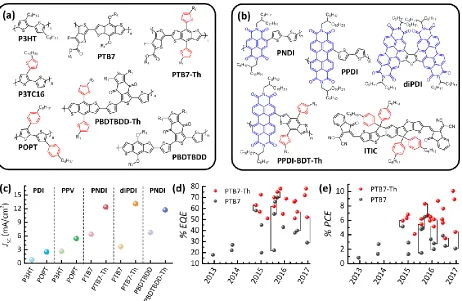
polythiophene-based donor polymers with phenyl-containing side chains (POPT, see Figure 1a) results in a general increase of the short-circuit current for a wide variety of acceptors including polymers (polyphenylenevinylene (PPV) and PNDI) and small molecules (monomeric perylene diimide (monoPDI)) (Figure 1c).25 This improvement was explained by an increase in the CT state
energy when compared to P3HT-containing blends, a characteristic related to the increased steric interactions and inter-chain separation arising from the orthogonally oriented phenyl groups along the POPT backbone. A similar approach was taken when optimizing the conjugated polymers PBDTTT and PTB7 (Figure 1a), two of the best performing donor polymers in combination with the fullerene PC70BM, where the exchange of the alkoxy side chains by alkylthiophene groups
(PTB7-Th, see Figure 1a) lead to an improved photocurrent and overall efficiency.26-27 Reviewing the literature of the past four years for PTB7 containing solar cells reveals that this trend is even more pronounced for non-fullerene acceptors (Figure 1c-e), which is best seen when PTB7 and PTB7-Th are combined with the same acceptor (data points connected by a black line in Figure 1d,e). Importantly, the concept of aromatic or cyclic side chains is also effective in more complex backbone structure, as in PBDTBDD (Figure 1a,c).28-29 Note that these materials are sometimes referred to as two-dimensional due to the conjugated nature of the side-chains, with larger dihedral angles between the main conjugated backbone and side chain being shown to improve solar cell efficiency.30 More evidence for the beneficial role of aromatic side chains arises from examining the structure of the newly designed acceptor molecule ITIC (Figure 1b) that has set several efficiency records over the last two years.431 32 This molecule comprises overall four phenyl-side chains attached to a relatively short and stiff molecular backbone pointing to a cumulative effect of the structural appearance of these side groups on either one or both components of a D-A BHJ solar cell, a conclusion that is supported by recent literature reviews. 33-34 In a similar fashion, largely twisted di- or trimeric acceptor molecules like diPDI (Figure 1b)
7
Figure 1. Influence of molecular structure on the device performance of non-fullerene organic solar cells. (a)
Examples of donor polymer structures comprising either alkyl/alkoxy side chains or aromatic side groups (highlighted
in red). R1=ethylhexyl.(b) Collection of recent acceptor materials including rylene-based copolymers (containing
either NDI or PDI, highlighted in blue), a dimeric PDI (diPDI) and of the high performance acceptor molecule (ITIC).
(c) Literature examples demonstrating the beneficial role of aromatic side chains for donor polymers shown in (a).
Comparison of the (d) PCE or (e) EQE of fullerene-free solar cells comprising either PTB735, 38, 40-50 (grey) or
PTB7-Th31, 35, 37-39, 41, 43, 46-48, 51-58 (red) as donor. Data points connected with brackets indicate that the same acceptor has been
used in the study allowing for a one-to-one comparison of both donors.
2. Results and Discussion 2.1. BHJ Solar Cells
To elaborate the interplay of polymer structure and charge generation, we expand our previous studies of P3HT-PNDI solar cells,13-14 which can be seen as a prototypical D-A blend that is dominated and intrinsically limited by high geminate recombination losses.14 Two major structural alterations were introduced with the aim to increase the efficiency of charge separation. To mimic the pronounced effect of conjugated side-chains (see Figure 1c-e), we first compare the performance of P3HT to that of donor polymers where the alkyl chains were substituted by either phenyl- (as in POPT) or thiophene-containing side chains (as in P3TC16)59. The second modification targets the size of the conjugated system by replacing naphthalenediimide (NDI) by perylenediimide (PDI) in two different acceptor backbone structures. The latter has been repeatedly shown to increase the photocurrent in all-polymer solar cells.35, 60-61 Importantly, all
polymers used in this study comprise a regio-regular structure which has been found to improve charge transport, molecular ordering, and charge separation.62
The sequence of all-polymer BHJ cells is shown in Figure 2, Table S1, and Figure S1, revealing that the structural alterations systematically improve the charge separation efficiency. Regarding the influence of the acceptor polymer structure by changing from PNDI to PPDI, an increase in the maximum external quantum efficiency (EQE) between 30% (POPT) and 110% (P3HT) is observed, rendering the PDI containing acceptors significantly more efficient than their NDI counterparts, consistent with previous observations. Furthermore, the effect related to the side chain substitution on the donor polymer is also apparent. By switching from P3HT to POPT, the short-circuit current (JSC) and EQE both increase by 60% and 30%, for the acceptor copolymers
9
[image:9.612.135.471.132.448.2]by PDI significantly improves the photocurrent (Figure S1). However, the difference between the two acceptor polymers is less pronounced which we attribute to the effective dilution of the rylene units in this complex polymer structure.
Figure 2. Solar cell characteristics of 4 blend combinations containing the donors P3HT (blue, top) and POPT (orange, bottom) and the acceptors (PNDI, open symbols) and (PPDI, closed symbols). (a) Current Density-Voltage characteristics under AM 1.5 G illumination, (b) EQE (gray) andIQE (color) for all 4 combinations.
tunable system with polymers that have a simple molecular structure, enabling us to fully analyze the underlying processes at the theoretical level.
2.2 Structural and electronic properties of the isolated oligomers
With these experimental results in hand, we now turn our attention to a density functional theory (DFT) study of the intrinsic photophysical processes at the D-A interface. A detailed description of the computational methods used here is given in the SI. Geometries of model oligomers are shown in Figure 3. The geometries obtained for mP3HT and mNDI (“m” standing for “model”) indicate small deviations from planarity. In the case of mPDI, the steric interactions between the PDI core and the thiophene rings at the junction positions result in strong deviation of the PDI core from planarity, with dihedral angles of 25⁰ between the four oxygen atoms. As for POPT, the
phenyl groups of the isolated oligomer adopt twisted orientations with respect to the thiophenes, with dihedral angles of roughly 48⁰ (in the central part of the 14-mer).
Select orbitals for the model donor and acceptor oligomers are shown in Figure 3. The HOMOs of the isolated mP3HT and mPOPT exhibit similar distributions along the thiophene backbone. No contributions are found on the phenyl groups of mPOPT, suggesting that these aromatic substituents impact the electronic characteristics of the solid state solely through steric interactions that dictate the interpolymer electronic coupling. As for the donor-acceptor-type model compounds mNDI and mPDI, their LUMOs contain contributions principally from two acceptor units, whereas the HOMOs are roughly localized on two bi-thiophene bridges.
HOMO and LUMO energies, ionization potentials (IPs) and electron affinities (EAs), and the theoretical S0S1 excitation energies are collected in Table 1. Generally, the trends found from the DFT calculations follow those determined experimentally. The IP of mPOPT is larger than mP3HT by 0.24 eV, consistent with the 0.3 eV difference found experimentally.25, 66 Similarly, the slightly larger EA for mPDI as compared to mNDI is consistent with the 0.05 eV difference found experimentally,65 both being in line with the increased -conjugated system and slightly lower
11
Figure 3. Shapes of isolated mP3HT, mPOPT, mNDI, and mPDI. Two views (face-on and side-on) are shown for each system, with the exception of mPOPT. The dihedral angles between the thiophene rings are indicated. The HOMOdonor and LUMOacceptor of the isolated oligomer models, obtained at the B3LYP/6-31G* level of theory, are also
shown (see computational methods in the SI for details on this choice). In the case of POPT, two different views of the HOMOdonor pictogram are shown, indicating absence of contribution from the lateral phenyl groups.
Table 1. HOMO and LUMO energies, adiabatic ionization potentials (IP), electron affinities (EA), and S0Si excitation energies as calculated at the B3LYP/6-31G* level of theory for the isolated oligomer models. Experimental values are given in parentheses. All values are in eV.
HOMO LUMO IP EA S0Si
mP3HT -4.44 -2.16 4.95 (5.2)a - 2.05b
mPOPT -4.77 -2.0 5.19 (5.5)a - 2.09b (2.06, 2.52) c
mNDI -5.41 -3.55 - 3.01(3.91)d 1.61e (1.45)d
mPDI -5.47 -3.60 - 3.11(3.96)d 1.65e (1.65)d
a Experimental IP values taken from Holcombe et al.25, 63 bValues taken in the model dimers. cTaken from Anderson et
al.64 dTaken from Chen et al.65eCorrespond to S
0S3 transition in the dimers (f~0.3), the first transitions being of negligible oscillator strength.
2 2
mP3HT mNDI
Donors
Acceptors
dih(Th-Th): ~18-23°
mPDI
LUMO
HOMO LUMO
mPOPT
dih(Th-Th): ~38-43°
[image:11.612.89.522.563.648.2]2.3 Structural properties of model dimers
To understand the optoelectronic characteristics of the pure materials in the solid state, we modelled a series of oligomeric dimers. For mP3HT, mNDI, and mPDI, the average (geometry optimized) inter-molecular distance for the dimers are 3.7 Å, 3.5 Å, and 3.7 Å respectively; these values are in good agreement with solid-state interplanar distances reported for P3HT (3.8 Å)67
and PNDI (3.9 Å).68 In the case of mPOPT, the phenyl side chains can adopt two orientations with respect to the backbone, resulting in two structurally different dimers with interplanar distances of either 3.8 Å or 5.3 Å (see Figure S3 and Annex I in the SI for more details). The shorter intermolecular distance (3.8 Å) arises from a “flat” mPOPT backbone (Th-Th dihedral angles of 13°-19°). A more contorted mPOPT backbone (Th-Th dihedral angles of 20°-28°) stems from twisting of the phenyl groups by roughly 90° as compared to the previous conformer, giving rise to the dimer exhibiting the largest inter-molecular distance (5.3 Å). Again, very good agreement is obtained with the inter-planar distances of 3.8 Åand 5.1 Åobserved experimentally.25 Note that these structural characteristics of mPOPT dimers are strongly related with the interchain interactions between phenyl groups (Figure S3). As such, these differences are not expected to manifest in the case of POPT-acceptor interfaces.
2.4 Donor-acceptor (D-A) complexes: geometries and charge-transfer states (CTS)
13
Figure 4. Global view of theoptimized geometries for a selection of donor-acceptor complexes as obtained at the ωB97XD/6-31G* level in gas phase. The corresponding frontier orbitals are also shown. The choice of the ωB97XD functional is motivated by the necessity to consider long-range correction and include dispersion interactions during geometrical optimizations.
Figure 5. State-energy diagrams for (a) mP3HT-mNDI, (b) mPOPT-mNDI, (c) mP3HT-mPDI, (d) mPOPT-mPDI. Each energy level (B3LYP/6-31G*//B97XD/6-31G* level) corresponds to the average over three values corresponding to three isomers for each D-A complex. In each of figures a-d, the lateral level stacks correspond to five lowest local excited states for the donors and acceptors (green and blue stacks respectively, calculated at the geometry of the complex), whereas the central stacks (black) correspond to 40 excited states for each D-A complex. The red levels and labels in each diagram indicate triplet states for donors, D-A complexes, and acceptors from left to the right respectively. The isolated donor and acceptor molecules are taken at the geometry of the complex.
LUMO
mP3HT-mNDI
mPOPT-mNDI
mP3HT-mPDI
HOMO
LUMO
HOMO
mPOPT-mPDI
S1 S1 CT1 T1 T1 CT1 S1 S1 CT1 T1 T1 CT1 S1 S1 CT1 T1 T1 CT1 0.9 1.0 1.1 1.2 1.3 1.4 1.5 1.6 1.7 1.8 1.9 2.0 2.1 2.2 2.3 2.4 2.5 2.6 2.7 2.8 2.9 3.0 S1 S1 CT1 T1 T1 CT1 Ener gy ( eV) (d) [image:13.612.170.444.456.623.2]Figure 5 shows excited-state energy diagrams for the four D-A complexes and the isolated donor and acceptor molecules in the same geometry as in the D-A complex. The corresponding orbital energy diagrams for the isolated molecules are given in Figure S4. Initial evaluation of the four diagrams suggests that there exist a number of possible channels for exciton dissociation, which increases when NDI is substituted by PDI; this is also seen from the larger number of acceptor virtual orbitals that lie below the LUMOdonor in mPDI when compared to mNDI (Figure S4).
[image:14.612.84.530.206.362.2]
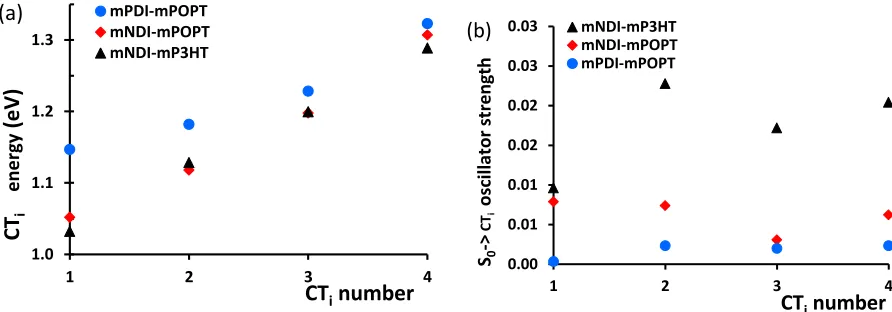
Figure 6. Electronic properties of the CT states for three different D-A complexes: (a) State-energy diagrams for the four lowest CT excited states and (b) oscillator strengths corresponding to the absorption spectra for mP3HT-mNDI, mPOPT-mNDI, and mPOPT-mPDI obtained by TDDFT calculations at the B3LYP/6-31G* level of theory.
The first four excited states for the DA complexes are pure charge transfer (CT) in character (transitions involving orbitals of pure donor- or pure acceptor nature). Their evolution across the series is shown in Figure 6a, indicating a global increase in the CT state energy across the series of DA complexes. We focus here on comparing the lowest CT state of each D-A complex (CT1),
given that E(CT1-CT2) is larger than kT at room temperature (0.025 eV) in all cases (0.096 eV,
0.135 eV, 0.044 eV, and 0.035 eV for mP3HT-mNDI, mPOPT-mNDI, mP3HT-mPDI, and mPOPT-mPDI, respectively). The average CT1 values vary between 1.03-1.15 eV across the D-A
series (Table 2) in good agreement with the experimental value of 1.2 eV obtained for NDI-P3HT.14, 69
The S0CTi oscillator strengths, averaged over three isomers for each D-A complex, are given in Figure 6b. Globally smaller oscillator strengths are obtained when mP3HT is replaced by mPOPT, and the NDI is replaced by PDI in the acceptor oligomer. This result is consistent with the increase in the average D-A distances from 3.57 Å to 3.80 Å across the series (Table S3), thus suggesting a decrease in S0-CTi electronic couplings with increasing oligomer separation. This effect, along
1.0 1.1 1.2 1.3
1 2 3 4
mPDI-mPOPT mNDI-mPOPT mNDI-mP3HT CT i ene rg y (eV )
CTinumber (a) 0.00 0.01 0.01 0.02 0.02 0.03 0.03
1 2 3 4
mNDI-mP3HT mNDI-mPOPT mPDI-mPOPT S0 -> CT i os cil la tor st rengt h (b)
15
with the increase in the CT1 energies across the series, have important consequences for the charge
separation efficiency as we will discuss in the following sections.
2.5 Charge-transfer state recombination (CTSR)
Figure 7a presents a distribution of the electronic couplings in mP3HT-mNDI among several acceptor unoccupied orbitals with the HOMOdonor – couplings that correspond to CTSR – and with
the LUMOdonor – couplings that correspond with exciton-dissociation. The averaged electronic
coupling values for each D-A combination, along with other electron-transfer parameters are given in Table 2. The electronic coupling between the S0 and CT1 states are determined by two methods:
(i) in the framework of Mulliken-Hush theory70-72 and (ii) as a weighted sum of couplings between
orbitals contributing to S0CT1 excitation, based on the TDDFT B3LYP/6-31G* calculations; these results are given in Table 2 and Table S3. As a general observation, we note that the electronic couplings are larger among the acceptor-LUMO orbitals and HOMOdonor (corresponding to CTSR)
as compared to couplings with donor-LUMO (corresponding to exciton dissociation). The reason for this can be related to the better matching between the nodal planes of interacting orbitals in the case of CTSR as compared to exciton dissociation, as shown schematically in Figure S5. As a consequence, very large S0CT1 couplings peaking at 0.16 eV are found (Figure 7a), whereas the electronic couplings related to exciton-dissociation remain generally smaller than 0.08 eV.73
Figure 7. Electronic couplings (eV) of the HOMOdonor with the LUMO+nacceptor (tCTSR, pink diamonds) and of
LUMOdonor with LUMO+nacceptor) (tExDis, black squares) associated with charge recombination and exciton dissociation,
respectively for (a) mP3HT-mNDI, and (b) for mPOPT-mPDI. The interactions corresponding to tCTSR and tExDis
calculations are also shown schematically in the inset. 0.00 0.02 0.04 0.06 0.08 0.10 0.12 0.14 0.16 0.18
transfer integral (eV)
LA
LA+1
LA+3
LA+2
LA+4
LA+5
LA+6
LA+7
LA+8
LA+9
LA+10
LA+11
(a)
0.00 0.02 0.04 0.06 0.08 0.10 0.12 0.14 0.16 0.18
transfer integral (eV)
LA
LA+1
LA+3
LA+2
LA+4
LA+5
LA+6
LA+7
LA+8
LA+9
LA+10
LA+11
[image:15.612.165.450.450.643.2]Upon substituting mP3HT with mPOPT (Figures S6b,c) and mNDI with mPDI (Figures S6d,e), the electronic couplings corresponding to CTSR decrease, with a quite important cumulative effect (Figure 7b), resulting in tCTSR < 0.07 eV. A possible explanation for this effect can be given in terms of (i) increased average D-A distances from 3.57 Å to 3.80 Å, in turn resulting in decreased HOMOdonor-LUMOacceptor overlaps (0.011 and 0.002 for mP3HT-mNDI and mPOPT-mNDI
respectively, Table 2), and (ii) the enhanced development of PDI-LUMO along the orthogonal direction as compared to the donor long axes (Figure 3), which may also contribute to the decreased HOMOdonor-LUMOacceptor overlap in the PDI-based complexes as compared to the NDI
[image:16.612.86.529.335.438.2]ones.
Table 2. Intramolecular reorganization energies corresponding to donor-acceptor charge recombination (λCTSR, eV),
CTSR Gibbs free energy (taken here equal to the CT1 energy, eV), HOMOdonor-LUMOacceptor electronic couplings
(tCTSR,eV) and overlaps (SH-L), average distance (d,Å ) between donor and acceptor backbones (standard deviations in parentheses), and rate constants (s-1) for four D-A complexes calculated at the B3LYP/6-31G*//B97XD/6-31G*
level in “gas phase”. A constant value of 0.4 eV is considered for the solvent reorganization energy.
CTSR E(CT1)a tCTSR a d a SH-L a kCTSR
mP3HT-mNDI 0.131 1.032 0.117 3.57 (0.15) 0.011 1.1x10¹⁰
mPOPT-mNDI 0.207 1.052 0.079 3.72 (0.33) 0.006 1.4x10⁹
mP3HT-mPDI 0.129 1.098 0.077 3.66 (0.33) 0.007 5.9x10⁸
mPOPT-mPDI 0.205 1.147 0.025 3.80 (0.40) 0.002 7.5x10⁶
aAverage over three values corresponding to three isomers for each D-A complex.
The CTSR rates were estimated in the framework of Marcus theory (Eq. S2)74-76 by using the
electronic couplings, CT1 energies, and intramolecular reorganization energies shown in Table 2.
We also used for all systems a contribution to the reorganization energy of 0.4 eV to mimic the polarizable environment of the solid state. For mP3HT-mNDI, kCTSR is calculated to 1.1x10¹⁰ s-1,
which is of the same order of magnitude as the geminate CR times (100-200 ps)14 measured in the case of PNDI-P3HT. Importantly, a decrease of kCTSR by three orders of magnitude upon replacing
mP3HT and mNDI by mPOPT and mPDI is found, due to the cumulative effect of the decreasing electronic couplings (by roughly 5 times) and increasing driving force (CT1 energies by roughly
17
2.6 Charge Separation.
We now turn to charge separation, and discuss two particular aspects: (i) the energy landscape near the D-A interface, with particular focus on the appearance and reasons for energy gradients, and (ii) the kinetics of charge separation.
Energy landscape. We focus first on the impact of two particular contributions on the frontier orbital energies at the D-A interface: (i) geometrical deformations of the polymers, and (ii) mutual electrostatic polarisation77 between adjacent polymer chains, reported hereafter as direct-contact
polarization (DCP). Additional comments on this parameter can be found in the SI.
[image:17.612.100.513.254.535.2]
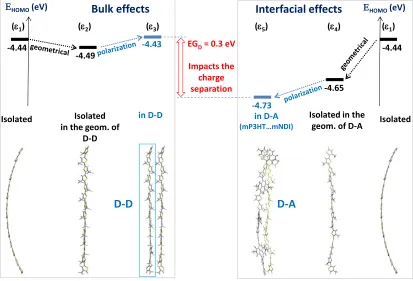
Figure 8. Energy diagram showing the evolution of the HOMO level of mP3HT in different environments (eV): (1)
isolated; (2) isolated in the geometry of the dimer (D-D), mimicking the effect of the geometrical deformations in the
bulk; (3) in the geometry of the dimer (D-D) and in the presence of the second monomer, partly mimicking the
additional mutual direct-contact polarization effects (DCP); (4) isolated in the D-A geometry, mimicking only
geometrical deformations at the interface; (5) in the geometry of the donor-acceptor complex and in the presence of
the acceptor, partly mimicking the DCP. The HOMO energies of mP3HT in the presence of a like molecule (dimer) or in the presence of mNDI correspond to the site energies deduced during electronic coupling calculations.
The origin of these two contributions is schematically shown in Figure 8 by following the evolution of the mP3HT HOMO from bulk (approximated by a mP3HT dimer) to the mP3HT-mNDI interface (modelled as a D-A complex); the energy offsets related to geometric deformations and to the electrostatic polarization induced by an adjacent molecule are considered
in D-A
(mP3HT…mNDI)
-4.44
-4.49
Isolated Isolated in the geom. of
D-D
-4.43
in D-D Isolated in the geom. of D-A
-4.65
-4.73
EGD= 0.3 eV
Impacts the charge separation
D-D D-A
(1) (2) (3) (5) (4)
EHOMO(eV)
-4.44
Isolated (1)
separately and cumulatively. When compared to isolated mP3HT (1 in Figure 8, -4.44 eV), the
geometric deformations of mP3HT in the D-D dimer (mimicking the geometrical bulk effects) and in the D-A complexes (at the interface) result in larger HOMO energies of the mP3HT fragment
due in part to reduced -conjugation efficiency. This effect is less important in the dimers (2,
-4.49 eV) than at the D-A interface (4, -4.65 eV). By comparing 2 (“geometrical-bulk”) with
respect to 4 (“geometrical- D-A interface”), an energy gradient (EG) stemming from the
geometrical deformations of 0.16 eV can be deduced, constituting a driving force for charge separation; this value is quite substantial when one compares it to a typical value of 0.3 eV for the electron-hole binding energy.
The DCP effects on P3HT in the bulk as compared to the interface are found to produce opposite energy shifts (Figure 8), which can be qualitatively understood as followed: due to the mutual electron-donor effect between adjacent P3HT chains in the bulk, a higher 3 value as compared to 2 is expected, while at the D-A interface, an opposite polarisation effect occurs where due to the
electron-withdrawing effect induced by the acceptor, a lower 5 value as compared to 4 value is
expected. By comparing the two geometric-only values (2 with respect to 4) and the two
geometric-plus-DCPvalues3 with respect to 5), the individual contributions due to the
geometrical deformations (0.16 eV) and to the DCP effects (0.14 eV) can be distinguished. The global variation between the HOMO(P3HT) at the D-A interface and in the “bulk” (0.3 eV) is shown by the red arrow (Figure 8). This energy difference reveals the establishing of an energy-gradient or energy bending at the organic-organic interfaces (reported hereafter as EGD and EGA
for the energy gradient corresponding to the donor and acceptor respectively).
Diagrams similar to Figure 8, showing the energy gradients (EGD and EGA) for each D-A complex,
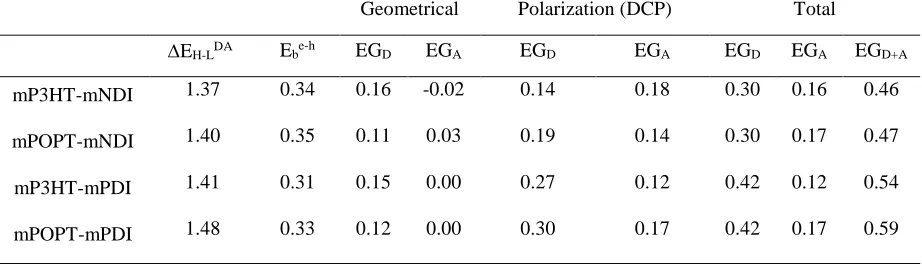
are shown in Figure S7, with the corresponding EG numerical values collected in Table 3 and displayed in Figure 9. Considering the total energy gradient (EGD+A, Table 3), values ranging from
0.45-0.6 eV are determined, which are large enough to overcome the e-h binding energy. The HOMOdonor-LUMOacceptor energy offsets for each D-A interface (EH-LDA) deduced from Figure S7
are also given in Table 3. Overall, the EH-LDA values increase by 0.11 eV when replacing mP3HT
and mNDI with mPOPT and mPDI. It is worth noting that the EH-LDA values are calculated by
considering each compound and complex in their ground state. The global increase in CT1 energies
-19
LUMOacceptor offsets at the interface. Based on these values, the electron-hole binding energies can
be calculated as Ebe-h = EH-LDA – E(CT1). The so calculated Ebe-h values of 0.31 to 0.34 eV
(Table 3) are consistent with the typical value of 0.3 eV, additionally indicating small Ebe-h
variation induced by different donor-acceptor polymers.
[image:19.612.82.539.167.296.2]
Figure 9. Energy diagrams showing the built-in energy gradient (eV, B3LYP/6-31G*) near and at the D-A interface for (a) HOMOdonor and (b) LUMOacceptor corresponding to mP3HT-mNDI, mPOPT-mNDI, mP3HT-mPDI, and
mPOPT-mPDI. The individual contributions (due to geometrical deformations and to direct-contact polarizations) and their sum are shown. Each value in the figure corresponds to the average out of three values. The lines have no physical
meaning and are just guide for the eye. For comparison purposes, the electron-hole binding energies (Ebe-h) are also
shown by the dashed lines.
Table 3. HOMO-LUMO offsets at the D-A interface, electron-hole binding energy (Ebe-h), energy gradient values for
the donor-HOMO (EGD), acceptor-LUMO (EGA), and their sum (EGD+A). The individual contributions of geometrical
deformations and electrostatic direct-contact polarizations (DCP) are also given. Note that these EG values include both “bulk” and interfacial effects, whereas only-interfacial values are collected in Table S4. All values are in eV.
Geometrical Polarization (DCP) Total
EH-LDA Ebe-h EGD EGA EGD EGA EGD EGA EGD+A
mP3HT-mNDI 1.37 0.34 0.16 -0.02 0.14 0.18 0.30 0.16 0.46
mPOPT-mNDI 1.40 0.35 0.11 0.03 0.19 0.14 0.30 0.17 0.47
mP3HT-mPDI 1.41 0.31 0.15 0.00 0.27 0.12 0.42 0.12 0.54
mPOPT-mPDI 1.48 0.33 0.12 0.00 0.30 0.17 0.42 0.17 0.59
Kinetics of charge separation. In order to obtain further insight on the mechanisms determining the efficiency of CS in these systems, we introduce a simple model for the calculation of the CS rate constants relying on Marcus’ theory and the EG mechanism. This model is based on the following hypothesis (see Annex III, SI, for a detailed description and justification): (i) the evolution of the CS efficiencies across the series of different D-A combinations can be reasonably
0 0.1 0.2 0.3 0.4 0.5 Energ y G ra die nt (eV ) Total Polarization Geometrical
EG on donors (effect of acceptors )
(a)
Ebe-h
0 0.1 0.2 0.3 0.4 0.5 Ener gy Grand ient (eV ) Total Polarization Geometrical EG on acceptors (effect of donors) (b)
[image:19.612.77.538.459.593.2]evaluated by comparing the very first hopping step of the charge transport from the interface toward the bulk. This is based on the idea that the electron-hole binding energy corresponding to the first CS step is at least two times larger than for the second CS step. Comparing the first CS steps across the series allows for a comparison of the propensity for electrons and holes to escape from the interface. This model is reported hereafter as first-step charge-separation model (FSCS); (ii) the CS rate constants can be calculated separately for holes (kCS-h) and electrons (kCS-e).
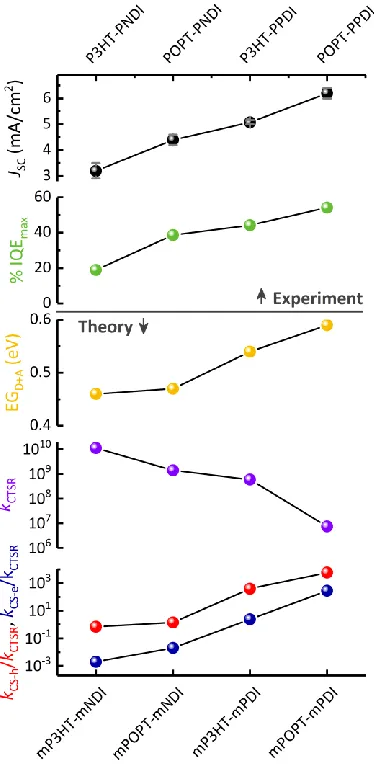
The results from the FSCS model calculations are shown in Figure 10 and Table S7, whereas a detailed analysis based on numerical simulations in the frame of FSCS model is given in Annexes II and III. The results indicate that the kCS-h / kCTSR and kCS-e / kCTSR ratios, which provide a pertinent
estimation of the charge generation efficiency, increase continuously upon substituting P3HT with POPT and NDI with PDI.
3. Discussion
The present results provide important insights into the impact of the polymer structure and composition on the charge-generation efficiency in BHJ solar cells. Figure 10 summarizes theoretical key parameters and compares these to the experimental photocurrents generated by the 4 model systems. As the photogeneration in these devices is field independent and free charge recombination nearly absent at short circuit (Fig. 2 and S2), the internal quantum efficiency provides a direct measure of the charge generation efficiency. Importantly, the FSCS model parameters as well as the total energy gradient and charge-transfer state recombination rate follow the trends in JSC and IQE. Thus, the gradually improved charge generation efficiencyobserved
experimentally can be explained by the joint contribution of the increased steric hindrance at the D-A interface, and the increased energy gradient between the interface and the bulk of the donor and acceptor materials. Both effects decrease kCTSR, and increase kCS-e,h, jointly improving charge
generation across the series, as shown in Figure 10. In the following we discuss the complex interplay between structural and electronic properties in detail.
Effect of steric hindrance. The increase in the steric hindrance in our compounds arises from the twisted phenyl groups with respect to the POPT backbone, but also from the strongly non-planar
-backbone in the case of PDI-based acceptor. Both steric effects result in reduced CTSR rate
21
electronic couplings between S0-CT1 (HOMOdonor- LUMOacceptor) by roughly 5 times. (ii) The CT1
state energy in POPT-containing D-A interfaces increases when compared to P3HT-containing blends by 0.11 eV. This last effect stems from the increased HOMOdonor-LUMOacceptor gap at the
interface, which increases by the same amount as the corresponding gap deduced from the isolated compounds (bulk), whereas the electron-hole binding energies exhibit minor variations (≤ 0.04 eV, Table 3). The increase in the CT state energy in this case thus stems from increased geometrical distortions at the D-A interface. Therefore, we conclude, in agreement with previous works,78-79 that increasing the steric hindrance by means of aromatic (bulky) side groups
Figure 10. Comparison of experimental parameters (uncertainties derived from device statistics are given in Table S1) of the solar cell systems presented in Figure 2 with key theoretical parameters describing the energy gradient at the D-A interface (EGD+A, Table 3), the charge-transfer state recombination rate (kCTSR, Table 2) and the relative
charge generation efficiencies (kCS-h / kCTSR and kCS-e / kCTSR ratios, Table S7) obtained by the FSCS model.
Evolution of the energy gradient. An important observation from Table 3 and Figure 9 is that the total energy gradient values (EGD+A), ranging from 0.45-0.6 eV, are large enough to overcome the
e-h binding energy of 0.3 eV, consistent with the field-independent charge generation observed in all D-A blends (Figure S1). The continuous increase in EG among the sample series follows the trend in JSC observed experimentally (Figure 10). However, the driving forces for the hole-drift
out of the interface (EGD = 0.30-0.42 eV) are larger than those of electrons (EGA = 0.12-0.17 eV).
23
for these systems: while holes could quickly escape from the interface, the electrons would spend more time in the vicinity of the donors, potentially enhancing the CTSR efficiency.
The presence of an EG that pushes charges from the interface to the bulk, has been previously proposed to be the origin for the efficient charge generation in fullerene-containing solar cells. 17-23 Important contributions to EG (up to 0.16 eV) come from the geometrical deformations of the
conjugated backbones of the thiophene donors. This finding is consistent with other theoretical studies on P3HT-PCBM systems (0.15 eV 18 and 0.12 eV 23) or from cyclic voltammetry- and
ultraviolet photoelectron spectroscopy (UPS) results, also reporting on an hole energy-level offset of up to 0.15 eV between crystalline and amorphous P3HT phases.81 These results suggest that the geometrical flexibility of thiophene-based polymers can provide roughly half of the driving force in fighting the e-h binding energy in these systems (≈0.3 eV), thus being beneficial to charge separation through EG mechanisms.
Interestingly, the geometric contribution to the energy gradient of the acceptor-LUMOs is roughly zero (EGA, Table 3), which could be attributed to the localization of the LUMOs on the rigid NDI
and PDI cores (Figure 3). One might expect that increased flexibility of the acceptor polymer -backbone would lead to larger molecular deformations that increase the energy gradient. However, while this assumption sounds reasonable, other factors seem to be involved. Indeed, test calculations for the geometrical contribution to the energy gradient of donor polymer frontier MOs (hence corresponding to identical geometrical deformations for both orbitals) reveal a much smaller impact on the LUMOs (0.076 eV and 0.015 eV for mP3HT and mPOPT respectively) as compared to the HOMOs (EGD of 0.150 eV and 0.120 eV, respectively, Table 3). The geometrical
flexibility of polymer -backbones is consequently neither the only factor responsible for the smaller geometrical contribution of the LUMO compared to that of the HOMO, nor the dominant one. Additional effects in this regard may include: (i) first-principles differences between frontier
orbitals in these polymers (Figure S5),18 and/or (ii) the flexibility of the polymer -backbone may not necessarily guarantee important impact of the geometrical contribution to EG.82 Nevertheless, the relatively large LUMO-EG found for the flexible P3HT -backbone (as compared to more rigid NDI- and PDI-based polymers) suggests that non-negligible beneficial effects to EGA could
As for the DCP contribution at the D-A interface, the largest EG values (0.18 and 0.21 eV ) were found for the effect of mPDI on the HOMO energy of mP3HT and mPOPT respectively, whereas mP3HT, mPOPT, and mNDI were found to induce smaller EG values ranging 0.06-0.11 eV (Table S4). We suspect the larger effect of PDI to be due to the increased direct contact between mPDI and the donor polymers: in spite of introducing a larger average intermolecular distance between donor and acceptor backbones (Table S2), mPDI increases the number of short-contacts ranging 3.0 to 3.3 Å (20 and 9 for mP3HT-mPDI and for mP3HT-mNDI respectively).83
Cumulative effects increase charge generation efficiency. The results obtained in the framework of the FSCS model indicate that the kCS-h / kCTSR and kCS-e / kCTSR ratios provide a pertinent
estimation of the charge generation efficiency (Figure 10, Annexes II and III). To understand the origin of this correlation requires to review the cumulative effects that influence the rate constants.
SubstitutingmNDI with mPDI in acceptor polymers results in increased kCS-h due to an increased
driving force for hole-drift from 0.30 eV to 0.42 eV (EGD, Table 3), and increased kCS-e due to the
larger electronic couplings (0.010 eV and 0.071 eV respectively, Table S6) for electron-drift away from the interface. On the other hand, replacing mP3HT with mPOPT increases the intramolecular reorganization energy (from 0.219 eV to 0.321 eV respectively, Table S6), and decreases the D-D electronic couplings (0.139 eV and 0.100 eV respectively, Table S6), both effects being slightly detrimental to CS-h. However, the cumulated effect of both substitutions results in increased CS rates (Annex III). The continuous increase in charge generation efficiency upon substituting P3HT with POPT and PNDI with PPDI is thus due to two effects: (i) decrease in kCTSR by roughly 3
orders of magnitude, and (ii) increase of CS efficiency by the same degree. The increase in CS / CTSR efficiency ratios is more important in the case of PDI-based acceptors, in which both electronic coupling- and driving force (EG) parameters enhance CS efficiency as compared to NDI-based acceptor.
Interfacial versus bulk properties. The discussion so far indicates that efficient charge generation can be achieved by increasing steric bulk and polymer backbone flexibility. However, the drawback of these polymer modifications is their detrimental impact on the charge mobility toward
25
aromatic side groups results in decreased electronic couplings and charge transport properties in the bulk of these materials. Structural modifications in order to improve charge generation operate consequently through opposite effects at the interface versus bulk, implying that judicious choices need to be made in order to avoid both detrimental limit cases. This could for instance be achieved by designing polymer chains exhibiting enhanced planarity driven by weak intra-chain hydrogen- or halogen bonds:84 while favorable planarity could be possible to preserve in the bulk, breaking of H-bonds (halogen-bonds) could occur at the D-A interface, followed by important geometrical deformations. Nevertheless, our results suggest that while both aspects need to be handled with care, improving interfacial properties should constitute the primary focus as compared to bulk properties, otherwise good charge mobility handling with small currents would be a less good choice (see also Annex IV, SI). This suggestion is consistent with our results: while the hole mobility of POPT and the electron mobility of PPDI were found to be lower than those of P3HT and PNDI respectively,63, 65 the former compounds were found to improve charge generation efficiency in BHJ devices.
4. Conclusions
The results presented in this study provide insights in the mechanisms determining the efficiency to charge separation in a series of conjugated polymer D-A heterojunctions. A model based on Marcus’ theory is proposed allowing comparative estimations with respect to the CS efficiencies. The results indicate that the experimentally observed improvements in device performance are due to a delicate balance between several opposite factors. The substitution of P3HT and PNDI with POPT and PPDI has two main effects: (i) the geminate donor-acceptor CTSR efficiency decreases, an effect mainly due to the decreased electronic couplings, in turn stemming from the enhanced
JSC values observed experimentally. However, the increased disorder at the interface due to the
above structural modifications is also suspected to enlarge the density of CT states, with the drawback of negatively impacting the Voc, which seems in line with the experimental results.
We conclude that the maximum strength of intermolecular interactions in these systems correspond to the face-to-face D-A orientation. The present study suggests that the crucial benefit of the face-to-face orientation in these polymer blends is the creation of the necessary driving forces required to repel / force charges away from the D-A interface. The geometrical deformations of polymer -backbones were found tocontribute substantially to the creation of the driving forces in the case of P3HT and POPT, whereas NDI- and PDI-based acceptor polymers lack this contribution due to (i) the localization of their LUMO on the rigid NDI and PDI moieties, and (ii) due to first-principles differences between HOMO and LUMO in polymers, making LUMO energy being less sensitive to the deformation of inter-monomer dihedral angles then HOMO one. These last effects are suspected to induce a detrimental disparity in driving forces for the separation of electrons and holes. Equilibrating the hole- and electron drift rates may thus be a challenge for high efficiency BHJ OPVs.
Our results suggest consequently several guidelines expected to improve charge generation in all polymer BHJ OPVs by:
1. Decreasing the HOMOdonor-LUMOacceptor overlap: (i) by increasing the steric hindrance at
the D-A interface by introducing aromatic side-chains in polymers or by distorting polymer
-backbones; (ii) by reducing spatial overlap between the donor-acceptor -backbones by
favoring D) versus A) space-extensions orthogonal to each other;
2. Increasing the HOMOdonor-LUMOacceptor energy gap (energy of the CT states)
3. Increasing the distortions at the interface by increasing the geometrical flexibility of polymer -backbones, ideally by handling as much as possible the potential for both facile deformability (at the D-A interface) and planarization (in the bulk).
27 Acknowledgments. The authors gratefully thank Jean-Luc Bredas (Georgia Tech, Atlanta, GA, USA) for stimulating discussions throughout this work. G.S. gratefully thanks the calculation center of Cergy-Pontoise University for the computing time and support. C.R. thanks the University of Kentucky Vice President for Research and the Department of the Navy, Office of Naval Research (Award No. N00014‐16‐1‐2985) for support. VC thanks the Department of the Navy, Office of Naval Research (Awards Nos. N00014-14-1-0580 and N00014-16-1-2520) for support. MS and DD acknowledge funding by the German Science Foundation through the SPP 1355 “Elementary Processes in Organic Photovoltaics”.
REFERENCES
1. Zhao, J.; Li, Y.; Yang, G.; Jiang, K.; Lin, H.; Ade, H.; Ma, W.; Yan, H., Effcient organic solar cells processed from hydrocarbon solvents. Nature Energy 2016, 1 (February 2016), 15027. 2. Bin, H. J.; Zhang, Z. G.; Gao, L.; Chen, S. S.; Zhong, L.; Xue, L. W.; Yang, C.; Li, Y. F., Non-Fullerene Polymer Solar Cells Based on Alkylthio and Fluorine Substituted 2D-Conjugated Polymers Reach 9.5% Efficiency. Journal of the American Chemical Society 2016, 138 (13), 4657-4664.
3. Lin, Y.; Zhao, F.; He, Q.; Huo, L.; Wu, Y.; Parker, T. C.; Ma, W.; Sun, Y.; Wang, C.; Zhu, D.; Heeger, A. J.; Marder, S. R.; Zhan, X., High-Performance Electron Acceptor with Thienyl Side Chains for Organic Photovoltaics. Journal of the American Chemical Society 2016, 138 (14), 4955-4961.
4. Zhao, W. C.; Qian, D. P.; Zhang, S. Q.; Li, S. S.; Inganas, O.; Gao, F.; Hou, J. H., Fullerene-Free Polymer Solar Cells with over 11% Efficiency and Excellent Thermal Stability. Advanced Materials 2016, 28 (23), 4734-4739.
5. Gao, L.; Zhang, Z. G.; Xue, L. W.; Min, J.; Zhang, J. Q.; Wei, Z. X.; Li, Y. F., All-Polymer Solar Cells Based on Absorption-Complementary Polymer Donor and Acceptor with High Power Conversion Efficiency of 8.27%. Advanced Materials 2016, 28 (9), 1884-1890.
6. Hwang, Y.-J.; Courtright, B. A. E.; Ferreira, A. S.; Tolbert, S. H.; Jenekhe, S. A., 7.7% Efficient All-Polymer Solar Cells. Advanced Materials 2015, 27 (31), 4578-4584.
7. Holliday, S.; Ashraf, R. S.; Wadsworth, A.; Baran, D.; Yousaf, S. A.; Nielsen, C. B.; Tan, C. H.; Dimitrov, S. D.; Shang, Z. R.; Gasparini, N.; Alamoudi, M.; Laquai, F.; Brabec, C. J.; Salleo, A.; Durrant, J. R.; McCulloch, I., High-efficiency and air-stable P3HT-based polymer solar cells with a new non-fullerene acceptor. Nature Communications 2016, 7, 11585.
8. Kim, T.; Kim, J. H.; Kang, T. E.; Lee, C.; Kang, H.; Shin, M.; Wang, C.; Ma, B. W.; Jeong, U.; Kim, T. S.; Kim, B. J., Flexible, highly efficient all-polymer solar cells. Nature Communications 2015, 6, 8547.
9. Jamieson, F. C.; Domingo, E. B.; McCarthy-Ward, T.; Heeney, M.; Stingelin, N.; Durrant, J. R., Fullerene crystallisation as a key driver of charge separation in polymer/fullerene bulk heterojunction solar cells. Chemical Science 2012, 3 (2), 485-492.
10. Rao, A.; Chow, P. C. Y.; Gelinas, S.; Schlenker, C. W.; Li, C. Z.; Yip, H. L.; Jen, A. K. Y.; Ginger, D. S.; Friend, R. H., The role of spin in the kinetic control of recombination in organic photovoltaics. Nature 2013, 500 (7463), 435-439.
11. Tamura, H.; Burghardt, I., Ultrafast Charge Separation in Organic Photovoltaics Enhanced by Charge Delocalization and Vibronically Hot Exciton Dissociation. Journal of the American Chemical Society 2013, 135 (44), 16364-16367.
12. Tamura, H.; Tsukada, M., Role of intermolecular charge delocalization on electron transport in fullerene aggregates. Physical Review B 2012, 85 (5), 054301.
13. Schubert, M.; Dolfen, D.; Frisch, J.; Roland, S.; Steyrleuthner, R.; Stiller, B.; Chen, Z.; Scherf, U.; Koch, N.; Facchetti, A.; Neher, D., Influence of Aggregation on the Performance of All-Polymer Solar Cells Containing Low-Bandgap Naphthalenediimide Copolymers. Advanced Energy Materials 2012, 2 (3), 369-380.
29
15. Sirringhaus, H.; Brown, P. J.; Friend, R. H.; Nielsen, M. M.; Bechgaard, K.; Langeveld-Voss, B. M. W.; Spiering, A. J. H.; Janssen, R. A. J.; Meijer, E. W.; Herwig, P.; de Leeuw, D. M., Two-dimensional charge transport in self-organized, high-mobility conjugated polymers. Nature 1999, 401 (6754), 685-688.
16. Yan, H.; Chen, Z.; Zheng, Y.; Newman, C.; Quinn, J. R.; Dotz, F.; Kastler, M.; Facchetti, A., A high-mobility electron-transporting polymer for printed transistors. Nature 2009, 457 (7230), 679-686.
17. Ishii, H.; Sugiyama, K.; Ito, E.; Seki, K., Energy level alignment and interfacial electronic structures at organic metal and organic organic interfaces. Advanced Materials 1999, 11 (8), 605-685.
18. McMahon, D. P.; Cheung, D. L.; Troisi, A., Why Holes and Electrons Separate So Well in Polymer/Fullerene Photovoltaic Cells. Journal of Physical Chemistry Letters 2011, 2 (21), 2737-2741.
19. Beljonne, D.; Cornil, J.; Muccioli, L.; Zannoni, C.; Bredas, J.-L.; Castet, F., Electronic Processes at Organic-Organic Interfaces: Insight from Modeling and Implications for Opto-electronic Devices. Chemistry of Materials 2011, 23 (3), 591-609.
20. Poelking, C.; Andrienko, D., Design Rules for Organic Donor-Acceptor Heterojunctions: Pathway for Charge Splitting and Detrapping. Journal of the American Chemical Society 2015, 137 (19), 6320-6326.
21. Poelking, C.; Tietze, M.; Elschner, C.; Olthof, S.; Hertel, D.; Baumeier, B.; Wuerthner, F.; Meerholz, K.; Leo, K.; Andrienko, D., Impact of mesoscale order on open-circuit voltage in organic solar cells. Nature Materials 2015, 14 (4), 434-439.
22. Yost, S. R.; Van Voorhis, T., Electrostatic Effects at Organic Semiconductor Interfaces: A Mechanism for "Cold" Exciton Breakup. Journal of Physical Chemistry C 2013, 117 (11), 5617-5625.
23. D'Avino, G.; Mothy, S.; Muccioli, L.; Zannoni, C.; Wang, L.; Cornil, J.; Beljonne, D.; Castet, F., Energetics of Electron-Hole Separation at P3HT/PCBM Heterojunctions. Journal of Physical Chemistry C 2013, 117 (25), 12981-12990.
24. Hou, J. H.; Tan, Z. A.; Yan, Y.; He, Y.; Yang, C.; Li, Y. F., Synthesis and Photovoltaic Properties of Two-Dimensional Conjugated Polythiophenes with Bi(thienylenevinylene) Side Chains. Journal of the American Chemical Society 2006, 128 (14), 4911-4916.
25. Holcombe, T. W.; Norton, J. E.; Rivnay, J.; Woo, C. H.; Goris, L.; Piliego, C.; Griffini, G.; Sellinger, A.; Bredas, J.-L.; Salleo, A.; Frechet, J. M. J., Steric Control of the Donor/Acceptor Interface: Implications in Organic Photovoltaic Charge Generation. Journal of the American Chemical Society 2011, 133 (31), 12106-12114.
26. Huo, L. J.; Zhang, S. Q.; Guo, X.; Xu, F.; Li, Y. F.; Hou, J. H., Replacing Alkoxy Groups with Alkylthienyl Groups: A Feasible Approach To Improve the Properties of Photovoltaic Polymers. Angewandte Chemie-International Edition 2011, 50 (41), 9697-9702.
27. Liao, S. H.; Jhuo, H. J.; Cheng, Y. S.; Chen, S. A., Fullerene Derivative-Doped Zinc Oxide Nanofilm as the Cathode of Inverted Polymer Solar Cells with Low-Bandgap Polymer (PTB7-Th) for High Performance. Advanced Materials 2013, 25 (34), 4766-4771.
28. Yao, H. F.; Ye, L.; Zhang, H.; Li, S. S.; Zhang, S. Q.; Hou, J. H., Molecular Design of Benzodithiophene-Based Organic Photovoltaic Materials. Chemical Reviews 2016, 116 (12), 7397-7457.
30. Zhang, S. Q.; Ye, L.; Zhao, W. C.; Liu, D. L.; Yao, H. F.; Hou, J. H., Side Chain Selection for Designing Highly Efficient Photovoltaic Polymers with 2D-Conjugated Structure. Macromolecules 2014, 47 (14), 4653-4659.
31. Lin, Y. Z.; Zhao, F. W.; He, Q.; Huo, L. J.; Wu, Y.; Parker, T. C.; Ma, W.; Sun, Y. M.; Wang, C. R.; Zhu, D. B.; Heeger, A. J.; Marder, S. R.; Zhan, X. W., High-Performance Electron Acceptor with Thienyl Side Chains for Organic Photovoltaics. Journal of the American Chemical Society 2016, 138 (14), 4955-4961.
32. Yao, H. F.; Yu, R. N.; Shin, T. J.; Zhang, H.; Zhang, S. Q.; Jang, B.; Uddin, M. A.; Woo, H. Y.; Hou, J. H., A Wide Bandgap Polymer with Strong pi-pi Interaction for Efficient Fullerene-Free Polymer Solar Cells. Advanced Energy Materials 2016, 6 (15).
33. Chen, W.; Zhang, Q., Recent progress in non-fullerene small molecule acceptors in organic solar cells (OSCs). Journal of Materials Chemistry C 2017, 5 (6), 1275-1302.
34. Zhang, Z. G.; Li, Y. F., Side-chain engineering of high-efficiency conjugated polymer photovoltaic materials. Science China-Chemistry 2015, 58 (2), 192-209.
35. Fan, Y. L.; Barlow, S.; Zhang, S. Y.; Lin, B. P.; Marder, S. R., Comparison of 3D non-fullerene acceptors for organic photovoltaics based on naphthalene diimide and perylene diimide-substituted 9,9 '-bifluorenylidene. Rsc Advances 2016, 6 (74), 70493-70500.
36. Hwang, Y. J.; Li, H. Y.; Courtright, B. A. E.; Subramaniyan, S.; Jenekhe, S. A., Nonfullerene Polymer Solar Cells with 8.5% Efficiency Enabled by a New Highly Twisted Electron Acceptor Dimer. Advanced Materials 2016, 28 (1), 124-131.
37. Zhong, H. L.; Wu, C. H.; Li, C. Z.; Carpenter, J.; Chueh, C. C.; Chen, J. Y.; Ade, H.; Jen, A. K. Y., Rigidifying Nonplanar Perylene Diimides by Ring Fusion Toward Geometry-Tunable Acceptors for High-Performance Fullerene-Free Solar Cells. Advanced Materials 2016, 28 (5), 951-958.
38. Zhong, Y.; Trinh, M. T.; Chen, R. S.; Wang, W.; Khlyabich, P. P.; Kumar, B.; Xu, Q. Z.; Nam, C. Y.; Sfeir, M. Y.; Black, C.; Steigerwald, M. L.; Loo, Y. L.; Xiao, S. X.; Ng, F.; Zhu, X. Y.; Nuckolls, C., Efficient Organic Solar Cells with Helical Perylene Diimide Electron Acceptors. Journal of the American Chemical Society 2014, 136 (43), 15215-15221.
39. Duan, Y.; Xu, X.; Yan, H.; Wu, W.; Li, Z.; Peng, Q., Pronounced Effects of a Triazine Core on Photovoltaic Performance–Efficient Organic Solar Cells Enabled by a PDI Trimer-Based Small Molecular Acceptor. Advanced Materials 2017, 29 (7), 1605115.
40. Dou, C.; Long, X.; Ding, Z.; Xie, Z.; Liu, J.; Wang, L., An Electron-Deficient Building Block Based on the B←N Unit: An Electron Acceptor for All-Polymer Solar Cells. Angewandte Chemie 2016, 128 (4), 1458-1462.
41. Deshmukh, K. D.; Prasad, S. K. K.; Chandrasekaran, N.; Liu, A. C. Y.; Gann, E.; Thomsen, L.; Kabra, D.; Hodgkiss, J. M.; McNeill, C. R., Critical Role of Pendant Group Substitution on the Performance of Efficient All-Polymer Solar Cells. Chemistry of Materials 2017, 29 (2), 804-816. 42. Jung, J. W.; Jo, W. H., Low-Bandgap Small Molecules as Non-Fullerene Electron Acceptors Composed of Benzothiadiazole and Diketopyrrolopyrrole for All Organic Solar Cells. Chemistry of Materials 2015, 27 (17), 6038-6043.
43. Lee, W.; Lee, C.; Yu, H.; Kim, D. J.; Wang, C.; Woo, H. Y.; Oh, J. H.; Kim, B. J., Side Chain Optimization of Naphthalenediimide-Bithiophene-Based Polymers to Enhance the Electron Mobility and the Performance in All-Polymer Solar Cells. Advanced Functional Materials 2016, 26 (10), 1543-1553.
31
45. Tang, Y. Q.; McNeill, C. R., All-polymer solar cells utilizing low band gap polymers as donor and acceptor. Journal of Polymer Science Part B-Polymer Physics 2013, 51 (6), 403-409. 46. Wu, C. H.; Chueh, C. C.; Xi, Y. Y.; Zhong, H. L.; Gao, G. P.; Wang, Z. H.; Pozzo, L. D.; Wen, T. C.; Jen, A. K. Y., Influence of Molecular Geometry of Perylene Diimide Dimers and Polymers on Bulk Heterojunction Morphology Toward High-Performance Nonfullerene Polymer Solar Cells. Advanced Functional Materials 2015, 25 (33), 5326-5332.
47. Zhang, X.; Li, W. P.; Yao, J. N.; Zhan, C. L., High-Efficiency Nonfullerene Polymer Solar Cell Enabling by Integration of Film-Morphology Optimization, Donor Selection, and Interfacial Engineering. Acs Applied Materials & Interfaces 2016, 8 (24), 15415-15421.
48. Zhong, Y.; Trinh, M. T.; Chen, R. S.; Purdum, G. E.; Khlyabich, P. P.; Sezen, M.; Oh, S.; Zhu, H. M.; Fowler, B.; Zhang, B. Y.; Wang, W.; Nam, C. Y.; Sfeir, M. Y.; Black, C. T.; Steigerwald, M. L.; Loo, Y. L.; Ng, F.; Zhu, X. Y.; Nuckolls, C., Molecular helices as electron acceptors in high-performance bulk heterojunction solar cells. Nature Communications 2015, 6. 49. Zhou, E.; Cong, J. Z.; Hashimoto, K.; Tajima, K., Control of Miscibility and Aggregation Via the Material Design and Coating Process for High-Performance Polymer Blend Solar Cells. Advanced Materials 2013, 25 (48), 6991-6996.
50. Zhou, N. J.; Lin, H.; Lou, S. J.; Yu, X. G.; Guo, P. J.; Manley, E. F.; Loser, S.; Hartnett, P.; Huang, H.; Wasielewski, M. R.; Chen, L. X.; Chang, R. P. H.; Facchetti, A.; Marks, T. J., Morphology-Performance Relationships in High-Efficiency All-Polymer Solar Cells. Advanced Energy Materials 2014, 4 (3).
51. Cai, Y. H.; Huo, L. J.; Sun, X. B.; Wei, D. H.; Tang, M. S.; Sun, Y. M., High Performance Organic Solar Cells Based on a Twisted Bay-Substituted Tetraphenyl Functionalized Perylenediimide Electron Acceptor. Advanced Energy Materials 2015, 5 (11).
52. Gautam, B. R.; Lee, C.; Younts, R.; Lee, W.; Danilov, E.; Kim, B. J.; Gundogdu, K., Charge Generation Dynamics in Efficient All-Polymer Solar Cells: Influence of Polymer Packing and Morphology. Acs Applied Materials & Interfaces 2015, 7 (50), 27586-27591.
53. Hwang, Y. J.; Li, H. Y.; Courtright, B. A. E.; Subramaniyan, S.; Jenekhe, S. A., Nonfullerene Polymer Solar Cells with 8.5% Efficiency Enabled by a New Highly Twisted Electron Acceptor Dimer. Advanced Materials 2016, 28 (1), 124-+.
54. Jung, J.; Lee, W.; Lee, C.; Ahn, H.; Kim, B. J., Controlling Molecular Orientation of Naphthalenediimide-Based Polymer Acceptors for High Performance All-Polymer Solar Cells. Advanced Energy Materials 2016, 6 (15).
55. Li, M. M.; Liu, Y. T.; Ni, W.; Liu, F.; Feng, H. R.; Zhang, Y. M.; Liu, T. T.; Zhang, H. T.; Wan, X. J.; Kan, B.; Zhang, Q.; Russell, T. P.; Chen, Y. S., A simple small molecule as an acceptor for fullerene-free organic solar cells with efficiency near 8%. Journal of Materials Chemistry A 2016, 4 (27), 10409-10413.
56. Lin, Y. Z.; Wang, J. Y.; Zhang, Z. G.; Bai, H. T.; Li, Y. F.; Zhu, D. B.; Zhan, X. W., An Electron Acceptor Challenging Fullerenes for Efficient Polymer Solar Cells. Advanced Materials 2015, 27 (7), 1170-1174.
57. Lin, Y. Z.; Zhang, Z. G.; Bai, H. T.; Wang, J. Y.; Yao, Y. H.; Li, Y. F.; Zhu, D. B.; Zhan, X. W., High-performance fullerene-free polymer solar cells with 6.31% efficiency. Energy & Environmental Science 2015, 8 (2), 610-616.
60. Wang, X. F.; Lv, L.; Li, L. L.; Chen, Y. S.; Zhang, K.; Chen, H. R.; Dong, H. L.; Huang, J. S.; Shen, G. Z.; Yang, Z.; Huang, H., High-Performance All-Polymer Photoresponse Devices Based on Acceptor-Acceptor Conjugated Polymers. Advanced Functional Materials 2016, 26 (34), 6306-6315.
61. Xiao, B.; Ding, G. D.; Tan, Z. A.; Zhou, E. J., A comparison of n-type copolymers based on cyclopentadithiophene and naphthalene diimide/perylene diimides for all-polymer solar cell applications. Polymer Chemistry 2015, 6 (43), 7594-7602.
62. Steyrleuthner, R.; Di Pietro, R.; Collins, B. A.; Polzer, F.; Himmelberger, S.; Schubert, M.; Chen, Z. H.; Zhang, S. M.; Salleo, A.; Ade, H.; Facchetti, A.; Neher, D., The Role of Regioregularity, Crystallinity, and Chain Orientation on Electron Transport in a High-Mobility n-Type Copolymer. Journal of the American Chemical Society 2014, 136 (11), 4245-4256.
63. Holcombe, T. W.; Woo, C. H.; Kavulak, D. F. J.; Thompson, B. C.; Frechet, J. M. J., All-Polymer Photovoltaic Devices of Poly(3-(4-n-octyl)-phenylthiophene) from Grignard Metathesis (GRIM) Polymerization. Journal of the American Chemical Society 2009, 131 (40), 14160-1. 64. Andersson, M. R.; Selse, D.; Berggren, M.; Jarvinen, H.; Hjertberg, T.; Inganas, O.; Wennerstrom, O.; Osterholm, J. E., Regioselective Polymerization of 3-(4-Octylphenyl)Thiophene With FeCl3. Macromolecules 1994, 27 (22), 6503-6506.
65. Chen, Z.; Zheng, Y.; Yan, H.; Facchetti, A., Naphthalenedicarboximide- vs Perylenedicarboximide-Based Copolymers. Synthesis and Semiconducting Properties in Bottom-Gate N-Channel Organic Transistors. Journal of the American Chemical Society 2009, 131 (1), 8-9.
66. Andersson, M. R.; Berggren, M.; Inganas, O.; Gustafsson, G.; Gustafssoncarlberg, J. C.; Selse, D.; Hjertberg, T.; Wennerstrom, O., Electroluminescence From Substituted Poly(Thiophenes) - From Blue to Near-Infrared. Macromolecules 1995, 28 (22), 7525-7529. 67. Verploegen, E.; Mondal, R.; Bettinger, C. J.; Sok, S.; Toney, M. F.; Bao, Z., Effects of Thermal Annealing Upon the Morphology of Polymer-Fullerene Blends. Advanced Functional Materials 2010, 20 (20), 3519-3529.
68. Rivnay, J.; Toney, M. F.; Zheng, Y.; Kauvar, I. V.; Chen, Z.; Wagner, V.; Facchetti, A.; Salleo, A., Unconventional Face-On Texture and Exceptional In-Plane Order of a High Mobility n-Type Polymer. Advanced Materials 2010, 22 (39), 4359-4363.
69. We note that we are aware of the well-known deficiencies of B3LYP to describe CT excited states, so that the above agreement is due to wrong reasons. However, we are interested only on the trends across the series of the DA complexes, which seems to be well reproduced in the frame of this study.
70. Hush, N. S., Intervalence-Transfer Absorption. Part 2. Theoretical Considerations and Spectroscopic Data. Progress in Inorganic Chemistry 1967, 8, 391.
71. Hush, N. S., Homogeneous and heterogeneous optical and thermal electron transfer. Electrochimica Acta 1968, 13 (5), 1005-1023.
72. Gould, I. R.; Noukakis, D.; Gomezjahn, L.; Young, R. H.; Goodman, J. L.; Farid, S., Radiative and Nonradiative Electron-Transfer in Contact Radical-Ion Pairs. Chemical Physics 1993, 176 (2-3), 439-456.
33
expected to negatively impact the CR rates, importantly overcompensating for the larger CR electronic couplings. .
74. Marcus, R. A., On the Theory of Oxidation‐ Reduction Reactions Involving Electron Transfer. I. J. Chem. Phys. 1956, 24, 966.
75. Marcus, R. A., Electron transfer reactions in chemistry. Theory and experiment. Rev. Mod. Phys. 1993, 65, 599.
76. Marcus, R. A.; Sutin, N., Electron transfers in chemistry and biology. Biochim. Biophys. Acta 1985, 811, 265.
77. We remember that, instead of energy contributions stemming from the interaction with- or between induced dipoles, the term “polarization” here includes (for historical reasons) principally contributions from electrostatic interactions.
78. Xiao, X.; Wei, G. D.; Wang, S. Y.; Zimmerman, J. D.; Renshaw, C. K.; Thompson, M. E.; Forrest, S. R., Small-Molecule Photovoltaics Based on Functionalized Squaraine Donor Blends. Advanced Materials 2012, 24 (15), 1956-1960.
79. Zimmerman, J. D.; Xiao, X.; Renshaw, C. K.; Wang, S. Y.; Diev, V. V.; Thompson, M. E.; Forrest, S. R., Independent Control of Bulk and Interfacial Morphologies of Small Molecular Weight Organic Heterojunction Solar Cells. Nano Letters 2012, 12 (8), 4366-4371.
80. Ryno, S. M.; Risko, C.; Bredas, J.-L., Impact of Molecular Orientation and Packing Density on Electronic Polarization in the Bulk and at Surfaces of Organic Semiconductors. ACS applied materials & interfaces 2016, 8 (22), 14053-62.
81. Sweetnam, S.; Graham, K. R.; Ndjawa, G. O. N.; Heumueller, T.; Bartelt, J. A.; Burke, T. M.; Li, W.; You, W.; Amassian, A.; McGehee, M. D., Characterization of the Polymer Energy Landscape in Polymer:Fullerene Bulk Heterojunctions with Pure and Mixed Phases. Journal of the American Chemical Society 2014, 136 (40), 14078-14088.
82. Troisi, A.; Shaw, A., Very Large π‑Conjugation Despite Strong Nonplanarity: A Path for Designing New Semiconducting Polymers. J. Phys. Chem. Lett 2016, 7, 4689−4694.
83. Attempts to correlate this difference with dipole moments were unsuccessful, as large variations in total dipole moments or in their z-component are not consistent with the trends of EGD or EGA across the series (Table S4). The increasing quadrupolar moments (Q) between mNDI and mPDI (-708 and -996 Debye-Å respectively) do correlate with the increased polarization-EGs from 0.08 eV to roughly 0.20 eV (Table S3). However, larger Q variation in the case of donors as compared to acceptors (delta-Q ~370 Debye-Å and ~290 Debye-Å respectively) seems to have no- or out-of-trend effect on the variation of the polarization-induced EGA. Indeed, mPOPT induces smaller LUMO-EG to mNDI as compared to mPDI (0.07 and 0.11 eV respectively), whereas the mPOPT quadrupolar z-component is larger in the mPOPT-mNDI complexe as compared to mPOPT-mPDI one (-979 and -922 Debye-Å respectively).
35
Understanding photocurrent generation at the molecular level is one of the biggest challenges in organic solar cell research. By performing an experimental and theoretical in-depth study we are able to correlate molecular structure with charge generation efficiency in prototypical polymer solar cells. Our results provide clear structure-property relationships that will help to design a new generation of non-fullerene acceptors.
Organic Heterojunctions
Gjergji Sini,#,* Marcel Schubert,#,* Chad Risko,* Steffen Roland, Olivia P. Lee, Zhihua Chen, Thomas V. Richter, Daniel Dolfen, Veaceslav Coropceanu, Sabine Ludwigs, Ullrich Scherf, Antonio Facchetti, Jean M. J. Fréchet, Dieter Neher*