Agents With Faces - What Can We Learn From
LEGO Minifigures?
Christoph Bartneck
HIT Lab NZ, University of Canterbury, PO Box 4800, 8410 Christchurch, New Zealand
Email: [email protected]
Mohammad Obaid
HIT Lab NZ, University of Canterbury, PO Box 4800, 8410 Christchurch, New Zealand
Email: [email protected]
Karolina Zawieska
Industrial Research Institute for Automation and Measurements – PIAP, Al. Jerozolimskie 202, 02-486 Warsaw, Poland
Email: [email protected]
Abstract—Emotional facial expressions are essential for agents. The LEGO company developed hundreds of facial ex-pressions for their Minifigures, which are often the centerpiece of LEGO construction. We investigate and present a summary of the development of the facial expression for all LEGO Minifigures that were released between 1975 and 2010. Our findings are based on several statistical tests that are performed on data gathered from an online questionnaire. The results show that the LEGO company started in 1989 to dramatically increase the variety of facial expressions. The two most frequent expressions are happiness and anger and the proportion of happy faces is decreasing over time. Through a k-cluster analysis we identified six types of facial expression: disdain, confidence, concern, fear, happiness, and anger. Our cluster analysis shows that toy design has become a more complex design space in which the imaginary world of play does not only consist of a simple division of good versus evil, but a world in which heroes are scared and villains can have superior smile. In addition we tested if the perception of the face changes when the face is presented in the context of a complete Minifigure. The impression of anger, disgust, sadness and surprise were significantly influenced by the presence of context information. The distinctiveness of the faces was, however, not significantly improved. The variation in skin color did also not change the perception of the Minifigure’s emotional expression.
I. INTRODUCTION
One of the application of agents, both screen based and robotics, is entertainment. Agents are of major importance in computer games and their facial expressions contribute significantly to their success. But also robots, such as Sony’s Aibo, have a clear goal to play with users. Playing is a very popular activity for children and adults. It is to some degree surprising that there still is a lot of debate about its scientific definition [1]. The role that play has in the development of children has been studied from different perspectives. Most scholars agree on the crucial importance of play not only for developing children wellbeing but also their cognitive and emotional skills, regardless the variety of forms that play and toys can take. Play, including playing with objects, is seen as an activity that helps children to learn [2]. It is through pretend play that children develop the capacity of abstract thought, i.e. thinking about symbols and meanings independently of the objects they represent [3]. Moreover, play allows children learning to practice adult roles and decision-making skills as
well as work in groups and resolve conflicts [4].
From the historical perspective play might be treated as a cultural practice that is being influenced by societal processes and technological innovations. The way toys are produced and consumed as well as the way of thinking about childhood have changed significantly over the centuries leading to the current “culture of the child” [5], [6].
A discussion about the relationship between playing with specific toys and intellectual and emotional development is an open research question and has not reached a conclusion. It has been proved that toys might help learning, especially those designed for educational purposes, like LEGO bricks [7]. However, few studies have shown that some toys may have a negative impact, in particular on very young children (5-8 years old). For example, research findings on the Barbie doll have shown that playing with very thin dolls can cause girls’ unhappiness with their bodies [8]. It is also an element of the broader question of the gender bias in toys [9]. LEGO products combine learning with playing but also raise questions about the role of the design of toys and its impact on children.
The Danish company LEGO is one of the biggest toy man-ufacturers. Company founder Ole Kirk Kristiansen produced wooden toys as early as the 1930s and plastic toys starting in 1947 [10]. The LEGO brick was first patented in 1958 in Denmark [11] and in the following years across Europe and the US. A well written summary of the LEGO company’s history is available [5]. Today, LEGO bricks are sold in more than 130 countries and in 2010 alone LEGO produced more than 36 billion bricks [12]. On average, every person on earth owns around 75 bricks. LEGO is popular with children and adults. Many people never loose their fascination for LEGO and a huge Adult Fan Of LEGO (AFOL) community has emerged over the years. Several books about the AFOL culture have reflect on this culture and the ideas of LEGO [13], [14].
play roleplaying games and explore human relationships.
Fig. 1. A LEGO Minifigure
The Minifigure was first introduced in 1975 and refined in 1978. The patent on this iconic design was granted in 1979 [15]. The Minifigures soon became a grant success with around 4 billion sold so far. The Minifigure has since then been extended and modified [16]. One of the first changes was the replacement of the torso stickers with prints that were made directly onto the plastic. The stickers could come off due to normal wear and the aging of the glue. In 1989 different designs for the facial expression became available [16]. Until then, every Minifigure had the same enigmatic smile. Now, Minifigures could also be angry or scared. Including ethnic elements further extended the variety of faces. The Indians in the Wild West theme made a start with distinct faces. They were the first faces that included a nose. In 2003 more skin colors were introduced within the NBA theme. The popular basketball player Shaquille O’Neal was portrait in a natural dark brown skin color. This trend was expanded in the licensed themes, such as Harry Potter in 2004. Harry was given a more natural skin color to better represent the actor Daniel Radcliffe. Further innovations in the Harry Potter theme were the introduction of the double-sided heads. The Quirell Minifigure was the first to have two face printed on the head [16]. Rotating the head can quickly change the face of a Minifigure. The licensed themes have become a major part of the LEGO world with the Star Wars theme taking the leading role. The Star Wars Minifigures have caught the attention of many collectors and guides have been published [17].
The Minifigure also grew out of the LEGO sets. Already in 1982 Minifigure key rings were introduced [18]. Minifigures are also part of chess games, LED flashlights and books. Naturally they are also the main characters for most LEGO computer games. In 2010 LEGO introduced the independent Minifigure theme. Minifigures are now available that are no
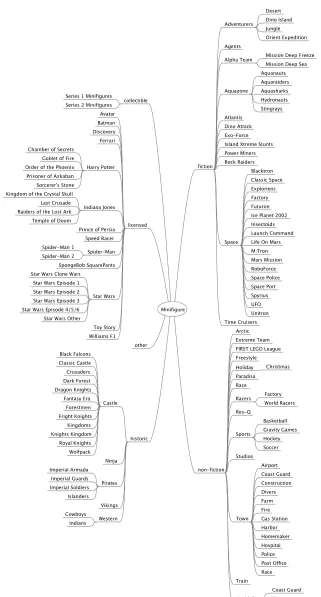
longer part of any other set. They are marketed as collectable items. Each series consists of 16 different Minifigures that are individual sold in sealed and unmarked bags. The themes in which the LEGO company released its sets and Minifigures can be classified by the Systema MinfiguræTaxonomy (see figure
2).
The vast use and popularity of LEGO has motivated us to investigate how the LEGO Minifigures have evolved over the past 35 years (1975-2010). In particular, this paper addresses the users’ perception of the facial expressions on the LEGO Minifigure faces. Over the years, LEGO produced face bricks that map the different facial expression states and facial exag-gerations in the style of cartoon. In this context, a facial cartoon exaggerates face features for a comical effect, and can create an entertaining, humorous, and cartoon-like description of a face. The head parts are mainly exaggerated to produce the cartoon-like facial effects that include the nose, eyes, eyebrows, lips, hair and ears. As LEGO bricks are considered toys, the use of a cartoon like exaggeration plays an important role in the LEGO construction, as it brings together a good entertainment format.
The work presented in this paper can lead other researchers in the field of understanding the science of play to investigate further the influence the LEGO Minifigures’ facial appearance have on LEGO users over time. We believe that the extensive and elaborate designs of faces on LEGO Minifigures can also inform the designers of other agents, such as computer game characters and robots. The LEGO company has developed hundreds of designs and can therefore be considered one of the most extensive set of agent faces.
A. Facial Expressions of Emotions
Moreover, facial expressions relate not only to the way people express emotions but also to how they interpret them while expressed by others. An attempt to understand the latter, for example, is an area of research in the field of Affective Computing (AC), which aims to detect the basic emotions from the face; the results can be applied in different areas, among which animation, virtual humans and robotics [20], [28].
In this paper we present a study that is focused on in-vestigating how users observe the iconic representations of the facial expressions of emotions conveyed by the LEGO minifigures over the years. We allow participants to not only define the observed emotional facial expression of the LEGO minifigures based on the basic universal emotions, but also with different intensities of the facial expressions.
Research in the field of Design & Emotions focuses on “understanding the emotions of product users, and on the development of tools and techniques that facilitate an emotion-focused design process” [29] while self-reports are used to “assess respondents behaviors, attitudes and subjective experi-ences, like moods, emotions or pain [30]. However, we invited participants to evaluate LEGO facial expressions and not their own emotional reactions or preferences towards LEGO minifigures. Our research methods therefore takes a slightly different approach than the established Design & Emotion research process, although a certain overlap certainly exists.
The limitation of the methodology we used lies in speci-ficity of questionnaires and the Likert-type scale: a predefined set of answers does not allow participants expressing a full range of opinions. Nevertheless, in our opinion the use of questionnaires based on labels is a suitable and widely used research technique to study six basic facial expressions [31], [32]. LEGO minifigures by definition provide a simplified representation of human-like emotions and an in-depth analysis of all possible perceptions of LEGO facial expressions goes beyond the scope of this study.
B. Design
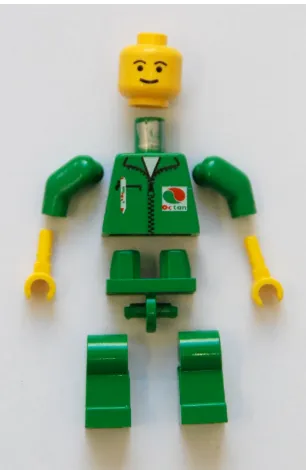
The Minifigures consist of a head, torso, arms, hands, hip and legs (see Figure 3). The Minifigure has seven degrees of freedom and is exactly four standard bricks tall, which is equal to 4.1mm. A Minifigure can have accessories on its head, such as hair, helmets and hats. Accessories are also often found around the neck, such as capes, or under the feed, such as flippers. Many Minifigures also hold items in their hands, such as swords, tools and books. At times, hands, arms and legs are replaced by special items, such as hooks and wooden legs.
The different parts of a Minifigure can be made of different colored plastics and prints can be made on the head, torso, arms, hip and legs. There are a great number of possibilities to combine the parts, which allows LEGO to provide an enormous variety of Minifigures. Two Minifigures may, for example, only differ by the face that is printed on their head.
[image:4.612.369.522.52.287.2]The face of the Minifigure is of particular importance, since it gives the strongest indicator of the emotional state of the character. People both consciously and subconsciously use facial expressions to communicate their emotions and intentions through variations in gaze direction, voice tone and gesture speed. Ekman showed that expressing emotions
Fig. 3. Anatomy of a LEGO Minifigure
through the face is a natural activity for humans and that it takes considerable effort to mask them [24]. There has also been a considerable debate on how much the context in which an emotion appears influences its perception. Carroll and Russell pointed out that situational information does indeed influence how a face is perceived [33]. This result is of interest to the design of Minifigures, since the same head can be combined with different bodies.
For the first eleven years, only one smiley face was produced, but since then the number of different faces seem to have increased and also the themes that LEGO is producing subjectively appear to become increasingly aggressive. The Bionicle theme could be the scariest theme at this point in time The Minifigures might not yet be as aggressive as the characters in the Bionicle theme, but skeleton warriors are also in their repertoire. In this study, we are trying to address the following research questions:
1) What emotions do the face in the LEGO Minifigure express?
2) How did the emotional expression of the faces change over time?
3) What influence does the context of the whole Minifig-ure have on the perception of its face?
II. METHOD
A. Setup
year in which the head was first introduced from a database of Minifigures [34]. We then randomly selected 100 heads. For these heads we randomly selected an associated Minifigure. We manually checked these Minifigures and six of them were not suitable for our experiment, since the face was not clearly visible on the Minifigure. A helmet, for example, covered a large portion of the face.
We created an online questionnaire that showed all the 628 heads and the 94 Minifigures. The Participants were asked to rate the emotional expression based on the scale shown in Figure 4. We utilized Amazon Mechanical Turk (MT) 1 to recruit participants and to administer the questionnaire. It has been shown that results obtained through MT are comparable to those obtained through the conventional method of question-naires [35]. There is no substantial difference between results obtained through an online questionnaire and results received through MT.
B. Measurements
Each face was rated on five point Likert scales ranging from very weak to very intense. The selection categories of the facial appearance are based on the work of Paul Ekman [24], who grouped the universal facial expressions into the following six categories: anger, disgust, fear, happiness, sadness, and surprise. Each of these categories has a number of intermediate facial expressions that are based on the intensity level and the expression details. Therefore, we asked participants to give one rating on one of the six scales that were labeled: anger, disgust, fear, happiness, sadness, and surprise. With one click the participants thereby identified the emotional facial expression and rated its intensity (see Figure 4).
C. Process
After reading the instructions, participants started rating the randomly presented images. The participants could rate as many faces as they wanted, but they could not rate the same image twice. Participants received one cent per rating.
D. Participants
264 adult participants, located in the US, filled in the ques-tionnaire. MT automatically made sure that exactly 30 different participants rated each image. To protect the privacy of its workers, MT does not directly allow to survey demographic data and hence this data is not available for this study. Previous surveys on the population of Mechanical Turk Users (MTU) reveals that MTUs from the US tend to be well educated, young, and with moderately high incomes, and roughly equally as many males as females [36], [37]. Mechanical Turk has been shown to be a viable, cost effective method for data collection that reduces threats to internal validity [38].
MT is only available for registered users, which does include a Captcha test. MT has in addiction a reputation system in place which enables requesters and workers to provide feedback. We can therefore assume that no automatic spam responses have been recorded. We performed a visual inspection to check for any obvious patterns in the data, such as respondents always giving the same answer. We could not find any obvious patterns.
[image:5.612.324.575.60.428.2]1http://www.mturk.com/
Fig. 4. The rating scales
III. RESULTS
On average, participants rated 82.05 images with a standard deviation of 155.3. The average response time per image was 17.33 seconds. On average, each face was rated on 3.9 different emotion scales with a standard deviation of 1.39. This indicates that many faces are to some degree ambiguous. The data for one face was corrupted due to a software failure and was therefore excluded from the further analysis. The remaining 627 faces form the basis for the statistical tests described below.
A. Distribution of facial expressions
happiness followed by anger. The other four emotions were observed considerably less.
TABLE I. COUNT OF FACE PER EMOTION
Emotion Count Happiness 324 Anger 192 Sadness 49 Disgust 28 Surprise 23
Fear 11
1) Cluster Analysis: We performed a k-cluster analysis to
[image:6.612.60.291.372.455.2]check if the faces would fall into certain design patterns. For this analysis we used the all six emotion ratings for every face. If, for example, a face F was rated 20 times on the surprise scale with an average of 4.2 and 10 times on the fear scale with an average of 3.1, then the data in Table II would be represent face F.
TABLE II. DATA REPRESENTATION OF FACEFBASED ON AVERAGE INTENSITY RATINGS
Anger Disgust Fear Sadness Happiness Surprise
F 3.1 4.2
This data represents a non-weighted average. We tried several values for the number of clusters k, but at no setting a meaningful result could be obtained. TableIIIshows the final clusters for k=6 after ten iterations.
TABLE III. FINAL CLUSTERS FOR K=6
Cluster
1 2 3 4 5 6
Anger 1.3080 3.5048 3.7042 2.8381 3.1558 2.4135 Disgust 1.6542 3.0613 2.0031 2.8871 1.7540 2.9300 Fear 1.6842 1.0714 1.8583 2.6750 2.8611 2.6950 Sadness 1.6423 1.5969 2.3145 3.7657 1.4250 2.1151 Happiness 1.5012 2.3262 1.7079 2.4189 2.0848 1.6418 Surprise 1.7256 2.9024 1.5967 2.8000 3.0926 2.3765
No clear clusters become visible. The results of this test show that too many faces were rated on too many scales. The average was, as already mentioned above, 3.9. It is not possible to plot the six dimensional space that represents our data, but we believe that our data would form a widely spread cloud of points. Using a weighted average would have not helped, since it would have not changed the fact that the faces were rated on too many different scales.
We therefore decided to repeat the cluster analysis only on the basis of the frequency of the classifications. We ignored the intensity ratings. Using the example above, Face F would then be represented as shown in TableIV.
TABLE IV. DATA REPRESENTATION OF FACEFBASED ON FREQUENCY
Anger Disgust Fear Sadness Happiness Surprise
F 20 10
A k-cluster analyses provides results for any k and we decided to set k = 6 in order to check if it would result in the same clusters as the emotional categories we presented to the participants. The resulting six clusters did not match the emotional categories directly. Two variations of happiness and anger emerged and the clusters were significantly distant
to each other (p<0.001). Table V shows the six clusters, an example face, its distance to the center of the cluster and how many faces fall into each cluster. Two clusters that include a considerable amount of happiness have been identified. We viewed some faces that are in the center of the cluster and interpreted their expression. We labeled the more negative form of happiness as confidence. Also two types of anger have emerged from the cluster analysis. One is a rather straight form of anger, while the other includes more mixed emotions. After reviewing some central faces, we interpreted this cluster as disdain. Cluster three loads strongly on the sadness emotion, but it does not seem to be as clean as for example the happiness cluster. We reviewed several central faces in this cluster and interpreted them as ”Concern”.
B. Distribution of facial expressions across time
The faces might not only be unevenly distributed across emotional categories, but also across the years in which they were released. We therefore plotted how many faces were newly introduced per year. Figure 5 shows that the number of new releases has grown substantially over the years.
0 10 20 30 40 50 60 70 80 90 100
1975 1976 1977 1978 1979 1980 1981 1982 1983 1984 1985 1986 1987 1988 1989 1990 1991 1992 1993 1994 1995 1996 1997 1998 1999 2000 2001 2002 2003 2004 2005 2006 2007 2008 2009 2010
Fig. 5. Number of new heads across years
It is of interest to see how the proportion of a certain emotion might have changed over time. Since the total number of faces per years varies substantially, we used the proportions of faces in a certain emotional category instead. If in a year 20 new faces were released and 10 of them were rated predominantly as happy then the graph would indicate a value of 50% (see Figure6).
0.00 0.10 0.20 0.30 0.40 0.50 0.60 0.70 0.80 0.90 1.00
1975 1976 1977 1978 1979 1980 1981 1982 1983 1984 1985 1986 1987 1988 1989 1990 1991 1992 1993 1994 1995 1996 1997 1998 1999 2000 2001 2002 2003 2004 2005 2006 2007 2008 2009 2010
[image:6.612.323.574.592.704.2]Happiness Anger Sadness Disgust Fear Surprise
TABLE V. THE SIX CLUSTERS OF FACES
Cluster
Cluster Nr. 1 2 3 4 5 6
Disdain Confidence Concern Fear Happiness Anger
Face
Distance 2.961 2.496 2.591 3.067 0.776 1.790
Anger 10 4 4 2 1 21
Disgust 9 3 3 1 0 4
Fear 2 1 3 17 0 1
Sadness 4 2 14 2 0 1
Happiness 2 15 3 1 26 2
Nr. Cases 80 140 57 13 198 139
Year 2010 2005 2000 1995 1990 1985 1980 1975 Intensit y 5.00 4.00 3.00 2.00 1.00 Anger (a) Anger Year 2010 2005 2000 1995 1990 1985 1980 1975 Intensit y 5.00 4.00 3.00 2.00 1.00 Disgust (b) Disgust Year 2010 2005 2000 1995 1990 1985 1980 1975 Intensit y 5.00 4.00 3.00 2.00 1.00 Fear (c) Fear Year 2010 2005 2000 1995 1990 1985 1980 1975 Intensit y 5.00 4.00 3.00 2.00 1.00 Happiness (d) Happiness Year 2010 2005 2000 1995 1990 1985 1980 1975 Intensit y 5.00 4.00 3.00 2.00 1.00 Sadness (e) Sadness Year 2010 2005 2000 1995 1990 1985 1980 1975 Intensit y 5.00 4.00 3.00 2.00 1.00 Surprise (f) Surprise
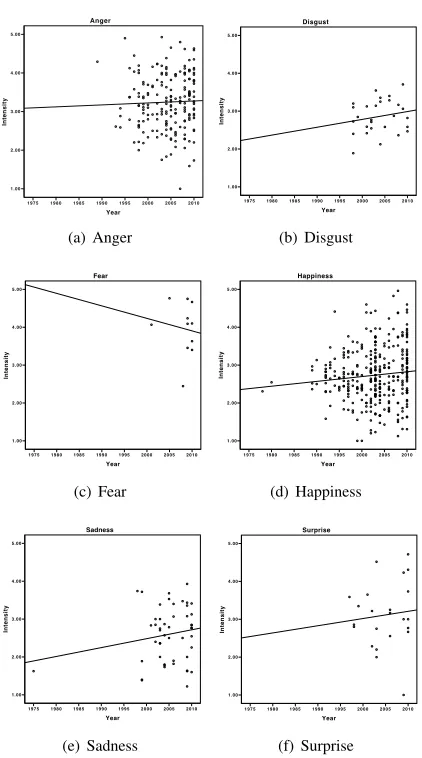
Fig. 7. Scatterplots of emotional intensities across time
We next plotted all the faces across time (see Figure 7) based on their average intensity of their dominant emotion. Besides the obvious differences in frequency that have already been described in Table I we notice that the faces are very scattered across the intensity scale for angry and happy faces. Faces in the other categories are more clustered. There are, for example, only very few faces expressing a low intensity level of fear (see Figure 7(c)).
We estimate a curve of best fit for each of the emotion categories. A linear model turned out to be the best fit for all emotion categories, but the enormous spread of the data resulted in models that are not able to significantly represent the data. For the angry faces, the linear model was only able to explain 0.1 % of the variance. Table VIshows theR2 values and the significance level for each of the linear estimations.
TABLE VI. RESULTS OF THE LINEAR CURVE ESTIMATIONS ACROSS THE SIX EMOTION CATEGORIES
Emotion R2 Sig.
Happiness 0.010 0.069 Anger 0.001 0.654 Sadness 0.034 0.205 Disgust 0.037 0.324 Surprise 0.010 0.651 Fear 0.017 0.699
C. Context
Next, we analyzed if the faces were perceived differ-ently depending on whether they were attached to a whole Minifigure or not. We analyzed how the frequencies across the six emotional categories may have changed. We conducted a related sample t-test in which the context (face or body) was the independent variable and the average frequencies per emotional category (anger, disgust, fear, sadness and happi-ness) were the dependent variables. TableVIIshows the mean frequencies of the emotional categories across the two con-texts. The mean for anger, disgust, sadness and surprise were significantly different. For anger and happiness the context of the body increased the mean frequency, while for disgust and sadness the context decreased the mean frequencies.
TABLE VII. MEAN,STANDARD DEVIATION AND P ACCROSS
EMOTIONAL CATEGORIES.
Emotion Mean Head Mean Body Std.Dev. P Anger 7.968 8.839 3.597 0.022 Disgust 3.462 2.688 2.468 0.003 Fear 1.301 1.602 3.103 0.352 Sadness 1.624 1.172 2.159 0.047 Happiness 12.946 13.677 4.062 0.086 Surprise 2.699 2.022 2.183 0.004
[image:7.612.341.545.614.676.2](a) Natural (b) Yellow
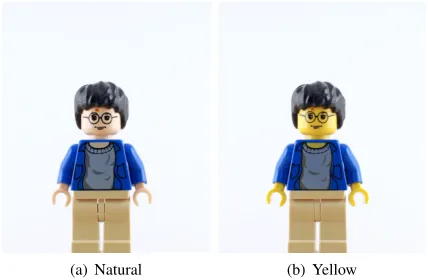
Fig. 8. Harry Potter with two different skin colors
context was the independent variable. The number emotional categories a face was categorized on and the associated χ2
value were the dependent variable. A face is very distinct if it was categorized into only on very few emotional categories. The mean χ2 value for the face condition (m= 0.0015) was not significantly (t(92) =−0.623, p= 0.535) higher than the mean χ2 value for the body condition (m = 0.0039). The
mean number of categories for the face condition (m= 3.98) was not significantly (t(92) = 0.592, p = 0.556) higher than the mean mean number of categories for the body condition (m= 3.90).
Finally, we analyzed if the change in the skin color that was first introduces in the Harry Potter theme had any influence on how the face was perceived. In our set of photographs of the full Minifigure, we had included the Harry Potter Minifigure with two different skin colors: Figure 8(a) shows the natural skin color introduced in 2004 and Figure 8(b) shows the traditional yellow LEGO skin color.
Table8shows how often the two Harry Potter Minifigures were classified into the six emotion categories. We conducted aχ2test on this data and although the assumption of the
mini-mum expected cell frequency was slightly violated. 83% of the cells had a value of less than five. Theχ2test showed that there
was no significant difference (Pearsonχ2= 1.953, p= 0.856)
[image:8.612.49.305.631.668.2]between the ratings of the two Harry Potter Minifigures. Next, we conducted a t-test only on the intensity scores of those participants that had classified the Minifigures as happy, which were 19 for the natural and 22 for the yellow Harry Potter. The t-test showed that there was no significant difference in the intensity scores (t(39) = −0.426, p = 0.672). The different skin color did not result in a significantly different evaluation by the users.
TABLE VIII. COUNT OF EMOTIONAL CATEGORIES PER SKIN COLOR.
Color Happiness Fear Anger Sadness Disgust Surprise Total
Natural 19 3 1 3 3 1 30
Yellow 22 1 1 2 2 2 30
Total 41 4 2 5 5 3 60
IV. CONCLUSIONS
The number of new faces that the LEGO company intro-duces every year is increasing steadily. Creating variations of Minifigures could possibly be more cost effective by creating
different face prints than torso prints. If the current trend continues, then soon every Minifigure in every set will be unique.
Only in the early 90s did the LEGO company start to produce a greater variety of faces. Happiness and anger seem to be the most frequent emotional expression of the Minifigure faces and their intensity is widely scattered. This scatter makes it very difficult to create a model that would adequately represent the development of faces over time. Still, we can observe a trend over time that the proportion of happy faces decrease and the proportion of angry faces increase. We have been able to identify six different clusters of faces. There are two different types of happiness and two different types of anger.
Four out of six emotional categories were significantly influenced by the context in which the face was presented. For anger the presence of the body increased the frequency of how often the face was categorized as such. For disgust, sadness and surprise, the presence of the body decreased the frequency. The context nearly significantly increased the frequency in the happiness category. We have to be careful with the interpretation of this result. A change in frequency does not necessarily mean that a face becomes more or less distinct. Our analysis of the faces distinctiveness shows that the availability of the context did not significantly increase the faces distinctiveness.
The introduction of more natural skin colors did not change how participants perceived the Harry Potter Minifigure. Since we only had this one sample of two different skin colors for the same Minifigure, we cannot necessarily generalize to all of the Minifigures that have been released with two different skin colors.
We have to consider this distribution of faces across emo-tional categories in the context of the LEGO themes. After all, most Minifigures are released in sets that belong to a certain theme, such as Pirates or Harry Potter. It is our impression that the themes have been increasingly based on conflicts. Often a good force is struggling with a bad one. May it be the good knights against the skeleton warriors or the space police against alien criminals. But the facial expressions are not directly matched to good and evil. Even the good characters suffer in their struggle and the villains can have a smug expression. In any case, the variety of faces has increased considerable.
We cannot help but wonder how the move from only positive faces to an increasing number of negative faces impacts how children play. So far LEGO did at least not produce classical military themes. There is no LEGO Desert Storm or LEGO D-Day. The Megablocks company, on the other hand, is producing a LEGO compatible construction toys that do fill this market space. Their HALO line of products, which is directly related to the popular computer game of the same name, is clearly embedded in a military culture. Other companies, such as Brickarms, are also already offering LEGO compatible weapons for Minifigures.
position. Still, LEGO might not be able to hold onto its highly positive reputation. The children that grow up with LEGO today will remember not only smileys, but also anger and fear in the Minifigures’ faces.
Designers of agent faces should take great care to design the expressions and to test their effect since toys play an important role in the development of children. The example of the Minifigures show that to appeal to users it is necessary to offer a wide range of emotional expressions that connect to the complex interaction scenarios of today’s users. Instead of focusing on highly realistic expressions, it may be worth-while to increase the variability of expressions. A comic style expression is sufficient to convey a full spectrum of emotions and intensities.
A. Limitations
Participants in this study could rate as many or as little faces as they wanted. The number of faces they rated varies greatly and hence we do recommend a Baysian approach to conduct more advanced statistics for future studies as described in [35].
REFERENCES
[1] B. Sutton-Smith,The ambiguity of play. Cambridge, Mass.: Harvard University Press, 1997.
[2] J. Goldstein, D. Buckingham, and G. Brougere,Toys, games and media. Mahwah, NJ: Lawrence Erlbaum Associates, 2004.
[3] H. Rakoczy, M. Tomasello, and T. Striano, “How children turn objects into symbols: A cultural learning account.” inSymbol use and symbol representation., L. Namy, Ed. New York: Erlbaum, 2005, pp. 67–97. [4] K. R. Ginsburg, “The importance of play in promoting healthy child development and maintaining strong parent-child bonds,” Pediatrics, vol. 119, no. 1, pp. 182–191, 2007.
[5] M. Lauwaert,The place of play : toys and digital culture, ser. Media-Matters. Amsterdam: Amsterdam University Press, 2009.
[6] G. Cross, Kids’ stuff : toys and the changing world of American childhood. Cambridge, Mass: Harvard University Press, 1997. [7] S. Hussain, J. Lindh, and G. Shukur, “The effect of lego training on
pupils’ school performance in mathematics, problem solving ability and attitude: Swedish data,”Educational Technology & Society, vol. 9, no. 3, pp. 182–194, 2006.
[8] H. Dittmar, E. Halliwell, and S. Ive, “Does barbie make girls want to be thin? the effect of experimental exposure to images of dolls on the body image of 5- to 8-year-old girls,”Developmental Psychology, vol. 42, no. 5, pp. 283–92, 2006.
[9] I. D. Cherney, L. Kelly-Vance, K. G. Glover, A. Ruane, and B. O. Ryalls, “The effects of stereotyped toys and gender on play assessment in children aged 18-47 months,”Educational Psychology, vol. 23, no. 1, p. 95, 2003.
[10] D. Lipkowitz,The LEGO Book. New York: DK Publishing, 2009. [11] G. K. Christiansen, “Patent ”leget¨ojsbyggeelement”, dk92683c,” 1958. [12] LEGO, “Company profile - an introduction to the lego group,” Tech. Rep., 2011. [Online]. Avail-able: http://cache.lego.com/en-gb/sitecore/shell/controls/rich%20text% 20editor/-/media/30e5da5c580a4141914659e26753c938.pdf
[13] J. Baichtal and J. Meno,The Cult of LEGO. San Francisco: No Starch Press, 2011.
[14] J. Bender,LEGO: A Love Story. Hoboken: Willey, 2010. [15] G. K. Christiansen and J. N. Knudsen, “Toy figure,” 1979.
[16] N. Martell, Standing small: a celebration of 30 years of the Lego minifigure. New York: DK Publisher, 2009.
[17] DK Publishing,LEGO Star Wars Character Encyclopedia. New York: DK Publishing, 2011.
[18] M. Steiner, LEGO collector: collector’s guide. Dreieich: Fantasia, 2008.
[19] D. G. Myers, Theories of Emotions. Worth Publisher, 2004, ch. Theories of Emotions, pp. 500–529.
[20] R. A. Calvo and S. D’Mello, “Affect detection: An interdisciplinary review of models, methods, and their applications,”IEEE Trans. Affect. Comput., vol. 1, no. 1, pp. 18–37, Jan. 2010. [Online]. Available:
http://dx.doi.org/10.1109/T-AFFC.2010.1
[21] P. Ekman,The face of man: expressions of universal emotions. New Guinea village, New York: Garland STPM Press, 1980.
[22] N. H. Frijda,The emotions. Cambridge, England: Cambridge Univer-sity Press., 1980.
[23] R. Buck,Human motivation and emotion (2nd ed.). New York: Wiley, 1980.
[24] P. Ekman and W. Friesen, Unmasking the Face. Englewood Cliffs: Prentice Hall, 1975.
[25] C. M. Whissel, “The dictionary of affect in language,”Emotion: Theory, Research and Experience, vol. 4, pp. 113–131, 1989.
[26] M. Obaid, R. Mukundan, M. Billinghurst, and C. Pelachaud, “Expres-sive MPEG-4 Facial Animation Using Quadratic Deformation Models,” inInternational Conference on Computer Graphics, Imaging and Visu-alisation (CGIV 2010). IEEE Computer Society, 2010.
[27] A. Raouzaiou, N. Tsapatsoulis, K. Karpouzis, and S. Kollias, “Parame-terized facial expression synthesis based on mpeg-4,”EURASIP J. Appl. Signal Process., vol. 2002, no. 1, pp. 1021–1038, Jan. 2002. [28] C. Bartneck and M. J. Lyons, “Hci and the face: towards an art
of the soluble,” in Proceedings of the 12th international conference on Human-computer interaction: interaction design and usability, ser. HCI’07. Berlin, Heidelberg: Springer-Verlag, 2007, pp. 20–29. [Online]. Available:http://dl.acm.org/citation.cfm?id=1772490.1772494
[29] P. Desmet and P. Hekkert, “Special issue editorial: Design & emotion,” International Journal of Design, vol. 3, no. 2, pp. 1–6, 2009. [30] N. Schwarz,Retrospective and Concurrent Self-Reports: The Rationale
for Real-Time Data Capture. Oxford University Press, 2007, pp. 11– 26.
[31] T. Koda, T. Ishida, M. Rehm, and A. Elisabeth, “Avatar culture: cross-cultural evaluations of avatar facial expressions,”AI and Society, vol. 24, no. 3, pp. 237–250, 2009.
[32] Z. Ruttkay, “Cultural dialects of real and synthetic emotional facial expressions,”AI and Society, vol. 24, no. 3, pp. 307–315, 2009. [33] J. M. Carroll and J. A. Russell, “Do facial expressions signal specific
emotions? judging emotion from the face in context,” Journal of Personality and Social Psychology, vol. 70, no. 2, pp. 205–218, 1996. [34] C. Bartneck, The Unofficial LEGO Minifigure Catalog. Charleston:
CreateSpace, 2011.
[35] C. Bartneck, K. Zawieska, A. D¨unser, and E. Moltchanova, “Comparing the quality of responses received from participants recruited with amazon’s mechanical turk to participants recruited through traditional methods,”International Journal of Human Computer Studies (submit-ted), 2012.
[36] P. G. Ipeirotis, “Demographics of mechanical turk,” New York Univer-sity, Tech. Rep., 2010.
[37] J. Ross, L. Irani, S. Silberman, A. Zaldivar, and B. Tomlinson, “Who are the crowdworkers? shifting demographics in mechanical turk,” in Proceedings of the 28th of the international conference extended abstracts on Human factors in computing systems. ACM, 2010, pp. 2863–2872.