Resource Differentiation of Knowledge
Evgeny Popov, Maxim Vlasov*
Institute of Economics, Ural Branch of the Russian Academy of Sciences, Yekaterinburg, Russia. Email: [email protected]
Receive February 28th, 2011; revised April 14th, 2011; accepted April 27th, 2011.
ABSTRACT
The objective of the present research is classification of institutions for knowledge generation at a minimal economic level and formulation of a strategy regarding knowledge generation, which would allow introducing modifications into engineering processes. Based on the methodological apparatus for institutional economics, classification of economic institutions for new knowledge generation at a minimal economic level has been accomplished. The author has con-ducted an empirical study concerned with allocation of shares of new knowledge generation according to the degree of change impact on production processes of economic entities. As a result of the research carried out by us the structure of external and internal risks in the context of new knowledge generation has been determined; evaluation of risk factor significance has been made; weighting coefficient values for each risk factor have been determined through expert es-timation. The received results allow the enterprises to carry out an estimation, forecasting and planning of generation of new knowledge.
Keywords: Knowledge Management, Knowledge Differentiation
1. Introduction
Onrush of market relations, generation of positive ten- dencies towards economic growth and well-being of po- pulation is grounded on all-round application of achieve- ments referred to knowledge-based economy.
A fair number of researches are dedicated to resolution of issues in the context of knowledge-based economy. However, the mentioned researches are generally nar- rowed down to consideration of knowledge-based econ- omy in terms of instrumental approach and opportunities for economic and mathematical modeling of innovation development. The issues concerned with cost estimate and generation of new knowledge remain unsolved. Processes of generation of new knowledge imply consid- erable risks, and that is ground for application of tech-niques related to institutional economics.
Significance of knowledge for economics was first ac- centuated by F. Hayek in the Nobel lecture of the prize winners in economics. Hereafter the issues related to the given field of economics were considered by well-known researchers of economics in their scientific works. F. Machlup substantiated significance of new knowledge generation for development of production activity by e- conomic agents. А. Marshall, one of the founders of neo- classical economics, acknowledged significance of know- ledge in economic processes; he believed that “know-
ledge is one of the most powerful production engines”. K. Viig determined position of knowledge in a modern company, and D. Stonehouse investigated conditions fa- voring knowledge control system functioning. E. Broo- king and Т. Stewart studied significance ofintellectual capital for a company. P. Druker considered importance of transition to knowledge management as a specific strategic concept. I. Nonaka determined capability of an economic entity to transform nonformalized knowledge into formalized one as a fundamental criterion of as-sessment regarding knowledge generation efficiency. R. Solow suggested a type of relationship specifying the re-sults of scientific and technological advance impact on the results of introduction of innovations, which cause engineering process change. F. Valenta introduced clas-sification in terms of profoundness of changes made in a production process. B. Twiss, carrying out research into new knowledge generation issues, determined that 80-90% of activity in the context of new knowledge genera-tion are not economically efficient in terms of real mar-ket activity.
Resource Differentiation of Knowledge 214
2. Differentiation of New Knowledge
Imbalance of actual and desired output of new knowl-edge is attributed to the lack of elaborated methodologies in Russian scientific literature that are referred to differ-entiation of changes introduced by this knowledge into production processes.
J. Shumpeter singled out the following typical changes of production processes: application of innovative tech-nologies and technological processes; introduction of new- quality production; readjustment of industrial organiza- tion and logistics [1].
Czech researcher F. Valenta introduced in his mono-graph classification in terms of profoundness of changes made in a production process: simple change of quality specified by low material costs, lack of change-related risks and, correspondingly, minor profit variance, with initial system characters are not subject to change; more profound process change concerned with more consider-able investments and risks, which allows increasing pro-duction activity profitability level, with all or most part of system characters are subject to change, but the basic structural concept is retained; major change in functional properties of the system or its part, which modifies its functional principle and imply considerable financial ex-penditures and risks [2].
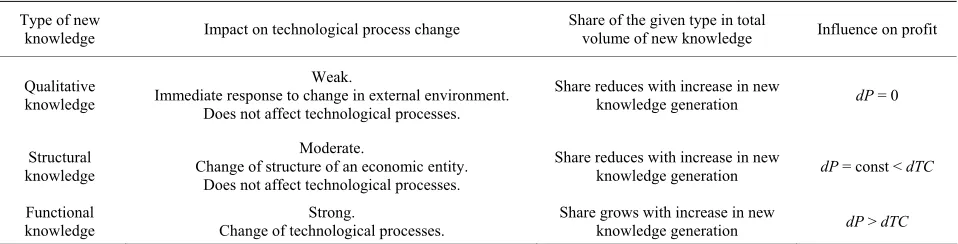
Introduction of new knowledge in the activity by eco-nomic entities modifies production processes, and it re-quires classification of new knowledge in terms of pro-foundness of changes made. The author suggests the fol-lowing differentiation of new knowledge in terms of pro-foundness of changes made in production processes ( Ta-ble 1).
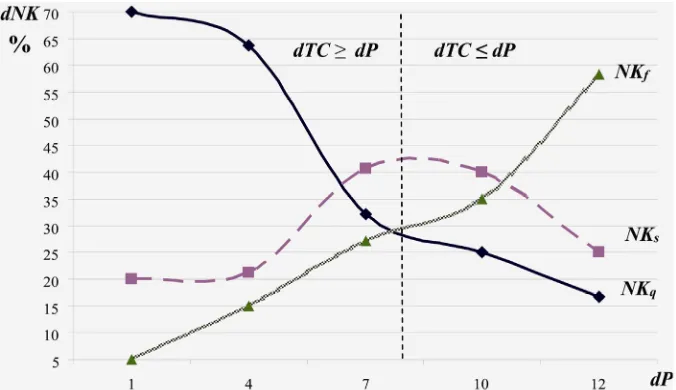
The author has conducted an empirical study con-cerned with allocation of shares of new knowledge gen-eration according to the degree of change impact on pro-duction processes of economic entities (Figure 1).
Based on the analysis in Figure 1, the following con-clusions can be drawn:
First, financing of new knowledge generation within
the scope less than 8% of profit and development of quality new knowledge does not afford an opportunity for economic entities to optimize technological processes and gain significant profit as a result of new knowledge introduction.
Second, substantial changes in technological processes and profit from new knowledge introduction occur when amount of financing of new knowledge generation is more than 8% of profit; when the share of new knowl-edge (which, if introduced, results in functional changes in technological processes) is more than 30% of the total volume of new knowledge introduced.
In the context of the present situation over the half of Russian enterprises finance new knowledge of a quality nature as a basic strategy for new knowledge generation, which does not give rise to technological process change and seizing the competitive edge, and, correspondingly, growth of profits.
Strategy that affords opportunity to optimize the activ-ity in terms of new knowledge generation and, corresp- ondingly, to increase profit as a result of new knowledge introduction, can be described by way of the following structure: 0.28 0.43 0.29 q s f dNK dNK dNK
(1) where:
dNKq- share of qualitative new knowledge;
dNKs - share of structural new knowledge;
dNKf - share of functional new knowledge.
3. Internal and External Risks Concerned
with New Knowledge Generation
One should mention that new knowledge generation risks are part of integral risks of economic entity operation.
[image:2.595.60.539.586.708.2]New knowledge generation processes are, in most cases, associated with considerable time lines between decision-making regarding knowledge generation and in-
Table 1. Differentiation of new knowledge in terms of impact on technological process change.
Type of new
knowledge Impact on technological process change
Share of the given type in total
volume of new knowledge Influence on profit
Qualitative knowledge
Weak.
Immediate response to change in external environment. Does not affect technological processes.
Share reduces with increase in new
knowledge generation dP = 0
Structural knowledge
Moderate.
Change of structure of an economic entity. Does not affect technological processes.
Share reduces with increase in new
knowledge generation dP = const < dTC
Functional knowledge
Strong.
Change of technological processes.
Share grows with increase in new
knowledge generation dP > dTC
Figure 1. Time history for profit (dP) to depend upon allocation of new knowledge generation volumes according to degree of impact on production processes (%). (NKq - qualitative change; NKs - structural change; NKf - functional change).
troduction of new knowledge into economic activity. Considerable span time predetermines uncertainty in terms of prospective conditions for new knowledge introduc- tion, which results in emergence of various risks related to its generation.
A new knowledge generation risk is an estimate of contradictions regarding prognostic and actual results of activity referred to new knowledge generation.
Considering the fact that new knowledge generation is one of business lines of enterprises, the risks related to such activity should be subdivided according to their re- lationship to an economic entity; subject to the field of occurrence; to external and internal. External risks of new knowledge generation include those with the source in external environment in reference to the considered object. Internal risks of new knowledge generation are those occurred due to immediate activity by an economic entity.
As a result of the research carried out by us the struc- ture of external and internal risks in the context of new knowledge generation has been determined; evaluation of risk factor significance has been made; weighting co- efficient values for each risk factor have been determ- ined through expert estimation (Tables 2 and 3).
One should mention that internal risks are much more significant for new knowledge generation than external risks. According to the empirical study results, internal risk weighting coefficient is 63.8%, external risks—36.2%.
4. Classification of Institutions for New
Knowledge Generation
So far as institution environment is a set of regulations structuring an activity by economic entities and their in
[image:3.595.308.538.464.590.2]teraction, then, in the context of institutional approach, activity by economic entities is specified by transforma- tion and transaction approaches. The first approach emp- hasizes internal factor impact on activity by economic entities. In turn, the transaction approach considers exter- nal factor impact. Thus, in compliance with classification of institutional theories by О. Willianson, classification of institutions should primarily be accomplished in terms of such criterion as “relationship to an economic entity”,
Table 2. Structure of internal risks in the context of new knowledge generation.
Type of risks Weighting
coefficient, %
Low staff proficiency 17.80 Staff instability 11.26
Negative result of the activity 15.82 Lack of result within the established time limit 17.65 Unconformity of the results obtained with those
planned 20.92
Practical use impossibility 16.57
Total 100
Table 3. Structure of external risks in the context of new knowledge generation.
Type of risks Weighting
coefficient, %
Divestiture by the market 27.42
Noncompetitiveness of new knowledge 28.76
Infringement of intellectual property 26.48
Availability of analogs in the global practice 17.34
Resource Differentiation of Knowledge 216
namely, internal and external institutions should be dis-tinguished. Therefore, considering the fact that knowl-edge generation is one of business lines by enterprises, an initial criterion in terms of classification of insti-tutions for new knowledge generation is their relation-ship to an economic entity. Therewith, the first line pro-vides analysis of enterprises and firms “on the inside”, i.е.
through a system of standards, agreements and contracts specified by various management approaches to new knowledge generation. The second line studies economic organizations “on the outside”, i.е. it considers regula-tions of economic entities’ interaction [3].
Application of modern economic approaches to activ-ity by economic agents requires examination of a cate- gory referred to market potential of an enterprise. In the process of generation of an institutional structure of new knowledge generation processes by economic entities on the basis of market potential of the enterprise, the follow-ing functions referred to endogenous institutions should be singled out: management, use of resources, interaction with third parties; for external institutions-relationship with contractors, market condition influence. Functional structure model of market potential of an enterprise is a requisite criterion for classification of institutions for new knowledge generation [4].
The block referred to institutions for management in-cludes newly developed mission, strategy and objectives of new knowledge generation. The given block is pre-sented as a set of components relative to the system of management: planning, organization, stimulation and con-trol [5].
There is an established conception in the economic lit-erature concerned with external uncontrolled factors of enterprise’s macroenvironment; the conception includes analysis into technological, economic, social and politi- cal factors. The author of the present research considers it essential to add analysis of environmental factors as well [6]. A complex of the given factors generates the block of institutions for external condition influence.
In order to understand a conception regarding probable lines of development, an essence of institutional structure of new knowledge generation activity by economic agents at a minimal economic level, classification of mini-economic institutions for new knowledge genera- tion is required.
Elements of market potential of an enterprise can be structured in terms of four management functions: plan- ning, organization, stimulation and control, and in terms of three scopes of activity by an enterprise: analytics, production and communication [4].
To classify institutions for knowledge-based mini-economy, the following approaches can be applied. One of the approaches to classification is a method of
posi-tioning at a two-dimensional plane suggested by a French professor О. Favereau [7]. The given method assumes disposal of the available theoretical models and ap-proaches at coordinates “internal market of an enter- prise-external market” and “actual rationality of decision -procedural rationality”. О. Williamson in his studies suggests such a classification approach as generation of a hierarchical system “hierarchy of goals” [3].
Since dominant features of institutions are endogen- eity or exogeneity of their generation or application, and the fact that the activity by the given institutions extends over the activity by singular employees or the enterprise as a whole, so it is exactly those features of minieco-nomic institutions for new knowledge generation that have to be employed as basic features for classification.
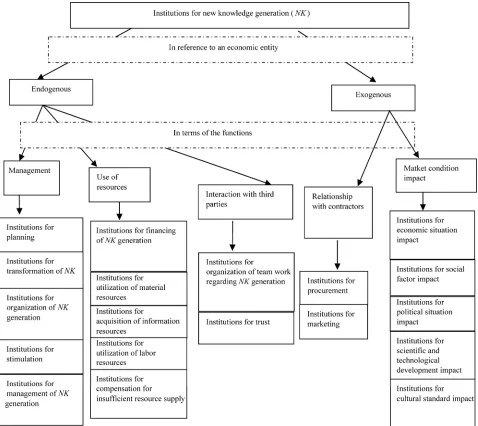
The elaborated classification of institutions for new knowledge generation based on the criteria stated above is demonstrated in Figure 2.
Thus, the analysis of the obtained fundamental theo-retical and empirical results of the research carried out by the authors, results in the following basic points.
First, classification of mini-economic institutions for new knowledge generation accomplished on the basis of the methodological apparatus for institutional economics and applicable to a minimal economic level affords an opportunity to reduce uncertainty in terms of analysis and organization of new knowledge generation, in terms of evaluation and prediction of development of the given economy elements.
Second, development of institutions for new knowl-edge generation as standards and regulations of organiza-tion referred to it has an effect of considerable reducorganiza-tion of costs and risks, which, being high, impede generation of new knowledge at a required level, and, correspond-ingly, satisfaction of needs in new knowledge by eco-nomic entities.
Institutions for knowledge management are subject to the established system of decision-making inside of a particular economic entity. Regarding the issues related to new knowledge generation, it is exactly the estab-lished knowledge management standards at an enter-prise—institutions for knowledge management—which determine activity lines, necessity and capability of fi-nancing new knowledge generation at an enterprise.
Endogenous institutions include standards of intera-ction between economic agents, which are established inside of a particular economic entity.
Exogenous institutions are standards established due to external factors in reference to an enterprise.
5. External Effects
Figure 2. Classification of mini-economic institutions for new knowledge generation.
2) Principle of step-by-step solution. process efficiency has also external impact on other
do-mains where new knowledge is applied. A study into in-novation activity by enterprises demonstrated the fact that enhancement of the material base and technological field of new knowledge appliance results in reduction of negative impact on the environment, ecology and im- provement of personal well-being.
In the given context we consider that substantiation of efficiency regarding new knowledge generation activity is possible by way of identification, assessment of re-serves, especially in the context of development and in-troduction of new knowledge into economic activity by economic agents.
The technique referred to assessment of conjugation effects in terms of new knowledge generation is based on classification of new knowledge in terms of fields of ap-pliance, identification of their potential, share, their inter-relation, correlation and conjugation effect.
Particular importance in the given context is given to institution for external factor assessment in terms of new knowledge generation.
For substantiation of efficiency regarding conjugation of activities related to new knowledge generation, the
following principles are applied: Conjugation effects in terms of new knowledge gen-eration are most effective provided they are allowed for in material production.
Resource Differentiation of Knowledge 218
To substantiate the conjugation effect, the author relies on a methodological statement concerned with the fact that the highest efficiency can be achieved in case of maximal conjugation of measures.
The institution for external factor assessment in terms of new knowledge generation is a certain complex of tra-ditions, habits and mechanisms of assessment of mutual influence of new knowledge generation external effects by economic entities. Significance of the given institu-tion increases in case the required financing of new knowledge generation is not provided. The essence of the institution is in wide application of external effects in the processes of new knowledge generation, dynamic re-sponse to changes in external economic environment, satiation of activity by economic entities with new know-ledge.
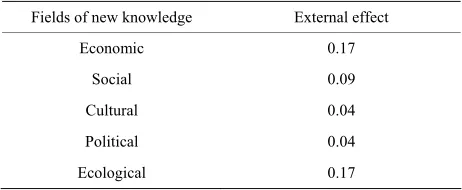
An analysis of new technological knowledge influence on other fields allowed estimating (according to the em-piric research data) the following external effects in terms of new knowledge generation (Table 4).
In other words, to produce 100% of technological knowledge, up to 17% of economic and ecological, 9% social, 4% (each) cultural and political knowledge are generated simultaneously.
The analysis given in Table 4 demonstrates the fact that external effects of production and introduction of new technological knowledge with the lowest risk values and maximal introduction coefficient afford an opportu-nity to reduce considerably the risks referred to produc-tion and introducproduc-tion of new knowledge in conjugate spheres with high risk coefficients, such as ecological, political and social.
In the course of the research external effects of pro- duction and introduction of new technological knowl-edge into economic activity by economic entities in cor-relation with other scopes of activity of economic entities have been identified. Growth in production and introduc-tion of new technological knowledge exerts an influence on other scopes of activity and allows reducing the risks related to production and introduction of new knowledge.
[image:6.595.56.287.625.720.2]Thus, in the process of calculation of new knowledge
Table 4. External effects in terms of new knowledge genera-tion in the field of technology according to the scopes of ap-pliance.
Fields of new knowledge External effect
Economic 0.17
Social 0.09
Cultural 0.04
Political 0.04
Ecological 0.17
value and, correspondingly, an effect of new knowledge introduction into economic activity, their influence on other fields of activity is required to be taken into con-sideration.
6. Conclusions
The research conducted by the author has yielded the fol-lowing results:
First, differentiation of new knowledge in terms of profundity of changes introduced into technological pro-cesses has been accomplished, which is ground to con-sider new knowledge generation processes from different aspects of economic activity. A diagrammatic model of new knowledge generation structure has been developed; it allows optimal structuring of scientific and engineering processes on the basis of their differentiation. By refer-ence of numerical criteria analysis related to the structure of the generated knowledge, guidelines regarding devel-opment of a strategy of its generation have been set forth.
Second, the author identified the structure of external and internal risks referred to new knowledge generation; assessment of risk factor significance has been made; weighing coefficient estimation for each risk factor has been accomplished in an expert way.
In the issuance of the conducted research classification of risks referred to new knowledge generation has been implemented. Trends towards reduction of external and internal risks referred to new knowledge generation have been identified. In order to assess capabilities for predic-tion of new knowledge generapredic-tion risks and work out the means to reduce them, the apparatus for institutional economics was suggested.
Third, based on the methodological apparatus for insti-tutional economics, classification of economic institu-tions for new knowledge generation at a minimal eco-nomic level has been accomplished. It affords an oppor-tunity to reduce uncertainties in terms of new knowledge generation, evaluation and prediction of development of elements referred to a certain economy.
Fourth, external effects of new technological knowl-edge introduction into economic domain and other scopes of activity by an enterprise have been exposed. Thus, external effects of new technological knowledge generation make it possible to substantially meet require-ments in ecological and social branches of knowledge.
REFERENCES
[1] J. A. Schumpeter, “The Theory of Economics Develop-ment,” George Alien & Unwin, London, 1952.
[2] F. Valenta, “Management of Innovations,” Progress, Moscow, 1985.
[3] O. E. Williamson, “The Economic Institution of Capital-ism: Firms, Markets, Relational Contracting,” Macmillan, London, 1985.
[4] E. V. Popov, “Market Potential of the Firm,” Interna-tional Advances in Economic Research, Vol. 10, No. 4, 2004, pp. 337-338.doi:10.1007/BF02295147
[5] R. Oldcorn, “Management Bases,” The Financial Press, Moscow, 1999.
[6] P. Kotler, “Marketing Bases,” Мarketing Bases Progress, Moscow, 1990.