Abstract—Wireless communications using microwaves are increasingly important, such as Wi-Fi. Performance is a crucial issue, leading to more reliable and efficient communications. Security is equally important. Laboratory measurements are made about several performance aspects of Wi-Fi (IEEE 802.11a, g) WEP point-to-point links. A contribution is given to performance evaluation of this technology under WEP encryption, using two types of equipments (RBTR2 access points from Enterasys Networks; DAP-1522 access points from D-Link and WPC600N adapters from Linksys). Detailed results are presented and discussed, namely at OSI levels 4 and 7, from TCP, UDP and FTP experiments: TCP throughput, jitter, percentage datagram loss and FTP transfer rate. Comparisons are made and conclusions are drawn about the comparative performance of the links.
Index Terms—Wi-Fi; WLAN; IEEE 802.11a; IEEE 802.11g; WEP Point-to-Point Links; Wireless Network Laboratory Performance.
I. INTRODUCTION
Wireless communication technologies have been developed using electromagnetic waves propagating in the air, in several frequency ranges. It is the case of e.g. Wi-Fi and FSO, whose importance and utilization have been increasing.
Wi-Fi is a microwave based technology providing for versatility, mobility and favourable prices. The importance and utilization of Wi-Fi have been growing for complementing traditional wired networks. It has been used both in ad hoc mode and in infrastructure mode. In this case an access point, AP, permits communications of Wi-Fi devices with a wired based LAN through a switch/router. In this way a WLAN, based on the AP, is formed. Wi-Fi has reached the personal home where a WPAN allows personal devices to communicate. Point-to-point and
Manuscript received March 16, 2012. Supports from University of Beira Interior and FCT (Fundação para a Ciência e a Tecnologia)/PEst-OE/FIS/UI0524/2011(ProjectoEstratégico-UI524-2011-2 012) are acknowledged.
J. A. R. Pacheco de Carvalho is with the Remote Detection Unit and the Physics Department, University of Beira Interior, 6201-001 Covilha, Portugal (phone: +351 275 319 703; fax: +351 275 319 719; e-mail: pacheco@ ubi.pt).
H. Veiga is with the Remote Detection Unit and the Informatics Centre, University of Beira Interior, 6201-001 Covilha, Portugal (e-mail: [email protected]).
C. F. Ribeiro Pacheco is with the Remote Detection Unit, University of Beira Interior, 6201-001 Covilha, Portugal (e-mail: [email protected]).
A. D. Reis is with the Remote Detection Unit and the Physics Department,
point-to-multipoint configurations are used both indoors and outdoors, requiring specific directional and omnidirectional antennas. Wi-Fi uses microwaves in the 2.4 and 5 GHz frequency bands and IEEE 802.11a, 802.11b, 802.11g and 802.11n standards [1]. As the 2.4 GHz band becomes increasingly used interferences increase. Therefore, the 5 GHz band has been receiving considerable attention, although absorption increases and ranges are shorter.
Nominal transfer rates up to 11 (802.11b), 54 Mbps (802.11 a, g) and 600 Mbps (802.11n) are specified. The medium access control is CSMA/CA. There are studies on wireless communications, wave propagation [2,3], practical implementations of WLANs [4], performance analysis of the effective transfer rate for 802.11b point-to-point links [5], 802.11b performance in crowded indoor environments [6].
Performance evaluation is a fundamentally important criterion to assess the reliability and efficiency of communication. New telematic applications are specially sensitive to performances, when compared to traditional applications. Requirements have been pointed out, such as: 1-10 ms jitter and 1-10 Mbps throughput for video on demand/moving images; jitter less than 1 ms and 0.1-1 Mbps throughputs for Hi Fi stereo audio [7].
Wi-Fi security is very important. Microwave radio signals travel through the air and can be easily captured by virtually everyone. Therefore, several security methods have been developed to provide authentication such as, by increasing order of security, WEP, WPA and WPA2. WEP was initially intended to provide confidentiality comparable to that of a traditional wired network. A shared key for data encryption is involved. The communicating devices use the same key to encrypt and decrypt radio signals. The CRC32 checksum used in WEP does not provide a great protection. However, in spite of its weaknesses, WEP is still widely used in Wi-Fi communications for security reasons, mainly in point-to-point links.
Several performance measurements have been made for 2.4 and 5 GHz Wi-Fi open [8,9] and WEP [10,11] links, as well as very high speed FSO [12]. In the present work new Wi-Fi (IEEE 802.11 a,g) results arise, using WEP, through OSI levels 4 and 7. Performance is evaluated in laboratory measurements of WEP point-to-point links using two types of available equipments. Comparisons are made about the comparative performance of the links.
The rest of the paper is structured as follows: Chapter II presents the experimental details i.e. the measurement setup and procedure. Results and discussion are presented in Chapter III. Conclusions are drawn in Chapter IV.
Comparative Performance Evaluation of Wi-Fi
IEEE 802.11 A,G WEP PTP Links
II. EXPERIMENTAL DETAILS
Two types of experiments were carried out, which are referred as Expa and Expd. The measurements of Expa used Enterasys RoamAbout RBTR2 level 2/3/4 access points (mentioned as APa), equipped with IEEE 802.11 a/b/g radio cards similar to the Agere-Systems model 0118 type, and firmware version 6.08.03 [13], and 100-Base-TX/10-Base-T Allied Telesis AT-8000S/16 level 2 switches [14]. The configuration was for minimum transmitted power i.e. micro cell, point-to-point, LAN to LAN mode, using the antenna which was built in the card. Other experimental details were as in [11]. Expd used a D-Link DAP-1522 bridge/access point [15], with internal PIFA *2 antenna, IEEE 802.11 a/b/g/n, firmware version 1.31 and the same type of level 2 switch [14]. The wireless mode was set to access point mode. The firmware from the manufacturer did not make possible a point-to-point link with a similar equipment. Therefore, a PC was used having a PCMCIA IEEE.802.11 a/b/g/n Linksys WPC600N wireless adapter with three internal antennas [16], to enable a PTP link to the access point (this configuration is mentioned as APd).
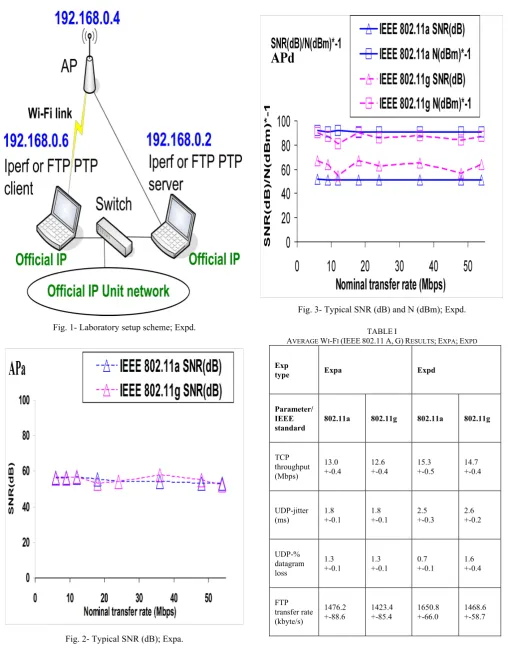
In both types of experiments, interference free communication channels were used, This was checked through a portable computer, equipped with a Wi-Fi 802.11 a/b/g adapter, running NetStumbler software [17]. WEP encryption was activated in both equipment types, using 128 bit encryption and a shared key for data encryption composed of up to 26 ASCII characters. The experiments were made under far-field conditions. No power levels above 30 mW (15 dBm) were required, as the access points were close. A laboratory setup has been planned and implemented for the measurements of Expd, as shown in Fig. 1. At OSI level 4, measurements were made for TCP connections and UDP communications using Iperf software [18], permitting network performance results to be recorded. For a TCP connection, TCP throughput was obtained. For a UDP communication with a given bandwidth parameter, UDP throughput, jitter and percentage loss of datagrams were determined. TCP packets and UDP datagrams of 1470 bytes size were used. A window size of 8 kbytes and a buffer size of the same value were used for TCP and UDP, respectively. One PC, with IP 192.168.0.2 was the Iperf server and the other, with IP 192.168.0.6, was the Iperf client. Jitter, which indicates the smooth mean of differences between consecutive transit times, was continuously computed by the server, as specified by RTP in RFC 1889 [19]. The scheme of Fig. 1 was also used for FTP measurements, where FTP server and client applications were installed in the PCs with IPs 192.168.0.2 and 192.168.0.6, respectively. The server PC also permitted manual control of the settings in the access point.
The server and client PCs were HP nx9030 and nx9010 portable computers, respectively, running Windows XP. They were configured to maximize the resources available to the present work. Batch command files have been written to enable the TCP, UDP and FTP tests.
The results were obtained in batch mode and written as data files to the client PC disk. Each PC had a second network adapter, to permit remote control from the official IP Unit network, via switch.
III. RESULTS AND DISCUSSION
In each type of experiment Expa and Expd, the corresponding equipment types, APa and APd, respectively, were manually configured for each standard IEEE 802.11 a, g with typical nominal transfer rates (6, 9, 12, 18, 24, 36, 48, 54 Mbps). For each experiment type, measurements were made for every fixed transfer rate. In this way, data were obtained for comparison of the laboratory performance of the links, measured namely at OSI levels 1 (physical layer), 4 (transport layer) and 7 (application layer). The setup of Fig. 1 was used for Expd. In each experiment type, for each standard and every nominal fixed transfer rate, an average TCP throughput was determined from several experiments. This value was used as the bandwidth parameter for every corresponding UDP test, giving average jitter and average percentage datagram loss.
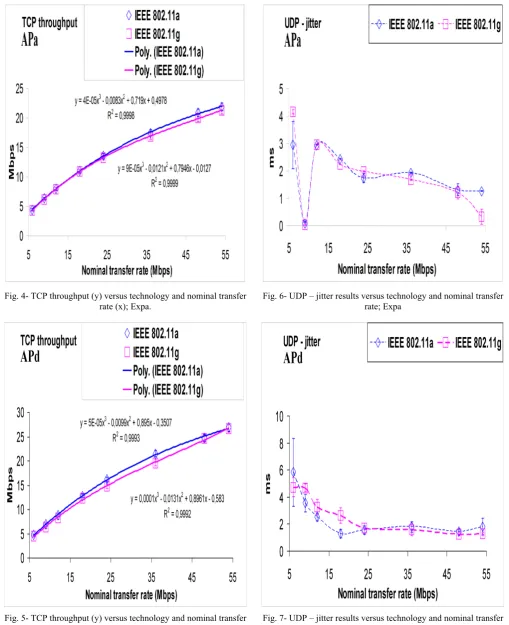
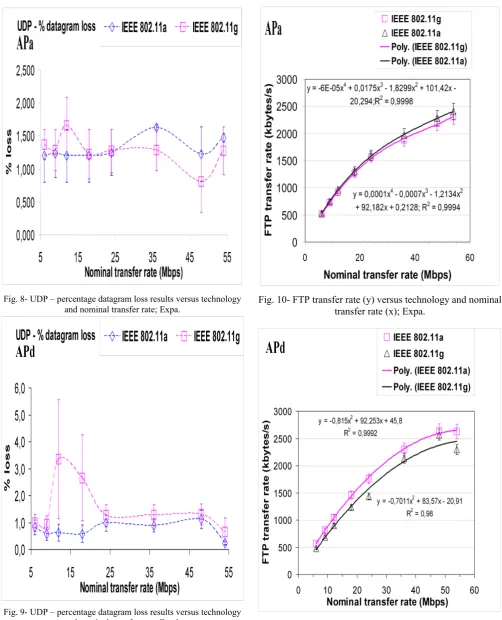
At OSI level 1, noise levels (N, in dBm) and signal to noise ratios (SNR, in dB) were monitored and typical values are shown in Fig. 2 and Fig. 3 for Expa and Expd, respectively.
The main average TCP and UDP results are summarized in Table I. In Fig. 4 and Fig. 5 for Expa and Expd, respectively, polynomial fits were made to the 802.11a, g TCP throughput data, where R2 is the coefficient of determination. It is seen
that on average, for each AP type, the best TCP throughputs are for 802.11 a. APd presents, on average, the best performance (+18% for 802.11a; +17% for 802.11g). In Figs. 6-9, the data points representing jitter and percentage datagram loss were joined by smoothed lines. It follows that, on average, the best jitter performances are for 802.11a. The best jitter performances are, on average, for APa. For APd the best jitter performances are, on average, for 802.11a. Concerning average percentage datagram loss data (1.2 % on average) there is a good agreement for both APa and APd and for both standards.
At OSI level 7 we measured FTP transfer rates versus nominal transfer rates configured in the access points for the IEEE 802.11a, g standards. The result for every measurement was an average of several experiments involving a single FTP transfer of a binary file with a size of 100 Mbytes. The average results thus obtained are summarized in Table I and represented in Fig. 10 and Fig. 11. Polynomial fits to data were made for the implementation of each standard. It was found that, for each AP type, the best FTP performances are for 802.11a. APd shows, on average, a better FTP performance than APa, both for 802.11a and 802.11g. These results show the same trends found for TCP throughput.
Generally, the results measured for WEP links were not found as significantly different, within the experimental errors, from corresponding data obtained for open links. Except for jitter, where the best performances were found for open links
Fig. 1- Laboratory setup scheme; Expd.
[image:3.595.304.551.55.343.2]Fig. 2- Typical SNR (dB); Expa.
Fig. 3- Typical SNR (dB) and N (dBm); Expd.
TABLEI
AVERAGE WI-FI (IEEE802.11A,G)RESULTS;EXPA;EXPD
Exp
type Expa Expd
Parameter/ IEEE standard
802.11a 802.11g 802.11a 802.11g
TCP throughput (Mbps)
13.0 +-0.4
12.6 +-0.4
15.3 +-0.5
14.7 +-0.4
UDP-jitter (ms)
1.8 +-0.1
1.8 +-0.1
2.5 +-0.3
2.6 +-0.2
UDP-% datagram loss
1.3 +-0.1
1.3 +-0.1
0.7 +-0.1
1.6 +-0.4
FTP transfer rate (kbyte/s)
1476.2 +-88.6
1423.4 +-85.4
1650.8 +-66.0
[image:3.595.43.553.368.678.2] [image:3.595.298.546.395.687.2]Fig. 4- TCP throughput (y) versus technology and nominal transfer rate (x); Expa.
Fig. 5- TCP throughput (y) versus technology and nominal transfer (x) rate; Expd.
[image:4.595.43.553.49.675.2]Fig. 6- UDP – jitter results versus technology and nominal transfer rate; Expa
Fig. 7- UDP – jitter results versus technology and nominal transfer rate; Expd.
Fig. 8- UDP – percentage datagram loss results versus technology and nominal transfer rate; Expa.
Fig. 9- UDP – percentage datagram loss results versus technology and nominal transfer rate; Expd.
[image:5.595.46.549.46.667.2]Fig. 10- FTP transfer rate (y) versus technology and nominal transfer rate (x); Expa.
IV. CONCLUSION
An additional laboratory setup arrangement has been planned and implemented, that contributed to systematic performance measurements of available wireless equipments (RBTR2 access points from Enterasys Networks; DAP-1522 access points from D-Link and WPC600N adapters from Linksys) for Wi-Fi (IEEE 802.11 a, g) in WEP point-to-point links.
Through OSI layer 4, TCP throughput, jitter and percentage datagram loss were measured and compared for each standard. For each AP type, the best TCP throughputs were found for 802.11a. TCP throughput was found sensitive to AP type. The best jitter performances were found sensitive to AP type. For one AP type the best jitter performance was found, on average, for 802.11a.
Concerning average percentage datagram loss, good agreements were found for both AP types and for both standards.
At OSI layer 7, the best FTP performances were, for each AP type, for 802.11a. FTP performance was found sensitive to AP type. These results show the same trends found for TCP throughput.
Generally, the results measured for WEP links were not found as significantly different, within the experimental errors, from corresponding data obtained for open links. Except for jitter, where the best performances were found for open links.
Additional performance measurements either started or are planned using several equipments and security settings, not only in laboratory but also in outdoor environments involving, mainly, medium range links.
REFERENCES
[1] Web site http://standards.ieee.org; IEEE 802.11a, 802.11b, 802.11g, 802.11n standards; accessed 10 Jan 2011.
[2] Mark JW, Zhuang W., Wireless Communications and Networking,
Prentice-Hall, Inc., Upper Saddle River, NJ, 2003.
[3] Rappaport TS, Wireless Communications Principles and Practice, 2nd ed., Prentice-Hall, Inc., Upper Saddle River, NJ, 2002.
[4] Bruce III WR, Gilster R., Wireless LANs End to End, Hungry Minds, Inc., NY, 2002.
[5] Schwartz M, Mobile Wireless Communications, Cambridge University Press, 2005.
[6] Sarkar N, Sowerby K., “High Performance Measurements in the Crowded Office Environment: a Case Study”, In Proc.
ICCT’06-International Conference on Communication Technology,
Guilin, China, 27-30 November 2006, 1-4.
[7] Monteiro E, Boavida F., Computer Networks Engineering, 4th ed., FCA-Editor of Informatics Ld., Lisbon, 2002.
[8] J. A. R. Pacheco de Carvalho, P. A. J. Gomes, H. Veiga, A. D. Reis, ”Development of a University Networking Project”, in Encyclopedia of
Networked and Virtual Organizations, Goran D. Putnik, Maria
Manuela Cunha, Eds. Hershey, PA (Pennsylvania): IGI Global, pp. 409-422, 2008.
[9] J. A. R. Pacheco de Carvalho, H. Veiga, P. A. J. Gomes, C. F. Ribeiro
Pacheco, N. Marques, A. D. Reis, “Wi-Fi Point-to-Point Links-
Performance Aspects of IEEE 802.11 a,b,g Laboratory Links”, in
Electronic Engineering and Computing Technology, Series: Lecture
Notes in Electrical Engineering, Sio-Iong Ao, Len Gelman, Eds.
Netherlands: Springer, 2010, Vol. 60, pp. 507-514.
[10] J. A. R. Pacheco de Carvalho, H. Veiga, N. Marques, C. F. Ribeiro Pacheco, A. D. Reis, ”Comparative Performance Evaluation of Wi-Fi IEEE 802.11 B,G WEP Point-to-Point Links”, Proc. WCE 2011 -
World Congress on Engineering 2011, pp. 1745-1750, Imperial
College London, London, England, 6-8 July 2011.
[11] J. A. R. Pacheco de Carvalho, H. Veiga, N. Marques, C. F. Ribeiro Pacheco, A. D. Reis, Wi-Fi WEP Point-to-Point Links- Performance Studies of IEEE 802.11 a,b,g Laboratory Links, in Electronic Engineering and Computing Technology, Series: Lecture Notes in
Electrical Engineering, Sio-Iong Ao, Len Gelman, Eds. Netherlands:
Springer, 2011, Vol. 90, pp. 105-114.
[12] J. A. R. Pacheco de Carvalho, N. Marques, H. Veiga, C. F. Ribeiro Pacheco, A. D. Reis, ”Field Performance Measurements of a Gbps FSO Link at Covilhã City, Portugal”, Proc. WCE 2010 - World Congress on
Engineering 2010, pp. 814-818, Imperial College London, London,
England, 30 June-2 July 2010.
[13] Web site http://www.enterasys.com; RoamAbout RBTR2 Access Point technical data; 2005; accessed 10 Dec 2008.
[14] Web site http://www.alliedtelesis.com; AT-8000S/16 level 2 switch technical data; 2009; accessed 10 Dec 2010.
[15] Web site http://www.dlink.com; DAP-1522 wireless bridge/access point technical manual; 2010; accessed 15 Jan 2012.
[16] Web site http://www.linksys.com; WPC600N notebook adapter user guide; 2008; accessed 10 Jan 2012.
[17] Web site http://www.netstumbler.com; NetStumbler software; 2005; accessed 21 Mar 2011.
[18] Web site http://dast.nlanr.net; Iperf software; 2003; accessed 10 Jan 2008.
[19] Network Working Group. “RFC 1889-RTP: A Transport Protocol for Real Time Applications”, http://www.rfc-archive.org; 1996; accessed 10 Feb 2008.