Abstract—Batch reactive distillation is aimed at achieving a high purity product, therefore, there is a great deal to find an optimal operating condition and effective control strategy to obtain maximum of the high purity product. An off-line dynamic optimization is first performed with an objective function to provide optimal product composition for the batch reactive distillation: maximum productivity. An inferential state estimator (an extended Kalman filter, EKF) based on simplified mathematical models and on-line temperature measurements, is incorporated to estimate the compositions in the reflux drum and the reboiler. Model Predictive Control (MPC) has been implemented to provide tracking of the desired product compositions subject to simplified model equations. Simulation results demonstrate that the inferential state estimation can provide good estimates of compositions. Therefore, the control performance of the MPC with the inferential state is better than that of PID. In addition, in the presence of unknown/uncertain parameters (forward reaction rate constant), the estimator is still able to provide accurate concentrations. As a result, the MPC with the inferential state is still robust and applicable in real plants.
Index Terms— Batch reactive distillation, Dynamic optimization, Inferential state estimation, Model predictive control
I. INTRODUCTION
Ethyl acetate is an important organic solvent widely used in the chemical industry that is available in three grades: 85-88%, 99%, and 99.5% [1]. One of the key issues in the production of ethyl acetate is the equilibrium limitation from the reversible reaction of acetic acid and alcohol. Reactive distillation (RD) is potentially attractive because the RD is an innovating process which combines both distillation and chemical reaction into a single unit.
In recent years, the development of batch chemical processes is getting much more attention from the process industry because batch operation can be readily changed that is depended on the market condition, and economic
W. Weerachaipichasgul, is with Department of Chemical Engineering, Faculty of Engineering, Chulalongkorn University, Bangkok 10330, THAILAND.
P. Kittisupakorn, is with Department of Chemical Engineering, Faculty of Engineering, Chulalongkorn University, Bangkok 10330, THAILAND(corresponding author to provide phone: +66-02-2186878; fax.: +66-02-2186877; e-mail: [email protected]).
I. M. Mujtaba, is with School of Engineering Design and Technology, University of Bradford, EDT 3, West Yorkshire BD7 1DP, UK.
intensive. Batch reactive distillation is an integrated functionality of separation and chemical reaction into a single unit operated in batch mode. The operation of the batch reactive distillation is concerned by academic research and industrial application because it offers many benefits such as the higher conversion and selectivity, lower energy consumption and capital investment.
Normally, control of batch processes is really a difficult task owing to its non-stationary and finite time duration nature of the underlying dynamics. Again, the control of batch reactive distillation is more challenging because of the additional effects of coupled reaction and separation operations. The use of linear control technique may give a poor performance, as the results that many advanced control techniques have been developed and applied to control. To synthesize the model based controller, the mathematical models are essentials to design the controller. Moreover, the mathematical models can be applied to formulate the software sensors, to estimate the state variables, and to solve the optimization problems.
The modeling of batch reactive distillation [2- 5] have been applied to achieve the high quality of product by the optimization technique. An objective function in the optimization problem depends on the nature of the problem [4-8]: maximum profit, minimum time, maximum conversion, and maximum product concentration. To obtain the product purity, the controller can be employed directly by using on-line measured composition but this measurement is expensive, difficult to maintain, necessitating frequent calibrations and it introduces measurement delay. Although the temperature measurement is suitable than the composition measurement, the product quality maybe off-spec and it can be known only at the end of the batch by using a direct temperature control. The tray temperature in distillation column does not correspond exactly to the compositions [9]. Thus inferential state control is one of the solutions that can be applied.
For the batch distillation with/without reaction processes, there are many techniques to infer compositions from the temperature data and then the estimated states are fed back to the controller; for example, an extended Luenberger Observer (ELO) with a conventional PI controller [10], an extended Kalman filter (EKF) [11-12], a Kalman filter based on multiple reduced order models with a model predictive control based on reduced order model [13-14], and an artificial neural network (ANN) estimator [15-16]. When composition control for batch reactive distillation is focused, it has not been much addressed; a model predictive control
Improvement of Multicomponent Batch
Reactive Distillation under Parameter
Uncertainty by Inferential State with
Model Predictive Control
based on the traveling wave phenomena of simplified model [17], the MPC based on the artificial neural network [16].
The aim of this work is devoted to design the composition control by an inferential state control with model predictive control strategy to tracking the desire values. The design of the MPC strategy bases on simplified mathematical models and the inferential state bases on an EKF estimator. However, the control performances of MPC are compared with a conventional control technique under the nominal and mismatch case.
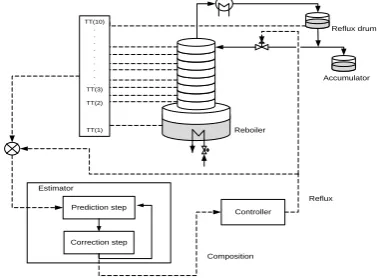
[image:2.595.303.542.48.604.2]II. Multicomponent batch reactive distillation In a conventional batch reactive distillation as show in Fig. 1, it has total ten trays, including the reboiler (1st tray) and condenser (10th tray). A reaction mixture is charged into a vessel and heat is added so that reaction takes place to form products and the vapours move up the column. The reaction occurs in liquid phase in reboiler, on all plates and in condenser. The chemical reaction and distillation proceed simultaneously and the product is collected from the condenser.
Estimator Prediction step
Correction step
TT(10) . . . . . . . . . TT(3) TT(2) TT(1)
Controller Reflux
Composition Condenser
Reflux drum
Accumulator
Reboiler
Fig.1. Inferential state estimation with controller for conventional reactive distillation column
A. Process description
A rigorous nonlinear model of batch reactive distillation column can represent realistic operation because it considers simultaneous effect of chemical reaction, heat and mass transfer operations, and fluid flow on the tray is needed. The derivation of model assumes that constant molar holdups on the plates, negligible vapour holdup, no chemical reactions in the vapour phase, the initial state of the column is the steady state total reflux condition with no reactions, constant operating pressure, perfect mixing and equilibrium on all plates, reaction occurred on the plates, and in the condenser and reboiler, fast energy dynamics, and total condensation with no subcooling [4]. To achieve the mathematical models, the material and energy can be balanced around the reboiler, the internal plate, and the reflux drum
--Reboiler (j=1) Total mass balance;
1
j
j j j j
dH
L V n H
dt = + − + ∆ (1) Component balance;
(
)
(
)
, 1
1, , , , , ,
j i j j
j i j i j i j i j i j i j
j j
dx L V
x x y x R x n
dt H H
+ +
= − − − + − ∆
(2) Energy balance;
(
) (
)
1 1
0=Lj+ hlj+ −hlj −Vj hvj−hlj −hlj(∆n Hj j)+Qr
(3) --Internal plate ( j=2:Np-1)
Total mass balance;
1 1
0=Lj+ −Lj+Vj− −Vj+ ∆n Hj j
(4) Component balance;
(
)
(
)
(
)
, 1 1
1, , 1, ,
, , , ,
...
j i j j
j i j i j i j i
j j
j
j i j i j i j i j
j
dx L V
x x y x
dt H H
V
y x R x n
H
+ −
+ −
= − + − +
− − + − ∆
(5) Energy balance;
(
)
(
)
1 1 1 1
0=Lj+ hlj+ −hlj +Vj− hvj− −hlj −V hj( vj−hlj)
(6) --Condenser and Distillate Accumulator
Condenser holdup tank: j =Np Total mass balance;
1
0=Vj− −Lc+ ∆n Hj j (7) Component balance;
(
)
, 1
1, , , ,
j i j
j i j i j i j i j
j
dx V
y x R x n
dt H
− −
= − + − ∆ (8)
Energy balance;
(
)
1 1
0=Vj− hvj− −hlj −hlj(∆n Hj j)−Qc (9) Distillate Accumulator
Total mass balance; a
d dH
L
dt = (10) Component balance;
(
)
,
, ,
a i d
Np i a i a
dx L
x x
dt =H − (11)
(
1)(
1)
d Np Np Np f
L = V − + ∆n H −r (12) where rf is the reflux ratio, and y is a vapour mol fraction that can calculated by the vapour-liquid equilibrium as;
, , , ,
s j i
j i j i
P
y x
P
= (13) where P is the column pressure
, and
Ps i j, , is the vapourpressure of component i in plate j. The vapour-liquid equilibrium relation can be used to compute bubble point temperature that
∑
Nci yj i, =1.
Moreover, the other variables such as hl, andhv can be calculated by using the relation of enthalpy respectively.(
, ,)
l
j j j
[image:2.595.68.257.317.456.2](
, ,)
v
j j j
h = f y T P (15) The esterification reaction of ethanol with acetic acid is an endothermic, reversible second order reaction, which the boiling temperatures are shown
3 (1) 2 2 (2) 3 (3) 2 (4)
CH COOH C H OH CH COOH H O
Acetic acid Ethanol Ethyl acetate Water
+ +
B.p.(K) 391.1 351.5 350.3 373.2
The rate of reaction can be given by
1 1 2 2 3 4
r r
R=k C C −k C C (16) where kr1 and kr2 is a forward and reverse reaction rate
constants, respectively, and C is concentration (gmol/l). In this system, ethyl acetate has the lowest temperature and the highest volatility in the mixture that can be removed by distillation. Moreover, withdrawal of ethyl acetate will shift the chemical equilibriumto the right hand side as the results that conversion of the reactants will be improved. The column specification and the vapour-liquid equilibrium and kinetic data [4] are given in Table 1- Table 2.
TABLEI
COLUMN SPECIFICATION FOR ETHANOL ESTERIFICATION PROCESS
No. of ideal stages (including reboiler and condenser) 10
Total fresh feed, B0 (kmol) 5.0
Feed composition (mole fraction, x) - Acetic Acid
- Ethanol - Ethyl acetate - Water
0.45 0.45 0.0 0.1
Column holdup (kmol) - Condenser (Hc)
- Internal plates(Hj)
0.1 0.0125
Column pressure (bar) 1.013
Reboiler heat duty Qr (MJ/h) 32
TABLEII
VAPOUR-LIQUID EQUILIBRIUM AND KINETIC DATA FOR ETHANOL ESTERIFICARTION REACTION
Vapour liquid equilibrium; log(Ps i,)=a Ti j+bi
Components a b
Ethanol (2) Ethyl acetate (3) Water (4)
-2.3×10³
-2.3×10³
-2.3×10³
6.588 6.742 6.484
Acetic acid (1) ; Ps,1=
(
2.25 10× −2)
T−7.812, T>347.6KPs,1=0.001, T≤347.6K
Reaction constants (litre/gmol min)
4
1 4.76 10
r
k = × − andkr2=1.63 10× −4
B. Optimal reflux policy
A dynamic optimization problem for a batch reactive distillation process is transformed into a nonlinear programming (NLP) problem by a sequential approach and uses the control vector parameterization (CVP) technique to ask this problem which is solved using a SQP-based optimization technique and process model is integrated by using Gear’s type method. Determining the optimal control profile follows to the objective function; maximum productivity subject to the process model Eq.(1) – Eq.(16)
and specified product purity is greater than 0.9. Reflux ratio is selected to be the decision variable into a finite set in which a piecewise constant function is utilized and reboiler heat duty give constant value along the operation time. It is assumed the operations are dived into 16 intervals to discretize the profile that are given in figure 2.
(a) 0 1 2 3 4 4.5 5 5.5 6 6.5 7 7.5 8 8.5 9 9.5 9.67 Reflux ratio 1 1 1 0.950 0.925 0.919 0.910 0.905 0.903 0.903 0.905 0.907 0.912 0.913 0.892 0.892
Switching time
(b)
0 1 2 3 4 5 6 7 8 9
0 0.1 0.2 0.3 0.4 0.5 0.6 0.7 0.8 0.9 1
Time (hrs)
A
c
c
um
ul
at
or
C
om
pos
it
ion
Acetic Acid Ethanol Ethyl Acetate Water
(b)
0 1 2 3 4 5 6 7 8 9
0 0.1 0.2 0.3 0.4 0.5 0.6 0.7 0.8 0.9 1
Time (hrs)
C
ondens
er
C
om
pos
it
ion
Acetic Acid Ethanol Ethyl Acetate Water
Fig.2. Optimal reflux ratio profiles with switching time (a), accumulator composition profiles (b), and distillate composition profiles (c) for 16 intervals
III. INFERENTIAL STATE ESTIMATION
In the control loop, the knowledge of current product composition (state) is required in order to compute the solution of an on-line optimal control problem. The current component cannot know direct by temperature data. Therefore, it is important to able to infer compositions from temperature measurement. The design of an inferential state estimation bases on simplified mathematical models that assumes constant liquid molar holdup on tray and in reflux drum, and constant vapour and liquid flow rates, is considered to design the estimator. The simplified equations are given by
2, 1, 1, 1, 1,
1, 1 1, 1 1
( ) ( ) ...
1 f i i i i
i
i i
j
r V x x V y x
dx
R H x n H
dt H
− − − +
=
− ∆
(17)
2 : 1
where j= Np−
1, , 1, , ,
, ,
( ) ( ) ...
1 f j i j i j i j i
j i
j i j j i j j j
r V x x V y y
dx
R H x n H
dt H
+ − + − − +
=
− ∆
1, , ,
, ,
( ) ...
1 Np i Np i
Np i
Np i Np Np i Np Np
Np
V y x
dx
R H x n H
dt H
− − +
=
− ∆
(19)
In this case, a state vector is x = [xB,2, x1,2, …, xD,2, xB,3,
x1,3,…,xD,3,xB,4,x1,4, …, xD,4]T in which only three
components are considered (ethanol, ethyl acetate and water). The mole fractions acetic acid can be obtained by subtracting the summation of the three components from one. The temperature measurement on plat j is given by
1 ,
, , 1
log si j
j i Nc i
j i si j i
P
T a b
x P
−
=
= −
∑
(20)
The compositions are directly estimated by the EKF with available temperature measurements; alternatively, the EKF is also used to provide the estimates of process parameters to handle unknown/uncertain parameters. To generate the mathematical models in the chemical processes, it is impossible to obtain the highly accurate mathematical models to describe the processes behaviour due to the limited of experimental data. As a result that, the practical implementation of model based controller design has to be concerned about parameter uncertainty. However, if there are many process parameters, the most sensitive parameter is regarded, firstly; the reaction rate constant (kr1). Here, state equation appended for parameter estimation is:
1 0
r dk
dt = (21) The initial condition for model to support the EKF estimator is used with a feed charge of 5 kmol, condenser holdup of 0.1 kmol, and tray holdup of 0.0125 kmol. Detailed regarding the EKF algorithm is given in Appendix. The diagonal elements of P0 and Q are selected as 1×10⁻⁴ for
inferential state estimation and 7×10⁴ for process parameter.
The diagonal elements of R are defined as 109.
IV. MODEL PREDICTIVE CONTROL (MPC) ALGORITHM The basic ideal of MPC controller is to determine a set of control moves for a time horizon minimizing an objective function subject to a dynamic process model with input/output constraints. At each control interval, an open-loop sequence of manipulated variables is computed in such a way to optimize the future behavior of the plant. Only initial value of the control profile is applied and then the optimization procedure, based on new information, is repeated to modify a new input profile with the control and prediction horizons moving forward one sampling time step.
The manipulated input profile u for M time steps can be determined by solving a minimization problem based on an objective function which is the sum of squares of the deviation of set point and predicted value on output and input over the prediction horizon (P) (P≥M ):
(
)
2( )
2, , 1 1 ( ),..., ( 1)
1
min
k P
sp i pred i i
u k u k M i k
y y W u W
+
+ − = =
− + ∆
∑
(22)Subject to
Mathematical models (Eqs.17-19)
,min 1
f f
r ≤r ≤
,max
f f
r r
∆ ≤ ∆
,3( ) ,3
d f d sp
x t+t =x
where W1 , and W2 is a weighting matrix on output, and
input, respectively. The control structure proposed in this work is shown in Fig.3 which consists of the dynamic optimization to carry out to compute the optimal product composition policy in reflux drum. And then, MPC controller with inferential state estimation is used to control the product composition to following the desired profile using a reflux ratio as a manipulated variable.
Batch reactive distillation process
Estimator Optimizer
Model Objective Function Equality Constraints Inequality Constraints
Decision Variables
State and parameter Input
Manipulated
Variable Measured
Variables MPC
Dynamic optimization
+
-Output(T xj,d)
( )Tj ( )rf
Fig.3. Block diagram of MPC with inferential state estimation for batch reactive distillation process
V. SIMULATION RESULTS
In simulation study, rigorous model equations are integrated using the Gear’s type method with a step size of 3 seconds. An approximation of differential equations used in an EKF estimator is achieved by the Euler integration method. Measurements of each tray temperature at every sampling time (6 s.) are corrupted with a zero mean random Gaussian noise having a standard deviation of 1 Kelvin. The set point profile (ethyl acetate composition in the reflux drum) can be calculated by an off-line dynamic optimization solving an optimization problem with an objective function: to minimize batch time and to maximize the weight of distillate product (61.74 kg in 9.67 hours) for a given specification product purity of greater than 0.9. The estimation performance of the EKF can be evaluated in terms of integral of the absolute error (IAE) between the estimated and actual compositions in the reflux drum and reboiler given in Table 3. The estimated compositions profiles in the reflux drum and reboiler are presented in Fig.4 (a) and Fig.4 (b), respectively. It can be seen that with measured temperatures, the EKF gives excellent estimation of compositions in the reflux drum and reboiler.
TABLEIII
Summary of IAE values for the inferential state estimation based on EKF estimator
IAE
d
x xb
Acetic acid 1.98 2
10−
× 9.01×10⁻²
Ethanol 5.66×10⁻² 9.00×10⁻²
Ethyl acetate 4.90×10⁻² 8.95×10⁻²
In the control methodology, after total reflux period, the MPC controller is introduced at every 2 minutes to control the product compositions tracking the desired profile by manipulating the reflux ratio. Tuning parameters (W1, W2, P
and M) of the MPC controller are 5, 0.01, 2, and 2, respectively. To compare the performance of the MPC, the PID is tuned to provide more or less identical control response in the nominal case with the tuning parameters of
c
K = 0.01 τI= 10, andτD= 0.2. Figure 5 shows the control responses of the MPC and PID controllers to track the desired profile in the nominal case. The product quantities under the controllers are summarized in Table 4. It has been observed that the amount of product under the MPC controller (60.32 kg) is greater than the amount of product under the PID controller (59.83 kg).
(a)
0 1 2 3 4 5 6 7 8 9
0 0.1 0.2 0.3 0.4 0.5 0.6 0.7 0.8 0.9 1
Time (hrs)
C
ondens
er
C
om
pos
it
ion
4 2
3
1
(b)
0 1 2 3 4 5 6 7 8 9
0 0.1 0.2 0.3 0.4 0.5 0.6 0.7 0.8 0.9 1
Time (hrs)
R
eboi
ler
C
om
pos
it
ion
1 2
3
4
Fig.4. Actual and estimated composition in distillate(a), reboiler(b) (actual (solid); estimated (dash); 1. acetic acid; 2.ethanol; 3.ethyl acetate; 4.water)
3 4 5 6 7 8 9
0.7 0.8 0.9 1
3 4 5 6 7 8 9
0.85 0.9 0.95 1
Time (hrs)
Int
er
nal
R
ef
lux
(
-)
Fig.5. Product composition profile in nominal case: set point (solid); inferential state control with PID (dash); MPC (dot)), and reflux profile: optimal reflux (solid); PID (dash); MPC (dot)
When plant/model mismatches and uncertainty in process parameters exist in actual plants, the robustness tests regarding plant/model mismatches and uncertainty must be carried out. Here, the proposed control strategy is tested in
the presence of plant/model mismatch in the forward reaction rate constant decreased 30 % from its real value. The control responses of the PID and MPC controllers are illustrated in Fig.6. Although the MPC and PID controllers can track the desired profile in the mismatch cases, the amounts of the product under the PID and MPC controllers decreases to -37.94 %, -36.64% respectively. As a result that the EKF needs to estimate the forward reaction rate constant that is employed in the MPC formulation. The control response of the MPC controller with the inferential states and parameter in the mismatch case of the rate constant is shown in Fig.7 (a) and the estimated parameter (kr1) is shown in Fig. 7 (b). The control performances of the
MPC controllers with the EKF for state estimation only, and state and parameter estimation are presented in table 4.
3 4 5 6 7 8 9
0.7 0.8 0.9 1
3 4 5 6 7 8 9
0.85 0.9 0.95 1
Time (hrs)
Int
er
nal
R
ef
lux
(
-)
Fig.6. Product composition profile in mismatch case of -30% kr1: set point (solid); inferential state control with PID (dash); MPC (dot)), and reflux profile: optimal reflux (solid); PID (dash); MPC (dot)
(a)
3 4 5 6 7 8 9
0.7 0.8 0.9 1
3 4 5 6 7 8 9
0.85 0.9 0.95 1
Time (hrs)
Int
er
nal
R
ef
lux
(
-)
(b)
0 1 2 3 4 5 6 7 8 9
3 4 5
x 10-4
Time (hrs)
K
r1
TABLE IV
PERFORMANCE OF CONTROLLERS AND PRODUCT QUANTITY AT FINAL TIME
Nominal case Parameter
mismatch case
IAE Product(kg) IAE Product(kg)
PID with inferential
states estimation 0.045 59.83 0.371 37.13 MPC with inferential
states estimation 0.021 60.32 0.333 38.22 MPC with inferential
states and parameter estimation
0.021 60.32 0.021 60.32
VI. CONCLUSIONS
In this study, the high product quality in batch reactive distillation improved by inferential state control with model predictive control has been proposed. The profile of ethyl acetate composition in the reflux drum determined by an off-line dynamic optimization is the set point of the controllers. The design of an inferential state estimator (EKF) based on simplified mathematical models can provide good estimates of compositions in the reflux drum and reboiler. The control performance of the MPC with the inferential state is better than that of PID. In the presence of unknown/uncertain parameters (forward reaction rate constant), the estimator is still able to provide accurate concentrations. As a result, the MPC with the inferential state is still robust and applicable in real plants.
APPENDIX
The basic algorithm of the EKF can be summarized as follows:
For the nonlinear system, the process model can be described by differential equations:
(
)
( ) ( ), ( ), ( )
x t = f x t u t t +w t (A.1)
(
)
( ) ( ) ( )
y t =h x t +v t (A.2) Where f is a vector of system function, h is a vector of
measurement function, and w(t) and v(t) are a zero mean
Gaussian process and measurement noise, with covariance
Q and R, respectively.
The calculation for the EKF has two steps. The first is a correction step, and the second is prediction step.
Correction step: The equations to obtain correctedestimates
are;
/ / 1 , / 1
ˆk k ˆk k est k( k (ˆk k ))
x =x − +K y −h x − (A.3)
1/ / 1 , / 1
k k k k est k k k k
P+ =P − −K H P − (A.4)
1 , / 1 ( / 1 )
T T
est k k k k k k k k
K =P −H H P −H +R− (A.5)
Prediction step: the estimates for the next step are predicted
based on the current estimates in which the discrete prediction equations are employed;
1/ /
ˆk k (ˆk k, k)
x + = f x u (A.6) The concerning covariance matrix can be rewritten as
1/ / T
k k k k k k
P+ =F P F +Q (A.7) where xˆk+1/kis the estimate of state x at t = k+1 from
information at t = k , Kestis Kalman gain matrix, P is
covariance matrix, and Jacobian matrices F and H are given;
/
,
ˆ , ,
( , ) |
k k k
j i
k x u
j i f x u F
x ∂ =
∂ , and ˆ/ 1
,
( ) |
k k
j
k x
j i h x H
x −
∂ =
∂
ACKNOWLEDGMENT
This work is supported by Thailand Research Fund through the Royal Golden Jubilee Ph.D. Program and Chulalongkorn University.
REFERENCES
[1] P. Dutia, “Product focus,” Chemical Weekly, vol. 10, pp. 179-186, 2004.
[2] P. E Cuille. and G. V. Reklaitis, “Dynamic simulation of multicomponent batch rectification with chemical reactions,” Computers chem. Engng, vol. 10, pp. 389-398, 1986.
[3] E.Reuter, G. Wozny, and L. Jeromin, “Modeling of multicomponent batch distillation processes with chemical reaction and their control systems,” Computers chem. Engng, vol.13, pp. 499-510, 1989. [4] I. M Mujtaba, and S. Macchietto, “Efficient optimization of batch
distillation with chemical reaction using polynomial curve fitting techniques,” Ind. Eng. Chem. Res., vol.36, pp. 2287-2295, 1997. [5] E. Sorensen, and S. Skogestad “Control strategies for reactive batch
distillation,” J. Process Control, vol.4, pp. 205-217, 1994.
[6] E. Sorensen, S. Macchietto, G. Stuart, and S. Skogestad, “Optimal control and on-line operation of reactive batch distillation,” Computers chem. Engng, vol.20, pp. 1491-1498, 1996.
[7] R.M. Wajge, and G.V. Reklaitis, “RBDOPT: a general-purpose object-oriented module for distributed campaign optimization of reactive batch distillation,” Chemical Engineering Journal, vol.75, pp. 57-68, 1999.
[8] P. Kaewpradit, P. Kittisupakorn, P. Thitiyasook, and I. M. Mujtaba, “Dynamic composition estimation for a ternary batch distillation,” Chemical Engineering Science, vol.63, pp. 3309-3318, 2008. [9] M. Kano, N. Showchaiya, S. Hasebe, and I.Hashimoto, “Inferential
control of distillation compositions: selection of model and control configuration,” Control Engineering Practice, vol.11, pp. 927–933, 2003.
[10] E.Quintero-Marmol, W.L. Luyben, and C.Georgakis, “Application of an extended Luenberger observer to the control of multicomponent batch distillation,” Ind. Eng. Chem. Res., vol.30, pp. 1870–1880, 1991.
[11] C. Venkateswarlu, and S. Avantika, “Optimal state estimation of multicomponent batch distillation,” Chemical Engineering Science, vol.56, pp. 5771-5786, 2001.
[12] C. Venkateswarlu, and B. Jeevan Kumar, “Composition estimation of multicomponent reactive batch distillation with optimal sensor configuration,” Chemical Engineering Science, vol.62, pp. 5560-5574, 2006
[13] P. Kaewpradit, P. Kittisupakorn, P. Thitiyasook, and I. M. Mujtaba, “Dynamic composition estimation for a ternary batch distillation,” Chemical Engineering Science, vol.63, pp. 3309-3318, 2008. [14] W. Weerachaipichasgul, P. Kittisupakorn, A. Saengchan, K.
Konakom, and I. M. Mujtaba, “Batch distillation control improvement by novel model predictive control,” Journal of Industrial and Engineering Chemistry, vol.16, pp. 305–313, 2010.
[15] A. Bahar,and C. Ozgen, “ State estimation and inferential control for a reactive batch distillation column,” Engineering Application of Artificial Intelligence, vol.23, pp. 262-270, 2010.
[16] K. Konakom, A. Saengchan, P. Kittisupakorn, and I. M. Mujtaba, “Neural network-based controller design of a batch reactive distillation column under uncertainty,” Asia-Pacific Journal of Chemical Engineering, 2011.