Comparative Study of Rigorous Analysis and
Superposition Principle for Floating Granular Piles
Group
Vaibhaw Garg1, Jitendra Kumar Sharma2
1Civil Engineering Deptt., Rajasthan Technical University, University Department, Kota-324010,India, 2Civil Engineering Deptt., Rajasthan Technical University, University Department, Kota-324010,India,
Abstract: In the modern time, where growth is the keyword in everyone’s life and the natural resources are exhausted continuously by the man kind including the land resource, the ground improvement is becoming the need of the hour, especially civil engineers, for areas consisting of soft soils. The most economical and feasible solution seems to be the use of granular piles (GP) in such cases, which are normally composed of boulders, sand etc. In the present paper a comparative analysis of a group of three and four partially stiffened GPs is presented revealing the comparison between rigorous and superposition methods for settlement interaction factor for floating group of piles.
Keywords: Relative stiffness of granular pile, Stiffening factor, Percentage length of stiffening, Settlement interaction factor.
Abbreviations
GP Granular pile
L Length of granular pile
n Total number of elements of GP
d Diameter of granular pile
L/d Relative length of GP
P Load on each granular pile of two pile group
Pb Load on the base of the GP
Es Deformation modulus of soil
Eb Deformation modulus of bearing stratum
νb Poisson’s Ratio of bearing stratum
νs Poisson’s Ratio of soil
Kgp =(Egp/Es) Relative stiffness of granular pile
pb Pile base pressure
s Spacing between center to center of the piles
s/d Normalized spacing center to center between piles
τ Shear stress
Ls Length of the pile stiffened from the top of the pile
η=Ls/L Percentage length of stiffening
χ Stiffening factor
ρ Normalized displacement of GP along its length
α 3F Settlement interaction factor for a group of three floating piles obtained by rigorous analysis
α 4F Settlement interaction factor for a group of three floating piles obtained by rigorous analysis
α 3FS Settlement interaction factor for a group of three floating piles obtained by superposition analysis
α 4FS Settlement interaction factor for a group of three floating piles obtained by superposition analysis
I. INTRODUCTION
In the present paper, the comparative analysis of a group of three and four partially stiffened floating granular pile, each axially loaded with a load, ‘P’, partially stiffened is carried out using elastic continuum approach. Stiffening means that the elastic properties of the material of GP are improved as the replacement of the conventional material of GP is done by a material having better engineering material, may be geo-textile,SCDMetc.
Major Assumptions Made During Analysis (i)Stress strain behavior is assumed to be linear. (ii)Soil is considered to be homogeneous, isotropic and linearly elastic. (iii)The base of stone column/granular pile is taken to be smooth across which the load is uniformly distributed. [1](iv)The present study has been done by assuming no slip or yield condition.
II. LITERATURE REVIEW
Since 1969 with pioneer study of [2]in the area of granular piles as ground improvement technique, number of researchers has worked in this area, giving new heights to this area. [3] studied two types of column i.e. plain and reinforced (encased) and propose an upper bound analysis of the settlement of the foundation system with stone column inclusions, considering the non-linear behavior of the surrounding soft clay. [4] conducted the finite element method (FEM) studies to study the effect of encasing stone columns with geo-synthetic material for improvement in the load carrying capacity of the stone columns. The stone columns and the soft soils were modeled using hyperbolic non-linear elastic models, while the geo-synthetic encasement around the stone column was modeled as a linear elastic material.Acceleration of consolidation rate by stone columns was analyzed by, [5] within the framework of a basic unit cell i.e., a cylindrical soil body around a column. [6] presented the, analytical solutions based on the unit-cell concept to predict deformation behaviors of geo-textile-encased stone columns at any depth below the top plane of the columns. [7] studied that for a given reinforcement condition, the percentage improvement in load-carrying capacity was found to be higher for un-drained conditions than for drained conditions. The variation in the magnitude of the percentage improvement in strength with area replacement ratio indicated that, for drained conditions, there could be an upper bound area replacement ratio beyond which the benefits of increasing the area ratio become economically unjustifiable. [8] investigates the effects of encasement stiffness and strength on the response of individual geo-textile encased granular columns embedded in soft soil through model tests. Similarity analysis was first executed to determine the suitable properties of the constituents used in the model tests to ensure that the prototype-scale and model-scale geo-textile encased granular columns exhibit comparable behavior.
III. PROBLEM DEFINITION AND METHOD OF ANALYSIS
Fig. 1 (a) and (b) show the system of three GPs at equal spacing in a group. Fig. 2 (a) and (b) shows the system of four granular piles at a spacing of, ‘s’ in a group. The analysis is similar to that of a three GP group except for the influence of one more GP at a distance of,2s. The soil displacements at the periphery of GP nodes are obtained for the influence of elemental shear stresses on own and all three adjacent GPs.
A. Soil Displacements
For three floating granular piles
s
E
s
IF
s
IF
s
IF
d
s
s
s
3
2
1
(1)Where [1IFs], [2IFs] and [3IFs] are soil displacement square matrices of size ‘(n+1)’ each due to influence of elemental shear stresses
of self and correspondingly adjacent two symmetric GPs in three pile group as shown in Fig.1(b). Due to symmetry of positions of granular piles, 2 and 3, [3IFs] = [2IFs] and thus soil displacement equations are
s
E
s
IF
s
IF
d
s
S
s
2
2
1
(2)where {Ss} and {s} are soil displacement and normalized soil displacement vectors of size’(n+1)’ respectively; {} is a column
vector of size, ‘(n+1)’, for GP-soil interface shear stresses including the base pressure; [[1IFs]+2x[2IFs]] is a combined square matrix
for soil displacement influence coefficients of size ‘(n+1)’, for a floating granular pile
s
E
s
IF
s
IF
s
IF
s
IF
d
s
s
s
4
3
2
1
(3)where [1IFs], [2IFs], [3IFs] and [4IFs] are soil displacement square matrices of size (n+1) each due to influence of elemental shear
stresses of own (first), second (at spacing s), third (at spacing s) and fourth GP (at spacing 2s) respectively as shown in Fig.2 (a) . All the other terms of equation are already defined in the analysis. Due to symmetry of positions of granular piles, 2 and 3, [3IFs] =
[2IFs] and thus soil displacement equations are
s
E
s
IF
s
IF
s
IF
d
s
S
s
4
2
2
1
(4)Fig.2(a) Plan of group of four symmetrically placed floating, partially stiffened GPs, 2(b) Sectional Elevation at X-X of a, group of four symmetrically placed floating partially stiffened floating GPs
B. Granular Pile Displacements
gp
E
v
v
(5)Where v is the axial strain of an element, v is the axial stresses on the element respectively. Egp is the deformation modulus of the
granular pile.
C. Vertical Gp Displacements
The vertical displacements of granular pile at different level are evaluated from displacement of the top of granular pile t in the
downward direction, by subtracting the displacement of first node from top displacement t. The settlement of the first element of
GP is-
d
z
t
d
p
S
p
2
1
v
1
1
(6)Where v1 is the axial strain of the first element of GP and z= (L/n) is element length.
S
p
1
andp
1
is the displacement and normalized displacements of the first node respectively.The vertical displacements of GP nodes in terms shaft shear stresses are
s
E
MD
t
p
1
(7)Where [MD] is a square matrix of size, (n+1) = [MB] [MA].
D. Compatibility Of Displacements Of Soil And Gp
For getting the solutions in terms of interface shear stresses and base pressure, apply the compatibility condition of displacements of the granular pile and the soil as described below. For three granular piles group (Equations (2) and (7))
or
1
t
s
E
AMC
p
s
(8)Where
AMC
IF
s
IF
s
MD
2
2
1
, of size (n+1) (n+1).For four granular piles group (Equations (3) and(7))
or
1
t
s
E
AMD
p
s
(9)Where
AMD
IF
s
IF
s
IF
s
MD
4
2
2
1
, of size (n+1) (n+1).For group of three granular pile partially stiffened, floating granular pile
α3F=
For group of four granular pile partially stiffened, floating granular pile
α4F=
Interaction factors for a three and four GP group are also obtained from the principle of superposition as
For a group of three GPs
F
FS
2
23
(10)For a group of four GPs
s)
2
spacing,
(for
s)
spacing,
(for
2
4
FS
2F
2F
(11)Where α2F is settlement interaction factor for group of two floating granular pile. The settlement interaction factors and top settlement influence factor are evaluated by rigorous method and superposition principle and compared with the variations of various parameters already listed.
IV. RESULTS AND DISCUSSION
Fig.3 Variation of settlement interaction factor α3F , α3FS, with relative stiffness of GP, KgpEffect of stiffening factor, χ, on a GP in a group of three partially stiffened floating pile GPs (s/d=3, L/d=10, η=30%) Rigorous and Superposition\
Fig.3 depicts the comparison between rigorous and superposition values of, α3F, α3FS, i.e. for a group of three GPs with the effect of
stiffening factor, χ, i.e. for, L/d=10, s/d=3, η=30% &Kgp=10 at χ=1, 2, 4 and 8, the value of, α3F, for rigorous analysis are, 0.44, 0.53, 0.61 and 0.67, while for superposition analysis the value of, α3FS, are 0.45, 0.54, 0.62 and 0.68, so there is a percentage difference of, 2.2, 1.8, 1.6 and 1.4 is observed while for Kgp=100 at χ=1, 2, 4 and 8, the valueof, α3F, for rigorous analysis are, 0.76,
0.4 0.5 0.6 0.7 0.8 0.9 1 1.1
10 100 1000
α
3F
K
gp
s/d=3, L/d=10,
η
=30%
χ=1, Rigrous
χ=2, Rigrous
χ=4, Rigrous
χ=8, Rigrous
χ=1, Superposition
χ=2, Superposition
χ=4, Superposition
χ=8, Superposition
0.82, 0.85 and 0.87, while for superposition analysis the value of, α3FS, are, 0.77, 0.83, 0.86and 0.88, so there is a percentage change of, 1.3, 1.2, 1.1 and 1.1, is observed. Hence more variation between rigorous and superposition values is at lower values of Kgp.
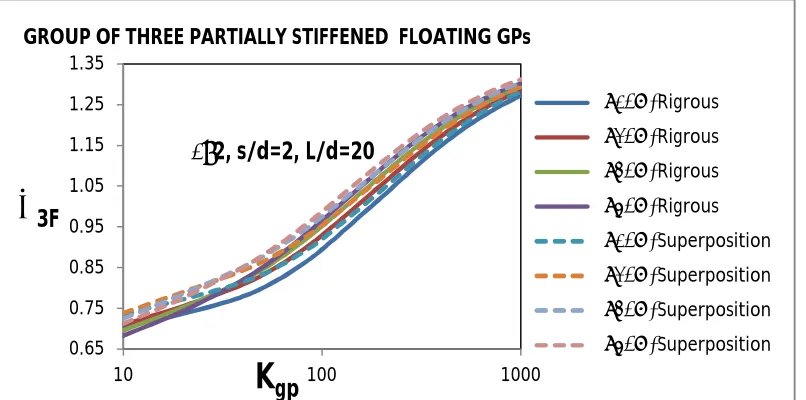
Fig. 4 Variation of settlement interaction factor, α3F, α3FS, with relative stiffness of GP, Kgp –Effect of % length of stiffening, η, on a GP in a group of three partially stiffened floating GPs (s/d=2, L/d=20, χ=2) Rigorous and Superposition
The Fig.4 reveals the comparison between rigorous and superposition values of, α3F, α3FS, i.e. for a group of three GPs with the effect of percentage length of stiffening, η, it can be seen that for, L/d=20, s/d=2, χ=2 & Kgp=10 at, η=10, 20, 30 and 40%, the value of, α3F, for rigorous analysis are, 0.706, 0.709, 0.696 and 0.683, while for superposition analysis the value of, α3FS, are, 0.735, 0.738, 0.724 and 0.712 so there is a percentage change of, 3.9, 3.9, 3.8 and 4.0, is observed while for, Kgp=100 at η=10, 20, 30 and 40%, the value of, α3F, for rigorous analysis are, 0.89, 0.92, 0.95 and 0.96, while for superposition analysis the value of, α3FS, are, 0.91, 0.95, 0.97 and 0.98, so there is a percentage change of, 2.1, 3.1, 2.0 and 2.0 occurs. Although it may be noted that variation is not significant. Fig.5 shows the comparison between rigorous and superposition values of, α4F, α4FS, i.e. for a group of four GPs with the
effect of stiffening factor, χ.It has been observed that for, L/d=10, s/d=3, η=30% & Kgp=10 at, χ=1, 2, 4 and 8, the value of, α4F , for
rigorous analysis are, 0.60, 0.73, 0.84 and 0.92, while for superposition analysis the value of, α4FS, are, 0.61, 0.74, 0.85 and 0.93, so there is a percentage change of, 1.6, 1.3, 1.1 and 1.0, is observed while for, Kgp=100 at, χ=1, 2, 4 and 8, the value of, α4F , for rigorous analysis the value are, 1.07, 1.15, 1.20 and 1.22, while for superposition analysis the value of, α4FS, are, 1.08, 1.16, 1.21 and 1.23, so there is a percentage increase of, 0.9, 0.8, 0.8 and 0.8, occurs.
Fig.5 Variation of settlement interaction factor,α4F , α4FS, with relative stiffness of GP, KgpEffect of stiffening factor, χ, on a GP in a group of four partially stiffened floating pile GPs (s/d=3, L/d=10, η=30%) Rigorous and Superposition
0.65 0.75 0.85 0.95 1.05 1.15 1.25 1.35
10 100 1000
α
3F
K
gp
χ=
2, s/d=2, L/d=20
η=10%, Rigrous
η=20%, Rigrous
η=30%, Rigrous
η=40%, Rigrous
η=10%, Superposition
η=20%, Superposition
η=30%, Superposition
η=40%, Superposition
GROUP OF THREE PARTIALLY STIFFENED FLOATING GPs
0.5 0.7 0.9 1.1 1.3
10 100 1000
α
4F
K
gp
L /d=10, s/d=3, η=30%
χ=1, Rigrous χ=2, Rigrous χ=4, Rigrous χ=8, Rigrous χ=1, Superposition χ=2, Superposition χ=4, Superposition χ=8, Superposition
[image:7.612.117.488.533.687.2]Fig.6 Variation of settlement interaction factor, α4F, α4FS, with relative stiffness of GP, Kgp –Effect of % length of stiffening, η, on a GP in a group of four partially stiffened floating GPs (s/d=2, L/d=20, χ=2) Rigorous and Superposition
Fig.6 is showing the comparison between rigorous and superposition values of, α4F, α4FS, i.e. for a group of four GPs with the effect
of percentage length of stiffening, η. It may be noted that for, L/d=20, s/d=2, χ=2 & Kgp=10 at, η=10, 20, 30 and 40%, the value of, α4F, for rigorous analysis are, 0.96, 0.97, 0.95 and 0.93, while for superposition analysis the value of, α4FS, are, 1.00, 1.01, 1.00 and 0.98, so there is a percentage increase of, 4, 3.9, 5 and 5.1, while for, Kgp=100 at η=10, 20, 30 and 40%, the value of, α4F, for rigorous analysis are, 1.26, 1.31, 1.34 and 1.36, while for superposition analysis the value of, α4FS, are, 1.30, 1.35, 1.38 and 1.40 thereby causing a percentage increase of, 3, 2.9, 2.8 and 2.8.
V. CONCLUSIONS
This analysis is based on elastic continuum approach, in which the Mindlin’s equations are used with introduction of stiffening parameters viz.stiffening factor, percentage length of stiffening. The analysis reveals that both rigorous and superposition analysis although are in close agreement but a slight variation occurs, which even decreases at higher values of relative stiffness of GP.
VI. ACKNOWLEDGEMENT
The author is privileged to express his sincere gratitude to, Prof. J.K. Sharma, (Civil Engineering Department, Rajasthan Technical University, Kota) for his contribution in present work. His high appreciation, positive attitude have played an important role in the outcome of this research work.
REFERENCES
[1] Madhav M.R., Sharma J.K. and Chandra S. (2006).Analysis and settlement of a non-homogeneous granular pile. Indian Geotechnical Journal, 2006; Vol. 36, No. 3, pp. 249-271
[2] Mattes, N. S., Poulos, H. G. Settlement of single compressible pile. Jl. of SM and F Div., ASCE, 1969; Vol. 95, SM1, pp. 189-207.
[3] Poorooshasb, H. B., Miura, N. and Noorzad, A. 1998. An upper bound analysis of the behavior of stone columns. Lecture presented at Saga University, Saga, Japan, pp. 7-37.
[4] Murugesan S, Rajagopal K (2006) Geo-synthetic-encased stone columns: numerical evaluation. Geo-text Geo-member Vol 24:pp-349–358
[5] Tan, S. A., Tjahyono, S. and Oo, K. K. 2008. Simplified plane-strain modeling of stone-column reinforced ground, Journal of Geotechnical and Geo-environmental Engineering, 134, (2), pp185–194.
[6] Zhang, L. and Zhao, M. 2015. Deformation analysis of geo-textile-encased stone columns, International Journal of Geo-mechanics, 15, (3)
[7] Najjar, S. S. and Skeini, H. 2015. Tri-axial response of clays reinforced with granular columns,Proceedings of the Institution of Civil Engineers – Ground Improvement, 168, (4), 265–281.
[8] Hong, Y.-S., Wu, C.-S. and Yu, Y.-S. 2016. Model tests on geo-textile-encased granular columns under 1-g and un-drained conditions, textiles and Geo-membranes, 44, (1),13–27.
[9] Mindlin R.D., (1936), Force at a point in the interior of a semi infinite solid, Physics, 7, pp 195-202.
[10] Mindlin R.D., (1937), Stress system in a circular disk under radial forces, presented at the Joint meeting of Applied Mechanics and Hydraulic division of the ASME held at Cornell University, N.Y. pp A115-118.
0.8 1 1.2 1.4 1.6 1.8
10 100 1000
α
4F
K
gp
χ=
2, s/d=2, L/d=20
η=10%, Rigrous
η=20%, Rigrous
η=30%, Rigrous
η=40%, Rigrous
η=10%, Superposition
η=20%, Superposition
η=30%, Superposition
η=40%, Superposition