CONTENTS
ORIGINAL PAPERS
Physiology and Reproduction
MARCIŇÁKOVÁ M., STROMPFOVÁ V., BOLDIŽÁROVÁ K., SIMONOVÁ M., LAUKOVÁ A., NAĎ P.: Effect
of potential probiotic Enterococcus faecium strains on selected microflora in turkeys ... 341 Genetics and Breeding
NEŠETŘILOVÁ H.: Multiphasic growth models for cattle ... 347 Nutrition and Feeding
ŠTERCOVÁ E., PAŽOUT V., STRAKOVÁ E., SUCHÝ P.: Effect of intensive fattening of bulls based
on a high-grain diet on growth intensity and biochemical and acid-base parameters of blood ... 355 KIRAZ S., ŞENGÜL T.: Relationship between abdominal fat and methionine deficiency in broilers ... 362 Animal Products
VORLOVÁ L., KARPÍŠKOVÁ R., CHABINIOKOVÁ I., KALÁBOVÁK., BRÁZDOVÁ Z.: The antimicrobial activity of honeys produced in the Czech Republic ... 369 ANTUNOVIC Z., BOGUT I., SENČIĆ D., KATIĆ M., MIJIĆ P.: Concentrations of selected toxic elements
(cadmium, lead, mercury and arsenic) in ewe milk in dependence on lactation stage ... 376
CZECH JOURNAL OF ANIMAL SCI ENCE
of the Czech Academy of Agricultural Sciences
Journals
C
ZECHJ
OURNAL OFA
NIMALS
CIENCEBreeding value for type traits in beef cattle in the Czech Republic
VESELÁZ., PŘIBYL J., ŠAFUS P., VOSTRÝ L., ŠEBA K., ŠTOLC L.
Effect of age upon digestibility of starch in chickens with different growth rate
ZELENKA J., ČEREŠŇÁKOVÁ Z.
Comparison of the apparent and true digestibility of nutrients determined in dairy cows either by the nylon capsule or in vivo method TŘINÁCTÝ J., RICHTERM., HOMOLKA P., RABIŠKOVÁ M., DOLEŽAL P.
Cathepsin involvement in meat-type bulls muscle proteolysis
ROSOCHACKI S.J., SAKOWSKI T., JUSZCZUK-KUBIAK E., BUTAREWICZ A., POŁOSZYNOWICZ J. Enterococci from rabbits – potential feed additive
341
Czech J. Anim. Sci., 50, 2005 (8): 341–346 Original Paper
Diarrhoeas caused by infectious agents are re-sponsible for large economic losses in animal pro-duction, including poultry farms. Antibiotics have traditionally been the most frequently administered drugs to control this type of infections. However, the current trend is to totally eliminate the prophy-lactic use of antibiotics in animal husbandry. The
use of several antibiotics has already been banned (Jin et al., 2000). Therefore, in an effort to prevent or reduce these disorders, alternatives are searched. Probiotics and bacteriocin-producing strains with probiotic properties have been suggested as alterna-tive possibilities for the reduction or prevention of gastroenteritis (Elmer et al., 1996; Filho-Lima et al.,
Effect of potential probiotic
Enterococcus faecium
strains on selected microflora in turkeys
M. MARCIŇÁKOVÁ
1, V. STROMPFOVÁ
1, K. BOLDIŽÁROVÁ
1, M. SIMONOVÁ
1,
A. LAUKOVÁ
1, P. NAĎ
21Institute of Animal Physiology of Slovak Academy of Sciences, Košice, Slovak Republic 2University of Veterinary Medicine, Institute of Experimental Veterinary Medicine, Košice,
Slovak Republic
ABSTRACT: A group of twenty-six turkeys at the age of seven weeks was divided into four groups (7 birds in three groups 5 in control). The first group of turkeys was used as the control group. The other three groups were inoculated for 7 days with the following bacteria: Enterococcus faecium EE3 strain (2.1 × 10⁹ cfu/ml), E.faecium
EK13 strain (1.76 × 10¹⁰ cfu/ml) and E. faecium EF55 strain (5 × 10⁸ cfu/ml). Sampling of faeces from each turkey
was done at the beginning of experiment (at day 0) and in 7 days from the strain application. The total counts of EE3 strain in faeces of turkeys in EE3 group at day 7 were 4.07 ± 1.04 log cfu/g. At the same day bacteriocin-producing strain EK13 reached the value 5.26 ± 0.2 log cfu/g and the counts of EF55 strain amounted to 4.13 ± 0.64 log cfu/g. When total counts of E. coli colonies were checked at day 7 after the application of EE3 and EF55 strains to turkeys, significant differences in cell counts were found out (in EE3 group a difference of 2.43 log,
P < 0.01; in EF55 group a difference of 1.93 log, P < 0.001) compared to the control and EE3 and EF55 groups. The highest reduction of Pseudomonas spp. was determined at day 7 after EE3 strain application (difference of 1.85;
P < 0.01) and after EF55 strain application (difference of 0.78 log, P < 0.05) in comparison with the control group. EK13 strain did not influence the counts of E. coli and Pseudomonas spp. in faeces of turkeys. The average daily gain increased in all probiotic groups compared to the control group (EE3 group – 12.2%, EK13 group – 12.9%, EF55 group – 11.8%). At the beginning of experiment the values of total proteins were below the physiological limit in all groups. Although the intake of probiotic strains was associated with an increase in total proteins, the values were not adjusted to the physiological level. The values of total lipids were above the physiological level at the beginning of experiment. Administration of only EE3 strain significantly decreased the level of total lipids (difference of 1.22; log P < 0.01). The values of haematocrit, haemoglobin and activity of the blood enzyme glu-tathione peroxidase were not influenced.
Keywords: Enterococcus faecium; probiotic; intestinal microflora; daily gain; biochemical and zootechnical parameters
2000). In vitro antagonistic effects of probiotics were already reported by several authors (Bomba et al., 1996; Jacobsen et al., 1999). Probiotic preparations are added to animal feeds with the intention to im-prove feed conversion, growth rate and prevention of diarrhoea (Fuller, 1999). Desired effects on weight gain and feed conversion in the range of 1 to 5% can be measured in many cases (Simon et al., 2001).
Enterococci belong to the group of lactic acid bacteria. Moreover, they are known as bacteriocin (antimicrobial) active bacteria (Franz et al., 1999). Although lactate exerts a bacteriostatic effect on bacteria, it is considered predominantly in lacto-bacilli as one of the probiotic effects in the control of pathogenic intestinal bacteria (Nousiainen and Setälä, 1993). Enterococci are mostly active by the effect of bacteriocin or both, lactic acid and bacte-riocin. That is why even less lactic acid producing strains of enterococci (e.g. Enterococcus faecium EK13), however bacteriocin-producing ones (EK13), can have an effective probiotic influence in the ani-mals. In addition, lactic acid bacteria are able to grow at lower pH values and thus dominate the proximal digestive tract of poultry (Kovalenko et al., 1989).
The objective of this study was to determine the effect of three Enterococcus faecium strains (orally administered) on the composition of intestinal mi-croflora and on biochemical parameters of turkey poults. Moreover, their influence on bird weight as well as haematocrit, haemoglobin and activity of the blood enzyme glutathione-peroxidase (GSH-Px) was investigated.
MATERIAL AND METHODS
Enterococcus faecium strains EE3, EK13 and EF55 (isolated in our laboratory from commercial feed, sewage and from the crop content of a chick) were selected according to criteria for potential probiot-ics. They produce lactic acid and possess sufficient adhesive capability to the mucus (for EE3 strain it is 7.3%–7.4%; for EK13 strain it is 6.3%–6.7%; for EF55 strain it is 4.2%–5.8%). Moreover, E. faecium EK13 produces an antimicrobial substance enterocin A (Mareková et al., 2003) and E. faecium EF55 pro-duces a bacteriocin-like substance EF55. Enterocin produced by EK13 strain are active against Gram-positive and Gram-negative bacteria, and the bacteri-ocin-like substance produced by EF55 strain inhibits the growth of Gram-positive bacteria (Mareková et al., 2003; Strompfová et al., 2003).
A group of twenty-six turkeys (BRANKO, Nitra, Slovak republic) at the age of seven weeks was di-vided into four groups: five birds in the control group and seven birds in the other groups. The experiment lasted for seven days. All birds received the commer-cial diet HYD 15 (TAJBA, Čaňa, Slovak republic) and had an ad libitum access to water. The experiment was designed for a 4-week duration. However, ac-cording to technological parameters it was necessary to terminate it already after one week.
The first group of turkeys was used as the control group. The other three groups were applied for sev-en days at the same hour in the morning rifampicin resistant mutants of the following bacteria: the first EE3 group received E. faecium EE3 strain (109 cfu
per ml), the second EK13 group was fed E. faecium EK13 strain (1010 cfu/ml) and the third EF55 group
received E. faecium EF55 strain (108 cfu per ml).
The doses of the strains (100 µl) were given per os. Rifampicin resistant mutants were obtained by sub-sequent cultivation of the strains using Todd-Hewitt agar (Becton and Dickinson, Cockeysville, USA) en-riched with rifampicin (100 µg/ml) at 37°C. Sampling of faeces was carried out by the technique of attach-ment of polyethylene bags according to Grešáková et al. (2003) from each turkey at the beginning of experiment, i.e. before the strain application (at day 0), and then after 7 days to monitor the effect of added strains on the microflora in the faeces of tur-keys. The samples of faeces were serially diluted in Ringer solution (pH 7; Oxoid, Basingstoke, England) according to the standard microbiological method and plated on the following media: Todd-Hewitt agar enriched with rifampicin for enumeration of rifampicin resistant mutants of EE3, EK13 and EF55 strains, M-Enterococcus agar (Becton and Dickinson, Cockeysville, USA) for enumeration of enterococci, De Man-Rogosa-Sharpe agar (Merck, Darmstadt, Germany) for lactic acid bacteria (LAB), MacConkey agar (Becton and Dickinson) for E. coli, Mannitol salt agar (Becton and Dickinson) for coagulase-negative staphylococci and Baird-Parker agar (Becton and Dickinson) for coagulase-positive staphylococci, Pseudocel agar (Becton and Dickinson) for pseu-domonads. Enterococci and E. coli were cultivated at 37°C for 24 h. LAB and staphylococci were cultivated at 30°C for 48 h and pseudomonads were cultivated at 25°C for 48 h. Numbers of colony forming units (cfu) were expressed in log 10 cfu/ml/g ± SD.
343
Czech J. Anim. Sci., 50, 2005 (8): 341–346 Original Paper
The blood samples were taken at the beginning of experiments as well as after 7 days and the values of total lipids and proteins (g/l ± SD) were deter-mined. The activity of blood glutathione-peroxi-dase (GSH-Px) as well as the values of haematocrit (%) and haemoglobin (g/100 ml) were determined by commercial standard kit RANSEL from Randox (The United Kingdom) according to Paglia and Valentine (1967) and activity of GSH-Px was ex-pressed in U/ml of blood.
Statistical analyses
Means and standard deviations were calculated using t-test. Statistical analysis of the GSH-Px ac-tivity was done by one-way analysis of variance (ANOVA) with the post hoc Tukey’s post-test.
RESULTS
The total counts of selected bacterial groups in the faeces of turkeys are summarized in Table 1. The intake of probiotic strains ofE. faecium was not associated with any clinical evidently adverse effect. After 7 days of application the count of EE3 strain in faeces of turkeys in EE3 group was 4.07 ± 1.04 log cfu/g. At the same time, enterocin A producing strain EK13 reached the value 5.26 ± 0.2 log cfu/g and finally EF55 strain amounted to 4.13 ± 0.64 log cfu/g (Table 1). The same counts of total enterococci (8.05 ± 0.02 log cfu/g) were esti-mated in control as well as in EK13 group after 7 days of its application. Although EE3 and EF55 strains colonized the gastrointestinal tract of turkeys suf-ficiently, the total counts of enterococci in those groups did not achieve the counts of enterococci in the control group. A similar situation was found out in lactic acid bacteria (LAB, Table 1). However, a slight decrease of staphylococci was detected after the application of EE3 and EF55 strains to turkeys (difference of 0.5 log in EE3 group, difference of 0.43 log in EF55 group). EK13 strain did not influ-ence the presinflu-ence of staphylococci in faeces of tur-keys in comparison with the control group. When total counts of E. coli and Pseudomonas spp. colonies were compared in control, EE3 and EF55 groups in 7 days from the application of both strains (EE3 and EF55 strains) to turkeys, significant differences in cell counts were found out (difference of 2.43 log for E. coli, P < 0.01; difference of 1.93 log forE. coli, Tabl
P < 0.001). The highest decrease ofPseudomonas spp. was determined at day 7 after EE3 strain ap-plication (difference of 1.85;P < 0.01) as well as after EF55 strain application (difference of 0.78 log,P < 0.05) in comparison with the control group. EK13 strain did not influence the counts of E. coli and Pseudomonas spp. in faeces of turkeys.
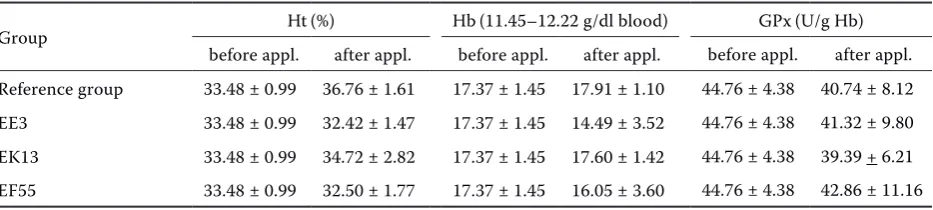
At the beginning of experiment the values of total proteins were below the physiological limit in all groups. Although the intake of probiotic strains was associated with an increase in total proteins, the values were not adjusted to the physiological level. The values of total lipids were above the physiologi-cal level at the start of experiment. The administra-tion of only EE3 strain significantly decreased the level of total lipids (difference of 1.22; log P < 0.01) compared with the control group. The values of total lipids were not influenced in the other groups (Table 2). The values of haematocrit, haemoglobin and of the blood enzyme glutathione peroxidase were not influenced either (Table 3).
The average daily gain of birds in EE3 group was 5.9 g while it was 4.8 g in the control group. The daily gain in EE3 group expressed as percentage
was 12.2%. In EK13 group, the average daily gain was 6.2 g. Comparing EK13 and control groups, a 12.9% difference in average daily gain was recorded (6.2 g and 4.8 g, respectively; expressed in %) in EK13 group. And finally, in EF55 group an 11.8% increase in daily gain of birds was found out com-pared to EF55 group, in which the average daily gain was 5.7 g, and to control group.
DISCUSSION
[image:6.595.64.532.102.207.2]Hatching, determination of sex and transport of animals are accompanied by bacterial colonization when enterobacteria and cocci are undoubtedly the first bacterial community in the turkey poult intestine. High numbers of facultative anaerobic bacteria were reported in chickens in the first week of life, which gradually decreased with the chicken age (Vahjen et al., 1998). Bacterial colonization means species and size diversity (Case, 1990) and thus massive doses of probiotics cells can repress potentially harmful bacteria (Vahjen et al., 2002). The probiotic strains used in this study colonized
Table 2. Selected blood biochemistry in turkeys before and after application of probiotic strains of E. faecium
Group TP(45.0–62.0 g/l) TL(5.0–7.0 g/l)
before appl. after appl. before appl. after appl.
Reference group 33.49 ± 4.89 37.04 ± 6.36 8.85 ± 0.7 8.89 + 0.77
EE3 33.49 ± 4.89 37.04 ± 3.51 8.85 ± 0.7 7.67 + 0.37**
EK13 33.49 ± 4.89 40.93 ± 4.62 8.85 ± 0.7 8.38 + 0.51
EF55 33.49 ± 4.89 43.69 ± 10.71 8.85 ± 0.7 8.72 + 1.23
TP – total proteins; TL – total lipids
before appl. – before application of strains probiotic (at day 0); after appl. – after application of strains probiotic (at day 7)
**P < 0.01
Table 3. Selected blood parameters in turkeys before and after application of probiotic strains of E. faecium
Group Ht(%) Hb(11.45–12.22 g/dl blood) GPx(U/g Hb)
before appl. after appl. before appl. after appl. before appl. after appl.
Reference group 33.48 ± 0.99 36.76 ± 1.61 17.37 ± 1.45 17.91 ± 1.10 44.76 ± 4.38 40.74 ± 8.12
EE3 33.48 ± 0.99 32.42 ± 1.47 17.37 ± 1.45 14.49 ± 3.52 44.76 ± 4.38 41.32 ± 9.80
EK13 33.48 ± 0.99 34.72 ± 2.82 17.37 ± 1.45 17.60 ± 1.42 44.76 ± 4.38 39.39 + 6.21
EF55 33.48 ± 0.99 32.50 ± 1.77 17.37 ± 1.45 16.05 ± 3.60 44.76 ± 4.38 42.86 ± 11.16
Ht – haematokrit; Hb – haemoglobin; GPx – glutathione peroxidase
[image:6.595.65.532.290.395.2]345
Czech J. Anim. Sci., 50, 2005 (8): 341–346 Original Paper
the gastrointestinal tract of turkeys sufficiently. Moreover, some inhibitory effects against spoilage bacteria (E. coli,Pseudomonas spp.) were observed after the application of EE3 and EF55 strains. The fact that the total counts of enterococci and LAB in EE3 and EF55 groups did not achieve their counts in the control and EK13 groups could probably be explained by competitive relations within the intes-tinal microflora of turkeys. Staphylococci were re-duced after the application of EE3 and EF55 strains. Strompfová et al. (2003) also reported the greatest cell count reduction of staphylococci (reduction of 22.9%) at the beginning of the administration of bac-teriocin-like substance produced by E.faecium EF55 in Japanese quails. Jin et al. (1996) reported that chickens fed a diet supplemented with commercial lactobacilli showed reduced numbers of coliforms in the intestine. Francis et al. (1978) found out a sig-nificant decrease of coliform bacteria in the intestine and caeca of turkeys after the feeding of probiotic Lactobacillus product. A reduction of pathogenic E. coli was also observed in the gastrointestinal tract of gnotobiotic chickens dosed with Lactobacillus acidophilus (Watkins et al., 1983). A bacteriocin-producing strain can successfully influence micro-bial community in the ecosystem by its bacteriocin; it seems that in our study E. faecium EK13 did not have any influence on the intestinal microflora of turkeys. Although EK13 strain reached 5.26 ± 0.2 log cfu/g in the digestive tract of turkeys at day 7 after its application, probably its growth was so fast that there was a misbalance between growth and bacteriocin production, i.e. bacteriocin production was insufficient. It seems that the beneficial effect of live E. faecium strains (EE3 and EF55) was not due only to the reduction of the intestinal population of pathogenic bacteria. On the other hand, E. faecium EK13 strain showed a favourable effect on the daily gain in turkeys. Beneficial effects of EE3 strain on daily gain in Japanese quails (7.6%; Marciňáková et al., 2004) as well as the influence of EK13 strain on daily gain in rabbits were recently reported by Lauková et al. (2004).
Although the intake of probiotic strains was asso-ciated with an increase in total proteins but with a decrease in total lipids, the values were not adjusted to the physiological level. Similar results were ob-tained after EE3 strain application to healthy dogs; a decrease in total lipids in the blood of dogs was found out (Marciňáková et al., 2005). On the other hand, Strompfová (2004) and Simonová (personal communication) reported an increase in blood
lipids in dogs and rabbits after the intake of pro-biotics Lactobacillus casei AD1 and L.rhamnosus GG strains. So, there are some controversial effects of probiotic bacteria on the lipid metabolism. The discrepancies in the results could be associated with the use of different species and strains (Strompfová, 2004; Marciňáková et al., 2005). The values of hae-matocrit, haemoglobin and activity of the blood en-zyme glutathione peroxidase were not influenced. Comparable results (GSH-Px not influenced) were obtained after the administration of EE3 strain under in vivo conditions using animal model – Japanese quails (Marciňáková et al., 2004).
The results indicate that the administration of E. faecium EE3 and EF55 strains reduced the lev-els of spoilage microorganisms such as E. coli and pseudomonads in the digestive tract of turkeys. The feeding of EK13 strain increased the body weight of turkeys. This strain also showed sufficient colo-nization in the digestive tract of turkeys. However, its antimicrobial effect was not shown here.
Although the efficacy of different probiotics was already discussed in literature (Ouwehand et al., 2002), under our conditions two mechanisms of the potential influence of probiotics could be speculated; probably they affect by competition to adhere the mostly part of intestinal tissue (EE3, EK13) and/or to produce an inhibitory substance (EK13, EF55).
All strains could be used as potential probiotics; EK13 and EE3 strains improved zootechnical pa-rameters. Moreover, EE3 and EF55 strains showed antimicrobial effects. Of course, a longer period of experiments is requested.
Acknowledgements
The authors thank Mrs Margita Bodnárová for her technical assistance.
REFERENCES
Bomba A., Nemcová R., Kastel R., Herich R., Pataky J., Cizek M. (1996): Interactions of Lactobacillus spp. and enteropathogenic Escherichia coli under in vitro and
in vivo conditions. Vet. Med. – Czech, 41, 155–158.
Case T.J. (1990): Invasion resistance arises in strongly interacting species-rich model competition communi-ties. Proc. Natl. Acad. Sci., 87, 9610–9614.
treat-Corresponding Author
MVDr. Miroslava Marciňáková, Institute of Animal Physiology Slovak Academy of Sciences, Šoltésovej 4–6, 04001 Košice, Slovak Republic
Tel. +421 556 336 251, fax +421 557 287 842, e-mail: [email protected]
ment and prevention of selected intestinal and vaginal infections. J. Am. Med. Assoc., 275, 870–876.
Filho-Lima J.V.M., Vieira E.C., Nicoli J.R. (2000): An-tagonistic effect ofLactobacillus acidophilus,
Saccha-romyces boulardii and Escherichia coli combinations
against experimental infections with Shigella flexneri
and Salmonella enteritidis subsp. typhimurium in
gnotobiotic mice. J. Appl. Microbiol., 88, 365–370. Francis C., Janky D.M., Arafa A.S., Harms R.H. (1978):
Interrelationship of Lactobacillus and zinc bacitracin in diets of turkey poults. Poult. Sci., 57, 1687–1689. Franz C.M.A., Holzapfel W.H., Stiles M.E. (1999):
Ente-rococci at the crossroads of food safety. Int. J. Food Microbiol., 47, 1–24.
Fuller R. (1999): Probiotics for farm animals. In: Tannock G.W. (ed.): Probiotics: A General Review. Horizon Sci-entific Press, Wymondham, U.K. 17.
Grešáková Ľ., Boldižárová K., Kuricová S., Levkut M., Leng Ľ. (2003): Device for quantitative collection of chicken excrements in balance studies. J. Anim. Fedd Sci., 12, 351–358.
Jacobsen C.N., Rosenfeldt-Nielsen V., Hayford A.E., Moller P.L., Michaelsen K.F., Paerregaard A., Sand-strom B., Tvede M., Kakobsen M. (1999): Screening of probiotic activities of forty-seven strains of
Lactobacil-lus spp. in vitro techniques and evaluation of the
colo-nization ability of five selected strains in humans. Appl. Environ. Microbiol., 65, 4949–4956.
Jin L.Z., Ho Y.W., Abdullah N., Jalaludin S. (1996): Influ-ence of dried Bacillus subtilis and Lactobacilli cultures on intestinal microflora and performance in broilers. Asian-Australasian J. Anim. Sci., 9, 397–404.
Jin L.Z., Marquardt R.R., Zhao X. (2000): A strain of
Ente-rococcus faecium (18C23) inhibits adhesion of
entero-toxigenic Escherichia coli K88 to porcine small intestine mucus. Appl. Environ. Microbiol., 66, 4200–4204. Kovalenko N.K., Golovach T.N., Kvasnikov E.I. (1989):
Lactic bacteria in the digestive tract of poultry. Mikro-biologiia, 58, 137–143.
Lauková A., Guba P., Nemcová R., Strompfová V., Ma-rounek M., Skřivanová V., Volek Z., Jindřichová E., Herich R. (2004): Kmeň Enterococcus faecium EK13 a jeho účinok v tráviacom trakte zvierat. In: XXI. Dni živočíšnej fyziológie, Košice, Slovak Republic, 8.
Mareková M., Lauková A., De Vuyst L., Skaugen M., Nes I.F. (2003): Partial characterization of bacteriocins pro-duced by environmental strain Enterococcusfaecium
EK13. J. Appl. Microbiol., 94, 523–530.
Marciňáková M., Strompfová V., Boldižárová K., Lauková A., Gancarčíková S. (2004): Effect of potential probiotic activity of Enterococccus faecium EE3 strain against
Salmonella infection in Japanese quails. Bull. Vet. Inst.
Pulawy, 48, 387–390.
Marciňáková M., Simonová M., Strompfová V., Lauková A. (2005): Application of Enterococcus faecium EE3 in healthy dogs. Vet. Res. Com., In press.
Nousianen J., Setälä J. (1993): Lactic acid bacteria as animal probiotics. In: Salminen S., von Wright A. (eds.): Lactic Acid Bacteria. Marcel Dekker, Inc., New York. 315–356. Ouwehand A.C., Salminen S., Isolauri E.(2002):
Probiot-ics: an overview of beneficial effects. Antonie van Lee-wenhoek, 82, 279–289.
Paglia D.E., Valentine W.N. (1967): Studies on the quantita-tive and qualitaquantita-tive characterization of erythrocyte glu-tathione peroxidase. J. Lab. Clin. Med., 70, 158–169. Simon O., Jadamus A., Vahjen W. (2001): Probiotic feed
additives – effectiveness and expected modes of action. J. Anim. Feed Sci., 10, 51–67.
Strompfová V. (2004): Produkcia bakteriocínov a probi-otické vlastnosti mikroorganizmov v tráviacom trakte živočíchov a ich fyziologický význam. [PhD Thesis.] 62–63.
Strompfová V., Lauková A., Mudroňová D. (2003): Effect of bacteriocin – like substance produced by
Enterococ-cus faecium EF55 on the composition of avian
gastroin-testinal microflora. Acta Vet.,72, 559–564.
Vahjen W., Gläser K., Schäfer K., Simon O. (1998): Influence of xylanase-supplemented feed on the development of selected bacterial groups in the intestinal tract of broiler chicks. J. Agric. Sci. Cambridge, 130, 489–500.
Vahjen W., Jadamus A., Simon O. (2002): Influence of a probiotic Enterococcus faecium strain on selected bacterial groups in the small intestine of growing tur-key poults. Arch. Anim. Nutr., 56, 419–429.
Watkins B.A., Kratzer F.H. (1983): Effect of oral dosing
of Lactobacillus strains on gut colonization and liver
biotin in broiler chicks. Poult. Sci., 62, 2088–2094.