An Exact A* Method for Deciphering Letter-Substitution Ciphers
Eric Corlett and Gerald Penn Department of Computer Science
University of Toronto
{ecorlett,gpenn}@cs.toronto.edu
Abstract
Letter-substitution ciphers encode a docu-ment from a known or hypothesized lan-guage into an unknown writing system or an unknown encoding of a known writing system. It is a problem that can occur in a number of practical applications, such as in the problem of determining the encod-ings of electronic documents in which the language is known, but the encoding stan-dard is not. It has also been used in rela-tion to OCR applicarela-tions. In this paper, we introduce an exact method for decipher-ing messages usdecipher-ing a generalization of the Viterbi algorithm. We test this model on a set of ciphers developed from various web sites, and find that our algorithm has the potential to be a viable, practical method for efficiently solving decipherment prob-lems.
1 Introduction
Letter-substitution ciphers encode a document from a known language into an unknown writ-ing system or an unknown encodwrit-ing of a known writing system. This problem has practical sig-nificance in a number of areas, such as in reading electronic documents that may use one of many different standards to encode text. While this is not a problem in languages like English and Chinese, which have a small set of well known standard en-codings such as ASCII, Big5 and Unicode, there are other languages such as Hindi in which there is no dominant encoding standard for the writing system. In these languages, we would like to be able to automatically retrieve and display the in-formation in electronic documents which use un-known encodings when we find them. We also want to use these documents for information re-trieval and data mining, in which case it is impor-tant to be able to read through them automatically,
without resorting to a human annotator. The holy grail in this area would be an application to ar-chaeological decipherment, in which the underly-ing language’s identity is only hypothesized, and must be tested. The purpose of this paper, then, is to simplify the problem of reading documents in unknown encodings by presenting a new rithm to be used in their decipherment. Our algo-rithm operates by running a search over the n-gram probabilities of possible solutions to the cipher, us-ing a generalization of the Viterbi algorithm that is wrapped in an A* search, which determines at each step which partial solutions to expand. It is guaranteed to converge on the language-model-optimal solution, and does not require restarts or risk falling into local optima. We specifically con-sider the problem of finding decodings of elec-tronic documents drawn from the internet, and we test our algorithm on ciphers drawn from ran-domly selected pages of Wikipedia. Our testing indicates that our algorithm will be effective in this domain.
It may seem at first that automatically decoding (as opposed to deciphering) a document is a sim-ple matter, but studies have shown that simsim-ple al-gorithms such as letter frequency counting do not always produce optimal solutions (Bauer, 2007). If the text from which a language model is trained is of a different genre than the plaintext of a cipher, the unigraph letter frequencies may differ substan-tially from those of the language model, and so frequency counting will be misleading. Because of the perceived simplicity of the problem, how-ever, little work was performed to understand its computational properties until Peleg and Rosen-feld (1979), who developed a method that repeat-edly swaps letters in a cipher to find a maximum probability solution. Since then, several different approaches to this problem have been suggested, some of which use word counts in the language to arrive at a solution (Hart, 1994), and some of
which treat the problem as an expectation max-imization problem (Knight et al., 2006; Knight, 1999). These later algorithms are, however, highly dependent on their initial states, and require a number of restarts in order to find the globally op-timal solution. A further contribution was made by (Ravi and Knight, 2008), which, though published earlier, was inspired in part by the method pre-sented here, first discovered in 2007. Unlike the present method, however, Ravi and Knight (2008) treat the decipherment of letter-substitution ci-phers as an integer programming problem. Clever though this constraint-based encoding is, their pa-per does not quantify the massive running times required to decode even very short documents with this sort of approach. Such inefficiency indi-cates that integer programming may simply be the wrong tool for the job, possibly because language model probabilities computed from empirical data are not smoothly distributed enough over the space in which a cutting-plane method would attempt to compute a linear relaxation of this problem. In any case, an exact method is available with a much more efficient A* search that is linear-time in the length of the cipher (though still horribly exponen-tial in the size of the cipher and plain text alpha-bets), and has the additional advantage of being massively parallelizable. (Ravi and Knight, 2008) also seem to believe that short cipher texts are somehow inherently more difficult to solve than long cipher texts. This difference in difficulty, while real, is not inherent, but rather an artefact of the character-level n-gram language models that they (and we) use, in which preponderant evidence of differences in short character sequences is nec-essary for the model to clearly favour one letter-substitution mapping over another. Uniform char-acter models equivocate regardless of the length of the cipher, and sharp character models with many zeroes can quickly converge even on short ciphers of only a few characters. In the present method, the role of the language model can be acutely per-ceived; both the time complexity of the algorithm and the accuracy of the results depend crucially on this characteristic of the language model. In fact, we must use add-one smoothing to decipher texts of even modest lengths because even one unseen plain-text letter sequence is enough to knock out the correct solution. It is likely that the method of (Ravi and Knight, 2008) is sensitive to this as well, but their experiments were apparently fixed
on a single, well-trained model.
Applications of decipherment are also explored by (Nagy et al., 1987), who uses it in the con-text of optical character recognition (OCR). The problem we consider here is cosmetically related to the “L2P” (letter-to-phoneme) mapping prob-lem of text-to-speech synthesis, which also fea-tures a prominent constraint-based approach (van den Bosch and Canisius, 2006), but the constraints in L2P are very different: two different instances of the same written letter may legitimately map to two different phonemes. This is not the case in letter-substitution maps.
2 Terminology
Substitution ciphers are ciphers that are defined by some permutation of a plaintext alphabet. Ev-ery character of a plaintext string is consistently mapped to a single character of an output string using this permutation. For example, if we took the string”hello world”to be the plaintext, then the string ”if mmp xpsme” would be a cipher that maps e to f, l to m, and so on. It is easy to extend this kind of cipher so that the plaintext alphabet is different from the ciphertext alphabet, but still stands in a one to one correspondence to it. Given a ciphertext C, we say that the set of characters used inCis the ciphertext alphabetΣC,
and that its size isnC. Similarly, the entire
possi-ble plaintext alphabet isΣP, and its size is isnP.
Since nC is the number of letters actually used
in the cipher, rather than the entire alphabet it is sampled from, we may find that nC < nP even
when the two alphabets are the same. We refer to the length of the cipher string C asclen. In the
above example,ΣP is{ , a, . . . z}andnP = 27,
whileΣC ={ , e, f, i, m, p, s, x},clen = 11and
nC = 8.
Given the ciphertext C, we say that a partial solutionof sizekis a mapσ = {p1 :c1, . . . pk :
ck},wherec1, . . . , ck ∈ ΣC and are distinct, and
p1, . . . , pk ∈ ΣP and are distinct, and wherek ≤
nC. If for a partial solutionσ0, we have thatσ ⊂
σ0, then we say thatσ0extendsσ. If the size ofσ0is
k+1andσis sizek, we say thatσ0is animmediate extensionofσ. Afull solutionis a partial solution of sizenC. In the above example,σ1 ={ : , d: e}would be a partial solution of size2, andσ2 = { : , d : e, g : m} would be a partial solution of size3 that immediately extends σ1. A partial
p, r : s, w : x}would be both a full solution and the correct one. The full solution σT extendsσ1
but notσ2.
Every possible full solution to a cipher C will produce a plaintext string with some associated language model probability, and we will consider the best possible solution to be the one that gives the highest probability. For the sake of concrete-ness, we will assume here that the language model is a character-level trigram model. This plain-text can be found by treating all of the lengthclen
stringsS as being the output of different charac-ter mappings fromC. A stringSthat results from such a mapping is consistent with a partial solu-tionσiff, for everypi:ci∈σ, the character
posi-tions ofCthat map topiare exactly the character
positions withci inC.
In our above example, we had C =
”if mmp xpsme”, in which case we had
clen = 11. So mappings from C to
”hhhhh hhhhh”or” hhhhhhhhhh” would be consistent with a partial solution of size 0, while”hhhhh hhhhn”would be consistent with the size2partial solutionσ={ : , n:e}.
3 The Algorithm
In order to efficiently search for the most likely so-lution for a ciphertext C, we conduct a search of the partial solutions using their trigram probabil-ities as a heuristic, where the trigram probability of a partial solutionσof lengthkis the maximum trigram probability over all strings consistent with it, meaning, in particular, that ciphertext letters not in its range can be mapped to any plaintext letter, and do not even need to be consistently mapped to the same plaintext letter in every instance. Given a partial solutionσ of lengthn, we can extendσ
by choosing a ciphertext letter cnot in the range ofσ, and then use our generalization of the Viterbi algorithm to find, for eachpnot in the domain of
σ, a score to rank the choice ofpforc, namely the trigram probability of the extensionσpofσ. If we
start with an empty solution and iteratively choose the most likely remaining partial solution in this way, storing the extensions obtained in a priority heap as we go, we will eventually reach a solution of sizenC. Every extension ofσ has a
probabil-ity that is, at best, equal to that of σ, and every partial solution receives, at worst, a score equal to its best extension, because the score is poten-tially based on an inconsistent mapping that does
not qualify as an extension. These two observa-tions taken together mean that one minus the score assigned by our method constitutes a cost function over which this score is an admissible heuristic in the A* sense. Thus the first solution of size nC
will be the best solution of sizenC.
The order by which we add the letterscto par-tial solutions is the order of the distinct cipher-text letters in right-to-left order of their final oc-currence inC. Other orderings for thec, such as most frequent first, are also possible though less elegant.1
Algorithm 1Search Algorithm
Order the lettersc1. . . cnC by rightmost
occur-rence inC,rnC < . . . < r1.
Create a priority queueQfor partial solutions, ordered by highest probability.
Push the empty solution σ0 = {} onto the
queue.
whileQis not emptydo
Pop the best partial solutionσfromQ.
s=|σ|.
ifs=nC then
returnσ
else
For all p not in the range of σ, push the immediate extension σp onto Q with the
score assigned to table cell G(rs+1, p, p)
by GVit(σ, cs+1, rs+1)if it is non-zero.
end if end while
Return ”Solution Infeasible”.
Our generalization of the Viterbi algorithm, de-picted in Figure 1, uses dynamic programming to score every immediate extension of a given partial solution in tandem, by finding, in a manner con-sistent with the real Viterbi algorithm, the most probable input string given a set of output sym-bols, which in this case is the cipherC. Unlike the real Viterbi algorithm, we must also observe the constraints of the input partial solution’s mapping.
1
A typical decipherment involves multiple runs of this algorithm, each of which scores all of the im-mediate extensions, both tightening and lowering their scores relative to the score of the input par-tial solution. A call GVit(σ, c, r)manages this by filling in a tableGsuch that for all1≤i≤r, and
l, k ∈ ΣP, G(i, l, k) is the maximum probability
over every plaintext stringSfor which:
• len(S) =i,
• S[i] =l,
• for everypin the domain ofσ, every1≤j ≤ i, ifC[j] =σ(p)thenS[j] =p, and
• for every position1 ≤ j ≤ i, if C[j] = c, thenS[j] =k.
The real Viterbi algorithm lacks these final two constraints, and would only store a single cell at
G(i, l). There,Gis called a trellis. Ours is larger, so so we will refer toGas agreenhouse.
The table is completed by filling in the columns from i = 1 toclen in order. In every column i,
we will iterate over the values of l and over the values of ksuch that k : candl :are consistent withσ. Because we are using a trigram character model, the cells in the first and second columns must be primed with unigram and bigram proba-bilities. The remaining probabilities are calculated by searching through the cells from the previous two columns, using the entry at the earlier column to indicate the probability of the best string up to that point, and searching through the trigram prob-abilities over two additional letters. Backpointers are necessary to reference one of the two language model probabilities. Cells that would produce in-consistencies are left at zero, and these as well as cells that the language model assigns zero to can only produce zero entries in later columns.
In order to decrease the search space, we add the further restriction that the solutions of every three character sequence must be consistent: if the ci-phertext indicates that two adjacent letters are the same, then only the plaintext strings that map the same letter to each will be considered. The num-ber of letters that are forced to be consistent is three because consistency is enforced by remov-ing inconsistent strremov-ings from consideration durremov-ing trigram model evaluation.
Because every partial solution is only obtained by extending a solution of size one less, and ex-tensions are only made in a predetermined order
of cipher alphabet letters, every partial solution is only considered / extended once.
GVit is highly parallelizable. ThenP×nP cells
of every columnido not depend on each other — only on the cells of the previous two columnsi−1 andi−2, as well as the language model. In our im-plementation of the algorithm, we have written the underlying program in C/C++, and we have used the CUDA library developed for NVIDIA graphics cards to in order to implement the parallel sections of the code.
4 Experiment
Greenhouse Array
(a) (b) (c) (d)
.. .
l m n .. .
z
l w · · · y t g · · · g u
[image:5.595.87.441.84.289.2]· · · e f g · · · z
Figure 1: Filling the Greenhouse Table. Each cell in the greenhouse is indexed by a plaintext letter and a character from the cipher. Each cell consists of a smaller array. The cells in the array give the best probabilities of any path passing through the greenhouse cell, given that the index character of the array maps to the character in columnc, wherecis the next ciphertext character to be fixed in the solution. The probability is set to zero if no path can pass through the cell. This is the case, for example, in (b) and (c), where the knowledge that ” ” maps to ” ” would tell us that the cells indicated in gray are unreachable. The cell at (d) is filled using the trigram probabilities and the probability of the path at starting at (a).
In all of the data considered, the frequency of spaces was far higher than that of any other char-acter, and so in any real application the character corresponding to the space can likely be guessed without difficulty. The ciphers we have consid-ered have therefore been simplified by allowing the knowledge of which character corresponds to the space. It appears that Ravi and Knight (2008) did this as well. Our algorithm will still work with-out this assumption, but would take longer. In the event that a trigram or bigram would be found in the plaintext that was not counted in the language model, add one smoothing was used.
Our character-level language model used was developed from the first 1.5 million characters of the Wall Street Journal section of the Penn Tree-bank corpus. The characters used in the lan-guage model were the upper and lower case let-ters, spaces, and full stops; other characters were skipped when counting the frequencies. Further-more, the number of sequential spaces allowed was limited to one in order to maximize context and to eliminate any long stretches of white space. As discussed in the previous paragraph, the space character is assumed to be known.
When testing our algorithm, we judged the time complexity of our algorithm by measuring the ac-tual time taken by the algorithm to complete its runs, as well as the number of partial solutions placed onto the queue (“enqueued”), the number popped off the queue (“expanded”), and the num-ber of zero-probability partial solutions not en-queued (“zeros”) during these runs. These latter numbers give us insight into the quality of trigram probabilities as a heuristic for the A* search.
We judged the quality of the decoding by mea-suring the percentage of characters in the cipher alphabet that were correctly guessed, and also the word error rate of the plaintext generated by our solution. The second metric is useful because a low probability character in the ciphertext may be guessed wrong without changing as much of the actual plaintext. Counting the actual number of word errors is meant as an estimate of how useful or readable the plaintext will be. We did not count the accuracy or word error rate for unfinished ci-phers.
Algorithm 2Generalized Viterbi Algorithm GVit(σ, c, r)
Input: partial solutionσ, ciphertext characterc, and indexrintoC.
Output: greenhouseG. InitializeGto 0. i = 1
for All (l, k) such thatσ ∪ {k : c, l : Ci} is
consistentdo
G(i, l, k) =P(l).
end for
i = 2
for All (l, k) such thatσ ∪ {k : c, l : Ci} is
consistentdo
forjsuch thatσ∪ {k:c, l:Ci, j :Ci−1}is
consistentdo
G(i, l, k) = max(G(i, l, k), G(0, j, k)× P(l|j))
end for end for
i = 3
for(l, k)such thatσ∪ {k:c, l:Ci}is
consis-tentdo
forj1, j2such thatσ∪{k:c, j2 :C[i−2], j1 : C[i−1], l:Ci}is consistentdo
G(i, l, k) = max(G(i, l, k), G(i−2, j2, k) ×P(j1|j2)×P(l|j2j1)).
end for end for
fori= 4tordo
for(l, k)such thatσ∪ {k:c, l:Ci}is
con-sistentdo
for j1, j2 such that σ ∪ {k : c, j2 : C[i−2], j1 : C[i−1], l : Ci} is consistent
do
G(i, l, k) = max(G(i, l, k),
G(i−2, j2, k)×P(j1|j2j2(back)) ×P(l|j2j1)).
end for end for end for
on texts and (case-sensitive) alphabets of this size with the computing hardware at our disposal.
5 Results
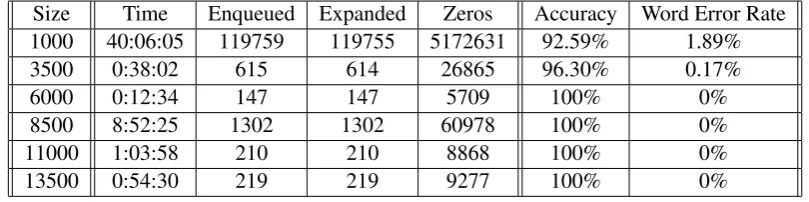
In our first set of tests, we measured the time con-sumption and accuracy of our algorithm over 10 ciphers taken from random texts that were 6000 characters long. The time values in these tables are given in the format of (H)H:MM:SS. For this set of tests, in the event that a test took more than 12 hours, we terminated it and listed it as unfinished. This cutoff was set in advance of the runs based upon our armchair speculation about how long one might at most be reasonably expected to wait for a web-page to be transliterated (an overnight run). The results from this run appear in Table 1. All running times reported in this section were ob-tained on a computer running Ubuntu Linux 8.04 with 4 GB of RAM and8×2.5GHz CPU cores. Column-level subcomputations in the greenhouse were dispatched to an NVIDIA Quadro FX 1700 GPU card that is attached through a 16-lane PCI Express adapter. The card has 512 MB of cache memory, a 460 MHz core processor and 32 shader processors operating in parallel at 920 MHz each. In our second set of tests, we measured the time consumption and accuracy of our algorithm over several prefixes of different lengths of a single 13500-character ciphertext. The results of this run are given in Table 2.
Cipher Time Enqueued Expanded Zeros Accuracy Word Error Rate
1 2:03:06 964 964 44157 100% 0%
2 0:13:00 132 132 5197 100% 0%
3 0:05:42 91 91 3080 100% 0%
4 Unfinished N/A N/A N/A N/A N/A
5 Unfinished N/A N/A N/A N/A N/A
6 5:33:50 2521 2521 114283 100% 0%
7 6:02:41 2626 2626 116392 100% 0%
8 3:19:17 1483 1483 66070 100% 0%
9 9:22:54 4814 4814 215086 100% 0%
[image:7.595.96.502.61.218.2]10 1:23:21 950 950 42107 100% 0%
Table 1: Time consumption and accuracy on a sample of 10 6000-character texts.
Size Time Enqueued Expanded Zeros Accuracy Word Error Rate
1000 40:06:05 119759 119755 5172631 92.59% 1.89%
3500 0:38:02 615 614 26865 96.30% 0.17%
6000 0:12:34 147 147 5709 100% 0%
8500 8:52:25 1302 1302 60978 100% 0%
11000 1:03:58 210 210 8868 100% 0%
13500 0:54:30 219 219 9277 100% 0%
Table 2: Time consumption and accuracy on prefixes of a single 13500-character ciphertext.
As far as the running time of the algorithm goes, we see a substantial variance: from a few minutes to several hours for most of the longer ciphers, and that there are some that take longer than the thresh-old we gave in the experiment. Specifically, there is substantial variability in the the running times seen.
Desiring to reduce the variance of the running time, we look at the second set of tests for possible causes. In the second test set, there is a general decrease in both the running time and the number of solutions expanded as the length of the ciphers increases. Running time correlates very well with A* queue size.
Asymptotically, the time required for each sweep of the Viterbi algorithm increases, but this is more than offset by the decrease in the number of required sweeps.
The results, however, do not show that running time monotonically decreases with length. In par-ticular, the length 8500 cipher generates more so-lutions than the length 3500 or 6000 ones. Recall that the ciphers in this section are all prefixes of the same string. Because the algorithm fixes char-acters starting from the end of the cipher, these prefixes have very different character orderings,
c1, . . . , cnC, and thus a very different order of
par-tial solutions. The running time of our algorithm depends very crucially on these initial conditions.
[image:7.595.96.501.254.355.2]6 Conclusions
In the above paper, we have presented an algo-rithm for solving letter-substitution ciphers, with an eye towards discovering unknown encoding standards in electronic documents on the fly. In a test of our algorithm over ciphers drawn from Wikipedia, we found its accuracy to be 100% on the ciphers that it solved within a threshold of 12 hours, this being 80% of the total attempted. We found that the running time of our algorithm is highly variable depending on the order of char-acters attempted, and, due to the linear-time the-oretical complexity of this method, that running times tend to decrease with larger ciphertexts due to our character-level language model’s facility at eliminating highly improbable solutions. There is, however, a great deal of room for improvement in the trigram model’s ability to rank partial solutions that are not eliminated outright.
Perhaps the most valuable insight gleaned from this study has been on the role of the language model. This algorithm’s asymptotic runtime com-plexity is actually a function of entropic aspects of the character-level language model that it uses — more uniform models provide less prominent sep-arations between candidate partial solutions, and this leads to badly ordered queues, in which ex-tended partial solutions can never compete with partial solutions that have smaller domains, lead-ing to a blind search. We believe that there is a great deal of promise in characterizing natural lan-guage processing algorithms in this way, due to the prevalence of Bayesian methods that use language models as priors.
Our approach makes no explicit attempt to ac-count for noisy ciphers, in which characters are erroneously mapped, nor any attempt to account for more general substitution ciphers in which a single plaintext (resp. ciphertext) letter can map to multiple ciphertext (resp. plaintext) letters, nor for ciphers in which ciphertext units corresponds to larger units of plaintext such syllables or words. Extensions in these directions are all very worth-while to explore.
References
Friedrich L. Bauer. 2007. Decrypted Secrets.
Springer-Verlag, Berlin Heidelberg.
George W. Hart. 1994. To Decode Short Cryptograms.
Communications of the ACM, 37(9): 102–108.
Kevin Knight. 1999. Decoding Complexity in
Word-Replacement Translation Models. Computational
Linguistics, 25(4):607–615.
Kevin Knight, Anish Nair, Nishit Rathod, Kenji
Ya-mada. Unsupervised Analysis for Decipherment
Problems. Proceedings of the COLING/ACL 2006,
2006, 499–506.
George Nagy, Sharad Seth, Kent Einspahr. 1987.
Decoding Substitution Ciphers by Means of Word
Matching with Application to OCR. IEEE
Transac-tions on Pattern Analysis and Machine Intelligence, 9(5):710–715.
Shmuel Peleg and Azriel Rosenfeld. 1979. Breaking Substitution Ciphers Using a Relaxation Algorithm.
Communications of the ACM, 22(11):589–605.
Sujith Ravi, Kevin Knight. 2008. Attacking Decipher-ment Problems Optimally with Low-Order N-gram
ModelsProceedings of the ACL 2008, 812–819.
Antal van den Bosch, Sander Canisius. 2006. Im-proved Morpho-phonological Sequence Processing
with Constraint Satisfaction Inference Proceedings