Munich Personal RePEc Archive
Does the Reserve Options Mechanism
really decrease exchange rate volatility?
The Synthetic Control Method Approach
Aytug, Huseyin
Bahrain Institute of Banking and Finance
1 January 2016
Online at
https://mpra.ub.uni-muenchen.de/71400/
Does the Reserve Options Mechanism really decrease exchange rate
volatility? The Synthetic Control Method Approach
∗
Huseyin Aytug
†January 1, 2016
Abstract
After the invention of the Reserve Option Mechanism (ROM) by the Central Bank of Turkey, it has been debated whether it can help decrease the volatility of foreign exchange rate. In this study, I apply a new microeconometric technique, the synthetic control method, in order to construct a counterfactual foreign exchange rate volatility in the absence of the ROM. I find that, USD/TRY rate is less volatile under the ROM. However, the ROM has not worked efficiently after the announcement of FEDs tapering in May 2013. Furthermore, the ROM could have decreased the volatility of foreign exchange rate if FED had not started tapering.
JEL Codes: C31, E58, F31,
Keywords: FX Intervention, Synthetic Control Method, Required Reserves
∗The views expressed herein are solely of the author and do not represent those of Bahrain Institute of Banking and Finance, its staff or any other institutions. For suggestions and comments, I thank Erdem Basci, Ahmet Bicer, Koray Alper, Fatih Altunok and my former colleagues at the Central Bank of Turkey.
1
Introduction
The invention of the Reserve Option Mechanism (ROM) by the Central Bank of the Republic of Turkey
(CBRT) has shed light on the alternative policy instruments, namely macro-prudential tools, which can be
used to mitigate exchange rate volatility. Between its adaption in September 2011 and FED’s tapering in
June 2013, the level of USD-TR exchange rate and its volatility have both followed a steady path due to the
automatic stabilizer feature of the ROM. However, FED’s tapering caused capital outflows in Turkey like in
other emerging countries and resulted in depreciation of the exchange rate. These developments led people
to ask two main questions? Does the ROM really work? Would the ROM have worked as expected in the
absence of the tapering?
The ROM basically allows banks to hold a certain ratio of their Turkish lira reserve requirements in
foreign exchange and/or gold. It is designed in such a way that it will act as an automatic stabilizer during
capital inflows and outflows. While capital inflows will make foreign exchange relatively cheaper and induce
banks to hold more reserves in foreign exchange, capital outflows will make the Turkish lira relatively cheaper
and induce banks to hold less reserves in foreign exchange. As a consequence, appreciation and depreciation
pressure on the Turkish lira will be eliminated without a need of central bank intervention. Thus, the ROM
has the potential to decrease exchange rate volatility and act as an automatic stabilizer. Figure 1 shows the
behavior of USD-TRY exchange rate and its volatility.1. Both the level and volatility of the exchange rate
are stabilized until the tapering. However, the Turkish lira kept depreciating and became volatile since the
end of May 2013.
The depreciation of the exchange rate has been mainly caused by the capital outflows but the ROM
should have abolished depreciation pressure as an automatic stabilizer. However, as Aslaner et al. (2015)
argue, CBRT’s systematic response to the tapering by increasing the short term interest rates deteriorated
the ROM’s automatic stabilizer feature unexpectedly. CBRT has been using overnight borrowing and lending
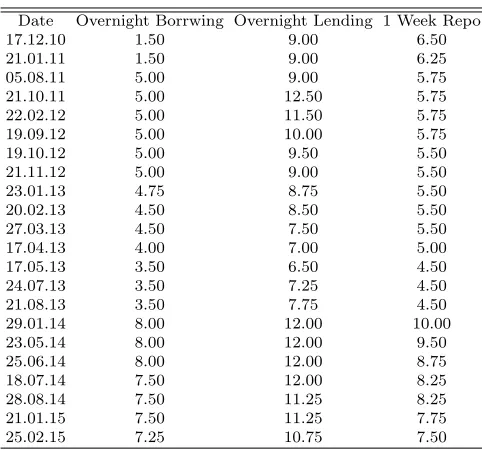
interest rates in addition to its policy interest rate, which is 1-Week Repo rate. Table 1 presents the short
term interest rates of CBRT since the establishment of ROM. CBRT initially increased overnight lending
interest rate in July and August 2013 but increased all the short term interest rates drastically in January
2014. Although, CBRT’s main intention was to avert capital outflows, it has also increased the cost of Turkish
lira funding, which has led Turkish banks to hold more reserves in relatively cheaper foreign exchange. Figure
2 illustrates net capital flows and the utilization of the ROM. During the successful phase of the ROM, the
amount of foreign exchange in the ROM increases as Turkey attracts capital flows. After the tapering, the
amount of foreign exchange in the ROM decreases in response capital outflow as expected until August 2013.
However, it started increasing again after CBRT raised the short term interest rates. As a result, the rise
in the utilization of the ROM despite the capital outflows weakened the stabilizer mechanism of the ROM.
In a similar sense, Aslaner et al. (2015) finds that the cost of Turkish lira funding is the underlying driving
force behind the utilization of the ROM. Thus, the behavior of Turkish banks rules out the foreign currency
liquidity concern, which enables the ROM to work as a stabilizer.
The only possible way of estimating the precise impact of the ROM is to construct a counterfactual
exchange rate volatility and calculate the difference between the two. However, this would be only possible if
we had two parallel universes, one with the implemented ROM and one without. We would also need another
universe to investigate whether the ROM could have worked efficiently if FED did not have the tapering. The
synthetic control method (SCM) offers a solution to this problem by constructing a counterfactual exchange
rate volatility with a data-driven method. Thus, the SCM can be used to understand whether the ROM
did really worked until the tapering and could have worked as an automatic stabilizer in the absence of the
tapering
In this study, I construct a counterfactual exchange rate volatility using the SCM and estimate the impact
of the ROM on the exchange rate volatility. I find that the ROM did work efficiently and stabilized the
volatility of the exchange rate until the tapering. I also show that the ROM would have worked better in
the absence of FED’s tapering. My optimization algorithm and placebo tests confirm that my findings are
robust. To the best of my knowledge, this is the first empirical study that utilizes the SCM in assessing the
impact of ROM on exchange rate volatility.
The rest of the paper is organized as follows. While Section 2 details the literature review, Section 3 and
4 present the methodology and the data, respectively. Finally, Section 5 presents the findings and Section 6
concludes the paper.
2
Literature Review
Since the ROM is only used by CBRT, there are only a couple of papers in the literature. Alper et al.
(2013) is a good starting point to understand how the ROM works. They introduce the ROM and compare
it with alternative models. Their findings show that ROM can decrease the exchange rate volatility and it
can be used as a useful policy tool for macroeconomic and financial stability. Kucuksarac and Ozel (2012)
evaluate the ROM and exemplify the calculation of reserve option coefficients. They find that the break-even
coefficients depend on the price of turkish lira and foreign exchange funds and the coefficients are sensitive
to changes in the cost of funds.
to examine the effectiveness of the ROM from an empirical stand of view. Oduncu et al. (2013) is the first
empirical paper in the literature. They basically estimate the effectiveness of the ROM on the exchange
rate volatility using the GARCH model. They find that the ROM is an effective tool to decrease the
volatility. Degerli and Fendoglu (2015) study the impact of the ROM on exchange rate expectations using
the seemingly unrelated regression model. They find that the USD/TL expectations have exhibited lower
levels of volatility after the implementation of the ROM. They also provide evidence that the ROM act as
an automatic stabilizer of expectations. The newest paper is Aslaner et al. (2015), which finds that Turkish
banks are more sensitive to the cost of Turkish funding rather than foreign currency liquidity.They also
argue that CBRT’s adjustment of short term interest rates as a response to capital outflows undermines the
stabilizer feature of the ROM.
3
Methodology
The synthetic control method (SCM) developed by Abadie and Gardeazabal(2003) is a new
microecono-metric technique that has been widely used for comparative case studies. Abadie and Gardeazabal (2003)
implement the SCM to evaluate the effect of terrorism in Spain, Abadie et al. (2010) estimate the effect of
California Tobacco program on tobacco consumption, Lee (2011) studies the inflation targetting and
Nan-nicini and Billimeier (2012) examine the effect of economic liberalization. Using this method, a weighted
combination of control units, the synthetic units, can be used to approximate the characteristics of the
treated unit. In other words, the counterfactual of the treated unit can be constructed in the absence of the
intervention.
Suppose there are J+ 1 units and only the first unit (j= 1) is exposed to intervention after the timeT0
while the otherJ units remain as control units. SetYI
1tas the outcome variable when the unitj= 1 receives
the treatment and YN
1t as the outcome variable in the absence of the treatment at timet ∈ [T0+1, T]. In order to estimateYI
1tandY1Nt Abadie et al. (2010) offer to use the following model:
Yjt=δt+τjtDjt+ ΘtZj+λtφj+ǫjt (1)
whereZjis a vector of independent variables, Θtis a vector of parameters,φj is a pair-specific unobservable,
λtis an unknown common factor,ǫjtis a transitory shock with zero mean andDjtis a dummy variable that
takes value 1 for the treated unit, 0 for the control unit. Then the treatment effect,τ1t, can be estimated
fort=T0+ 1, T0+ 2, ..., T by
τ1t=Y1It−Y N
Even toughYI
1t=Y1tare observable, the estimation of the treatment effect becomes complicated because of
the unobserved control unitYN
1t. Abadie and Gardeazabal (2003) consider a vectorW = (w2, ..., wj+1) such thatwj ≥0 forj= 2, ..., J+ 1 andP
J+1
j=2 wj= 1. In the vector W, each element represents a weight that will
be used to construct a potential synthetic control unit that is approximately same as the treated unit before
the intervention. Hence, for the pre-intervention period (t∈[1, T0]),W∗= (w∗2, ..., wj∗+1) is determined such that
Y1t= J+1
X
j=2
w∗
jYjt (3)
Z1=
J+1
X
j=2
w∗
jZj (4)
where Zjt is a vector of observed covariates not affected by the intervention. Once W∗ is determined, the
treatment effect att=T0+ 1, T0+ 2, ...is estimated as
τ1t=Y1It− J+1
X
j=2
w∗
jYjt (5)
As mentioned above, the weights have to be chosen that the synthetic unit is almost same as the treated unit
before the intervention. LetX1= (Z1, Y11, ..., Y1T0 be a vector of pre-intervention characteristics for the unit j=1 andX0= (Zj, Yjt, ..., YjT0 be a matrix of the same characteristics for the control unitsjǫ[2, J+ 1]. Then the vector W is chosen to minimize the distance betweenX1andX0W subject towj≥0 forj= 2, ..., J+ 1
andw2+...+wJ+1
min
W kX1−X0W kV= minW(V)
q
(X1−X0W)′V(X1−X0W) (6)
In order to solve this minimization problem Abadie et al. (2007) introduce a diagonal and positive
semidef-inite matrix V such that the mean squared prediction error of the outcome variable is minimized over the
control period. The choice of V is very crucial since each diagonal entry reflects the relative importance of
pre-intervention characteristics.
4
Data
Our sample includes 14 emerging countries (Argentina, Brazil, Chile Colombia, Czech Republic, Hungary,
India, Indonesia, Mexico, Poland, Romania, Russia South Africa, and Turkey) and the Euro group. These
countries are selected since they have a similar pattern of current account deficits in the last decade. Our
transfer from the US, and CDS variables for those countries from 2001 M6 to 2014 M9.2 All the exchange
rates are expressed in terms of US dollar. Interest rate differential is defined as the difference between US
and home country interest rate. Inflation differential is also defined in the same manner. Since Argentina,
Romania and Russia are excluded in the estimations since they have either no or larger number of missing
values in interest rate differential.
The measure of exchange rate volatility is critically important since it will influence how well the synthetic
unit approximates the treated unit. While year-over-year changes are too smooth, monthly changes are too
volatile. Thus, I prefer using percentage changes of exchange rates from 3 months before as the volatility
measure.
Exchange rates and inflation are obtained from the IMF. CDSs and interest rates are from Bloomberg.
Finally, asset transfer, which shows financial asset transaction data between the US and a home country,
from the US Treasury TIC data. Asset transfers are normalized with monthly US personal income that is
obtained from the BEA since monthly US GDP data is not available.
5
Results
5.1
The Choice of Control Period
The main purpose of this paper is to estimate the counterfactual trajectory of TR-USD exchange rate
volatility by a convex combination of other currencies. This counterfactual is the hypothetical TR-USD
exchange rate volatility which is assumed to would have existed if the Central Bank of Turkey had not
adopted the ROM after 2011 October. Thus, the period between 2011 October and 2014 November becomes
the treatment period. Choosing the appropriate control period is vital as the optimal weights of other
currencies are estimated in the control period.
One approach in the literature is to use the whole period before the treatment as the control period.
However, it not easy to assume that the whole period before the treatment is the best control period to
approximate the trajectory of TR-USD exchange rate volatility. Cheung et al. (2005) argues that even
well-defined exchange rate models do not work in all sample periods. Thus, I implement a ”rolling optimization”
algorithm in order to find the appropriate control period. That is, regressions are run over a period window
by keeping window size same, then the window is moved up one month forward until the treatment period.
The ”rolling optimization ” is implemented over 1-year, 2-year, 3-year, 4-year and full (the whole period
2Although we have observations before 2001 M6, we exclude those because Turkey had a severe financial crises over
before the treatment) control periods to find the best approximate of the treated exchange rate volatility. As
Inoue (2012) argues the main issue in the optimization process is the explanatory power of the control period.
The explanatory power of control periods is measured by Root Mean Squared Prediction Erros (RMSPE)3
that is provided after the SCM estimations. The smaller RMSPE is a sign of better approximation of the
treated volatility. Additionally, I also check correlation and Adjust R2 between the treated and synthetic
volatility.
It is very important how the optimization works since the estimation of control unit weights and the
synthetic exchange rate volatility purely depends on it. The optimization algorithm minimizes the difference
between observed variables and the synthetic variable that is the weighted average of control units over the
control period. While observed variables, which are shown with subscript j, are the actual observations of
Turkey, the synthetic variable, which is shown with subscript k, are the weighted average of control countries’
observations. CP Ij(k),t is the CPI based inflation differential at time t between the US and the country j
(k),rj(k),t is the interest rate differential at time t between the US and the country j (k),Assetj(k) is the
net asset transaction between the US and the country j (k) divided by US personal income,CDSj(k) is the
CDS of country j (k) at time t. J P Yt is the TR-USD percent change from 3 months before at time t and
Sj,t is the weighted of control currencies’ percent change from 3 months before at time t. The upper bar
on variables represents a simple average over the control period. The optimization algorithm used for the
estimation of optimal weights is as follows;
min
w2,...,wj+1
CP Ij−Pk=2wkCP Ik
rj−Pk=2wkrk
Assetj−Pk=2wkAssetk
CDSj−Pk=2wkCDSk
J P Y0−Pk=2wkSk,0
J P Y1−Pk=2wkSk,1 ..
.
J P YT0−
P
k=2wkSk,12
(7)
Among 380 control groups, I chose 2 periods from 1-year, 2-year, 3-year and 4-year control periods that
have the lowest RMSPE, highest Adj2R and highest correlation. I also include full control period. Table
2 presents 9 optimal control periods and reveals that correlations and AdjR2s are similar while RMSPE
decreases when the window size expands. Thus, I choose the period over 2007M3-2008M2 as the control
3RMSPE is estimated as
s T P
t
(YI 1t−Y1Nt)
2
period since it has the minimum RMSPE, high correlation and Adj2
R. The weights that are obtained for
the control period is presented in Table 3. Based on the minimization process, the volatility of TR-USD
exchange rate can be duplicated by the convex combination of the Brazilian Real, the Czech Krone and the
South African dollar. The estimated weights are 0.74, 0.126, and 0.134, respectively.
The weights of the control currencies are estimated using predictor variables of the TR-USD exchange
rate, which are interest rate spreads, asset transfers, CPI inflation differential, and the volatility of the
TR-USD exchange rate at different periods. Both predictor variables and the outcome variable are well
balanced during the optimization process between the synthetic control and treatment units. In other
words, the difference between actual and synthetic values of these variables are very close to each other. The
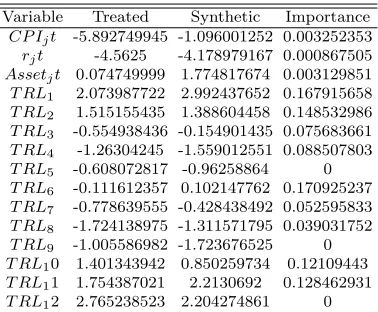
predictor balance over the optimization process and the importance of each variable are presented in Table 4.
Importance of a variables represents the relative importance of each predictor variable, which are normalized
weights in constructing the synthetic control units. Volatility of TR-USD exchange rate in different periods
seem to be relatively important compared to the macro variables. While the normalized weight of macro
variables are smaller than 1 percent, the volatility of TR-USD exchange rate in each month has a normalized
weight of 10 percent on average.
5.2
Average Treatment Effects
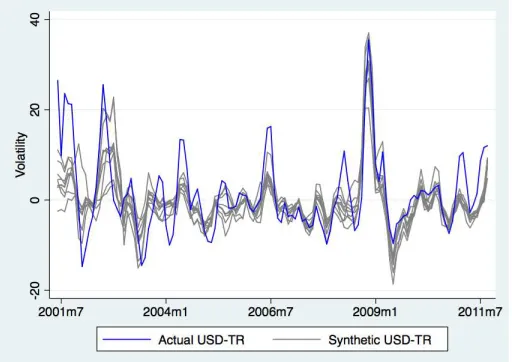
In Figure 4 and 5, I calculate the average treatment effect of the reserve option mechanism by taking the
difference between the actual and synthetic volatility TR-USD exchange rate. The positive(negative) sign of
ATE stands represents that the ROM works efficiently (not efficiently). The effect of the ROM is evaluated
as efficient when TR-USD exchange rate has a lower volatility. Thus, smaller depreciation and appreciation
under the ROM will be both considered as efficient. However, there are some periods that while the actual
TR-USD exchange rate depreciates, the synthetic one appreciates. For these periods, the absolute value
of the volatility is taken and then the difference is estimated in order to be consistent with the evaluation
criterion.
It is shown that ATEs are mainly positive until the FED’s tapering in May 2013 and mainly negative
after that. The average of ATEs until May 2013 is 2.5 percent and it becomes -1.15 afterwards, which is an
evidence that the ROM works. These results confirm that the ROM had worked efficiently as an automatic
stabilizer and decreased the volatility until the FED’s Tapering. The findings here are consistent with those
in Oduncu et al (2013) and Degerli and Fendoglu (2013). I re-calculate the synthetic TR-USD exchange rate
by including the credit swap defaults (CDS) as a predictor variable the findings are very similar. Likewise the
While the average of ATEs until May 2013 is 2.28 percent, it becomes -1.34 afterwards. The alternative
estimation with CDSs confirm my initial findings that the ROM had worked efficiently until May 2013.
The puzzle that why the ROM stopped working efficiently after May 2013 is worth investigating. Aslaner
et al. (2015) investigate the the determinants of ROM utilization and find that foreign currency liquidity is
not an important parameter for ROM utilization, which is in contrast to the mechanism of ROM. As argued
in Alper et al (2013), the ROM is expected to work as an automatic stabilizer if banks act accordingly with
foreign currency liquidity constraint. They also argue that the policy induced movements in the short term
interest rates may mitigate the efficiency of the ROM. Thus, the puzzle can be investigated by examining
how the CBRT changed its short term interest rates after the FED’s tapering. The CBRT has mainted a
stable monetary policy between the implementation of ROM and the FED’s tapering. It kept the policy
interest rate, which 1 week repo interest rate and the interest corridor, which is overnight borrowing and
lending interest rates around the same level. Thus, there was a small variation in interest rates during the
efficient phase of the ROM. However, after August 2013, the CBRT started increasing short term interest
rates to stop capital outflows, which is induced by the FED’s tapering. The increase in the short term
interest rates raised the cost of Turkish lira funding that is believed to be the important driving force of high
ROM utilization of Turkish banks after the FED’s tapering. As a result, the increase in short term interest
rates during capital outflows deteriorated the automatic stabilizer function of the ROM.
5.3
A World without the FED’s tapering
The puzzle caused by the CBRT’s respond to capital outflows can be investigated by estimating the
synthetic TR-USD exchange rate if the CBRT had not increased the short term interest rates. Since the
ROM had worked efficiently between October 2011 and August 2013, this period can be used a control period
and the synthetic TR-USD exchange rate can be re-estimated for the period after July 2013. Likewise, the
length of optimization period is vital since the weights estimated in the optimization period will be used
for the construction of synthetic TR-USD exchange rate. I re-optimze the control periods for different
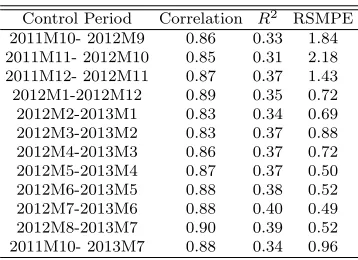
1-year periods and full control period. The estimated RSMPE’s andAdj2
Rs are given in Table 5. Among 12
optimizations, the control period between 2012 M6 and 2013 M5 has the smallest RSMPE and relatively
highAdj2R. The weights that are estimated using this control period are given in Table 6. Thus, the synthetic volatility of TR-USD exchange rate can be calculated by the convex combination of Chilean Peso, Colombian
Peso, the Euro, Hungarian Forint and Mexican Peso. The estimated weights are 0.136, 0.643, 0.049, 0.78 and
0.94, respectively. Predictor balance of the new optimization is given in Table 7. Like the ROM optimization,
rather than macro variables.
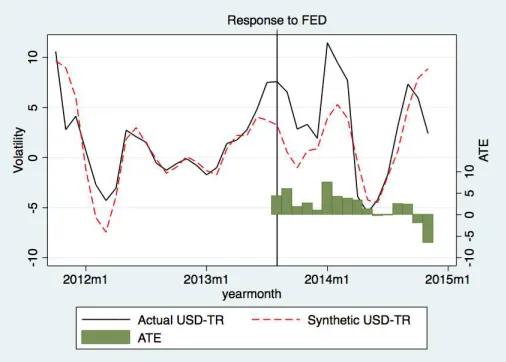
The volatility of actual and synthetic TR-USD exchange are plotted in Figure 7. I also calculate the
average treatment effect for the treatment period by taking the difference between the actual and synthetic
volatility TR-USD exchange rate, which is shown in Figure 7. ATEs are positive until the last two months,
which confirms that the ROM would have worked efficiently if the CBRT had not increased short term interest
rates systematically. The average of ATEs for the treatment period is 2 percent. When the estimation is
iterated by including the credit swap defaults (CDS) as a predictor variable, I estimate similar results. Thus,
the findings are robust.
5.4
Placebo Study
Using the SCM, I estimate the counterfactual USD-TR exchange rate volatility, which is percent changes
from 3 months before, by a convex combinations of currencies of 10 different countries. There is a possibility
that my estimation could be driven by chance. Thus, I run placebo tests to check the robustness of my
estimates. The placebo test helps answering whether I would estimate similar effects if I had chosen a
random country from the dataset.
Following Abadie and Gardeazabal (2003) and Abadie et al. (2010), I estimate the synthetic exchange
rate volatility for countries in the control group. If the placebo studies generate similar results for other
currencies, then the volatility of USD-TR exchange rate was stabilized by other factors than the automatic
stabilizer feature of the ROM. Otherwise, my results provide significance and robust evidence for the ROM’s
ability to decrease the exchange rate volatility.
Table 8 shows pre RMSPE, post RMSP, the ratio of post and pre RSMPEs and average ATE for Turkish
lira and other currencies. The average gap between the synthetic and actual volatility of the exchange rate is
expected to be close or less than 0 for other currencies. Especially, Brazillian Real, Czech Krone and South
African Rand are of importance since their weights are different than 0 in the construction of synthetic
volatility of USD-TR exchange rate. While the average gap is negative for Brazillian Real and South African
Rand, it is very close to zero for Czech Krone. Based on the placebo tests, we can confirm that my estimation
are robust in estimating the impact of the ROM on the exchange rate volatility.
The placebo test results for the tapering are shown in Table 9. The average between rhe synthetic and
actual volatility of the USD-TR exchange rate is 2 percent and the average gap for control currencies that are
Chilean Peso, Columbian Peso, the Euro, Hungarian Forint and Mexican Peso should be smaller. As shown
in Table 9, the average gap for control currencies is smaller than 2 percent and is close to zero for the most
than control currencies. These results reveal that I chose the right control currencies in my optimization
process. Thus, my estimation are significant and robust, which confirms that the ROM could have worked
efficiently in the absence of the tapering.
6
Conclusion
The ROM is an important macroprudential tool, which has been used by the CBRT to stabilize the
exchange rate volatility.It had worked efficiently and decreased the volatility of the USD-TR exchange rate
until the FED’s tapering in May 2013 . However, CBRT’s change in short term interest rates as a response
to stop capital flows deteriorated the automatic stabilizer feature of the ROM. Thus, the volatility of the
exchange rate was not stabilized after the tapering. In this paper, I use the Synthetic Control Method
to confirm that the ROM had worked as an automatic stabilizer until the tapering. To the best of my
knowledge, this is the first application of that methodology to investigate the ROM.
My results indicate that the ROM decreased the exchange rate volatility by 2 percentage points on
average and the estimated cumulative effect is around 50 percentage points between September 2011 and
August 2013. However, the ROM did not work efficiently after August 2013 caused by the behavior of
Turkish banks in response to changes in short term interest rates. My estimates also reveals that the ROM
could have worked as expected and stabilized the exchange rate volatility in the absence of the tapering.
The ROM could have decreased the exchange rate volatility by 2 percentage points on average and volatility
could have been decreased by 32 percentage points cumulatively after the tapering. Robustness of both
results are confirmed via placebo study as well.
Our results are consistent with the general view in the literature that the ROM can decrease exchange
rate volatility. However, the ROM can work efficiently when CBRT does not change short term interest rate
during capital outflows. The reason is that the behavior of the Turkish banks is strongly determined by the
Figure 1: USD-TRY Exchange Rate
Figure 2: Capital Flows and FX Reserves in ROM. Source: CBRT
[image:13.612.179.435.512.693.2]Figure 4: Actual and Synthethic USD-TR Exchange Rate
Figure 5: Actual and Synthethic USD-TR Exchange Rate and Average Treatment Effects
[image:14.612.180.434.513.693.2]Figure 7: Actual and Synthethic USD-TR Exchange Rate and Average Treatment Effects
[image:15.612.180.433.458.639.2]Table 1: CBRT Interest Rates
Date Overnight Borrwing Overnight Lending 1 Week Repo
17.12.10 1.50 9.00 6.50
21.01.11 1.50 9.00 6.25
05.08.11 5.00 9.00 5.75
21.10.11 5.00 12.50 5.75
22.02.12 5.00 11.50 5.75
19.09.12 5.00 10.00 5.75
19.10.12 5.00 9.50 5.50
21.11.12 5.00 9.00 5.50
23.01.13 4.75 8.75 5.50
20.02.13 4.50 8.50 5.50
27.03.13 4.50 7.50 5.50
17.04.13 4.00 7.00 5.00
17.05.13 3.50 6.50 4.50
24.07.13 3.50 7.25 4.50
21.08.13 3.50 7.75 4.50
29.01.14 8.00 12.00 10.00
23.05.14 8.00 12.00 9.50
25.06.14 8.00 12.00 8.75
18.07.14 7.50 12.00 8.25
28.08.14 7.50 11.25 8.25
21.01.15 7.50 11.25 7.75
[image:16.612.216.394.409.508.2]25.02.15 7.25 10.75 7.50
Table 2: Control Periods for ROM
Control Period Correlation R2 RSMPE 2007M3-2008M2 0.74 0.54 1.06 2010M1-2010M12 0.65 0.42 1.06 2005M8-2007M4 0.64 0.40 2.79 2008M12-2010M11 0.57 0.32 2.57 2003M9-2006M8 0.76 0.57 6.06 2005M11-2008M10 0.75 0.56 6.17 2003M4-2007M3 0.75 0.56 6.22 2006M9-2010M8 0.73 0.54 6.29 2001M6-2011M9 0.74 0.54 6.41
Table 3: Currency Weights for ROM
Table 4: Predictor Balance for ROM
Variable Treated Synthetic Importance
CP Ijt -5.37875 -1.238373 0.0014311 rjt -12.1515 -5.625667 0.0090698
Assetjt 0.1489167 0.8200997 0.0002259
T RL1 -1.611773 -1.412259 0.0434617
T RL2 -4.708365 -4.227849 0.0367692 T RL3 -4.235464 -4.788174 0.0581586 T RL4 -6.125362 -5.846677 0.1186323 T RL5 -5.604718 -5.7288 0.1100892
T RL6 -1.424283 -0.4320435 0.1139845
T RL7 -4.476481 -2.150733 0 T RL8 -6.718748 -4.50028 0 T RL9 -9.733842 -9.755344 0.1953708 T RL10 -6.910238 -6.187835 0.1180902
T RL11 -1.842542 -1.563376 0
[image:17.612.215.394.365.495.2]T RL12 0.4212296 -0.5087929 0.1947169
Table 5: Control Periods for Tapering
Control Period Correlation R2 RSMPE 2011M10- 2012M9 0.86 0.33 1.84 2011M11- 2012M10 0.85 0.31 2.18 2011M12- 2012M11 0.87 0.37 1.43 2012M1-2012M12 0.89 0.35 0.72 2012M2-2013M1 0.83 0.34 0.69 2012M3-2013M2 0.83 0.37 0.88 2012M4-2013M3 0.86 0.37 0.72 2012M5-2013M4 0.87 0.37 0.50 2012M6-2013M5 0.88 0.38 0.52 2012M7-2013M6 0.88 0.40 0.49 2012M8-2013M7 0.90 0.39 0.52 2011M10- 2013M7 0.88 0.34 0.96
Table 6: Currency Weights for Tapering
Table 7: Predictor Balance for Tapering
Variable Treated Synthetic Importance
CP Ijt -5.892749945 -1.096001252 0.003252353
rjt -4.5625 -4.178979167 0.000867505
Assetjt 0.074749999 1.774817674 0.003129851
T RL1 2.073987722 2.992437652 0.167915658 T RL2 1.515155435 1.388604458 0.148532986 T RL3 -0.554938436 -0.154901435 0.075683661
T RL4 -1.26304245 -1.559012551 0.088507803
T RL5 -0.608072817 -0.96258864 0
T RL6 -0.111612357 0.102147762 0.170925237 T RL7 -0.778639555 -0.428438492 0.052595833 T RL8 -1.724138975 -1.311571795 0.039031752 T RL9 -1.005586982 -1.723676525 0
T RL10 1.401343942 0.850259734 0.12109443
[image:18.612.77.537.435.484.2]T RL11 1.754387021 2.2130692 0.128462931 T RL12 2.765238523 2.204274861 0
Table 8: Placebo Test Results for ROM
Turkey Brazil Chile Columbia Czech Rep Euro Hungary India Indonesia Mexico Poland South Africa pre RSMPE 6.55 7.48 5.21 4.44 3.49 3.06 3.84 4.21 5.91 4.86 3.93 7.96 post RSMPE 4.58 5.96 2.16 5.06 2.18 3.56 4.13 4.54 4.74 3.18 2.27 5.11 post/pre 0.70 0.80 0.41 1.14 0.62 1.17 1.08 1.08 0.80 0.65 0.58 0.64 Average ATE 2.50 -2.04 -0.09 1.78 0.18 1.16 -1.30 -1.78 2.36 -1.67 -1.05 -1.26
Table 9: Placebo Test Results for Tapering
[image:18.612.80.535.618.669.2]References
Alberto Abadie, Alexis Diamond, and Jens Hainmueller. Synthetic control methods for comparative case
studies: Estimating the effect of californias tobacco control program. Journal of the American Statistical
Association, 105(490), 2010.
Alberto Abadie and Javier Gardeazabal. The economic costs of conflict: A case study of the basque country.
American economic review, pages 113–132, 2003.
Koray Alper, Hakan Kara, and Mehmet Y¨or¨uko˘glu. Reserve options mechanism. Central Bank Review,
13(1), 2012.
Oguz Aslaner, Ugur Ciplak, Hakan Kara, and Doruk Kucuksarac. Reserve option mechanism: Does it work
as an automatic stabilizer? Central Bank Review, 15(1), 2015.
Andreas Billmeier and Tommaso Nannicini. Assessing economic liberalization episodes: A synthetic control
approach. Review of Economics and Statistics, 95(3):983–1001, 2013.
N Campos, Fabrizio Coricelli, and Luigi Moretti. Economic growth and political integration: Synthetic
counterfactuals evidence from europe. Technical report, mimeo, 2014.
Marcos Chamon, M´arcio Garcia, and Laura Souza. Fx interventions in brazil: a synthetic control approach.
Technical report, 2015.
Ahmet De˘gerli and Salih Fendo˘glu. Reserve option mechanism as a stabilizing policy tool: Evidence from
exchange rate expectations. International Review of Economics & Finance, 35:166–179, 2015.
Pedro Gomis-Porqueras and Laura Puzzello. Winners and losers from the euro.
Doruk K¨u¸c¨uksara¸c and ¨Ozg¨ur ¨Ozel. Reserve options mechanism and computation of reserve options
coeffi-cients. TCMB Ekonomi Notu, (12/33), 2012.
Wang-Sheng Lee. Comparative case studies of the effects of inflation targeting in emerging economies.Oxford
Economic Papers, page gpq025, 2010.
Arif Oduncu, Yasin Akcelik, and Ergun Ermisoglu. Reserve options mechanism and fx volatility. Central