Dynamic Behavior of Non-Newtonian Droplets Impinging on Solid Surfaces
Joo Hyun Moon, Jae Bong Lee and Seong Hyuk Lee
+School of Mechanical Engineering, Chung-Ang University, 221 Heuksuk-Dong, Dongjak-Gu, Seoul 156-756, Korea
This article illustrates the spreading and receding characteristics of non-Newtonian droplets impinging on solid surfaces at different Weber numbers. A xanthan gum solution was used to generate non-Newtonian droplets. From digital images captured using a high speed camera, spreading diameters and dynamic contact angles (DCA) were measured during the impact process. Depending on impact velocity, distinct differences in spreading and receding motions were found between Newtonian and non-Newtonian droplets, which were highly associated with viscous energy dissipation. The maximum spreading diameters for Newtonian and non-Newtonian droplets were nearly the same, but a much slower receding motion was observed for non-Newtonian droplets because of the shear-thinning effect. Moreover, a rapid decrease of DCA in the spreading regime was observed for both non-Newtonian and Newtonian droplets, indicating that the inertial force became dominant. By contrast, measured DCAs for non-Newtonian fluid droplets in the receding regime were larger than those for Newtonian fluid droplets, demonstrating that cohesive surface forces were more dominant than inertial forces in this regime. [doi:10.2320/matertrans.M2012215]
(Received June 25, 2012; Accepted December 5, 2012; Published January 19, 2013)
Keywords: non-Newtonianfluid, shear-thinning, weber number (We), droplet, dynamic contact angle (DCA)
1. Introduction
Droplet impingement on solid surfaces has been studied for more than a century and has been vigorously discussed with respect to many natural phenomena such as soil erosion and acid rain impacting on leaves. In fact, the study of droplet impingement on a solid surface is not only of fundamental scientific interest in material science but is also of significant importance for a variety of industrial applications such as spray coating, corrosion of solid surfaces, and ink-jet printing. In particular, liquid impact-induced erosion prob-lems on solid surfaces have been recognized as one of the important problems to be solved in the material industry.1)
The damage produced by the impingement of a water-jet promotes erosion of turbine blades.1)Therefore, the dynamic liquidfilm behavior of a droplet on a solid surface should be investigated to predict erosion damage and to select suitable materials for use as components which are highly erosion resistant.13)A fundamental understanding of dynamic liquid
film behavior on solid surfaces is thus very important in
finding controllable factors including surface characteristics, impact conditions, and fluid properties. Accordingly many efforts have been made in experimental and numerical manners.17)To investigate the dynamic behavior of imping-ing droplets on surfaces, important parameters to be considered are surface roughness, wettability (defined by the contact angle), fluid viscosity, liquid density, droplet diameter, surface tension, and impact velocity.13)
Recently, interest in non-Newtonian fluids has rapidly grown becausefluids used in many industrial applications are non-Newtonian. Seevaratnam et al.,8) Son et al.9) Neogi10) and Wang et al.11) investigated dynamic characteristics of Newtonian and non-Newtonianfluids by tracking the contact line motion offluid expansion. In addition, some researchers have observed non-Newtonian liquid droplet impingement on various solid surfaces. Bergeronet al.12)showed that a drop
with small amounts of aflexible polymer inhibits its receding motion, resulting in the suppression of the rebound and the
improvement of the deposition after impact on a hydrophobic surface without significantly altering the shear viscosity of the solutions. An and Lee1315)studied the impact dynamics of shear-thinning drops, which indicates that the viscosity of the liquid decreases with an increase of shear rate, on solid surfaces, and compared their results with those of Newtonian drops. They also experimentally investigated the effects of liquid viscosity with shear-thinning characteristics, surface wettability, and impact velocity on dynamic behavior of droplets. They found empirical correlations based on the energy balance for estimating the maximum spreading diameters of non-Newtonian droplets. Luu and Forterre16)
reported various impact regimes from irreversible visco-plastic coating to giant elastic spreading. The role of elasticity in the transient hydrodynamics of yield-stress fluids, which behave as solids under small stress and liquids beyond a critical stress, was emphasized. Saidi et al.17) also inves-tigated the influence of yield stress level, and showed there was a close relation between the yield stress and drop formation. Moreover, Cooper-White et al.18) and Aytouna
et al.19)investigated dynamics of surfactant solution droplets, and showed that the impact behavior of each solution varied with changes in dynamic surface tension and viscoelastic properties. In addition, German and Bertola20) investigated
dynamic behaviors of impinging non-Newtonian droplets with yield-stress and shear-thinning characteristics. They also predicted the maximum spreading diameters with variation in wettability and yield stress.
Although some researchers have conducted experiments with non-Newtonian impinging droplets on solid surfaces, there is a lack of experimental data for the dynamics of non-Newtonian droplet characteristics after impingement espe-cially regarding the shear-thinning effect. The main objective of this study was to experimentally investigate dynamic behaviors of the spreading and receding processes when Newtonian and non-Newtonian droplets impinged on solid surfaces. We measured spreading diameters and dynamic con-tact angles from images captured with a high-speed camera to examine the influence of impact velocity andfluid viscosity on both spreading and receding motions after impact.
+Corresponding author, E-mail: shlee89@cau.ac.kr
2. Experimental Set-Up
As shown in Fig. 1, we used the pendant method to generate well-controlled droplets with the dispenser system, which consisted of aflat-tipped metal hub needle (gage 30, Hamilton) and a syringe pump (LSP01-1A, LongerPump). Syringe pump injected droplets were detached from the end of the needle due to their weight. The detached droplets had a 2.27 mm«0.03 mm equivalent droplet diameter, calculated from d0=(dx2©dy)1/3, where dx and dy are the measured horizontal and vertical diameters.21) Therefore, we could estimate the density of the de-ionized (DI) water and xanthan gum solution by calculating droplet volume from an estimated equivalent droplet diameter21)and the
correspond-ing weight measured by a microbalance (AC 121S, Sartorius) at a volume of 6.4 µL calculated from equivalent droplet diameters. The impact velocity was controlled by changing the distance between the needle tip and the top of the surface from 150 to 450 mm. The Weber number is defined as μv02d0/£LVwhereμ,v0, and£LVdenote liquid density, impact
velocity, and surface tension between liquid and vapor phases, respectively. In the present experiments, the Weber number ranged from 97.5 to 290.
Prior to considering the shear-thinning effect on surface wettability, we measured equilibrium contact angles (ªe,
ECA) for DI-water and the xanthan droplets deposited on the solid surfaces. All the images for measuringªewere analyzed
by the developed shape analysis (Low Bond-Axisymmetric Drop Shape Analysis, LB-ADSA) in ImageJ on the basis of the YoungLaplace equation.22) The results are listed in
Table 1, and showed that ECAs remained nearly constant while the particle concentration increased. It is confirmed that the surface tension remained very similar despite differences in solution concentration.
Dynamic droplet behavior was visualized with a high-speed camera (Motion Xtra HG-LE, Redlake) and a Telecentric lens (TEC-M55, Computar) to capture non-distorted images at 5000 frames·s¹1 with a 300 W halogen lamp. Moreover, we used another setup comprised of a CMOS camera (Artray-MI300) and a Telecentric lens (TML-HP lens, Edmund) to ensure that the shape of droplet impinged was axisymmetric. Dynamic contact angles (ªDCA,
DCA) were measured with respect to time from images by using the angle tool included in ImageJ. Unlike the ECA measurement, the angle tool can measure the dynamic
contact angle by prescribing the triple-line among three different phases. An aluminum surface (Al 6061) was used as the target solid surface, with the roughness controlled by polishing with silicon carbide abrasive sandpaper. Average roughness Ra was about 0.06 µm. The experiments were conducted under controlled environmental conditions (at a room temperature of 25«1°C and a relative humidity of 30«5%).
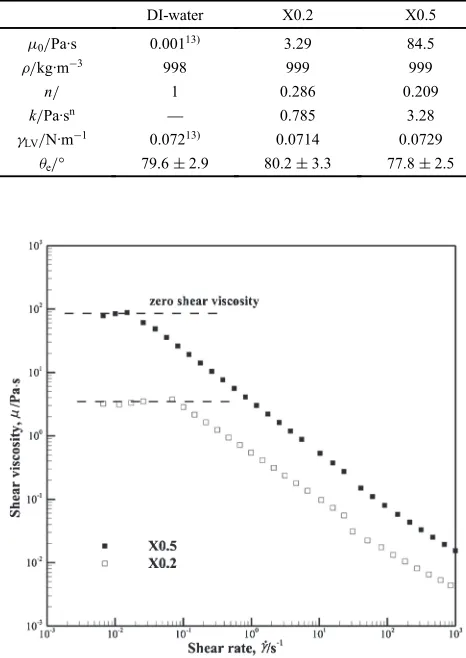
DI-water and xanthan solutions were used to make Newtonian and non-Newtonian fluid droplets. Two xanthan solutions with different shear viscosity characteristics were prepared at 0.2 and 0.5 mass%(hereafter denoted as X0.2 and X0.5). To make the xanthan solutions, we used a magnetic stirrer to mix DI-water and xanthan gum particles for 24 h and a vacuum pump to remove air bubbles from the liquids. Meanwhile, viscosity and surface tension of the xanthan solutions were measured at 25°C. Liquid viscosity with shear rates ranging from 6©10¹3to 103s¹1were measured using a rotational viscometer (RS-1, HAAKE). Unfortunately, we could not measure liquid viscosity with shear rates below 10¹3 s to estimate the zero-shear viscosity. Therefore, the zero-shear viscosity was estimated with an average value in the range of 6©10¹3to 2©10¹3s¹1, as shown in the dashed lines of Fig. 2. Shear viscosity of all solutions rapidly decreased with an increase in the shear rate above 6©10¹3s¹1. Shear viscosity can be expressed by a power law as follows:
[image:2.595.64.275.68.198.2]Fig. 1 A schematic diagram of the experimental setup.
Table 1 Fluid properties and equilibrium contact angles for DI-water and xanthan solutions.
DI-water X0.2 X0.5
®0/Pa·s 0.00113) 3.29 84.5
μ/kg·m¹3 998 999 999
n/ 1 0.286 0.209
k/Pa·sn ® 0.785 3.28
£LV/N·m¹1 0.07213) 0.0714 0.0729
ªe/° 79.6«2.9 80.2«3.3 77.8«2.5
[image:2.595.302.549.93.182.2] [image:2.595.309.542.95.424.2]®¼kð£_Þn1: ð1Þ
Coefficients in eq. (1) were determined from measurement data, where µ is shear viscosity,kis consistency index,£_ is shear rate, and n is power law index (see Table 1). To measure surface tension for the xanthan solutions, we used a digital surface tension analyzer (DST 60, SEO) based on the well-known Du Noüy ring method.23) This method uses a
ring slowly lifting from a liquid surface and measures the surface tension force when the liquid lamella is stretched to its maximum. For DI-water droplets, surface tension data measured by An and Lee13) was used. This data is summarized in Table 1.
3. Results and Discussion
3.1 Dynamics of impinging droplets on surfaces
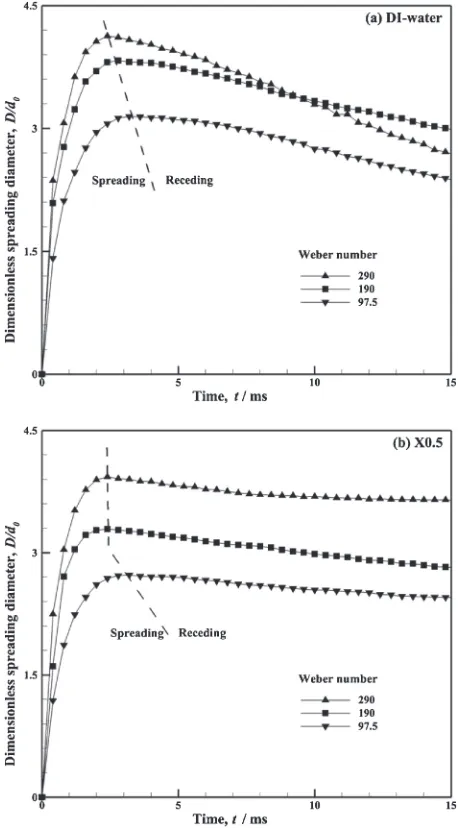
Figure 3 shows spreading and receding diameters of Newtonian and non-Newtonian droplets. After a droplet started to spread on the surface, it reached the maximum spreading diameter rapidly. Time taken for the maximum spreading diameter of non-Newtonian droplets was similar to that of Newtonian droplets. Figure 4 shows dimensionless spreading and receding diameters with respect to the Weber number. As the Weber number increases, the maximum spreading diameter increases. For both Newtonian and non-Newtonian fluids, we observed very similar maximum spreading diameters and also very similar motions in the spreading regime. This indicated that at the same impact velocity, kinetic energy became more dominant than surface tension energy and viscous dissipation in the early stages of spreading. However, there was a clear difference in the receding regime, where stored surface energy drove kinetic motion after the maximum spread.13) In Fig. 4, shrinking
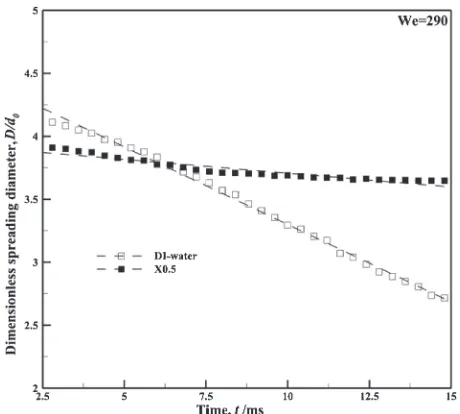
motions of the liquid lamellar in the receding regime did not change much with the Weber number for the xanthan droplets. However, DI-water droplets shrunk faster at higher Weber numbers. Figure 5 shows receding diameters of DI-water and xanthan (X0.5) droplets at We=290. We see that the receding velocity of the xanthan droplets is much slower than that of the Newtonian liquid droplets. The contact line velocity was estimated to lie between 0.027 and 0.0285 m·s¹1 for X0.5, as opposed to, 0.078 and 0.14 m·s¹1 for DI-water when the Weber number ranged from 97.5 to 290.
3.2 Prediction of the maximum spreading diameter and energy budget analysis
After impact of a droplet on a surface, it spreads rapidly due to kinetic energy (KE) but is accompanied by surface
energy (SE) and viscous dissipation energy (W), following eq. (2);
KE1þSE1¼KE2þSE2þW; ð2Þ where kinetic energy (KE1) and surface energy (SE1) before
droplet impact are given by
KE1¼ 12μv02
³
6d03
; ð3Þ
Fig. 3 Sequential images for DI-water and X0.2 droplets impinging on surfaces at We=97.5.
[image:3.595.85.509.73.168.2] [image:3.595.312.541.212.626.2]SE1¼³d0£LV: ð4Þ
Recently, models to predict the maximum spreading diameter of Newtonian droplets have been studied for flat solid surfaces and textured surfaces.21,2426) For instance, Ukiwe and Kwok24) developed a model to estimate the maximum
spreading diameter for flat surfaces based on energy conservation with non-dimensional parameters such as the Weber number (We) and Reynolds number (Re) (μv0d0/®0),
where®0is zero-shear viscosity. The expression for the
non-dimensional maximum spreading diameter DMAX on flat surfaces is (DMAX=DMAX/d0, where DMAX is measured maximum spreading diameter)
ðWeþ12ÞD
MAX
¼8þDMAX3 4 Weffiffiffiffiffiffi
Re
p þ3ð1cosªaÞ
; ð5Þ
where ªa is advancing contact angle. From eq. (5), the
[image:4.595.54.284.68.275.2]maximum spreading diameter was estimated by using measured advancing contact angle at maximum spread. Since the above equation (denoted as the U-K model) was derived for Newtonian fluids, it has limitations in predicting the maximum spreading diameter of non-Newtonian droplets. Figure 6 compares maximum spreading diameters estimated via the U-K model, represented in eq. (5), for DI-water and xanthan droplets. In terms of DI-water droplets, the U-K model successfully predicted the maximum spreading diameter, whereas for xanthan droplets, the maximum deviation based on the predicted value is approximately 93.3%. This happens because the U-K model does not consider shear rate-dependent variations in liquid viscosity, which is crucial in estimating viscous dissipation energy after impact. Inspired by these results, we proceeded to scrutinize the energy budgets during the impact process to better understand the phenomenon. In the U-K model, at the maximum spread in which kinetic motion vanishes instantly, there are two terms representing viscous dissipation energy and surface energy as follows:
WN¼ Ztc
0 Z
ddt
tc³3μv02d0D2MAX
ffiffiffiffiffiffiffiffiffiffiffiffi® 0 μv0d0 r
; ð6Þ
SE2¼23³ d 3 0
DMAX£LVþ ³
4£LVD2MAXð1cosªaÞ; ð7Þ
where WNandSE2indicate viscous dissipation energy for a
Newtonian droplet and surface energy at maximum spread, respectively. In eq. (6),+is the volume of the viscousfluid,
)is the viscous dissipation energy per unit volume per unit time, andtcis the time required for maximum spread. Wefirst estimated the total energy on the left hand side of eq. (2) for a DI-water droplet before impact using the U-K model as 10.22©10¹6J. Based on measured values of the maximum spreading diameter, we estimated viscous dissipation energy to be about 7.97©10¹6J when We=97.5. This shows that viscous dissipation energy is almost 3.5 times surface energy after impact (SE2). Although shear viscosity of a Newtonian
droplet is quite small, estimating viscous dissipation is crucial for accurate prediction of the dynamic motion of liquidfilms on solid surfaces after impact in the spreading and receding regime.
A similar analysis was carried out for xanthan solution (X0.2). Viscous dissipation energy was estimated to be 920©10¹6J, which is larger than the total energy of a droplet before impact. This implies a violation of energy conservation, and thus the U-K model is unable to accurately predict viscous dissipation energy. The main reason for this failure is that the original U-K model cannot describe the dynamic variation in viscosity due to the shear rate. Using the original U-K model and the model developed by Pasandideh-Fard et al.,25) we modified the viscous dissipation energy
term as follows:
W¼¦WN; where¦®k 0
v0 ¤
n1
; ð8Þ Fig. 5 Transient evolution of droplet diameter for DI-water and X0.5
droplets in the receding regime.
[image:4.595.310.543.70.274.2] [image:4.595.327.548.338.419.2]where ¤ is boundary layer thickness (=2d0/pffiffiffiffiffiffiRe) at the solidliquid interface.25) Pasandideh-Fard et al.25) used the
boundary layer assumption for liquidfilm motion occurring after impact, and proposed an analytical expression for the boundary layer thickness by assuming that liquid motion in the droplet can be represented by axisymmetric stagnation point flow. The present study modified the viscous dissipation energy term by considering variations in viscosity due to the shear rate for the shear-thinning behavior represented by the power-law model. From eqs. (1) and (6), we can thus obtain the modified viscous dissipation energy term as seen in eq. (8). The shear rate£_can be approximately described in terms of impact velocity and boundary layer thickness. By inserting SE2 in eq. (7) and Win eq. (8) into
eq. (2) the modified U-K model is obtained as follows: ðWeþ12ÞD
MAX
¼8þDMAX3 4 Weffiffiffiffiffiffi
Re
p ¦þ3ð1cosªaÞ
: ð9Þ
In the case of a modified U-K model, morefluid properties are needed to obtain the maximum spreading diameters than the original U-K model. For example, the measured advancing contact angle, Weber number, Reynolds number, zero-shear viscosity, consistency index, boundary layer thickness, and power-law index are needed. We suggested the modified U-K model by using eq. (9) to consider the non-Newtonian effect and compared the predicted maximum spreading diameter from the modified U-K model, our experimental data, and the predictions of the original U-K model24) in Fig. 6. It can be seen that the modified U-K
model yields a slightly better prediction than the original U-K model. Although the deviation between the predicted data and the measured data is reduced as much as 70.2%, still a more elaborate model is needed for accurate prediction by considering continuous variation of liquid viscosity during the receding period after impact.
3.3 Dynamic changes in wettability
After the impact, triple lines undergo a rapid dynamic change due to mutual interactions among representative energies: surface energy, kinetic energy, and viscous dissipation energy. Although there has been extensive research on the dynamic motion of liquid droplets after impact, information is still insufficient to explain dynamic changes in wettability. As stated above, variations of dynamic contact angle should be regarded as one of the important parameters to accurately predict the maximum spreading diameter. In general, dynamic contact angle suddenly decreases after impact, but remains qualitatively similar during spreading.26,27) It can be represented by the well-known Young’s equation as follows:
cosªDCA¼£SV££SL
LV ; ð10Þ
where£SVis the surface tension between solid and vapor,£SL
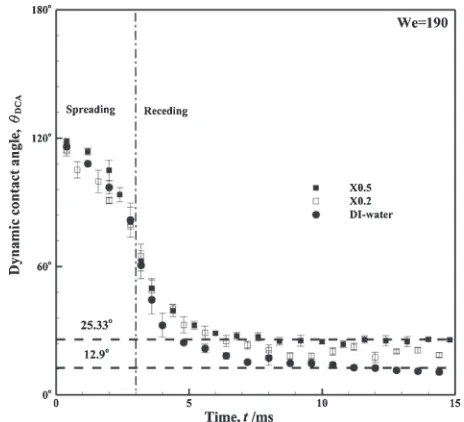
is the surface tension between solid and liquid. Figure 7 shows DCA measurements for various liquids with respect to time. In the spreading regime, there were small changes in DCAs between DI-water and xanthan solutions because of dominant shear-thinning effect of xanthan solution by fast
contact line velocity and shear rate driven from kinetic energy. However, in the receding regime, we observed distinct differences among DI-water and xanthan solutions. In addition, DCA increased with particle concentration in xanthan solution in the receding regime. For instance, DCAs for X0.5 increased approximately twice as much as that of DI-water droplets after 7.5 ms. Thus, dynamic variation in contact angle is important for understanding non-Newtonian characteristics. Change in DCA can be explained by the presence of effective viscosity force at the contact line.13,14)
The contact line velocity of a receding droplet is much slower than the spreading velocity because the receding droplet is driven by stored surface energy. Therefore, the receding droplet is influenced by large shear viscosity at low shear rates driven by slow contact line velocities. This result is similar to observations from other experiments, which studied increasing DCAs as shear viscosity (or the zero-shear viscosity) increased in the receding regime.27,28) However, variation of shear rate during spreading or receding is not calculated in this study, and additional work to calculate the shear rate is needed.
4. Conclusions
In this study, we conducted extensive experiments for non-Newtonian droplet impingement on solid surfaces to investigate non-Newtonian effects on the dynamic behavior of liquid droplets in the spreading and receding regimes. As a result, the following conclusions can be drawn:
(1) Depending on the Weber number, distinct differences between Newtonian and non-Newtonian droplets were found in the receding regime; these differences were closely associated with viscous dissipation energy. For non-Newtonian droplets, the receding motion was much slower due to the shear-thinning effect and a large zero-shear viscosity.
(2) In experiments, measured maximum spreading diame-ters were nearly the same among DI-water and xanthan Fig. 7 Measured dynamic contact angles for DI-water and xanthan
[image:5.595.310.542.69.280.2]droplets. The original U-K model failed to predict the maximum spreading diameter accurately for xanthan droplets. Our modification of viscous dissipation energy reduced prediction errors, but better models are still needed.
(3) DCAs of non-Newtonian and Newtonian droplets were similar in the spreading regime where the inertial force is dominant. In the receding regime, on the other hand, DCAs of non-Newtonian droplets were larger, because of larger shear viscosity at lower shear rates.
Acknowledgements
This research was sponsored by Chung-Ang University Research Grants in 2010.
REFERENCES
1) Y. I. Oka, S. Mihara and H. Miyata:Wear263(2007) 386394.
2) S. Nicolici, I. Prisecaru and P. Ghitescu: U. P. B. Sci. Bull. Series D74 (2012) 147154.
3) S. Hattori: ISaG2010, (General Review Session of The NISA-Project, 2010) pp. 5871.
4) Q. Zhou, N. Li, X. Chen, A. Yonezu, T. Xu, S. Hui and D. Zhang:
Mater. Trans.49(2008) 16061615.
5) R. Wang and M. Kido:Mater. Trans.48(2007) 14511457.
6) H. Wu, H. Lin, Y. Kuo and W. Hwang:Mater. Trans.45(2004) 893 899.
7) J. Ye and Y. Sahai: Mater. Trans.37(1996) 175180.
8) G. K. Seevaratnam, Y. Suo, E. Rame, L. M. Walker and S. Garoff:
Phys. Fluids19(2007) 012103.
9) Y. Son, C. Kim, D. H. Yang and D. J. Ahn:Langmuir24(2008) 2900 2907.
10) P. Neogi:AIChE J.56(2010) 32843285.
11) X. D. Wang, D. J. Lee, X. F. Peng and J. Y. Lai:Langmuir23(2007) 80428047.
12) V. Bergeron, D. Bonn, J. Y. Martin and L. Vovelle:Nature405(2000) 772775.
13) S. M. An and S. Y. Lee:Exp. Therm Fluid Sci.38(2012) 140148.
14) S. M. An and S. Y. Lee:Exp. Therm Fluid Sci.37(2012) 3745.
15) S. M. An and S. Y. Lee: ILASS-Asia 2010, (Institute for Liquid Atomization and Spray Systems, 2010) pp. 321328.
16) L. Luu and Y. Forterre:J. Fluid Mech.632(2009) 301327.
17) A. Saidi, C. Martin and A. Magnin:J. Non-Newtonian Fluid Mech.165 (2010) 596606.
18) J. J. Cooper-White, R. C. Crooks and D. V. Boger:Colloids Surf. A210 (2002) 105123.
19) M. Aytouna, D. Bartolo, G. Wegdam, D. Bonn and S. Rafai: Exp. Fluids48(2010) 4957.
20) G. German and V. Bertola:J. Phys. Condens. Matter21(2009) 375111.
21) T. Mao, C. S. Kuhn and H. Tran:AIChE J.43(1997) 21692179.
22) A. F. Stalder, T. Melchior, M. Muller, D. Sage, T. Blu and M. Unser:
Colloids Surf. A364(2010) 7281.
23) P. L. du Noüy:J. Gen. Physiol.7(1925) 625631.
24) C. Ukiwe and D. Y. Kwok:Langmuir21(2005) 666673.
25) M. Pasandideh-Fard, Y. M. Qiao, S. Chandra and J. Mostaghimi:Phys. Fluids8(1996) 650659.
26) D. C. Vadillo, A. Soucemarianadin, C. Delattre and D. C. D. Roux:
Phys. Fluids21(2009) 122002.
27) S. Sikalo, H. D. Wilhelm, I. V. Roisman, S. Jakirlic and C. Tropea:
Phys. Fluids17(2005) 062103.