Munich Personal RePEc Archive
Study of E-banking services and
products in Afghanistan
Karimi, Abdul Matin
Kardan University
15 May 2016
Online at
https://mpra.ub.uni-muenchen.de/71319/
Study of E-banking services and products in Afghanistan
Prepared and submitted by: Abdul Matin Karimi
This thesis research paper has been prepared by; Abdul Matin Karimi, bachelor degree qualified in Economics from Kardan University, Kabul, Afghanistan.
This particular research has not been yet published anywhere else before, and all the contents are hereby reserved by the author.
Regarding any issue, please contact through given email.
Abstract
This particular research has been conducted in Afghanistan to study and evaluate the individual’s perception toward e-banking platform, and to further identify the challenges that are faced with this infant phenomenon. Despite of decades’ war and destruction in Afghanistan, still, it was observed that the private banks took a vital and special part in the recognition of e-banking services and products through their financial institutions in such a wide variety of context which can be an optimistic vision for the improvement of the future of electronic banking in Afghanistan. This research is descriptive, and a quantitative research technique was considered efficient for the fulfillment and attainment of settled objectives. Where a detailed questionnaire was the main primary data source plus various secondary data sources. And also, main hub of data collection was from AIB, AUB, Bakhtar and Aziz banks customers and employees.
Table of Content
Page Title ... Page Numbers
Cover Page ……….………... i
Abstract ……….………..………..………... ii
List of Figures ………...…..………..……….…………...…….... 3
List of Acronym ………...………..…….……….. 4
Acknowledgment ………...………….……..….………..…. 5
Chapter - 1 ……...………...………..….……….………. 6
Introduction………..……….……...……...………….…. 6
1.1 Background of Study...……….…....……… 6
1.2 Problem Statement ………...……..…..………..…… 9
1.3 Objectives of the Study …….………....…..……….... 9
1.4 Aim of the Study ……….………..………..…… 9
1.5 Significance of the Study …..………...…..……..………...………..…… 10
1.6 Scheme of the Study …….………..……..……… 11
Chapter - 2 ……...………..………...…...….………. 12
Literature Review………..………...12
2.1 Review of Literature Studies ……….………….………..………. 12
2.2 Research Gap ………..………….………. 15
Chapter - 3 ……...………..……….………...……….…………...… 16
Research Methodology………..………...16
3.1 Methodology ……….………….…………...………...………….…… 16
3.2 Research Technique ………….……….…………....……… 16
3.3 Population and Sample ……….………. 16
3.4 Primary Data Collection ……….……...………..….……… .17
3.5 Secondary Data Collection ……….….…….……… 17
3.6 Limitation of the Study ………….…….…...………...….……… 17
Chapter - 4 ……...……….….…..……….. 21
4.1 Finding and Analysis ……… 19
4.2 Result and Discussion of Questionnaire ……….………... 20
Chapter- 5 ………..………...………. 36
Conclusion and Recommendations………..……… 36
5.1 Conclusion ………...………... 36
5.2 Recommendations ……….………...………. 37
5.3 References ………..….…………...………...……… 39
List of Figures
Figure Number ... Page Numbers
Figure 4.1: Gender of Respondents ………...………....…………. 20
Figure 4.2: Age of Respondents ………...………..… 20
Figure 4.3: Education of Respondents ………..………. 21
Figure 4.4: Account type of Respondents ………...………..……. 21
Figure 4.5: Trust in E-banking for Secureness ………...………... 22
Figure 4.6: E-banking Preference for other Individuals …………...……….. 23
Figure 4.7: E-banking utility for ATM and/or POS ……….…….…………... 24
Figure 4.8: E-banking utility for online channels ……….………..…………... 25
Figure 4.9: Price and documentation influence over E-banking utility …....…………... 26
Figure 4.10: E-banking Convenience for ATM, Online and transfers ………..……... 27
Figure 4.11: E-banking access 24/7 ………...……….. 28
Figure 4.12: Illiteracy and low internet access influence over E-banking services……….. 29
Figure 4.13: E-banking Secureness in term of payments/receipts ……….…... 30
Figure 4.14: E-banking efficiency and effectiveness in comparison to CB ………... 31
Figure 4.15: Documentation and access duration of E-banking services ……….... 32
Figure 4.16: E-banking service charges ………... 33
Figure 4.17: E-banking in term of resource management ……… 34
List of Acronym
- E-Banking Electronic Banking - CB Conventional Banking - I-Banking Internet Banking
- AIB Afghanistan International Bank - DAB Da Afghanistan Bank
- AISA Afghanistan Investment Support Agency - EFT Electronic Fund Transfer
- ATM Automatic Teller Machine - POS Point of Sale
- SME Small Medium Enterprises - UK United Kingdom
- SWOT Strength, Weakness, Opportunity, Threat - IMF International Monetary Fund
- ABA Afghanistan Banking Association - ISP Internet Service Provider
Acknowledgement
After due perseverance and hard work followed by my cordial passion, I have successfully completed this research project with the grace and blessing of most merciful, almighty Allah. And also, frequent support of my honorable academic professors, colleagues, friends, fellows and all other individuals who took part in completion of this research project was countless and outstanding, for which I’m cordially thankful to them.
It worth’s to mention that Mr. Kokab Manzoor, my leading project supervisor has added a special value to the completion of this project with his consistent support, leadership and guidance. And it was not possible for me to end up with this project without his endeavors.
At the Kardan University, I am thankful to my honorable professors, academic advisory board, fellows, student support team and all other individuals who added value for smooth and professional educational environment.
At the Afghanistan International Bank (AIB), I cordially appreciate and convey my pleasure to my respected colleagues, supervisors and all others who took a vital part in the submission of questionnaire and their feedbacks and support was outstanding and countable.
Chapter 1
Introduction
1.1 Background of Study
Advancement and efficiency in technology, resources utilization and service sector has changed the world in a global village. Hence, at this scenario for a modern person time is becoming more and more valuable, they are less enthusiastic about wasting their time, in events like long queues in Banks, poor customer service or being restricted to business hours. Now by taking benefit over E-banking you can accomplish most of the simple banking procedures in minutes and at any time.
Afghanistan banking sector faced huge challenges since late 2001 after collapse of Taliban regime; New banking laws were passed in 2003 and in early 2004, based largely on international best practices. Following decades of conflict, the financial and banking systems of Afghanistan was devastated. As an example; informal gray market for transferring and exchanging money still dominates financial services in the country which causes that afghan private banks faces problems with transferring money from abroad to Afghanistan despite the approval of the anti-Money laundering and counter financing terrorism (AML/CFT) laws, as number of foreign banks have reportedly refused to transfer money into Afghanistan being intermediaries.
In between 2002-2004 major banks were initially operating and providing its basic services as; branch permitted institutions (4 Banks), private Afghanistan incorporate entities (4 Banks) and State owned relicensed entities (3 Banks) with authorize issued license by AISA and DAB. Hopefully, ending 2014 there were 17 licensed banks including three state-owned banks and five branches of foreign banks. Additionally, there were 89 licensed money service providers, and 8 more in the process of being licensed. Also, 14 microfinance institutions, including 12 nongovernmental organizations provides financial assistance for business sector in Afghanistan.
As of 2005, majority of banks started offering various basic competitive and unique e-banking services and products in order to attract private and corporate customers. But in most of the cases their operations were constrained severely due to deficiencies with regard to inadequate banking laws and regulations, technology limitations, limited knowledge of peoples, inadequate access to internet, poor competitive labor market, minor support of government and due security issues limited the operation of commercial banks in remote areas.
But in most recent years the commercial banks are providing a wide variety of competitive, efficient and upgraded e-banking services and products in accordance to domestically and internationally accessibility and usage.
Afghanistan has made considerable progress in revitalizing its banking sector by undertaking modern technology and providing different products and services in line with international standards. As a result, now a day an intensive competition among banks have been arisen by providing various kind of e-banking services/products and efficient management in resources allocation and saving money. It is a well-known fact that an effective and efficient banking system is important for long-term sustainable growth and economic development. Thus, each bank tries to be unique in products and services to achieve a higher market share.
E-banking is the latest delivery channel to be presented by commercial banks. Since now a day there is large customer acceptance rate which means customers are willing to shift from conventional practices into modernize, efficient, ease accessible and convenient banking affairs.
E-banking technology has been numerously expanded in recent years which can be a good start up for efficient and effective financial setup and dealings. E-Banking services are based on the uses of new technologies to provide various conventional banking affairs directly to customers around the clock. Banks offer a wide range of these services that can be used by electronic tools also, such as: ATM, POS, Master Cards, Maestro Cards, online banking, SMS banking, statement accessibility, wire transfer, payroll transfer, etc.
and it can be counted successful if a commercial bank takes into account clients preference, availability of resources, system security, suitable brand name, multiple integrated distribution channels, specific marketing tools, support from top management and good customer services are the vital factors for the success of e-banking. And to be successful, banks should take initiatives and have to offer e-banking facility instead of being pushed into it by others.
With the help of E-banking platform customers can access for any banking affair not only when they want but also with convenience, comfort, confidentiality and security from their homes, office or any other place by using internet or other networks, television, telephone/modems. Due to various aspects of technology, there is a need to monitor efficiency of the banks to best judge their status in global environment. The banks with adequate electronic base are gaining momentum where the others are fighting for their survival.
Recent years have seen a quiet revolution in the way we choose to pay for things, as more and more transactions happen by cards and online instead of cash. Many of us lead busy lives; we rush to work, rush to get the kids to school, and at the end of the day we rush home only to brace ourselves for the next day. After a hectic day, the last thing you want to do is spend time waiting in line at the bank. That's where e-banking services and products will give you a support hand for any banking affairs.
There are many advantages inherent with E-banking which allows you to conduct your banking transactions safely and securely without leaving the comfort of your home and office. Or uses of other service and products such as: Master cards, ATM, POS, SMS banking, mobile banking and many more.
E-banking service and products are available to everyone, regardless of credit rating, income, banking background, or even some of them can be accessible without holding a prior bank account. i.e.: Prepaid Master Card; which majority of banks offers in Afghanistan.
The introduction and use of upgraded E-banking service and products therefore brought efficiency in the banking industry majorly in terms of speed, data processing, online and cash payments. Thus, a long queuing in most of bank halls are mitigated.
1.2 Problem Statement:
E-banking services and products has entered into market of Afghanistan as an infant phenomenon over past decade with establishment of private owned commercial banks. Hence banking industries are still not able to provide its services concern with e-banking in compliance with international standards. For instance, the credit card is issued with secure functionality with majority of banks in which the bank holds customer funds instead of providing them credit facility thoroughly.
Mostly, due to; high risks associated, technology unavailability, budget shortage and government stagnancy in support for banks; are the reasons that the banks cannot provide its services and products related to e-banking in compliance with international standards, and hence the adverse impact will be upon customers’ satisfaction and sales of banks. Apart from; people’s unawareness, illiteracy, service charges, documentation process are also the core issues which needs to be taken into account. Due to less number of branches and staff, hence customers needs to wait for long lines and wait for days in order to grasp that specific product or service they are in need of. Hence, at this research each effort has been given to find to reasons behind these problems and provide best possible solutions to it.
1.3 Objectives of the Study
The main objectives of my research are as follows:
1.
Analysis of individuals preference and documentation process for access of E-banking services and products.2.
To identify the challenges faced to e-banking in Afghanistan.1.4 Aim of the Study
remedies in order to vast and improve the quality of existing e-banking products/services in compliance with international standard and practices.
The study will provide guidance and motivation for peoples in order to move toward e-banking technology and get familiarize with electronic banking in order to attain and fulfil their needs through this platform with efficiency and effectiveness. This study thus shed light on the awareness of E-banking to society and as a view point for banking industry by showing how quality services offered by E-banking are essential and its relationship to customer satisfaction. Furthermore, seeks to show how customers perceive values, and what underlying factors that affect their choice of banking services the most, as well as the researcher will strive to examine the mediating role of Customer value in the impact of e-banking services on customer loyalty.
1.5 Significance of the Study
This research project will help to know about the close interrlationship of E-banking services with commercial banks development, factors for entrance of E-banking sector into commercial banking and how the E-banking products and services influnced the routine activites of customers and on other hand how much it has influence over aggregate sales and income of commercial banks . Also this research project can give a bright and detailed outcome to individuals and commercial banks regarding constraints, hurdles, soluitons, and benefits which can be generated over utility of such services and products.
Since in Afghanistan there is a great need for commercial banks that can provide capital, services and products for corporations, Industries, SME’s and private individuals. Any bank with the right management and good corporate governance will create and present lots of economic and financial benefits and opportunities.
1.6 Scheme of the Study
- Chapter One: Highlights the introductory arguments about the study, problems statement, Aim of study, Research Objectives and Significance of study.
- Chapter Two: Discusses the literature review of E-banking considering different research projects and articles.
- Chapter Three: Intends to introduce the methodological issues used in finding out the materials for this project.
- Chapter Four: Findings and Analysis attained through questionnaires, interviews and observations
Chapter 2
Literature Review
2.1 Review of Literature Studies
E-banking concept is, the delivery of banking services and products through effective, rapid, convenient and flexible methods other than conventional practices. Since revolution and advancement in technology most of the banks had tried and trying to pave the way for its customer to have access for E-banking services and products through internet, designed software’s and even mobile phone applications.
E-banking enable the individuals and corporations to have access for account information, transferring funds, account statement and other attached services through private or public networks.
For the purpose of this study there are lots of literature and research articles on electronic banking services, customer responses and choices considering different locations and time periods. This chapter will contain some theories for the literature review which will cover the chosen subject in major. For instance, some of underneath given literatures will lead and help to know what other researchers, scholars or professional individuals have found and recommended in regard to their chosen subject of matter concerned with E-banking.
Milind, Sathye. (1999) asserted in his research paper that; Since e-banking is the newest and upgraded delivery channel of different services through which bank customers can request information’s and carry out most retail banking services via, computer, television or mobile phone hence it can be defined differently with different researches.
Burr, W. (1996) Described and defined e-banking; As an electronic connection between bank and customer in order to prepare, manage and control financial transactions. Further he mentioned that, increase in income and revenue over the sales of e-banking services/products needs innovation, invention, convenience and improvement which needs to be taken into account by commercial banks. But to my point of view (The researcher) ; E-banking is the practice and capability of utilizing and benefiting the existed products and services of a bank through public or private based networks including Internet or designed software’s and applications for convenience, efficiency and ease of access.
in the banking world of tomorrow is to embrace new concepts of reaching and satisfying customers. In his publications it was also mentioned that in 2003, that 10 million online money accounts were active in the UK (this was the highest figure for any European Country).
Ismail, Mohammad. A., & Osman, Mohammad. A. Y. (2012) asserted in one of their researches adopted in Sudan that; Usage of e-banking services/products will consist some charges, knowledge and access of attached technology, income of individuals, type of accounts and willingness of individuals. Hence findings in Sudan shown that the usage of e-banking is likely attached to income, account type and basic literature of computer and internet. In which high income clients and those who have current account and computer and internet literate are more likely to use e-banking services.
Krishnamoorthy, V. and Dr. Srinivasan. (2013) found and explained; that banks are finding difficulty in retaining their existing customers, for which either they need to come up with innovating, customized products or they need to develop trust with their customers and maintain the relation with them.
Safeena, R., Abdullah and Date, Hema. (2010) explained that; Information technology is considered as the key driver for the changes taking place around the world. Internet banking (IB) is the latest and most innovative service offered by the banks. The transformation from the traditional banking to e-banking has been a 'leap' change. The evolution of e-banking started from the use of Automatic Teller Machines (ATMs) and telephone banking (tele-banking), direct bill payment, electronic fund transfers and the revolutionary online banking.
Brannan, Susan. (April 52, 2004), this article discusses the importance of usability within the e-banking sector and identifies common usability problems and ways to resolve them.
Research shows 50% of perspective customers registering for online banking bail out before signing up, mostly due to problems navigating the site, completing online form, security fears, and understanding content and feedback.
Sharma, Himani. (2011), She has conducted the research with the subject of “Banker’s Perspectives on E-Banking”, and data for this research was collected through a questionnaire in Northern region of India by administering to 192 bankers. The enquiry reveals that customers generally use e-banking services on persuasion of bankers. The bankers are convinced that e-banking helps in improving the relationship between bankers and customers and that it would bring patent improvement in the overall performance of banks.
Mermod. Asli Yüksel. (April 2011) has concluded from his research in turkey that; The usage rate of the internet banking is significantly related with the education levels. Education and also income level makes an important difference in the usage of internet banking facilities. Today, banks are switching to multi-channel distribution of financial services through internet, and most used internet banking service is the “transfer from one account to another”.
Singh, N. P. (2007) Hi-tech fraudsters have urbanized a new way of tricking on line banking customers. One such most well-known and fast growing technique is phishing. Phishing: is derived from the 3word fishing. Phishing also called brand spoofing, is a term used for a short of fraud where phishes send out spoof email to a random database to fool the recipient in to divulging personal information like credit cards details, usernames and passwords, that can be used for identity theft. The study opined that there is a sharp rise in phishing statistics as it evident from the values in various tables. May it be number of hosting of phishing sites, or mails received about phishing monetary loss either of the customers or of organizations. The main reason for losses/success of frauds is ignorance on part of customer as well as service providers (bankers, retailers, etc.). It requires stringent methods of educating customers and regular review of security related information of individual customers.
2.2 Research Gap
This study does not differ greatly from other studies in this field; however, it differs in some matters which make it a distinct study such as:
The review of literature suggest that most studies have discussed the issues, hurdles, advantages, characteristics and the benefits which the banks obtain from their electronic service in other regions. While this study focused on customer’s perception regarding e-banking and challenges that are faced with e-banking in Afghanistan.
Chapter 3
Research Methodology
3.1 Methodology
A descriptive research design has been considered the most suitable approach in view of the nature of the problem being investigated. A structured questionnaire based on the objectives of the research has been adopted which consist of close ended and Likert scale questions. Questionnaire was the main data gathering instrument followed by some observations and various secondary data sources to back up, assure and add value for the attained result and outcome. First of all, a set of structured likert scale and close ended questions were prepared and circulated amongst number of randomly selected individuals of both genders who were involved in the utility of E-banking services and products, followed by few semi-structured interviews and personal observations from and with bank officials, duty-bearers and other e-banking services users. Also, due to commercial confidentiality and sensitivity of the e-banking information the questionnaire was structured and presented in a manner that did not required the respondents to reveal their bank or account holding stations.
3.2 Research Technique
For the current study, a quantitative research method has been used with the help of structured questionnaire that includes close ended and likert scale questions. Also, different secondary data sources have been used for adding value to attained result. For attainment of a good and efficient outcome over settled objectives it was important to use quantitative research method. Because, major portion of objectives were attached with customer preferences over banks and associated e-banking services, government initiatives and challenges of e-banking in Afghanistan. Hence, by taking into account a quantitative research method the settle objectives can be attained efficiently and effectively.
3.3 Population and Sample
Further on, convenient sampling technique has been used in this research; It’s is a type of non probability sampling technique which involves the sample being drawn from that part of the population which is convenient, easily accessible and proximate to the researcher. For which, the sample size of (100) selected individuals; including bank employees, bank customer and other professional experts of e-banking affairs have been collected, and the derived outcome has been described and explained in details with relevant chapter of this research project.
3.4 Primary Data Collection
Major efforts have been made to collect data freshly and widely through primary data source, hence he main portion of information in this report have been collected through circulated and structured questionnaire that includes close ended and likert scale questions amongst specific number of banks such as; Azizi bank, Bakhtar bank, Afghan United bank and Afghanistan International bank employees and random selected customers who utilizes e-banking service and products.
3.5 Secondary Data Collection
Secondary data source was also vital for the completion of this research project and a major portion of secondary data source was collected for the first and second chapter of this research project.
The secondary data in this research report was collected through the following sources: Bulletins, annual reports and journals of Da Afghanistan Bank. Research papers of scholars and researchers. Afghanistan Banking Association journals, bulletin’s and reports. World Bank, IMF and AISA research papers and reports, Private Banks annual reports, journals and magazines. Personal records, Commercial magazines and internet sources (Wikipedia).
3.6 Limitation of the Study
Every research is limited to some areas, and the limitations of this research are stated as follows:
types, hence usually they do not disclose most of the information’s. Accessing information on the topic and especially from the government entities (DAB) might be difficult.
Occasionally, sometimes the weak communication network between supervisors and students may causes difficulties. Because, mostly the supervisors are leaving university toward their homelands and it become hard for students to see them frequently and speak to them.
Chapter 4
Finding and Analysis
4.1 Finding and Analysis
Briefly to describe about the findings; the customers were highly satisfied and please with e-banking in term of secureness, technology in use, variety of services/products and accessibility at any place and point of time. Also it worth’s to mention that the majority and/or half of respondents were of the view that; illiteracy, low internet access, high service charges, huge wait in lines and low quality service can cause low usage of e-banking service and products. Which is a solid fact in researcher point of view and above issues can be counted as challenges faced by e-banking, and hence these issues has to be considered into account highly important by the banks and regulatory bureau’s in order to boost and improve the utility of e-banking.
Major data was obtained from primary sources through a structured questionnaire; which was designed with consideration of 3 parts; background information of respondents, close ended questions and likert scale questions. Which was latterly conducted inside Kabul province of Afghanistan, and major respondents were selected individual customers and employees of the banks (Afghanistan International bank, Afghan United bank, Bakhtar bank and Azizi bank).
The result for this research consist of 100 respondents from above mentioned banks customers and employees. Also each effort has been made to take the respond from those who are directly involved with the utilization of e-banking services/products and can provide a proper feedback upon each given question stated in the questionnaire sheet.
Over all the total effort was to find out the personal perception of individual users regarding e-banking services and products charges, convenience, documentation, personal ideas and over all challenges that they face while accessing it. And to more extend a good outcome was attained from each given section and each question consisted in between.
The questionnaire was developed in such a manner where it could cover all the required necessities to find a favorable answer and feedback from selected individual users.
4.2 Result and Discussion of Questionnaire
Section 1: Background Information of Respondent
1- Gender:
[image:23.595.73.549.252.409.2]The research which was conducted with consideration of four private banks customers and employees in Afghanistan have had the result that 90% of respondents were randomly selected males and 10% were females, as it illustrates beneath with the help of pie graph.
Figure 4.1: Gender of Respondents
2- Age:
Amongst respondents from both genders of males and females about 53% were age between 18-25 years old, 42% were age between 26-35 years old and the remaining 5% were age between 36-45 years old. As it illustrates beneath with the help of pie graph.
Figure 4.2: Age of Respondents
90% 10%
Gender
Gender
Male Female
53% 42%
5% 0%
Age
Age
[image:23.595.70.548.577.750.2]3- Education Level:
[image:24.595.71.571.180.373.2]From over all respondents, 18% were high school degree holders, 77% were u undergraduate (bachelor) degree holders and the remaining 5% were graduate (master) degree holders. As it illustrates beneath with the help of pie graph.
Figure 4.3: Education of Respondents
4- Account Type:
While asking respondents for their feedback of designed questionnaire, round about 77% of respondents were having current accounts, 7% were having saving accounts, 1% were having fixed term accounts and the remaining 15% were having Islamic accounts. As it illustrates beneath with the help of pie graph.
Figure 4.4: Account type of Respondents
18%
77% 5%0%
Education Level
Education Level
High School Bachelor Master Phd
77% 7%
1%
15%
Account Type
Account Type
[image:24.595.74.556.561.756.2]Section 2: Close Ended questions (Yes/No)
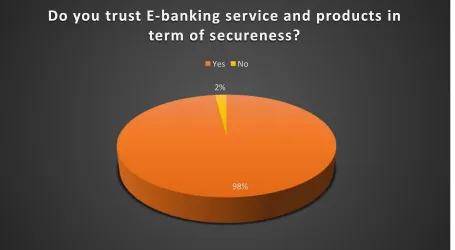
1- Do you trust E-banking service and products in term of secureness?
[image:25.595.74.529.429.679.2]As per the data attained from respondents it was found that 98% are of the view that e-banking services and products are secure and are willing to utilize them for the ease of their routine need and to take transactions with them without any fear of insecurity, but only 2% were not assure that the e-banking services and products are not secure to be utilized and used for the transactions purposes which is a minor percentage. But still a major percentage of users are satisfy with the secureness of e-banking service and products inside Afghanistan with stated banks. And this is a good news toward utility of e-banking service and products for both, the user and service providers (banks).
Figure 4.5: Trust in E-banking for Secureness
98% 2%
Do you trust E-banking service and products in
term of secureness?
Do you trust E-banking service and products in
term of secureness?
2- Do you prefer E-banking services and products for your friends and other individual account holders?
Based on given question 97% of randomly selected respondent from both the genders agreed to prefer e-banking services and products to their friends and other individual users in order they can be benefited also. And only 3% of respondent were of the view that they will not prefer e-banking service and products to their friends and other individuals.
[image:26.595.76.541.404.661.2]Over all its optimistic that majority of customers are willing to inform their friends and prefer them to utilize e-banking service and products of concern banks to where they hold accounts. And also this a good new for private banks in order to further develop and pave the way for advancement, improvement, revolution and addition in their existed service and products of e-banking.
Figure 4.6: E-banking Preference for other Individuals
97% 3%
Do you prefer E-banking services and products
for your friends and other individual account
holders?
Do you prefer E-banking services and products
for your friends and other individual account
holders?
3- Do you use E-banking Services and products for cash withdrawal through ATM and/or POS machine?
[image:27.595.75.548.352.620.2]From total respondents, 93% were utilizing debit card for ATM and/or POS transactions and only remaining 7% were not utilizing. It can be a good news for the banks that majority of account holders are willing and utilizing these facilities for ease of access and better service. And the remaining minority may not utilize because they are not aware of these ease and service and/or they are willing to not take transactions for usual through banks.
Figure 4.7: E-banking utility for ATM and/or POS
93% 7%
Do you use E-banking Services and products for
cash withdrawal through ATM and/or POS
machince?
Do you use E-banking Services and products for
cash withdrawal through ATM and/or POS
machince?
4- Do you utilize E-banking services and products for online payments and online purchasing?
[image:28.595.73.538.419.680.2]About 63% of randomly selected individual users were utilizing e-banking service and products for online payments and purchasing and the rest 37% were not utilizing e-banking services and products for online transactions. The minor gap in between utilizing users and no utilizing users was that in Afghanistan majority of population, business dealers and other entities are not that standardize which can benefit from modern technology in order to have all the dealing through internet and online payments and hence majority of individual users are not that interested regarding online transactions. But those who utilize these facilities, they may need it because of payments out of country or upon their need while resident in foreign countries.
Figure 4.8: E-banking utility for online channels
63% 37%
Do you Utilize E-banking services and products
for online payments and online purchasing?
Do you Utilize E-banking services and products
for online payments and online purchasing?
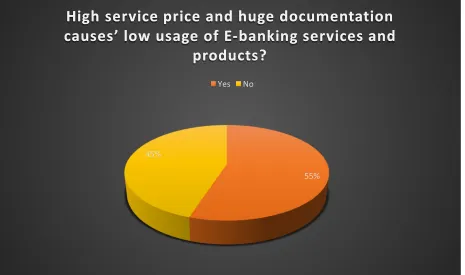
5- High service price and huge documentation causes’ low usage of E-banking services and products?
[image:29.595.74.539.405.680.2]Round about 55% of the individual users are upon the view that high service charges and huge documents causes the low usage of e-banking service and products, whereas 45% others are of the view that high service charges and huge documentation does not affect the low usage of e-banking service and products. Now, based upon found measure it’s important that the private banks must take a look back into the service charges and documentation process in order they can provide convenience and ease to customer in terms of favorable charges and documentation process which will definitely bring positive outcomes to the cross sales of banks service and products.
Figure 4.9: Price and documentation influence over E-banking utility
55% 45%
High service price and huge documentation
causes’ low usage of E-banking services and
products?
High service price and huge documentation
causes’ low usage of E-banking services and
products?
Section 3: Likert Scale questions
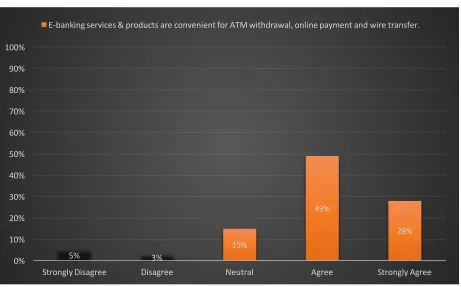
1- E-banking services & products are convenient for ATM withdrawal, online payment and wire transfer?
From total respondents; 5 % responded with strongly disagree, 3% responded with disagree, 15% responded with neutral, 49% responded with agree and the rest 28% responded with strongly agree for convenience of e-banking service and products while ATM withdrawal, online payments and wire transfers.
[image:30.595.76.537.412.699.2]From over all responds, still 77% were whether agree or strongly agree with stated question which can be a good news for banks, and also its shows the trend of individual users toward high level utilization of e-banking services and products in Afghanistan.
Figure 4.10: E-banking Convenience for ATM, Online and transfers
5% 3%
15%
49%
28%
0% 10% 20% 30% 40% 50% 60% 70% 80% 90% 100%
Strongly Disagree Disagree Neutral Agree Strongly Agree
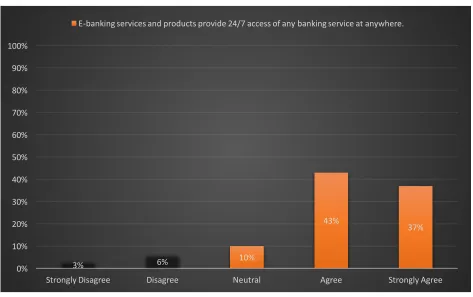
2- E-banking services and products provide 24/7 access of any banking service at anywhere?
For given question 3% respondents replied with strongly disagree, 6% with disagree, 10% with neutral, 43% agreed and remaining 37% with strongly agree.
[image:31.595.73.546.379.676.2]As It can be seen, jointly, round about 80% of respondents are agree and strongly agree with stated question that e-banking service and products are providing 24/7 access of all banking services and products which is an optimistic outcome and show the satisfaction of customers from e-banking service and products. And also it can be a good news for private banks in order to further boost and improve the security, access and improvement of such services and products.
Figure 4.11: E-banking access 24/7
3% 6% 10%
43%
37%
0% 10% 20% 30% 40% 50% 60% 70% 80% 90% 100%
Strongly Disagree Disagree Neutral Agree Strongly Agree
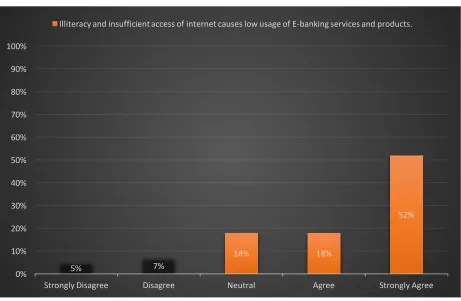
3- Illiteracy and insufficient access of internet causes low usage of E-banking services and products?
As per respondent’s replies, its seen that 5% respondents are strongly disagree, 7% respondents are disagree, 18% respondents are neutral, 18% respondents are agree and 52% respondents are strongly agree with stated question that illiteracy and insufficient access of internet can cause low utility of e-banking services and products.
[image:32.595.74.535.428.729.2]As it can be seen, majority of percentage respondents, totally, round about 70% are of the view that illiteracy and insufficient internet access can really causes low utility of e-banking services and products. This is the challenge and shortcoming concern with e-banking utility, where government initiatives can be useful for solvency, because government can provide short courses and training facilities for individual users, bank employees and civil servants of different organizations. And also the internet and e-banking utility education facility can be provided very conveniently through government support and help.
Figure 4.12: Illiteracy and low internet access influence over E-banking services
5% 7%
18% 18%
52%
0% 10% 20% 30% 40% 50% 60% 70% 80% 90% 100%
Strongly Disagree Disagree Neutral Agree Strongly Agree
4- E-banking is a secure setup for sending remittances and executing commercial payments?
Individual respondents replied with, 5% strongly disagree, 3% disagree, 18% neutral, 50% agree and 24% strongly agree replies for stated question.
[image:33.595.76.536.386.700.2]Totally 8% were of the view that the e-banking is not a secure setup for receipt or execution of remittances and commercial payments, 18% were neither agree nor disagree, and remaining 74% were of the view that e-banking can be a secure setup for sending remittances and execution of commercial payments which is again a good news for banks in order to further improve and motivate its customer by providing such secure and prominent services and on other hand customers also seems satisfy with the services that banks provide through their e-banking panel.
Figure 4.13: E-banking Secureness in term of payments/receipts
5% 3%
18%
50%
24%
0% 10% 20% 30% 40% 50% 60% 70% 80% 90% 100%
Strongly Disagree Disagree Neutral Agree Strongly Agree
5- E-banking services are more efficient and effective than conventional banking services?
Stated question was replied with 0% strongly disagree response, 5% disagree, 23% neutral, 38% agree and 34% strongly disagree from random selective individual users.
As a whole it can be seen that, round about 72% respondents were preferring e-banking services and products for being efficient and effective than conventional banking services with agreement or strongly agreement, because now a day majority of individual users are busy with their personal and professional life’s in such an era where the time needs to be managed with very caution and importance and hence these contemporary e-banking services and products can really satisfy their needs up to a high extend.
[image:34.595.73.537.459.733.2]Hence the banks need to focus on this issue and try level best to improve and expand the level of such services and products where customers can feel comfort and to have access for such services which can give them a support hand at any place and any time. And on same scenario this way banks can generate a high level of profit margin and remain a competitive entity in the market against their competitors.
Figure 4.14: E-banking efficiency and effectiveness in comparison to CB
0% 5%
23%
38% 34%
0% 10% 20% 30% 40% 50% 60% 70% 80% 90% 100%
Strongly Disagree Disagree Neutral Agree Strongly Agree
6- To access E-banking services and products, huge documentation and wait in line is required?
[image:35.595.75.537.442.736.2]Over all response of random individual users to this question was that 17% strongly disagreed, 33% disagreed, 24% neutral, 23% agreed and remaining 3% strongly agreed that access of e-banking services and products require huge documentation and wait in line with banks. Overall with a final result, half of individual respondents, about 50% were of the view that; access of e-banking service and products does not need huge documentation and wait line with banks and 24% were neither agree nor disagree. But, the rest 26% were of the view that long hours wait in line and huge documentation is required to access for e-banking service and products. At this point banks needs to focus once again on the terms, conditions and accessibility of e-banking services and products. And maybe this way the percentage of customer’s tendency will increase toward disagreement or strongly disagreement for stated question.
Figure 4.15: Documentation and access duration of E-banking services
17%
33%
24% 23%
3% 0%
10% 20% 30% 40% 50% 60% 70% 80% 90% 100%
Strongly Disagree Disagree Neutral Agree Strongly Agree
7- Current charges for E-banking services and products are satisfactory with banks in Afghanistan?
12% responded with strongly disagreement, 8% with disagreement, 29% neutral, 41% agreed and 10% strongly agreed with the current charges for e-banking services and products in Afghanistan.
[image:36.595.74.541.392.687.2]Overall as it can be seen, about 51% respondents are satisfy with current charges for e-banking services and products, 29% were neither agree nor disagree, and the remaining 20% are whether disagree or strongly disagree. At this scenario banks needs to focus on this issue in order to minimize the service charges to some extend in order to gain more percentage support of individual users toward optimal utility of e-banking services and products.
Figure 4.16: E-banking service charges
12%
8%
29%
41%
10% 0%
10% 20% 30% 40% 50% 60% 70% 80% 90% 100%
Strongly Disagree Disagree Neutral Agree Strongly Agree
8- Usage of E-banking services and products save time and resources for both, the user and bank itself?
[image:37.595.76.535.396.699.2]Regarding stated question responses were that; 0% strongly disagreed, 2% disagreed, 5% neutral, 28% agreed and remaining 65% were strongly agreed that the utility of e-banking services and products can save the time and other resources for both, the users and banks. It’s a clear and vivid truth that e-banking services and products are equipped with contemporary technologies and can be accessible at anytime and anyplace through access of internet, network, mobile, computer and other electrical equipment’s. For which it can save time and other resources very well and hence totally 93% respondents replied with agreed or strongly agreed responses to this question which is a beneficial and an important achievement for banks.
Figure 4.17: E-banking in term of resource management
0% 2% 5%
28%
65%
0% 10% 20% 30% 40% 50% 60% 70% 80% 90% 100%
Strongly Disagree Disagree Neutral Agree Strongly Agree
9- E-banking services and products are equipped and backed with secure and contemporary technologies?
2% Responded with strongly disagreement, 0% with disagreement, 20% with neutral, 53% with agreement and remaining 20% replied with strongly agreement for back up of e-banking services and products through contemporary securities and technologies.
As it can be seen majority of respondents trust banks and its services in terms of secureness with contemporary and updated technologies. As it can be seen, as a whole 73% response is with agreement and strongly agreement for the secureness of e-banking services and products equipment with contemporary technologies. Which can be a good news for banks and they should keep trying to remain update and such active for secureness of the services and products they provide to customers.
[image:38.595.76.535.453.732.2]And also this is a key strength for banks in order to attract more and more customers by showing them that they have the latest and upgraded technology for back up of their services and products which they provide.
Figure 4.18: E-banking secureness in term of upgrade/contemporary technology
2% 0%
20%
53%
20%
0% 10% 20% 30% 40% 50% 60% 70% 80% 90% 100%
Strongly Disagree Disagree Neutral Agree Strongly Agree
Chapter 5
Conclusion and Recommendations
5.1 Conclusion
Since this research was conducted based on individual’s preferences and also to identify the challenges that banks faces on usual bases, concern with e-banking, the result found was satisfactory and majorly in favor of banks. Because majority of respondents were please and satisfied with e-banking services/products in terms of secureness, technology in use and accessibility at anywhere and any point of time. But still there were some challenges and hurdles that individual users were facing with banks regarding the services and products that they were utilizing and/or willing to utilize. And those hurdles and challenges were mostly with the documentation processes, service charges, low internet accessibility, illiteracy of users and low cooperation of banks and regulatory bureau’s in education of users toward utility of e-banking.
It was also found that, majority of customers were utilizing e-banking services and products for wide variety of needs such as: ATM withdrawals, POS purchasing, online payments, online banking, SMS banking, mobile banking and many more concern activities.
Individual users in majority were preferring e-banking against conventional banking which can be deemed as a good and optimistic vision for future convenience, because this will boost the preference of other individuals also toward this contemporary technology which will definitely have positive impact over economy and currency of Afghanistan. And a good outcome which can be derived from utility of e-banking services and products is that time and resources can be managed and saved with the desire and passion of each individual users as per his/her need.
solve with the help of government initiatives and ISP organizations which will definitely boost the performance of economy from each and every perspective.
Overall the opportunities and good news for banks are that individual users are satisfy with technology, secureness, level of services and products, varieties of services and products, and utility of e-banking services and products at anywhere and anytime. But, the challenges that banks are facing concern with e-banking are; with, high service charges, documentation process of access to e-banking services and products, huge wait in lines at branches, low awareness of peoples, low access of internet by individual users, and illiteracy. And these points were also noticed by individual users and their responses were to improve and mitigate the shortcoming and flows. And of course at this point both, the government and banks needs to take a collective action and set a scope for each flow and shortcoming to come over and improve it in favor of individuals and their own convenience.
5.2 Recommendations
As of each research, this research also had some shortcomings and hurdles concern with the e-banking services and products that banks are providing in Afghanistan and each effort is given to find a good solution and recommendation in compliance with the desire, needs and requirements of individuals and current market for which beneath pointed recommendations have been suggested:
1- Banks need more than any other time to activate, develop, and innovate new techniques to encourage their customers for utility of e-banking services and products.
2- The banks must maintain frequent long term relationships with their customers through email, phone, and social media channels in order to obtain the advantages of a customer base loyalty to the bank, it is necessary to develop strategies that prevent loss of customers. 3- Banks should provide proper training materials and facilities through different channels such as email, social media, printed booklets and phone call support to their customers about e-banking facilities and mechanism of operation for their customers’ better understanding, especially the public sector banks. Because it has been found that the customers are more influenced by the bankers rather than by the print Medias.
apart from their other objectives. Even the customer complaint resolution process shall be faster and have to end with a positive and justify outcome and feedback.
5- E-banking data and systems should be classified according to their sensitivity and importance and protected accordingly. Appropriate mechanisms, such as encryption, access control and data recovery plans should be used to protect all sensitive and high-risk e-banking systems, servers, databases and applications.
6- It is important for banks to differentiate themselves from competitors by providing variety and most convenient, secure and contemporary e-services and products. And for sure those banks which provide variety and convenient e-banking services and products will benefit and enjoy from huge cross sales.
7- Government and Afghanistan Banking Association needs to create a mechanism for which the banks tend to start competition with each other for the e-services and products which they provide and hence the quality and variety of e-services and products will also boost and improve in favor of customers. Which will latterly decrease the service charges and customer satisfaction can also be attained for best performer bank.
8- Government initiative and intervention can lead toward better and optimal usage of e-banking through different public awareness announcements, accepting the online payments for gas, oil, electricity, rent and water bill payments.
9- Banks should take appropriate steps to inform and assure e-banking customers about the confidentiality and privacy of their information.
10-It is important to highlight for banks to focus on the value that the customer generates, rather than the value that banks can offer to their customers.
11-It is important to make customers aware of the information and relative advantages of e-banking services for expansion of e-e-banking usage for financial dealings.
12-Banks’ policies and procedures should be transparent and any updating or revision in the same shall also be then cascade to the customers.
5.3 References
Croft, Jane. (May 19, 2003), Financial Times Published: "E-Banking." 123HelpMe.com. 18 Sep 2015, http://www.123HelpMe.com/view.asp?id=164704.
Krishnamoorthy. V and R. Srinivasan (2013), Internet Banking as a tool for Customer Relationship Management – A Study on Customer Perspective, Indian Journal of Research, Volume 2, Issue 2, pp 187-190
Safeena, R., Abdullah and Date, Hema (2010), Customer’s Perspective on E-Business Value: A Case Study on Internet Banking, Journal of Internet Banking and Commerce, Volume 15, No. 1, pp 2
Sharma, Haimani. (2011), Banker’s Perspective on E-Banking, NJRIM, Volume 1, No. 1, pp 1
Pavlović. Jelena and Charap. Joshua (2009), Development of the Commercial Banking System
in Afghanistan: Risks and Rewards. International Monetary Fund publications, Paper No. 09/150.
Singh, N. P. (2007), Online Frauds in Banks with Phishing, Journal of Internet Banking and Commerce, Volume 12, No. 2, pp 2
Joya, Omar. (April 2012), Access to finance in Afghanistan, brochure publications of AISA.
http://www.aisa.org.af/Content/Media/Documents/finance-brochure-eng7112014134352387553325325.pdf
Dixit, Neha and Datta, Saroj. K. (2010), Acceptance of E-Banking among Adult Customers: An Empirical Investigation in India, Journal of Internet Banking and Commerce, Volume 15, No. 2, pp 2
Milind. Sathye. , (1999) "Adoption of Internet banking by Australian consumers: an empirical investigation", International Journal of Bank Marketing, Vol. 17 Iss: 7, pp.324 - 334
Burr, W. (1996). Wie Informationstechnik die Bankorganisation verändern könnte,” Bank und Market, 11, pp. 28–31.
Economy of Afghanistan, https://en.wikipedia.org/wiki/Economy_of_Afghanistan
Mermod. Asli Yüksel. (April 2011), Customer’s Perspectives and Risk Issues on E-Banking in Turkey; Should we still be online? Journal of Internet Banking and Commerce, vol. 16, no.1
Ismail, Mohammad. A., & Osman, Mohammad. A. Y. (December 2012), Factors Influencing the Adoption of E-banking in Sudan (Perceptions of Retail Banking Clients), Journal of Internet Banking and Commerce, vol. 17, no.3
Brannan, Susan. (April 25, 2004), User Friendly E-Banking, http://uservision.co.uk/2004/04/user-friendly-e-banking/
Product and Service information, http://www.aub.af/index.php/en/ct-menu-item-35/ct-menu-item-41#
Generation of different details from given reports,
http://www.aisa.org.af/en/page/resources/downloads/presentations
Uses of the circular, http://dab.gov.af/en/page/laws-regulations/circulars
Financial Report of Afghanistan, https://www.cia.gov/library/publications/the-world-factbook/geos/af.html
E. Klein (2005), Capital Formation, Governance and Banking, https://books.google.com.af/books/about/Capital_Formation_Governance_and_Banking.html ?id=RGEytr4fuHMC&redir_esc=y
5.4 Appendix
Research Questionnaire For
Study of E-banking services and products in Afghanistan
Please read the instructions provided for each section before answering the questions that follow.
Section 1: Background Information of respondent (Please fill and encircle the appropriate part)
Organization: ________________________ Designation: _________________________
1- Gender: a. Male b. Female
2- Age: a. 18 – 25 b. 26– 35 c. 36 – 45 d. 46 –Above 3- Education Level: a. High School b. Bachelor c. Master d. PhD 4- Account Type: a. Current b. Saving c. Fixed Term d. Islamic
Section 2: Close Ended questions (Yes/No)
(Please select at least one of the option for each question given)
1- Do you trust E-banking services and products in term of Secureness? Yes No
2- Do you prefer E-banking services and products for your friends and other individual account holders?
Yes No
3- Do you uses E-banking services and products for cash withdrawal through ATM and/or POS machine?
Yes No
4- Do you utilize E-banking services and products for online payments and online purchasing?
Yes No
5- High service price and huge documentation causes’ low usage of E-banking services and products?
Section 3: Likert Scale questions
(Please rate the following questions by circling a digit, on the scale of 1-5, Where):
1= Strongly Disagree 2= Disagree 3= Neutral 4= Agree 5= Strongly Agree
1- E-banking services & products are convenient for ATM withdrawal, online payment and wire transfer.
1 2 3 4 5
2- E-banking services and products provide 24/7 access of any banking services at anywhere. 1 2 3 4 5
3- Illiteracy and insufficient access of internet causes low usage of E-banking service and products.
1 2 3 4 5
4- E-banking is a secure setup for sending remittances and executing commercial payments. 1 2 3 4 5
5- E-banking services are more efficient and effective than conventional banking services. 1 2 3 4 5
6- To access E-banking services and products huge documentation and wait in line is required.
1 2 3 4 5
7- Current charges for E-banking services and products are satisfactory with banks in Afghanistan.
1 2 3 4 5
8- Usage of E-banking services and products save time and resources for both, the user and bank itself.
1 2 3 4 5
9- E-banking service and products are equipped and backed with secure and contemporary technologies.